| Enduring Understanding | Learning Objective | Essential Knowledge |
|---|---|---|
EIN-2 | EIN-2.A |
|
Land and Water Use
AP Environmental Science · Topic 5
 13:36
Land and Water Use
Three ordinary places. A logging truck carrying trees that stood here this morning. A pit so wide you could see it from space. A city spreading over the…
English narration · English + 中文 subtitles burned in
5.1
The Tragedy of the Commons
Syllabus
Source: College Board AP Course and Exam Description
For 500 years, the Grand Banks off Newfoundland held so many cod that sailors said you could walk across the sea on their backs. Then large factory trawlers arrived, each boat catching as much as it could before the others did. In 1992 the cod stock collapsed, Canada closed the fishery, and about 35 000 people lost their jobs in a single year. Thirty years later the cod have still not fully recovered. This unit is about how we use land and water to feed and house eight billion people – and how to do it without using up the resources we depend on.
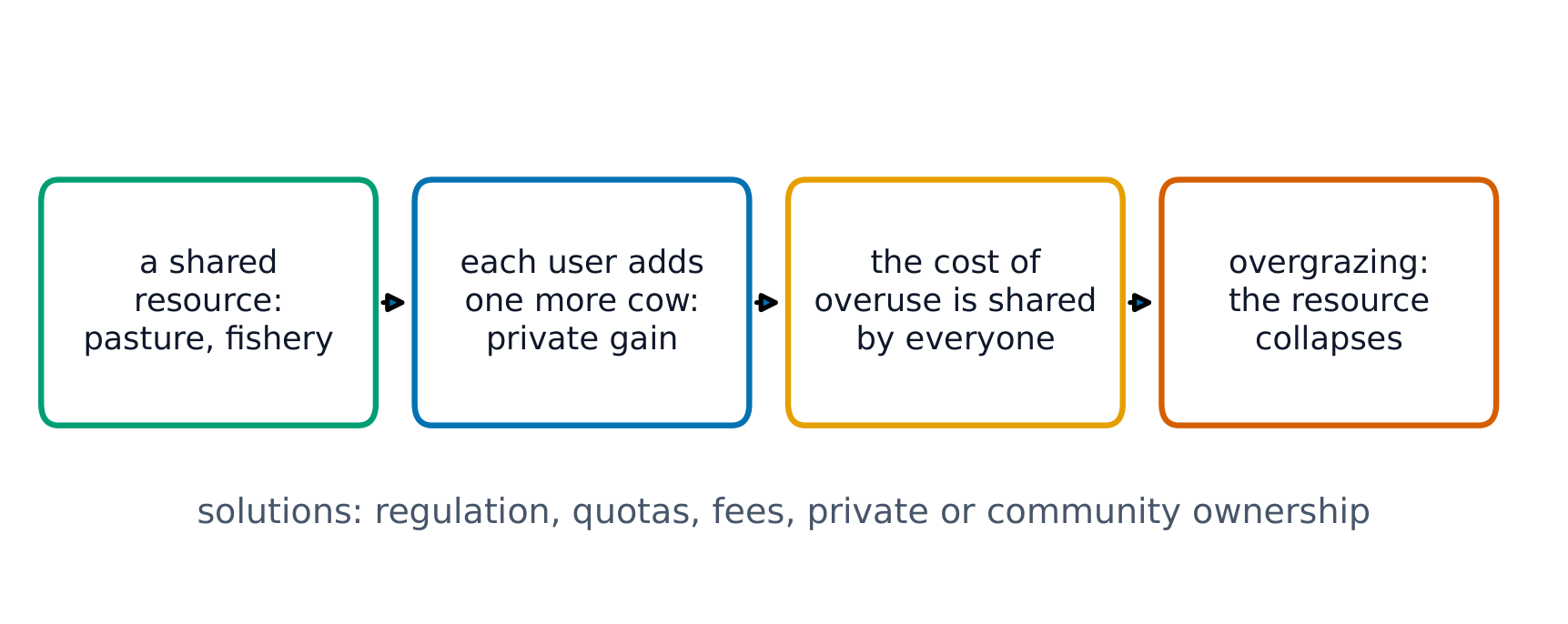
The tragedy of the commons 公地悲剧 suggests that individuals will use a shared resource in their own self-interest rather than for the common good, and so deplete it. Each user gains the full benefit of taking a little more (one more cow on the shared pasture, one more boatload of fish), while the cost – a damaged pasture or a smaller fish stock – is shared by everyone. Examples: open-ocean fisheries, the atmosphere (as a dump for $\text{CO}_2$), groundwater pumped by many farmers, and public grazing land.
Solutions change the rules so that users carry the cost of their actions:
- Regulation – catch quotas, fishing seasons, limits on how many animals may graze;
- Fees or taxes – grazing fees, a carbon tax;
- Private or community ownership – a group that owns a resource has a reason to protect it for the long term;
- International agreements for resources no single country owns.
Vocabulary
Train
| English |
|---|
| tragedy of the commons/ˈtrædʒədi ɒvðə ˈkɒmənz/ |
5.2
Clearcutting
Syllabus
| Enduring Understanding | Learning Objective | Essential Knowledge |
|---|---|---|
EIN-2 | EIN-2.B |
|
Source: College Board AP Course and Exam Description
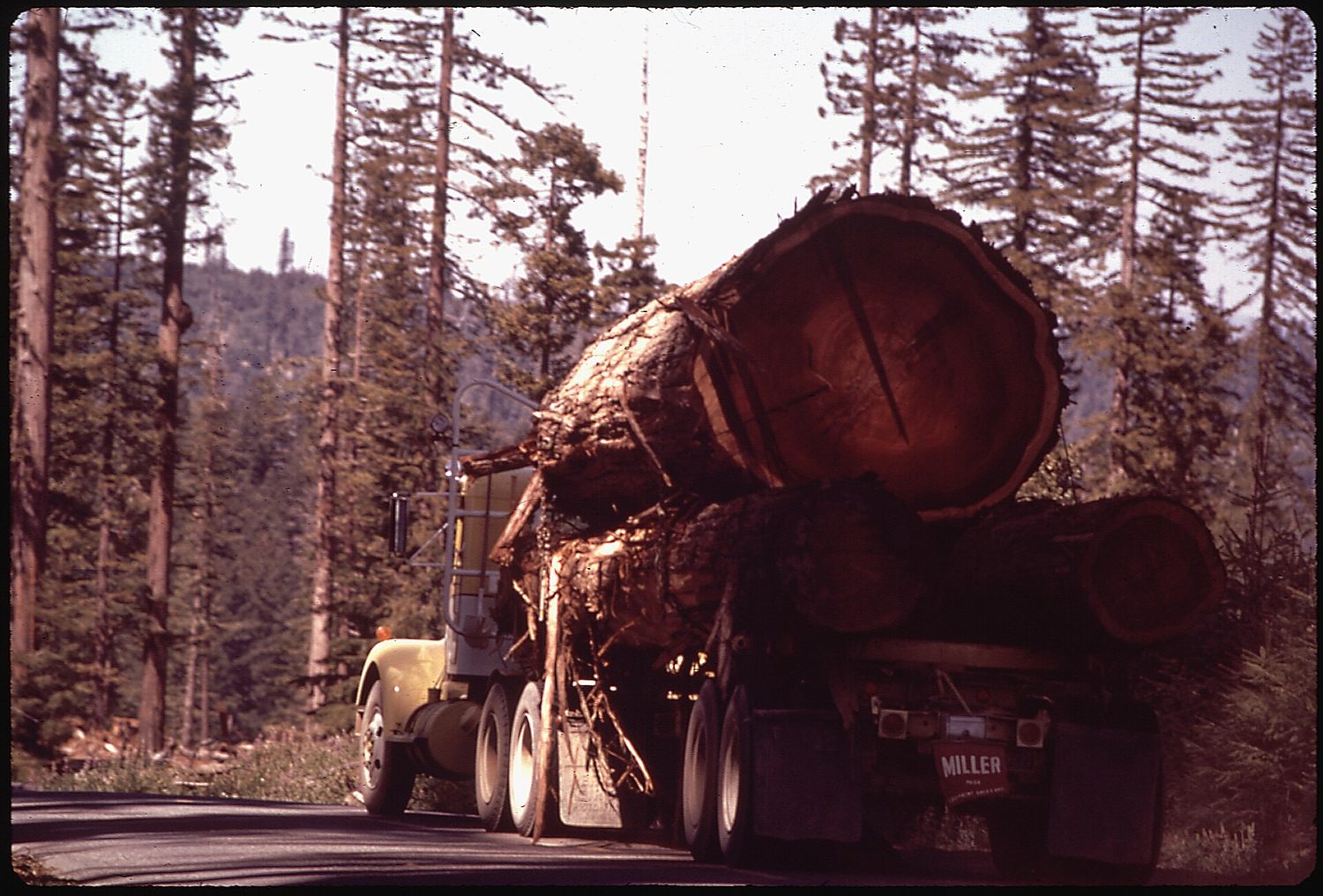
Clearcutting 皆伐 removes all the trees from an area at once. It is economically advantageous – it is the fastest and cheapest way to harvest timber, and it suits trees such as pines that need full sun to regrow. But it leads to:
- soil erosion 土壤侵蚀 – no roots hold the soil, and rain washes it into streams;
- higher soil and stream temperatures – no shade, so soil dries out and streams warm, holding less dissolved oxygen for fish;
- flooding – without trees to soak up and transpire water, more rain runs straight off the land;
- loss of habitat and biodiversity.
Forests contain trees that absorb pollutants and store carbon dioxide. Cutting and burning trees releases that carbon as $\text{CO}_2$ and contributes to climate change. Deforestation causes roughly a tenth of global $\text{CO}_2$ emissions.

Explore
Benefit or harm of clearcutting?
Sort each effect of clearcutting into a short-term benefit or a long-term harm.
Vocabulary
Train
| English |
|---|
| clearcutting/ˈklɪəkʌtɪŋ/ |
| soil erosion/sɔɪl ɪˈrəʊʒn/ |
5.3
The Green Revolution
Syllabus
| Enduring Understanding | Learning Objective | Essential Knowledge |
|---|---|---|
EIN-2 | EIN-2.C |
|
Source: College Board AP Course and Exam Description
The Green Revolution 绿色革命 (from the 1940s to the 1970s) shifted farming to new strategies that greatly increased food production. Its methods:
- mechanization – tractors and combine harvesters;
- high-yield crop varieties and, later, genetically modified organisms (GMOs);
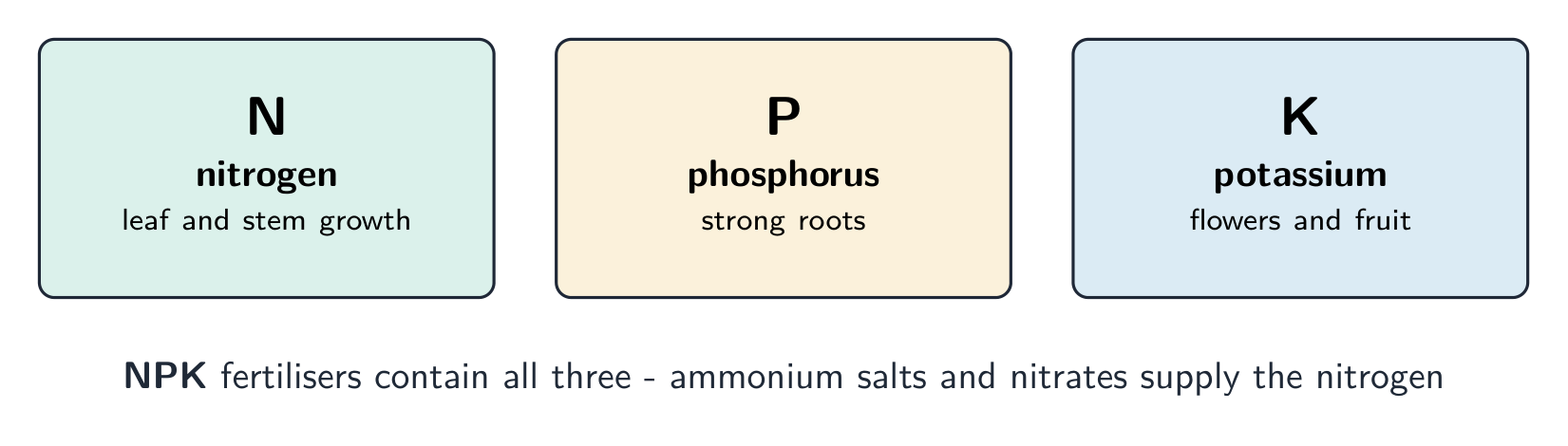
- synthetic fertilizers 化肥;
- irrigation;
- pesticides 农药.
The results were both positive and negative. World grain production roughly tripled, and famine became far rarer even as the population doubled. Mechanization increases profits and efficiency – one farmer can work far more land – but it also increases reliance on fossil fuels for machinery, fertilizer manufacture and transport. Other costs include soil degradation, water pollution from fertilizer and pesticide runoff, falling water tables, and loss of crop diversity as farmers plant a few high-yield varieties in monoculture 单一栽培.
Explore
Benefit or cost of the Green Revolution?
Sort each result of the Green Revolution into a benefit or a cost.
Vocabulary
Train
| English |
|---|
| Green Revolution/ɡriːn ˌrevəˈluːʃn/ |
| synthetic fertilizers/sɪnˈθetɪk ˈfɜːtəlaɪzəz/ |
| pesticides/ˈpestɪsaɪdz/ |
| monoculture/ˈmɒnəʊkʌltʃə/ |
5.4
Impacts of Agricultural Practices
Syllabus
| Enduring Understanding | Learning Objective | Essential Knowledge |
|---|---|---|
EIN-2 | EIN-2.D |
|
Source: College Board AP Course and Exam Description
Three practices named by the course cause most of the environmental damage:
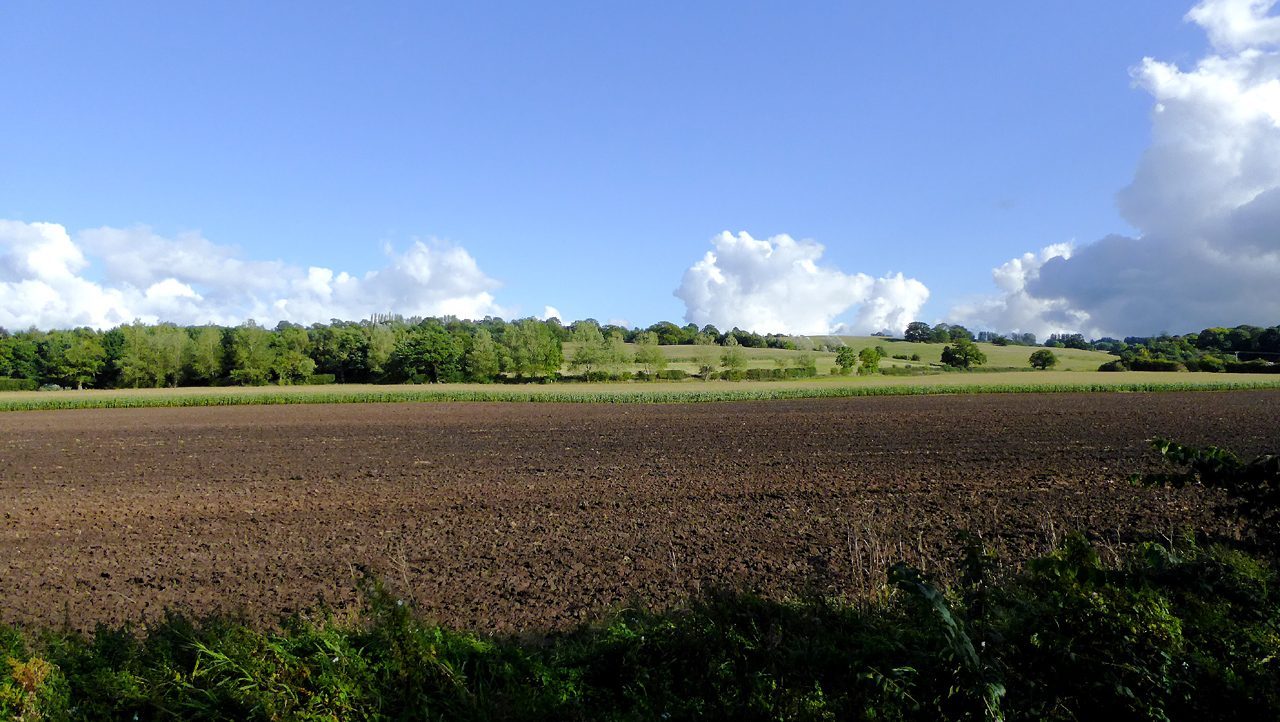
- Tilling (ploughing) loosens the soil and buries weeds, but leaves the topsoil bare and loose, so wind and water erode it. It also speeds up decomposition, releasing soil carbon as $\text{CO}_2$. During the 1930s Dust Bowl in the US Great Plains, ploughed and drought-dried soil blew away in storms that reached the Atlantic coast.
- Slash-and-burn farming clears tropical forest by cutting and burning it; the ash fertilizes the soil for a few years, then the nutrients are used up and the farmer moves on to clear more forest. It causes deforestation, air pollution and $\text{CO}_2$ release.
- Synthetic fertilizers – excess nitrogen and phosphorus run off into rivers and lakes and cause eutrophication 富营养化; nitrates also leach into groundwater, and making nitrogen fertilizer uses a lot of natural gas. Over time, heavy use without organic matter can leave soil less able to hold water.
Irrigation can also cause soil salinization 土壤盐碱化 (see Irrigation Methods).
Explore
Match the practice to its impact
Sort each farming practice by the environmental problem it can cause.
Vocabulary
Train
| English |
|---|
| eutrophication/ˌjuːtrəfɪˈkeɪʃn/ |
| soil salinization/sɔɪl ˌseɪlɪnaɪˈzeɪʃn/ |
5.5
Irrigation Methods
Syllabus
| Enduring Understanding | Learning Objective | Essential Knowledge |
|---|---|---|
EIN-2 | EIN-2.E |
|
EIN-2.F |
|
Source: College Board AP Course and Exam Description
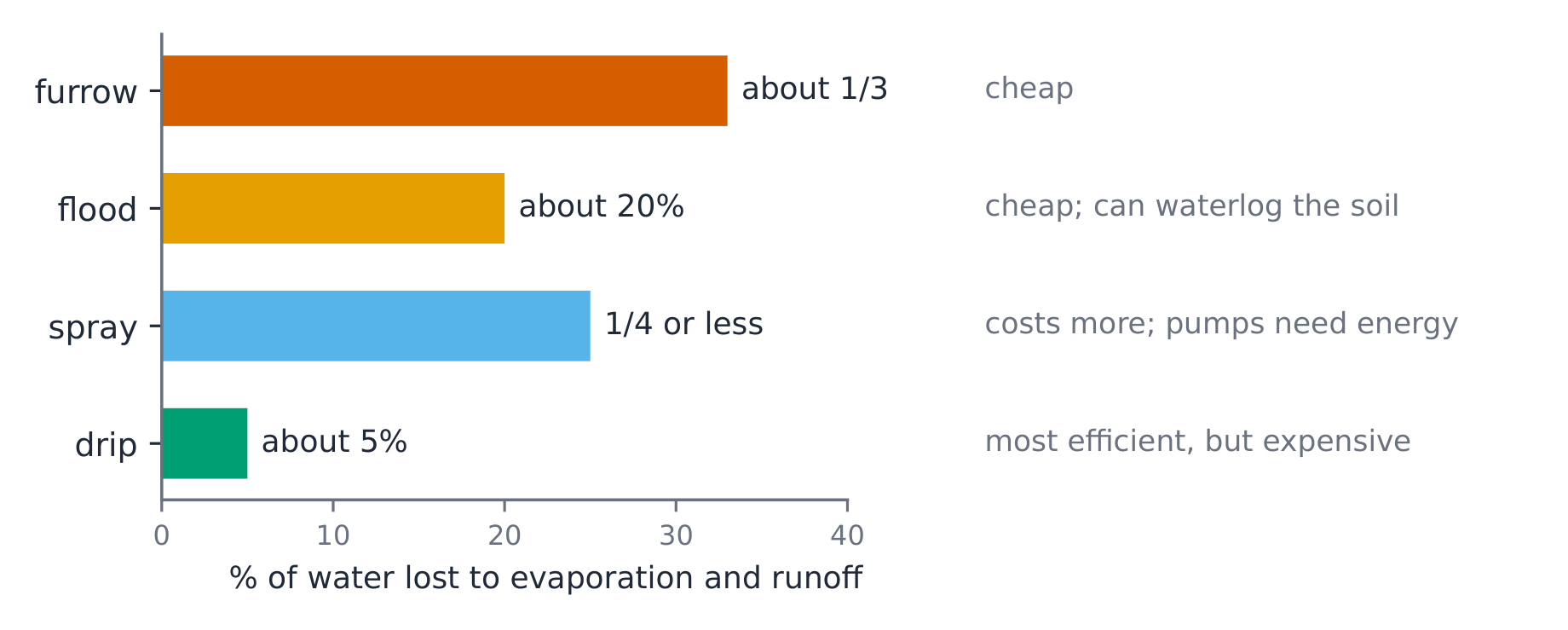
Irrigation 灌溉 supplies water to crops, and it is by far the largest human use of freshwater – about 70% of it worldwide, a figure the exam expects you to know.
| Method | How it works | Water lost to evaporation and runoff | Notes |
|---|---|---|---|
| Furrow | ditches (furrows) are cut between crop rows and filled with water | about 1/3 | inexpensive |
| Flood | the whole field is flooded | about 20% | inexpensive; can waterlog the soil |
| Spray | groundwater is pumped to spray nozzles across the field | 1/4 or less | more efficient than furrow and flood, but more expensive and needs energy |
| Drip | perforated hoses release small amounts of water at the plant roots | about 5% | the most efficient, but expensive, so not often used |
Over-irrigation causes two kinds of soil damage:
- Waterlogging – too much water sits in the soil, raising the water table so that plant roots cannot absorb oxygen.
- Salinization – irrigation water (especially groundwater) contains dissolved salts. When the water evaporates, the salts stay behind in the soil. Over time the soil becomes toxic to plants. Salinization has damaged farmland in Pakistan, Australia and California's Central Valley. Solutions include drip irrigation, flushing the soil with fresh water, and good drainage.
Irrigation also depletes aquifers 含水层 (underground stores of freshwater) when water is pumped out faster than rain can refill them. The Ogallala Aquifer under the US Great Plains supplies about a third of US irrigation water; in parts of Kansas and Texas its water level has dropped more than 30 m, and some wells have run dry.
Worked example (irrigation). A farm applies 1 000 000 L of water a season by furrow irrigation, losing 1/3 to evaporation and runoff. How much water reaches the crops, and how much would a drip system need to deliver the same amount? With furrow irrigation, the crops receive $1\,000\,000 \times \tfrac{2}{3} \approx 667\,000$ L. Drip loses only 5%, so it needs $\dfrac{667\,000}{0.95} \approx 702\,000$ L. Switching saves about $1\,000\,000 - 702\,000 \approx 298\,000$ L a season – about 30%.
Explore
How efficient is each method?
Sort each irrigation method by how much water it wastes.
Vocabulary
Train
| English |
|---|
| irrigation/ˌɪrɪˈɡeɪʃn/ |
| aquifers/ˈækwɪfəz/ |
5.6
Pest Control Methods
Syllabus
| Enduring Understanding | Learning Objective | Essential Knowledge |
|---|---|---|
EIN-2 | EIN-2.G |
|
Source: College Board AP Course and Exam Description
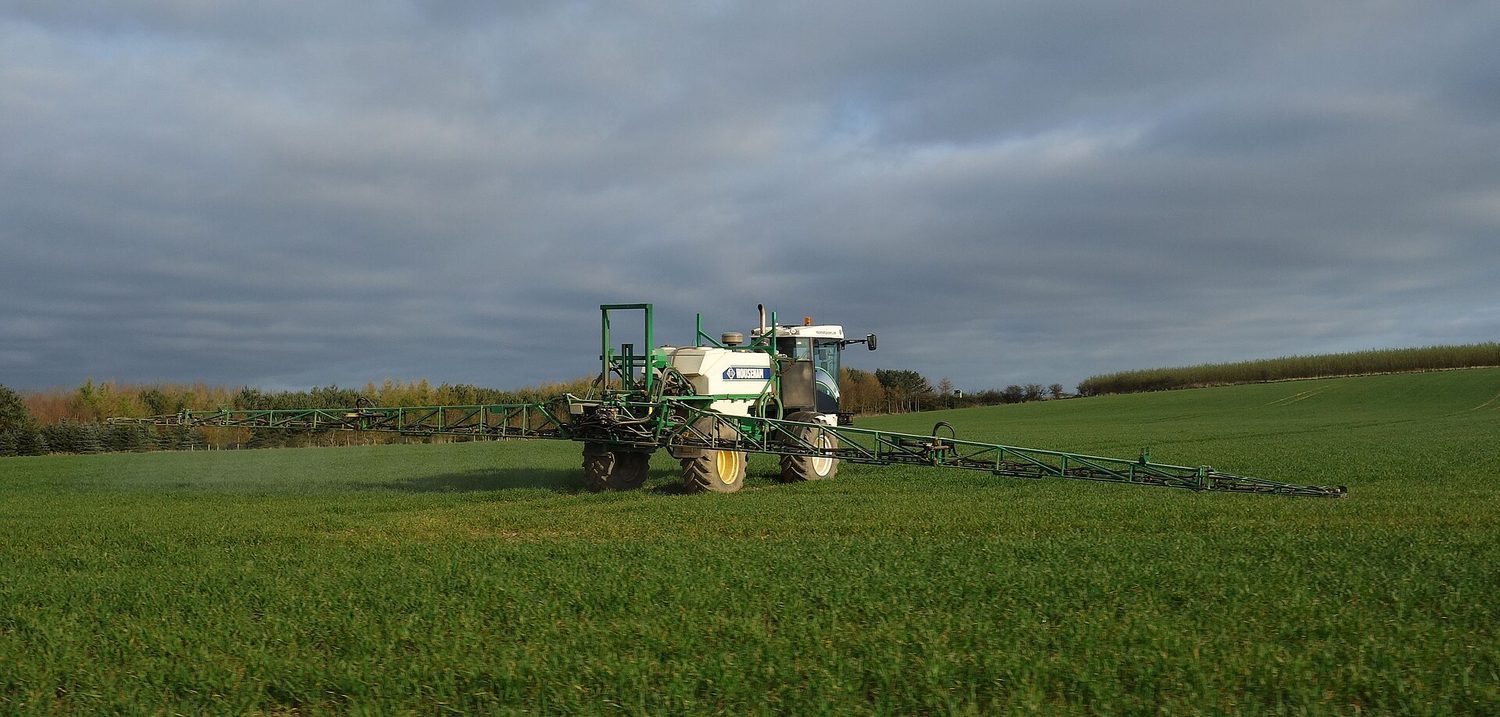
Pest-control chemicals include pesticides (the general term), herbicides (kill weeds), fungicides (kill fungi), rodenticides (kill rats and mice) and insecticides (kill insects). They decrease crop damage and increase crop yields, but:
- they harm non-target species – pollinating bees, birds, fish, and the natural predators of the pests;
- they pollute water and soil, and some persist and biomagnify;
- pests develop pesticide resistance 抗药性 through artificial selection: the few pests that survive a spraying carry resistance genes, breed, and pass them on, so the next generation is harder to kill. Farmers then use stronger doses or new chemicals – the "pesticide treadmill".
Genetically engineered crops can be made resistant to pests and diseases – for example Bt corn, which produces its own insecticide protein. This reduces spraying, but planting the same engineered variety everywhere leads to a loss of genetic diversity in that crop, so a single new pest or disease could damage the whole harvest.
Explore
Chemical or natural control?
Sort each pest control method into chemical (pesticides) or natural (biological) approaches.
Vocabulary
Train
| English |
|---|
| pesticide resistance/ˈpestɪsaɪd rɪˈzɪstəns/ |
5.7
Meat Production Methods
Syllabus
| Enduring Understanding | Learning Objective | Essential Knowledge |
|---|---|---|
EIN-2 | EIN-2.H |
|
EIN-2.I |
|
Source: College Board AP Course and Exam Description
Meat is produced in two main ways:
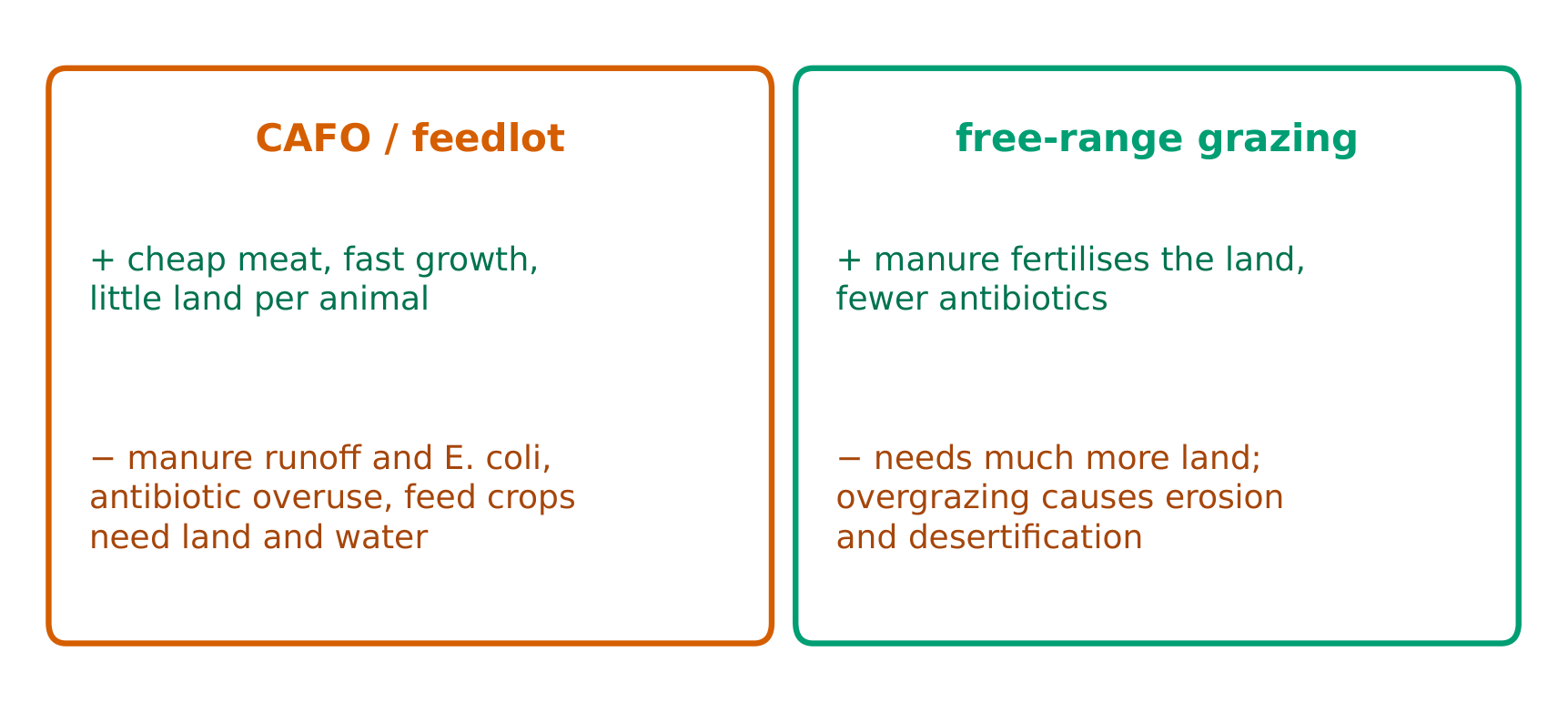
- Concentrated animal feeding operations (CAFOs), also called feedlots, crowd livestock together and feed them grain to get them ready for slaughter quickly. Grain is a less suitable food than grass for cattle, so antibiotics and growth hormones are often used. Feedlots generate huge amounts of organic waste, which can contaminate groundwater and surface water with nutrients and E. coli bacteria. But they are less expensive, which keeps prices down for consumers.
- Free-range grazing lets animals graze on grass for their whole life. The meat tends to be free of the antibiotics and other chemicals used in feedlots, and the manure fertilizes the land. But it needs large areas of land, and the meat is more expensive.
Meat production is much less efficient than growing crops for people to eat: it takes about 20 times more land to produce the same number of calories from meat as from plants, because of the 10% rule – most of the energy in the animals' feed is lost as heat at each trophic level.
Overgrazing 过度放牧 occurs when too many animals feed on one area of land. The vegetation is eaten faster than it regrows, so the soil is left bare and erodes. On dry land this can drive desertification 荒漠化: the degradation of low-precipitation regions until they become increasingly arid deserts, as in the Sahel south of the Sahara.
Eating less meat could reduce emissions of $\text{CO}_2$, methane 甲烷 (from cattle digestion and manure) and $\text{N}_2\text{O}$ (from manure and feed-crop fertilizer); conserve water; reduce the use of antibiotics and growth hormones; and improve topsoil.
Worked example (pasture needed). A beef cow eats 11.8 kg of food a day. A hectare of pasture grows 2000 kg of grass a year. How much pasture does one cow need?
- Food per year: $11.8 \times 365 \approx 4310$ kg.
- Area: $4310 \div 2000 \approx 2.2$ hectares per cow.
- A herd of 500 cattle needs about 1100 hectares, which is why free-range beef uses so much land.
Explore
Which production method?
Sort each feature by whether it describes intensive feedlots or open grazing.
Vocabulary
Train
| English |
|---|
| overgrazing/ˌəʊvəˈɡreɪzɪŋ/ |
| desertification/dɪˌzɜːtɪfɪˈkeɪʃn/ |
| methane/ˈmiːθeɪn/ |
5.8
Impacts of Overfishing
Syllabus
| Enduring Understanding | Learning Objective | Essential Knowledge |
|---|---|---|
EIN-2 | EIN-2.J |
|
Source: College Board AP Course and Exam Description
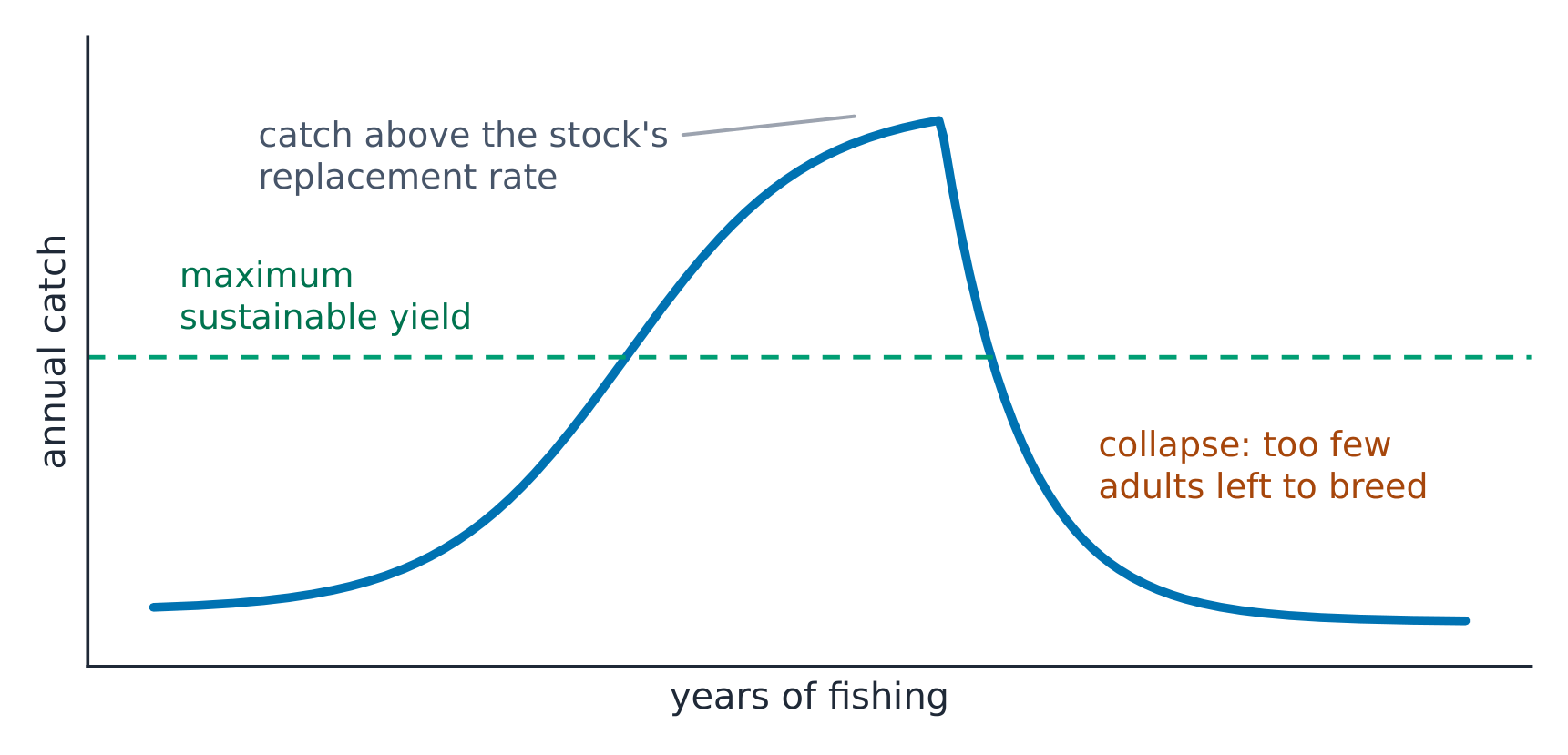
Overfishing 过度捕捞 removes fish faster than they can reproduce. It has made some fish species extremely scarce – Atlantic cod, bluefin tuna and many sharks – which reduces biodiversity in aquatic systems and harms the people who depend on fishing for food and commerce, especially coastal communities in developing countries. About a third of the world's assessed fish stocks are now overfished.
Destructive methods make it worse. Bottom trawling drags heavy nets across the seafloor, destroying corals and sponges. Bycatch – unwanted species such as dolphins, sea turtles and seabirds caught along with the target fish – is thrown back dead or dying. As large predatory fish are fished out, fleets move to smaller fish lower in the food web ("fishing down the food web").
Overfishing is a classic tragedy of the commons in the open ocean. Solutions include catch quotas set at a sustainable yield, marine protected areas where fishing is banned, larger net mesh sizes so young fish escape, and bycatch-reduction devices such as turtle excluders.
Explore
Push a fish stock past its limit
A population grows toward its carrying capacity $K$, but harvesting faster than it can breed collapses the stock. Raise the pressure and watch the population crash.
Vocabulary
Train
| English |
|---|
| overfishing/ˌəʊvəˈfɪʃɪŋ/ |
5.9
Impacts of Mining
Syllabus
| Enduring Understanding | Learning Objective | Essential Knowledge |
|---|---|---|
EIN-2 | EIN-2.K |
|
EIN-2.L |
|
Source: College Board AP Course and Exam Description
Mining 采矿 provides the low-cost energy and raw materials needed to make products – metals, coal, sand, phosphate. Its methods:
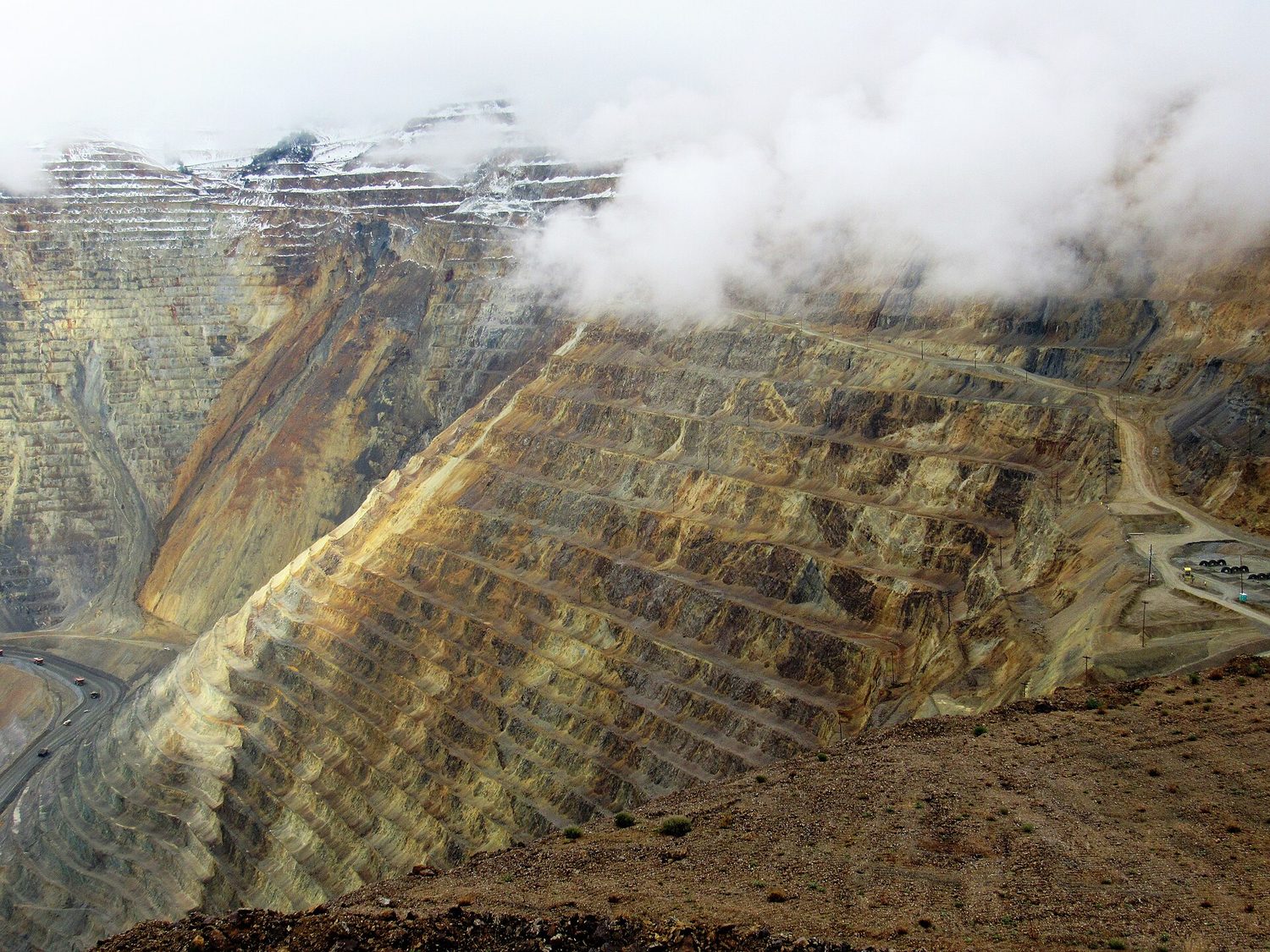
- Surface mining removes large amounts of soil and rock, called overburden, to reach the ore beneath. Strip mining removes the vegetation and soil in strips, so the area is easily eroded; open-pit mining digs a huge stepped pit; mountaintop removal blasts off the top of a mountain to reach coal seams and dumps the rock into nearby valleys and streams.
- Subsurface mining reaches deep deposits through shafts and tunnels. As the easily reached coal reserves are used up, it becomes necessary to mine underground, which is very expensive – and more dangerous for miners (cave-ins, explosions, lung disease).
Mining wastes include the soil and rock moved to reach the ore, plus slag (waste from smelting) and tailings (the crushed rock left after the mineral is removed). Water draining through these wastes picks up sulfuric acid and heavy metals – acid mine drainage 酸性矿山废水. Coal mining can also destroy habitats, contaminate groundwater, and release dust particles and methane.
As the more accessible, higher-grade ores are mined to depletion, companies turn to lower-grade ores. Extracting the same amount of metal from poorer ore needs more digging, energy and water, and produces more waste and pollution.
When the easily reached deposits are gone, mining moves underground to subsurface mining 地下开采, which is far more expensive and dangerous – the same pattern applies to coal as its accessible reserves shrink. Mined land can be partly restored by reclamation: putting back the overburden and topsoil and replanting, as US law requires for coal mines.
Worked example (ore grade). A phone contains 0.034 g of gold. A gold ore holds 5 g of gold per metric ton of ore. How much ore must be mined for the gold in one million phones?
- Gold needed: $0.034 \times 1{,}000{,}000 = 34{,}000$ g.
- Ore needed: $34{,}000 \div 5 = 6800$ metric tons.
- Recycling the phones instead avoids digging up, crushing and treating 6800 tonnes of rock, with all its waste and water use.
Explore
Surface or subsurface mining?
Sort each feature by whether it describes surface mining or underground (subsurface) mining.
Vocabulary
Train
| English |
|---|
| mining/ˈmaɪnɪŋ/ |
| acid mine drainage/ˈæsɪd maɪn ˈdreɪnɪdʒ/ |
| subsurface mining/ˈsʌbsəfɪs ˈmaɪnɪŋ/ |
| open-pit mine/ˈəʊpən pɪt maɪn/ |
5.10
Impacts of Urbanization
Syllabus
| Enduring Understanding | Learning Objective | Essential Knowledge |
|---|---|---|
EIN-2 | EIN-2.M |
|
Source: College Board AP Course and Exam Description
Urbanization 城市化 – the growth of cities – affects several cycles:
- Hydrologic cycle 水循环: cities use large amounts of water and can deplete local supplies. Heavy groundwater pumping near a coast draws seawater into the aquifer – saltwater intrusion 海水入侵 – which can ruin a freshwater supply.
- Carbon cycle: burning fossil fuels for transport, power and heating, and landfill decomposition, increase the $\text{CO}_2$ in the atmosphere.
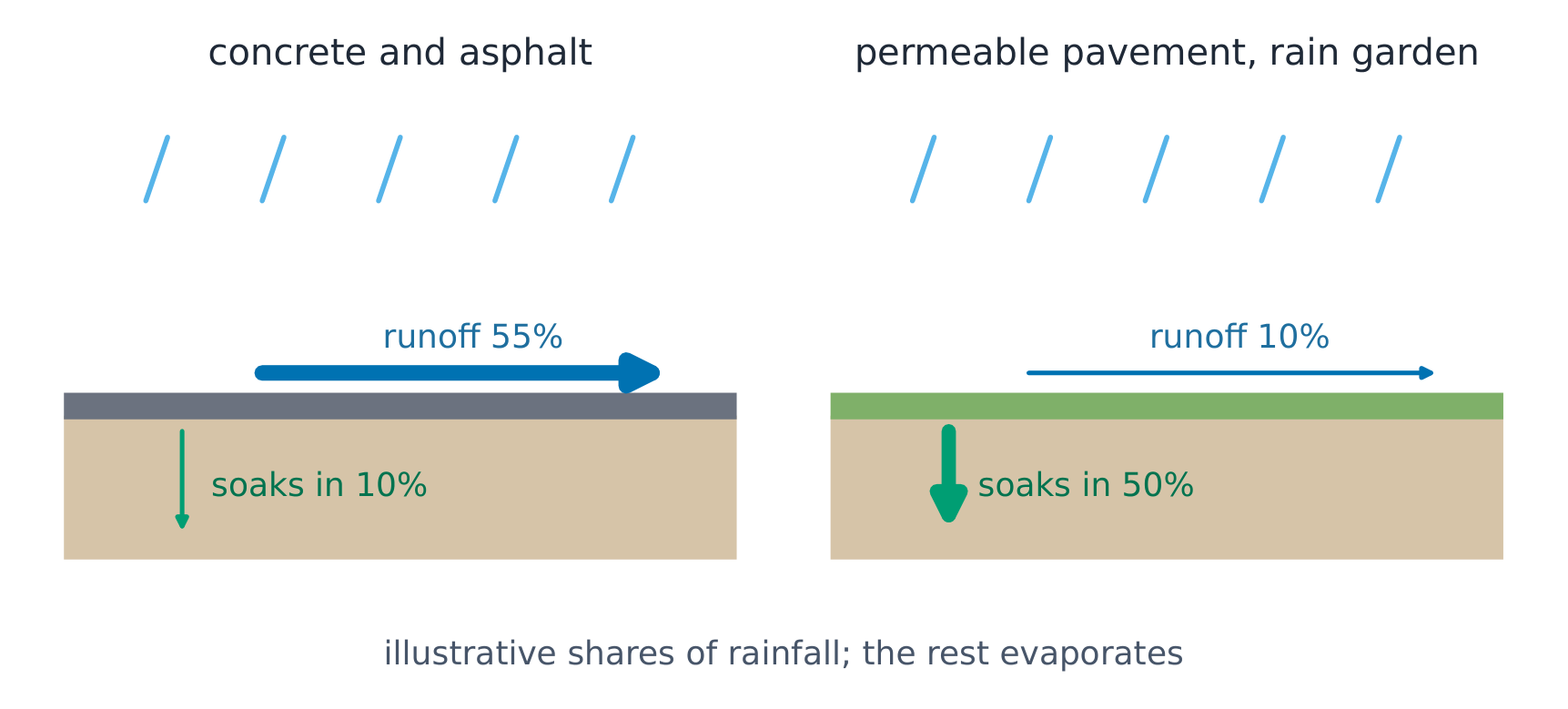
- Impervious surfaces 不透水面 – roads, buildings, sidewalks and parking lots – do not let water reach the soil. Rain runs off quickly into drains and streams, causing flooding, carrying oil, metals and litter into rivers, and leaving less water to recharge groundwater.
- Dark surfaces absorb heat, so cities become urban heat islands 热岛, several degrees warmer than the surrounding countryside.
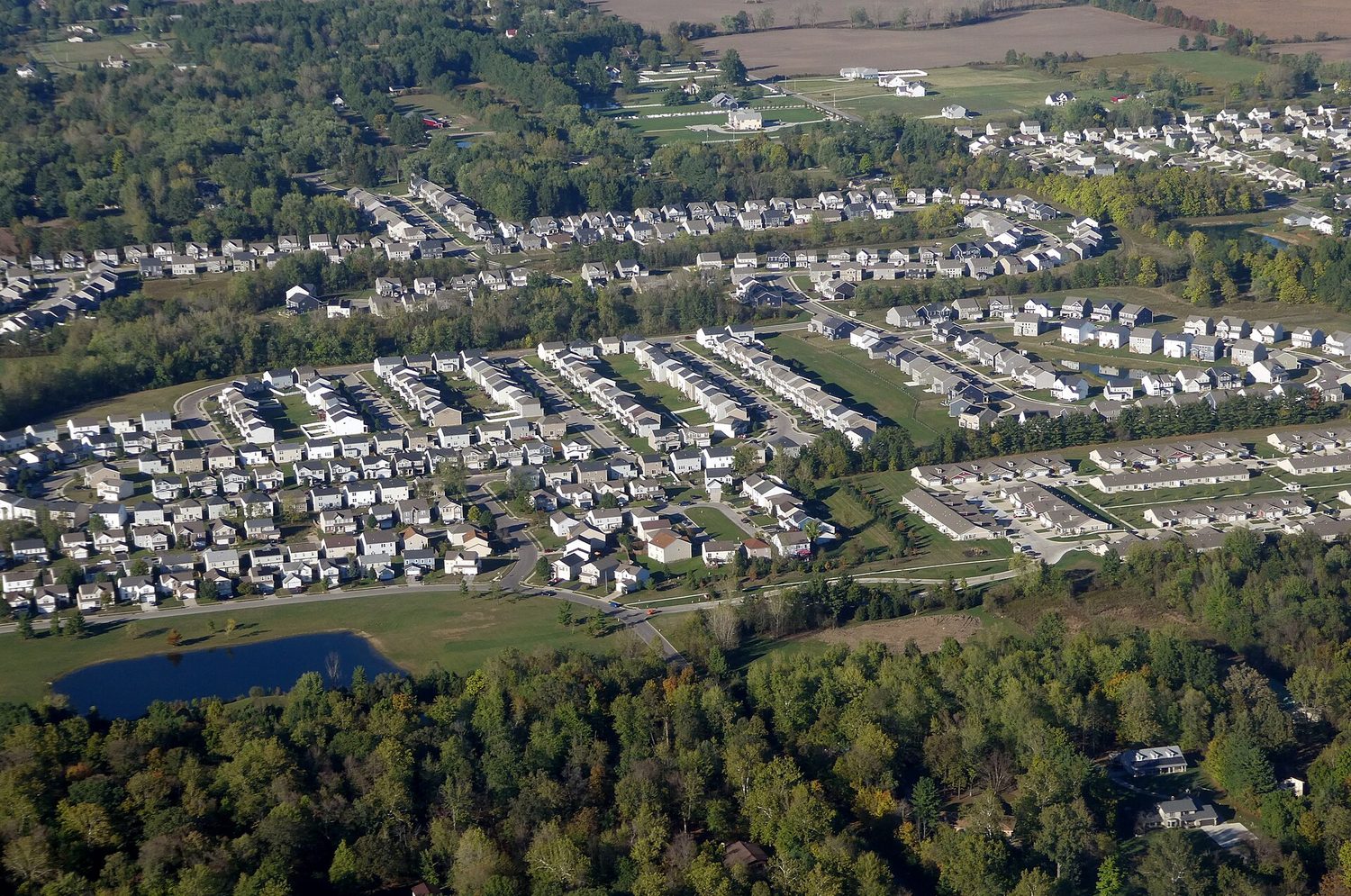
Urban sprawl is the shift of population from high-density cities to low-density suburbs that spread into rural land. It consumes farmland and habitat, fragments ecosystems, increases car use (and so air pollution and $\text{CO}_2$), and needs more roads, pipes and impervious surfaces per person.
Explore
What does urbanization cause?
Sort each effect of urban growth by the environmental problem it causes.
Vocabulary
Train
| English |
|---|
| urbanization/ˌɜːbənaɪˈzeɪʃn/ |
| hydrologic cycle/ˌhaɪdrəˈlɒdʒɪk ˈsaɪkl/ |
| saltwater intrusion/ˈsɒltwɔːtə ɪnˈtruːʒn/ |
| impervious surfaces/ɪmˈpɜːvɪəs ˈsɜːfɪsɪz/ |
| urban heat islands/ˈɜːbən hiːt ˈaɪləndz/ |
| urban sprawl/ˈɜːbən sprɔːl/ |
5.11
Ecological Footprints

Syllabus
| Enduring Understanding | Learning Objective | Essential Knowledge |
|---|---|---|
EIN-2 | EIN-2.N |
|
Source: College Board AP Course and Exam Description
An ecological footprint 生态足迹 compares the resource demands and waste production of an individual or a society: it measures the area of productive land and water needed to supply the food, energy, timber and space that person or society uses, and to absorb its wastes (especially $\text{CO}_2$). It is measured in global hectares (gha). Wealthy, high-consumption nations have much larger footprints – the carbon from energy use is usually the largest part.
A related measure is the carbon footprint: the total greenhouse gases released by a person's or product's activities, measured in tonnes of $\text{CO}_2$-equivalent.
Worked example (footprint). Earth provides roughly $1.6$ global hectares (gha) of biocapacity per person. If the average person's footprint is $2.7\ \text{gha}$, humanity is demanding about $\tfrac{2.7}{1.6}\approx1.7$ Earths – living beyond what the planet can renew. Worse, if everyone consumed like a high-income nation at $8\ \text{gha}$ per person, it would take $\tfrac{8}{1.6}=5$ Earths – exactly why footprint-per-person is the key sustainability yardstick.
Explore
Bigger or smaller footprint?
Sort each choice by whether it raises or lowers a person's ecological footprint.
Vocabulary
Train
| English |
|---|
| ecological footprint/ˌekəˈlɒdʒɪkl ˈfʊtprɪnt/ |
5.12
Introduction to Sustainability
Syllabus
| Enduring Understanding | Learning Objective | Essential Knowledge |
|---|---|---|
STB-1 | STB-1.A |
|
Source: College Board AP Course and Exam Description
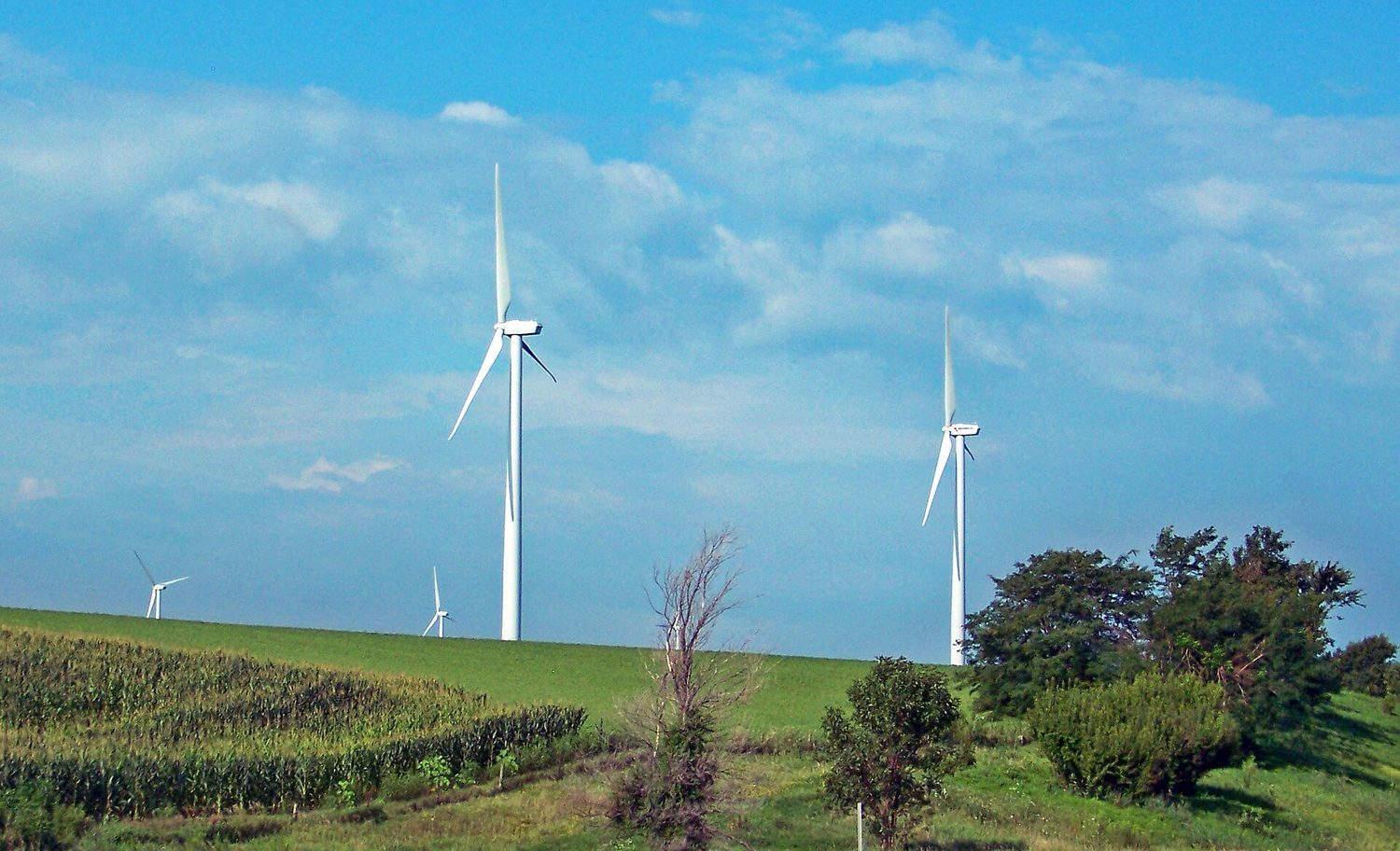
Sustainability 可持续性 refers to humans living on Earth and using its resources without depleting them for future generations. It balances environmental health, economic viability and social equity.
Scientists track environmental indicators that show whether we are moving toward sustainability:
- biological diversity;
- food production;
- average global surface temperatures and $\text{CO}_2$ concentrations;
- human population;
- resource depletion.
Sustainable yield is the amount of a renewable resource that can be taken without reducing the available supply – for example, harvesting no more fish each year than the population adds through reproduction, or cutting no more wood than the forest grows.
Worked example (sustainable yield). A lake holds 10 000 trout. Each year the population adds about 15% through births minus natural deaths. The sustainable yield is about $10\,000 \times 0.15 = 1\,500$ trout a year. If anglers take 2 500 a year, the population shrinks by about 1 000 each year, and the catch must eventually fall.
Explore
Sustainable or not?
Sort each practice by whether it can continue indefinitely without depleting resources.
Vocabulary
Train
| English |
|---|
| sustainability/səˌsteɪnəˈbɪlɪti/ |
5.13
Methods to Reduce Urban Runoff
Syllabus
| Enduring Understanding | Learning Objective | Essential Knowledge |
|---|---|---|
STB-1 | STB-1.B |
|
Source: College Board AP Course and Exam Description
Methods that increase water infiltration let rain soak into the ground, filtering pollutants and recharging groundwater instead of flooding streams:
- replacing traditional pavement with permeable pavement 透水路面, which lets water drain through gaps or pores;
- planting trees, whose roots and leaves slow the water and help it soak in;
- rain gardens, green roofs 绿色屋顶 and retention ponds that catch and hold rainwater;
- increased use of public transportation, which means fewer roads and parking lots;
- building up, not out – taller, denser buildings cover less ground per person than sprawling suburbs.
Worked example (runoff volume). A parking lot is 200 m long and 100 m wide. How much water runs off it in a 5 cm rainfall, if none soaks in?
- Area: $200 \times 100 = 20{,}000\ \text{m}^2$.
- Depth in metres: $5\ \text{cm} = 0.05\ \text{m}$.
- Volume: $20{,}000 \times 0.05 = 1000\ \text{m}^3$ of water.
For a whole town of $10\ \text{km}^2$ that is 20% impervious, the paved area is $0.20 \times 10 \times 10^6 = 2 \times 10^6\ \text{m}^2$, so the same storm sends $2 \times 10^6 \times 0.05 = 1 \times 10^5\ \text{m}^3$ into the drains. Always convert km² to m² ($1\ \text{km}^2 = 10^6\ \text{m}^2$) and cm to m before multiplying.
Percent change. FRQs often ask for one: $\text{percent change} = \dfrac{\text{new} - \text{old}}{\text{old}} \times 100$. If ocelots were once found in 30 Texas counties and now in only 2, the change is $\frac{2 - 30}{30} \times 100 \approx -93\%$: a 93% decrease. Keep the minus sign, or say "decrease".
Explore
Helps or worsens runoff?
Sort each urban feature by whether it reduces or increases stormwater runoff.
Vocabulary
Train
| English |
|---|
| permeable pavement/ˈpɜːməbl ˈpeɪvmənt/ |
| green roofs/ɡriːn ruːfs/ |
5.14
Integrated Pest Management
Syllabus
| Enduring Understanding | Learning Objective | Essential Knowledge |
|---|---|---|
STB-1 | STB-1.C |
|
STB-1.D |
|
Source: College Board AP Course and Exam Description
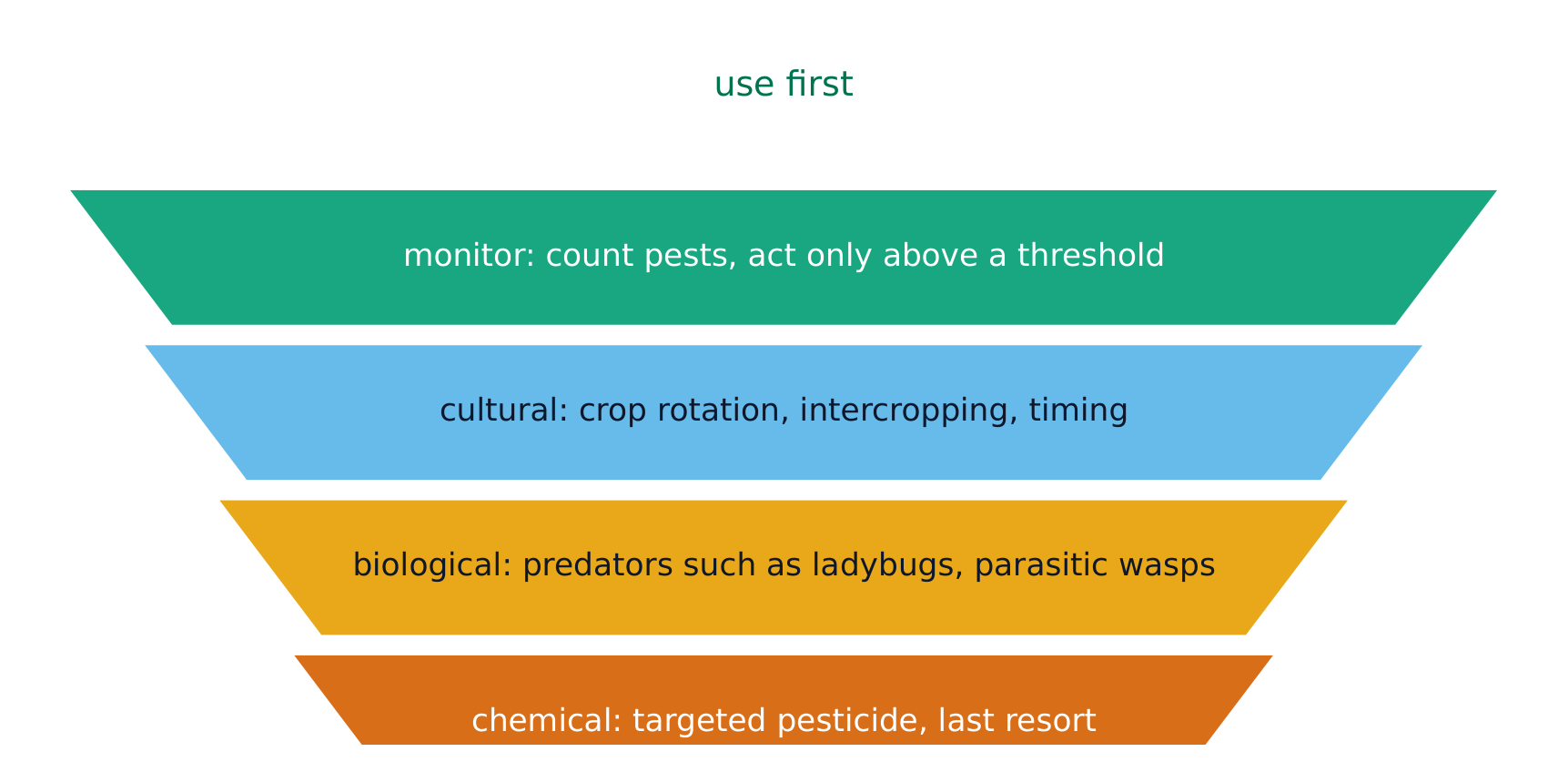
Integrated pest management 病虫害综合治理 (IPM) is a combination of methods used to control pests effectively while minimizing disruption to the environment. It starts by monitoring pest numbers and acts only when they pass a damage threshold. Its methods are biological, physical and only limited chemical:
- biocontrol – releasing natural predators or parasites of the pest, such as ladybugs that eat aphids;
- intercropping – planting two or more crops together, so pests that specialize on one crop spread less easily;
- crop rotation 轮作 – changing the crop grown in a field each year, which breaks the life cycle of pests that depend on one crop;
- physical methods – traps, barriers, removing infected plants;
- targeted pesticides only as a last resort.
IPM reduces the risks that pesticides pose to wildlife, water supplies and human health, and slows the evolution of resistance. Its drawbacks are that it can be complex (farmers need training and time to monitor) and expensive at first.
Vocabulary
Train
| English |
|---|
| integrated pest management/ˈɪntɪɡreɪtɪd pest ˈmænɪdʒmənt/ |
| crop rotation/krɒp rəʊˈteɪʃn/ |
5.15
Sustainable Agriculture
Syllabus
| Enduring Understanding | Learning Objective | Essential Knowledge |
|---|---|---|
STB-1 | STB-1.E |
|
Source: College Board AP Course and Exam Description
The goal of soil conservation is to prevent soil erosion. Methods include:
- contour plowing 等高耕作 – ploughing across a slope along its contour lines, so the furrows catch water instead of channelling it downhill;
- windbreaks – rows of trees along field edges that slow the wind;
- perennial crops – plants that live for many years, so the soil is never left bare;
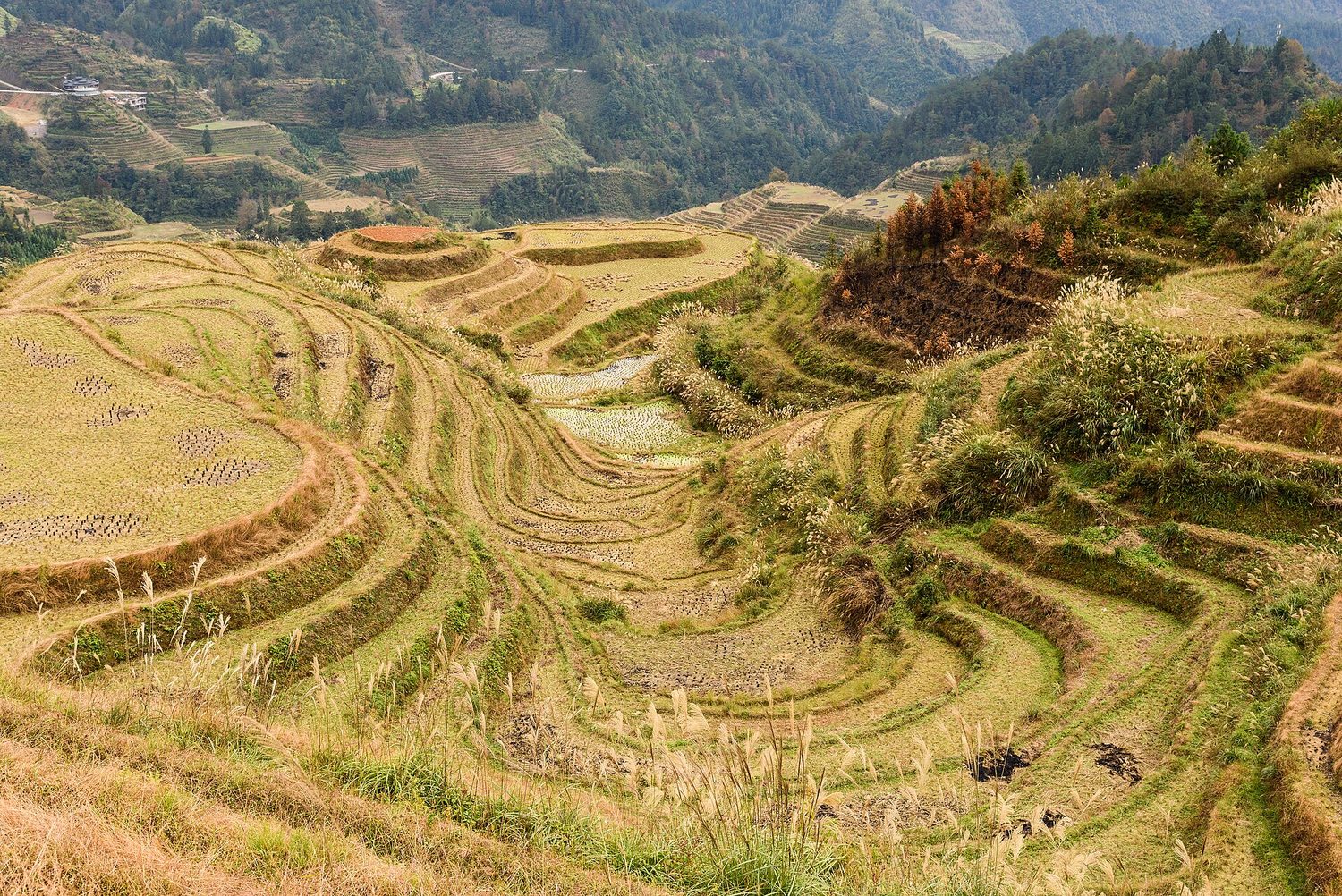
- terracing 梯田 – cutting a steep slope into level steps;
- no-till agriculture – planting seeds straight into the remains of the last crop without ploughing;
- strip cropping – alternating strips of a row crop (such as corn) with a soil-holding crop (such as grass or clover).
Strategies to improve soil fertility include crop rotation (alternating nutrient-hungry crops with legumes, which fix nitrogen), adding green manure (a cover crop ploughed back into the soil), and adding limestone to neutralize acidic soil.
Rotational grazing 轮牧 regularly moves livestock between different pastures so no area is overgrazed, giving the grass time to regrow.
Explore
Sustainable or harmful practice?
Sort each farming practice by whether it protects the soil or damages it.
Vocabulary
Train
| English |
|---|
| contour plowing/ˈkɒntʊə ˈplaʊɪŋ/ |
| terracing/ˈterɪsɪŋ/ |
| rotational grazing/rəʊˈteɪʃənl ˈɡreɪzɪŋ/ |
5.16
Aquaculture
Syllabus
| Enduring Understanding | Learning Objective | Essential Knowledge |
|---|---|---|
STB-1 | STB-1.F |
|
Source: College Board AP Course and Exam Description
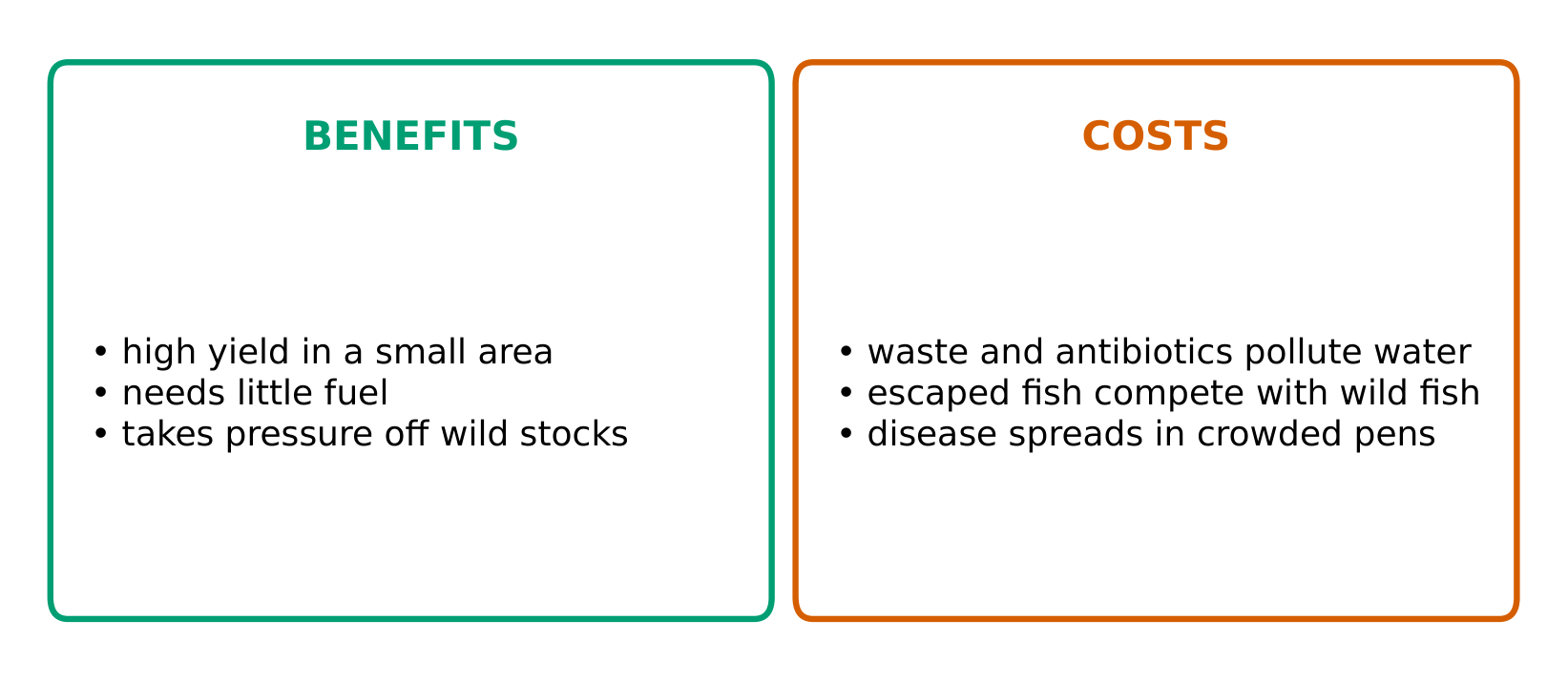
Aquaculture 水产养殖 – raising fish, shellfish or seaweed in tanks, ponds or ocean pens – now provides about half of the fish people eat. It has expanded because it is highly efficient, needs only small areas of water, and uses little fuel compared with fishing fleets. It also takes pressure off wild fish stocks.
Its problems:
- contaminated wastewater – fish waste, uneaten feed and antibiotics pollute nearby water;
- escaped fish may compete or interbreed with wild fish, weakening wild populations' genetic adaptations;
- the high density of fish increases disease and parasites (such as sea lice on salmon), which can spread to wild fish;
- habitat loss – shrimp farms have replaced large areas of mangroves;
- farming predatory fish such as salmon requires feed made from wild-caught fish.
Explore
Benefit or cost of aquaculture?
Sort each effect of fish farming into a benefit or a cost.
Vocabulary
Train
| English |
|---|
| aquaculture/ˈækwəkʌltʃə/ |
5.17
Sustainable Forestry
Syllabus
| Enduring Understanding | Learning Objective | Essential Knowledge |
|---|---|---|
STB-1 | STB-1.G |
|
Source: College Board AP Course and Exam Description
Sustainable forestry keeps forests productive for the long term: selective cutting 择伐 of mature trees instead of clearcutting, replanting, leaving buffer strips along streams, and long rotation times. It maintains habitat, prevents erosion, and lets forests keep providing ecosystem services.
Ways to mitigate deforestation include reforestation 重新造林 (replanting), using and buying wood harvested by ecologically sustainable forestry techniques (certified wood), and reusing wood.
Forests can be protected from pathogens and insects (such as the emerald ash borer or bark beetles) by integrated pest management and by removing affected trees before the pest spreads.
A prescribed burn 计划烧除 sets a forest on fire under controlled conditions to clear dead wood and undergrowth. This reduces the fuel available, so natural wildfires are less frequent and less catastrophic, and it helps fire-adapted species regrow.
Explore
Sustainable or harmful forestry?
Sort each forestry practice by whether it keeps the forest healthy or destroys it.
Vocabulary
Train
| English |
|---|
| selective cutting/sɪˈlektɪv ˈkʌtɪŋ/ |
| reforestation/rɪˌfɒrɪˈsteɪʃn/ |
| prescribed burn/prɪˈskraɪbd bɜːn/ |
5.17
Exam tips
- Explain the tragedy of the commons – individuals overuse a shared resource for self-interest – and give a solution (quotas, fees, ownership).
- Clearcutting is economically advantageous but causes erosion, warmer soil and streams, and flooding; burning trees releases $\text{CO}_2$.
- Green Revolution methods: mechanization, GMOs, fertilizers, irrigation, pesticides. Mechanization raises efficiency but increases fossil-fuel reliance.
- Know the four irrigation methods and their losses: furrow ~1/3, flood ~20%, spray ≤1/4, drip ~5%. Irrigation is 70% of freshwater use. Explain waterlogging and salinization; name the Ogallala Aquifer.
- Pests become resistant through artificial selection; GE crops can reduce genetic diversity.
- CAFOs: cheap meat, but waste contaminates water. Free-range: fewer chemicals, more land, higher price. Meat needs about 20 times more land per calorie. Overgrazing → erosion → desertification.
- Mining: overburden, slag and tailings; lower-grade ores mean more waste; subsurface mining is expensive.
- Urbanization: saltwater intrusion, more $\text{CO}_2$, impervious surfaces → flooding; urban sprawl spreads into rural land.
- Compute an ecological footprint in "number of Earths" (footprint ÷ biocapacity per person) and a sustainable yield.
- Reduce runoff: permeable pavement, trees, public transport, build up, not out.
- IPM: biocontrol, intercropping, crop rotation, natural predators – safer, but complex and expensive.
- Soil conservation: contour plowing, windbreaks, perennial crops, terracing, no-till, strip cropping. Fertility: crop rotation, green manure, limestone.
- Aquaculture is efficient but pollutes water and spreads disease and escaped fish to the wild. Forests: reforestation, sustainable wood, reuse, prescribed burns.
Interactive lessons on this topic
Work through it step by step, with instant-check exercises.
- The Tragedy of the Commons
- Clearcutting
- The Green Revolution
- Impacts of Agricultural Practices
- Irrigation Methods
- Pest Control Methods
- Meat Production Methods
- Impacts of Overfishing
- Impacts of Mining
- Impacts of Urbanization
- Ecological Footprints
- Introduction to Sustainability
- Methods to Reduce Urban Runoff
- Integrated Pest Management
- Sustainable Agriculture
- Aquaculture
- Sustainable Forestry