| Enduring Understanding | Learning Objective | Essential Knowledge |
|---|---|---|
STB-3 | STB-3.A |
|
Aquatic and Terrestrial Pollution
AP Environmental Science · Topic 8
 8:37
Aquatic and Terrestrial Pollution
Look at this pond. It is bright green, and it is full of life. Every fish in it is dead. Now look at this hill. It is not a hill. It is our rubbish, buried.…
English narration · English + 中文 subtitles burned in
8.1
Sources of Pollution
Syllabus
Source: College Board AP Course and Exam Description
In the 1950s and 60s, cats in the fishing town of Minamata, Japan began to stagger, convulse and die – the locals called it "dancing cat disease". Then people fell ill too: numb hands, slurred speech, and babies born with brain damage. A chemical factory had been releasing mercury into the bay for decades. Bacteria in the mud turned it into methylmercury, fish absorbed it, and the people and cats who ate the fish received the highest doses of all. More than 2 000 people were officially recognized as victims. Almost every idea in this unit – point sources, bioaccumulation, biomagnification, toxicity – is in that one story.
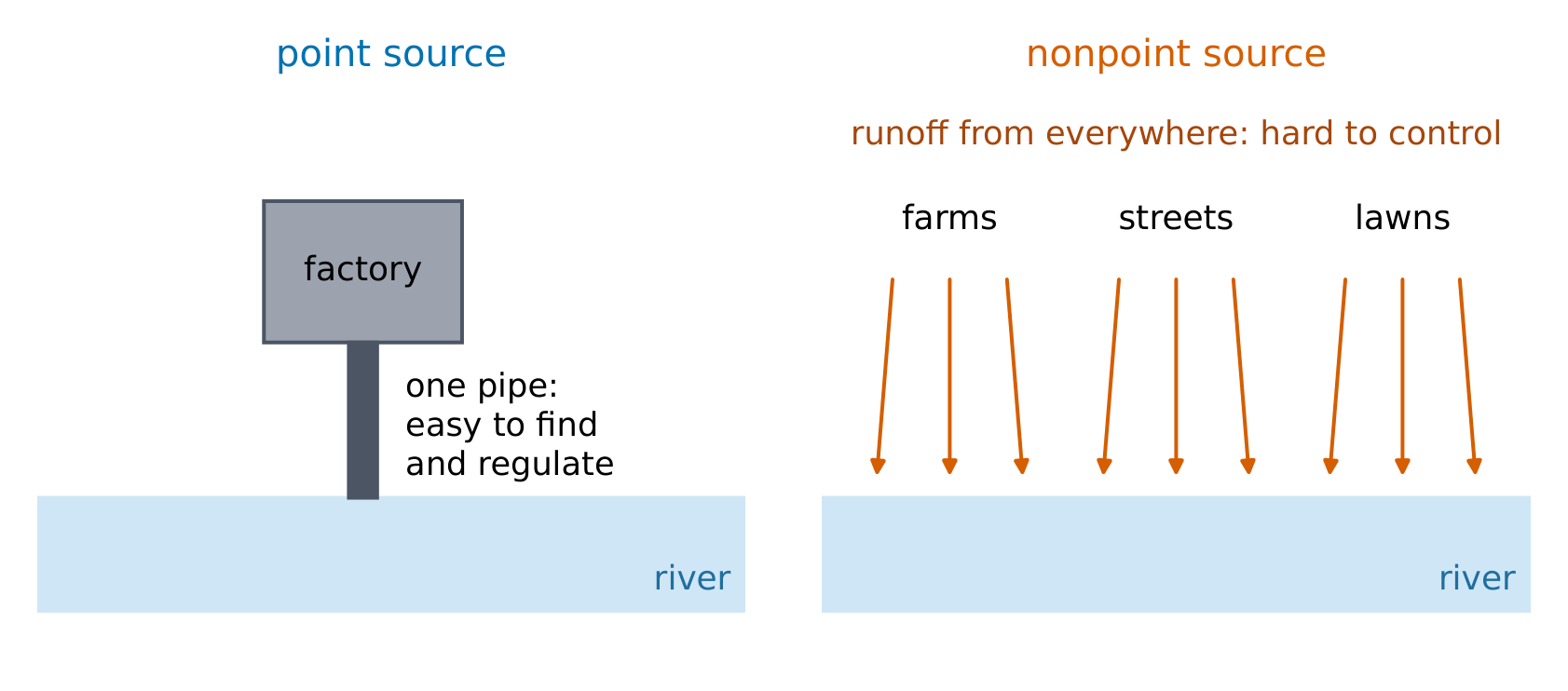
Pollution sources are point or nonpoint:
- A point source 点源 is a single, identifiable source of a pollutant – a smokestack, a factory waste-discharge pipe, a sewage outfall. It is easy to locate, measure and regulate (for example with a discharge permit).
- A nonpoint source 非点源 is diffuse: the pollution comes from a wide area, so it is hard to identify and control – pesticide spraying, fertilizer runoff from many farms, urban runoff carrying oil and litter from streets, and car exhaust.
Explore
Point source or nonpoint source?
Sort each pollution source by whether it comes from one spot or many spread-out places.
Vocabulary
Train
| English |
|---|
| point source/pɔɪnt sɔːs/ |
| nonpoint source/ˌnɒnˈpɔɪnt sɔːs/ |
8.2
Human Impacts on Ecosystems
Syllabus
| Enduring Understanding | Learning Objective | Essential Knowledge |
|---|---|---|
STB-3 | STB-3.B |
|
Source: College Board AP Course and Exam Description
Organisms have a range of tolerance for each pollutant, just as for temperature or salinity. Inside the optimum range they can maintain homeostasis (stable internal conditions). Outside it they experience physiological stress, limited growth, reduced reproduction and, in extreme cases, death. AP questions often ask how a specific pollutant pushes organisms out of their range:
- Coral reefs are damaged by rising ocean temperature (bleaching), sediment runoff that blocks the light their algae need, and destructive fishing practices such as dynamite and cyanide fishing.
- Oil spills kill marine organisms through the toxic hydrocarbons in oil. Floating oil coats the feathers of birds and the fur of marine mammals, so they lose insulation and buoyancy; some components sink and kill bottom-dwelling organisms. Oil washing onto beaches harms the fishing and tourism industries – the 2010 Deepwater Horizon spill closed large parts of the Gulf of Mexico to fishing.
- Oceanic dead zones are areas of low oxygen caused by nutrient pollution (see Eutrophication). The Gulf of Mexico dead zone, fed by fertilizer from the Mississippi basin, covers about 15 000 km² most summers.
- Heavy metals from mining, industry and burning fossil fuels (lead, mercury, arsenic, cadmium) can seep into groundwater and contaminate drinking water.
- Litter in water is unsightly, but it also causes intestinal blockage and choking in wildlife and introduces toxic substances (from plastics) into the food chain.
- Sediment from erosion makes water cloudy (high turbidity), reducing light for primary producers and making it hard for visual predators to find prey. When it settles, it smothers gravel beds where fish lay eggs.
- Mercury: when elemental mercury enters water, bacteria convert it to methylmercury, which is far more toxic and easily absorbed by living things.
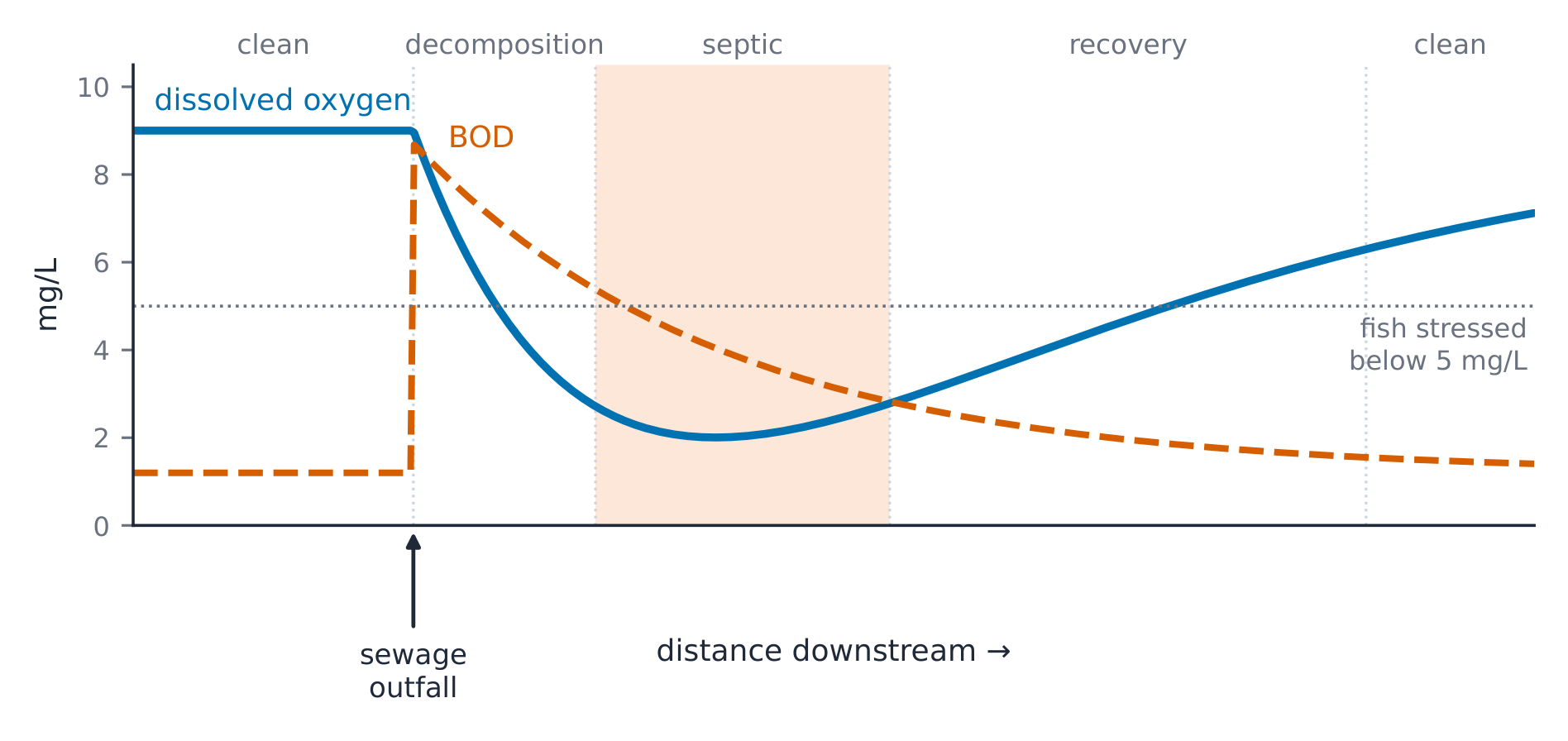
An oxygen sag curve plots dissolved oxygen against distance downstream from a source of organic pollution such as sewage or animal waste. Bacteria decomposing the waste use oxygen faster than air and plants can replace it, so dissolved oxygen "sags" to a minimum some distance downstream, then recovers as the waste is used up. Biochemical oxygen demand (BOD) – how much oxygen the microbes need – is highest at the outfall.
Explore
Harms or helps an ecosystem?
Sort each human action by whether it damages ecosystems or helps protect them.
8.3
Endocrine Disruptors
Syllabus
| Enduring Understanding | Learning Objective | Essential Knowledge |
|---|---|---|
STB-3 | STB-3.C |
|
STB-3.D |
|
Source: College Board AP Course and Exam Description
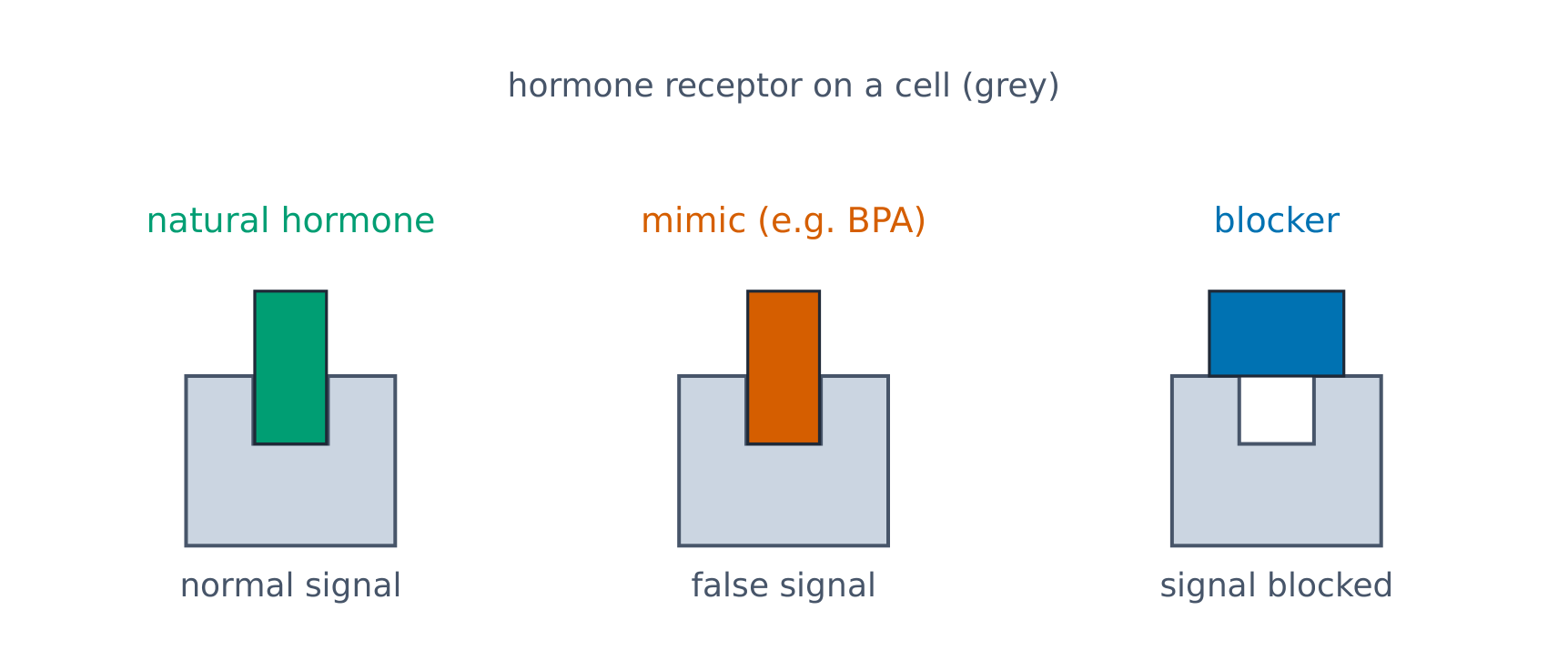
Endocrine disruptors 内分泌干扰物 are chemicals that interfere with the endocrine (hormone) system of animals. Some mimic a natural hormone and send a false signal; others block the receptor so the real hormone cannot work. Examples include the pesticide atrazine, BPA and phthalates from plastics, PCBs, and the synthetic estrogen from birth-control pills that passes through sewage treatment into rivers.
Because hormones control growth, development and reproduction, even very low doses can cause birth defects, developmental disorders and gender imbalances in fish and other species. Male fish downstream of sewage outfalls have been found growing eggs, and frogs exposed to atrazine can develop both male and female organs.
Vocabulary
Train
| English |
|---|
| endocrine disruptors/ˈendəʊkraɪn dɪsˈrʌptəz/ |
8.4
Human Impacts on Wetlands and Mangroves
Syllabus
| Enduring Understanding | Learning Objective | Essential Knowledge |
|---|---|---|
STB-3 | STB-3.E |
|
Source: College Board AP Course and Exam Description
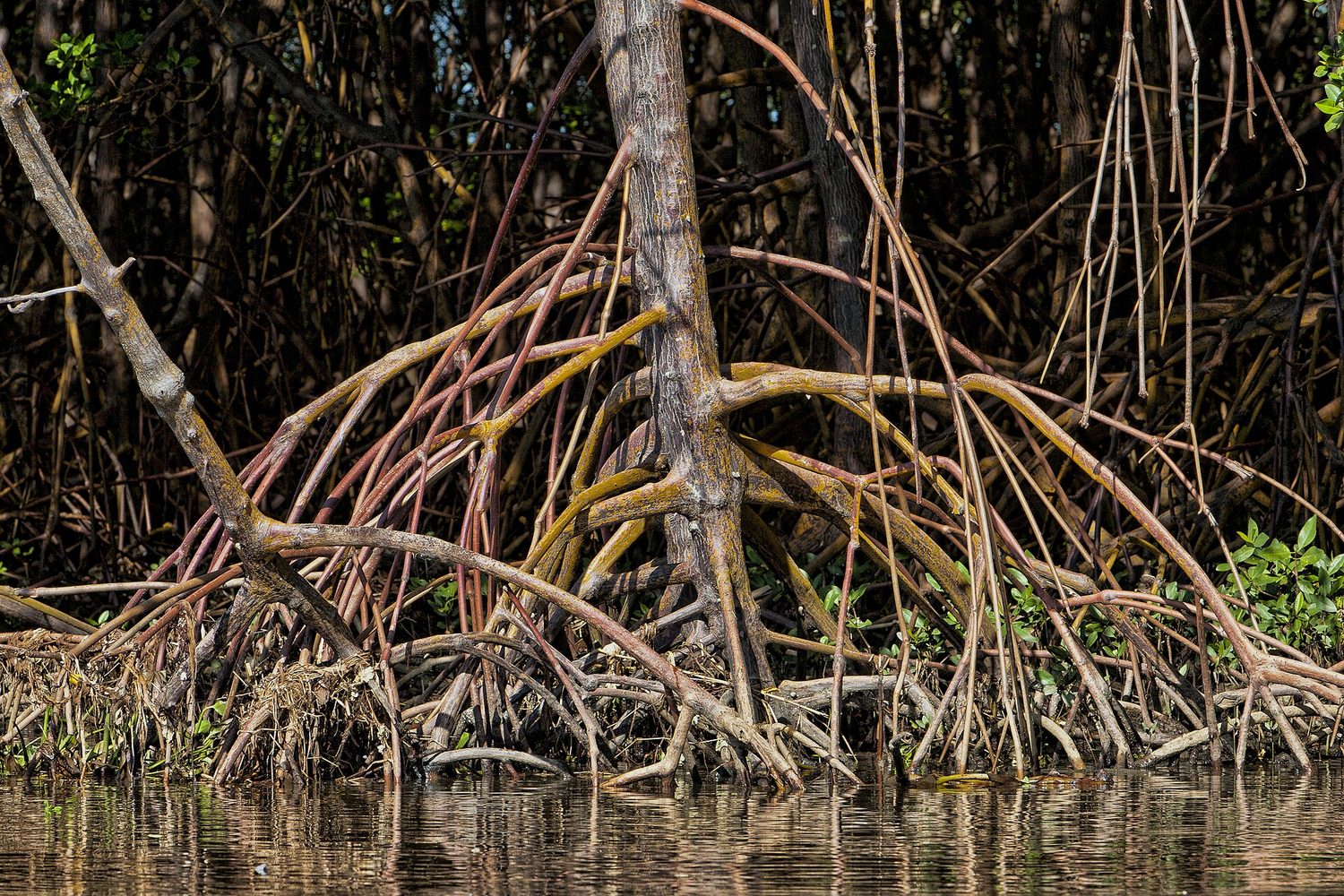
A wetland 湿地 is an area where water covers the soil, either part or all of the time – marshes, swamps, bogs, and coastal mangroves 红树林. Wetlands provide valuable ecosystem services:
- water purification and filtration – plants and sediments trap pollutants and excess nutrients;
- flood protection – wetlands soak up water like a sponge and release it slowly; mangroves absorb storm surges;
- habitat – nurseries for young fish and shellfish, and stopovers for migrating birds.
Threats to wetlands and mangroves include commercial development (draining for housing, farms and shrimp ponds), dam construction (which cuts off the water and sediment that feed downstream wetlands), overfishing, and pollutants from agriculture and industrial waste. The United States has lost more than half of its original wetlands. When they go, communities pay for flood defences and water treatment that the wetland once provided for free.
Explore
A benefit wetlands give, or a harm we do them?
Sort each item into a benefit wetlands provide or a way humans damage them.
Vocabulary
Train
| English |
|---|
| wetland |
| mangroves/ˈmæŋɡrəʊvz/ |
8.5
Eutrophication
Syllabus
| Enduring Understanding | Learning Objective | Essential Knowledge |
|---|---|---|
STB-3 | STB-3.F |
|
Source: College Board AP Course and Exam Description
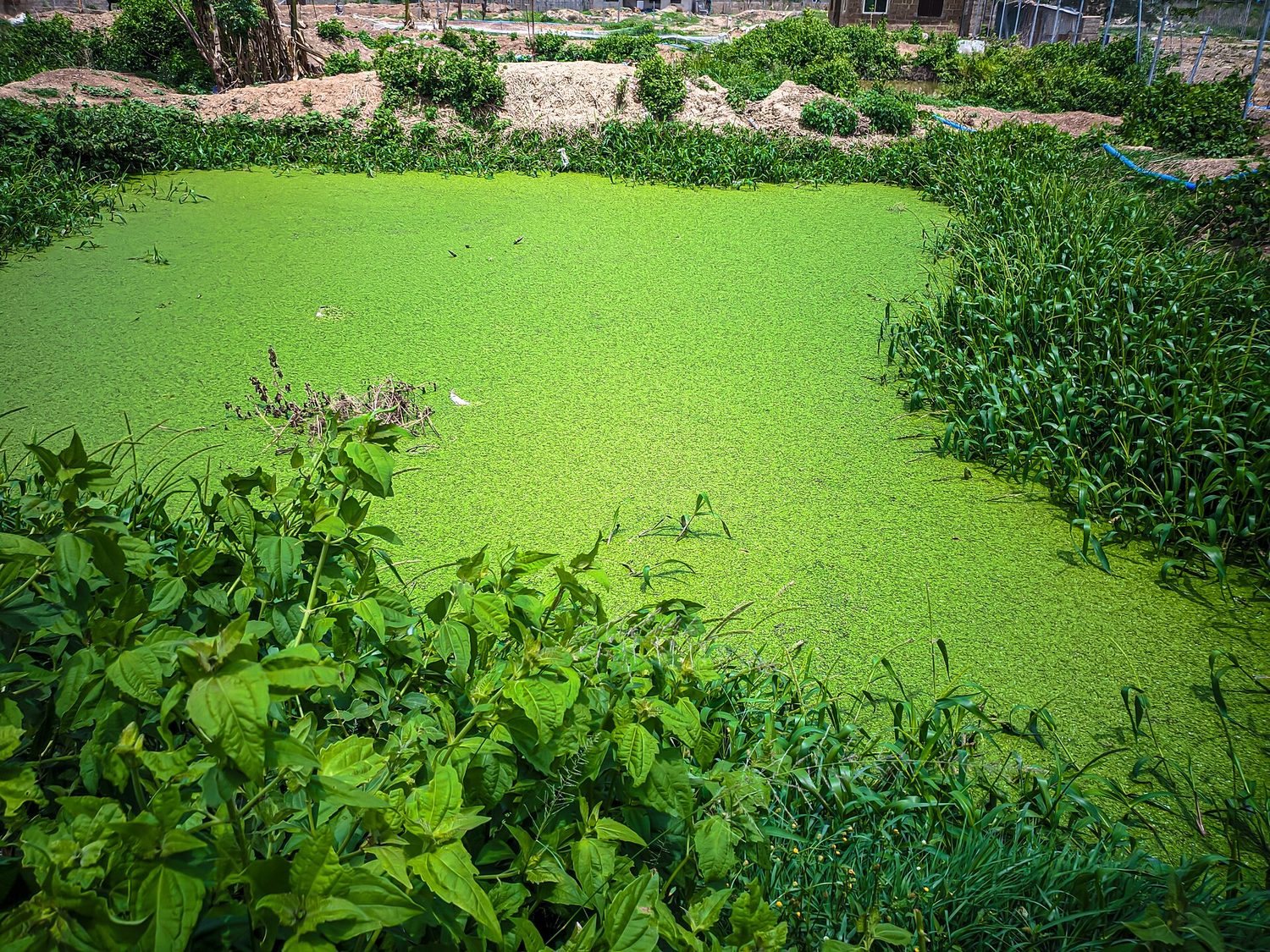
Eutrophication 富营养化 occurs when a body of water is enriched in nutrients, usually nitrogen and phosphorus. The anthropogenic causes are agricultural runoff (fertilizer and manure) and wastewater release (sewage, detergents). It proceeds in a chain that you should be able to write step by step:
- Extra nitrogen and phosphorus enter the water.
- They remove the limit on plant growth, so algae grow rapidly – an algal bloom 藻华.
- The bloom blocks sunlight, so plants on the bottom die.
- The algae die, and bacteria decompose them, using up dissolved oxygen.
- The water becomes hypoxic 缺氧 (low in dissolved oxygen), and fish and other aquatic animals die – a dead zone.
The opposite of a eutrophic lake is an oligotrophic lake: very low in nutrients, with a stable algae population, clear water and high dissolved oxygen – often deep, cold mountain lakes.
Solutions target the nutrient source: apply fertilizer only as needed, plant buffer strips of vegetation along streams, restore wetlands to catch runoff, use phosphate-free detergents, and add tertiary sewage treatment to remove nitrogen and phosphorus.
Vocabulary
Train
| English |
|---|
| eutrophication/ˌjuːtrəfɪˈkeɪʃn/ |
| algal bloom/ˈælɡl bluːm/ |
| hypoxic/ˌhaɪpəʊˈzɪk/ |
8.6
Thermal Pollution
Syllabus
| Enduring Understanding | Learning Objective | Essential Knowledge |
|---|---|---|
STB-3 | STB-3.G |
|
Source: College Board AP Course and Exam Description
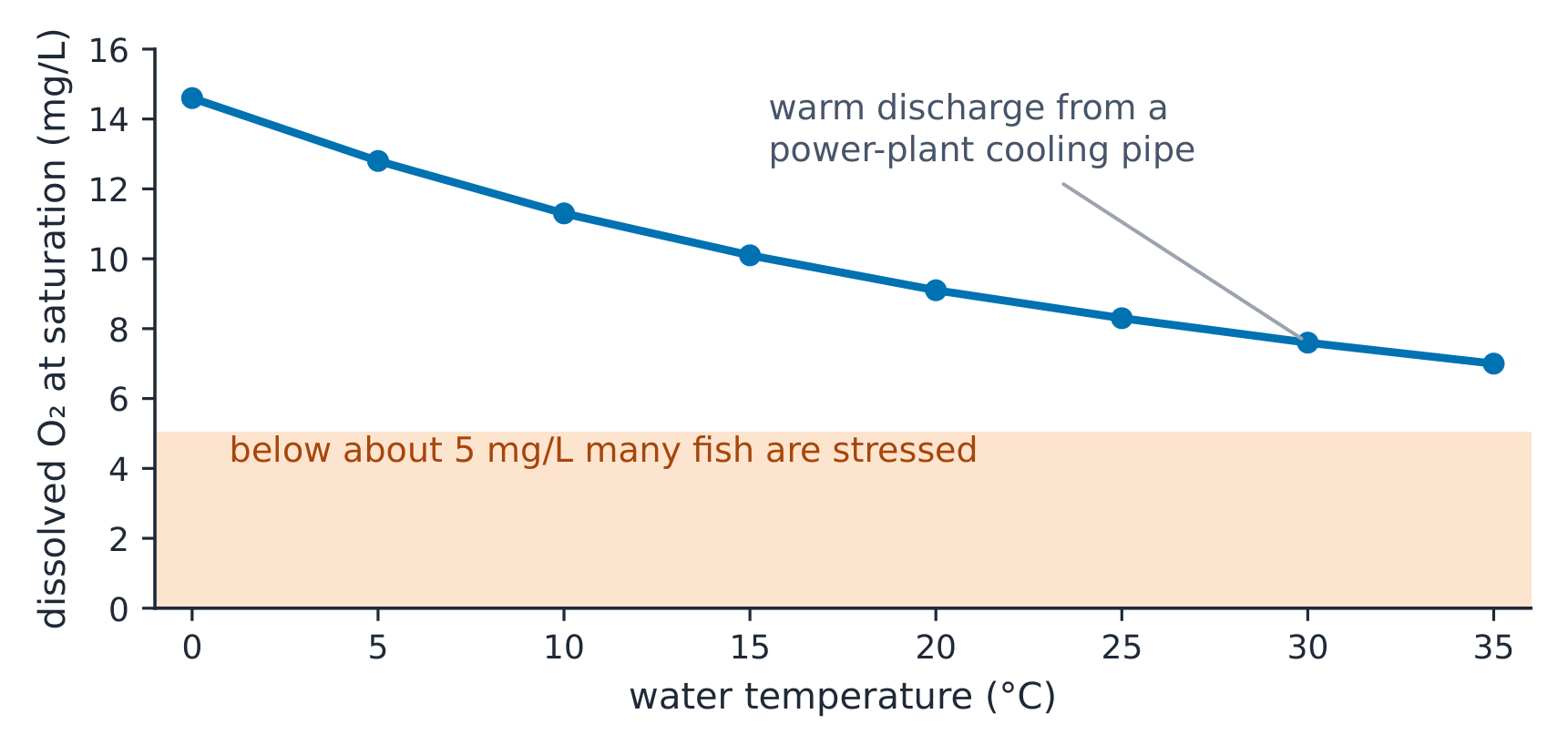
Thermal pollution 热污染 occurs when heat released into water harms the organisms living there. The usual source is a power plant or factory that takes in cool river water to cool its machinery and returns it several degrees warmer.
Warm water holds less dissolved oxygen than cold water, while fish and other cold-blooded animals breathe faster in warm water and need more oxygen. Heat also speeds up decomposition (using more oxygen), and sudden changes in temperature (thermal shock) can kill organisms adapted to stable conditions. Solutions include cooling towers and cooling ponds that release the heat to the air before the water returns to the river.
Vocabulary
Train
| English |
|---|
| thermal pollution/ˈθɜːml pəˈluːʃn/ |
8.7
Persistent Organic Pollutants (POPs)
Syllabus
| Enduring Understanding | Learning Objective | Essential Knowledge |
|---|---|---|
STB-3 | STB-3.H |
|
Source: College Board AP Course and Exam Description
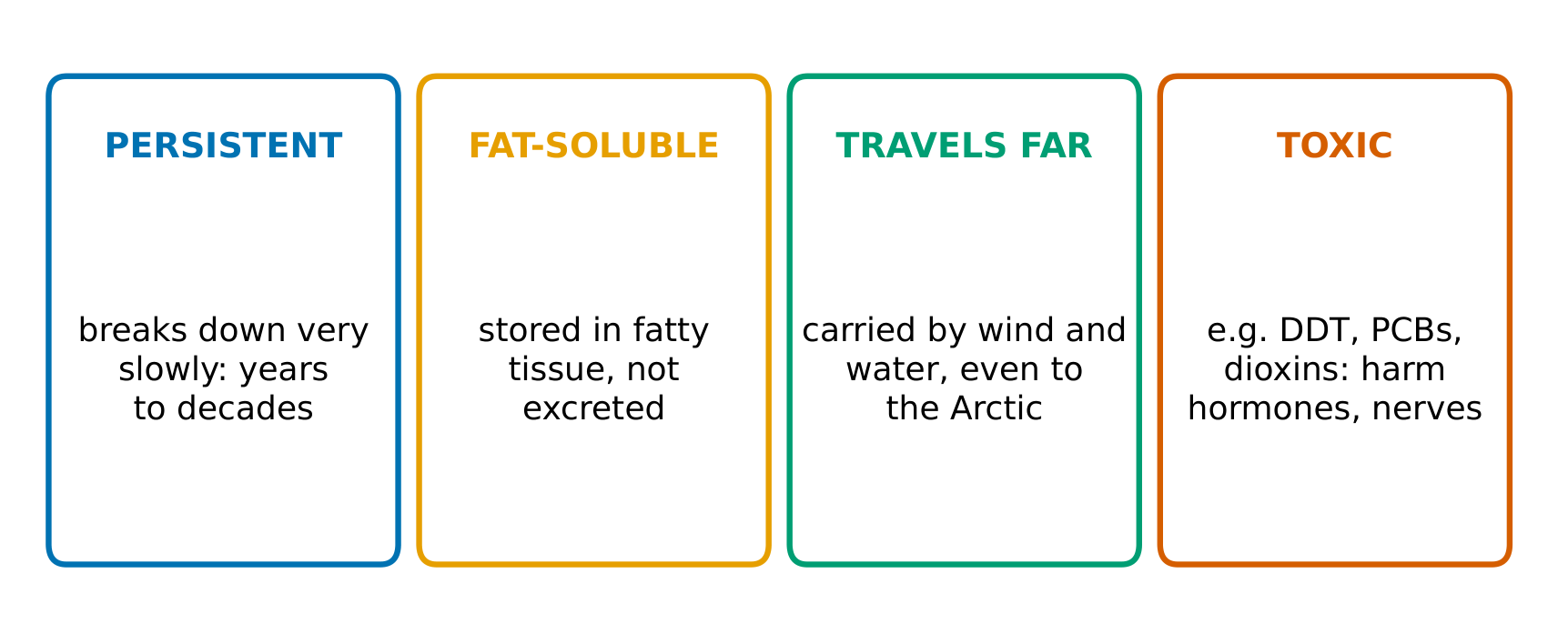
Persistent organic pollutants 持久性有机污染物 (POPs) are synthetic, carbon-based molecules – such as the pesticide DDT and the industrial chemicals PCBs – that do not easily break down in the environment. Three properties make them dangerous:
- Persistent – microbes and sunlight break them down very slowly, so they last for years or decades.
- Fat-soluble – they dissolve in fat rather than water, so they are stored in organisms' fatty tissues instead of being excreted.
- Mobile – they travel long distances on wind and water before being redeposited. POPs used in the tropics evaporate, drift toward the poles and condense in the cold, so Inuit people and polar bears in the Arctic carry some of the highest levels on Earth.
The 2001 Stockholm Convention bans or restricts the worst POPs worldwide.
Explore
A dangerous POP trait, or a safe one?
Sort each trait by whether it makes a pollutant a dangerous POP or a safer chemical.
Vocabulary
Train
| English |
|---|
| persistent organic pollutants/pəˈsɪstənt ɔːˈɡænɪk pəˈluːtənts/ |
8.8
Bioaccumulation and Biomagnification
Syllabus
| Enduring Understanding | Learning Objective | Essential Knowledge |
|---|---|---|
STB-3 | STB-3.I |
|
STB-3.J |
|
Source: College Board AP Course and Exam Description
Bioaccumulation 生物累积 is the selective absorption and concentration of a substance by cells within one organism over its lifetime – most commonly fat-soluble compounds that the body cannot excrete. An older fish carries more mercury than a younger one of the same species.
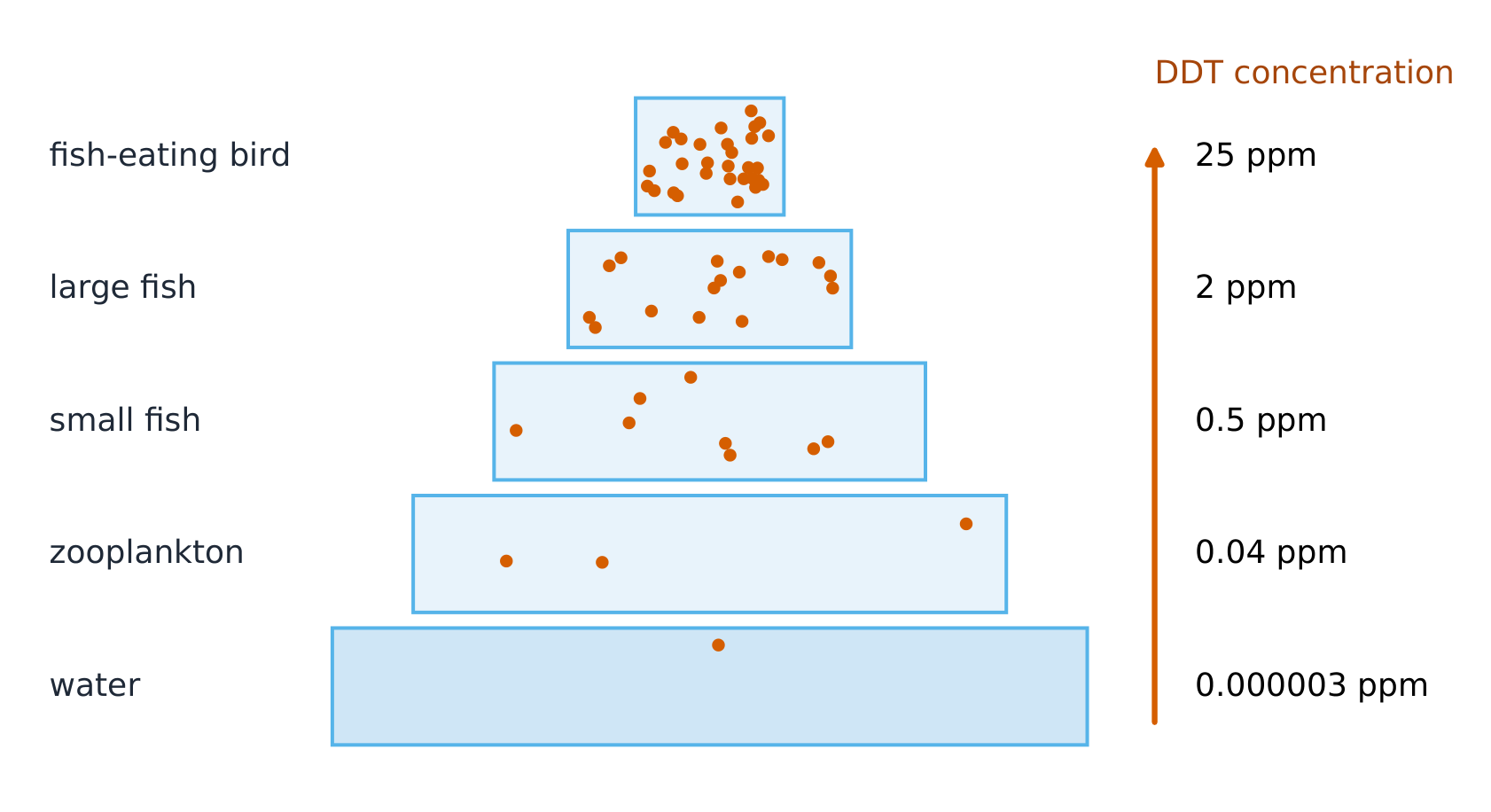
Biomagnification 生物放大 is the increase in concentration per unit of body tissue at successively higher trophic levels of a food chain or web. Each predator eats many prey and keeps their stored toxin, so top predators end up with the highest levels – which is why large predatory fish such as tuna and swordfish carry the most mercury.
Effects of biomagnification on top carnivores include eggshell thinning (DDT made eagle, osprey and pelican eggs so thin they broke under the parents' weight, and bald eagles nearly vanished from the lower 48 US states until DDT was banned in 1972) and developmental deformities. Humans suffer harm to their reproductive, nervous and circulatory systems. The three classic substances that bioaccumulate are DDT, mercury and PCBs.
Worked example (biomagnification). In the classic DDT study shown above, water held $0.000003\ \text{ppm}$ of DDT and a fish-eating bird held $25\ \text{ppm}$. The bird's concentration is $\dfrac{25}{0.000003} \approx 8\,300\,000$ times that of the water. From small fish ($0.5$ ppm) to the bird alone, the concentration rose $\dfrac{25}{0.5} = 50$-fold. This is why a top predator can be poisoned even when the water itself looks clean.
Explore
Toxins concentrate up the food chain
Bioaccumulation builds a toxin up in one organism; biomagnification concentrates it at each step up the food chain, so top predators carry the highest doses.
Vocabulary
Train
| English |
|---|
| bioaccumulation/ˌbaɪəʊəˌkjuːmjʊˈleɪʃn/ |
| biomagnification/ˌbaɪəʊˌmæɡnɪfɪˈkeɪʃn/ |
8.9
Solid Waste Disposal
Syllabus
| Enduring Understanding | Learning Objective | Essential Knowledge |
|---|---|---|
STB-3 | STB-3.K |
|
STB-3.L |
|
Source: College Board AP Course and Exam Description
Solid waste is any discarded material that is not a liquid or gas. It is generated in domestic, industrial, business and agricultural sectors; in the US, households produce about 2 kg per person per day.
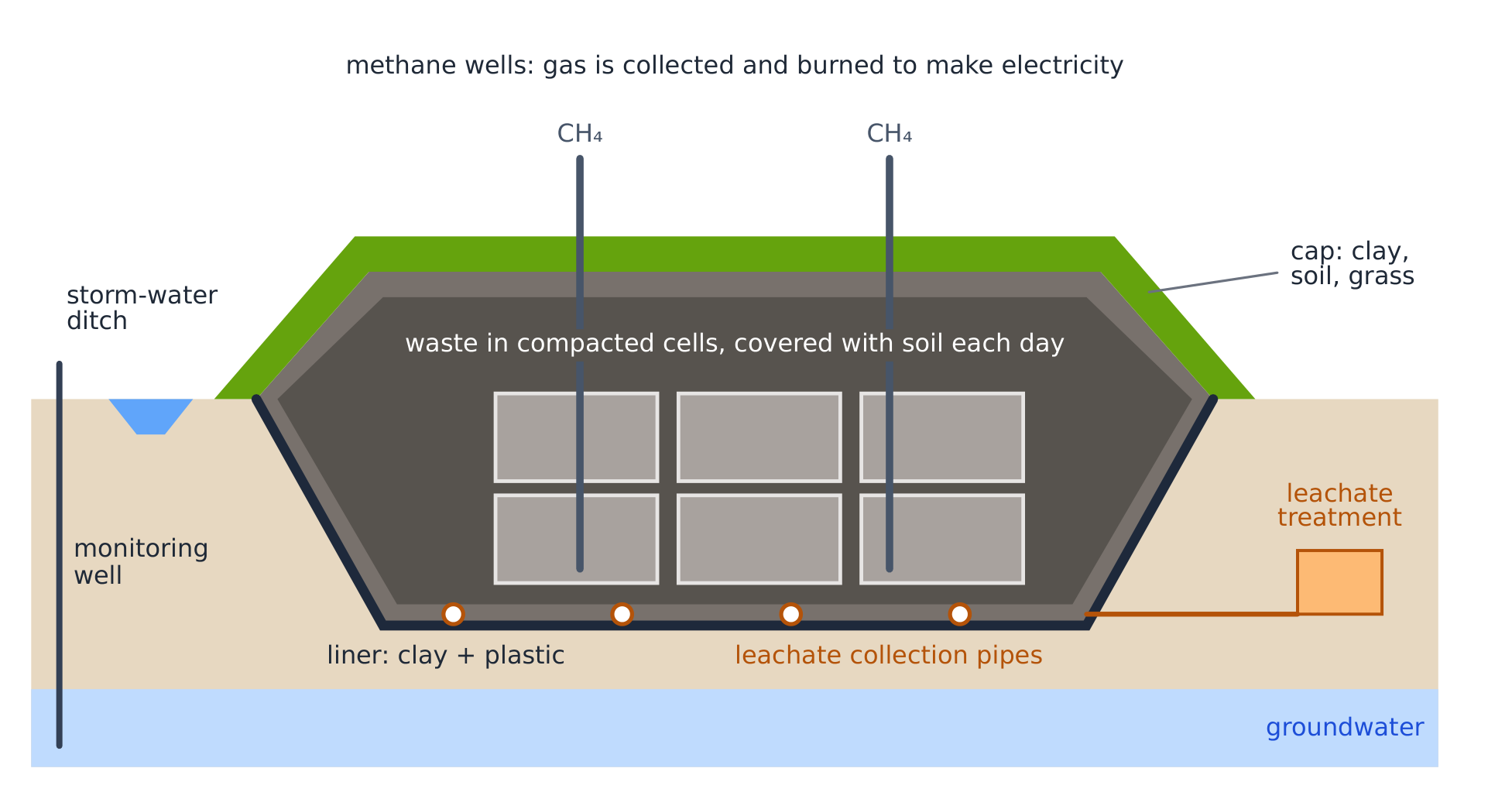
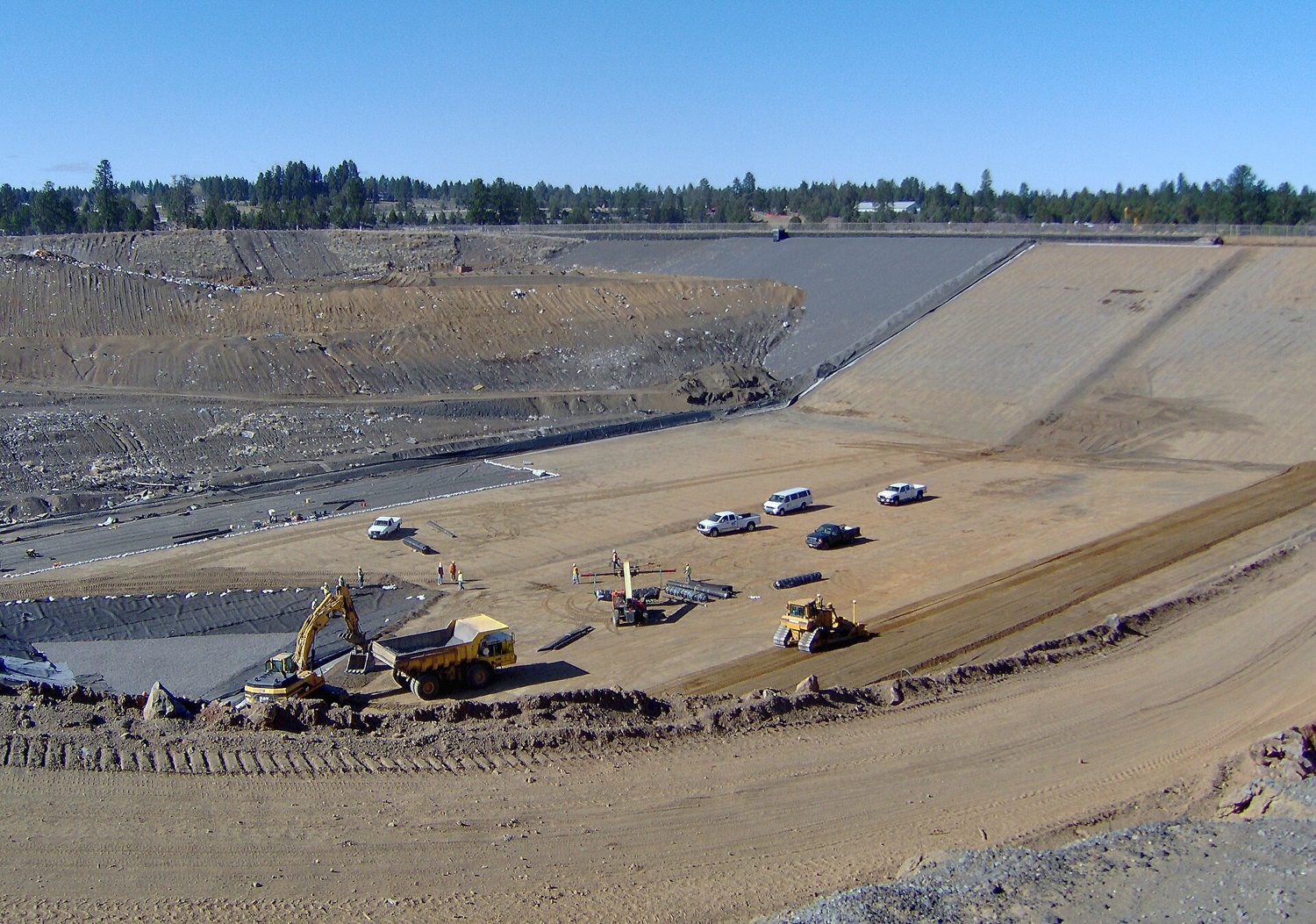
Solid waste is most often disposed of in landfills, which can contaminate groundwater (through leachate, the polluted liquid that drains out of trash) and release harmful gases – mostly methane and carbon dioxide from decomposition. A sanitary municipal landfill 卫生填埋场 is designed to prevent this. It has:
- a bottom liner of plastic and compacted clay, so leachate cannot reach groundwater;
- a leachate collection system – pipes along the liner that carry leachate to treatment;
- a storm-water collection system – ditches that carry rain away before it soaks into the trash;
- a cap of clay and soil, planted with grass, once a section is full;
- a methane collection system – wells and pipes that collect landfill gas.
Decomposition inside a landfill depends on the composition of the trash (food and yard waste rot; plastics and metals do not) and the conditions microbes need – moisture, oxygen and warmth. Because landfills are sealed, dry and low in oxygen, even newspapers can stay readable for decades.
Incineration 焚烧 burns waste at high temperatures. It significantly reduces the volume of waste (by about 90%) and can generate electricity, but it releases air pollutants (particulates, dioxins, heavy metals) and leaves toxic ash that must itself go to a landfill.
Some items are not accepted in sanitary landfills and may be dumped illegally. Piles of used rubber tires, for example, collect rainwater and become breeding grounds for mosquitoes that spread disease; they can also catch fire and burn for months.
E-waste 电子垃圾 is discarded electronic devices – televisions, phones, computers. Some countries dump waste in the ocean; together with plastic from rivers and ships, this has created large floating garbage patches 垃圾带, such as the Great Pacific Garbage Patch. Wildlife becomes entangled in nets and plastic, and ingests it – sea turtles mistake plastic bags for jellyfish, and seabirds feed bottle caps to their chicks.
Microplastics. Plastic does not biodegrade; sunlight and waves break it into ever smaller pieces. Pieces under 5 mm, together with the tiny microbeads once added to face scrubs and toothpaste, are microplastics. Filter feeders and fish swallow them, mistaking them for food. Microplastics fill the stomach without giving energy, so animals feel full and starve, and they can block or damage the gut. Persistent organic pollutants stick to the plastic surface, so the plastic also carries toxins into the food chain, where they biomagnify. Many countries now ban microbeads in cosmetics.
Worked example (percent increase). US municipal solid waste rose from 152 million tons in 1980 to 251 million tons in 2012.
- Percent increase $= \dfrac{251 - 152}{152} \times 100 \approx 65\%$.
- Always divide by the old (earlier) value.
- Over the same years the population grew more slowly, so waste per person also rose.
Explore
Landfill or incineration?
Sort each feature under the disposal method it describes.
Vocabulary
Train
| English |
|---|
| sanitary municipal landfill |
| incineration/ɪnˌsɪnəˈreɪʃn/ |
| e-waste/iː weɪst/ |
| garbage patches/ˈɡɑːbɪdʒ ˈpætʃɪz/ |
8.10
Waste Reduction Methods
Syllabus
| Enduring Understanding | Learning Objective | Essential Knowledge |
|---|---|---|
STB-3 | STB-3.M |
|
Source: College Board AP Course and Exam Description
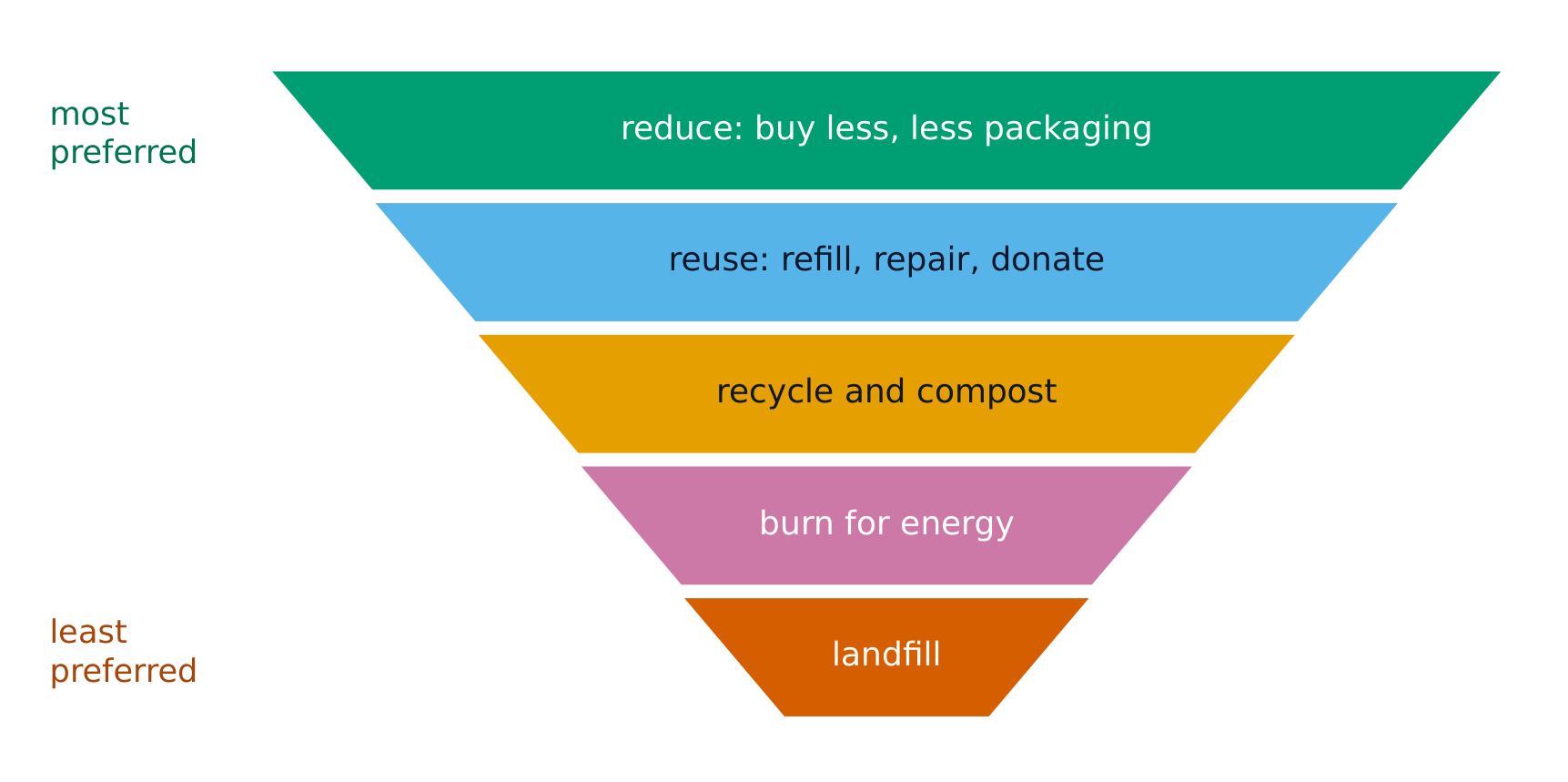
The waste hierarchy is reduce, reuse, recycle 减量、再利用、回收. Reducing consumption is best, because there is then no waste to manage at all.
- Recycling processes certain waste materials (paper, glass, aluminium, some plastics) and converts them into new products. It reduces the demand for mining new minerals – recycled aluminium needs about 95% less energy than new aluminium from ore – but the process itself is energy-intensive and can be costly (collecting, sorting and cleaning).
- Composting 堆肥 lets organic matter such as food scraps, paper and yard waste decompose; the product can be used as a natural fertilizer. Drawbacks are odour and rodents.
- E-waste can be reduced by recycling and reuse (repairing and passing on devices). E-waste contains hazardous chemicals – heavy metals such as lead and mercury – that can leach from landfills into groundwater if not disposed of properly. It also contains valuable gold, copper and rare metals worth recovering.
Landfill mitigation ranges from burning waste for energy to restoring habitat on closed landfills and turning them into parks. The methane collected from decomposing organic waste can be burned to turn turbines and generate electricity; this also reduces the landfill's volume and stops a powerful greenhouse gas from escaping.
Explore
Reduce, reuse, or recycle?
Sort each action into the "R" it belongs to.
Vocabulary
Train
| English |
|---|
| reduce, reuse, recycle/rɪˈdjuːs riːˈjuːz rɪˈsaɪkl/ |
| composting/ˈkɒmpɒstɪŋ/ |
8.11
Sewage Treatment
Syllabus
| Enduring Understanding | Learning Objective | Essential Knowledge |
|---|---|---|
STB-3 | STB-3.N |
|
Source: College Board AP Course and Exam Description
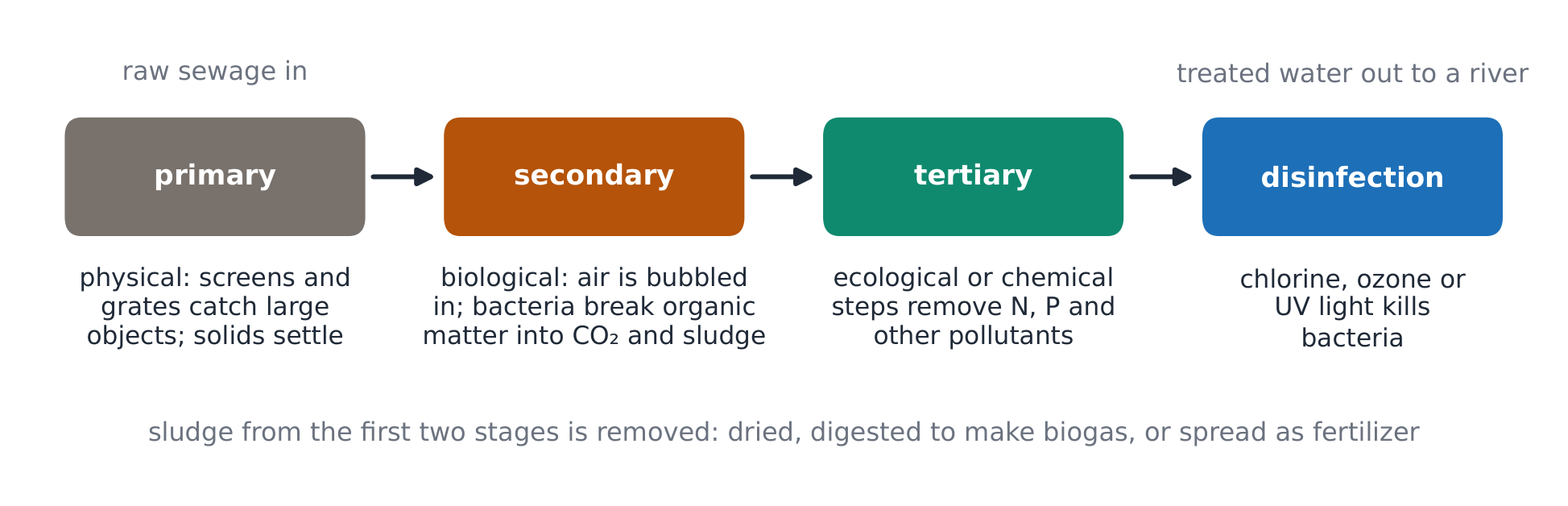
Sewage treatment 污水处理 cleans wastewater in stages before it returns to a river or the sea:
- Primary treatment (physical): screens and grates remove large objects (rags, sticks, plastic), then the water sits in a tank so solid waste settles to the bottom as sludge.
- Secondary treatment (biological): bacteria break down the organic matter into carbon dioxide and inorganic sludge, which settles. The tank is aerated (air is bubbled through) to give the bacteria oxygen and speed up their work.
- Tertiary treatment: ecological or chemical processes remove pollutants left after the first two stages – especially nitrogen and phosphorus, which would otherwise cause eutrophication. Constructed wetlands are one ecological method.
- Disinfection: before discharge, the water is exposed to chlorine, ozone or UV light to kill bacteria and other pathogens.
The sludge is dried and buried, digested by bacteria to make biogas, or treated and spread on fields as fertilizer (if it is free of heavy metals).
Vocabulary
Train
| English |
|---|
| sewage treatment/ˈsuːɪdʒ ˈtriːtmənt/ |
8.12
Lethal Dose 50% (LD50)
Syllabus
| Enduring Understanding | Learning Objective | Essential Knowledge |
|---|---|---|
EIN-3 | EIN-3.A |
|
Source: College Board AP Course and Exam Description
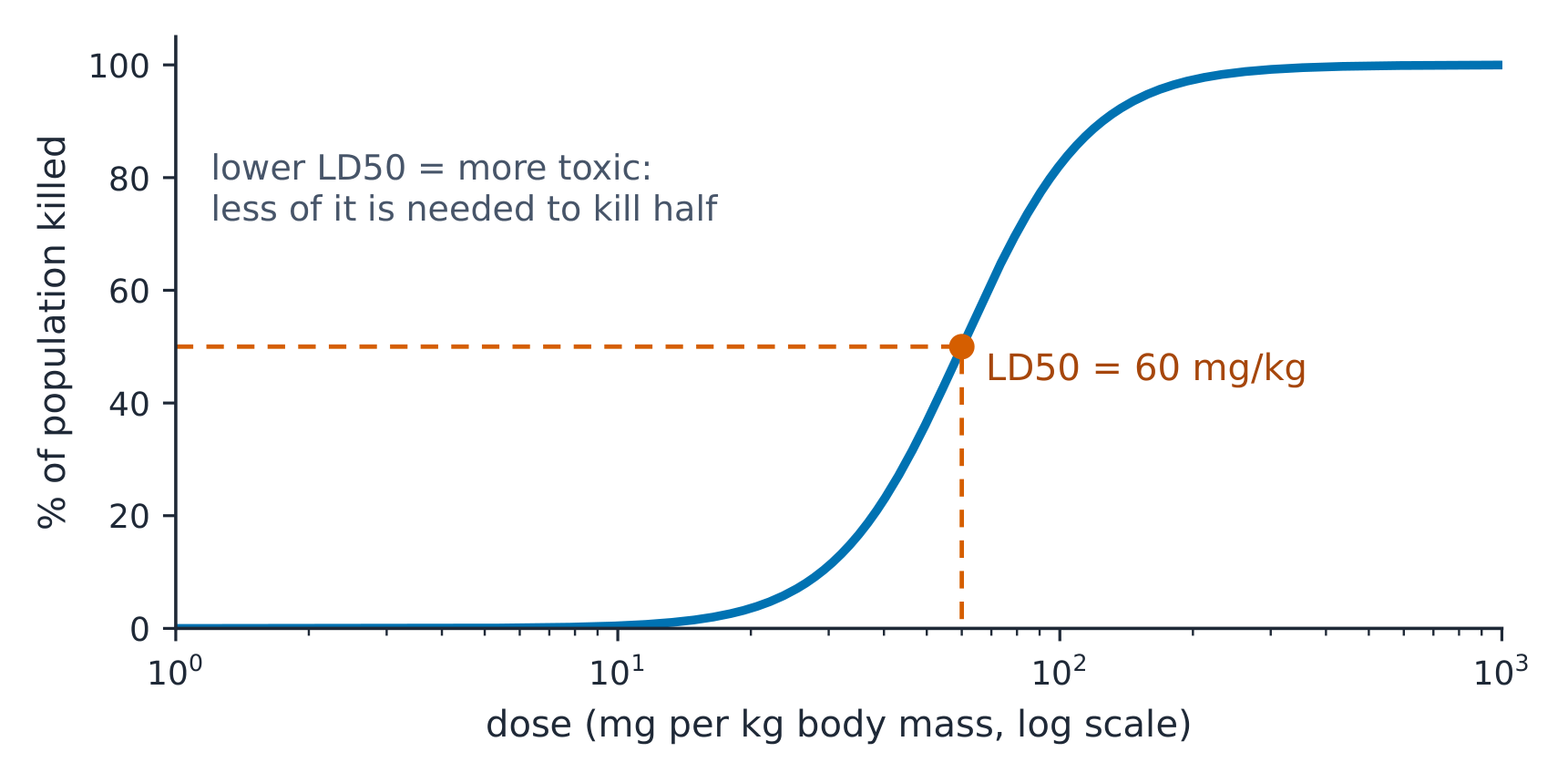
The LD50 半数致死量 (lethal dose 50%) is the dose of a chemical that is lethal to 50% of a population of a particular species in a test. It is usually given in milligrams of chemical per kilogram of body mass (mg/kg), so it can be scaled to animals of different sizes. A lower LD50 means a more toxic substance – less of it is needed to kill half the population.
LD50 values are measured on lab animals such as rats, and humans may respond differently, so safety limits are set far below them – often 100 to 1 000 times lower.
Worked example (LD50). Chemical A has an LD50 of $5\ \text{mg}$ per kg of body weight; chemical B, $500\ \text{mg/kg}$. Because A's value is $100$ times smaller, A is about $100\times$ more toxic. For a $70\ \text{kg}$ adult, the dose of A expected to be lethal to half of people is $5\ \text{mg/kg}\times70\ \text{kg}=350\ \text{mg}$ – a tiny amount, whereas B would take $500\times70=35\,000\ \text{mg}$ ($35\ \text{g}$).
Explore
More toxic or less toxic?
Sort each substance by its LD50 - remember, a lower LD50 means more toxic.
Vocabulary
Train
| English |
|---|
| LD50/ˌel diː ˈfɪfti/ |
8.13
Dose Response Curve
Syllabus
| Enduring Understanding | Learning Objective | Essential Knowledge |
|---|---|---|
EIN-3 | EIN-3.B |
|
Source: College Board AP Course and Exam Description
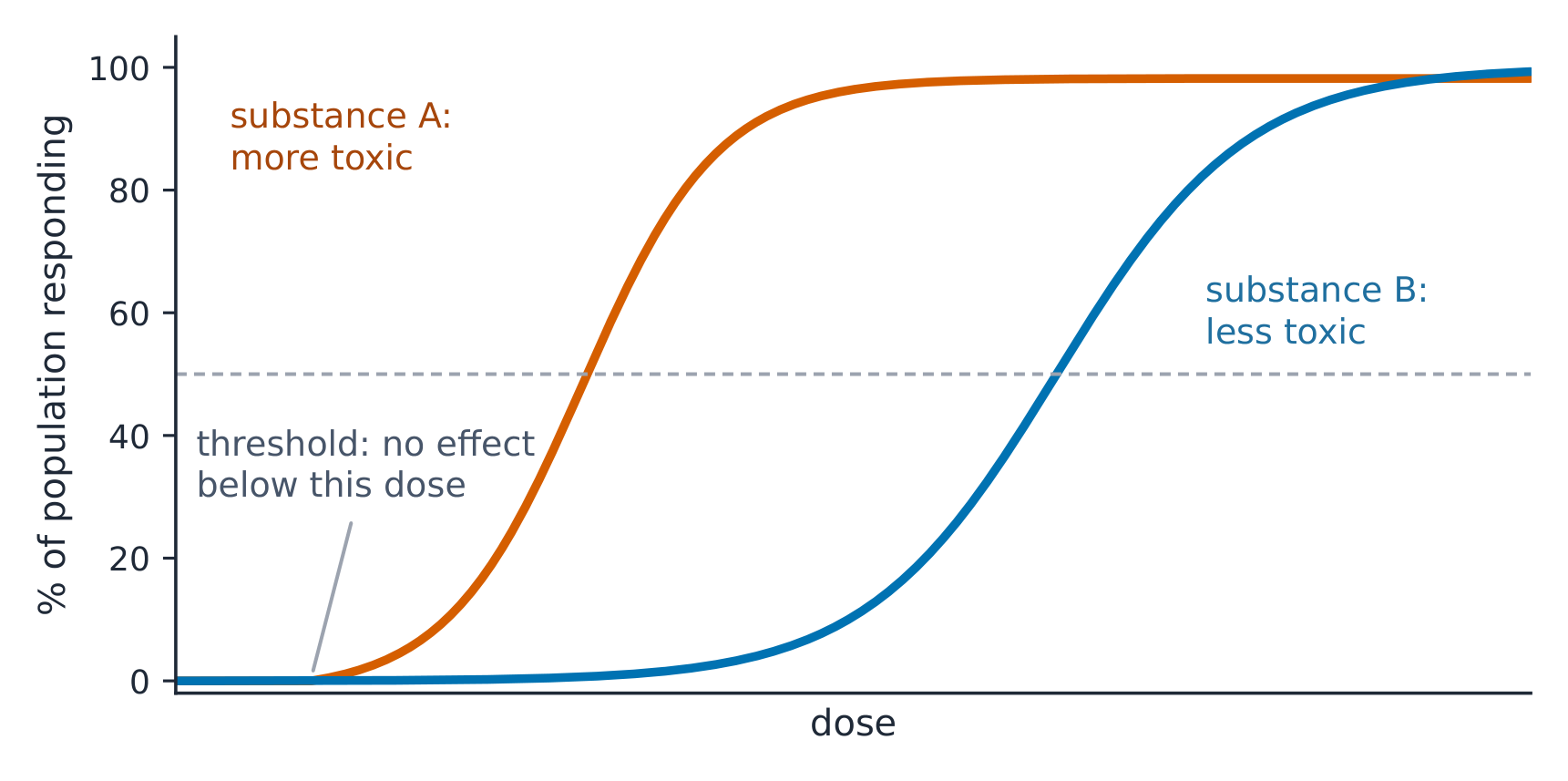
A dose–response curve 剂量反应曲线 shows the effect on an organism, or the mortality rate in a population, at each dose of a particular toxin or drug. Reading one:
- The x-axis is the dose (often on a log scale); the y-axis is the percentage of the population responding or dying.
- Generally, a higher dose causes a greater effect.
- The dose at which 50% respond is read straight from the curve: the LD50 for deaths, or the ED50 for a non-lethal effect.
- Some chemicals have a threshold 阈值 – a dose below which there is no measurable effect. For others, such as many carcinogens, any exposure may carry some risk.
- A curve further to the left belongs to a more toxic substance.
Explore
Little effect or strong effect?
Sort each dose by the size of the response it causes on the curve.
Vocabulary
Train
| English |
|---|
| dose–response curve/dəʊs rɪˈspɒns kɜːv/ |
| threshold/ˈθreʃəʊld/ |
8.14
Pollution and Human Health
Syllabus
| Enduring Understanding | Learning Objective | Essential Knowledge |
|---|---|---|
EIN-3 | EIN-3.C |
|
Source: College Board AP Course and Exam Description
It can be difficult to establish cause and effect between a pollutant and a human health problem, because people are exposed to many chemicals and pollutants at once, over many years, and also differ in diet, smoking, genes and age. Scientists rely on large studies comparing exposed and unexposed groups, and on animal experiments. Dose, duration and individual sensitivity all affect the outcome; children, the elderly and pregnant women are most sensitive. Poor communities are often the most exposed and the least protected.
Examples the exam names:
- Dysentery 痢疾 – caused by untreated sewage in streams and rivers.
- Mesothelioma – a cancer of the lining of the lungs caused mainly by breathing in asbestos fibres, once used in building insulation. It can appear 20–50 years after exposure.
- Tropospheric (ground-level) ozone – irritates the airways and reduces lung function, worsening asthma and other respiratory problems.
Explore
Acute or chronic effect?
Sort each health effect by whether it strikes at once or builds up over time.
Vocabulary
Train
| English |
|---|
| dysentery/ˈdɪsəntəri/ |
8.15
Pathogens and Infectious Diseases
Syllabus
| Enduring Understanding | Learning Objective | Essential Knowledge |
|---|---|---|
EIN-3 | EIN-3.D |
|
Source: College Board AP Course and Exam Description
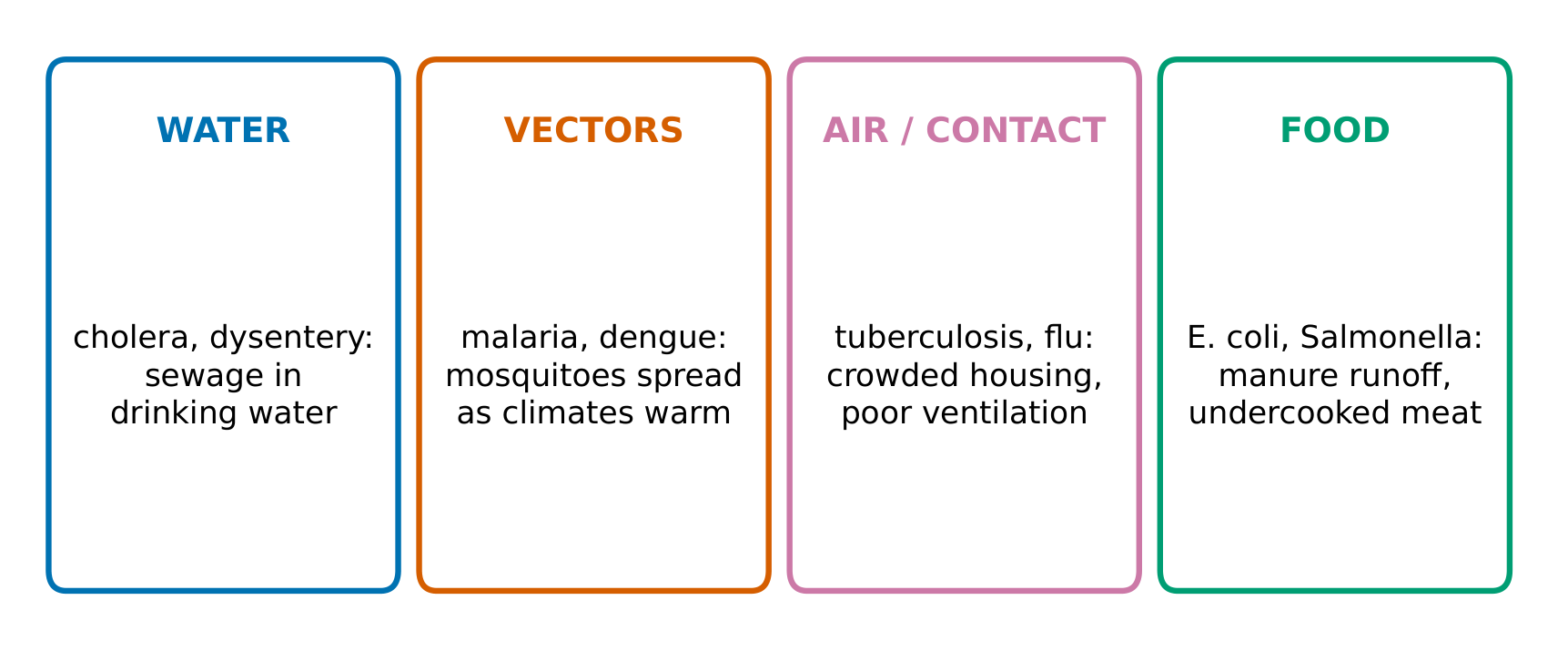
Pathogens 病原体 (bacteria, viruses, parasites) adapt to take advantage of new opportunities to infect and spread through human populations – new hosts, crowded cities, air travel and changing climates. Specific pathogens can occur in many environments regardless of how clean they look: clear water can still carry cholera bacteria.
The exam names specific diseases and expects you to know how each one is transmitted, because the transmission route decides the defence:
| Disease | Type | How it spreads |
|---|---|---|
| Cholera 霍乱 | bacterial | drinking water contaminated with sewage |
| Dysentery | bacterial | untreated sewage in streams and rivers |
| Plague 鼠疫 | bacterial | bite of an infected organism (e.g. fleas) or contact with infected fluids or tissues |
| Tuberculosis (TB) 结核病 | bacterial | breathing in bacteria from an infected person's bodily fluids; attacks the lungs |
| Malaria 疟疾 | parasitic | bite of an infected mosquito 蚊子 (mostly sub-Saharan Africa) |
| West Nile / Zika 西尼罗/寨卡 | viral | bite of an infected mosquito (Zika also via sexual contact) |
| SARS / MERS | viral | SARS, a form of pneumonia: inhaling or touching infected fluids; MERS passes from animals (camels) to humans |
Two big-picture ideas carry marks. Poverty deepens the problem – low-income areas often lack sanitary waste disposal and clean water, giving water-borne diseases a haven. And climate change spreads disease: as warm equatorial climate zones expand toward the poles, mosquitoes and other vectors 传播媒介 – and the diseases they carry – move into subtropical and temperate regions where these diseases were not known before. Clean water, sanitation, and vector control (draining standing water, bed nets) remain the main defences.
Explore
Waterborne or vector-borne?
Sort each disease by how it spreads - through water or through an animal carrier.
Vocabulary
Train
| English |
|---|
| pathogens/ˈpæθədʒnz/ |
| cholera/ˈkɒlərə/ |
| plague/pleɪɡ/ |
| tuberculosis (TB)/ˌtjuːbəkjʊˈləʊsɪs/ |
| malaria/mæˈleərɪə/ |
| mosquito/məˈskiːtəʊ/ |
| West Nile / Zika/west naɪl ˈziːkə/ |
| vectors/ˈvektəz/ |
8.15
Exam tips
- Give a specific example of a point source (one pipe or smokestack) and a nonpoint source (farm or urban runoff), and say why nonpoint is harder to regulate.
- Trace eutrophication step by step: nutrient runoff → algal bloom → algae die → bacteria decompose them and use up oxygen → hypoxia → fish die. Contrast with oligotrophic water.
- On an oxygen sag curve, dissolved oxygen falls below a sewage outfall, reaches a minimum downstream, and recovers.
- Thermal pollution: warm water holds less dissolved oxygen.
- POPs are persistent, fat-soluble and travel far. Bioaccumulation builds up in one organism; biomagnification increases up the food chain, so top predators are hit hardest (eggshell thinning). Bacteria turn mercury into methylmercury.
- Name the parts of a sanitary landfill: liner, leachate collection, storm-water collection, cap, methane collection.
- Incineration cuts volume but releases air pollutants; recycling saves minerals but is energy-intensive; composting smells and draws rodents.
- Describe the stages of sewage treatment: primary (physical), secondary (biological, aerated), tertiary (ecological or chemical), then disinfection.
- Read an LD50: a lower value means more toxic; multiply by body mass for a lethal dose.
- Match each disease to its route of transmission, and link vectors spreading poleward to climate change.
Interactive lessons on this topic
Work through it step by step, with instant-check exercises.
- Sources of Pollution
- Human Impacts on Ecosystems
- Endocrine Disruptors
- Human Impacts on Wetlands and Mangroves
- Eutrophication
- Thermal Pollution
- Persistent Organic Pollutants (POPs)
- Bioaccumulation and Biomagnification
- Solid Waste Disposal
- Waste Reduction Methods
- Sewage Treatment
- Lethal Dose 50% (LD50)
- Dose Response Curve
- Pollution and Human Health
- Pathogens and Infectious Diseases