The Tragedy of the Commons
Introduced| English | Meaning |
|---|---|
| tragedy of the commons/ˈtrædʒədi ɒvðə ˈkɒmənz/ | Overuse of a shared resource when individuals act in their own interests without accounting for the costs imposed on others. |
| common resource/ˈkɒmən rɪˈzɔːs/ | A resource that is difficult to exclude people from using but is depleted or made less available when one person uses it. |
When sharing goes wrong
- Imagine a pasture open to every herder in a village.
- Each one gains by grazing more animals there.
- But if everyone keeps adding animals, the grass is destroyed.
- This self-defeating pattern is the tragedy of the commons.
The shared resource
- The tragedy of the commons 公地悲剧 is the overuse of a shared resource.
- A common resource 公共资源 is one no single person owns — open to all.
- Each user gains the full benefit of taking a bit more.
- But the cost — a slightly more damaged resource — is shared by everyone.
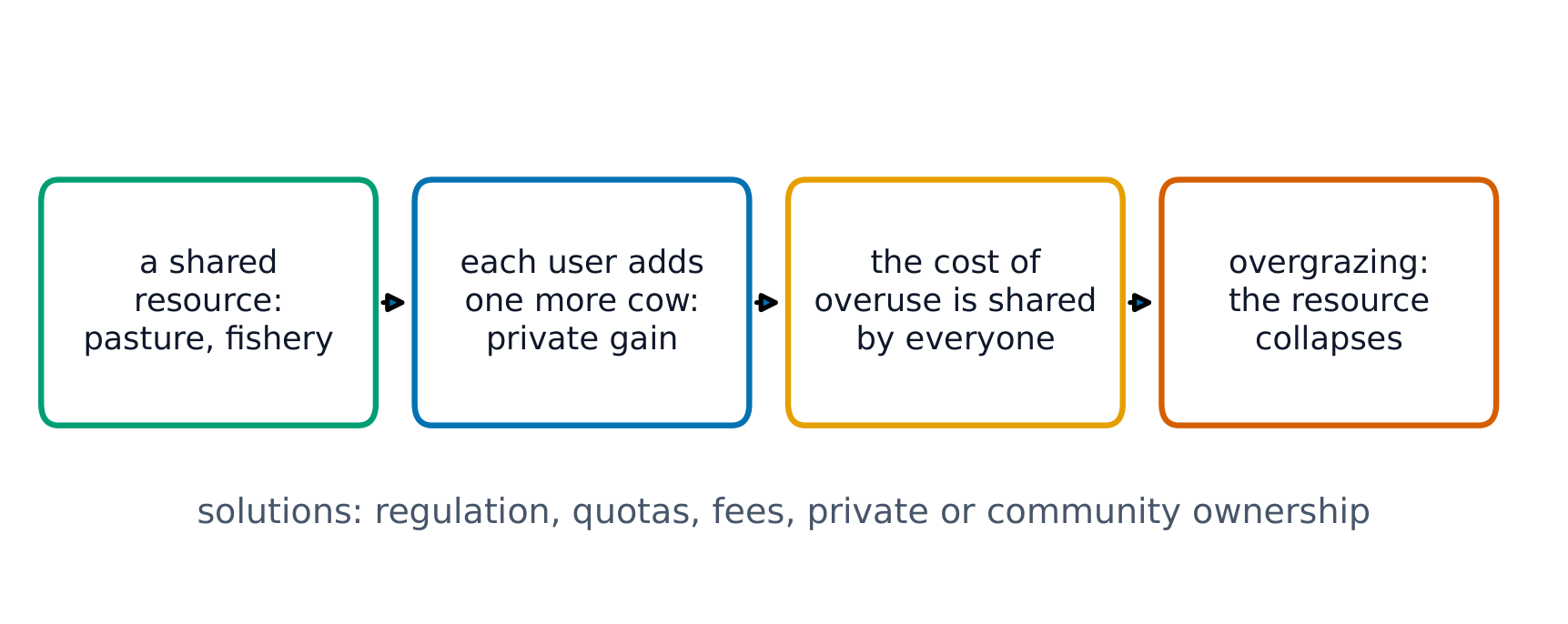
The tragedy of the commons: private gain, shared cost
The tragedy of the commons happens when…
Difficulty 1/5 · 100 coins + a small bonus on first completion today
The tragedy of the commons: each person, acting in self-interest, overuses a shared resource until it collapses.
The trap
- Because you keep the benefit but share the cost, taking more always looks worth it.
- So every user reasons the same way and takes more.
- Together, they overuse the resource far past what it can sustain.
- In the end the resource collapses, and everyone loses.
The tragedy of the commons
Step through how a shared resource gets destroyed when each user takes as much as they can.
Why does each individual keep taking more?
Difficulty 1/5 · 100 coins + a small bonus on first completion today
Each user keeps the full benefit but shares the cost, so it always seems worth taking a bit more.
Avoiding the tragedy
- The tragedy can be avoided by setting rules and limits.
- Quotas, fees, or shared ownership can limit how much each person takes.
- Well-managed commons — with agreed rules — can last indefinitely.
- The key is that no one may simply take as much as they want.
One way to avoid the tragedy is to ____ how much each person can take (rules or limits).
Difficulty 1/5 · 100 coins + a small bonus on first completion today
Rules, quotas, or shared ownership that limit use can protect a common resource.
The tragedy of the commons applies only to privately owned land.
Difficulty 1/5 · 100 coins + a small bonus on first completion today
False. It applies to shared resources that no one owns, such as ocean fisheries, clean air and groundwater; private owners have an incentive to protect their own land.
Select all true statements about the tragedy of the commons.
Difficulty 2/5 · 140 coins + a small bonus on first completion today
It harms everyone who shares the resource, not just one person. The other three are correct.
The tragedy is driven by a mismatch: the benefit is private, but the cost is shared. That is why it is so hard to stop by goodwill alone — even a caring person still gains by taking more, while the damage spreads across everyone. Rules and limits, not just good intentions, are usually needed.
Overfishing the ocean:
- The sea is a shared resource open to all fishing fleets.
- Each fleet gains by catching more, so all of them keep catching more.
- The fish are taken faster than they can breed, and the fishery collapses — a tragedy of the commons on a global scale.
The tragedy of the commons is the overuse of a shared common resource, because each user keeps the benefit of taking more while the cost is shared by all. This drives everyone to overuse it until it collapses. Rules, quotas, and limits — not just goodwill — can prevent the tragedy.