| Enduring Understanding | Learning Objective | Essential Knowledge |
|---|---|---|
STB-4 | STB-4.A |
|
Global Change
AP Environmental Science · Topic 9
 8:14
Global Change
In nineteen eighty-five, scientists studying the sky above Antarctica found something frightening: a hole in the ozone layer, the thin shield that keeps the…
English narration · English + 中文 subtitles burned in
9.1
Stratospheric Ozone Depletion
Syllabus
Source: College Board AP Course and Exam Description
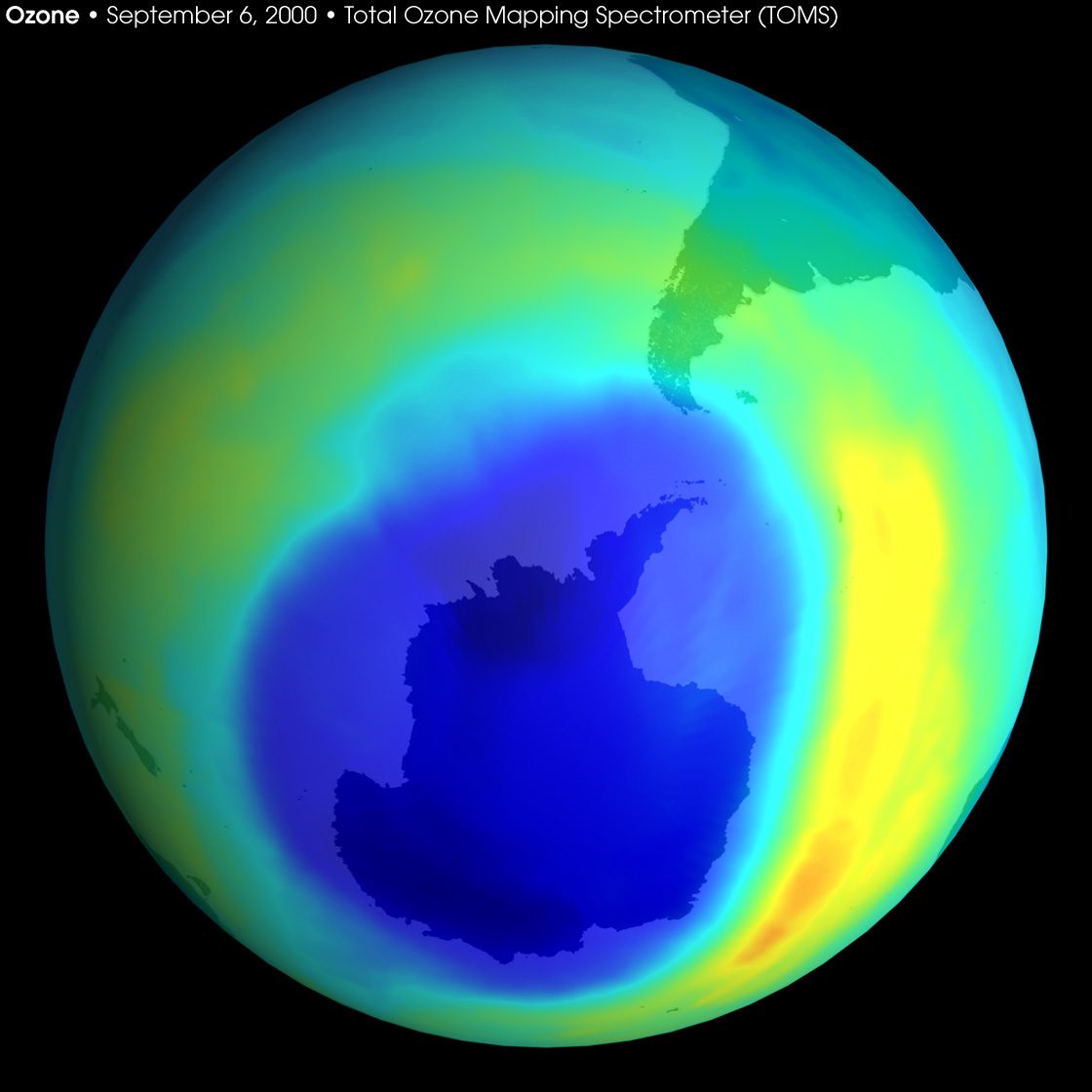
In 1985 three British scientists at a research station in Antarctica published a surprising result: every southern spring, the ozone above them dropped by about a third. Satellite readings had not raised the alarm: values that low were first treated as instrument errors. Within two years, the world had signed a treaty to stop making the chemicals responsible. This unit covers the global changes people cause, and the ones like this that we have learned to reverse.
The ozone layer 臭氧层 is a band of ozone ($\text{O}_3$) about 15–35 km up, in the stratosphere. It absorbs most of the Sun's harmful ultraviolet 紫外线 (UV) radiation, especially UV-B. Life on land only became possible after this layer formed, and it still protects every living thing on the surface.
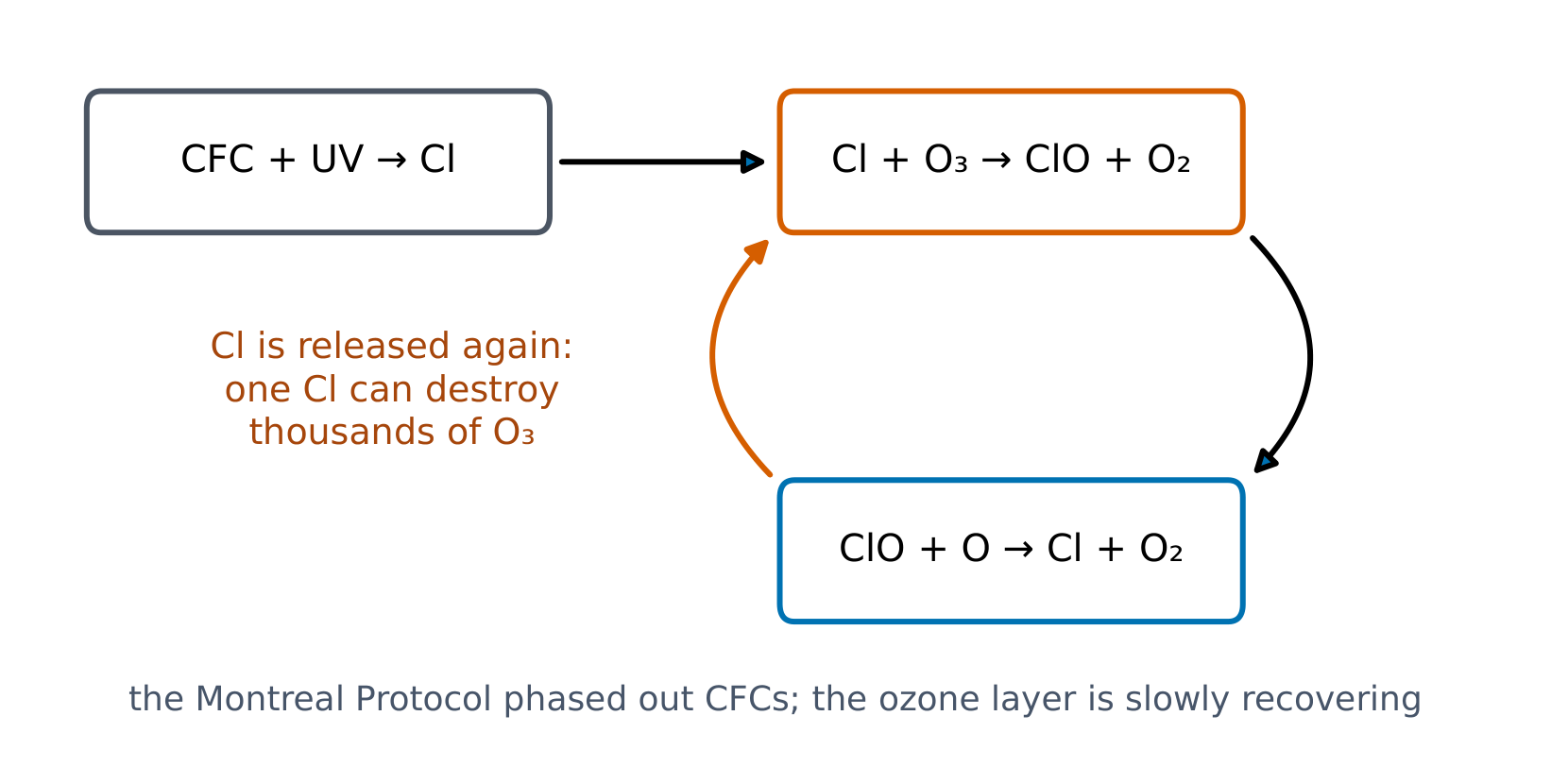
CFCs 氯氟烃 (chlorofluorocarbons, once used in fridges, air conditioners, aerosol sprays and foam) are very stable, so they last long enough to drift up into the stratosphere. There, UV light breaks them apart and frees chlorine atoms. One chlorine atom acts as a catalyst – it is not used up – so it can destroy tens of thousands of ozone molecules:
$$\text{Cl} + \text{O}_3 \rightarrow \text{ClO} + \text{O}_2$$
$$\text{ClO} + \text{O} \rightarrow \text{Cl} + \text{O}_2$$
The chlorine atom comes out of the second step free to start again.
A natural factor makes the damage worst over Antarctica. In the dark polar winter, extremely cold air forms ice-crystal clouds high in the stratosphere. Chlorine compounds collect on the crystals. When the Sun returns in spring (September–October) and the crystals melt, they release a burst of active chlorine, and ozone collapses – the "ozone hole".
Less ozone means more UV reaches the surface. In humans, UV causes skin cancer, cataracts (clouding of the eye lens) and sunburn, and weakens the immune system. It also damages crops and kills the phytoplankton at the base of ocean food webs.
Vocabulary
Train
| English |
|---|
| ozone layer/ˈəʊzəʊn ˈleɪə/ |
| ultraviolet/ˌʊltrəˈvaɪəlɪt/ |
| CFCs/ˌsiː ef ˈsiːz/ |
| ozone hole |
9.2
Reducing Ozone Depletion
Syllabus
| Enduring Understanding | Learning Objective | Essential Knowledge |
|---|---|---|
STB-4 | STB-4.B |
|
Source: College Board AP Course and Exam Description
The Montreal Protocol 蒙特利尔议定书 (1987) phased out CFCs worldwide and is a rare environmental success – every country in the world signed it, CFC levels in the air are falling, and the ozone layer is expected to recover to 1980 levels by about 2066 over Antarctica.
Ozone depletion is reduced by replacing ozone-depleting chemicals with substitutes:
- HCFCs – contain less chlorine and break down sooner; a temporary step, now also being phased out.
- HFCs (hydrofluorocarbons) – contain no chlorine, so they do not harm ozone. But many HFCs are strong greenhouse gases, with GWPs in the thousands. The 2016 Kigali Amendment to the Montreal Protocol now phases down HFCs too.
- Natural refrigerants (ammonia, propane, $\text{CO}_2$) and pump sprays instead of aerosols.
Common mistake. Ozone depletion and climate change are different problems. The ozone hole lets in more UV; it does not cause global warming. The link between them is only that CFCs and HFCs are also greenhouse gases.
Explore
Helps or harms the ozone layer?
Sort each action by whether it helps the ozone layer recover or keeps harming it.
Vocabulary
Train
| English |
|---|
| Montreal Protocol/ˌmɒntrɪˈɔːl ˈprəʊtəkɒl/ |
9.3
The Greenhouse Effect
Syllabus
| Enduring Understanding | Learning Objective | Essential Knowledge |
|---|---|---|
STB-4 | STB-4.C |
|
STB-4.D |
|
Source: College Board AP Course and Exam Description
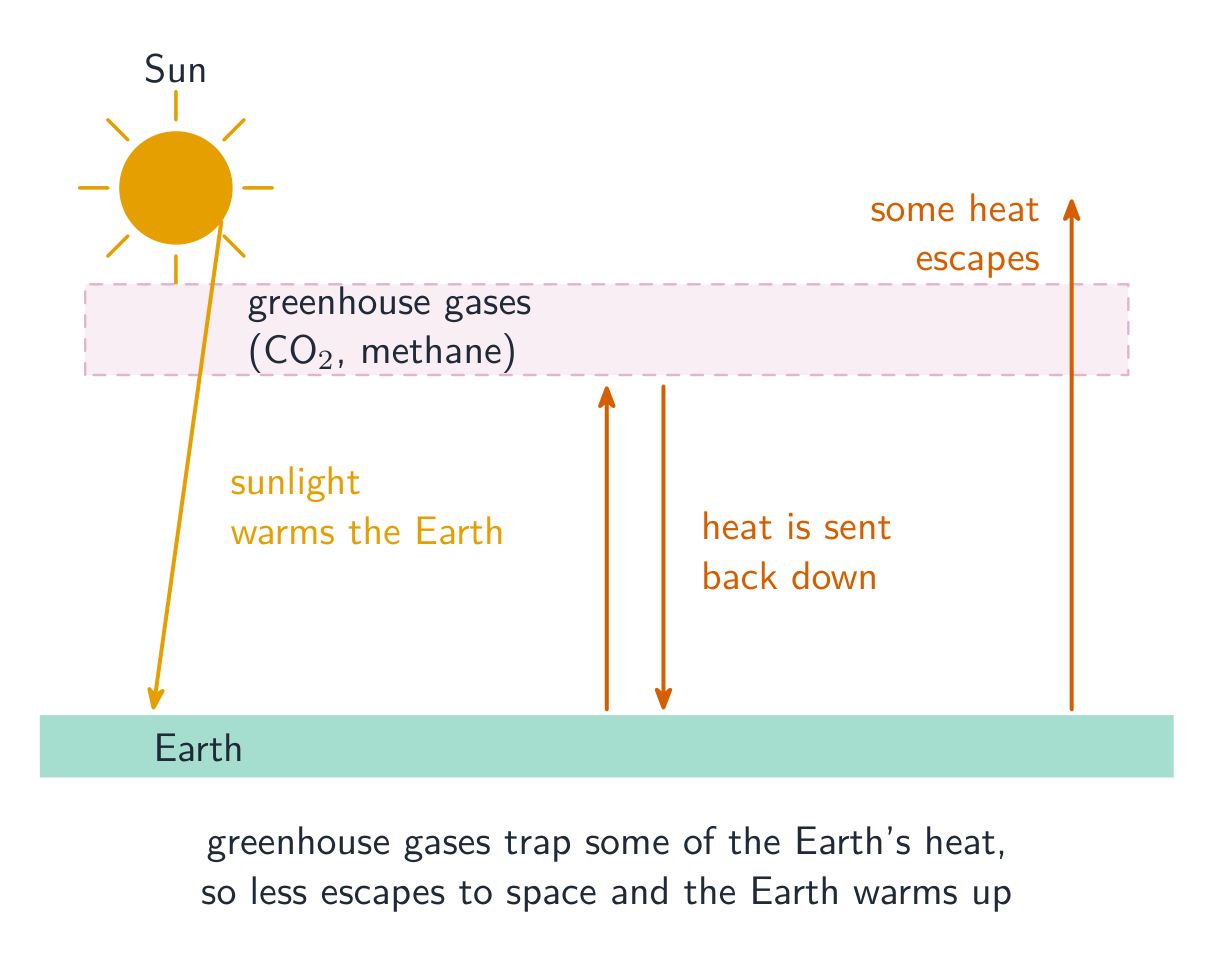
The greenhouse effect 温室效应 keeps Earth warm. Sunlight (mostly visible light) passes through the atmosphere and warms the surface. The warm surface gives off infrared (heat) radiation. Greenhouse gases 温室气体 absorb much of this infrared and send part of it back down. Without this natural effect, Earth's average surface temperature would be about −18 °C instead of about 15 °C – too cold for most life.
The principal greenhouse gases are carbon dioxide, methane, water vapour, nitrous oxide and CFCs. Water vapour is actually the most abundant greenhouse gas, but it does not drive climate change: it has a short residence time (about 9 days before it rains out), so its amount simply follows the temperature rather than setting it.
The problem is the enhanced greenhouse effect – humans adding extra long-lived gases that trap more heat, so the surface warms further.
Vocabulary
Train
| English |
|---|
| greenhouse effect/ˈɡriːnhaʊs ɪˈfekt/ |
| greenhouse gases/ˈɡriːnhaʊs ˈɡæsɪz/ |
9.4
Increases in the Greenhouse Gases
Syllabus
| Enduring Understanding | Learning Objective | Essential Knowledge |
|---|---|---|
STB-4 | STB-4.E |
|
Source: College Board AP Course and Exam Description
Human activities raise each greenhouse gas:
| Gas | Main human sources |
|---|---|
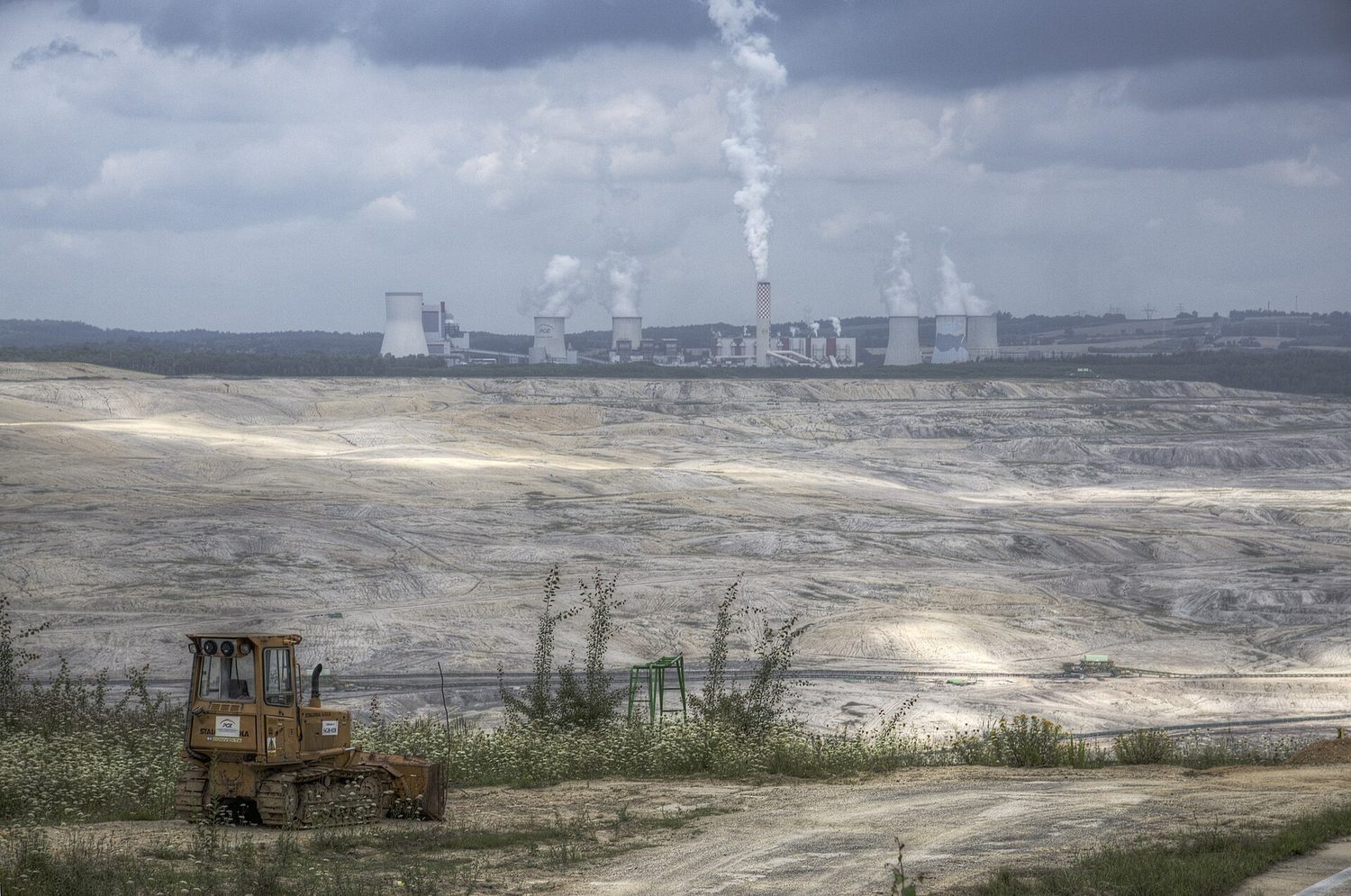
| $\text{CO}_2$ | burning fossil fuels (power plants, vehicles), cement making, deforestation |
| Methane 甲烷 ($\text{CH}_4$) | cattle and other livestock, landfills, rice paddies, leaks from natural gas wells and pipes, thawing permafrost |
| Nitrous oxide ($\text{N}_2\text{O}$) | nitrogen fertilizers on farms, animal manure, burning fuels |
| CFCs and HFCs | refrigerants, air conditioners, old aerosols and foams |
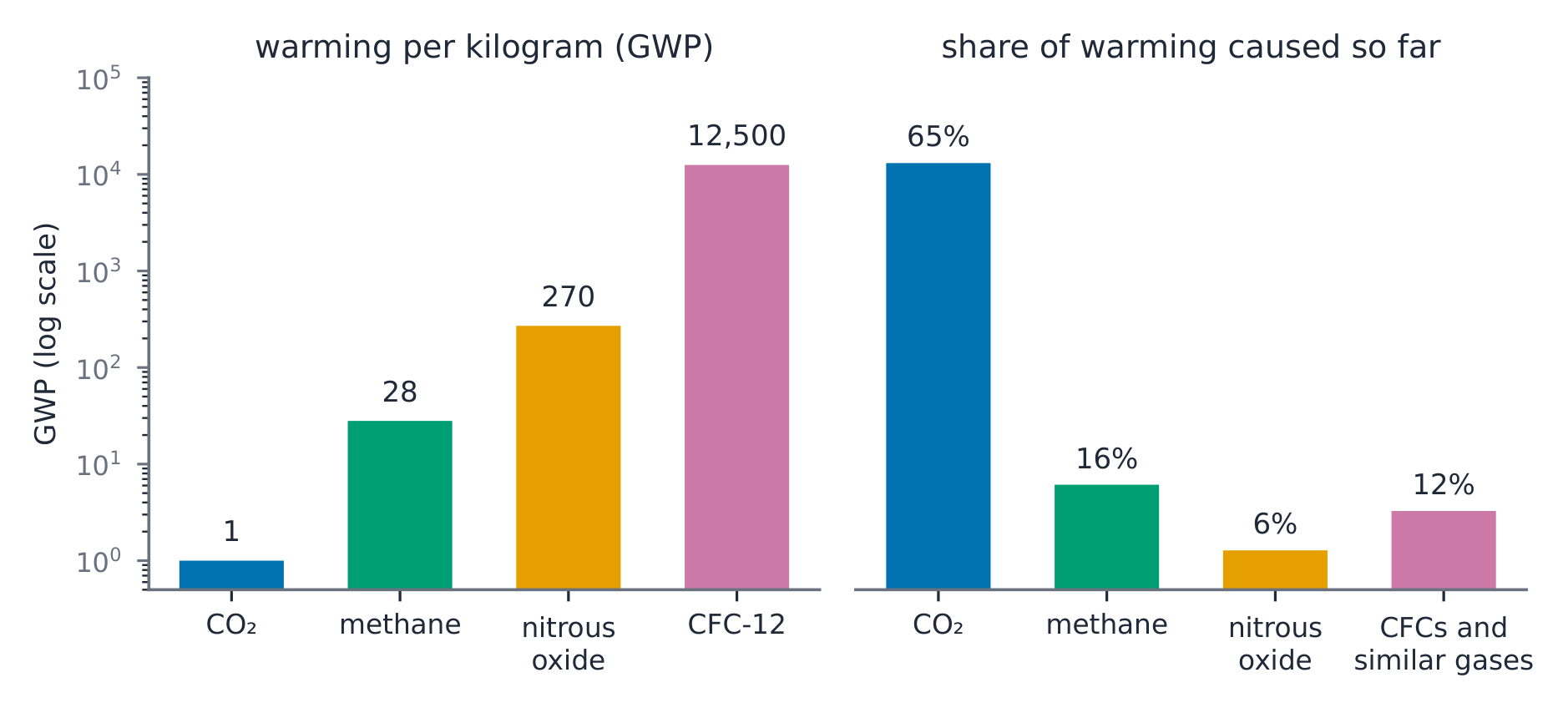
To compare gases fairly, we use global warming potential (GWP) 全球变暖潜能值 – how much heat one kilogram of a gas traps over a set time (usually 100 years), relative to $\text{CO}_2$. $\text{CO}_2$ is the reference, with GWP = 1, so every other gas is measured against it. Ranked by GWP: CFCs are highest, then nitrous oxide, then methane – all trap far more heat per molecule than $\text{CO}_2$.
But GWP alone does not decide impact: $\text{CO}_2$ still causes the most warming overall because it is released in vastly greater quantity and stays in the air for centuries. The exam expects both ideas – a high GWP and how much is emitted.
Worked example (CO₂ equivalent). A landfill releases 500 tonnes of methane a year. Methane's GWP is about 28. Its warming effect equals $500 \times 28 = 14\,000$ tonnes of $\text{CO}_2$ (14 000 t $\text{CO}_2$-equivalent). If the landfill captures the methane and burns it to make electricity, it releases about 1 375 t of $\text{CO}_2$ instead (each tonne of methane burns to 2.75 t of $\text{CO}_2$) – a cut of about 90% in warming effect, and useful energy.
Rising greenhouse gases threaten human health and the environment. Expect to explain:
- Rising sea levels, from melting ice sheets and the expansion of warming ocean water, which floods coasts and pushes salt water into farmland and aquifers.
- Disease vectors – carriers such as mosquitoes and ticks – spreading from the tropics toward the poles and to higher altitudes, bringing malaria, dengue and Lyme disease to new places.
- More frequent heat waves, droughts and heavy rainfall events.
Explore
Which greenhouse gas comes from each source?
Match each human activity to the greenhouse gas it mainly releases.
Vocabulary
Train
| English |
|---|
| methane/ˈmiːθeɪn/ |
| global warming potential (GWP)/ˈɡləʊbl ˈwɔːmɪŋ pəˈtenʃl/ |
9.5
Global Climate Change
Syllabus
| Enduring Understanding | Learning Objective | Essential Knowledge |
|---|---|---|
STB-4 | STB-4.F |
|
Source: College Board AP Course and Exam Description
Global climate change 气候变化 is the long-term shift in climate from the enhanced greenhouse effect: rising average temperatures, melting ice, rising sea levels 海平面, more extreme weather, and shifting rainfall.
Climate has always changed. Air bubbles trapped in ice cores from Antarctica record the atmosphere for the past 800 000 years. They show ice ages and warm periods rising and falling together with $\text{CO}_2$ – but $\text{CO}_2$ never went above about 300 ppm. Today it is over 420 ppm, and it has risen in about 150 years rather than thousands.
Worked example. Atmospheric $\text{CO}_2$ rose from about 280 ppm before industrialisation to about 420 ppm today. The percent increase is $\dfrac{420-280}{280}\times100\% = \dfrac{140}{280}\times100\% = 50\%$. This roughly 50% rise in the main long-lived greenhouse gas is the core driver of the enhanced greenhouse effect and modern warming.
Effects on Earth's systems.
- On land: rising temperatures, melting permafrost 永久冻土 and sea ice, rising sea levels and the displacement of coastal populations (people forced to move, such as from low Pacific islands and Bangladesh's delta).
- In the sea: rising sea level floods continental shelves, creating new shallow habitat for some species. But communities that were already deep may end up below the photic zone (the sunlit layer), so their algae and seagrass can no longer photosynthesize.
- In the air: winds carry heat from the equator toward the poles. Warming changes Hadley cells and the jet stream, shifting where deserts and rain belts lie and making weather patterns "stick" for longer.
- In the ocean: currents such as the ocean conveyor belt (thermohaline circulation) carry heat around the world. Fresh meltwater from Greenland can slow it, with big effects on coastal climates such as western Europe.
- In soil: more heat and changed rainfall dry out some soils and flood others, reducing fertility and increasing erosion.
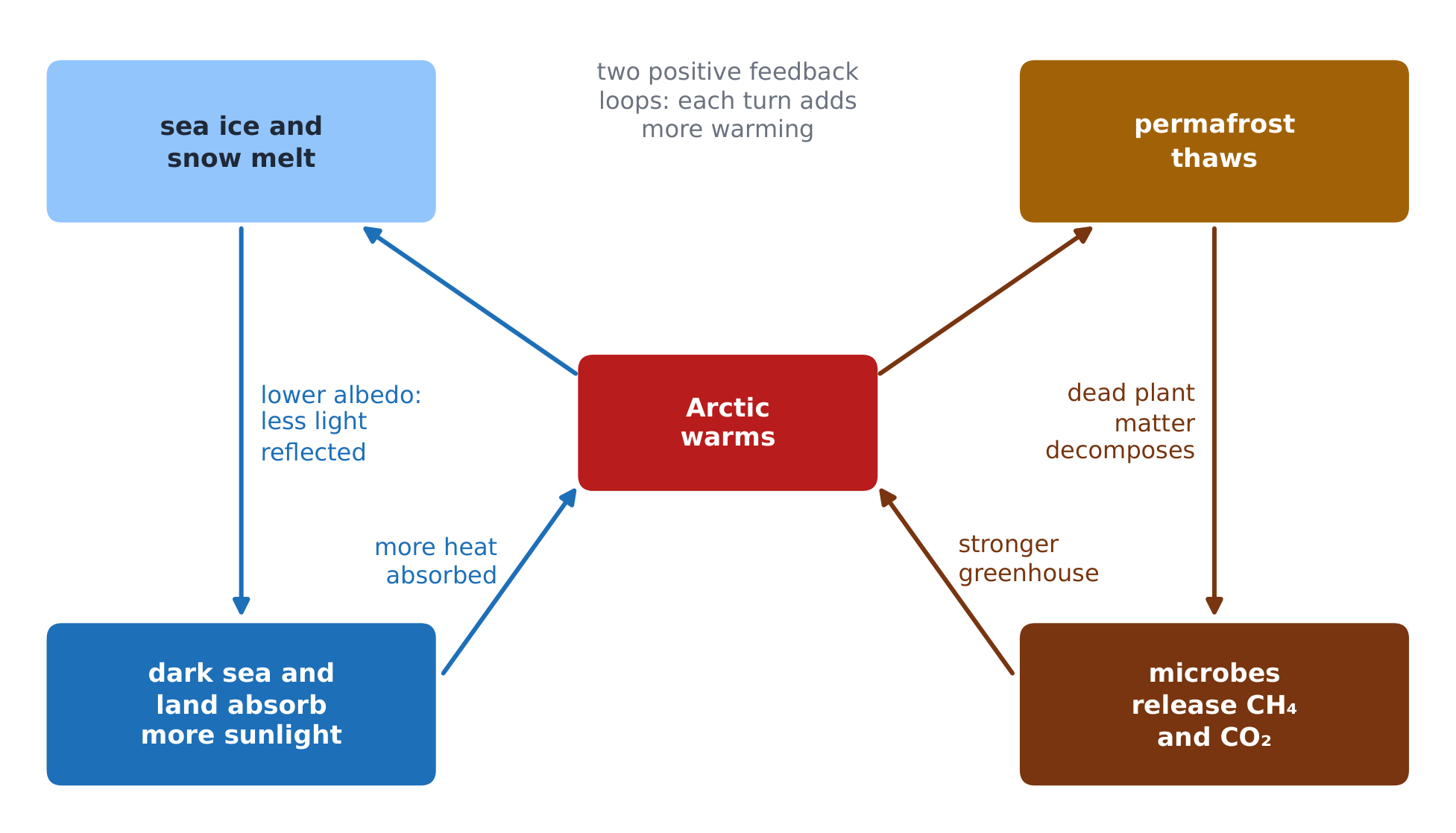
Why the poles warm fastest. Ice and snow reflect most sunlight back to space – they have a high albedo 反照率. Polar regions are warming two to four times faster than the global average because of positive feedback loops 正反馈:
- Ice–albedo loop: warming melts sea ice and snow → the darker ocean and land beneath absorb more sunlight → more warming → more melting.
- Permafrost loop: warming thaws the frozen tundra soil → microbes decompose the dead plant matter stored in it → methane and $\text{CO}_2$ are released → a stronger greenhouse effect → more warming.
Species that depend on ice lose habitat and food. Polar bears hunt seals from sea ice; walruses rest on it between dives; Arctic cod and the krill that many Antarctic animals eat live under it.
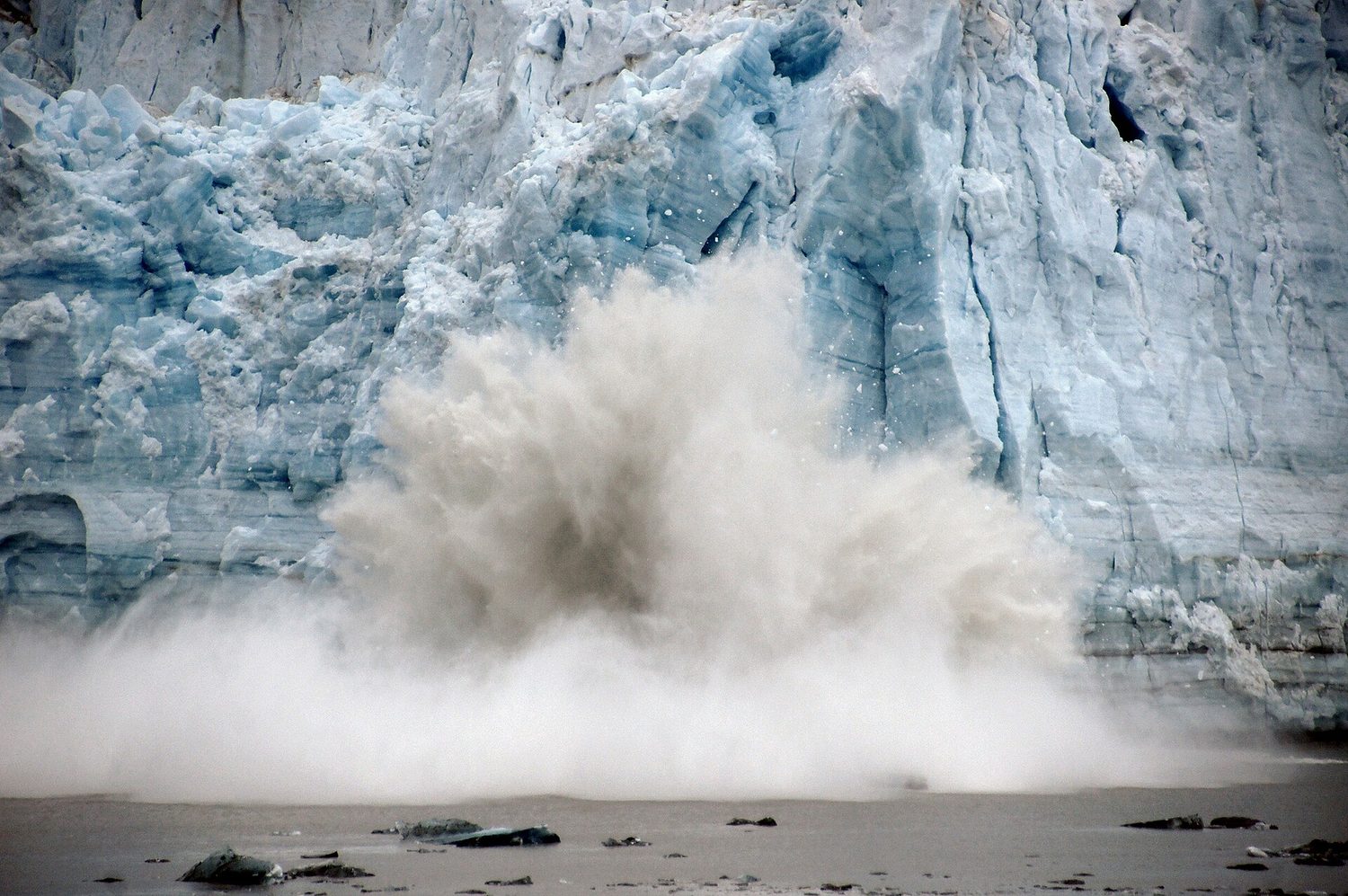
Protecting coasts from rising seas. Sea level rises for two reasons: water expands as it warms (thermal expansion), and melting ice on land, such as the Greenland and Antarctic ice sheets, adds water to the ocean. (Melting sea ice does not raise sea level much, because it was already floating.) Local ways to protect coastal communities:
- building sea walls and levees, or raising buildings and roads;
- restoring wetlands, mangroves and dunes, which absorb storm surges;
- managed retreat: moving homes and roads away from the most exposed coast, and banning new building there.
Rising seas also cost coastal towns money: flooded property, beach erosion that drives away tourists, and salt water getting into wells.
Explore
Cause or effect of climate change?
Sort each item into a cause of climate change or an effect of it.
Vocabulary
Train
| English |
|---|
| global climate change/ˈɡləʊbl ˈklaɪmət tʃeɪndʒ/ |
| sea levels/siː ˈlevlz/ |
| permafrost |
| albedo |
| positive feedback loops |
| glacier |
9.6
Ocean Warming
Syllabus
| Enduring Understanding | Learning Objective | Essential Knowledge |
|---|---|---|
STB-4 | STB-4.G |
|
Source: College Board AP Course and Exam Description
The oceans have absorbed more than 90% of the extra heat trapped by greenhouse gases. Ocean warming is caused by the rise in greenhouse gases, and it affects marine species in several ways:
- Habitat loss – species move toward the poles or into deeper water to stay cool; those that cannot move lose their range.
- Metabolic changes – cold-blooded animals use energy faster in warm water, while warm water holds less dissolved oxygen. Fish need more oxygen just when less is available.
- Reproductive changes – spawning and migration timing shifts; in sea turtles, warmer sand produces more females.
- Thermal expansion – warm water takes up more space, which accounts for about a third of sea-level rise so far.
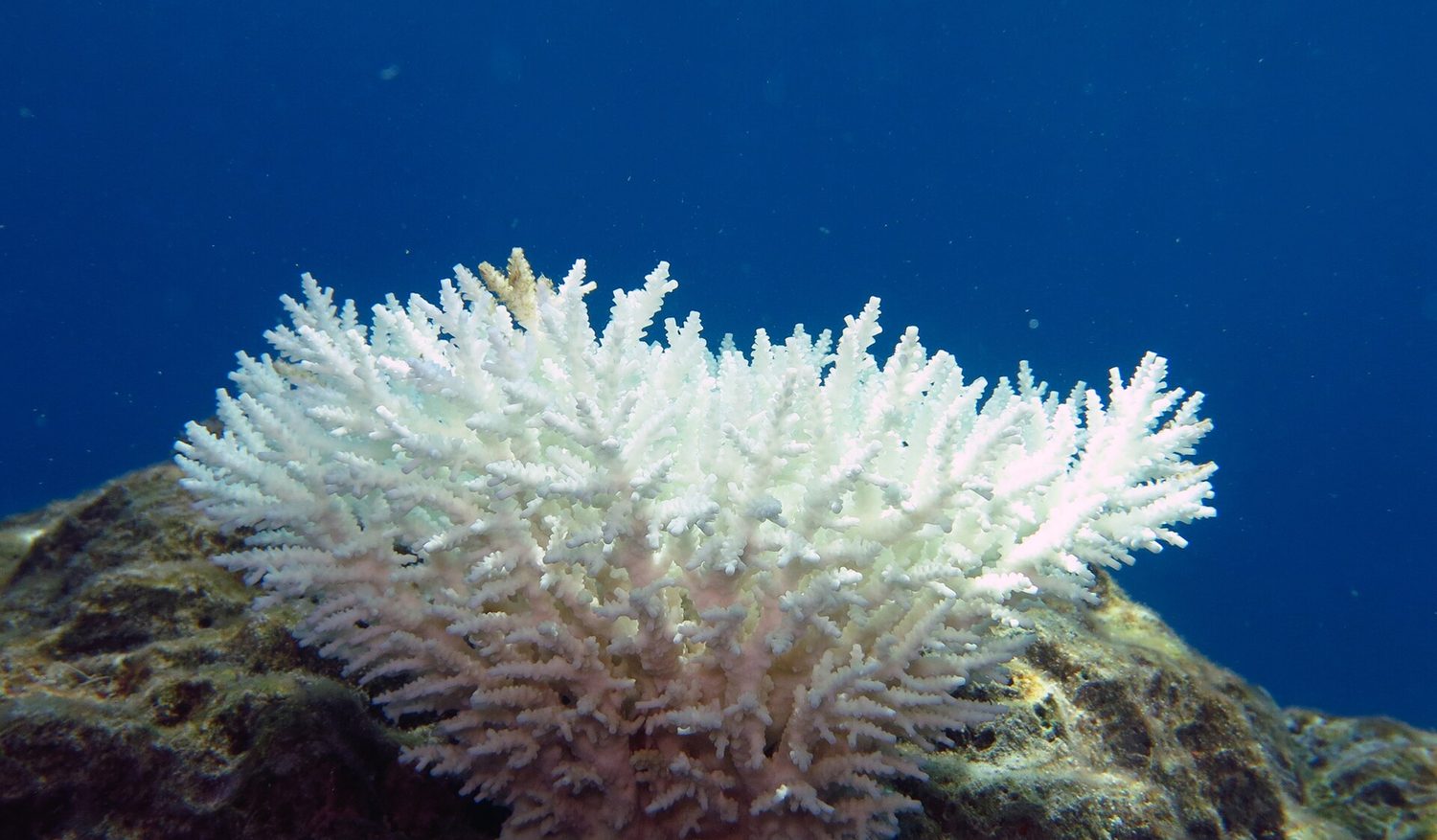
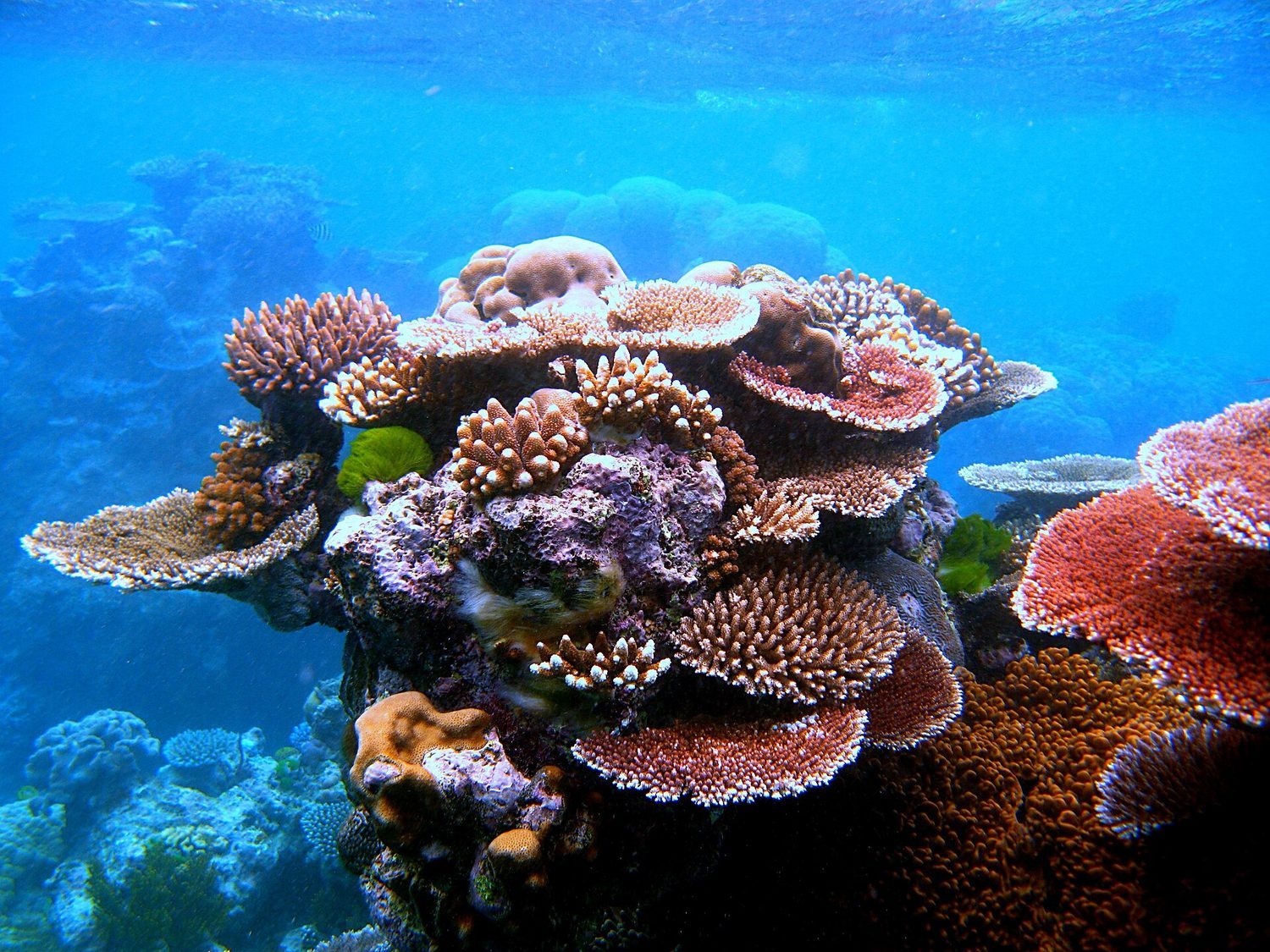
Coral bleaching 珊瑚白化 happens when water stays even 1–2 °C above the normal summer maximum for a few weeks. The corals expel the algae (zooxanthellae) living in their tissues. These algae give corals their colour and most of their food, so the coral turns white and starts to starve. If the water cools in time, some corals take algae back in and recover; if the heat lasts, they die.
Vocabulary
Train
| English |
|---|
| coral bleaching/ˈkɒrəl ˈbliːtʃɪŋ/ |
9.7
Ocean Acidification
Syllabus
| Enduring Understanding | Learning Objective | Essential Knowledge |
|---|---|---|
STB-4 | STB-4.H |
|
Source: College Board AP Course and Exam Description
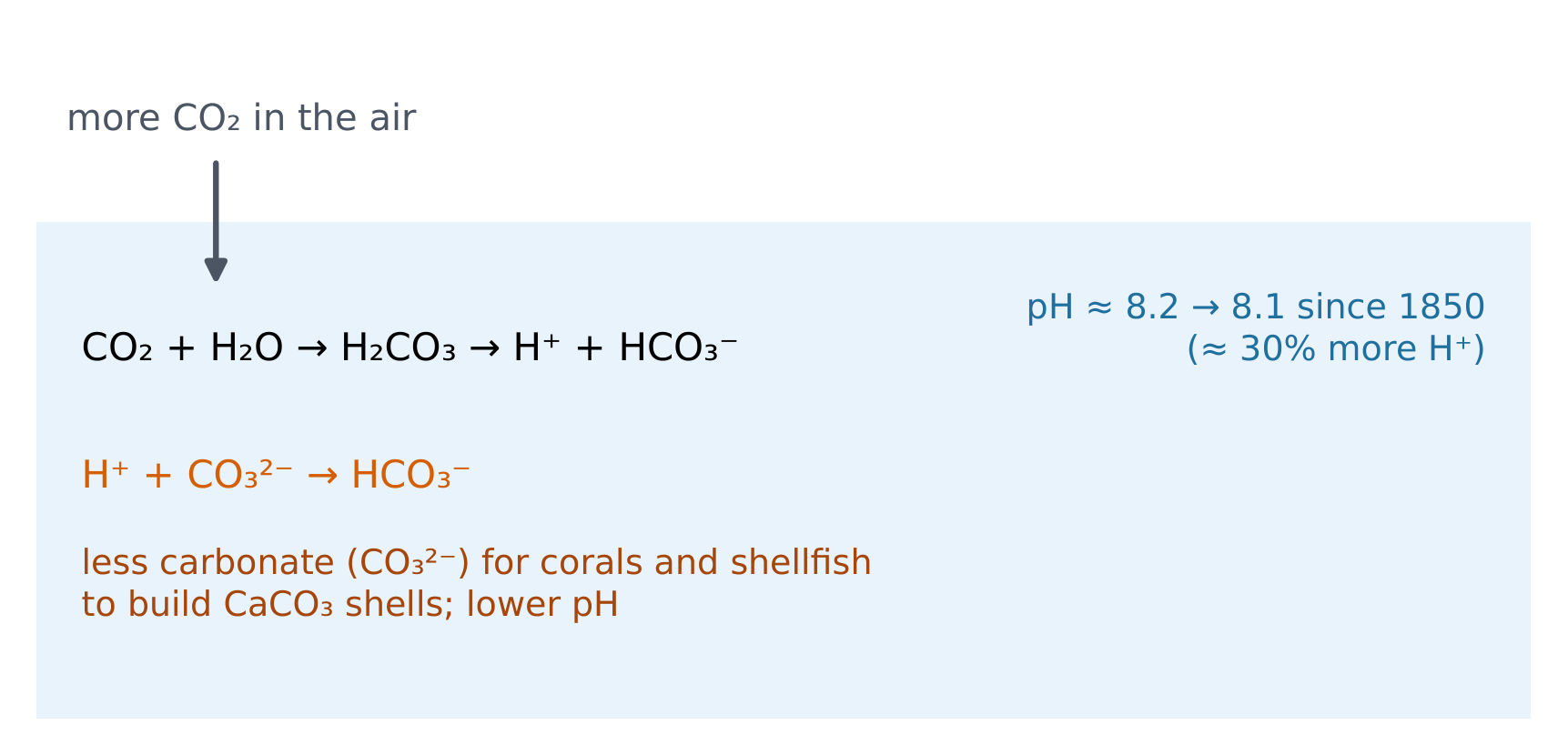
The ocean absorbs about a quarter of the $\text{CO}_2$ we release. Dissolved $\text{CO}_2$ reacts with water to form carbonic acid, which releases hydrogen ions – ocean acidification 海洋酸化, a fall in the ocean's pH:
$$\text{CO}_2 + \text{H}_2\text{O} \rightleftharpoons \text{H}_2\text{CO}_3 \rightleftharpoons \text{H}^+ + \text{HCO}_3^-$$
The extra $\text{H}^+$ ions then combine with carbonate ions that shell-builders need:
$$\text{H}^+ + \text{CO}_3^{2-} \rightarrow \text{HCO}_3^-$$
With less carbonate available, corals, oysters, clams, sea snails and some plankton find it harder to build calcium carbonate 碳酸钙 ($\text{CaCO}_3$) shells and skeletons, and in more acidic water existing shells can start to dissolve. Because plankton and shellfish sit near the base of marine food webs, the damage spreads upward to fish, seabirds and people who depend on fisheries.
The human activities behind ocean acidification are the same ones that raise atmospheric $\text{CO}_2$: burning fossil fuels, vehicle emissions and deforestation.
Worked example (pH). Average ocean surface pH has fallen from about 8.2 to about 8.1 since the 1800s. The pH scale is logarithmic: each drop of 1 unit means 10 times more $\text{H}^+$. A drop of 0.1 means $10^{0.1} \approx 1.26$ times as much $\text{H}^+$ – about 26% more acidic, even though the number changed only a little. (With the more exact values, 8.18 to 8.07, scientists quote about 30%.)
Explore
How the ocean acidifies
Oceans absorb CO$_2$, which forms carbonic acid and lowers seawater pH. Even a small drop is a big rise in acidity (the scale is logarithmic) and harms shell-builders.
Vocabulary
Train
| English |
|---|
| ocean acidification/ˈəʊʃn əˌsɪdɪfɪˈkeɪʃn/ |
| calcium carbonate/ˈkælsɪəm ˈkɑːbəneɪt/ |
9.8
Invasive Species
Syllabus
| Enduring Understanding | Learning Objective | Essential Knowledge |
|---|---|---|
EIN-4 | EIN-4.A |
|
Source: College Board AP Course and Exam Description
An invasive species 入侵物种 is a non-native species that lives, and often thrives, outside its normal range and threatens native species. Not every introduced species is invasive – many crops and garden plants cause no harm, and some introduced species are beneficial. Invasive species are often generalists and r-selected (they mature fast and have many offspring), so with no natural predators or diseases in their new home, they outcompete natives for resources.
| Species | How it arrived | Harm |
|---|---|---|
| Zebra mussels | in ships' ballast water into the Great Lakes | cover native mussels, clog water-intake pipes, filter out plankton that native fish need |
| Asian carp | brought to fish farms in the southern US to eat algae; escaped in floods | eat huge amounts of plankton, outcompete native fish, spread up the Mississippi |
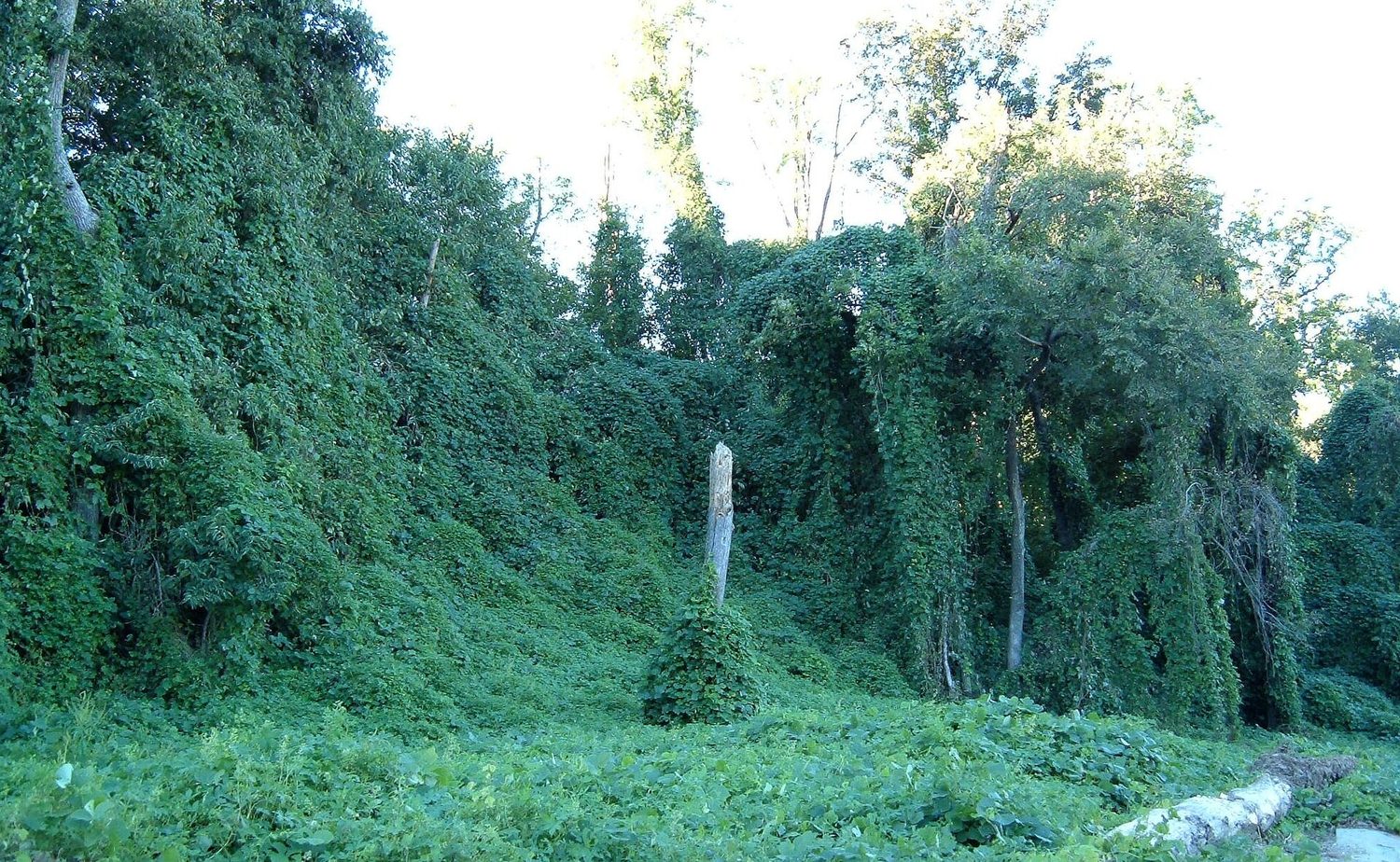
| Kudzu | planted in the US to control erosion | grows up to 30 cm a day and smothers trees |
| Burmese pythons | released or escaped pets in Florida | have eaten most of the small mammals in parts of the Everglades |
| Brown tree snake | stowaway on cargo planes to Guam | wiped out most of the island's native forest birds |
Invasive species can be controlled through human interventions:
- Prevention (cheapest): inspecting cargo and luggage, laws requiring ships to exchange or treat ballast water, banning the sale of risky pets and plants, cleaning boats between lakes.
- Early detection and rapid removal before a population spreads.
- Physical removal: trapping, hunting, pulling or cutting plants, electric barriers in rivers (used against Asian carp near Chicago).
- Biological control: introducing a natural predator or disease from the invader's home range – which must be tested carefully, since the new species could become invasive itself (cane toads in Australia).
- Chemical control: herbicides and pesticides, which can also harm non-target species.
Explore
Native or invasive?
Sort each example into a native species or an invasive one.
Vocabulary
Train
| English |
|---|
| invasive species/ɪnˈveɪsɪv ˈspiːsiːz/ |
9.9
Endangered Species
Syllabus
| Enduring Understanding | Learning Objective | Essential Knowledge |
|---|---|---|
EIN-4 | EIN-4.B |
|
Source: College Board AP Course and Exam Description
An endangered species 濒危物种 is at risk of extinction. A species is more likely to become endangered if it:
- is extensively hunted or poached (for meat, ivory, horn, fur, or the pet trade);
- has a limited diet (the giant panda and bamboo) or specific and limited habitat requirements (a specialist);
- is outcompeted by invasive species;
- has a low reproductive rate and large body size (K-selected – elephants, whales, rhinos).
Not every species is equally at risk when the same change hits its ecosystem. Species that can adapt to the change, or move to a new environment, are less likely to go extinct. Any factor that changes the behaviour and fitness (survival and reproduction) of organisms is a selective pressure 选择压力. Competition between species for territory, food, mates and habitat is also a selective pressure, and when resources shrink it can push the weaker competitor toward extinction.
Strategies to protect animal populations:
- Criminalizing poaching and enforcing the law (anti-poaching patrols, bans on ivory sales).
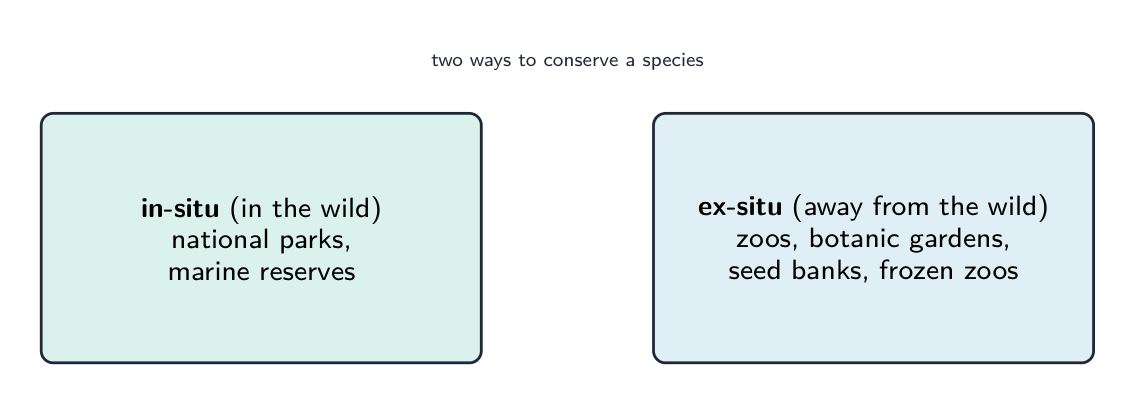
- Protecting habitats (national parks, marine reserves, wildlife refuges).
- Legislation: the US Endangered Species Act (1973) lists threatened and endangered species and protects their critical habitat; CITES is an international treaty that controls trade in endangered species and their products.
- Captive breeding and reintroduction (California condors, black-footed ferrets).
- Reducing accidental deaths: North Atlantic right whales die mainly from ship strikes and tangling in fishing gear, so ships are made to slow down in whale areas, shipping lanes are moved, and fishing ropes are designed to break.
Worked example (percent loss). Africa had about 1.3 million elephants in 1970 and about 0.6 million in 2000.
- Percent change $= \dfrac{0.6 - 1.3}{1.3} \times 100 \approx -54\%$.
- So about 54% of the elephants were lost in 30 years.
Why amphibians are declining. Amphibians are falling fast worldwide, not only from deforestation. Their thin, permeable skin absorbs pollutants such as pesticides; the fungal disease chytridiomycosis, spread by the international trade in frogs, has wiped out many species; and climate change dries the ponds they breed in. Because they live both in water and on land, they are exposed to problems in both.
Example – piping plovers. These small shorebirds nest on open sandy beaches. They were nearly hunted to extinction for hat feathers around 1900, recovered after a law protected them, and are now threatened again by beach development, vehicles and people on nesting beaches, and predators drawn by human food waste. Fencing nest sites and closing parts of beaches during nesting season has helped some populations grow.
Explore
A population under pressure
When deaths outpace births, a population falls toward extinction. Below a critical size, low genetic diversity and chance events make recovery harder.
Vocabulary
Train
| English |
|---|
| endangered species/enˈdeɪndʒəd ˈspiːsiːz/ |
| selective pressure |
9.10
Human Impacts on Biodiversity
Syllabus
| Enduring Understanding | Learning Objective | Essential Knowledge |
|---|---|---|
EIN-4 | EIN-4.C |
|
Source: College Board AP Course and Exam Description
Together, human pressures are driving a rapid loss of biodiversity – extinction rates are now hundreds of times the natural background rate, and some scientists call it a sixth mass extinction. The main causes are summarized as HIPPCO:
- Habitat destruction
- Invasive species
- Population growth (human)
- Pollution
- Climate change
- Overexploitation (overhunting, overfishing, overharvesting)
A specific and heavily-tested driver is habitat fragmentation 栖息地破碎化: large continuous habitats are broken into smaller, isolated patches by roads and pipelines, clearing for agriculture or development, and logging. Fragmentation is worse than simple area loss, because the small patches cut populations off from each other, reduce genetic diversity, and expose more edge to predators, invasive species, wind and drying. The scale that causes harm varies from species to species: a road that a beetle cannot cross may mean nothing to a hawk, while a forest patch large enough for a squirrel population is far too small for a bear or a jaguar.
Climate change causes habitat loss through changes in temperature, precipitation and sea-level rise – for example, mountain species pushed uphill until no higher ground is left, and coastal marshes drowned by rising seas.
Domestication reduces biodiversity too. Honeybee colonies and livestock are bred for a few useful traits, so they have low genetic diversity, and one disease or pest can spread through them quickly. Managed honeybees can also outcompete wild native bees for flowers.
Ways humans can reduce biodiversity loss:
- Creating protected areas – national parks, wildlife refuges and marine reserves.
- Habitat corridors – strips of habitat, or bridges and tunnels for wildlife, that link fragments so animals can move and breed.
- Sustainable land use – selective logging instead of clear-cutting, agroforestry, and building housing in compact areas rather than spreading it out.
- Restoring lost habitats – replanting forests, restoring wetlands, removing old dams.
Worked example (FRQ style). Populations of large animals such as African elephants and snow leopards are declining. Identify one human activity responsible and propose one solution. Activity: habitat fragmentation from farming and road building cuts the large territories these animals need into small patches, so they cannot find enough food or mates. Solution: create protected areas linked by habitat corridors, so animals can move between patches safely; this keeps populations large enough to breed and keeps genetic variety flowing. (Poaching with an anti-poaching law is another valid pair.)
Explore
Reduces or protects biodiversity?
Sort each human action by whether it reduces biodiversity or helps protect it.
Vocabulary
Train
| English |
|---|
| habitat fragmentation/ˈhæbɪtæt ˌfræɡmənˈteɪʃn/ |
9.10
Practice
Answer each before reading the answers below.
- Explain how CFCs destroy stratospheric ozone, and name the agreement that phased them out.
- Methane has a global warming potential of about $28$. What does that mean?
- Write the reaction that acidifies the ocean, and explain how it affects corals and shellfish.
- Atmospheric $\text{CO}_2$ rose from $280$ ppm before industrialization to about $420$ ppm. Calculate the percent increase.
- Give two causes of sea-level rise.
- Name two traits that make a species likely to become invasive.
9.10
Answers
- UV light breaks CFCs, releasing chlorine atoms; each Cl atom catalytically breaks down thousands of ozone molecules. The Montreal Protocol (1987).
- Over $100$ years, $1$ kg of methane traps about $28$ times as much heat as $1$ kg of $\text{CO}_2$.
- $\text{CO}_2 + \text{H}_2\text{O} \rightarrow \text{H}_2\text{CO}_3 \rightarrow \text{H}^+ + \text{HCO}_3^-$. The extra $\text{H}^+$ reduces carbonate ions, so corals and shellfish struggle to build calcium carbonate shells and skeletons.
- $\dfrac{420 - 280}{280} \times 100 = 50\%$.
- Thermal expansion of warming seawater, and melting of land ice (glaciers and ice sheets).
- Any two: generalist; r-selected (fast reproduction); tolerant of many conditions; no predators in the new habitat.
9.10
Exam tips
- Keep ozone depletion (CFCs → chlorine → less ozone → more UV → skin cancer, cataracts) and climate change (greenhouse gases trap more heat) as two different problems.
- Name a natural factor in the ozone hole: ice crystals in polar stratospheric clouds melting in the Antarctic spring.
- HFCs do not harm ozone but are strong greenhouse gases.
- GWP: CFCs > nitrous oxide > methane > $\text{CO}_2$ (= 1). $\text{CO}_2$ causes the most warming because of its quantity. Water vapour does not drive climate change: its residence time is short.
- Explain a polar positive feedback loop step by step (ice melts → lower albedo → more absorption → more warming).
- Ocean acidification: $\text{CO}_2$ + water → carbonic acid → $\text{H}^+$ → less carbonate → weaker shells. Its causes are fossil fuels, vehicles and deforestation.
- Invasive species are often generalist, r-selected species with no natural predators; give a control method and its drawback.
- Summarise threats to biodiversity with HIPPCO (Habitat destruction, Invasive species, Population growth, Pollution, Climate change, Overexploitation).
- Solutions to biodiversity loss: protected areas, habitat corridors, sustainable land use, habitat restoration.
Interactive lessons on this topic
Work through it step by step, with instant-check exercises.