| Enduring Understanding | Learning Objective | Essential Knowledge |
|---|---|---|
STB-2 | STB-2.A |
|
Atmospheric Pollution
AP Environmental Science · Topic 7
 8:02
Atmospheric Pollution
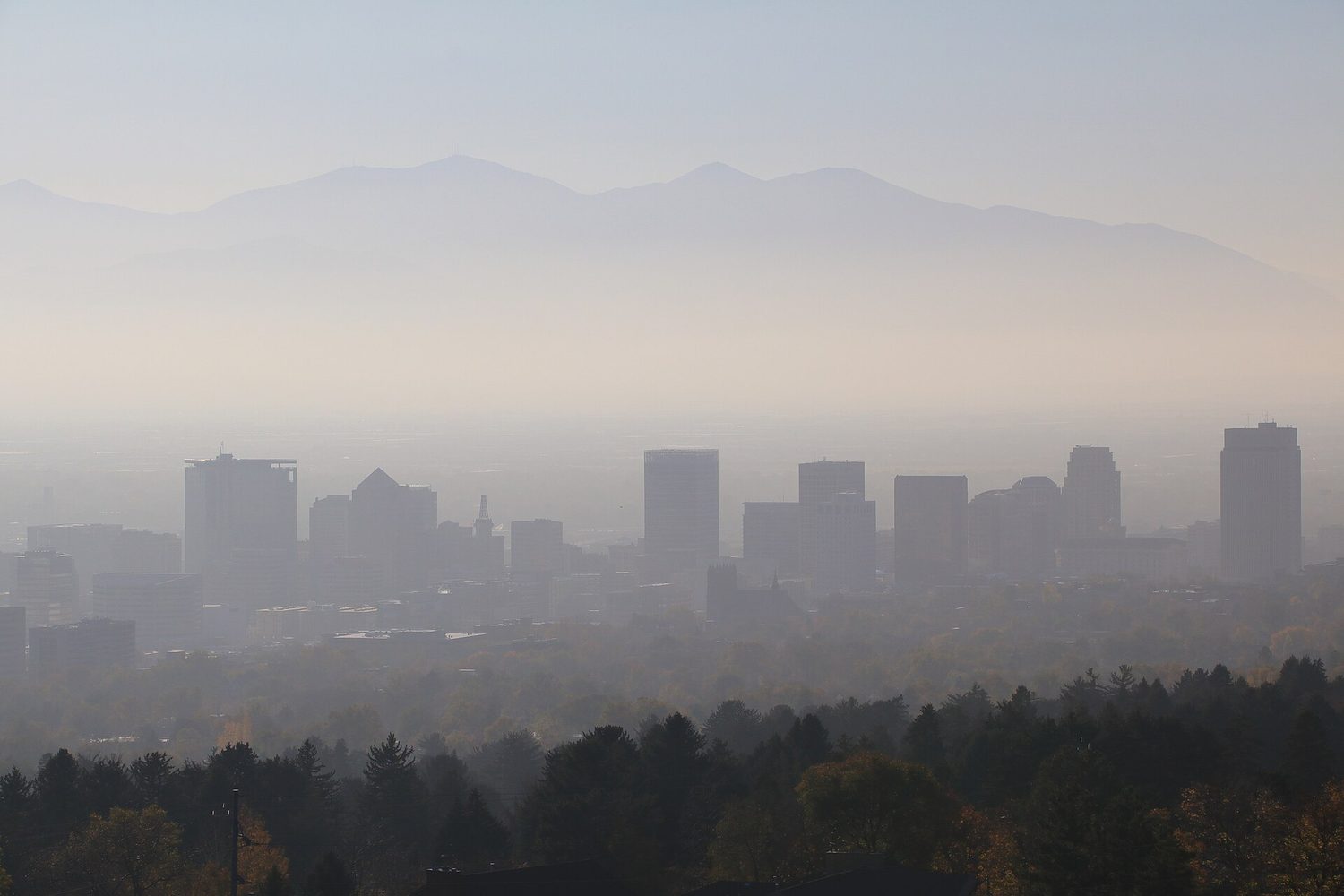
Look at this city. You cannot see the buildings, because you can see the air. Now step inside a kitchen, where one cooking fire fills the room with smoke. Now…
English narration · English + 中文 subtitles burned in
7.1
Introduction to Air Pollution
Syllabus
Source: College Board AP Course and Exam Description
In December 1952 a cold, windless fog settled over London. Smoke from millions of coal fires could not escape, and for five days people could not see their own feet. About 4000 people died that week, and thousands more in the months after. The "Great Smog" led to Britain's Clean Air Act of 1956. This unit explains what was in that air, why it stayed near the ground, and how laws and technology now clean it.
Air pollution 空气污染 is any substance in the atmosphere at a level that harms living things or materials. AP questions ask you to name a pollutant, its source and its effect, so learn them as a set.
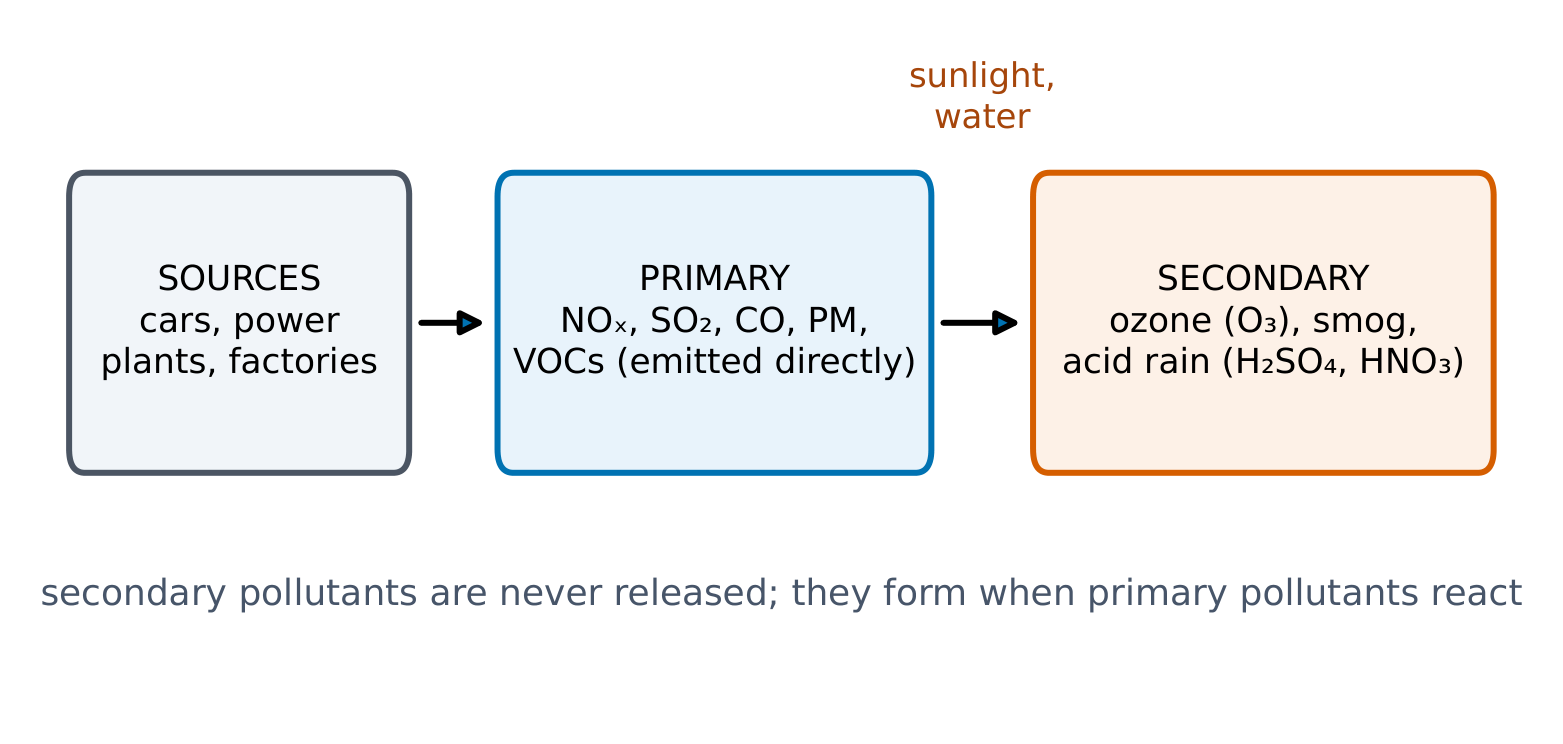
Primary pollutants 一次污染物 are emitted directly from a source. Secondary pollutants 二次污染物 are not emitted; they form in the air when primary pollutants react with each other, with water or with sunlight.
Most outdoor air pollution comes from combustion 燃烧 (burning) of fossil fuels:
| Pollutant | Main human source | Main effect |
|---|---|---|
| Carbon dioxide ($\text{CO}_2$) | all fossil-fuel burning | greenhouse gas: climate change |
| Sulfur dioxide ($\text{SO}_2$) | coal burning; diesel fuel | acid rain; breathing problems |
| Nitrogen oxides ($\text{NO}_x$) | vehicle engines; power plants | smog, ozone and acid rain |
| Carbon monoxide (CO) | incomplete combustion in engines and stoves | stops blood carrying oxygen |
| Particulates (PM) | coal burning, diesel, wood fires | lung and heart disease; haze |
| Hydrocarbons and VOCs | unburned fuel, fuel evaporating | help make smog |
| Toxic metals (mercury, lead) | coal burning; old leaded fuel | damage nerves and brains |
Coal is the dirtiest fuel: it releases $\text{CO}_2$, $\text{SO}_2$ (from sulfur in the coal), particulates and toxic metals such as mercury. Nitrogen oxides form in any very hot flame, because the heat makes nitrogen and oxygen from the air combine.
Lead 铅 is a success story. Lead was once added to gasoline. Under the Clean Air Act 清洁空气法, the US Environmental Protection Agency (EPA) phased lead out of fuel, and lead in US air fell by more than 90%.
Worked example (percent change). In one national park the visibility was 25 miles in 1990 and 45 miles in 2015. Find the percent change.
$$\text{percent change} = \frac{\text{new} - \text{old}}{\text{old}} \times 100 = \frac{45 - 25}{25} \times 100 = +80\%$$
Always subtract old from new, divide by the old value, and keep the sign: a fall gives a negative answer.
Explore
Primary or secondary pollutant?
Sort each pollutant by whether it is emitted directly or forms later in the air.
Vocabulary
Train
| English |
|---|
| Air pollution/eə pəˈluːʃn/ |
| Primary pollutants/ˈpraɪməri pəˈluːtənts/ |
| secondary pollutants/ˈsekəndəri pəˈluːtənts/ |
| combustion/kəmˈbʌstʃn/ |
| lead/liːd/ |
| Clean Air Act |
7.2
Photochemical Smog
Syllabus
| Enduring Understanding | Learning Objective | Essential Knowledge |
|---|---|---|
STB-2 | STB-2.B |
|
Source: College Board AP Course and Exam Description
Photochemical smog 光化学烟雾 is a brown haze that forms when nitrogen oxides and volatile organic compounds 挥发性有机化合物 (VOCs) react in sunlight and heat. Its main harmful product is ground-level ozone 臭氧 ($\text{O}_3$), a secondary pollutant.
The chemistry follows the clock:
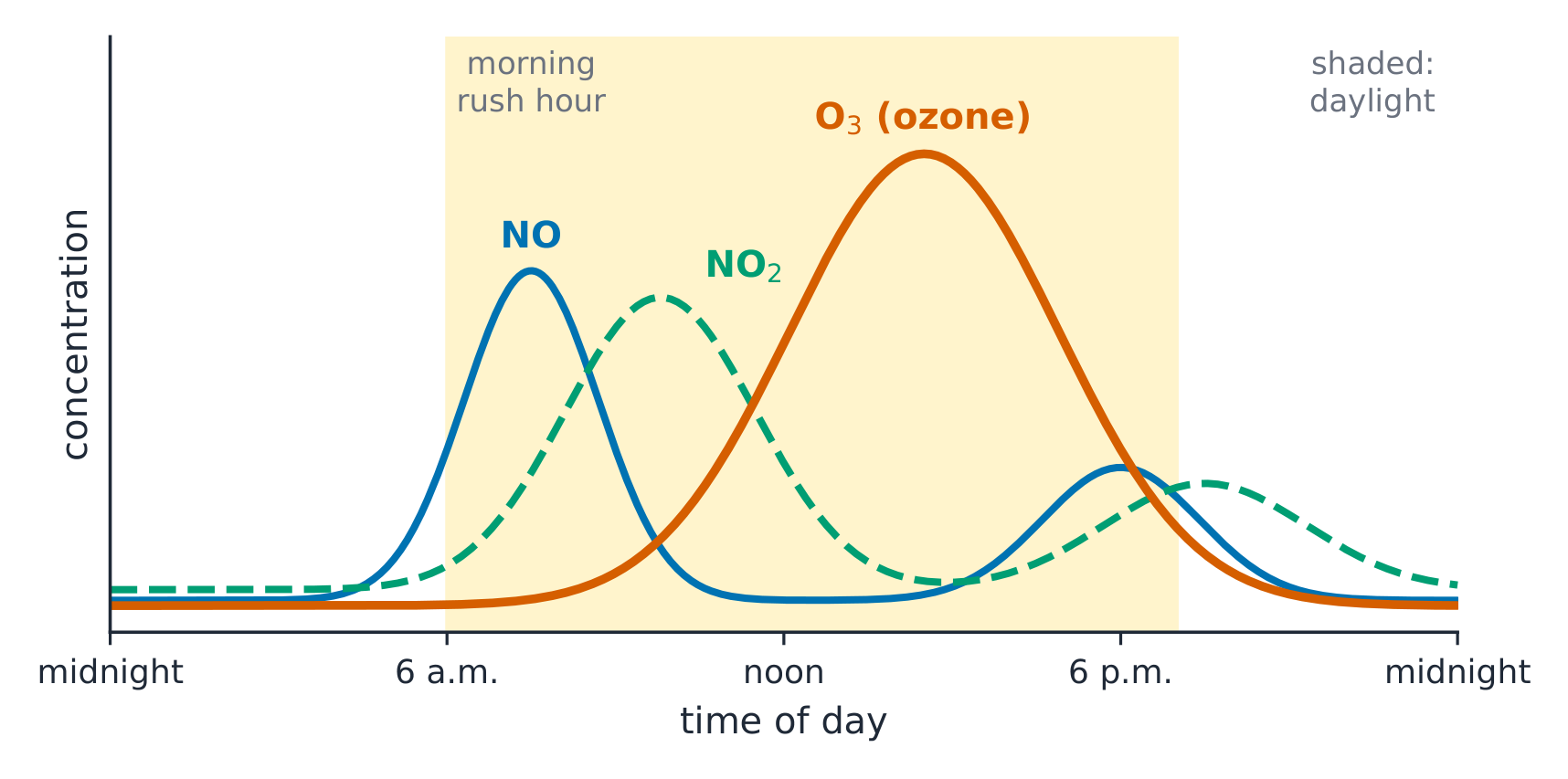
- Morning rush hour. Car engines emit nitrogen monoxide (NO) and VOCs.
- Mid-morning. NO reacts with oxygen to make nitrogen dioxide ($\text{NO}_2$), a brown gas.
- Afternoon. Sunlight splits $\text{NO}_2$ into NO and a single oxygen atom (O). That atom joins an $\text{O}_2$ molecule to make ozone. Ozone peaks in mid-afternoon, when sunlight is strongest.
- Evening. Without sunlight, ozone is not made, and NO destroys some of it.
$$\text{NO}_2 \xrightarrow{\text{sunlight}} \text{NO} + \text{O} \qquad \text{O} + \text{O}_2 \rightarrow \text{O}_3$$
VOCs make things worse: they react with NO, so NO cannot break down the ozone, and ozone builds up.
Conditions that favour smog: many cars (cities), strong sunlight and high temperatures (summer), little wind, and land shapes such as valleys that hold air still. VOCs come from gasoline, paints and solvents, and also naturally from trees.
Effects: ozone irritates the eyes and lungs and makes asthma worse. It also damages plant leaves, lowering crop yields and slowing forest growth.
Reducing smog: cut $\text{NO}_x$ and VOCs, for example with catalytic converters, vapor recovery nozzles at gas pumps, public transport, and electric vehicles.
Worked example (explain a graph). "Explain why ozone peaks after nitrogen dioxide." Ozone is made when sunlight splits $\text{NO}_2$. $\text{NO}_2$ builds up first, from morning traffic. Ozone needs both that $\text{NO}_2$ and strong sunlight, so its peak comes later, in the afternoon.
Vocabulary
Train
| English |
|---|
| Photochemical smog/ˌfəʊtəʊˈkemɪkl smɒɡ/ |
| ozone/ˈəʊzəʊn/ |
| volatile organic compounds/ˈvɒlətaɪl ɔːˈɡænɪk ˈkɒmpaʊndz/ |
7.3
Thermal Inversion
Syllabus
| Enduring Understanding | Learning Objective | Essential Knowledge |
|---|---|---|
STB-2 | STB-2.C |
|
Source: College Board AP Course and Exam Description
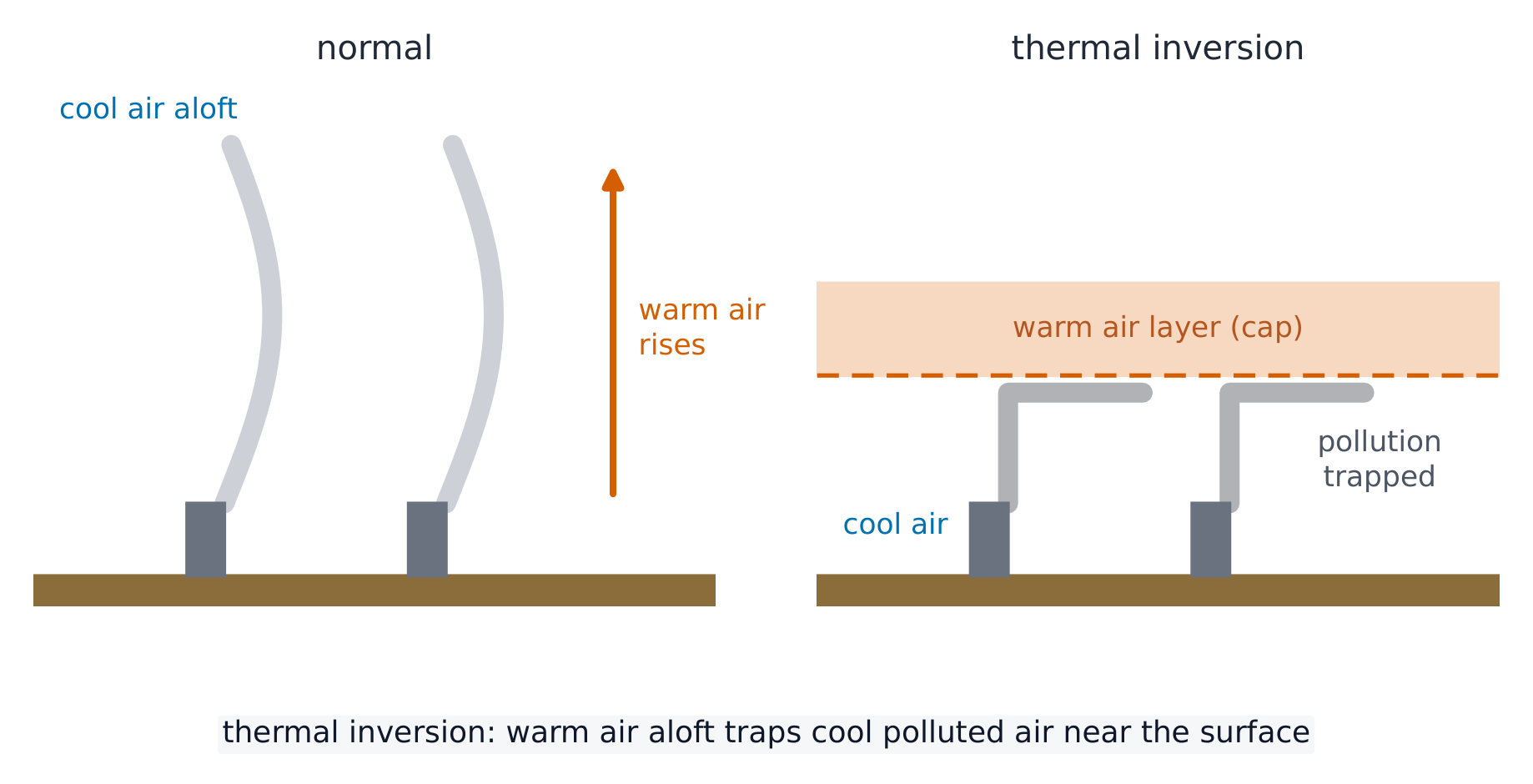
Normally the air is warmest at the ground and gets cooler with height (about 6.5 °C cooler per kilometre). Warm air near the ground is less dense, so it rises, carrying pollutants up and mixing them into a large volume of air.
In a thermal inversion 逆温, a layer of warm air sits above cooler air near the ground. The cool surface air is denser than the warm layer above it, so it cannot rise. The warm layer acts like a lid, and pollutants (especially smog and particulates) build up underneath.
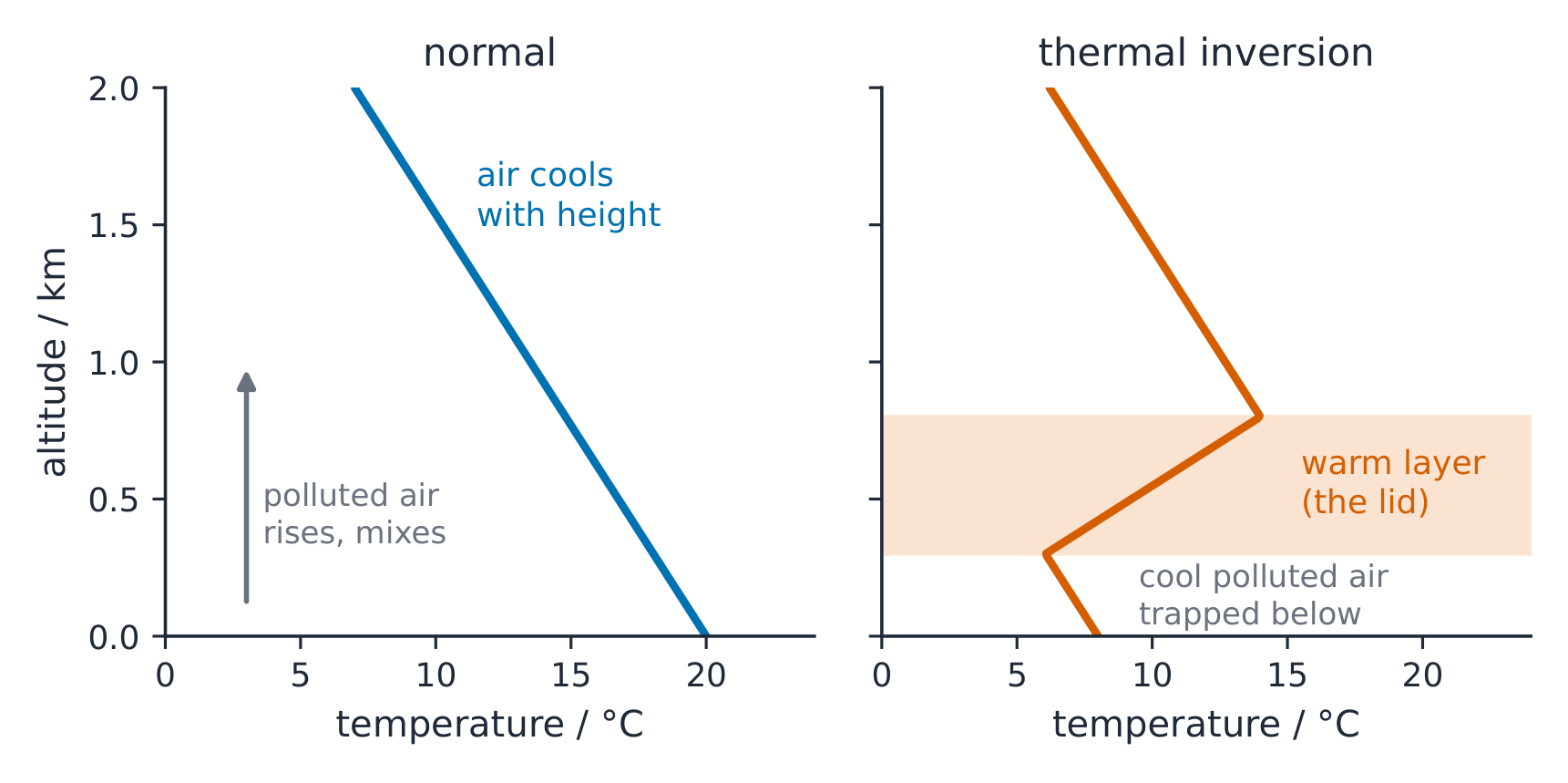
Inversions are common on clear, calm winter nights, when the ground loses heat fast and cools the air touching it. They are also common in valleys and in coastal cities such as Los Angeles, where cool sea air slides under warmer air. The London smog of 1952 was trapped by an inversion. An inversion does not make new pollution; it stops existing pollution from spreading out, so concentrations rise.
Vocabulary
Train
| English |
|---|
| thermal inversion/ˈθɜːml ɪnˈvɜːʃn/ |
7.4
Atmospheric CO2 and Particulates
Syllabus
| Enduring Understanding | Learning Objective | Essential Knowledge |
|---|---|---|
STB-2 | STB-2.D |
|
Source: College Board AP Course and Exam Description
Carbon dioxide and particulates have natural sources as well as human ones. AP questions often ask you to name one of each.
- Natural $\text{CO}_2$: respiration by living things, decomposition 分解 of dead matter, volcanic eruptions and natural forest fires.
- Human $\text{CO}_2$: burning fossil fuels and clearing or burning forests. Natural sources are roughly balanced by natural uptake (photosynthesis and the oceans). Human emissions add extra $\text{CO}_2$ on top, so the level keeps rising and enhances the greenhouse effect.
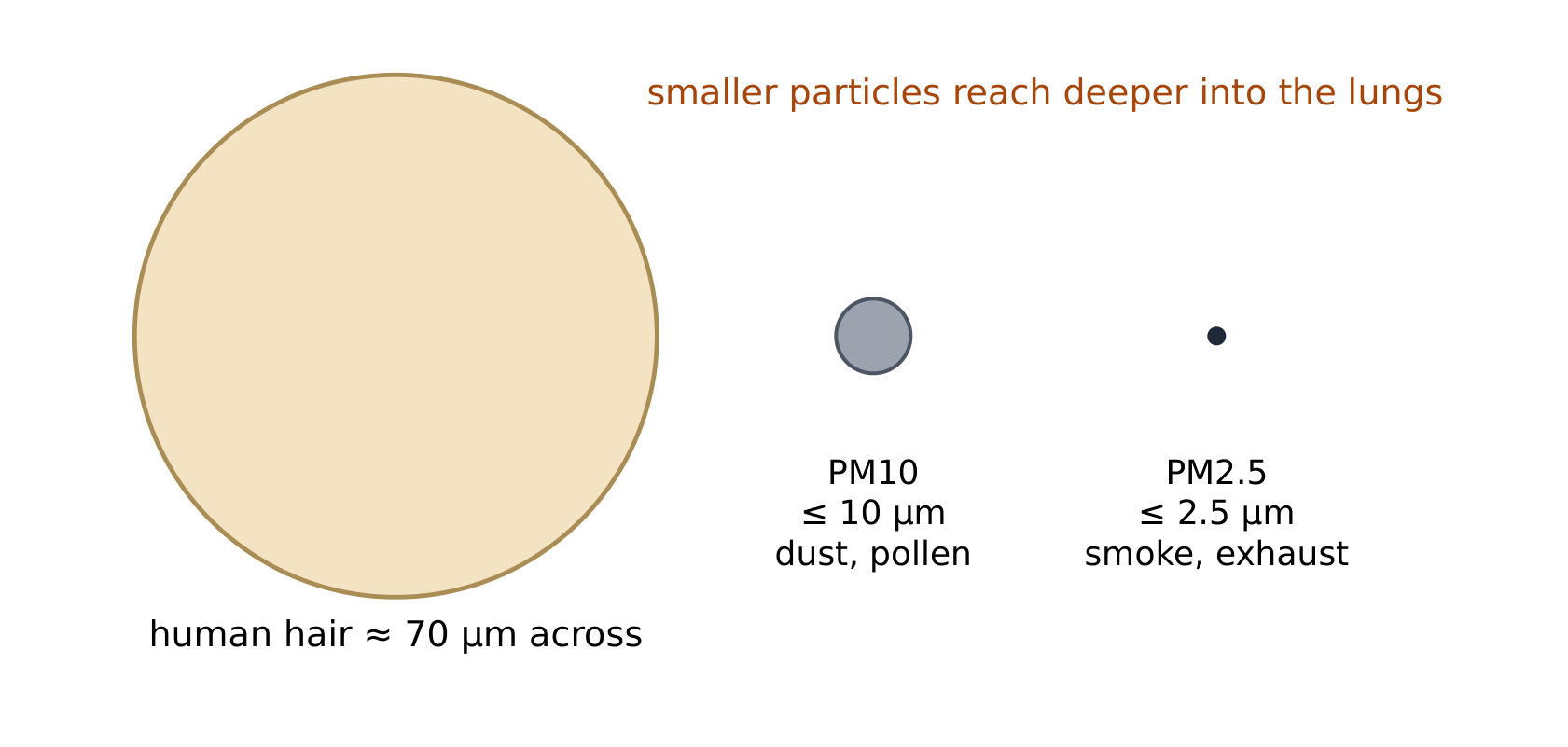
Particulate matter 颗粒物 (PM) is tiny solid or liquid particles in the air. Size matters: PM10 is smaller than 10 micrometres; PM2.5 is smaller than 2.5 micrometres, about 30 times thinner than a human hair. PM2.5 reaches deep into the lungs and even into the blood, causing asthma, lung disease and heart disease. Particulates also scatter light, which causes haze and reduces visibility.
- Natural particulates: dust storms, volcanic ash, sea salt, pollen, smoke from wildfires.
- Human particulates: coal power plants, diesel engines, construction, farming, burning wood or crop waste.
Worked example (rate per area). Trees remove 2.3 kg of PM2.5 per hectare each year. Logging removes 400 hectares of forest. The yearly loss of PM2.5 removal is $2.3 \times 400 = 920$ kg. Write the units at every step: kg per hectare times hectares gives kg.
Explore
Carbon dioxide or particulates?
Sort each description under the pollutant it fits.
Vocabulary
Train
| English |
|---|
| Particulate matter/pəˈtɪkjʊleɪt ˈmætə/ |
| decomposition/ˌdiːkɒmpəˈzɪʃn/ |
7.5
Indoor Air Pollutants
Syllabus
| Enduring Understanding | Learning Objective | Essential Knowledge |
|---|---|---|
STB-2 | STB-2.E |
|
STB-2.F |
|
Source: College Board AP Course and Exam Description
Indoor air is often more polluted than outdoor air, because pollutants build up in closed rooms. Learn the three source groups:
| Group | Examples | Effect |
|---|---|---|
| Combustion | carbon monoxide (CO), $\text{NO}_x$, particulates, tobacco smoke, smoke from cooking fires | CO is an asphyxiant 窒息剂: it stops the blood carrying oxygen |
| Natural | radon 氡, mold, dust | radon causes lung cancer; mold triggers allergies and asthma |
| Human-made materials | asbestos 石棉 insulation, VOCs and formaldehyde 甲醛 from furniture, carpets and glues; lead paint in old houses | asbestos fibres scar the lungs; VOCs irritate the eyes and lungs; lead harms children's brains |
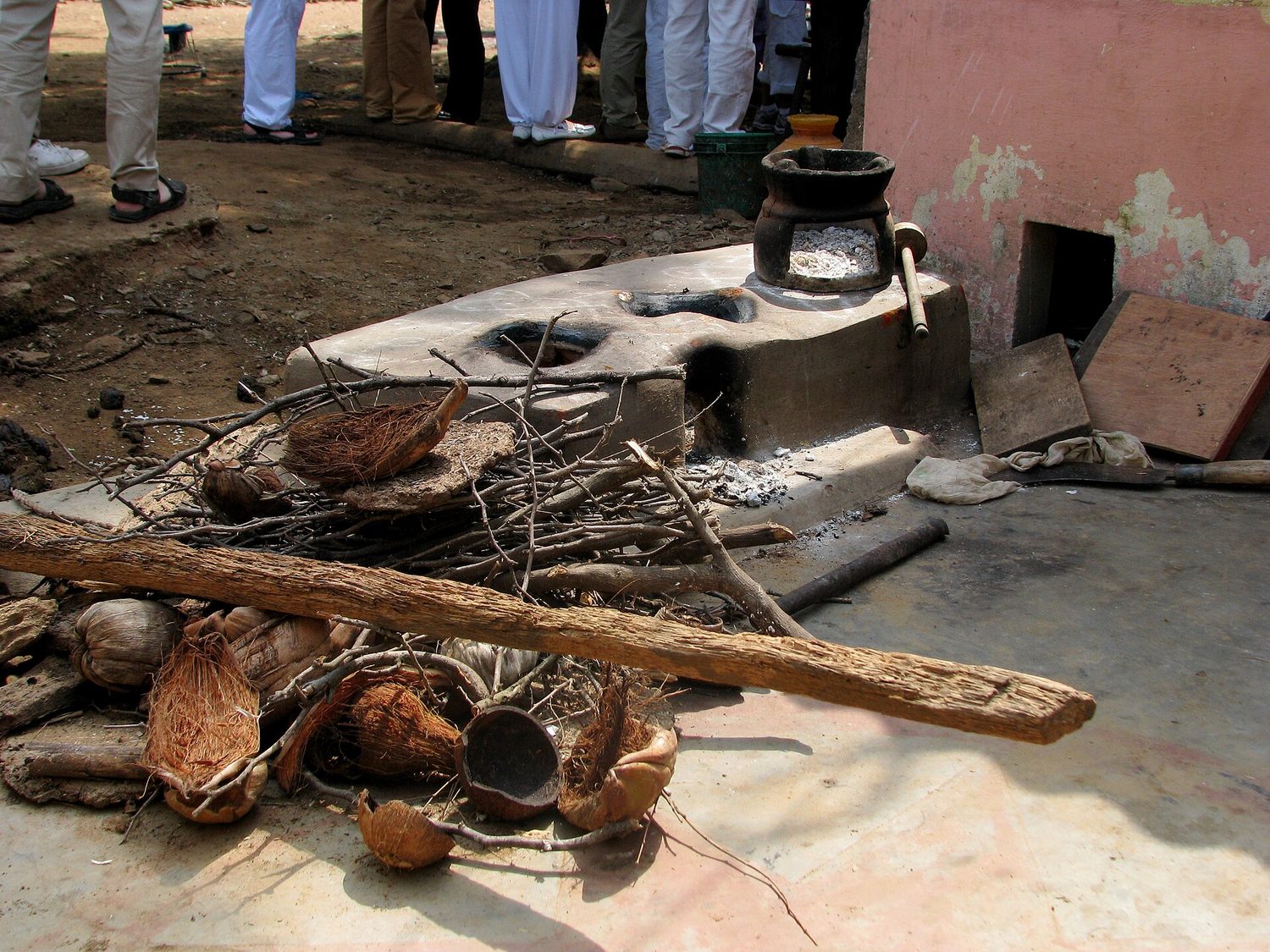
Biomass smoke. About two billion people cook on open fires of wood, crop waste or dung. The smoke contains particulates and CO, and causes lung disease, especially in women and children who spend most time near the fire. Realistic fixes are cleaner cookstoves with chimneys, better ventilation, or switching to cleaner fuels such as liquid gas.
Radon. Radon-222 is a radioactive gas made by the decay of uranium in some rocks and soils. It moves up through the soil and enters homes through cracks in the foundation, basement walls and well water. Breathing it in exposes the lungs to radiation; radon is the second leading cause of lung cancer in the USA, after smoking. Fixes: test the home, seal cracks, and fit a ventilation fan that pulls air from under the floor to the outside.
Carbon monoxide has no colour or smell. Faulty gas heaters, stoves and generators used indoors produce it. A CO detector, regular servicing and good ventilation prevent poisoning.
Explore
Where does each indoor pollutant come from?
Sort each indoor pollutant by whether it comes from burning or from materials and the ground.
Vocabulary
Train
| English |
|---|
| radon/ˈreɪdɒn/ |
| asbestos/æsˈbestəs/ |
| scrubbers/ˈskrʌbəz/ |
| asphyxiant |
| formaldehyde |
7.6
Reduction of Air Pollutants
Syllabus
| Enduring Understanding | Learning Objective | Essential Knowledge |
|---|---|---|
STB-2 | STB-2.G |
|
Source: College Board AP Course and Exam Description
Pollution can be reduced in three main ways: regulation (laws and limits), conservation (using less energy, so less is burned) and alternative fuels (natural gas, renewables). The best methods stop the pollutant at its source.
| Device | Where | What it removes | How it works |
|---|---|---|---|
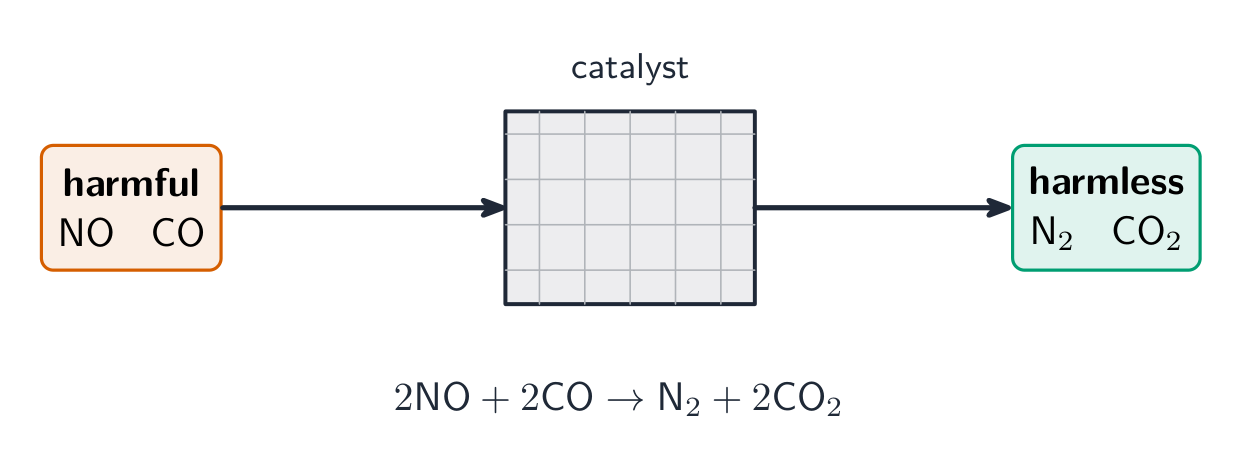
| Catalytic converter 催化转化器 | car exhaust | CO, $\text{NO}_x$, hydrocarbons | a metal catalyst turns them into $\text{CO}_2$, $\text{N}_2$, $\text{O}_2$ and $\text{H}_2\text{O}$ |
| Vapor recovery nozzle 油气回收喷嘴 | gasoline pump | VOCs (fuel vapor) | a sleeve on the nozzle sucks fuel vapor back into the underground tank |
| Wet scrubber 洗涤器 | smokestack | $\text{SO}_2$, particulates | exhaust passes through a spray of water and lime, which reacts with $\text{SO}_2$ |
| Dry scrubber | smokestack | $\text{SO}_2$ | a powder of lime reacts with the gas |
| Electrostatic precipitator 静电除尘器 | coal power plant | particulates | particles are given an electric charge and stick to charged plates |
| Baghouse filter 袋式除尘器 | factories | particulates | fabric bags filter out dust |
Other methods: burning low-sulfur coal, fluidized bed combustion (burning coal at a lower temperature mixed with limestone, which makes less $\text{NO}_x$ and traps $\text{SO}_2$), switching from coal to natural gas (almost no $\text{SO}_2$ or particulates), public transport and car-sharing, and emissions trading under the Clean Air Act.
Worked example (justify a solution). "Propose a government action to cut oil use and justify it." Claim: give tax credits for electric vehicles. Justification: fewer petrol cars means less $\text{NO}_x$ and VOCs, so less photochemical smog and ground-level ozone in cities. Always link the action to a named pollutant and a named effect.
Explore
Reduces or worsens air pollution?
Sort each action by whether it cuts air pollution or adds to it.
Vocabulary
Train
| English |
|---|
| catalytic converter/ˌkætəˈlɪtɪk kənˈvɜːtə/ |
| vapor recovery nozzle |
| wet scrubber |
| electrostatic precipitator |
| baghouse filter |
7.7
Acid Rain
Syllabus
| Enduring Understanding | Learning Objective | Essential Knowledge |
|---|---|---|
STB-2 | STB-2.H |
|
STB-2.I |
|
Source: College Board AP Course and Exam Description
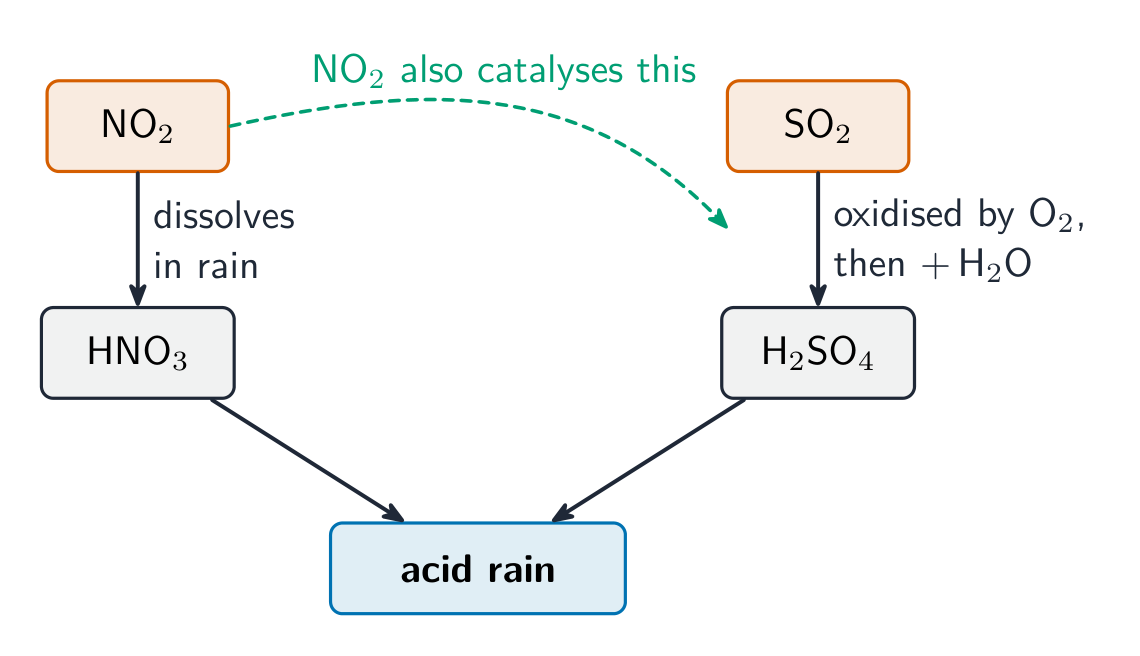
Acid rain 酸雨 (more fully, acid deposition 酸沉降, which includes dry particles) forms when sulfur dioxide and nitrogen oxides react with water and oxygen in the air to make sulfuric acid and nitric acid. Clean rain is already slightly acidic, pH about 5.6, because $\text{CO}_2$ dissolves in it; acid rain is below that.
$$\text{SO}_2 \rightarrow \text{H}_2\text{SO}_4 \qquad \text{NO}_x \rightarrow \text{HNO}_3$$
Sources: $\text{SO}_2$ comes mainly from coal-burning power plants. $\text{NO}_x$ comes from coal power plants and motor vehicles. Volcanoes and lightning are natural sources. Tall smokestacks send the gases high, so the acid falls hundreds of kilometres downwind, often in another state or country.
Effects:
- Water: lakes become acidic; fish eggs and young fish die below about pH 5. Acid also releases toxic aluminium 铝 from rocks into the water.
- Soil: acid washes calcium and magnesium out of the soil (leaching 淋溶) and releases aluminium, which damages roots. Trees weaken and die.
- Buildings: acid dissolves limestone and marble statues and corrodes metal.

Bedrock matters. Lakes on limestone 石灰岩 bedrock are protected: calcium carbonate neutralizes the acid (it acts as a buffer 缓冲剂). Lakes on granite have no buffer, so they acidify quickly. Farmers and lake managers can add crushed limestone (liming) to neutralize acidic soil and water.
Worked example (pH). Normal rain has pH 5.6; a sample of acid rain has pH 3.6. pH is a logarithmic scale: each unit is a 10-times change in acidity. The sample is $10^{5.6-3.6} = 10^2 = 100$ times more acidic than normal rain.
Explore
How acidic is acid rain?
Acid rain forms when sulfur and nitrogen oxides dissolve into rain, dropping its pH well below the normal ~5.6. Each pH unit down is ten times more acidic.
Vocabulary
Train
| English |
|---|
| Acid rain/ˈæsɪd reɪn/ |
| acid deposition |
| aluminium/ˌæljʊˈmɪnɪəm/ |
| leaching |
| limestone/ˈlaɪmstəʊn/ |
| buffer/ˈbʌfə/ |
7.8
Noise Pollution
Syllabus
| Enduring Understanding | Learning Objective | Essential Knowledge |
|---|---|---|
STB-2 | STB-2.J |
|
Source: College Board AP Course and Exam Description
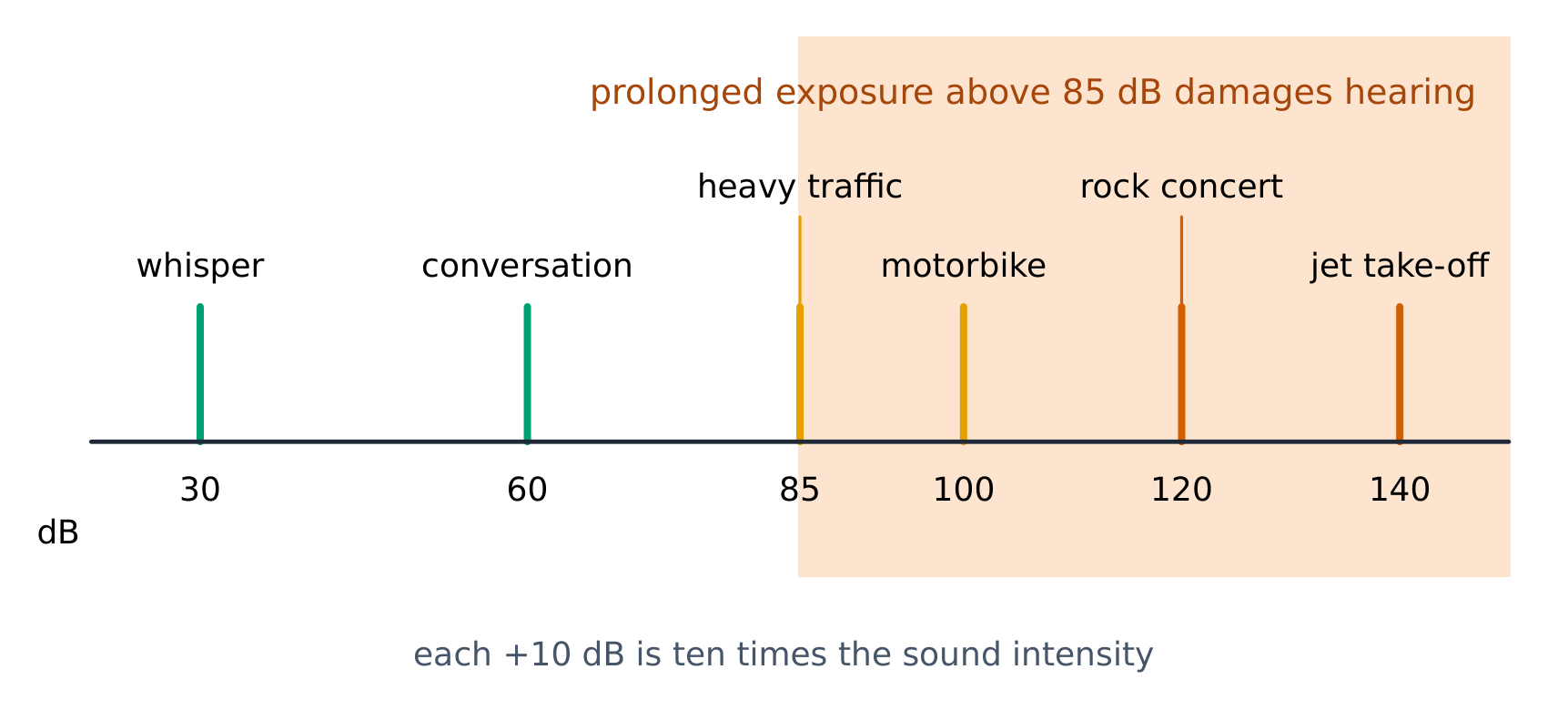
Noise pollution 噪声污染 is sound at a level high enough to cause physiological stress or hearing loss. Sound level is measured in decibels 分贝 (dB). The scale is logarithmic: every 10 dB is ten times the sound intensity, so 90 dB is ten times as intense as 80 dB. Long exposure above about 85 dB damages hearing.
Sources in cities: transportation (road traffic, aircraft, trains), construction, and domestic and industrial activity.
Effects on people: hearing loss 听力损失, stress 压力, poor sleep and higher blood pressure.
Effects on animals: noise causes stress, masks the sounds animals use to communicate, find mates or hunt, damages hearing, and can change migration routes. Birds in noisy areas sing louder or at a higher pitch, or leave. Ship engines and sonar are especially harmful to whales and dolphins, which use sound to navigate.
Reducing noise: sound barriers along highways, quieter engines and mufflers, limits on night flights, and land-use planning that keeps homes away from airports and factories.
Worked example (percent change). Near a new power plant, bird species richness fell from 7.5 to 6.0 species per hectare. Percent change $= \frac{6.0 - 7.5}{7.5} \times 100 = -20\%$, a 20% decrease.
Explore
Source or effect of noise pollution?
Sort each item into a source of noise or an effect it causes.
Vocabulary
Train
| English |
|---|
| noise pollution/nɔɪz pəˈluːʃn/ |
| decibel |
| hearing loss/ˈhɪərɪŋ lɒs/ |
| stress/stres/ |
7.8
Exam tips
- Distinguish primary pollutants (emitted directly: CO, $\text{NO}_x$, $\text{SO}_2$, particulates, VOCs) from secondary pollutants (formed in the air: ground-level ozone, sulfuric and nitric acid).
- Ground-level ozone is a pollutant; the ozone layer in the stratosphere protects us. Do not mix them up.
- For a smog graph: NO peaks in the morning, $\text{NO}_2$ next, and ozone in the afternoon, because ozone needs sunlight. Smog is worse in summer.
- For a thermal inversion, say which air is warm and which is cool: warm air above cool air stops the cool polluted air rising.
- Match each control device to its pollutant: catalytic converter (CO, $\text{NO}_x$, hydrocarbons), scrubber ($\text{SO}_2$), electrostatic precipitator (particulates), vapor recovery nozzle (VOCs).
- Acid rain falls downwind of coal power plants; limestone bedrock buffers it.
- In a calculation, write the formula, substitute with units, and give the sign of a percent change.
- When asked to "propose a solution", name a realistic action, the pollutant it reduces and the effect that improves.
Interactive lessons on this topic
Work through it step by step, with instant-check exercises.