| Enduring Understanding | Learning Objective | Essential Knowledge |
|---|---|---|
ERT-1 | ERT-1.A |
|
The Living World: Ecosystems
AP Environmental Science · Topic 1
 8:06
The Living World: Ecosystems
Picture a grassland. Grass covers the ground everywhere you look. Rabbits and other grazers are common — you can find them all day. But the big cats that hunt…
English narration · English + 中文 subtitles burned in
1.1
Introduction to Ecosystems
Syllabus
Source: College Board AP Course and Exam Description
In 1995 fourteen grey wolves were released into Yellowstone National Park, where wolves had been absent for 70 years. Elk numbers fell and elk stopped grazing along rivers; willows and aspens grew back; beavers returned to use them, and their dams created ponds for fish and birds. One predator changed a whole ecosystem. This unit is about how living things are linked to each other, and to the energy and matter that flow through them.
An ecosystem 生态系统 is all the living (biotic 生物的) and non-living (abiotic 非生物的) parts of an area and the interactions among them. Abiotic factors include sunlight, temperature, water, soil and nutrients.
Species in an ecosystem interact in several ways:
| Interaction | Effect on species A | Effect on species B | Example |
|---|---|---|---|
| Predation 捕食 | predator gains (+) | prey loses (−) | wolf eats elk; herbivores eating plants work the same way |
| Competition 竞争 | loses (−) | loses (−) | lions and hyenas for the same prey |
| Mutualism 互利共生 | gains (+) | gains (+) | bees pollinate flowers and get nectar; coral and algae |
| Commensalism 偏利共生 | gains (+) | unaffected (0) | barnacles riding on a whale |
| Parasitism 寄生 | parasite gains (+) | host loses (−) | ticks on a deer; tapeworms |
Symbiosis 共生 is any close, long-term relationship between two species: mutualism, commensalism and parasitism are all types of symbiosis.
Competition happens within a species and between species when a resource is limited. Over time, competing species often evolve resource partitioning 资源分配: they use the resource in different ways, in different places or at different times. For example, several warbler species feed in the same spruce tree but in different parts of it; hawks hunt by day and owls by night.
Explore
Explore how a population grows
Change the growth rate $r$ and the carrying capacity $K$. Growth is fast when a population is small, then levels off as resources run short and the ecosystem fills up.
Vocabulary
Train
| English |
|---|
| ecosystem/ˈiːkəʊsɪstəm/ |
| biotic/baɪˈɒtɪk/ |
| abiotic/ˌæbɪˈɒtɪk/ |
| predation/prɪˈdeɪʃn/ |
| competition/ˌkɒmpəˈtɪʃn/ |
| mutualism/ˈmjuːtʃuːəlɪzəm/ |
| commensalism |
| parasitism/ˈpærəsɪtɪzəm/ |
| symbiosis/ˌsɪmbaɪˈəʊsɪs/ |
| resource partitioning/rɪˈzɔːs pɑːˈtɪʃənɪŋ/ |
1.2
Terrestrial Biomes
Syllabus
| Enduring Understanding | Learning Objective | Essential Knowledge |
|---|---|---|
ERT-1 | ERT-1.B |
|
Source: College Board AP Course and Exam Description
A biome 生物群系 is a large region with a characteristic community of plants and animals adapted to its climate. Terrestrial biomes are set mainly by average temperature and precipitation 降水, which in turn depend on latitude and altitude.
| Biome | Climate | Plants and soil |
|---|---|---|
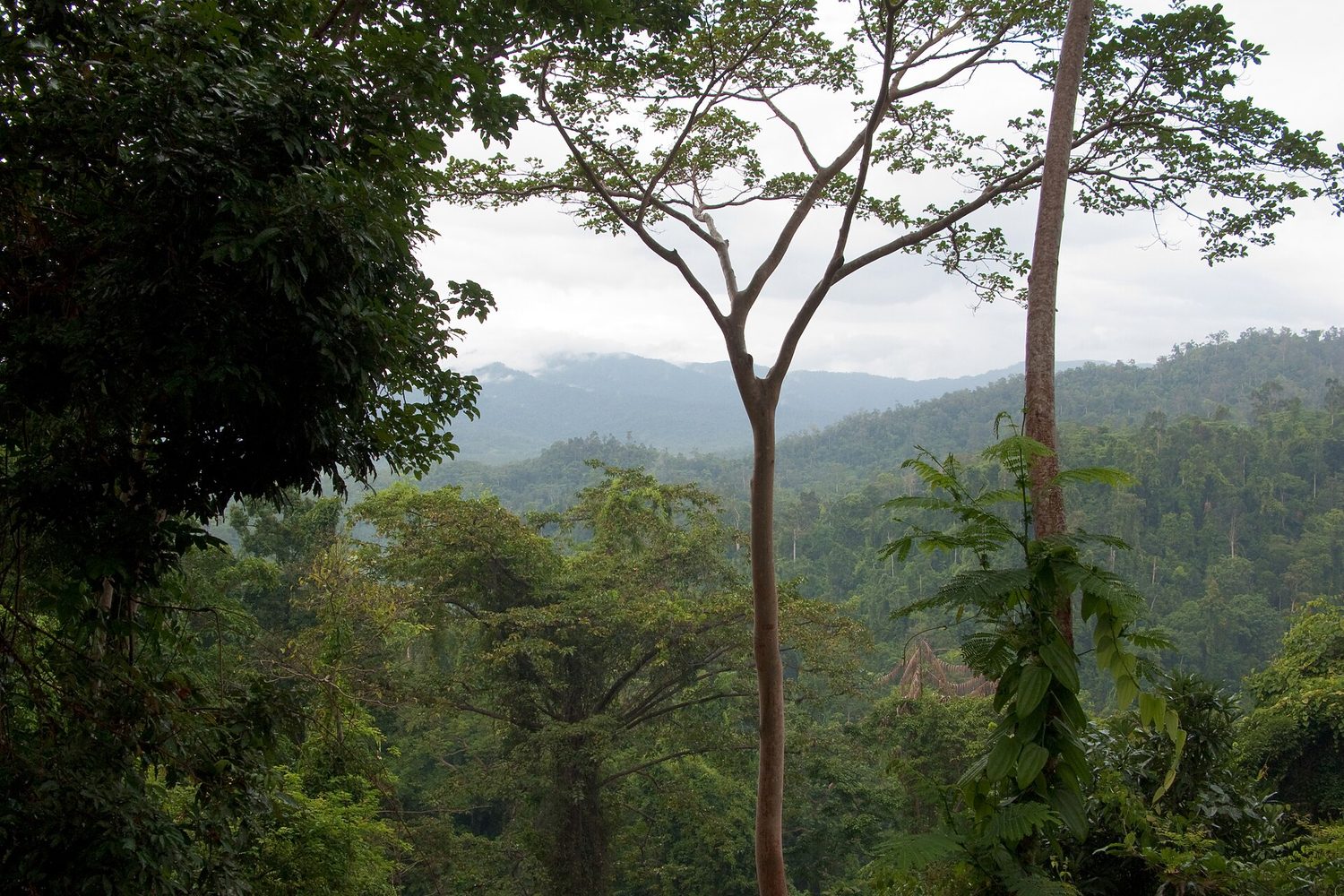
| Tropical rainforest | hot, very wet all year | tall layered forest; thin, nutrient-poor soil (nutrients are held in the plants) |
| Temperate rainforest | mild, very wet (coastal) | giant conifers, mosses |
| Temperate seasonal forest | warm summers, cold winters, moderate rain | deciduous trees that lose leaves; rich soil |
| Taiga (boreal forest) | long cold winters, short summers | conifers; acidic, slow-decaying soil |
| Tundra | very cold, dry; permafrost 永久冻土 | mosses, lichens, low shrubs; no trees |
| Temperate grassland | hot summers, cold winters, too dry for forest | grasses; deep, very fertile soil |
| Savanna | warm all year, wet and dry seasons | grasses with scattered trees |
| Shrubland (chaparral) | hot dry summers, mild wet winters | drought-adapted shrubs; fire common |
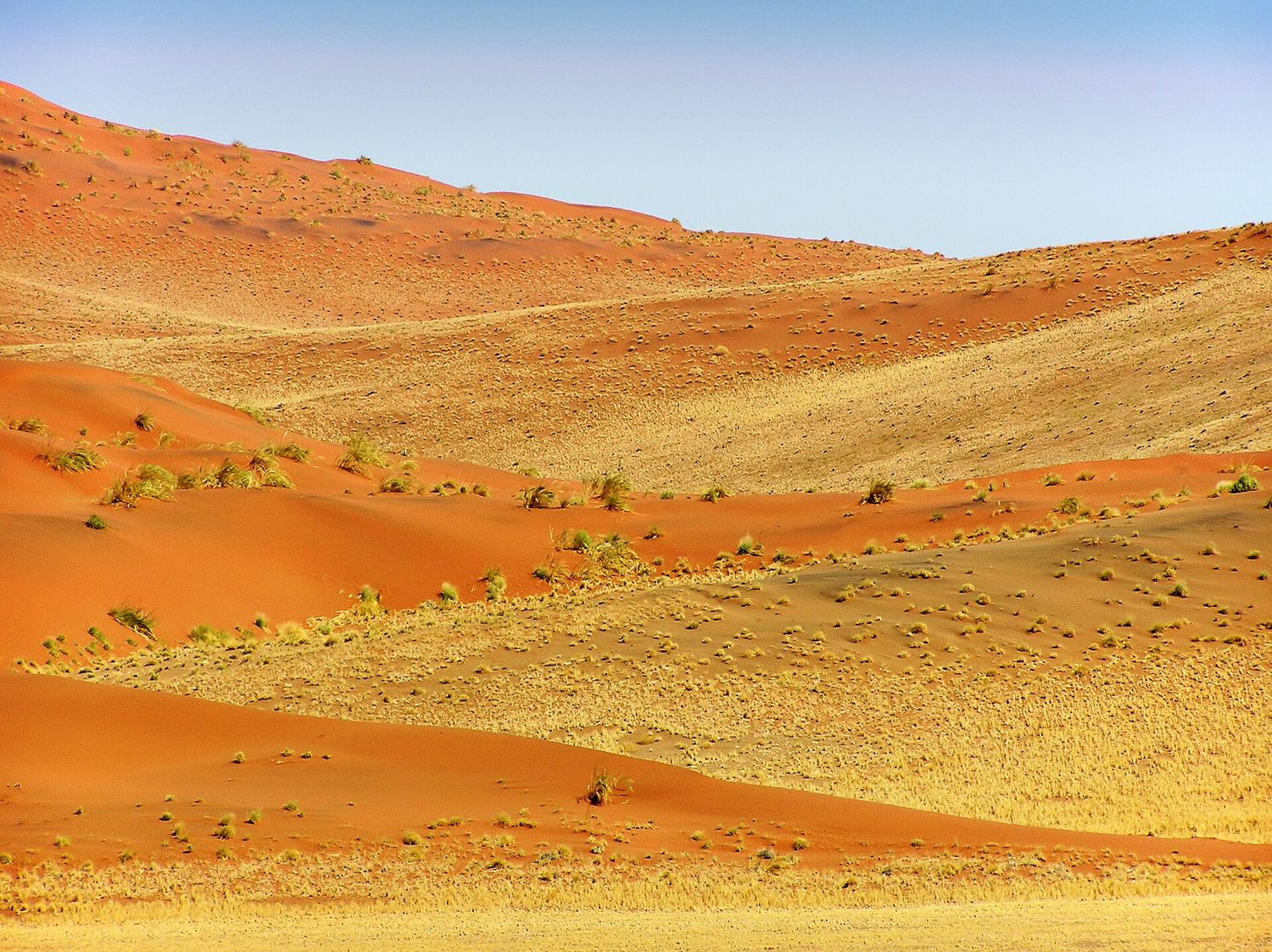
| Desert | very dry (under 25 cm rain a year) | cacti and succulents with deep or wide roots |
The two images below sit at opposite ends of the precipitation scale, which is why their life looks so different:
Natural resources on land, such as fresh water and timber, are unevenly spread because of climate, geography, latitude, altitude, nutrients and soil. Biome boundaries are not fixed: as the climate warms, biomes are shifting toward the poles and up mountains, and species that cannot move fast enough are at risk.
Explore
Match the biome to its climate
Sort each terrestrial biome by the temperature and rainfall that define it.
Vocabulary
Train
| English |
|---|
| biome/ˈbaɪəʊm/ |
| precipitation/prɪˌsɪpɪˈteɪʃn/ |
| permafrost |
| tropical rainforest/ˈtrɒpɪkl ˈreɪnfɒrɪst/ |
| desert/ˈdezət/ |
1.3
Aquatic Biomes

Syllabus
| Enduring Understanding | Learning Objective | Essential Knowledge |
|---|---|---|
ERT-1 | ERT-1.C |
|
Source: College Board AP Course and Exam Description
Aquatic biomes are divided by salinity 盐度 (salt content), depth, water flow, temperature and turbidity (cloudiness).
- Freshwater biomes: streams and rivers (flowing water, high oxygen), ponds and lakes (still water), and freshwater wetlands. They are a vital source of drinking water.
- Marine biomes: the open ocean, coral reefs (warm, clear, shallow tropical water), salt marshes, and estuaries 河口, where rivers meet the sea and fresh water mixes with salt water.
- Wetlands 湿地 (marshes, swamps, mangroves) are land covered by water for at least part of the year. They filter pollutants, store floodwater and provide nurseries for fish.
Estuaries, salt marshes and coral reefs are among the most productive ecosystems, because rivers or upwelling bring in nutrients and the water is shallow enough for sunlight to reach the bottom. In the open ocean, tiny algae 藻类 (phytoplankton) produce a large share of Earth's oxygen and take in carbon dioxide from the atmosphere.
Explore
Freshwater, marine, or in-between?
Sort each aquatic biome by its salinity - fresh, salty, or the brackish mix where they meet.
Vocabulary
Train
| English |
|---|
| salinity/seɪˈlɪnɪti/ |
| estuaries/ˈestjuːəriz/ |
| wetlands/ˈwetləndz/ |
| algae/ˈælɡiː/ |
| coral reef/ˈkɒrəl riːf/ |
1.4
The Carbon Cycle

Syllabus
| Enduring Understanding | Learning Objective | Essential Knowledge |
|---|---|---|
ERT-1 | ERT-1.D |
|
Source: College Board AP Course and Exam Description
A biogeochemical cycle 生物地球化学循环 is the movement of an element between reservoirs 储库 (stores). A reservoir that takes in more of the element than it releases is a sink 汇; one that releases more than it takes in is a source 源. Some reservoirs hold the element briefly (the atmosphere, living things), others for millions of years (rocks, fossil fuels).
The carbon cycle 碳循环 moves carbon between the atmosphere, living things, the ocean, soil and rocks:
- Photosynthesis 光合作用 takes $\text{CO}_2$ from the air and stores the carbon in sugars: $6\text{CO}_2 + 6\text{H}_2\text{O} \rightarrow \text{C}_6\text{H}_{12}\text{O}_6 + 6\text{O}_2$.
- Cellular respiration 细胞呼吸 by plants, animals and decomposers releases it again as $\text{CO}_2$.
- Decomposition 分解 of dead matter returns carbon to the air and soil.
- The ocean absorbs $\text{CO}_2$ from the air (it is the largest active carbon sink); marine organisms build shells of calcium carbonate, which settle and form limestone.
- Burial of dead plants and plankton under sediment, over millions of years, formed fossil fuels 化石燃料 (coal, oil, natural gas).
Human impact. Burning fossil fuels moves carbon that was stored for millions of years into the atmosphere in a few decades, much faster than photosynthesis and the ocean can remove it. Deforestation 森林砍伐 adds more: burning forests releases carbon, and fewer trees remain to absorb $\text{CO}_2$. The result is rising atmospheric $\text{CO}_2$ and climate change.
Vocabulary
Train
| English |
|---|
| biogeochemical cycle |
| reservoirs |
| sink/sɪŋk/ |
| source/sɔːs/ |
| carbon cycle/ˈkɑːbən ˈsaɪkl/ |
| photosynthesis/ˌfəʊtəʊˈsɪnθəsɪs/ |
| cellular respiration/ˈseljʊlə ˌrespɪˈreɪʃn/ |
| decomposition/ˌdiːkɒmpəˈzɪʃn/ |
| fossil fuels/ˈfɒsl ˈfjuːəlz/ |
| deforestation/diːˌfɒrɪˈsteɪʃn/ |
1.5
The Nitrogen Cycle

Syllabus
| Enduring Understanding | Learning Objective | Essential Knowledge |
|---|---|---|
ERT-1 | ERT-1.E |
|
Source: College Board AP Course and Exam Description
Nitrogen is needed to make proteins and DNA. The atmosphere is the largest nitrogen reservoir (78% $\text{N}_2$), but plants and animals cannot use $\text{N}_2$ gas directly. Most nitrogen reservoirs (soil, living things) hold it only for a short time.
The nitrogen cycle 氮循环 has five main steps:
- Nitrogen fixation 固氮作用: $\text{N}_2$ is converted to ammonia ($\text{NH}_3$) or ammonium ($\text{NH}_4^+$), which plants can use. Bacteria in the soil and in root nodules of legumes (beans, clover) do this; lightning fixes a little; the industrial Haber process makes fertilizer.
- Nitrification 硝化作用: soil bacteria turn ammonium into nitrite ($\text{NO}_2^-$) and then nitrate ($\text{NO}_3^-$).
- Assimilation 同化作用: plants take up nitrate and ammonium through their roots and build them into proteins; animals get nitrogen by eating plants.
- Ammonification 氨化作用: decomposers break down dead matter and wastes, releasing ammonium back to the soil.
- Denitrification 反硝化作用: bacteria in waterlogged, low-oxygen soil turn nitrate back into $\text{N}_2$ (and some $\text{N}_2\text{O}$, a greenhouse gas), which returns to the air.
Human impact. Synthetic fertilizer and manure add large amounts of nitrogen. Nitrate dissolves easily, so excess fertilizer leaches into groundwater (unsafe for drinking) or runs off into rivers, where it causes algal blooms. Burning fuels releases nitrogen oxides, which cause smog and acid rain.
Vocabulary
Train
| English |
|---|
| nitrogen cycle/ˈnaɪtrədʒn ˈsaɪkl/ |
| nitrogen fixation/ˈnaɪtrədʒn fɪkˈseɪʃn/ |
| nitrification/ˌnaɪtrɪfɪˈkeɪʃn/ |
| assimilation/əˌsɪmɪˈleɪʃn/ |
| ammonification/ˌæməˌnɪfɪˈkeɪʃn/ |
| denitrification/diːˌnaɪtrɪfɪˈkeɪʃn/ |
1.6
The Phosphorus Cycle
Syllabus
| Enduring Understanding | Learning Objective | Essential Knowledge |
|---|---|---|
ERT-1 | ERT-1.F |
|
Source: College Board AP Course and Exam Description
Phosphorus is needed for DNA, ATP (the cell's energy molecule), cell membranes, and bones and teeth.
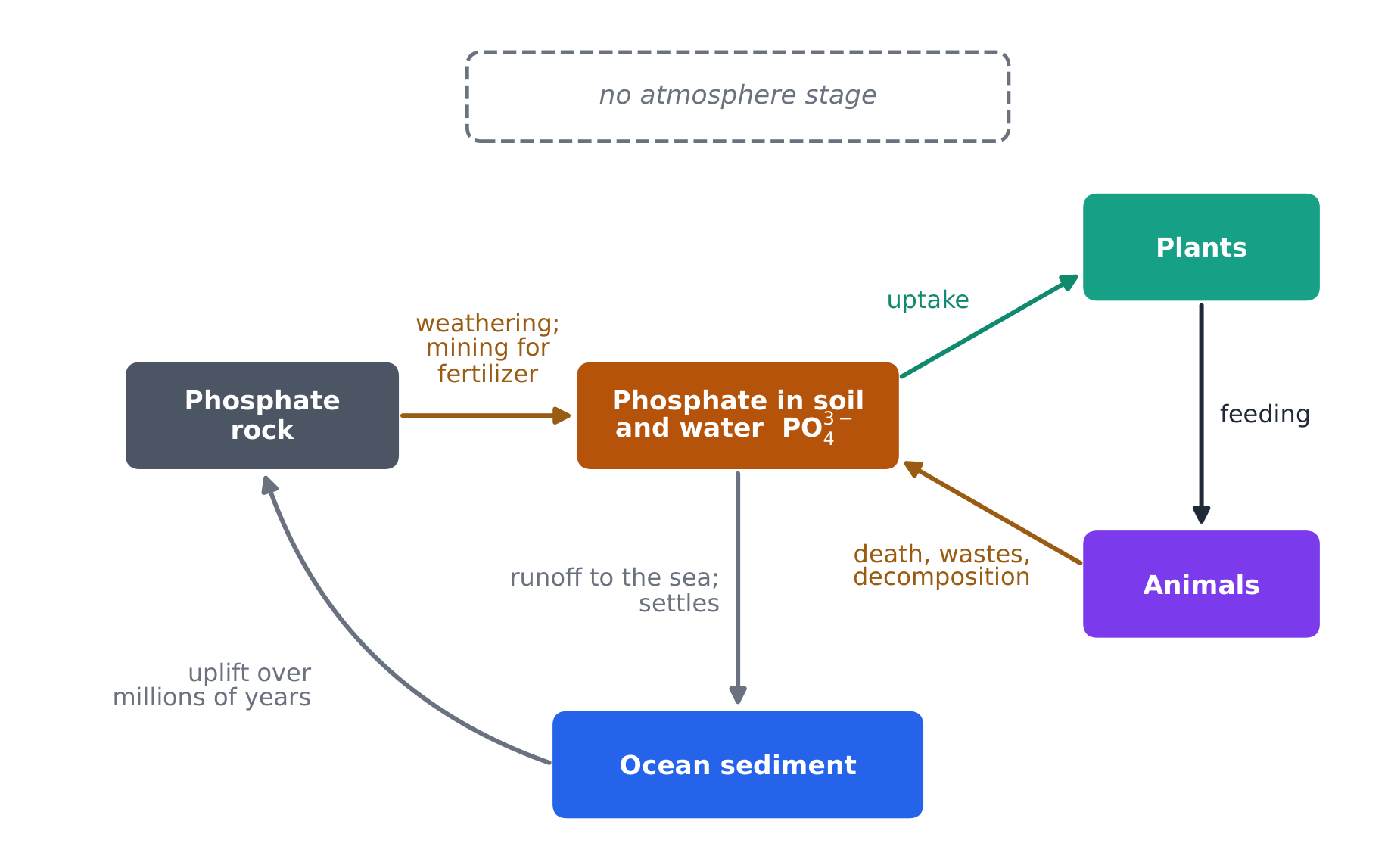
The phosphorus cycle 磷循环 is unusual: it has no atmospheric stage. Its main reservoirs are rocks and sediments containing phosphate minerals.
- Weathering of rock slowly releases phosphate ($\text{PO}_4^{3-}$) into soil and water.
- Plants take it up; animals get it by eating plants.
- Decomposers return phosphate to the soil from wastes and dead organisms.
- Runoff carries phosphate to lakes and the ocean, where it settles into sediment.
- Over millions of years, geologic uplift turns sediment back into rock on land.
Because phosphorus cannot travel through the air, it returns from the ocean to the land only very slowly. So it is naturally scarce in most ecosystems and is often the limiting nutrient 限制性养分 for plant and algae growth.
Human impact. Phosphate rock is mined for fertilizer, and phosphates were common in detergents. Runoff from farms and sewage adds phosphorus to lakes and rivers, which causes eutrophication 富营养化: algae grow rapidly, then die and decompose, and the decomposers use up the dissolved oxygen, killing fish.
Vocabulary
Train
| English |
|---|
| phosphorus cycle/ˈfɒsfɔːrəs ˈsaɪkl/ |
| limiting nutrient/ˈlɪmɪtɪŋ ˈnjuːtrɪənt/ |
| eutrophication/ˌjuːtrəfɪˈkeɪʃn/ |
1.7
The Hydrologic (Water) Cycle

Syllabus
| Enduring Understanding | Learning Objective | Essential Knowledge |
|---|---|---|
ERT-1 | ERT-1.G |
|
Source: College Board AP Course and Exam Description
The water cycle 水循环 (hydrologic cycle) moves water between its solid, liquid and gas forms. It is powered by energy from the Sun.
- Evaporation 蒸发: the Sun heats surface water, which turns into water vapour.
- Transpiration 蒸腾作用: plants release water vapour from their leaves.
- Condensation 凝结: vapour cools and forms clouds.
- Precipitation: water falls as rain, snow or hail.
- Runoff and infiltration 下渗: water flows over the land into rivers, or soaks into the soil to become groundwater in aquifers 含水层.
The oceans are the main reservoir, holding about 97% of Earth's surface water. Ice caps and glaciers hold about 2%, and groundwater less than 1%; lakes, rivers and the atmosphere hold only a tiny fraction. So less than 1% of all water is easily available fresh water.
Human impact. Paving surfaces increases runoff and flooding and reduces infiltration; deforestation reduces transpiration and local rainfall; pumping groundwater faster than it refills lowers the water table.
Vocabulary
Train
| English |
|---|
| water cycle/ˈwɔːtə ˈsaɪkl/ |
| evaporation/ɪˌvæpəˈreɪʃn/ |
| transpiration/trænspəˈreɪʃn/ |
| condensation/kɒndenˈseɪʃn/ |
| infiltration |
| aquifers/ˈækwɪfəz/ |
1.8
Primary Productivity

Syllabus
| Enduring Understanding | Learning Objective | Essential Knowledge |
|---|---|---|
ENG-1 | ENG-1.A |
|
Source: College Board AP Course and Exam Description
Primary productivity 初级生产力 is the rate at which producers convert solar energy into the chemical energy of organic compounds by photosynthesis. It is measured as energy (or biomass) per unit area per unit time, for example $\text{kcal/m}^2/\text{yr}$.
- Gross primary productivity 总初级生产力 (GPP) is the total rate of photosynthesis in an area.
- Net primary productivity 净初级生产力 (NPP) is the energy left after the producers use some for their own respiration ($R$). NPP is the energy available to consumers.
$$\text{NPP} = \text{GPP} - R$$
Worked example. Producers in a grassland capture $20{,}000\ \text{kcal/m}^2/\text{yr}$ (GPP) and use $8{,}000\ \text{kcal/m}^2/\text{yr}$ in respiration. $\text{NPP} = 20{,}000 - 8{,}000 = 12{,}000\ \text{kcal/m}^2/\text{yr}$. Only that NPP, not the full GPP, is available to the consumers.
The most productive ecosystems are warm, wet and sunny, with plenty of nutrients: tropical rainforests, swamps and marshes, estuaries and coral reefs. Deserts, tundra and the open ocean (few nutrients) have low productivity per square metre.
Light in water. Water absorbs light quickly. Most red light is absorbed in the top metre, and only blue light reaches deeper than 100 m, even in the clearest water. So most aquatic photosynthesis happens near the surface, and deep-water algae have pigments that capture blue light.
Explore
Explore GPP, respiration and NPP
The energy producers capture (GPP) splits into what they burn for their own respiration $R$ and what is left over as new biomass — $\text{NPP} = \text{GPP} - R$, and useful + wasted always equals the input.
Vocabulary
Train
| English |
|---|
| primary productivity/ˈpraɪməri ˌprɒdəkˈtɪvɪti/ |
| gross primary productivity/ɡrəʊs ˈpraɪməri ˌprɒdəkˈtɪvɪti/ |
| net primary productivity/net ˈpraɪməri ˌprɒdəkˈtɪvɪti/ |
1.9
Trophic Levels
Syllabus
| Enduring Understanding | Learning Objective | Essential Knowledge |
|---|---|---|
ENG-1 | ENG-1.B |
|
Source: College Board AP Course and Exam Description
Every ecosystem needs a continuous inflow of high-quality energy, almost always from the Sun. Energy flows from the Sun to producers 生产者 at the lowest trophic level 营养级, then up to higher levels:
- Producers (autotrophs): plants, algae and phytoplankton make their own food by photosynthesis.
- Primary consumers (herbivores) eat producers.
- Secondary consumers eat primary consumers.
- Tertiary consumers eat secondary consumers; top predators 顶级捕食者 have no natural predators.
Decomposers 分解者 (bacteria and fungi) and detritivores 食腐动物 (earthworms, millipedes) break down dead matter and wastes from every level, returning nutrients to the soil and water. Without them, matter would not cycle.
Energy flows one way, but matter cycles: the biogeochemical cycles show the conservation of matter. Atoms are never destroyed; they move between reservoirs.
Explore
Build the trophic pyramid
Stack the trophic levels - producers at the base feed each higher level of consumers.
Vocabulary
Train
| English |
|---|
| producers/prəˈdjuːsəz/ |
| trophic level/ˈtrəʊfɪk ˈlevl/ |
| top predators |
| decomposers/ˌdiːkəmˈpəʊzəz/ |
| detritivores |
1.10
Energy Flow and the 10% Rule

Syllabus
| Enduring Understanding | Learning Objective | Essential Knowledge |
|---|---|---|
ENG-1 | ENG-1.C |
|
Source: College Board AP Course and Exam Description
The 10% rule: on average only about 10% of the energy at one trophic level is passed on to the next. The other 90% is used for the organisms' own life processes (movement, keeping warm, growing) and is finally lost as heat, or is in parts that are not eaten or digested.
The laws of thermodynamics 热力学 explain this. The first law says energy is not created or destroyed, only changed in form. The second law says that every time energy changes form, some becomes heat, which is not useful to the next level. So energy cannot be recycled up the food chain.
Worked example. From $12{,}000\ \text{kcal/m}^2/\text{yr}$ of NPP, primary consumers receive about $10\% = 1200$ kcal, secondary consumers about $120$ kcal, and tertiary consumers only about $12$ kcal. After three transfers the energy has shrunk a thousand-fold.
Worked example (backwards). A hawk population needs $50$ kcal per day from snakes. Working down, the snakes need $500$ kcal, the mice $5000$ kcal and the grass $50{,}000$ kcal. Multiply by 10 for each level you go down.
Worked example (food needed). An ocelot needs 720 g of food a day, and 46% of its diet by mass is pocket mice. Each mouse has a mass of 43 g. How many mice does one ocelot eat a day?
- Mass of mice eaten: $720 \times 0.46 \approx 331$ g per day.
- Number of mice: $331 \div 43 \approx 7.7$, so about 8 mice a day.
- Show each step with units; FRQs give a mark for the set-up, even if the final number is rounded differently.
Why the trophic level of the food matters. Mice eat plants, so they are primary consumers; snakes eat other animals, so they are at least secondary consumers. An ocelot eating snakes gets energy that has passed through one more 10% transfer than energy from mice, so far more primary production is needed to supply the same 720 g of snakes.
This energy loss explains why food chains rarely have more than four or five levels, why top predators are few, and why eating lower on the food chain (plants rather than meat) feeds more people from the same land.
Explore
Explore the 10% rule
Set the energy producers capture and the ecological efficiency, then watch only about a tenth pass to each level up — this is why the apex predator is left with so little and food chains stay short.
Vocabulary
Train
| English |
|---|
| thermodynamics/ˌθɜːməʊdaɪˈnæmɪks/ |
1.11
Food Chains and Food Webs

Syllabus
| Enduring Understanding | Learning Objective | Essential Knowledge |
|---|---|---|
ENG-1 | ENG-1.D |
|
Source: College Board AP Course and Exam Description
A food chain 食物链 is a single path of who eats whom. A food web 食物网 shows many interlocking food chains in an ecosystem. In both, the arrows point from the food to the eater: they show the direction in which energy and nutrients flow.
Because species are connected, adding or removing one species affects others:
- Removing a predator lets its prey increase, which may overeat the producers. Removing spiders, for example, can let plant-eating insects multiply and damage crops.
- Adding an invasive species, such as Asian carp in the Great Lakes, which eat huge amounts of plankton, leaves less food for native fish.
- A keystone species 关键种 has a much larger effect on its ecosystem than its numbers suggest. The Yellowstone wolves and sea otters (which eat sea urchins that would otherwise destroy kelp forests) are examples.
Feedback loops 反馈回路 operate in food webs. In a negative feedback loop a change produces effects that reverse it: more rabbits feed more foxes, which then reduce the rabbits, keeping both populations stable. In a positive feedback loop a change produces effects that amplify it: fewer trees lead to more erosion, which leads to even fewer trees.
Explore
Energy along a food chain
Follow energy from producers up the chain, losing about 90% at each link.
Vocabulary
Train
| English |
|---|
| food chain/fuːd tʃeɪn/ |
| food web/fuːd web/ |
| keystone species/ˈkiːstəʊn ˈspiːsiːz/ |
| feedback loops |
1.11
Exam tips
- Energy flows one way and is lost as heat (the 10% rule); matter cycles (carbon, nitrogen, phosphorus, water).
- For symbiosis, state the effect on both species (+/+, +/0, +/−).
- Know which cycle has no gas phase (phosphorus) and where each element is stored longest (carbon in rocks and fossil fuels, nitrogen in the atmosphere, phosphorus in rock).
- Name the nitrogen cycle steps in order and say which organisms do them: fixation (bacteria), nitrification (bacteria), assimilation (plants), ammonification (decomposers), denitrification (bacteria).
- Use NPP = GPP − respiration; only NPP is available to consumers. Give units such as $\text{kcal/m}^2/\text{yr}$.
- In a food web, arrows show the direction of energy flow, from food to eater.
- When a species is removed, follow the effects at least two steps through the web.
- Show every step in calculations, with units; the FRQ calculator is allowed but marks need the setup.
Interactive lessons on this topic
Work through it step by step, with instant-check exercises.