| Enduring Understanding | Learning Objective | Essential Knowledge |
|---|---|---|
ERT-2 | ERT-2.A |
|
The Living World: Biodiversity
AP Environmental Science · Topic 2
 7:58
The Living World: Biodiversity
A volcano pushes a new island up out of the sea. At first there is nothing on it — bare rock, no soil, no life at all. Fifty years later, it is green. So how…
English narration · English + 中文 subtitles burned in
2.1
Introduction to Biodiversity
Syllabus
Source: College Board AP Course and Exam Description
In the 1990s only about 50 Florida panthers were left in the wild. So many were related that kittens were born with heart defects, kinked tails and weak sperm. In 1995 scientists brought in eight female cougars from Texas. Within twenty years the panther population had grown to over 200 and the defects had become rare. The panthers did not need more food or more land first. They needed more genetic variety. This unit is about why variety at every level keeps living systems working.
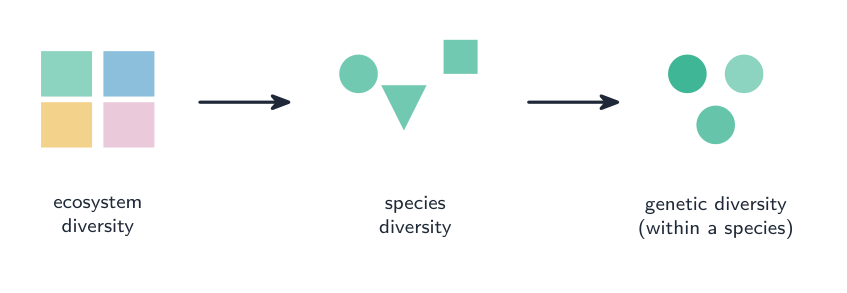
Biodiversity 生物多样性 is the variety of life, measured at three levels:
- Genetic diversity – variety of genes within a species. More genetic variety means a population can better respond to environmental stressors 环境压力 such as a new disease, drought or warmer water: some individuals are likely to carry alleles that help them survive.
- Species diversity – the number of species (species richness 物种丰富度) and how evenly individuals are spread among them (species evenness).
- Habitat diversity – the variety of habitats in a region. A landscape with forest, wetland, grassland and streams supports more species than one large wheat field.
A population bottleneck 种群瓶颈 is a sharp drop in population size, from hunting, habitat loss or a disaster. Even if the population later recovers, it has lost most of its genetic variety, because the new population descends from only a few survivors. Low variety brings inbreeding (harmful recessive traits appear more often) and leaves the whole population open to one new disease. Cheetahs and northern elephant seals both passed through bottlenecks and today show very little genetic variation.
More species-rich ecosystems are more resilient 有韧性的: they recover from disruption more readily, because varied species can fill roles when conditions change. If one grass species dies in a drought, a grassland with twenty grass species still has others to hold the soil and feed grazers.
Habitat loss removes species in a predictable order:
- Specialist 特化 species (narrow needs – one food, one nesting site) go first. The giant panda eats almost only bamboo.
- Species that need large territories decline as their range shrinks and is cut into small pieces (big predators such as tigers and wolves).
- Hardy generalist 广适性 species (broad diets, wide tolerance – raccoons, rats, pigeons) survive longest and may even increase.
Worked example (Simpson's Diversity Index). A pond holds 3 fish species with 5, 3, and 2 individuals ($N=10$). A second pond also has 10 fish of 3 species, split 8, 1, 1.
$$D = 1-\sum\left(\tfrac{n}{N}\right)^2$$
Pond 1: $D = 1-\left[(0.5)^2+(0.3)^2+(0.2)^2\right] = 1-0.38 = 0.62$. Pond 2: $D = 1-\left[(0.8)^2+(0.1)^2+(0.1)^2\right] = 1-0.66 = 0.34$. Both ponds have the same species richness (3), but pond 1 is more even, so it is more diverse. A value near 1 means high diversity; near 0 means one species dominates.
Explore
Which level of biodiversity?
Sort each example by the level of biodiversity it describes - genes, species, or whole ecosystems.
Vocabulary
Train
| English |
|---|
| biodiversity/ˌbaɪəʊdaɪˈvɜːsɪti/ |
| environmental stressors/enˌvaɪrənˈmentl ˈstresəz/ |
| species richness/ˈspiːsiːz ˈrɪtʃnəs/ |
| population bottleneck/ˌpɒpjʊˈleɪʃn ˈbɒtəlnek/ |
| resilient/rɪˈsɪlɪənt/ |
| specialist/ˈspeʃəlɪst/ |
| generalist/ˈdʒenərəlɪst/ |
2.2
Ecosystem Services

Syllabus
| Enduring Understanding | Learning Objective | Essential Knowledge |
|---|---|---|
ERT-2 | ERT-2.B |
|
ERT-2.C |
|
Source: College Board AP Course and Exam Description
Ecosystem services 生态系统服务 are the free benefits nature gives people, in four categories:
| Category | What it means | Examples |
|---|---|---|
| Provisioning | products we take from nature | food, fresh water, timber, fibre, medicines |
| Regulating | processes that keep conditions stable | climate regulation (carbon storage), water filtration, pollination, flood control, erosion control |
| Cultural | non-material value | recreation, tourism, beauty, spiritual and educational value, scientific research |
| Supporting | the services that make the others possible | nutrient cycling, soil formation, photosynthesis (primary productivity), habitat |
Anthropogenic 人为的 (human-caused) activities can disrupt these services, with real economic and ecological costs. AP questions often ask for both, so learn to name each one:
- Deforestation removes timber for later harvests (provisioning), releases stored carbon and increases flooding downstream (regulating), and ends ecotourism income (cultural).
- Clearing mangroves for shrimp farms removes the young-fish nurseries that support local fisheries (provisioning) and the roots that absorb storm surges (regulating). Towns behind the mangroves then pay for sea walls and storm damage.
- Losing pollinators to pesticides and habitat loss forces farmers to rent beehives or pollinate by hand – paying for a service bees once did for free.
- Draining wetlands removes natural water filtration, so a city must build a more expensive water treatment plant.
Worked example (FRQ style). A company plans to clear a forest above a city's drinking-water reservoir. Identify one ecosystem service the forest provides and describe one economic cost of losing it. The forest provides water filtration (a regulating service): roots and soil trap sediment and pollutants before rain reaches the reservoir. Without the forest, more sediment and nutrients enter the water, so the city must spend money on extra treatment or a new filtration plant.
Explore
Sort the ecosystem services
Sort each benefit nature gives us into its type of ecosystem service.
Vocabulary
Train
| English |
|---|
| ecosystem services/ˈiːkəʊsɪstəm ˈsɜːvɪsɪz/ |
| anthropogenic/ˌænθrəpəˈdʒenɪk/ |
2.3
Island Biogeography

Syllabus
| Enduring Understanding | Learning Objective | Essential Knowledge |
|---|---|---|
ERT-2 | ERT-2.D |
|
ERT-2.E |
|
Source: College Board AP Course and Exam Description
Island biogeography 岛屿生物地理学 studies how many species an island holds. The same ideas apply to any habitat island: a lake, a mountaintop, or a park surrounded by farms and roads. The number of species settles at a balance between two rates:
- Immigration of new species – higher for islands closer to the mainland, because seeds, insects and birds reach them more easily.
- Extinction of resident species – lower on larger islands, because they have more habitat types, more resources and larger populations that are less likely to die out by chance.
So big, near islands hold the most species; small, remote ones the fewest. Scientists find a rough rule: an island with ten times the area holds about twice as many species.
Isolation also drives evolution. A few colonists reach a remote island and adaptive radiation follows: they evolve into many new species, each using a different resource (Darwin's finches in the Galápagos, honeycreepers in Hawaii). Island species often become specialists because resources are limited, and many are endemic 特有 – found nowhere else. That makes them fragile. When an invasive species 入侵物种 (usually a tough generalist with no local predators) arrives, it can outcompete or eat the specialists, which have nowhere else to go. Brown tree snakes, carried to Guam on cargo planes, wiped out most of the island's native forest birds.
Applying it to conservation. Roads, farms and towns cut large habitats into small, isolated patches (habitat fragmentation 栖息地破碎化). Each patch behaves like a small, remote island: it holds fewer species and loses them faster. Planners respond by:
- protecting one large reserve rather than several small ones where possible;
- linking patches with wildlife corridors 野生动物廊道 – strips of habitat, or bridges and tunnels over and under highways – so animals can move, find mates and recolonize patches. This raises the "immigration rate" and keeps genetic variety flowing.
Explore
Bigger islands hold more species
Plot island size against species number - larger islands support more species (the species-area relationship).
Vocabulary
Train
| English |
|---|
| island biogeography/ˈaɪlənd ˌbaɪəʊdʒɪˈɒɡrəfi/ |
| endemic/enˈdemɪk/ |
| invasive species/ɪnˈveɪsɪv ˈspiːsiːz/ |
| habitat fragmentation/ˈhæbɪtæt ˌfræɡmənˈteɪʃn/ |
| wildlife corridors |
2.4
Ecological Tolerance
Syllabus
| Enduring Understanding | Learning Objective | Essential Knowledge |
|---|---|---|
ERT-2 | ERT-2.F |
|
Source: College Board AP Course and Exam Description
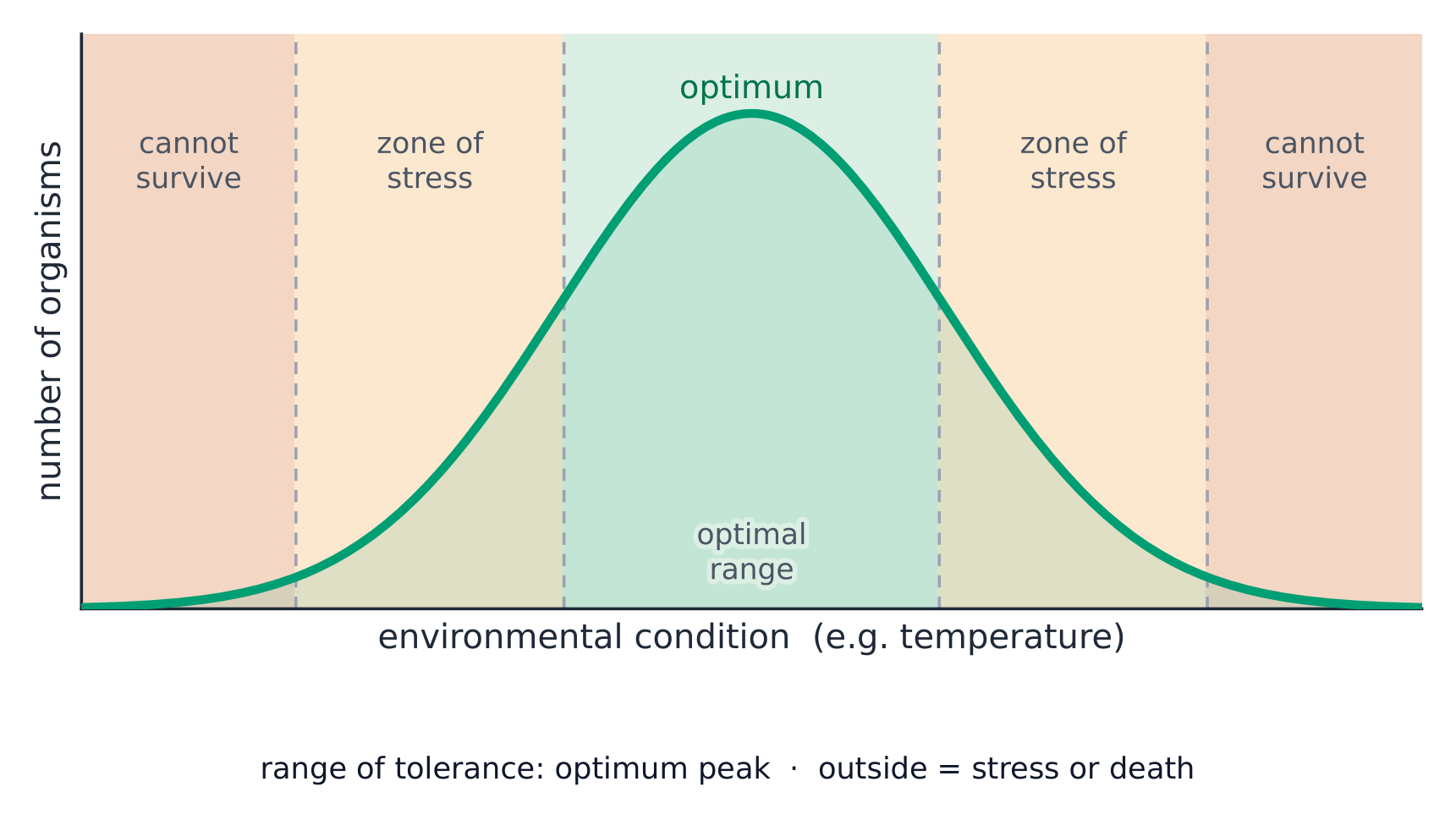
Every species has a range of tolerance 耐受范围 – the span of conditions (temperature, salinity, pH, dissolved oxygen, sunlight) it can survive. Near the middle is an optimal range 最适范围 where individuals thrive and reproduce; toward the edges are zones of stress 胁迫区 (zones of physiological stress) where they survive but grow slowly, reproduce little and fall sick more easily; beyond the limits they die. Ecological tolerance 生态耐受性 applies both to a single individual and to a whole species, and it decides where an organism can live and how it copes with change.
Two ideas make tolerance useful in exam answers:
- A species is limited by the factor it tolerates least. A trout stream may have perfect temperature and food, but if dissolved oxygen falls below the trout's range, the trout disappear.
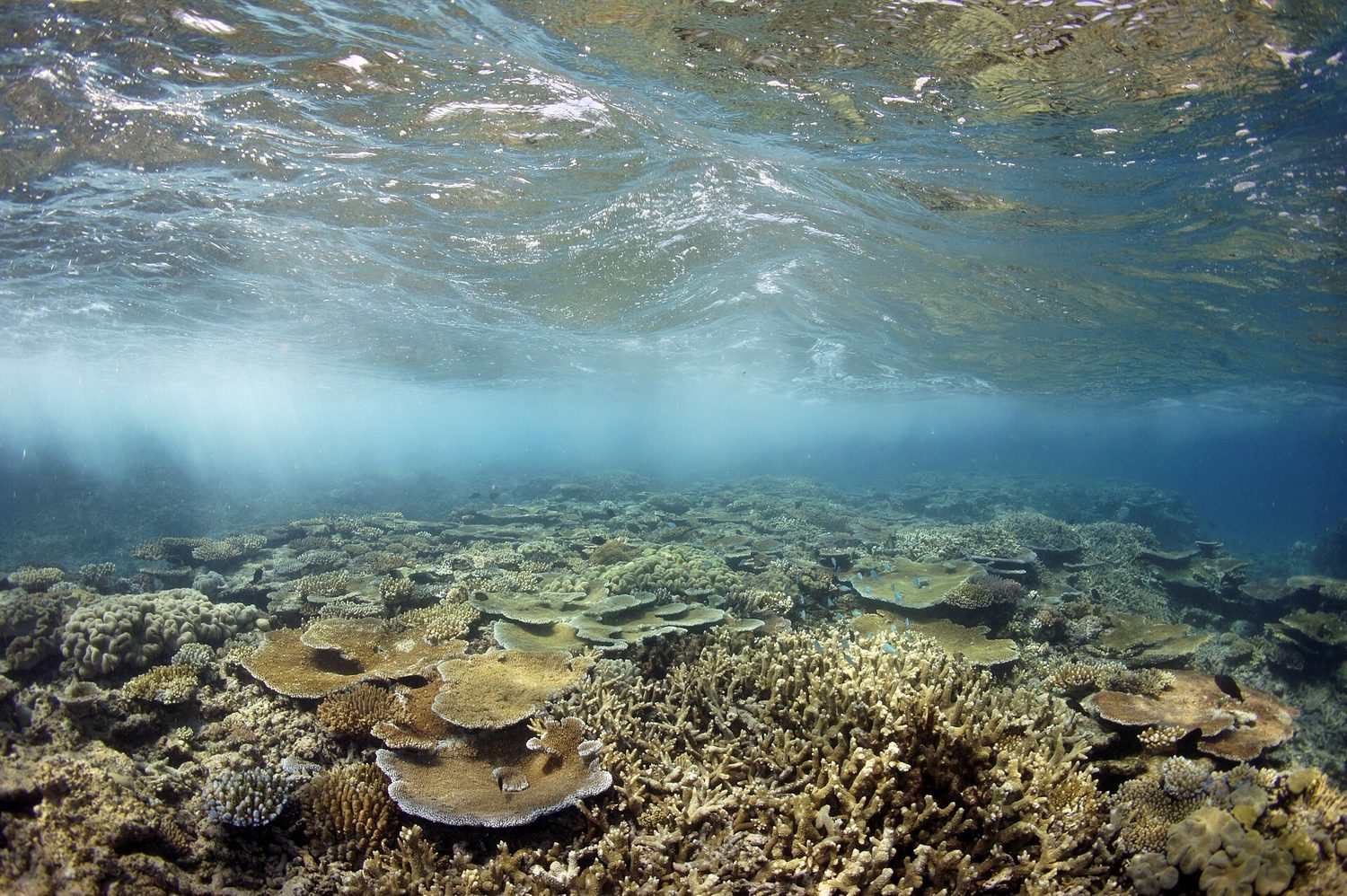
- Species with narrow ranges are sensitive. Reef-building corals live within about 1–2 °C of their upper temperature limit. A small rise pushes them into the stress zone, and they expel their algae (coral bleaching).
Worked example (reading a tolerance curve). A fish's optimal range is 18–24 °C and it dies above 30 °C. A power plant raises the river from 22 °C to 27 °C. Predict the effect. At 27 °C the fish are outside the optimal range but still below the lethal limit, so they are in the zone of stress. They survive, but they grow and reproduce less, so the population declines over time. Warm water also holds less dissolved oxygen, which adds a second stress.
Vocabulary
Train
| English |
|---|
| range of tolerance/reɪndʒ ɒv ˈtɒlərəns/ |
| optimal range/ˈɒptɪml reɪndʒ/ |
| zones of stress/zəʊnz ɒv stres/ |
| ecological tolerance/ˌekəˈlɒdʒɪkl ˈtɒlərəns/ |
2.5
Natural Disruptions to Ecosystems

Syllabus
| Enduring Understanding | Learning Objective | Essential Knowledge |
|---|---|---|
ERT-2 | ERT-2.G |
|
Source: College Board AP Course and Exam Description
Natural events disrupt ecosystems across every timescale, and a single natural event can rival or exceed a human-made one. Earth's processes come in three timing patterns:
- Periodic 周期性 – regular cycles (seasons, tides, monsoons).
- Episodic 偶发性 – occasional, irregular events (fires, floods, droughts, volcanic eruptions, El Niño years).
- Random 随机 – no pattern at all (a meteor strike, an earthquake).
Over geological time, Earth's climate has shifted for many reasons (changes in Earth's orbit, volcanic activity, the movement of continents). Sea level has risen and fallen with the amount of glacial ice: when ice sheets grow, they lock up ocean water and sea level drops; when they melt, sea level rises. During the last ice age, sea level was about 120 m lower than today, and land bridges joined Asia to North America. Each change reshaped large areas of habitat.
Wildlife responds by migration 迁徙, moving short or long distances to follow food, water or suitable temperatures. Some migrations are seasonal (wildebeest on the Serengeti, geese flying south); others are slow shifts of a whole range – many plants and animals are now moving toward the poles and up mountains as the climate warms.
Explore
How often does it happen?
Sort each natural disruption by how regularly it occurs - periodic, episodic, or random.
Vocabulary
Train
| English |
|---|
| periodic/ˌpɪərɪˈɒdɪk/ |
| episodic/ˌepɪˈsɒdɪk/ |
| random/ˈrændəm/ |
| migration/maɪˈɡreɪʃn/ |
2.6
Adaptations
Syllabus
| Enduring Understanding | Learning Objective | Essential Knowledge |
|---|---|---|
ERT-2 | ERT-2.H |
|
Source: College Board AP Course and Exam Description
An adaptation 适应 is an inherited trait that improves survival and reproduction in an environment. Adaptations arise through natural selection 自然选择: individuals vary, some variations help survival, and those individuals leave more offspring, so the helpful trait becomes common. This is incremental genetic change accumulating over generations, not change within a single lifetime – a giraffe cannot stretch its neck and pass the stretch to its calves.
When the environment changes, individuals have three choices: adapt (if the population has enough variety and enough time), move (migrate to suitable habitat), or die. If change comes faster than a population can adapt – for example, rapid warming or a sudden new predator – the population declines and may go extinct. Species with short generation times (insects, bacteria, weeds) adapt fastest; this is why pests evolve resistance to pesticides within a few years.
A periodic disturbance such as fire is often part of a healthy cycle, and many species are adapted to it. Some pine cones open only in a fire's heat, and thick bark protects mature trees. Putting out every small fire lets dead wood build up, so the fire that finally comes is far larger and hotter.
Explore
What kind of adaptation?
Sort each adaptation by its type - a body structure, a behaviour, or an internal process.
Vocabulary
Train
| English |
|---|
| adaptation/ˌædæpˈteɪʃn/ |
| natural selection/ˈnætʃərəl sɪˈlekʃn/ |
2.7
Ecological Succession

Syllabus
| Enduring Understanding | Learning Objective | Essential Knowledge |
|---|---|---|
ERT-2 | ERT-2.I |
|
ERT-2.J |
|
Source: College Board AP Course and Exam Description
Ecological succession 生态演替 is the gradual, orderly change in the species of a community over time:
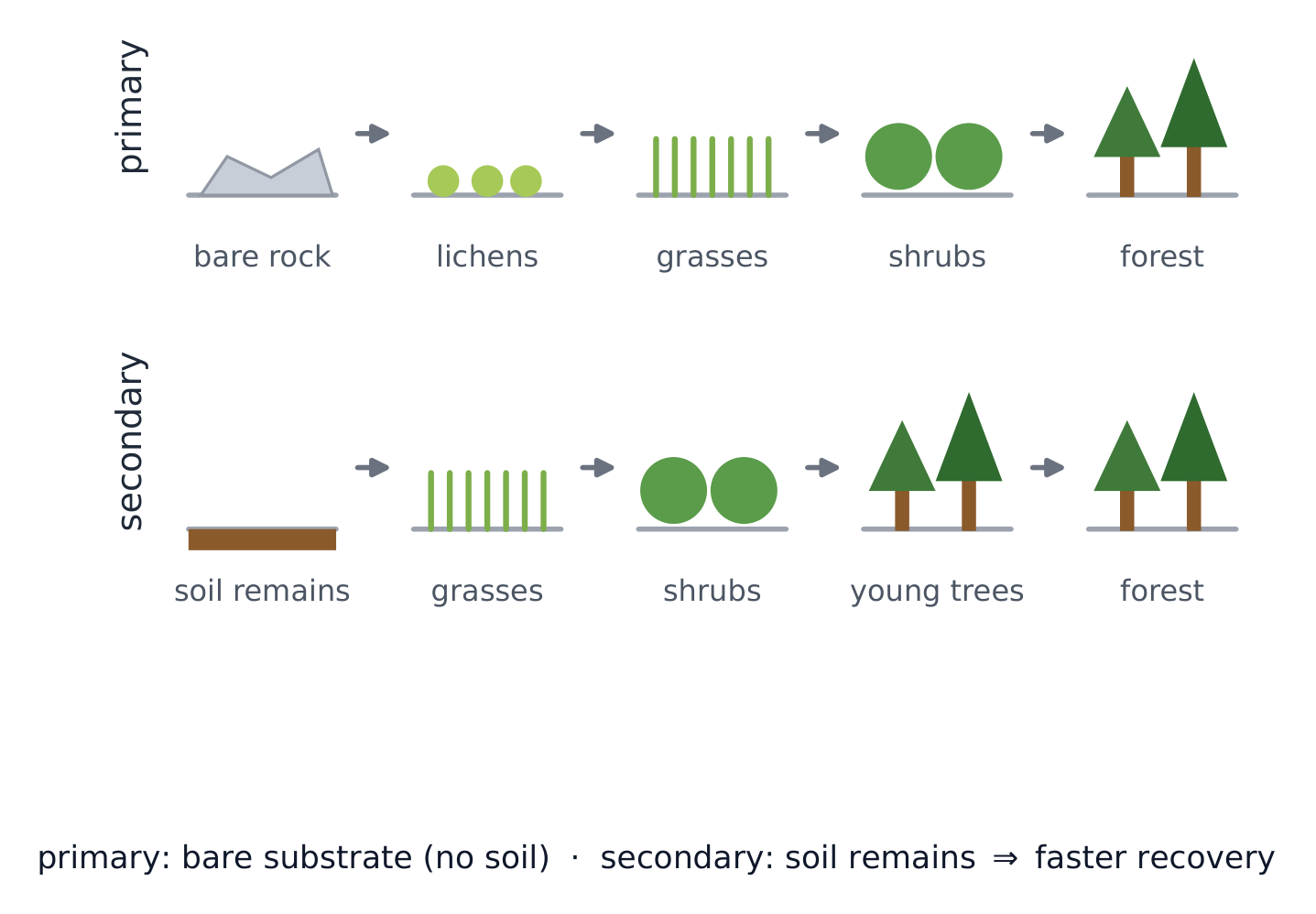
- Primary succession 初级演替 starts on bare rock with no soil – after a glacier retreats, lava cools, or a new volcanic island rises. Pioneer species 先锋物种 such as lichens 地衣 and mosses arrive first. They break rock down with acids and add dead organic matter, slowly building a thin soil. It takes hundreds to thousands of years.
- Secondary succession 次级演替 follows a disturbance that leaves the soil intact – after a fire, a flood, logging, or an abandoned farm field. Seeds and roots are already in the soil, so it is much faster (decades). Grasses and weeds come first, then shrubs, then fast-growing trees, and finally slow-growing, shade-tolerant trees.
Succession tends toward a relatively stable climax community 顶极群落, such as a mature oak–hickory forest. Each stage changes conditions (more soil, more shade, more moisture) in ways that help the next set of species and push out the earlier ones.
How the ecosystem changes during succession. AP questions ask about three quantities:
- Total biomass rises steadily and levels off as large, long-lived trees store more and more carbon.
- Species richness rises quickly as new habitats appear, then levels off or falls slightly in the mature forest as a few dominant trees shade out other plants.
- Net primary productivity (NPP) is highest in the middle stages, when fast-growing plants add new growth quickly. In a mature forest, much of the energy captured is used for the respiration of large trees, so NPP drops.

Two special roles shape a community out of proportion to their numbers:
- A keystone species 关键种 holds the community structure together; remove it and the community collapses. Sea otters eat sea urchins; without otters, urchins strip kelp forests bare. Beavers build dams that create ponds and wetlands used by fish, birds and insects; remove the beavers and the wetland drains.
- An indicator species 指示物种 signals the condition of the whole ecosystem by its presence, absence or health. Lichens vanish where the air holds sulfur dioxide; mayfly and stonefly larvae live only in clean, well-oxygenated streams; frogs, with thin skin, are early warnings of water pollution.
Worked example (FRQ style). A farm field in Pennsylvania is abandoned. Describe the type of succession that follows, and explain how net primary productivity changes over 150 years. The soil is still present, so this is secondary succession. Annual weeds and grasses arrive first, followed by shrubs and fast-growing trees such as pines, then hardwoods such as oaks. NPP rises during the early and middle stages as plants grow quickly and cover the ground, peaks when young trees are growing fastest, and then falls in the mature forest because large trees use much of their gross productivity for respiration.
Designing an investigation. Many APES FRQs describe a field study and ask about its design. Know these words:
- Hypothesis: a testable prediction, often "if … then …". If grassland is left unmowed, then it will have more ant species than mowed grassland.
- Independent variable: what the investigator changes or compares (mowed or unmowed).
- Dependent variable: what is measured (number of ant species, or Simpson's index).
- Control: the group or site with no treatment, used for comparison. An untouched zone upstream of a pollution source is a typical control.
- Constants: things kept the same in every group, such as sampling time, trap size and weather.
Worked example (changing the method). Students counted ant species in a grassland in May. Explain how the results would change if they (a) sampled a paved playground instead, or (b) sampled in winter.
- (a) A playground has little food, no plants and no soil for nests, so far fewer ant species would be found. The comparison would then measure habitat loss, not mowing.
- (b) In winter, many ants are inactive underground, so counts would be lower in every plot, and real differences between plots might be hidden.
- In each answer, name the direction of the change (more or fewer) and give the reason.
Recovering after a disturbance. In data on restored land, such as old mine spoil, species numbers rise with the age of the site. Areas left to recover by themselves (spontaneous succession) are first colonised by pioneer plants: small, fast-growing, wind-dispersed, and able to live in poor soil. The same recovery is much slower in the tundra, where the cold, short growing season and thin soil slow plant growth and decomposition.
Vocabulary
Train
| English |
|---|
| ecological succession/ˌekəˈlɒdʒɪkl səkˈseʃn/ |
| primary succession/ˈpraɪməri səkˈseʃn/ |
| pioneer species/paɪəˈnɪə ˈspiːsiːz/ |
| lichens/ˈlaɪkənz/ |
| secondary succession/ˈsekəndəri səkˈseʃn/ |
| climax community/ˈklaɪmæks kəˈmjuːnɪti/ |
| keystone species/ˈkiːstəʊn ˈspiːsiːz/ |
| indicator species/ˈɪndɪkeɪtə ˈspiːsiːz/ |
2.7
Exam tips
- Describe biodiversity at three levels: genetic, species, and habitat, and link higher diversity to greater resilience.
- Explain why a bottleneck is harmful even after numbers recover: genetic variety has been lost.
- Specialist species (narrow needs) are more vulnerable than generalists when a habitat changes; large-territory species decline as habitat is fragmented.
- Name the four ecosystem services (provisioning, regulating, cultural, supporting) and give an economic cost when one is lost.
- Island biogeography: larger islands mean lower extinction; nearer islands mean higher immigration. Apply it to habitat fragments and wildlife corridors.
- On a tolerance curve, name the optimal range, zones of stress and the limits; a narrow range means a sensitive species.
- Distinguish primary succession (bare rock, no soil, slow) from secondary (soil intact, faster), and name a pioneer species.
- During succession: biomass rises and levels off, richness rises then levels, NPP peaks in the middle.
- Explain a keystone species (outsized effect) and an indicator species (signals ecosystem health) with an example of each.
Interactive lessons on this topic
Work through it step by step, with instant-check exercises.