| Enduring Understanding | Learning Objective | Essential Knowledge |
|---|---|---|
ENG-3 | ENG-3.A |
|
Energy Resources and Consumption
AP Environmental Science · Topic 6
 9:13
Energy Resources and Consumption
Look at this hole in the ground. A machine digs out soft brown coal, and the power station behind it burns it the same day. Now look at this: three towers on a…
English narration · English + 中文 subtitles burned in
6.1
Renewable and Nonrenewable Resources
Syllabus
Source: College Board AP Course and Exam Description
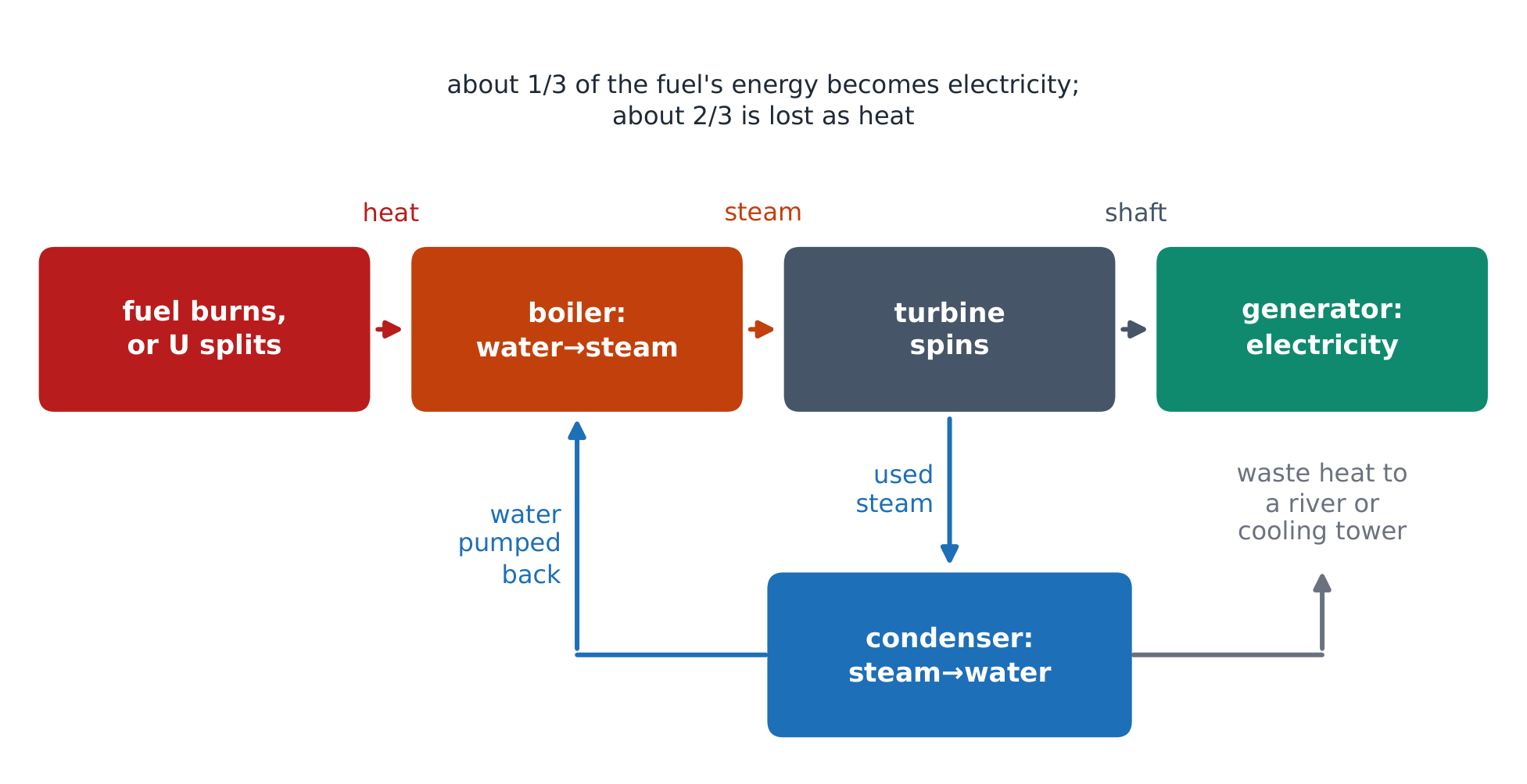
Every time you charge a phone in China, there is roughly a 60% chance the electricity came from burning coal. The coal was dug up, carried by train, burned to boil water, and the steam spun a turbine – and about two-thirds of the coal's energy was lost as heat on the way. This unit compares every major energy source by the same questions: where does the energy come from, how is it turned into electricity, and what does it cost the environment?
A nonrenewable resource 不可再生资源 exists in a fixed amount and cannot be replaced on a human timescale once it is used; forming more takes millions of years. Fossil fuels (coal, oil, natural gas) and nuclear fuel (uranium) are nonrenewable. A renewable resource 可再生资源 is replenished naturally, at or near the rate we use it: sunlight, wind, flowing water, tides, geothermal heat, and biomass.
Two cautions for the exam:
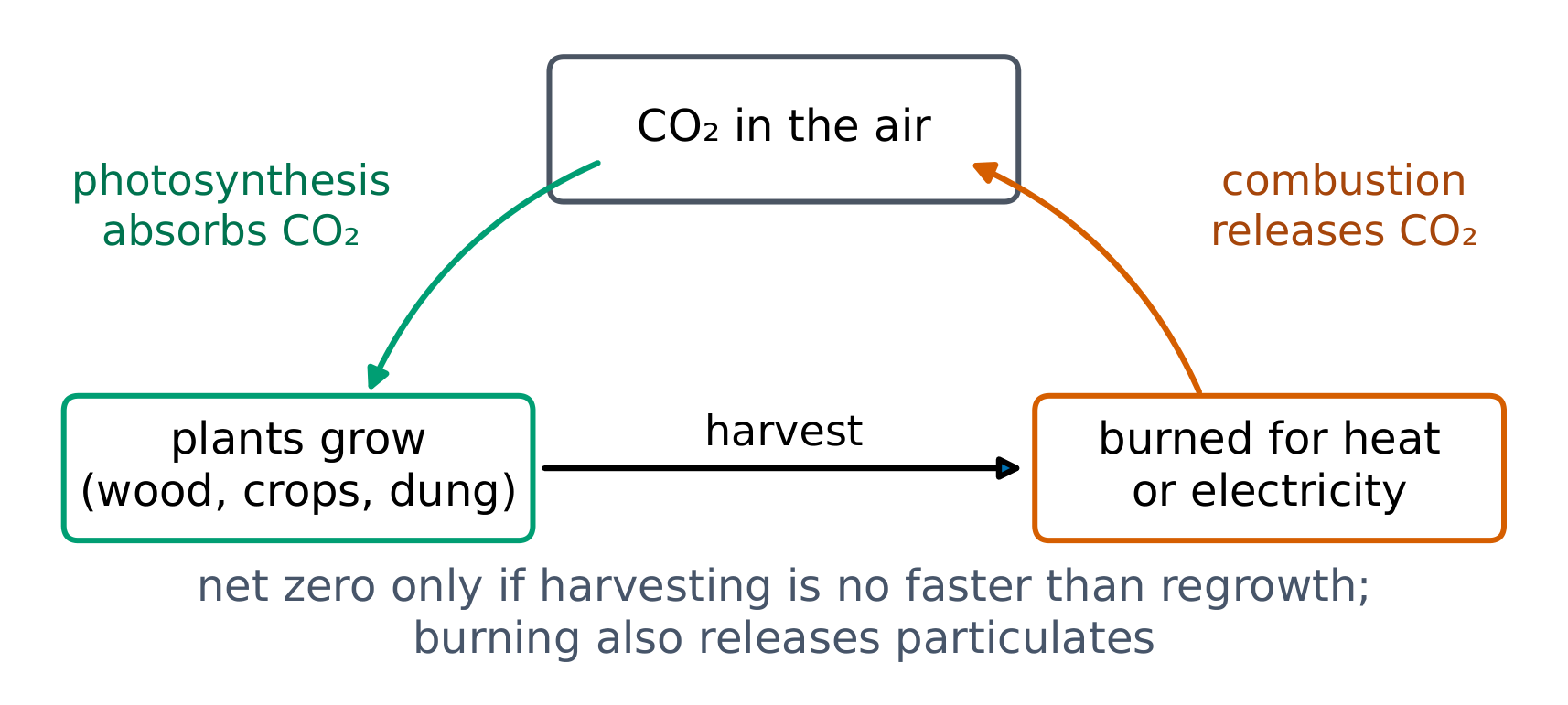
- Biomass is renewable only if we harvest it no faster than it regrows. Cutting forests for firewood faster than they regrow turns a renewable resource into a shrinking one.
- Nuclear power is nonrenewable even though it releases no $\text{CO}_2$: uranium ore is mined and is finite.
Explore
Renewable or nonrenewable?
Sort each energy source by whether nature refills it or it runs out.
Vocabulary
Train
| English |
|---|
| nonrenewable resource/ˌnɒnrɪˈnjuːəbl rɪˈzɔːs/ |
| renewable resource/rɪˈnjuːəbl rɪˈzɔːs/ |
6.2
Global Energy Consumption
Syllabus
| Enduring Understanding | Learning Objective | Essential Knowledge |
|---|---|---|
ENG-3 | ENG-3.B |
|
Source: College Board AP Course and Exam Description
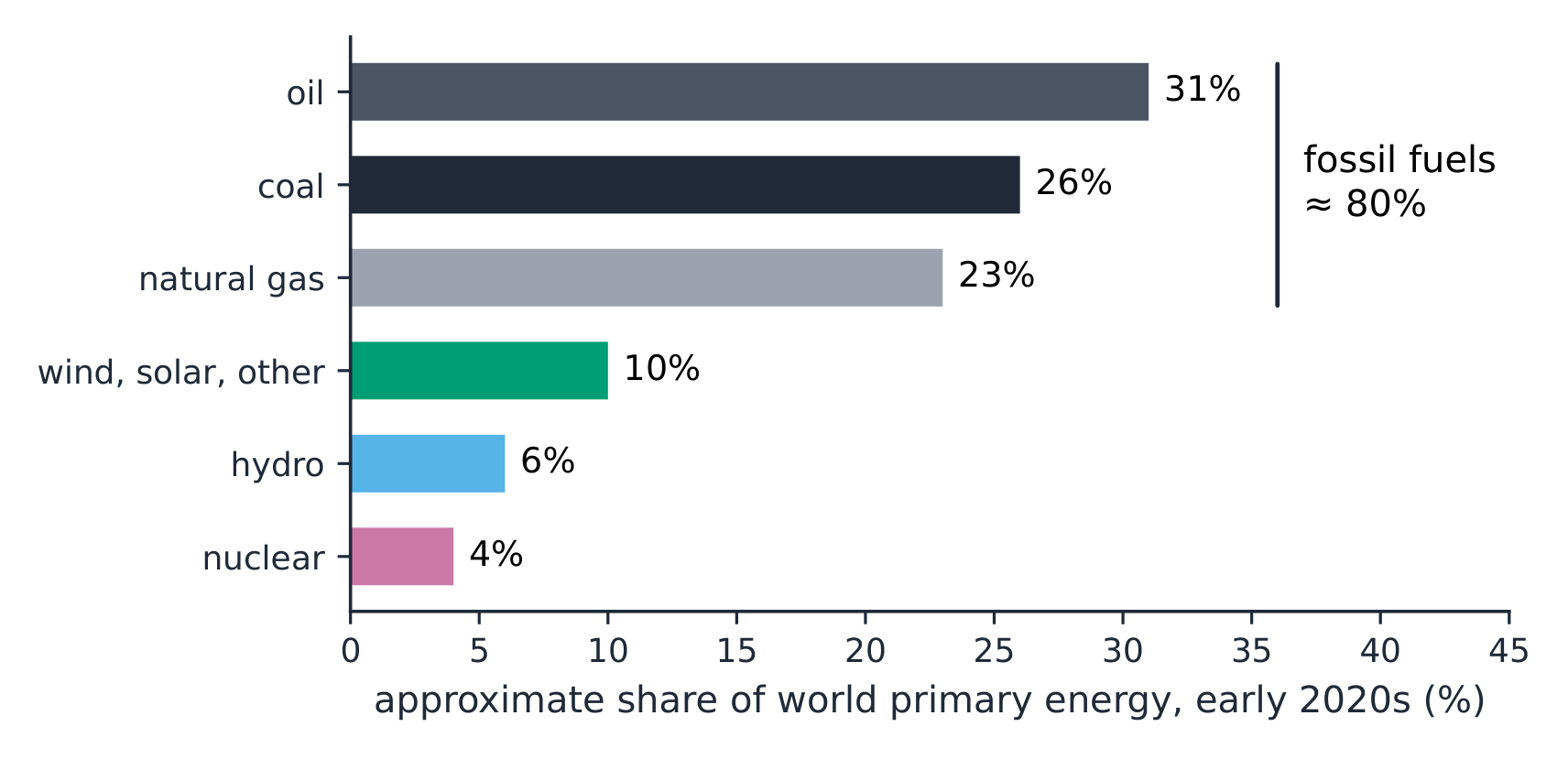
The world's most widely used energy sources are fossil fuels 化石燃料 – about 80% of primary energy. Energy use is not evenly distributed: a person in the United States or Canada uses about ten times as much energy as a person in India, and many times more than a person in most sub-Saharan African countries.
- As the world becomes more industrialized, the total demand for energy increases.
- As developing countries become more developed, their reliance on fossil fuels usually increases at first – factories, cars and air conditioning arrive faster than renewable capacity is built. China's coal use grew several-fold between 2000 and 2020.
- Availability, price, and government regulations decide which sources people use. A country with cheap local coal tends to burn coal; subsidies for solar panels or a carbon tax shift choices toward low-carbon sources; a ban on new petrol cars changes how people travel.
Explore
Trace energy from source to use
A Sankey diagram shows how energy flows from sources to useful work — and how much is lost. Most primary energy is wasted as heat before it does anything useful.
Vocabulary
Train
| English |
|---|
| fossil fuels/ˈfɒsl ˈfjuːəlz/ |
6.3
Fuel Types and Uses
Syllabus
| Enduring Understanding | Learning Objective | Essential Knowledge |
|---|---|---|
ENG-3 | ENG-3.C |
|
Source: College Board AP Course and Exam Description
Different fuels suit different needs:
| Fuel | Main uses | Notes |
|---|---|---|
| Wood and charcoal | cooking and heating | common in developing countries because it is easy to collect; indoor smoke and deforestation |
| Peat 泥炭 | heating, some power plants (Ireland, Finland) | partly decomposed plant material from bogs; burned after drying |
| Coal | electricity, steel making | three ranks: lignite, bituminous, anthracite |
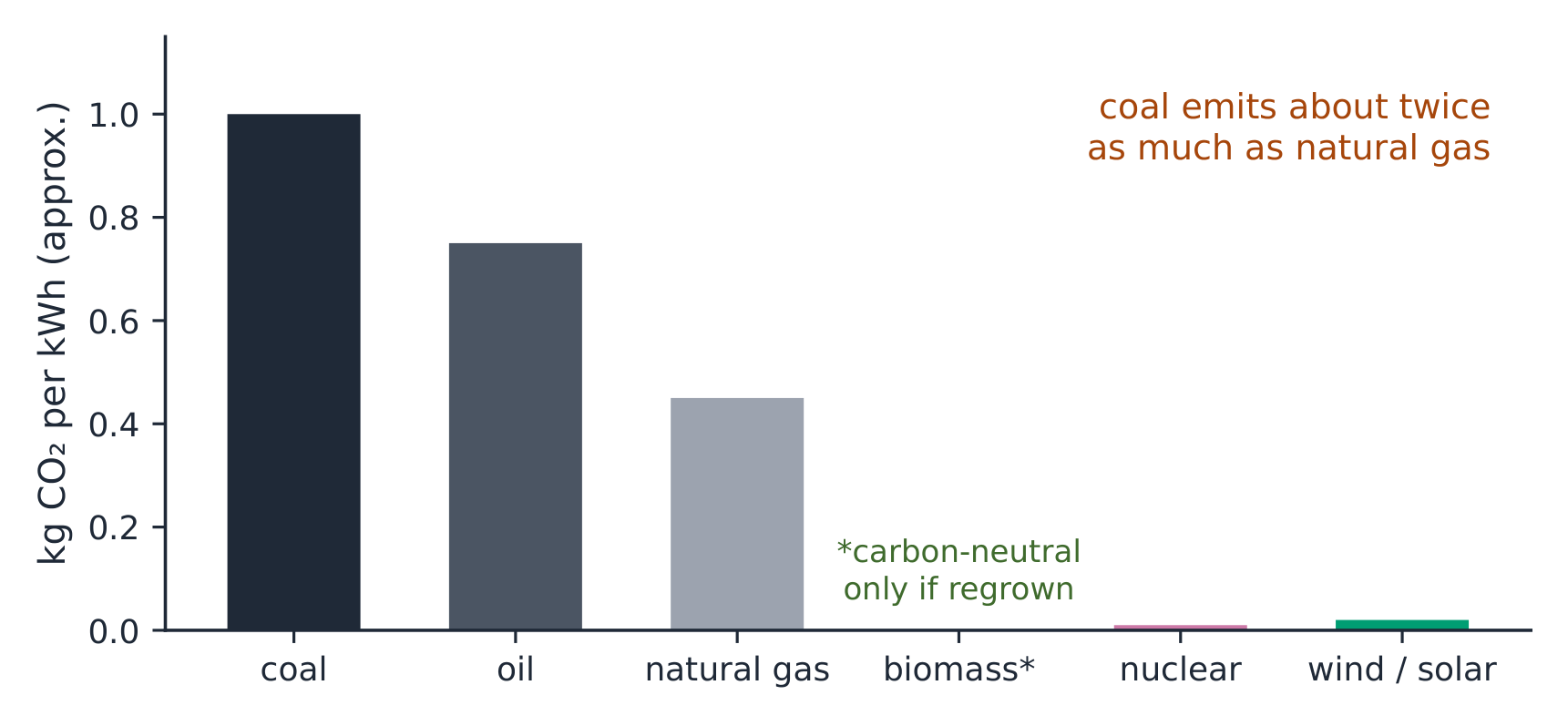
| Natural gas (mostly methane) | electricity, heating, cooking | the cleanest fossil fuel: fewest pollutants and least $\text{CO}_2$ per unit of energy |
| Crude oil | refined into petrol (gasoline), diesel, jet fuel, heating oil, plastics | the main transport fuel |
Crude oil is refined into specialized fuels: a refinery heats it and separates it by boiling point into gases, petrol for cars, kerosene for jets, diesel for trucks, and heavy oils and asphalt.
Cogeneration 热电联产 (combined heat and power) uses one fuel source to produce both electricity and useful heat. An ordinary power plant dumps about two-thirds of its fuel energy as waste heat; a cogeneration plant pipes that heat to nearby buildings or factories, so 70–90% of the fuel's energy does useful work.
Explore
What is each fuel mainly used for?
Sort each fuel by its main use - moving vehicles or making electricity and heat.
Vocabulary
Train
| English |
|---|
| peat/piːt/ |
| cogeneration/ˌkəʊdʒənəˈreɪʃn/ |
6.4
Distribution of Natural Energy Resources
Syllabus
| Enduring Understanding | Learning Objective | Essential Knowledge |
|---|---|---|
ENG-3 | ENG-3.D |
|
Source: College Board AP Course and Exam Description
Energy resources are unevenly distributed, and the reason is geologic history. Coal formed where swamp forests were buried about 300 million years ago (eastern US, northern China, Germany). Oil and gas formed from marine plankton buried in ancient seas, then collected in traps in sedimentary rock (the Persian Gulf, Texas, Siberia). Metal ores form where magma and hot fluids concentrated minerals.
Renewables depend on local conditions: strong steady winds (coasts, plains), strong sunlight (deserts), large rivers in steep valleys, or hot rock near the surface (volcanic regions). This uneven distribution drives trade, prices and geopolitics – countries without their own oil must import it, which can make them vulnerable to supply cuts.
Explore
What does each resource depend on?
Sort each resource by whether its location depends on climate or on geology.
6.5
Fossil Fuels
Syllabus
| Enduring Understanding | Learning Objective | Essential Knowledge |
|---|---|---|
ENG-3 | ENG-3.E |
|
ENG-3.F |
|
Source: College Board AP Course and Exam Description
Fossil fuels (coal, oil, natural gas) formed from ancient organisms buried and changed by heat and pressure. They are energy-dense and reliable, but nonrenewable and the main source of $\text{CO}_2$ and air pollution. Coal is the dirtiest; natural gas burns cleaner but leaks methane 甲烷, a strong greenhouse gas.
Combustion is a chemical reaction between the fuel and oxygen that releases energy and produces carbon dioxide and water. For methane:
$$\text{CH}_4 + 2\,\text{O}_2 \rightarrow \text{CO}_2 + 2\,\text{H}_2\text{O} + \text{energy}$$
Coal and oil also contain sulfur and nitrogen, so burning them releases $\text{SO}_2$, $\text{NO}_x$, particulates and mercury.
How a power plant makes electricity. Burning fuel heats water into high-pressure steam. The steam turns a turbine, the turbine spins a generator, and the generator produces electricity. The used steam is cooled back to water and pumped round again. Nuclear, geothermal, biomass and solar-thermal plants use the same steam-turbine chain; only the heat source differs.
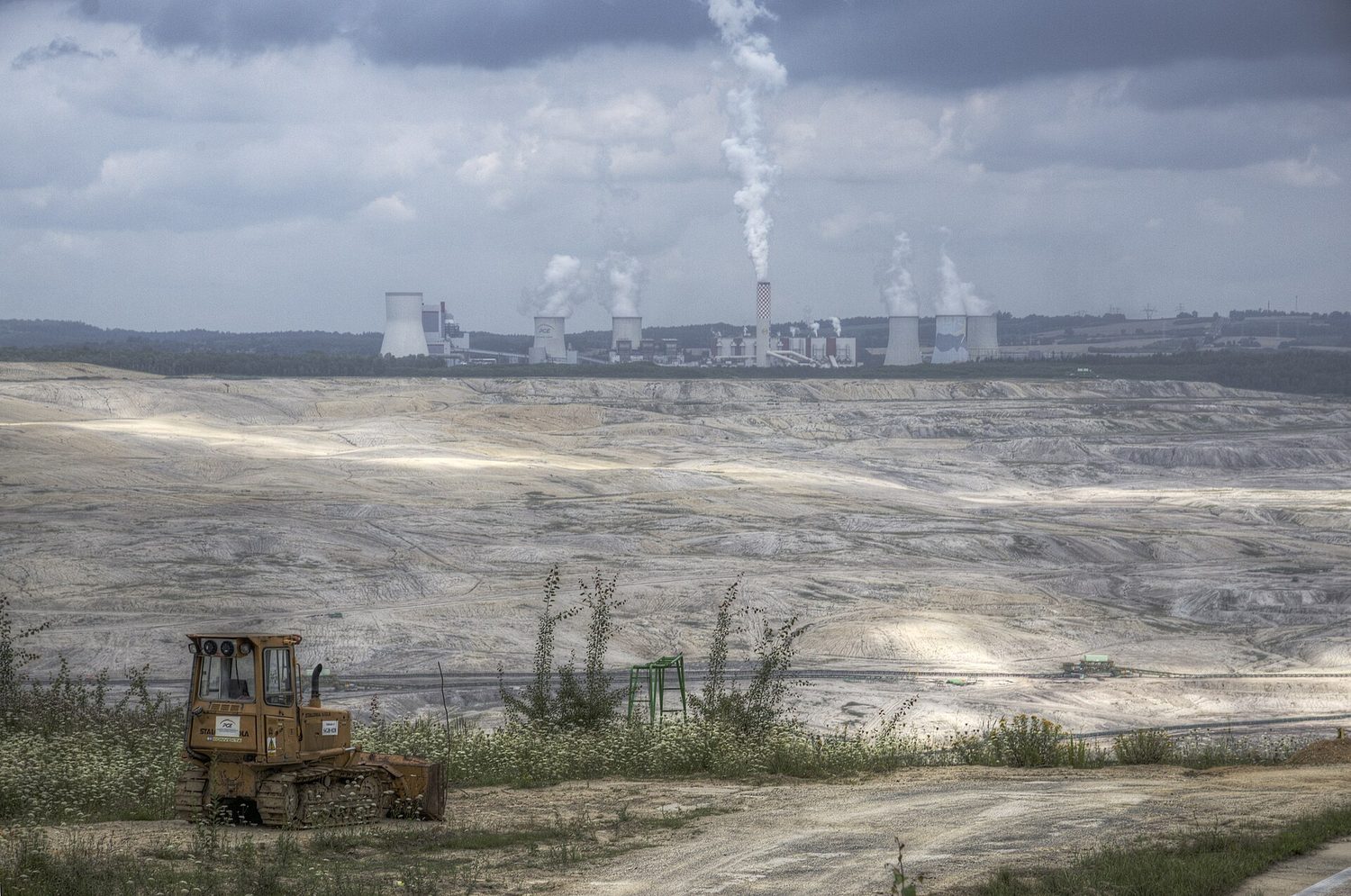
Coal forms in stages, and its rank climbs with the heat, pressure, and depth of burial it has endured. Partly decomposed plant matter first becomes peat, then soft brown lignite, then bituminous 烟煤 coal, and finally hard anthracite 无烟煤 – each step is drier, more carbon-rich, and higher in energy, so anthracite burns hottest and cleanest.
Humans use several methods to extract fossil fuels: surface (strip) mining and mountaintop removal for shallow coal, underground mining for deep coal, and drilling wells for oil and gas, on land and offshore.
Oil and natural gas are increasingly reached by hydraulic fracturing 水力压裂 ("fracking"): water, sand and chemicals are pumped at high pressure into shale rock to crack it open and release the trapped fuel. It has unlocked huge reserves, but it can contaminate groundwater (methane and chemicals reaching drinking-water wells), release volatile organic compounds 挥发性有机化合物 into the air, use large amounts of water, and trigger minor earthquakes when waste water is injected underground.
Crude oil can also be recovered from tar sands 油砂 – a mix of clay, sand, water, and thick bitumen 沥青. Separating the oil is energy- and water-intensive and clears large areas of forest, so its environmental cost per barrel of oil is high.
Worked example (power-plant energy). A coal plant must deliver $1.0\times10^{9}$ kWh of electricity a year and is 33% efficient. One kilogram of coal releases about 8 kWh of heat. Heat needed $= \dfrac{1.0\times10^{9}\ \text{kWh}}{0.33} \approx 3.0\times10^{9}\ \text{kWh}$. Coal needed $= \dfrac{3.0\times10^{9}\ \text{kWh}}{8\ \text{kWh/kg}} \approx 3.8\times10^{8}\ \text{kg}$, or about 380 000 tonnes a year. Raising the efficiency to 45% would cut that to about 280 000 t – which is why efficiency and cogeneration matter.
Worked example (how long will it last?). An oil-sands deposit holds $1.7 \times 10^{11}$ barrels of recoverable bitumen, extracted at $3.0 \times 10^{6}$ barrels a day.
- Days: $\dfrac{1.7 \times 10^{11}}{3.0 \times 10^{6}} \approx 5.7 \times 10^{4}$ days.
- Years: $5.7 \times 10^{4} \div 365 \approx 155$ years.
- A faster extraction rate shortens this; new discoveries lengthen it. That is why a "reserve lifetime" is an estimate, not a fixed date.
Vocabulary
Train
| English |
|---|
| methane/ˈmiːθeɪn/ |
| lignite/ˈlɪɡnaɪt/ |
| bituminous/baɪˈtjuːmɪnəs/ |
| anthracite/ˈænθrəsaɪt/ |
| hydraulic fracturing/haɪˈdrɔːlɪk ˈfræktʃərɪŋ/ |
| volatile organic compounds/ˈvɒlətaɪl ɔːˈɡænɪk ˈkɒmpaʊndz/ |
| tar sands/tɑː sændz/ |
| bitumen/ˈbɪtʃuːmən/ |
| power station/ˈpaʊə ˈsteɪʃn/ |
6.6
Nuclear Power

Syllabus
| Enduring Understanding | Learning Objective | Essential Knowledge |
|---|---|---|
ENG-3 | ENG-3.G |
|
ENG-3.H |
|
Source: College Board AP Course and Exam Description
Nuclear power 核能 is generated by fission 裂变. Atoms of uranium-235, packed into fuel rods, are struck by a neutron and split into smaller parts, releasing a large amount of heat and two or three more neutrons, which split more atoms in a chain reaction. Control rods absorb neutrons to keep the chain reaction steady. The heat makes steam, which drives a turbine and generator just like a coal plant.
Radioactivity happens when the nucleus of a radioactive isotope loses energy by emitting radiation (alpha particles, beta particles or gamma rays). Used fuel rods stay radioactive for thousands of years, which makes the disposal of nuclear waste 核废料 a long-term problem: it is stored in cooling pools, then dry casks, and no country yet runs a permanent deep repository at full scale.
Nuclear power is nonrenewable. It is considered cleaner than fossil fuels because it releases no air pollutants and no $\text{CO}_2$ while running, but it does release thermal pollution (warm cooling water returned to rivers or the sea, which lowers dissolved oxygen) and hazardous solid waste.
| Accident | Year | What happened | Impact |
|---|---|---|---|
| Three Mile Island (USA) | 1979 | cooling failure; partial meltdown | small radiation release; no confirmed deaths; ended new US reactor orders for decades |
| Chernobyl (Ukraine) | 1986 | a test went wrong; reactor exploded and burned | radiation spread across Europe; 30 km exclusion zone still in place; rise in thyroid cancers |
| Fukushima (Japan) | 2011 | earthquake and tsunami knocked out cooling; three meltdowns | radiation released to land and sea; over 100 000 people evacuated |

A radioactive element's half-life – the time for half of it to decay – lets you calculate how much remains, and how radioactive it is, at any point in time.
Worked example (half-life). Suppose an isotope has a half-life of $30$ years and a reactor leaves $100\ \text{g}$ of it. After $30$ years $50\ \text{g}$ remains; after $60$ years $25\ \text{g}$; after $90$ years (three half-lives) $100\times\left(\tfrac12\right)^3=12.5\ \text{g}$. To fall below 1 g needs 7 half-lives ($100 \div 2^7 \approx 0.78$ g), or 210 years. Because the drop is halving, not linear, the waste stays hazardous for many half-lives – the core reason it must be stored safely for centuries.
Vocabulary
Train
| English |
|---|
| nuclear power/ˈnjuːklɪə ˈpaʊə/ |
| fission/ˈfɪʃn/ |
| waste/weɪst/ |
| nuclear power station/ˈnjuːklɪə ˈpaʊə ˈsteɪʃn/ |
6.7
Energy from Biomass
Syllabus
| Enduring Understanding | Learning Objective | Essential Knowledge |
|---|---|---|
ENG-3 | ENG-3.I |
|
Source: College Board AP Course and Exam Description
Biomass 生物质 is energy from living or recently living material: wood, charcoal, crop waste, animal dung, and biofuels such as ethanol and biodiesel. Burning biomass gives heat at a relatively low cost, but it releases carbon dioxide, carbon monoxide, nitrogen oxides, particulates and volatile organic compounds. Indoor cooking fires are a leading cause of respiratory disease in developing countries, and overharvesting trees for fuel causes deforestation.
Ethanol 乙醇, made from crops such as corn or sugarcane, can substitute for gasoline and adds no new carbon when burned (the plant absorbed that $\text{CO}_2$ as it grew). Its drawback, especially for corn ethanol, is a low energy return on energy investment (EROEI) 能量投资回报率: growing, fertilizing, harvesting, and distilling the corn uses nearly as much energy as the fuel finally delivers. (Sugarcane ethanol returns several times its energy input.) Growing fuel crops also competes with food crops for farmland.
Explore
Benefit or cost of biomass energy?
Sort each feature of burning biomass into a benefit or a cost.
Vocabulary
Train
| English |
|---|
| biomass/ˌbaɪəʊˈmæs/ |
| ethanol/ˈeθənɒl/ |
| energy return on energy investment (EROEI)/ˈenədʒi rɪˈtɜːn ɒn ˈenədʒi ɪnˈvestmənt/ |
6.8
Solar Energy

Syllabus
| Enduring Understanding | Learning Objective | Essential Knowledge |
|---|---|---|
ENG-3 | ENG-3.J |
|
ENG-3.K |
|
Source: College Board AP Course and Exam Description
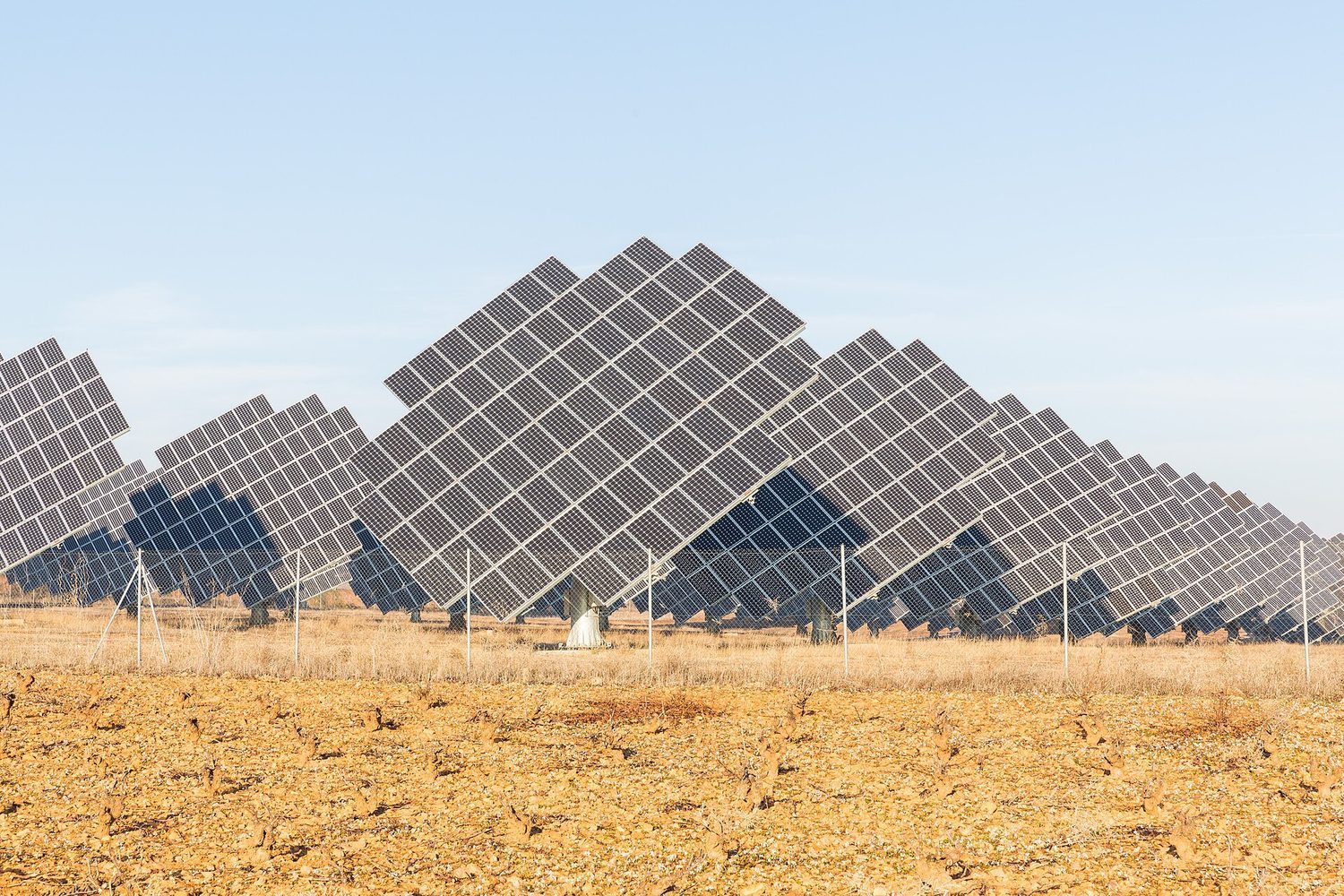
Solar 太阳能 energy can be captured in three ways:
- Photovoltaic (PV) cells capture light energy and transform it directly into electricity, with no turbine. Their use is limited by the availability of sunlight – none at night, less in winter and cloud.
- Active solar systems use mechanical and electric equipment (pumps, fans) to heat a liquid in rooftop collectors and collect and store the heat, for example in a hot-water tank.
- Passive solar design absorbs heat directly from the sun with no mechanical or electric equipment – south-facing windows (in the Northern Hemisphere), thick walls and dark floors that soak up heat by day and release it at night. The energy is used where it falls and cannot be collected or stored.
Solar energy has a low environmental impact and produces clean energy while it runs, but panels can be expensive and their manufacture uses energy and some toxic materials. Large solar farms can harm desert ecosystems by clearing land, fragmenting habitat for animals such as desert tortoises, and changing soil and shade.
Explore
Active or passive solar?
Sort each example by whether it uses equipment (active) or just smart design (passive).
Vocabulary
Train
| English |
|---|
| solar/ˈsəʊlə/ |
| photovoltaic/ˌfəʊtəʊvəʊlˈteɪɪk/ |
6.9
Hydroelectric Power
Syllabus
| Enduring Understanding | Learning Objective | Essential Knowledge |
|---|---|---|
ENG-3 | ENG-3.L |
|
ENG-3.M |
|
Source: College Board AP Course and Exam Description
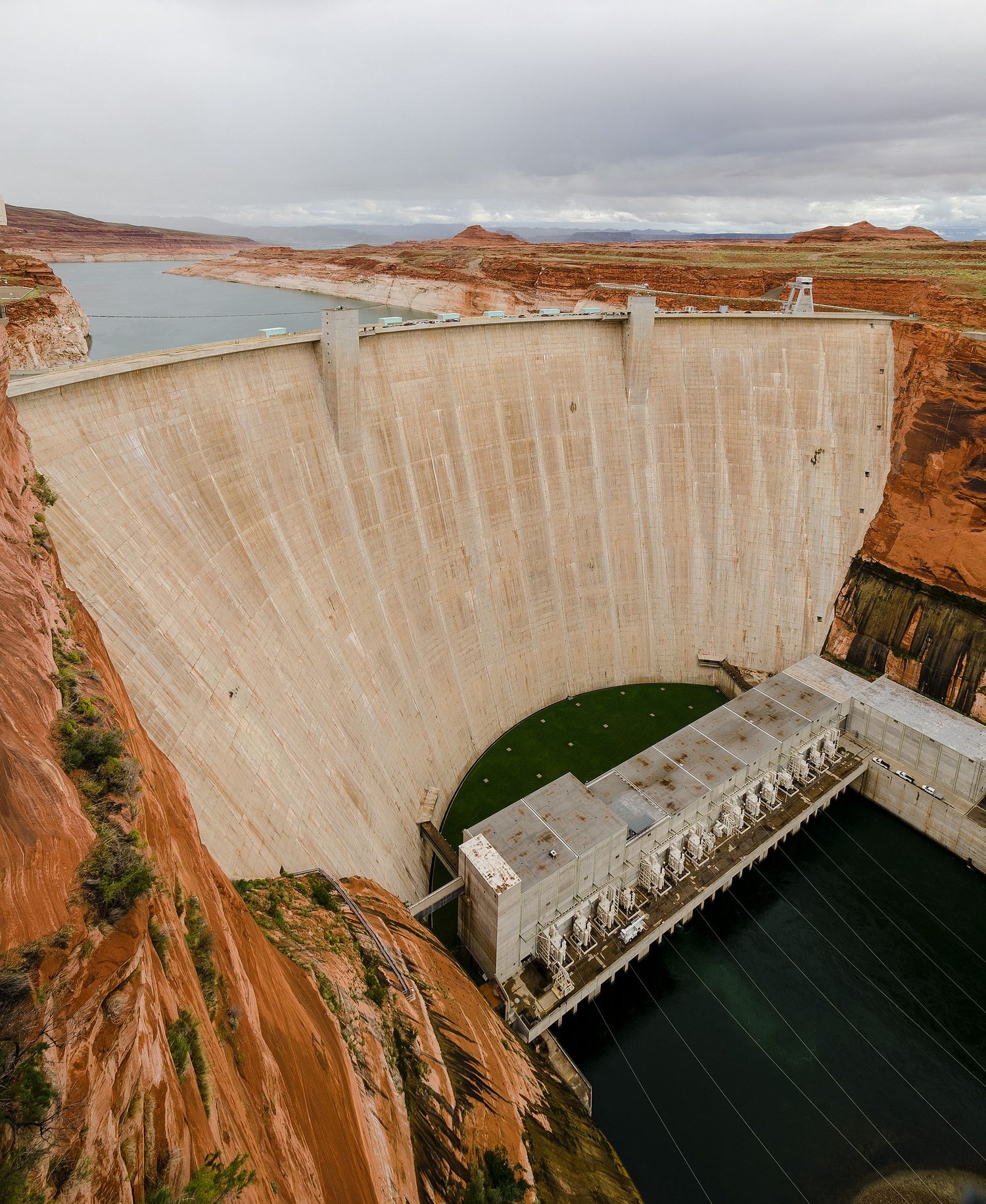
Hydroelectric 水电 power uses moving water to spin a turbine. It is generated in several ways:
- Dams built across rivers collect water in a reservoir 水库; water released through the dam spins turbines. The Three Gorges Dam on the Yangtze is the largest power station in the world.
- Run-of-the-river turbines are placed in small rivers, where the flowing water spins them without a large reservoir.
- Tidal energy uses the flow of tides in and out of a bay or estuary to turn turbines. Tides are predictable, unlike wind and sun, but few sites have a large enough tidal range.
Hydroelectric power produces no air pollution or waste while running, and a reservoir can store energy for when demand peaks. But construction is expensive, and dams change habitats: they flood forests and farmland, displace people, block fish migration (salmon cannot reach spawning streams without fish ladders), trap the sediment that would rebuild downstream deltas, and change water temperature and oxygen below the dam. Rotting plants in new reservoirs also release methane.
Explore
Benefit or cost of a dam?
Sort each effect of a hydroelectric dam into a benefit or a cost.
Vocabulary
Train
| English |
|---|
| hydroelectric/ˌhaɪdrəʊɪˈlektrɪk/ |
| reservoir/ˈrezəvwɑː/ |
| dam/dæm/ |
6.10
Geothermal Energy

Syllabus
| Enduring Understanding | Learning Objective | Essential Knowledge |
|---|---|---|
ENG-3 | ENG-3.N |
|
ENG-3.O |
|
Source: College Board AP Course and Exam Description
Geothermal 地热能 energy uses heat stored in Earth's interior to heat underground water, which is brought to the surface as steam. The steam drives a turbine and generator. Geothermal power is renewable and runs day and night, so it is reliable. Its drawbacks: it is only practical where hot rock lies near the surface (Iceland, New Zealand, Kenya, California), drilling can be prohibitively expensive elsewhere, and it can release hydrogen sulfide ($\text{H}_2\text{S}$, a toxic gas that smells of rotten eggs).
Small ground-source heat pumps, which use the steady temperature a few metres underground to heat and cool buildings, work almost anywhere.
Vocabulary
Train
| English |
|---|
| geothermal/ˌdʒiːəʊˈθɜːml/ |
| steam/stiːm/ |
6.11
Hydrogen Fuel Cell

Syllabus
| Enduring Understanding | Learning Objective | Essential Knowledge |
|---|---|---|
ENG-3 | ENG-3.P |
|
ENG-3.Q |
|
Source: College Board AP Course and Exam Description
A hydrogen fuel cell 氢燃料电池 is an alternative to nonrenewable fuels. It combines hydrogen fuel with oxygen from the air to form water, releasing energy as electricity:
$$2\,\text{H}_2 + \text{O}_2 \rightarrow 2\,\text{H}_2\text{O} + \text{electricity}$$
Water is the only emission. If the hydrogen is made by splitting water (electrolysis) with renewable electricity, the whole system has a low environmental impact and produces no $\text{CO}_2$. However, the technology is expensive, energy is still needed to make the hydrogen gas (today most hydrogen is made from natural gas, which releases $\text{CO}_2$), and hydrogen is hard to store and transport because it is a very light, flammable gas.
Vocabulary
Train
| English |
|---|
| hydrogen fuel cell/ˈhaɪdrədʒn ˈfjuːəl sel/ |
6.12
Wind Energy

Syllabus
| Enduring Understanding | Learning Objective | Essential Knowledge |
|---|---|---|
ENG-3 | ENG-3.R |
|
ENG-3.S |
|
Source: College Board AP Course and Exam Description
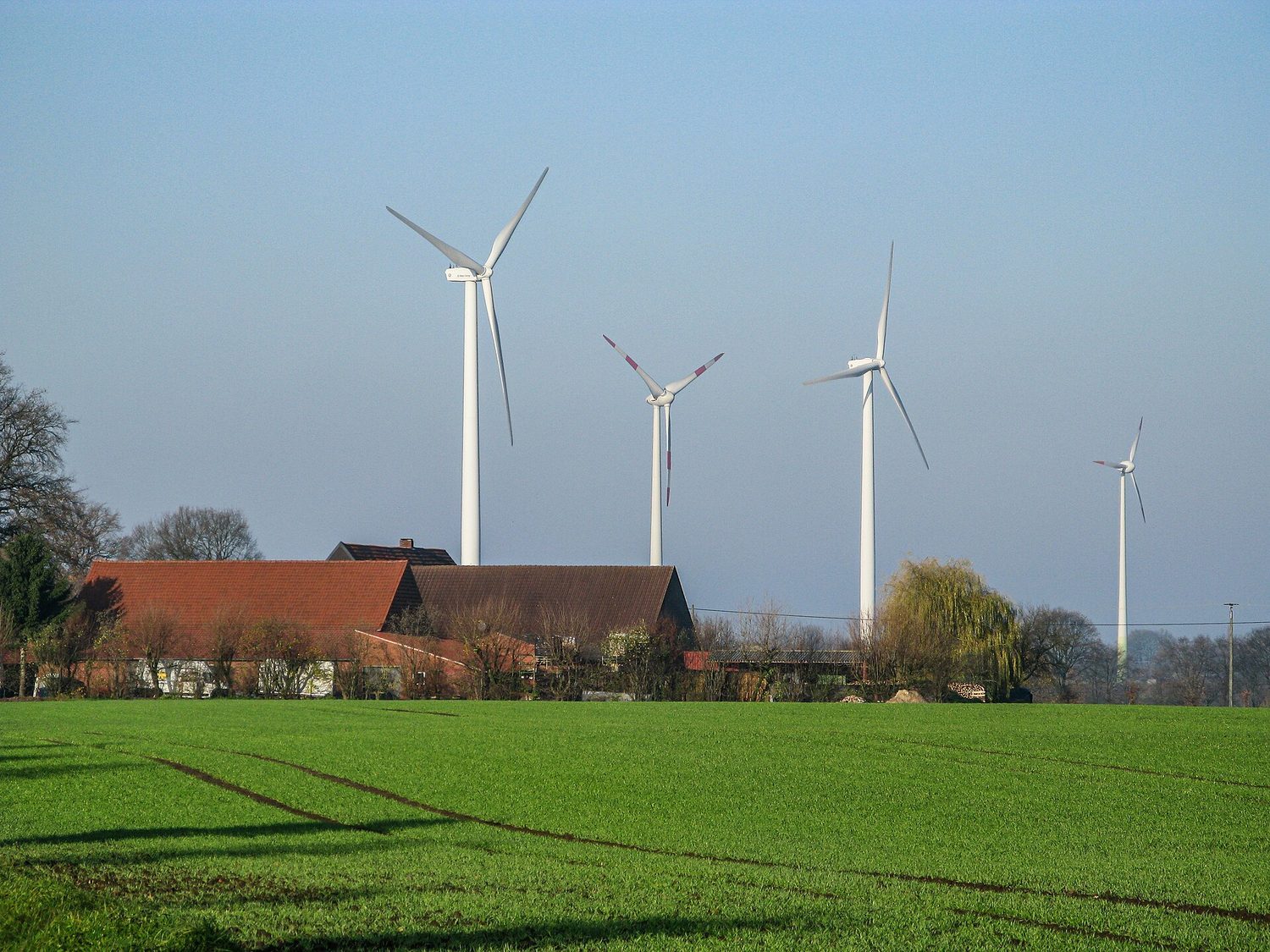
Wind 风能 turbines use the kinetic energy of moving air to spin a turbine, which spins a generator, producing electricity. Wind is a renewable, clean source: no fuel, no air pollution and low running costs, and the land between turbines can still be farmed. Its drawbacks are that it is intermittent (no wind, no power), turbines can be noisy and change the landscape, and birds and bats may be killed if they fly into the spinning blades. Careful siting away from migration routes reduces the harm. The best sites have strong, steady winds – coasts, open plains, ridges and offshore.
Worked example (wind farm). A town uses $6.0 \times 10^{7}$ kWh of electricity a year. A wind farm has 20 turbines, each producing 1500 kW when turning. How many hours must they run to supply 80% of the town's demand, and what is that electricity worth at $0.20 per kWh?
- Energy needed: $0.80 \times 6.0 \times 10^{7} = 4.8 \times 10^{7}$ kWh.
- Farm output: $20 \times 1500 = 30{,}000$ kW, so hours $= \dfrac{4.8 \times 10^{7}\ \text{kWh}}{3.0 \times 10^{4}\ \text{kW}} = 1600$ hours.
- Value: $4.8 \times 10^{7} \times 0.20 = \$9.6 \times 10^{6}$, about 9.6 million dollars a year.
Remember: energy (kWh) = power (kW) × time (h). A year has 8760 hours, so 1600 hours is under a fifth of the year, which suits a wind farm that does not turn all the time.
Explore
Benefit or cost of wind power?
Sort each feature of wind power into a benefit or a cost.
Vocabulary
Train
| English |
|---|
| wind/wɪnd/ |
| wind turbines/wɪnd ˈtɜːbaɪnz/ |
6.13
Energy Conservation
Syllabus
| Enduring Understanding | Learning Objective | Essential Knowledge |
|---|---|---|
ENG-3 | ENG-3.T |
|
Source: College Board AP Course and Exam Description
Energy conservation 节能 reduces demand. It is often the cheapest and cleanest option – the energy you do not use needs no fuel and makes no pollution.
Around the home:
- adjust the thermostat (a little cooler in winter, warmer in summer) to reduce heating and air conditioning;
- conserve water, especially hot water, since pumping and heating water uses energy;
- use energy-efficient appliances and LED lighting;
- conservation landscaping: plant trees to shade the house in summer and block winter winds, and choose native plants that need little watering.
On a large scale:
- improve the fuel economy of vehicles;
- use battery electric vehicles (BEVs) and hybrid vehicles;
- expand public transportation;
- use green building design: good insulation, passive solar design, green roofs, natural lighting and efficient heating and cooling.
Worked example (lighting). Replacing a $60\ \text{W}$ incandescent bulb with a $10\ \text{W}$ LED that gives the same light saves $50\ \text{W}$. Running it $5$ hours a day saves $50\ \text{W}\times5\ \text{h}=250\ \text{Wh}=0.25\ \text{kWh}$ per day, or about $0.25\times365\approx91\ \text{kWh}$ per year. At 0.15 US dollars per kWh, that saves about 14 dollars a year for one bulb. Multiply that by every bulb in a city and conservation rivals a new power plant – at far lower cost.
Explore
Saves energy or wastes energy?
Sort each everyday action by whether it saves or wastes energy.
Vocabulary
Train
| English |
|---|
| energy conservation/ˈenədʒi ˌkɒnsəˈveɪʃn/ |
6.13
Practice
Answer each before reading the answers below.
- A $60$ W incandescent bulb is replaced by a $10$ W LED, used $5$ hours a day for a year. Calculate the energy saved in kWh and the money saved at $0.12 per kWh.
- Give one advantage and two disadvantages of nuclear power.
- A radioactive waste sample of $100$ g has a half-life of $30$ years. How much is left after $90$ years?
- Classify each as renewable or nonrenewable: geothermal, natural gas, biomass, uranium.
- Describe two environmental effects of building a large hydroelectric dam.
- A hydrogen fuel cell's only product is water. Explain why hydrogen cars are not always carbon-free.
6.13
Answers
- $50$ W $\times$ ($5 \times 365$) h $= 91\,250$ Wh $= 91.25$ kWh; $91.25 \times 0.12 \approx$ $10.95.
- Advantage: no $\text{CO}_2$ released while generating electricity. Disadvantages: long-lived radioactive waste; thermal pollution of cooling water; risk of accidents; mining impacts.
- Three half-lives: $100 \rightarrow 50 \rightarrow 25 \rightarrow 12.5$ g.
- Renewable: geothermal, biomass. Nonrenewable: natural gas, uranium.
- Any two: blocks fish migration; traps sediment upstream; floods habitat; rotting flooded vegetation releases methane; changes water temperature and flow downstream.
- Most hydrogen is made from natural gas, which releases $\text{CO}_2$; electrolysis is clean only if the electricity is renewable.
6.13
Exam tips
- Separate renewable (sun, wind, water, geothermal, biomass if regrown) from nonrenewable (fossil fuels, nuclear) and weigh each source's trade-offs.
- Describe the steam chain: heat → steam → turbine → generator → electricity. It is the same for coal, gas, nuclear, geothermal and biomass.
- Write the combustion equation: fuel + oxygen → carbon dioxide + water + energy.
- Fossil fuels are energy-dense but emit $\text{CO}_2$; natural gas is the cleanest fossil fuel. Nuclear emits no $\text{CO}_2$ or air pollutants but leaves long-lived waste and thermal pollution.
- Know the three nuclear accidents: Three Mile Island, Chernobyl, Fukushima.
- Do half-life math: after $n$ half-lives a fraction $(\tfrac12)^n$ remains. Show units and every step in energy calculations.
- Distinguish PV (light → electricity directly), active solar (pumps, stores heat) and passive solar (no equipment, no storage).
- Solar and wind are intermittent; tides are predictable; geothermal can release hydrogen sulfide.
- Know the coal ranks (peat → lignite → bituminous → anthracite) and the problems of fracking (groundwater contamination, VOCs) and tar sands (bitumen, energy-intensive).
- Ethanol adds no new carbon but has a low EROEI; cogeneration makes both electricity and useful heat from one fuel.
- Conservation: thermostats, efficient appliances, conservation landscaping; fuel economy, BEVs and hybrids, public transport, green building design.
Interactive lessons on this topic
Work through it step by step, with instant-check exercises.