Persistent Organic Pollutants (POPs)
Introduced| English | Meaning |
|---|---|
| persistent organic pollutants/pəˈsɪstənt ɔːˈɡænɪk pəˈluːtənts/ | synthetic carbon-based chemicals such as DDT and PCBs that break down very slowly and build up in fatty tissue |
| Persistent/pəˈsɪstənt/ | Persistent |
| tissue/ˈtɪʃuː/ | A group of cells organised to carry out a particular function. |
Pollutants that never leave
- Most chemicals break down and disappear over time.
- A few refuse to break down and linger for decades.
- These are persistent organic pollutants 持久性有机污染物 (POPs).
- Because they last, they cause harm long after they are used.
They resist breaking down
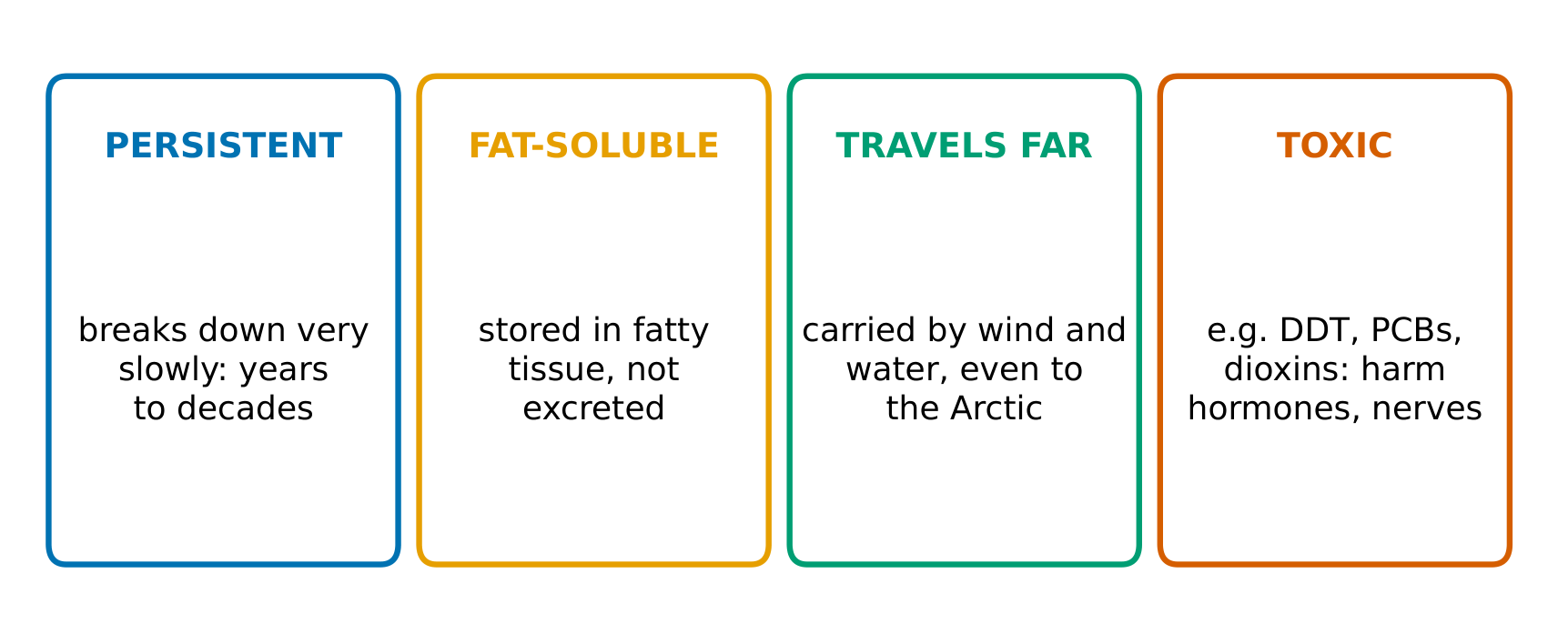
- "Persistent 持久" means they do not break down easily.
- A POP can stay in soil or water for years or decades.
- Sunlight, water, and bacteria barely touch it.
- So it keeps causing harm long after it was released.
What makes a persistent organic pollutant
A key feature of a persistent organic pollutant is that it…
Difficulty 1/5 · 100 coins + a small bonus on first completion today
"Persistent" means it resists breaking down — POPs can last for years or decades.
They build up in fat
- POPs dissolve in fat, not water.
- So they collect in the fatty tissue 组织 of animals.
- Instead of flushing out, they build up over a lifetime.
- Predators that eat many prey end up with the most.
A dangerous POP trait, or a safe one?
Sort each trait by whether it makes a pollutant a dangerous POP or a safer chemical.
DDT, a famous POP, was originally used as a…
Difficulty 1/5 · 100 coins + a small bonus on first completion today
DDT was a widely used pesticide until its persistence and harm to wildlife were discovered.
POPs dissolve in fat, so they build up in the fatty ____ of animals.
Difficulty 1/5 · 100 coins + a small bonus on first completion today
Because POPs dissolve in fat, they collect in fatty tissue and stay there for years.
They spread worldwide
- Wind and water carry POPs across the whole planet.
- They have been found in Arctic animals far from any factory.
- Famous POPs include the pesticide DDT and industrial PCBs.
- Because they travel and last, controlling them takes global treaties.
POPs can travel thousands of kilometres and reach even the remote Arctic.
Difficulty 1/5 · 100 coins + a small bonus on first completion today
Wind and water carry POPs worldwide — they have been found in Arctic animals far from any source.
Select all traits that make POPs so dangerous.
Difficulty 2/5 · 140 coins + a small bonus on first completion today
POPs persist, bioaccumulate, and spread globally. They do NOT break down quickly — that is the problem.
POPs are dangerous because of three traits working together: they persist (don't break down), they bioaccumulate (build up in fat), and they travel (spread worldwide). Any one alone would be manageable — but combined, a chemical sprayed in one country can end up decades later in a polar bear on the other side of the world. That's why POPs need international bans, not just local ones.
The DDT story:
- DDT was sprayed on crops to kill insects — cheap and effective.
- But it didn't break down. It built up in the tissue of birds, thinning their eggshells until the eggs broke.
- Populations of eagles and other birds crashed. DDT was eventually banned, but decades later traces still linger in soil and animals worldwide.
Persistent organic pollutants (POPs) are dangerous because of three combined traits: they are persistent (resist breaking down for years), they build up in fatty tissue (bioaccumulate), and they spread worldwide on wind and water. Famous examples include DDT and PCBs. Controlling them requires international agreements.