Bioaccumulation and Biomagnification
Introduced| English | Meaning |
|---|---|
| predator/ˈpredətə/ | predator |
| bioaccumulation/ˌbaɪəʊəˌkjuːmjʊˈleɪʃn/ | A toxin building up *within one organism* over its life. |
| biomagnification/ˌbaɪəʊˌmæɡnɪfɪˈkeɪʃn/ | The concentration rising *at each higher level* of the food chain. |
How a trace becomes a poison
- A pollutant may be present in water at a tiny, harmless level.
- Yet the top predators can end up dangerously poisoned.
- Two linked processes explain this.
- They are bioaccumulation 生物累积 and biomagnification 生物放大.
Bioaccumulation: building up in one body
- Some toxins dissolve in fat and are hard to excrete.
- So an animal takes them in faster than it can get rid of them.
- Over its life, the toxin builds up in its body.
- This buildup inside one organism is bioaccumulation.
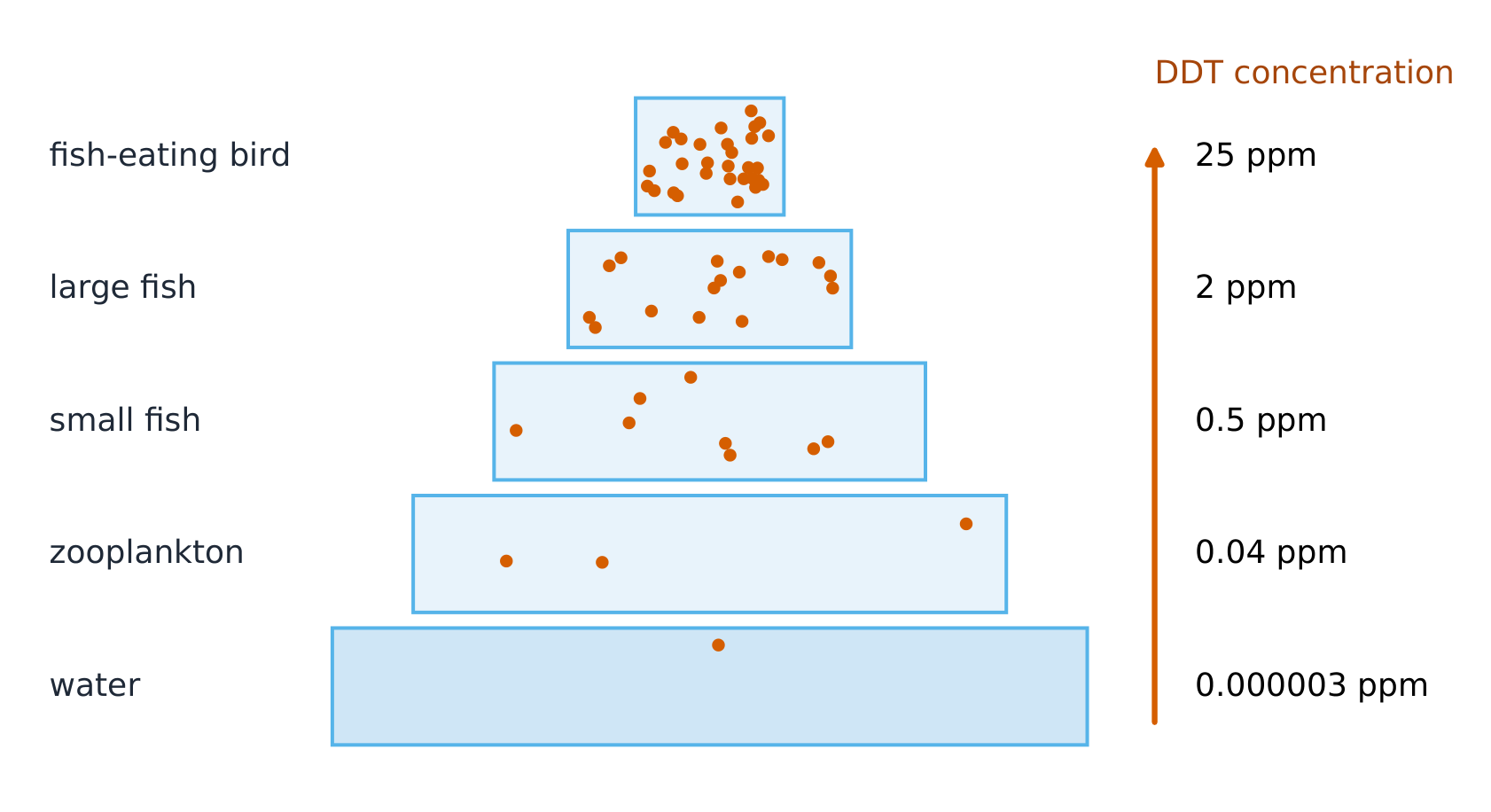
Biomagnification: DDT concentration rises at each trophic level
Bioaccumulation is when a toxin…
Difficulty 1/5 · 100 coins + a small bonus on first completion today
Bioaccumulation is the buildup of a toxin inside a single organism over time, faster than it can excrete it.
Biomagnification: rising up the chain
- A small fish eats hundreds of contaminated plankton.
- It keeps all their toxin, so it is more concentrated than any plankton.
- A big fish eats many small fish, concentrating it further.
- Rising concentration up each level is biomagnification.
How a toxin climbs the food chain
Follow a trace of toxin from water up to the top predator, growing at every step.
Biomagnification means the toxin concentration…
Difficulty 1/5 · 100 coins + a small bonus on first completion today
Biomagnification is the increase in toxin concentration at each higher trophic level.
The animal with the highest toxin level is usually the top ____.
Difficulty 1/5 · 100 coins + a small bonus on first completion today
The top predator eats many contaminated prey, so it ends up with the highest concentration.
The top predator pays
- Each step up the food chain multiplies the dose.
- The top predator 捕食者 ends up with the highest level of all.
- Eagles, big fish, and humans are near the top.
- A trace in the water becomes a deadly dose at the top.
Toxins that break down quickly are the ones most likely to biomagnify.
Difficulty 1/5 · 100 coins + a small bonus on first completion today
False. Only persistent toxins that are stored in fat and not broken down or excreted, such as POPs and mercury, build up and magnify along food chains.
Select all true statements.
Difficulty 2/5 · 140 coins + a small bonus on first completion today
Toxins concentrate — not dilute — up the chain, so top predators carry the most. The last option is backwards.
Keep the two words straight. Bioaccumulation is within one organism — a toxin building up in a single body over time. Biomagnification is across the food chain — the concentration rising at each higher level. They work together: each animal accumulates, and because predators eat many prey, the total magnifies upward. Only persistent, fat-stored toxins (like POPs and mercury) do this.
Mercury in a lake:
- The water holds only a trace of mercury — far too little to harm anything directly.
- Plankton bioaccumulate it; small fish eat thousands of plankton; big fish eat many small fish.
- By the time it reaches the eagle (or the human) at the top, the mercury has biomagnified to a dose thousands of times higher than the water — high enough to cause real harm.
Bioaccumulation is a toxin building up within one organism over its life. Biomagnification is the concentration rising at each higher level of the food chain. Together they mean a harmless trace in water becomes a dangerous dose in the top predator. Only persistent, fat-stored toxins (POPs, mercury) behave this way.