Pathogens and Infectious Diseases
Introduced| English | Meaning |
|---|---|
| pathogen/ˈpæθədʒn/ | Disease-causing agents, such as certain bacteria, viruses, fungi or parasites. |
| Infectious diseases/ɪnˈfekʃəs dɪˈziːzɪz/ | A disease caused by a pathogen, such as a bacterium, virus, fungus or parasite. |
| waterborne/ˈwɔːtəbɔːn/ | waterborne |
| vector/ˈvektə/ | An organism or carrier that transfers a pathogen or genetic material to another cell or organism. |
The living causes of disease
- Many diseases are caused by living things.
- A pathogen 病原体 is an organism that causes disease.
- Bacteria, viruses, and parasites are all pathogens.
- Infectious diseases 传染病 spread from one host to another.
Waterborne diseases
- A waterborne 水传播 disease spreads through dirty water.
- Cholera and typhoid spread when sewage taints drinking water.
- People fall ill after drinking the contaminated water.
- Clean water and sewage treatment are the best defence.
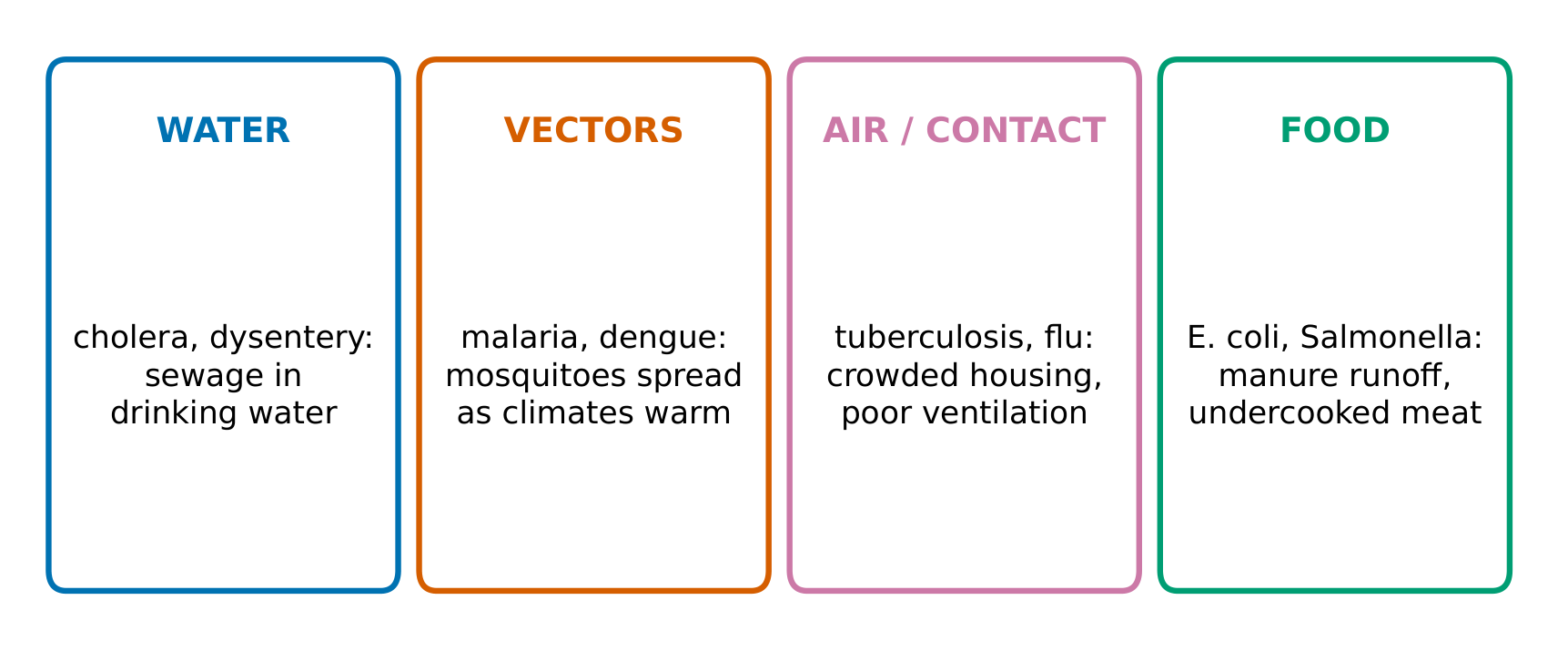
How pathogens spread and the environmental conditions that help them
A pathogen is…
Difficulty 1/5 · 100 coins + a small bonus on first completion today
A pathogen is a disease-causing organism — a bacterium, virus, or parasite.
Vector-borne diseases
- A vector 媒介 is an animal that carries a pathogen.
- Mosquitoes carry malaria and dengue from person to person.
- Ticks carry Lyme disease.
- Controlling the vector helps control the disease.
Waterborne or vector-borne?
Sort each disease by how it spreads - through water or through an animal carrier.
A waterborne disease like cholera spreads through…
Difficulty 1/5 · 100 coins + a small bonus on first completion today
Waterborne diseases spread when people drink water tainted with sewage or pathogens.
An animal that carries a pathogen from host to host, like a mosquito, is a ____.
Difficulty 1/5 · 100 coins + a small bonus on first completion today
A vector (like a mosquito or tick) carries a pathogen and passes it to new hosts.
Prevention
- Safe drinking water stops most waterborne disease.
- Sewage treatment keeps pathogens out of water supplies.
- Controlling mosquitoes cuts vector-borne disease.
- Vaccines and clean living conditions protect people too.
Clean water and good sewage treatment prevent many infectious diseases.
Difficulty 1/5 · 100 coins + a small bonus on first completion today
Safe water and proper sewage treatment stop waterborne pathogens, preventing disease.
Select all vector-borne diseases.
Difficulty 2/5 · 140 coins + a small bonus on first completion today
Malaria, dengue, and Lyme spread through animal vectors. Cholera is waterborne.
Sorting by how it spreads tells you how to stop it. A waterborne disease (cholera, typhoid) is beaten with clean water and sewage treatment. A vector-borne disease (malaria, dengue) is beaten by controlling the vector — draining mosquito breeding pools, nets, repellents. Attack the wrong route and the disease keeps spreading, so identifying the transmission path is the first step.
Two outbreaks, two solutions:
- A town's water is tainted by leaking sewage, and cholera breaks out — a waterborne disease. The fix is clean water and proper sewage treatment.
- A tropical village suffers malaria — carried by mosquitoes, a vector-borne disease. The fix is nets, repellents, and draining the still water where mosquitoes breed.
- The pathogen differs, and so does the cure — because the route differs.
A pathogen is a disease-causing organism (bacterium, virus, parasite), and infectious diseases spread between hosts. Waterborne diseases (cholera, typhoid) spread through dirty water and are stopped by clean water and sewage treatment. Vector-borne diseases (malaria, dengue) spread by a vector like a mosquito and are stopped by controlling that carrier.