Dose Response Curve
Introduced| English | Meaning |
|---|---|
| dose-response curve/dəʊs rɪˈspɒns kɜːv/ | dose-response curve |
| response/rɪˈspɒns/ | A reaction or reply produced after a stimulus, event or request. |
| threshold/ˈθreʃəʊld/ | A boundary value at which a specified effect begins or a decision changes. |
How much harm from how much?
- A tiny dose of a chemical may do nothing.
- A large dose of the same chemical may kill.
- To show this, scientists draw a dose-response curve 剂量反应曲线.
- It plots the effect against the dose.
Reading the curve
- The dose goes along the bottom; the response 反应 goes up the side.
- As the dose rises, the effect usually gets stronger.
- The curve starts low and climbs upward.
- At high doses the harm can become severe or lethal.
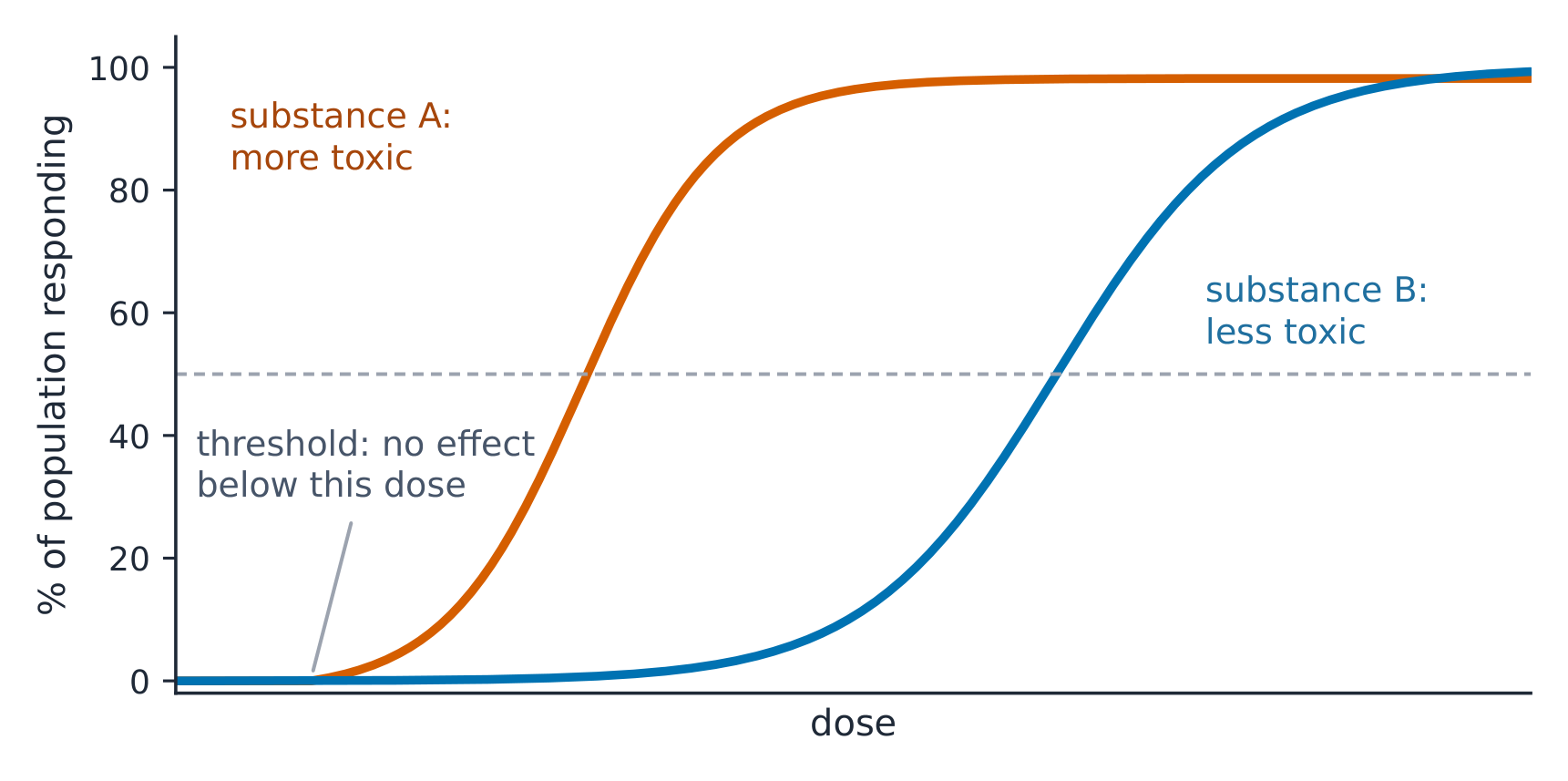
Dose-response curves: a threshold 阈值, and a more toxic substance acts at lower doses
A dose-response curve shows how…
Difficulty 1/5 · 100 coins + a small bonus on first completion today
A dose-response curve plots the response (effect) against the dose of a substance.
The threshold
- Many substances have a threshold dose.
- Below the threshold, there is no visible effect.
- Above it, the effect begins and grows.
- Finding the threshold helps set safe exposure limits.
Little effect or strong effect?
Sort each dose by the size of the response it causes on the curve.
On most dose-response curves, as the dose increases, the effect…
Difficulty 1/5 · 100 coins + a small bonus on first completion today
Generally, more dose means more effect — the curve rises as the dose increases.
The dose below which there is no visible effect is called the ____.
Difficulty 1/5 · 100 coins + a small bonus on first completion today
The threshold is the lowest dose that starts to cause a measurable effect.
The dose makes the poison
- Almost any substance can harm you at a high enough dose.
- Even water is deadly if you drink far too much.
- And a "poison" may be harmless in a tiny amount.
- So it is the dose, not just the substance, that decides the harm.
"The dose makes the poison" - even a safe substance can harm you at a high enough dose.
Difficulty 1/5 · 100 coins + a small bonus on first completion today
Almost anything - even water - becomes harmful at a high enough dose. The dose is what matters.
Select all true statements about dose-response curves.
Difficulty 2/5 · 140 coins + a small bonus on first completion today
The curve links dose to effect and helps set safe limits. The effect very much depends on the dose.
The big idea is centuries old: "the dose makes the poison." There's no such thing as a substance that is simply "toxic" or "safe" — it depends entirely on how much. Water, oxygen, even vitamins become harmful at high enough doses; deadly chemicals may be harmless in trace amounts. The dose-response curve is how scientists pin down exactly where "safe" turns into "harmful".
Reading a real curve:
- At a very low dose (below the threshold), the test animals show no effect — the curve sits flat at the bottom.
- As the dose climbs, more and more show harm, and the curve rises.
- Past a high dose, nearly all are affected — the curve levels off near the top.
- Regulators read the threshold off this curve to set a legal "safe" limit.
A dose-response curve plots the response (effect) against the dose of a substance. Usually the effect grows as the dose rises. Many substances have a threshold dose below which there is no visible harm. The core principle is "the dose makes the poison" — almost anything is harmful at a high enough dose, and the curve shows where safe becomes harmful.