Fossil Fuels
Introduced| English | Meaning |
|---|---|
| fossil fuels/ˈfɒsl ˈfjuːəlz/ | Coal, oil and natural gas formed from ancient organic matter over millions of years. |
| pressure/ˈpreʃə/ | Force acting normally per unit area. |
| nonrenewable/ˌnɒnrɪˈnjuːəbl/ | Not naturally replaced fast enough to keep pace with human use. |
| carbon dioxide/ˈkɑːbən daɪˈɒksaɪd/ | A compound whose molecules contain one carbon atom and two oxygen atoms. |
| greenhouse gas/ˈɡriːnhaʊs ɡæs/ | A gas that absorbs and emits infrared radiation, contributing to atmospheric warming. |
Buried sunshine
- Coal, oil, and gas are called fossil fuels 化石燃料.
- They are the buried remains of life from long ago.
- The energy in them is ancient sunlight, stored by living things.
- Burning them releases that energy — and its stored carbon.
How they formed
- Long ago, plants and tiny sea plankton died and sank.
- Layers of mud and sand buried them deep.
- Heat and pressure 压力 cooked the remains for millions of years.
- Plants became coal; plankton became oil and natural gas.
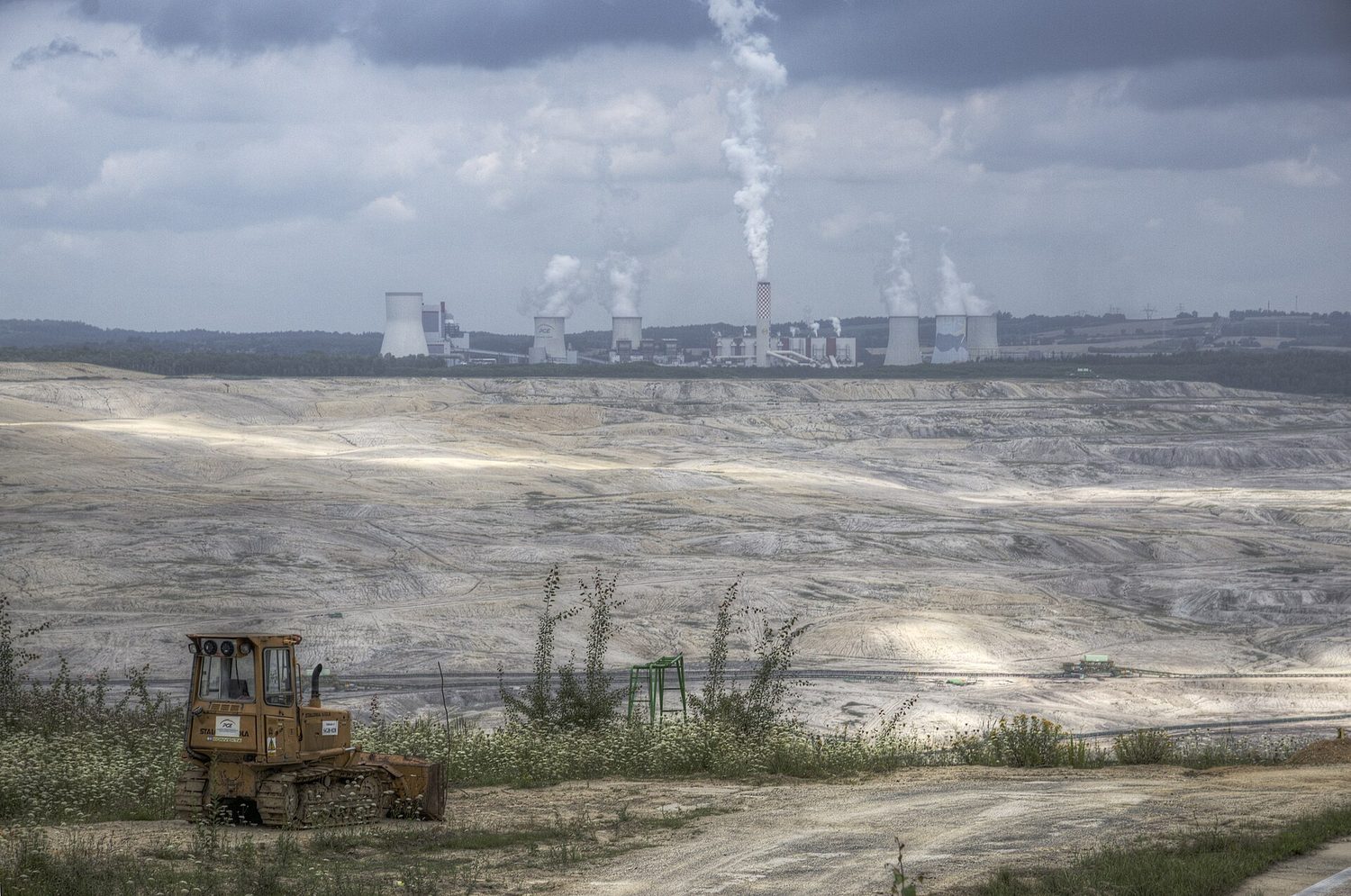
An open-pit lignite mine: the coal is dug out of the ground on the left, then burned in the power station behind it
Fossil fuels formed from…
Difficulty 1/5 · 100 coins + a small bonus on first completion today
Fossil fuels are the remains of plants and plankton, cooked by heat and pressure over millions of years.
Why they run out
- That slow cooking took millions of years.
- We burn fossil fuels in seconds, far faster than they form.
- So the supply only shrinks — they are nonrenewable 不可再生.
- Once a coal seam or oil field is empty, it is gone for good.
How fossil fuels form
Step through the millions of years that turn dead life into coal, oil, and gas.
How long does it take fossil fuels to form?
Difficulty 1/5 · 100 coins + a small bonus on first completion today
It takes millions of years — which is exactly why fossil fuels are nonrenewable on any human timescale.
Burning fossil fuels releases carbon ____, the main greenhouse gas.
Difficulty 1/5 · 100 coins + a small bonus on first completion today
Combustion releases carbon dioxide (CO2), which traps heat and warms the climate.
The pollution problem
- Burning fossil fuels releases carbon dioxide 二氧化碳 (CO2).
- CO2 is the main greenhouse gas 温室气体 that warms the climate.
- Coal also releases sulfur, causing acid rain and smog.
- So fossil fuels are cheap and powerful, but dirty.
Fossil fuels are renewable because they are still forming underground.
Difficulty 1/5 · 100 coins + a small bonus on first completion today
False. They form over millions of years but we use them far faster, so the supply only shrinks; that makes them nonrenewable.
Select all fossil fuels.
Difficulty 2/5 · 140 coins + a small bonus on first completion today
Coal, oil, and natural gas are the three fossil fuels. Sunlight is a renewable source.
Fossil fuels are just stored solar energy. Ancient plants captured sunlight; burial locked their carbon underground for millions of years. Burning them undoes that in an instant — releasing the carbon back into the air all at once. That is why they are both energy-rich and the main driver of climate change.
A lump of coal:
- 300 million years ago it was a fern in a swamp, catching sunlight.
- The swamp was buried; heat and pressure slowly turned the plant into coal.
- Today it burns in a power station in minutes, releasing energy — and the carbon that fern pulled from the air 300 million years ago.
Fossil fuels (coal, oil, natural gas) are the buried remains of ancient plants and plankton, cooked by heat and pressure over millions of years. They are nonrenewable — we burn them far faster than they form. Burning them releases carbon dioxide, the main greenhouse gas, making them powerful but polluting.