Energy from Biomass
Introduced| English | Meaning |
|---|---|
| biomass energy/ˌbaɪəʊˈmæs ˈenədʒi/ | biomass energy |
| ethanol/ˈeθənɒl/ | A two-carbon alcohol with molecular formula C₂H₅OH. |
| biogas/ˌbaɪəʊˈɡæs/ | biogas |
| renewable/rɪˈnjuːəbl/ | Describing a resource that can be replenished naturally on a timescale relevant to its use. |
| particulates/pəˈtɪkjʊleɪts/ | Small solid particles or liquid droplets suspended in air or another fluid. |
| deforestation/diːˌfɒrɪˈsteɪʃn/ | The removal of forest cover, often to convert the land to another use. |
Energy from living things
- Biomass energy 生物质能 comes from burning plant and animal material.
- Wood, crop waste, and animal dung are all biomass.
- People have burned wood for heat and cooking for thousands of years.
- It is still a major energy source in much of the world.
How we use it
- The simplest way is to burn it directly for heat.
- Crops like corn and sugarcane become liquid ethanol 乙醇 fuel.
- Rotting waste can be captured as biogas 沼气 for cooking.
- So biomass gives us solid, liquid, and gas fuels.
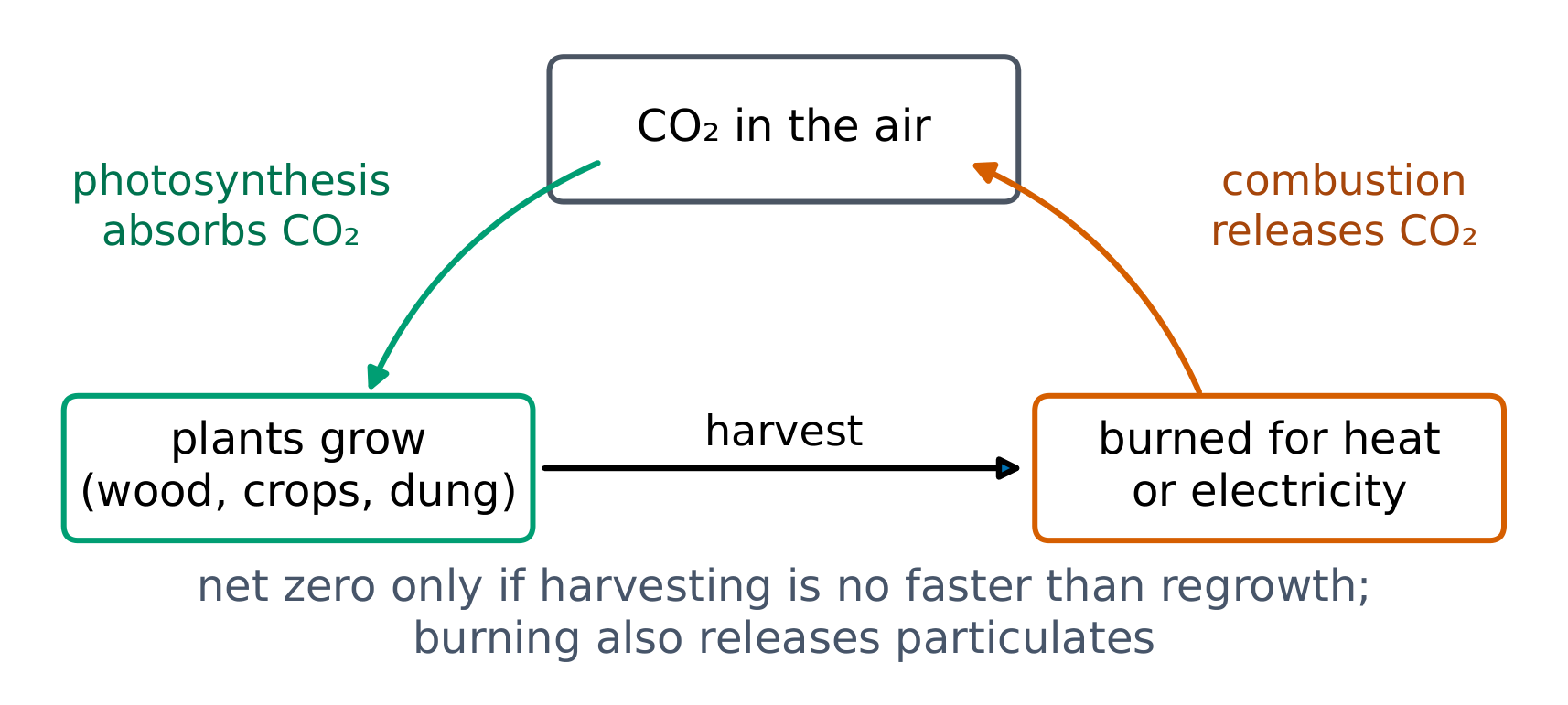
Biomass energy is carbon-neutral only if regrowth keeps pace with harvest
Biomass energy comes from…
Difficulty 1/5 · 100 coins + a small bonus on first completion today
Biomass is organic material — wood, crop waste, dung — burned or converted to fuel.
The benefits
- Plants regrow, so biomass is renewable 可再生.
- It can use waste — scraps, sawdust, dung — that would rot anyway.
- Growing crops absorbs CO2, so it can be near carbon-neutral.
- It gives poorer areas a cheap, local fuel.
Biomass is considered renewable because…
Difficulty 1/5 · 100 coins + a small bonus on first completion today
Crops and trees regrow, so biomass can be replaced — that is what makes it renewable.
Corn and sugarcane can be turned into a liquid biofuel called ____.
Difficulty 1/5 · 100 coins + a small bonus on first completion today
Ethanol is a biofuel made from crops, often blended into gasoline.
The costs
- Burning biomass still releases smoke and particulates 颗粒物.
- Cutting forests for fuel causes deforestation 森林砍伐.
- Fuel crops can compete with food crops for land.
- So "renewable" does not mean "harmless".
Benefit or cost of biomass energy?
Sort each feature of burning biomass into a benefit or a cost.
Burning biomass produces no smoke or air pollution.
Difficulty 1/5 · 100 coins + a small bonus on first completion today
False. Like any combustion, burning biomass releases smoke and fine particulates that harm air quality and lungs.
Select all sources of biomass energy.
Difficulty 2/5 · 140 coins + a small bonus on first completion today
Firewood, crop waste, and dung are all biomass. Uranium is a nuclear fuel, not biomass.
Biomass is renewable but not automatically clean. Burned in the open, it pollutes the air like any fire. And it is only carbon-neutral if the plants are actually regrown — clear a forest for fuel and never replant, and you've released its stored carbon for good. The benefit depends on managing it well.
Two villages:
- One collects fallen wood and crop scraps, and replants trees — a renewable cycle with modest smoke.
- The other clears standing forest for firewood and never replants — the "renewable" fuel becomes deforestation and lost carbon storage.
- Same fuel; management makes the difference.
Biomass energy comes from burning organic material — wood, crop waste, dung — or converting crops into ethanol and biogas. Its benefits: it is renewable, uses waste, and can be near carbon-neutral. Its costs: burning releases smoke and particulates, and demand can drive deforestation and compete with food land.