Acid Rain
Introduced| English | Meaning |
|---|---|
| acid rain/ˈæsɪd reɪn/ | Precipitation made unusually acidic mainly by atmospheric reactions involving sulfur dioxide and nitrogen oxides. |
| sulfur dioxide/ˈsʌlfɜː daɪˈɒksaɪd/ | A compound of sulfur and oxygen with formula SO₂, formed in processes such as burning sulfur-containing fuels. |
| nitrogen oxides/ˈnaɪtrədʒn ˈɒksaɪdz/ | Compounds of nitrogen and oxygen; in air-pollution discussions, NOx mainly refers to nitric oxide and nitrogen dioxide. |
When rain turns sour
- Normal rain is slightly acidic, which is fine.
- But pollution can make rain far more acidic.
- This is acid rain 酸雨.
- It harms lakes, forests, and even buildings.
Where the acid comes from
- Burning coal releases sulfur dioxide 二氧化硫 (SO2).
- Cars and power plants release nitrogen oxides 氮氧化物 (NOx).
- High in the clouds, these gases meet water.
- They react to form sulfuric and nitric acid.
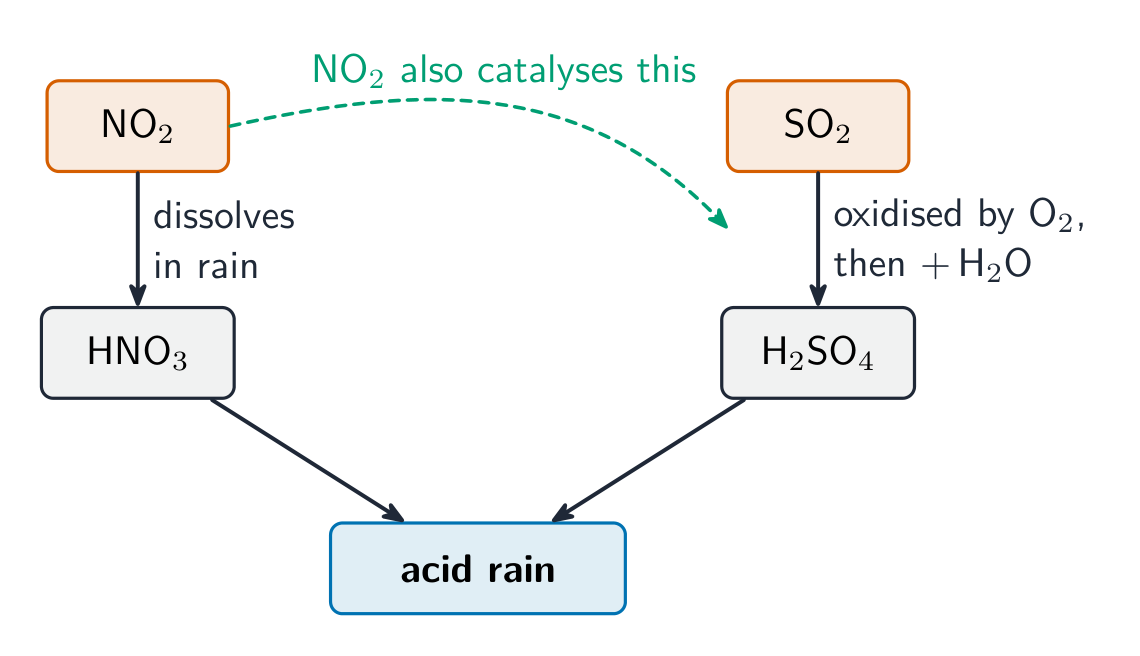
Nitrogen and sulfur oxides form nitric and sulfuric acid in rain

Forest dieback: acid deposition from SO2 and NOx can damage trees far downwind of the source
Acid rain is caused mainly by…
Difficulty 1/5 · 100 coins + a small bonus on first completion today
Sulfur dioxide and nitrogen oxides react with water to form the acids in acid rain.
A secondary pollutant
- No smokestack emits acid rain directly.
- It forms in the air when gases react with water.
- That makes it a secondary pollutant.
- The acid then falls as rain, snow, or fog.
How acid rain forms
Follow sulfur and nitrogen gases from a smokestack to acid falling on a forest.
Acid rain is a secondary pollutant because it…
Difficulty 1/5 · 100 coins + a small bonus on first completion today
No smokestack emits acid rain — it forms in clouds when gases react with water, so it is secondary.
Acid rain has a low pH, meaning it is ____ (the opposite of basic).
Difficulty 1/5 · 100 coins + a small bonus on first completion today
A low pH means acidic — acid rain can be far more acidic than normal rain.
The damage it does
- Acid rain lowers the pH of lakes, killing fish.
- It weakens trees and strips nutrients from soil.
- It slowly eats away stone buildings and statues.
- Winds can carry the gases far, so the damage crosses borders.
Acid rain only falls close to the factory that released the pollution.
Difficulty 1/5 · 100 coins + a small bonus on first completion today
False. Winds carry sulfur and nitrogen oxides hundreds of kilometres, so acid rain often falls far from the source, even in another country.
Select all damage caused by acid rain.
Difficulty 2/5 · 140 coins + a small bonus on first completion today
Acid rain kills fish, harms forests, and erodes stone. It does not help crops — it harms soil and plants.
Acid rain is a secondary pollutant and a cross-border one. It isn't emitted — it forms in the clouds from sulfur and nitrogen gases reacting with water. And because winds carry those gases hundreds of kilometres, the country that burns the coal often isn't the one that gets the acid rain. That makes it a problem countries must solve together.
Downwind of the power plants:
- A country burns coal, sending sulfur dioxide high into the sky.
- Winds carry the gas across the border into a neighbouring country's mountains.
- There it falls as acid rain — killing the fish in clear mountain lakes and browning the forests, far from any smokestack.
Acid rain forms when sulfur dioxide and nitrogen oxides (from burning fuels) react with water in clouds to make acids. It is a secondary pollutant — it forms in the air, not at the source. It kills fish, weakens forests, and erodes stone, and winds carry it across borders.