Introduction to Air Pollution
Introduced| English | Meaning |
|---|---|
| Air pollution/eə pəˈluːʃn/ | The presence of substances in air at concentrations that harm health, ecosystems, materials or other valued conditions. |
| fossil fuels/ˈfɒsl ˈfjuːəlz/ | Coal, oil and natural gas formed from ancient organic matter over millions of years. |
| primary/ˈpraɪməri/ | primary |
| secondary/ˈsekəndəri/ | secondary |
| ozone/ˈəʊzəʊn/ | The molecule O3, made of three oxygen atoms; it absorbs ultraviolet radiation in the stratosphere but is a pollutant near the ground. |
What is in dirty air
- Air pollution 空气污染 is harmful stuff added to the air.
- It can be gases, tiny particles, or droplets.
- Most of it comes from burning fossil fuels 化石燃料.
- Cars, power plants, and factories are the biggest sources.
Primary pollutants
- A primary 一次 pollutant is released directly into the air.
- Carbon monoxide pours out of a car's exhaust.
- Sulfur dioxide leaves a coal power plant's smokestack.
- Soot and dust particles come straight from fires and engines.
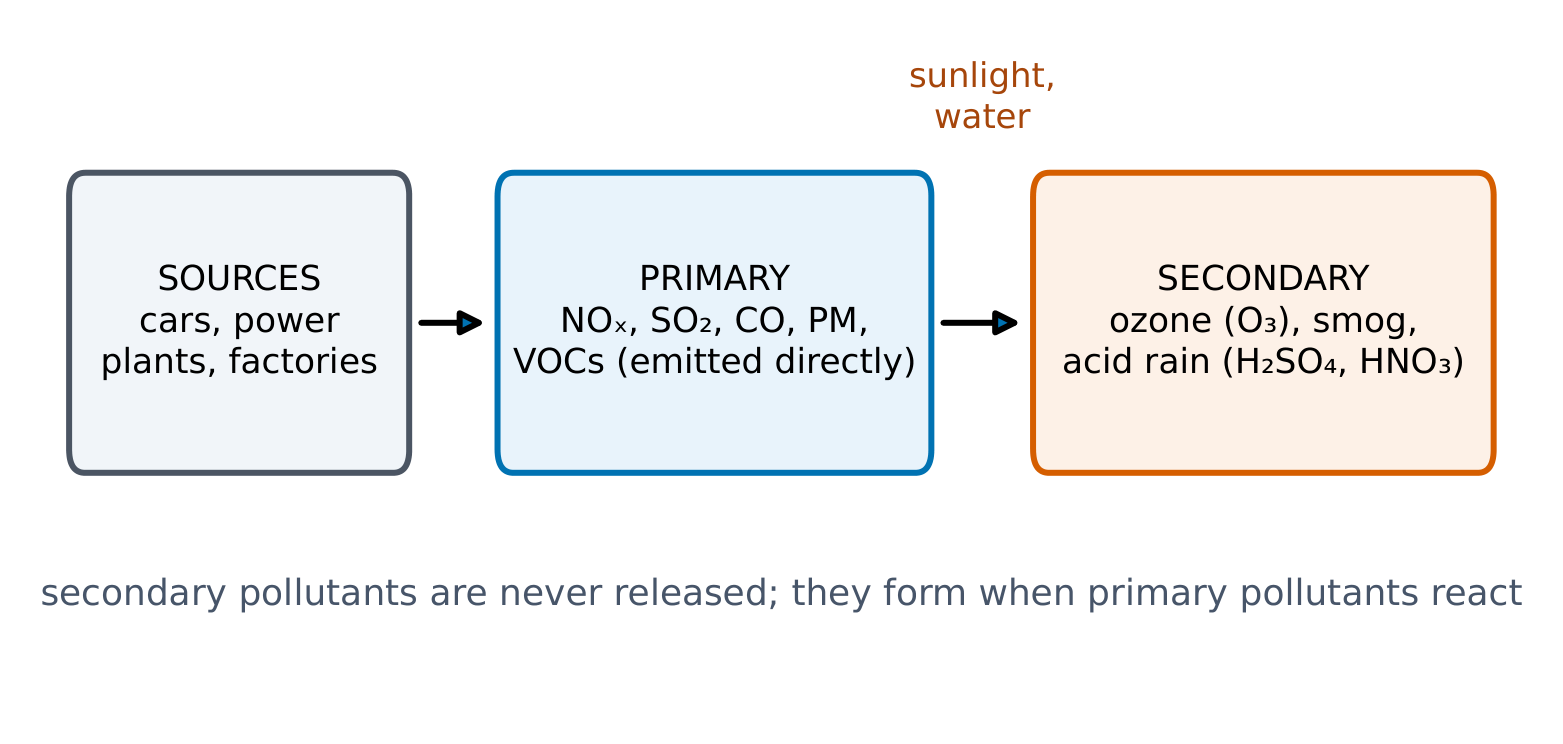
Primary pollutants are emitted directly; secondary 二次 pollutants form in the air
Air pollution is…
Difficulty 1/5 · 100 coins + a small bonus on first completion today
Air pollution is any harmful substance added to the air — gases, particles, or droplets.
Secondary pollutants
- A secondary pollutant is not emitted directly.
- It forms in the air when primary pollutants react.
- Ground-level ozone 臭氧 forms when sunlight hits car exhaust.
- Acid rain forms when sulfur and nitrogen gases react with water.
Primary or secondary pollutant?
Sort each pollutant by whether it is emitted directly or forms later in the air.
A primary pollutant is one that…
Difficulty 1/5 · 100 coins + a small bonus on first completion today
A primary pollutant comes straight from the source — like CO from a tailpipe or SO2 from a smokestack.
A ____ pollutant forms in the air when primary pollutants react, like ozone in smog.
Difficulty 1/5 · 100 coins + a small bonus on first completion today
A secondary pollutant is not emitted directly — it forms in the atmosphere, like ground-level ozone.
Why the split matters
- Primary pollutants can be cut at the source — cleaner engines, scrubbers.
- Secondary pollutants need us to cut the primary ones that make them.
- You cannot filter ozone from a tailpipe — it isn't there yet.
- So controlling air pollution means understanding where each one comes from.
Burning fossil fuels is a major source of air pollution.
Difficulty 1/5 · 100 coins + a small bonus on first completion today
Cars, power plants, and factories burning fossil fuels are the biggest sources of air pollution.
Select all primary pollutants (emitted directly).
Difficulty 2/5 · 140 coins + a small bonus on first completion today
CO, SO2, and soot are emitted directly. Ground-level ozone is secondary — it forms in the air.
The key distinction: primary = emitted directly (you can trap it at the smokestack or tailpipe). Secondary = forms in the atmosphere from primary pollutants reacting, often with sunlight. Ground-level ozone is the classic secondary pollutant — no engine emits ozone; it's built in the air from exhaust plus sunlight.
A city morning:
- Rush-hour traffic pours out primary pollutants — carbon monoxide, nitrogen oxides, soot.
- As the sun climbs, its light drives those nitrogen oxides and vapours to react, building up secondary ground-level ozone.
- By midday the "smog" hanging over the city is largely a pollutant that no single tailpipe ever emitted.
Air pollution is harmful gases, particles, and droplets added to the air, mostly from burning fossil fuels. A primary pollutant is emitted directly (carbon monoxide, sulfur dioxide, soot). A secondary pollutant forms in the air when primary ones react — like ground-level ozone in smog. The split guides how we control each.