Thermal Inversion
Introduced| English | Meaning |
|---|---|
| lid/lɪd/ | lid |
| thermal inversion/ˈθɜːml ɪnˈvɜːʃn/ | thermal inversion |
| inversion/ɪnˈvɜːʃn/ | inversion |
A lid on the air
- Normally, air near the warm ground rises and carries pollution away.
- Sometimes this stops working, and smog just sits there.
- The cause is a thermal inversion 逆温现象.
- It puts a warm lid over a city and traps the dirty air.
The normal case
- Usually the air gets colder as you go higher.
- Warm air near the ground is lighter, so it rises.
- Rising warm air carries pollution up and away.
- The air near the ground stays fairly clean.
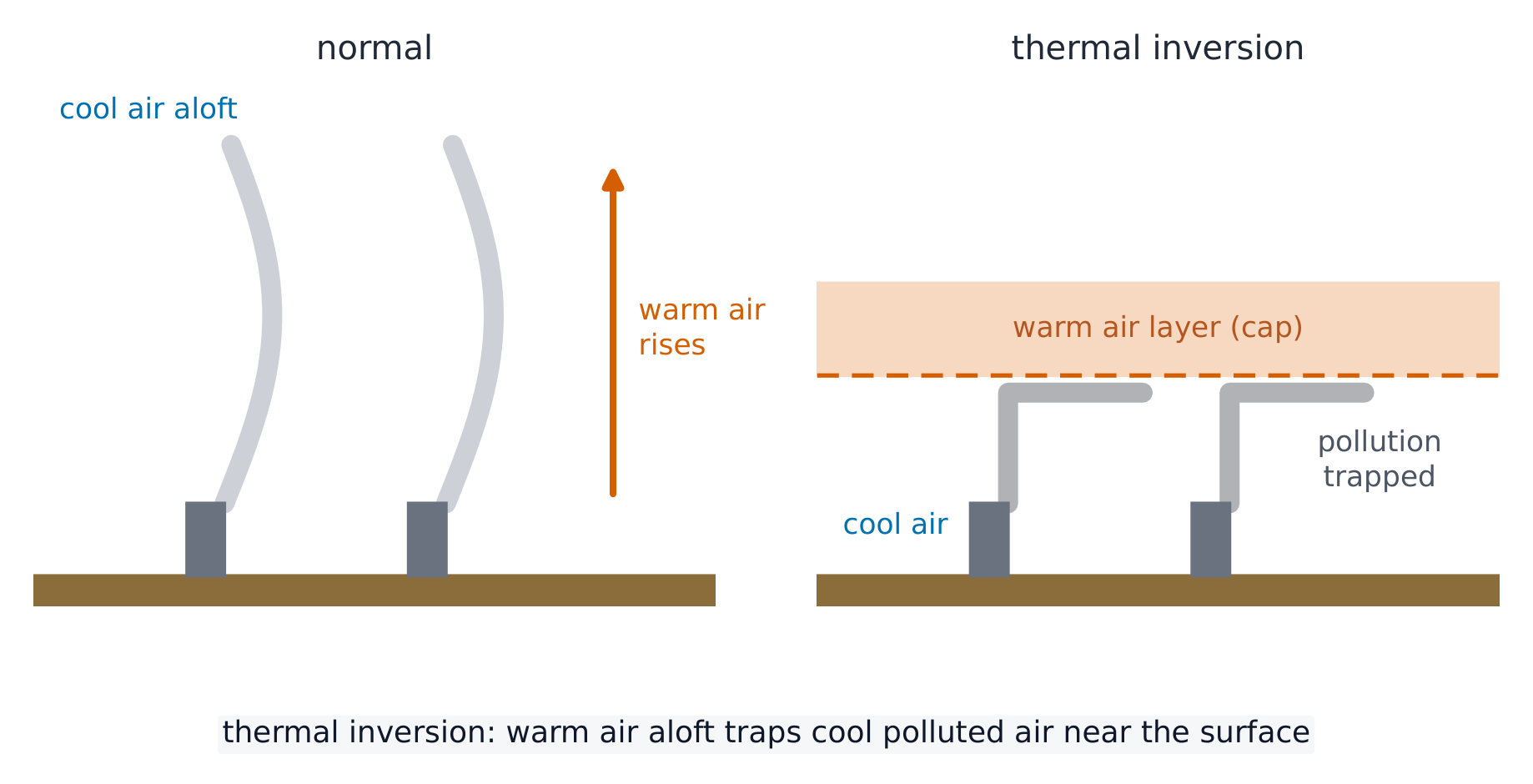
A thermal inversion 逆温: warm air above cool air traps pollution near the ground
In a thermal inversion, the unusual thing is that…
Difficulty 1/5 · 100 coins + a small bonus on first completion today
Normally air cools with height. In an inversion, a warm layer sits on top of cooler air — upside down.
The inversion
- In an inversion, a layer of warm air sits above the cool air.
- This is upside down from normal — hence "inversion".
- The warm layer acts like a lid 盖子 on the cool air below.
- Cool, polluted air cannot rise through it and escape.
How a thermal inversion traps pollution
See how a warm-air lid stops polluted air from rising and clearing away.
A thermal inversion makes air pollution…
Difficulty 1/5 · 100 coins + a small bonus on first completion today
The warm lid stops polluted air from rising and clearing, so smog builds up near the ground.
The warm air layer acts like a ____ that traps pollution below it.
Difficulty 1/5 · 100 coins + a small bonus on first completion today
The warm layer is a lid — cooler polluted air cannot rise through it and escape.
Pollution piles up
- With no way to rise, pollution builds up near the ground.
- Smog grows thicker hour by hour under the lid.
- Cities in valleys are hit hardest — hills hold the cool air in.
- The smog clears only when the weather breaks the inversion.
Cities in valleys are protected from temperature inversions by the surrounding hills.
Difficulty 1/5 · 100 coins + a small bonus on first completion today
False. Surrounding hills trap the cool air layer and its pollution, so valley cities often suffer worse inversions.
Select all true statements about thermal inversions.
Difficulty 2/5 · 140 coins + a small bonus on first completion today
An inversion puts warm air on top, trapping pollution and worsening smog. It does not clear the air.
The whole trick is the reversed temperature order. Normal air: cold on top, warm below → warm air rises → pollution disperses. Inversion: warm on top, cool below → the cool air (and its pollution) can't rise through the warm lid → smog is trapped. An inversion doesn't make pollution; it stops pollution from clearing.
A valley city in winter:
- Cold air pools in the valley overnight; a layer of warm air settles above it.
- Morning traffic and heating pump pollution into that trapped cold air.
- The warm lid holds it all down, and with hills blocking the wind, the smog thickens for days — until a storm finally mixes the air and clears it.
A thermal inversion flips the usual pattern: a layer of warm air sits above cooler air, acting as a lid. Cool, polluted air near the ground cannot rise through it, so smog is trapped and builds up. Inversions make air pollution far worse, especially in cities ringed by hills.