Skip to content · ⁨Pular para o conteúdo⁩

Equações Paramétricas, Coordenadas Polares e Funções Vetoriais

Cálculo BC do AP · Topic 9 · ⁨Tópico 9⁩

Train · ⁨Treinar⁩
Video lesson for this topic · ⁨Videoaula para este tópico⁩ Open the video page · ⁨Abrir a página do vídeo⁩
6:06

Paramétrico, Vetorial e Polar

Algumas curvas não podem ser escritas como y igual a uma função de x. Pense em uma partícula dando voltas ou um caminho que se cruza — para um x haveria dois y…

English narration · English + 中文 subtitles burned in · ⁨Narração em inglês · Legendas em inglês + 中文 gravadas⁩

9.1

Defining and Differentiating Parametric Equations · ⁨Definindo e Diferenciando Equações Paramétricas⁩

Syllabus · ⁨Programa⁩
English

Enduring Understanding (CHA-3): Derivatives allow us to solve real-world problems involving rates of change.

Learning Objective CHA-3.G: Calculate derivatives of parametric functions. BC ONLY

  • CHA-3.G.1 Methods for calculating derivatives of real-valued functions can be extended to parametric functions. BC ONLY
  • CHA-3.G.2 For a curve defined parametrically, the value of $\dfrac{dy}{dx}$ at a point on the curve is the slope of the line tangent to the curve at that point. $\dfrac{dy}{dx}$, the slope of the line tangent to a curve defined using parametric equations, can be determined by dividing $\dfrac{dy}{dt}$ by $\dfrac{dx}{dt}$, provided $\dfrac{dx}{dt}$ does not equal zero. BC ONLY
Português

Compreensão Duradoura (CHA-3): As derivadas nos permitem resolver problemas do mundo real envolvendo taxas de variação.

Objetivo de Aprendizagem CHA-3.G: Calcular derivadas de funções paramétricas. APENAS BC

  • CHA-3.G.1 Métodos para calcular derivadas de funções de valores reais podem ser estendidos para funções paramétricas. APENAS BC
  • CHA-3.G.2 Para uma curva definida parametricamente, o valor de $\dfrac{dy}{dx}$ em um ponto na curva é a inclinação da reta tangente à curva nesse ponto. $\dfrac{dy}{dx}$, a inclinação da reta tangente a uma curva definida por equações paramétricas, pode ser determinada dividindo-se $\dfrac{dy}{dt}$ por $\dfrac{dx}{dt}$, desde que $\dfrac{dx}{dt}$ não seja igual a zero. APENAS BC
Source: College Board AP Course and Exam Description · ⁨Fonte: College Board AP Course and Exam Description⁩

English

Parametric equations 参数方程 give $x$ and $y$ each as functions of a parameter $t$ (often time): $x=x(t)$, $y=y(t)$. They trace a curve that need not be a function of $x$. The slope of the curve is found with the chain rule:

$$\frac{dy}{dx}=\frac{dy/dt}{dx/dt}\qquad(dx/dt\neq0).$$

Worked example. For $x=t^2$, $y=t^3-t$, find the slope at $t=2$. Here $\dfrac{dx}{dt}=2t$ and $\dfrac{dy}{dt}=3t^2-1$, so $\dfrac{dy}{dx}=\dfrac{3t^2-1}{2t}$; at $t=2$ this is $\dfrac{11}{4}$.

Português
A ISS em órbita: equações paramétricas descrevem posição em função do tempo

Equações paramétricas 参数方程 fornecem $x$ e $y$ cada uma como função de um parâmetro $t$ (muitas vezes tempo): $x=x(t)$, $y=y(t)$. Elas traçam uma curva que não precisa ser uma função de $x$. A inclinação da curva é encontrada com a regra da cadeia:

$$\frac{dy}{dx}=\frac{dy/dt}{dx/dt}\qquad(dx/dt\neq0).$$

Exemplo resolvido. Para $x=t^2$, $y=t^3-t$, encontre a inclinação em $t=2$. Aqui $\dfrac{dx}{dt}=2t$ e $\dfrac{dy}{dt}=3t^2-1$, então $\dfrac{dy}{dx}=\dfrac{3t^2-1}{2t}$; em $t=2$ isso é $\dfrac{11}{4}$.

Vocabulary · ⁨Vocabulário⁩ Train · ⁨Treinar⁩
English · ⁨Inglês⁩ Chinese · ⁨Chinês⁩ Pinyin
Parametric equations/ˌpærəˈmetrɪk ɪˈkweɪʒnz/ 参数方程 cān shù fāng chéng
vector-valued function/ˈvektə ˈvæljuːd ˈfʌŋkʃn/ 向量值函数 xiàng liàng zhí hán shù
Polar coordinates/ˈpəʊlə kəʊˈɔːdɪnəts/ 极坐标 jí zuò biāo
9.2

Second Derivatives of Parametric Equations · ⁨Derivadas Segundas de Equações Paramétricas⁩

Syllabus · ⁨Programa⁩
English

Enduring Understanding (CHA-3): Derivatives allow us to solve real-world problems involving rates of change.

Learning Objective CHA-3.G: Calculate derivatives of parametric functions. BC ONLY

  • CHA-3.G.3 $\dfrac{d^2 y}{dx^2}$ can be calculated by dividing $\dfrac{d}{dt}\left(\dfrac{dy}{dx}\right)$ by $\dfrac{dx}{dt}$. BC ONLY
Português

Compreensão Duradoura (CHA-3): As derivadas nos permitem resolver problemas do mundo real envolvendo taxas de variação.

Objetivo de Aprendizagem CHA-3.G: Calcular derivadas de funções paramétricas. APENAS BC

  • CHA-3.G.3 $\dfrac{d^2 y}{dx^2}$ pode ser calculado dividindo-se $\dfrac{d}{dt}\left(\dfrac{dy}{dx}\right)$ por $\dfrac{dx}{dt}$. APENAS BC

Source: College Board AP Course and Exam Description · ⁨Fonte: College Board AP Course and Exam Description⁩

English

The second derivative is not $\dfrac{d^2y/dt^2}{d^2x/dt^2}$. Instead, differentiate the first derivative with respect to $t$, then divide by $dx/dt$ again:

$$\frac{d^2y}{dx^2}=\frac{\dfrac{d}{dt}\!\left(\dfrac{dy}{dx}\right)}{dx/dt}.$$
Use it to test concavity of a parametric curve.

Português

A derivada segunda não é $\dfrac{d^2y/dt^2}{d^2x/dt^2}$. Em vez disso, diferencie a primeira derivada em relação a $t$, depois divida por $dx/dt$ novamente:

$$\frac{d^2y}{dx^2}=\frac{\dfrac{d}{dt}\!\left(\dfrac{dy}{dx}\right)}{dx/dt}.$$
Use-a para testar a concavidade de uma curva paramétrica.

9.3

Finding Arc Lengths of Curves Given by Parametric Equations · ⁨Encontrando Comprimentos de Arco de Curvas Dadas por Equações Paramétricas⁩

Syllabus · ⁨Programa⁩
English

Enduring Understanding (CHA-6): Definite integrals allow us to solve problems involving the accumulation of change in length over an interval.

Learning Objective CHA-6.B: Determine the length of a curve in the plane defined by parametric functions, using a definite integral. BC ONLY

  • CHA-6.B.1 The length of a parametrically defined curve can be calculated using a definite integral. BC ONLY
Português

Compreensão Duradoura (CHA-6): Integrais definidas permitem-nos resolver problemas envolvendo a acumulação de mudança no comprimento sobre um intervalo.

Objetivo de Aprendizagem CHA-6.B: Determinar o comprimento de uma curva no plano definida por funções paramétricas, usando uma integral definida. APENAS BC

  • CHA-6.B.1 O comprimento de uma curva definida parametricamente pode ser calculado usando uma integral definida. APENAS BC

Source: College Board AP Course and Exam Description · ⁨Fonte: College Board AP Course and Exam Description⁩

English

The length of a parametric curve for $t$ from $a$ to $b$ is

$$L=\int_a^b\sqrt{\left(\frac{dx}{dt}\right)^2+\left(\frac{dy}{dt}\right)^2}\,dt.$$
This is the parametric version of arc length – summing tiny hypotenuses $\sqrt{dx^2+dy^2}$ over the parameter.

Português

O comprimento de uma curva paramétrica para $t$ de $a$ a $b$ é

$$L=\int_a^b\sqrt{\left(\frac{dx}{dt}\right)^2+\left(\frac{dy}{dt}\right)^2}\,dt.$$
Esta é a versão paramétrica do comprimento de arco – somando pequenos hipotenusas $\sqrt{dx^2+dy^2}$ sobre o parâmetro.

9.4

Defining and Differentiating Vector-Valued Functions · ⁨Definindo e Diferenciando Funções Vetoriais⁩

Syllabus · ⁨Programa⁩
English

Enduring Understanding (CHA-3): Derivatives allow us to solve real-world problems involving rates of change.

Learning Objective CHA-3.H: Calculate derivatives of vector-valued functions. BC ONLY

  • CHA-3.H.1 Methods for calculating derivatives of real-valued functions can be extended to vector-valued functions. BC ONLY
Português

Compreensão Duradoura (CHA-3): As derivadas nos permitem resolver problemas do mundo real envolvendo taxas de variação.

Objetivo de Aprendizagem CHA-3.H: Calcular derivadas de funções de valor vetorial. APENAS BC

  • CHA-3.H.1 Métodos para calcular derivadas de funções de valores reais podem ser estendidos para funções de valor vetorial. APENAS BC

Source: College Board AP Course and Exam Description · ⁨Fonte: College Board AP Course and Exam Description⁩

English

A vector-valued function 向量值函数 $\vec{r}(t)=\langle x(t),\,y(t)\rangle$ gives a position vector for each $t$. Differentiate component-wise: the velocity is $\vec{v}(t)=\langle x'(t),\,y'(t)\rangle$ and the acceleration is $\vec{a}(t)=\langle x''(t),\,y''(t)\rangle$. The speed is the magnitude $|\vec{v}|=\sqrt{x'^2+y'^2}$.

Português

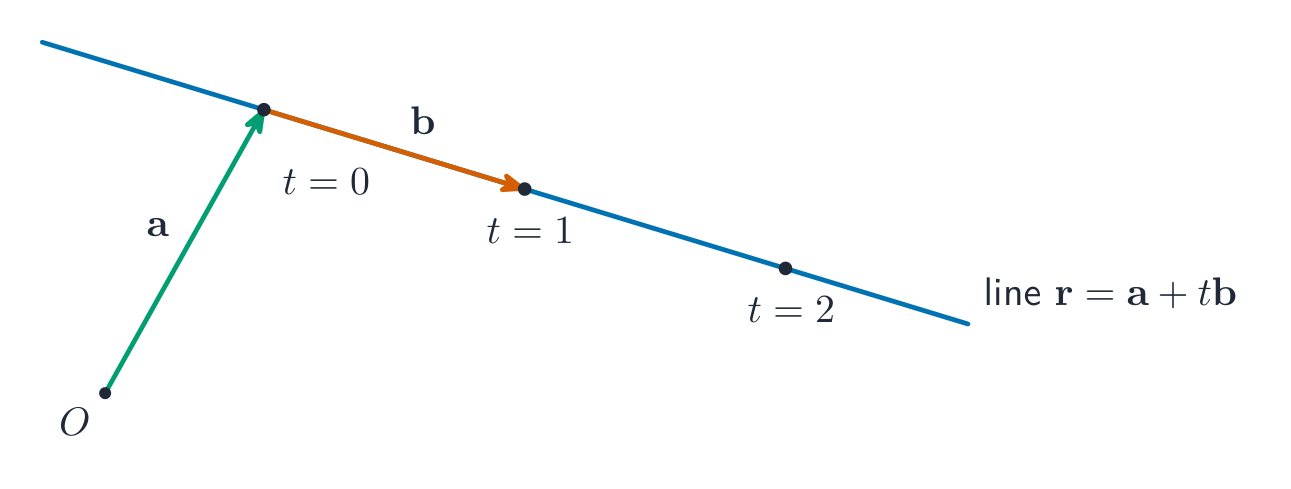
Uma função vetorial 向量值函数 $\vec{r}(t)=\langle x(t),\,y(t)\rangle$ fornece um vetor posição para cada $t$. Diferencie componente a componente: a velocidade é $\vec{v}(t)=\langle x'(t),\,y'(t)\rangle$ e a aceleração é $\vec{a}(t)=\langle x''(t),\,y''(t)\rangle$. A rapidez é a magnitude $|\vec{v}|=\sqrt{x'^2+y'^2}$.

Uma linha vetorial: comece em a, depois deslize t unidades na direção b
Explore · ⁨Explorar⁩

Adicionar componentes com valor vetorial

Uma função com valor vetorial empacota um $x(t)$ e $y(t)$ em um único vetor. Diferenciar cada componente fornece o vetor velocidade, tangente à trajetória.

9.5

Integrating Vector-Valued Functions · ⁨Integrando Funções Vetoriais⁩

Syllabus · ⁨Programa⁩
English

Enduring Understanding (FUN-8): Solving an initial value problem allows us to determine an expression for the position of a particle moving in the plane.

Learning Objective FUN-8.A: Determine a particular solution given a rate vector and initial conditions. BC ONLY

  • FUN-8.A.1 Methods for calculating integrals of real-valued functions can be extended to parametric or vector-valued functions. BC ONLY
Português

Compreensão Duradoura (FUN-8): Resolver um problema de valor inicial permite-nos determinar uma expressão para a posição de uma partícula movendo-se no plano.

Objetivo de Aprendizagem FUN-8.A: Determinar uma solução particular dado um vetor velocidade e condições iniciais. APENAS BC

  • FUN-8.A.1 Métodos para calcular integrais de funções de valores reais podem ser estendidos para funções paramétricas ou de valor vetorial. APENAS BC

Source: College Board AP Course and Exam Description · ⁨Fonte: College Board AP Course and Exam Description⁩

English

Integrate a vector function component by component. Given acceleration or velocity plus an initial condition, integrate each component and use the condition to find the constants – recovering velocity from acceleration, or position from velocity.

Português

Integre uma função vetorial componente a componente. Dada aceleração ou velocidade mais uma condição inicial, integre cada componente e use a condição para encontrar as constantes – recuperando a velocidade a partir da aceleração, ou a posição a partir da velocidade.

9.6

Solving Motion Problems Using Parametric and Vector-Valued Functions · ⁨Resolvendo Problemas de Movimento Usando Funções Paramétricas e Vetoriais⁩

Syllabus · ⁨Programa⁩
English

Enduring Understanding (FUN-8): Solving an initial value problem allows us to determine an expression for the position of a particle moving in the plane.

Learning Objective FUN-8.B: Determine values for positions and rates of change in problems involving planar motion. BC ONLY

  • FUN-8.B.1 Derivatives can be used to determine velocity, speed, and acceleration for a particle moving along a curve in the plane defined using parametric or vector-valued functions. BC ONLY
  • FUN-8.B.2 For a particle in planar motion over an interval of time, the definite integral of the velocity vector represents the particle's displacement (net change in position) over the interval of time, from which we might determine its position. The definite integral of speed represents the particle's total distance traveled over the interval of time. BC ONLY
Português

Compreensão Duradoura (FUN-8): Resolver um problema de valor inicial permite-nos determinar uma expressão para a posição de uma partícula movendo-se no plano.

Objetivo de Aprendizagem FUN-8.B: Determinar valores para posições e taxas de mudança em problemas envolvendo movimento planar. APENAS BC

  • FUN-8.B.1 Derivadas podem ser usadas para determinar velocidade, rapidez e aceleração para uma partícula movendo-se ao longo de uma curva no plano definida por equações paramétricas ou funções de valor vetorial. APENAS BC
  • FUN-8.B.2 Para uma partícula em movimento planar sobre um intervalo de tempo, a integral definida do vetor velocidade representa o deslocamento da partícula (mudança líquida na posição) sobre o intervalo de tempo, do qual podemos determinar sua posição. A integral definida da rapidez representa a distância total percorrida pela partícula sobre o intervalo de tempo. APENAS BC

Source: College Board AP Course and Exam Description · ⁨Fonte: College Board AP Course and Exam Description⁩

English

For a particle moving in a plane: position is $\langle x(t),y(t)\rangle$, velocity and acceleration are its derivatives, speed is $|\vec v|$, and the distance traveled over $[a,b]$ is

$$\int_a^b\sqrt{x'(t)^2+y'(t)^2}\,dt.$$

Exam skill: these plane-motion problems appear on the BC free-response nearly every year – be fluent finding speed, the position at a later time (initial point plus the integral of velocity), and total distance.

Worked example. A particle has position $\langle t^2,\ t^3-t\rangle$. Its velocity is $\langle 2t,\ 3t^2-1\rangle$, so at $t=1$ the velocity is $\langle 2,\ 2\rangle$ and the speed is $\sqrt{2^2+2^2}=2\sqrt{2}$. Its position at $t=2$ is $\langle 4,\ 6\rangle$.

Português

Para uma partícula movendo-se em um plano: a posição é $\langle x(t),y(t)\rangle$, velocidade e aceleração são suas derivadas, rapidez é $|\vec v|$, e a distância percorrida sobre $[a,b]$ é

$$\int_a^b\sqrt{x'(t)^2+y'(t)^2}\,dt.$$

Habilidade de prova: esses problemas de movimento plano aparecem na questão discursiva do BC quase todo ano – esteja fluente ao encontrar a rapidez, a posição em um tempo posterior (ponto inicial mais a integral da velocidade) e a distância total.

Exemplo resolvido. Uma partícula tem posição $\langle t^2,\ t^3-t\rangle$. Sua velocidade é $\langle 2t,\ 3t^2-1\rangle$, então em $t=1$ a velocidade é $\langle 2,\ 2\rangle$ e a rapidez é $\sqrt{2^2+2^2}=2\sqrt{2}$. Sua posição em $t=2$ é $\langle 4,\ 6\rangle$.

9.7

Defining Polar Coordinates and Differentiating in Polar Form · ⁨Definindo Coordenadas Polares e Diferenciando na Forma Polar⁩

Syllabus · ⁨Programa⁩
English

Enduring Understanding (FUN-3): Recognizing opportunities to apply derivative rules can simplify differentiation.

Learning Objective FUN-3.G: Calculate derivatives of functions written in polar coordinates. BC ONLY

  • FUN-3.G.1 Methods for calculating derivatives of real-valued functions can be extended to functions in polar coordinates. BC ONLY
  • FUN-3.G.2 For a curve given by a polar equation $r = f(\theta)$, derivatives of $r$, $x$, and $y$ with respect to $\theta$, and first and second derivatives of $y$ with respect to $x$ can provide information about the curve. BC ONLY
Português

Compreensão Duradoura (FUN-3): Reconhecer oportunidades para aplicar regras de derivada pode simplificar a diferenciação.

Objetivo de Aprendizagem FUN-3.G: Calcular derivadas de funções escritas em coordenadas polares. APENAS BC

  • FUN-3.G.1 Métodos para calcular derivadas de funções de valores reais podem ser estendidos para funções em coordenadas polares. APENAS BC
  • FUN-3.G.2 Para uma curva dada por uma equação polar $r = f(\theta)$, derivadas de $r$, $x$ e $y$ com respeito a $\theta$, e as primeiras e segundas derivadas de $y$ com respeito a $x$ podem fornecer informações sobre a curva. APENAS BC

Source: College Board AP Course and Exam Description · ⁨Fonte: College Board AP Course and Exam Description⁩

English
Tracing a polar curve

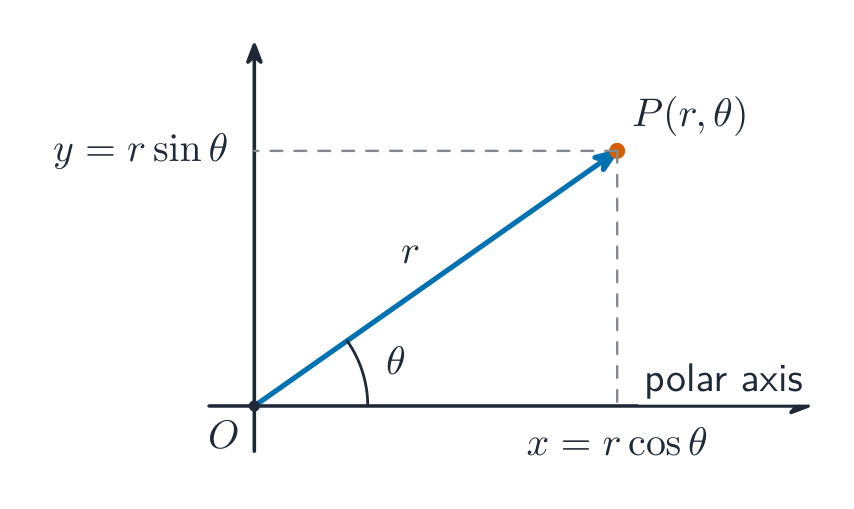
Polar coordinates 极坐标 locate a point by its distance $r$ from the origin and angle $\theta$: convert with $x=r\cos\theta$, $y=r\sin\theta$. A polar curve $r=f(\theta)$ is a parametric curve in $\theta$, so its slope is

$$\frac{dy}{dx}=\frac{dy/d\theta}{dx/d\theta},\quad\text{with } x=r\cos\theta,\ y=r\sin\theta.$$

Português
Traçando uma curva polar

Coordenadas polares 极坐标 localizam um ponto por sua distância $r$ à origem e ângulo $\theta$: converta com $x=r\cos\theta$, $y=r\sin\theta$. Uma curva polar $r=f(\theta)$ é uma curva paramétrica em $\theta$, então sua inclinação é

$$\frac{dy}{dx}=\frac{dy/d\theta}{dx/d\theta},\quad\text{with } x=r\cos\theta,\ y=r\sin\theta.$$

Coordenadas polares dão um ponto por sua distância r e ângulo theta
Explore · ⁨Explorar⁩

Plote uma curva polar

Nas coordenadas polares, um ponto está a uma distância $r$ no ângulo $\theta$. Deixando $r$ depender de $\theta$ traça curvas como este cardioides.

9.8

Finding the Area of a Polar Region · ⁨Encontrando a Área de uma Região Polar⁩

Syllabus · ⁨Programa⁩
English

Enduring Understanding (CHA-5): Definite integrals allow us to solve problems involving the accumulation of change in area or volume over an interval.

Learning Objective CHA-5.D: Calculate areas of regions defined by polar curves using definite integrals. BC ONLY

  • CHA-5.D.1 The concept of calculating areas in rectangular coordinates can be extended to polar coordinates. BC ONLY
Português

Compreensão Permanente (CHA-5): Integrais definidas nos permitem resolver problemas envolvendo a acumulação de mudança na área ou volume sobre um intervalo.

Objetivo de Aprendizagem CHA-5.D: Calcular áreas de regiões definidas por curvas polares usando integrais definidas. APENAS BC

  • CHA-5.D.1 O conceito de cálculo de áreas em coordenadas retangulares pode ser estendido para coordenadas polares. APENAS BC

Source: College Board AP Course and Exam Description · ⁨Fonte: College Board AP Course and Exam Description⁩

English

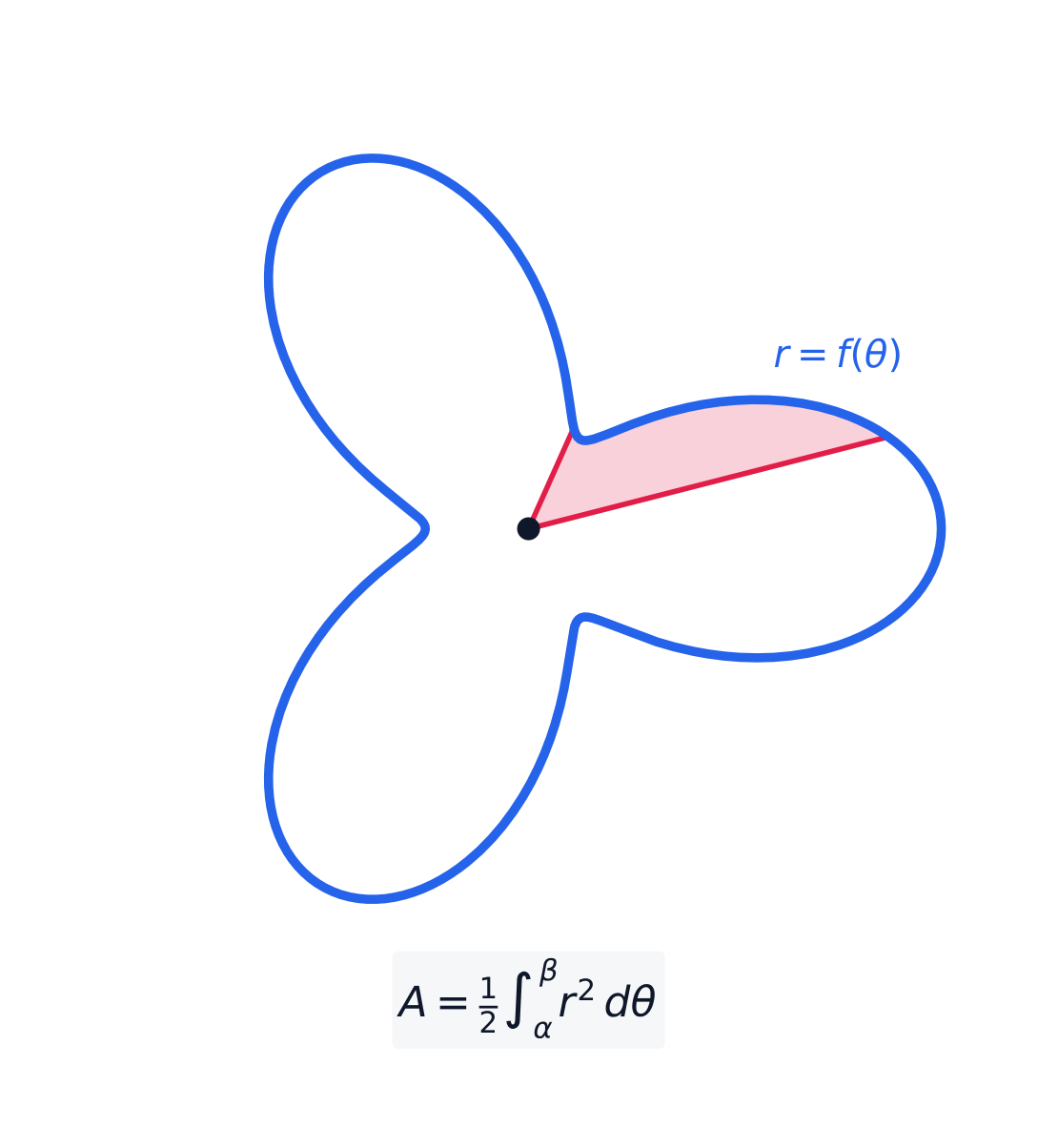
The area swept out by a polar curve $r=f(\theta)$ from $\alpha$ to $\beta$ is

$$A=\frac12\int_\alpha^\beta \big(f(\theta)\big)^2\,d\theta.$$
The region is a "fan" of thin triangular sectors; choosing the correct $\theta$-limits (where the curve starts and finishes tracing the region) is the main challenge.

Worked example. Find the area of one petal of the rose $r=2\sin(2\theta)$ (traced for $\theta$ from $0$ to $\tfrac{\pi}{2}$). Using $\sin^2 u=\tfrac12(1-\cos 2u)$,

$$A=\frac12\int_0^{\pi/2}(2\sin 2\theta)^2\,d\theta=\int_0^{\pi/2}(1-\cos 4\theta)\,d\theta=\left[\theta-\tfrac{\sin 4\theta}{4}\right]_0^{\pi/2}=\frac{\pi}{2}.$$

Português

A área varrida por uma curva polar $r=f(\theta)$ de $\alpha$ a $\beta$ é

$$A=\frac12\int_\alpha^\beta \big(f(\theta)\big)^2\,d\theta.$$
A região é um "leque" de finos setores triangulares; escolher os limites corretos de $\theta$ (onde a curva começa e termina de traçar a região) é o principal desafio.

Exemplo resolvido. Encontre a área de uma pétala da rosa $r=2\sin(2\theta)$ (traçada para $\theta$ de $0$ a $\tfrac{\pi}{2}$). Usando $\sin^2 u=\tfrac12(1-\cos 2u)$,

$$A=\frac12\int_0^{\pi/2}(2\sin 2\theta)^2\,d\theta=\int_0^{\pi/2}(1-\cos 4\theta)\,d\theta=\left[\theta-\tfrac{\sin 4\theta}{4}\right]_0^{\pi/2}=\frac{\pi}{2}.$$

A área de uma região polar é varrida como metade da integral de r² d theta
A região sombreada é um leque de finos setores varridos de $\alpha$ a $\beta$; cada um tem área $\tfrac12 r^2\,d\theta$, então o total é $\tfrac12\int_\alpha^\beta r^2\,d\theta$.
9.9

Finding the Area of the Region Bounded by Two Polar Curves · ⁨Encontrando a Área da Região Limitada por Duas Curvas Polares⁩

Syllabus · ⁨Programa⁩
English

Enduring Understanding (CHA-5): Definite integrals allow us to solve problems involving the accumulation of change in area or volume over an interval.

Learning Objective CHA-5.D: Calculate areas of regions defined by polar curves using definite integrals. BC ONLY

  • CHA-5.D.2 Areas of regions bounded by polar curves can be calculated with definite integrals. BC ONLY
Português

Compreensão Permanente (CHA-5): Integrais definidas nos permitem resolver problemas envolvendo a acumulação de mudança na área ou volume sobre um intervalo.

Objetivo de Aprendizagem CHA-5.D: Calcular áreas de regiões definidas por curvas polares usando integrais definidas. APENAS BC

  • CHA-5.D.2 As áreas de regiões delimitadas por curvas polares podem ser calculadas com integrais definidas. APENAS BC

Source: College Board AP Course and Exam Description · ⁨Fonte: College Board AP Course and Exam Description⁩

English

For the area between an outer curve $r_1$ and an inner curve $r_2$, subtract the sectors:

$$A=\frac12\int_\alpha^\beta\big(r_1^2-r_2^2\big)\,d\theta.$$
Find the intersection angles first (set $r_1=r_2$), and be careful which curve is outer over each interval – they can swap.

Português

Para a área entre uma curva externa $r_1$ e uma interna $r_2$, subtraia os setores:

$$A=\frac12\int_\alpha^\beta\big(r_1^2-r_2^2\big)\,d\theta.$$
Encontre os ângulos de interseção primeiro (igualando $r_1=r_2$), e tenha cuidado com qual curva é externa em cada intervalo – elas podem inverter.

9.9

Exam tips · ⁨Dicas de prova⁩

English
  • For parametric curves, $\tfrac{dy}{dx}=\tfrac{dy/dt}{dx/dt}$; speed is $\sqrt{(dx/dt)^2+(dy/dt)^2}$.
  • A vector-valued function carries the same information — differentiate/integrate it component by component.
  • In polar, convert with $x=r\cos\theta$, $y=r\sin\theta$; area swept is $\tfrac12\int r^2\,d\theta$.
  • Watch the direction of tracing (the sign of $dx/dt$) and set correct $\theta$-limits for polar area.
  • Eliminate the parameter to recover the ordinary $y$-vs-$x$ shape when it helps.
Português
  • Para curvas paramétricas, $\tfrac{dy}{dx}=\tfrac{dy/dt}{dx/dt}$; a rapidez é $\sqrt{(dx/dt)^2+(dy/dt)^2}$.
  • Uma função vetorial carrega a mesma informação – diferencie/integre-a componente a componente.
  • Em polares, converta com $x=r\cos\theta$, $y=r\sin\theta$; a área varrida é $\tfrac12\int r^2\,d\theta$.
  • Observe a direção do traçado (o sinal de $dx/dt$) e defina limites corretos de $\theta$ para área polar.
  • Elimine o parâmetro para recuperar a forma ordinaria $y$ vs-$x$ quando ajudar.

Interactive lessons on this topic · ⁨Aulas interativas sobre este tópico⁩

Work through it step by step, with instant-check exercises. · ⁨Passe por ele passo a passo, com exercícios de verificação instantânea.⁩

Past Papers · ⁨Provas Anteriores⁩

More topics in Cálculo BC do AP · ⁨Mais tópicos em Cálculo BC do AP⁩

Log in or create account · ⁨Entrar ou criar conta⁩

IGCSE, A-Level & AP