Integrating Vector-Valued Functions
Introduced| English | Meaning |
|---|---|
| initial condition/ɪˈnɪʃl kənˈdɪʃn/ | A specified starting value used to determine a particular solution of an equation or model. |
| constant vector | constant vector |
| displacement/dɪˈspleɪsmənt/ | The straight-line change in position, including direction. |
A rate needs a starting state
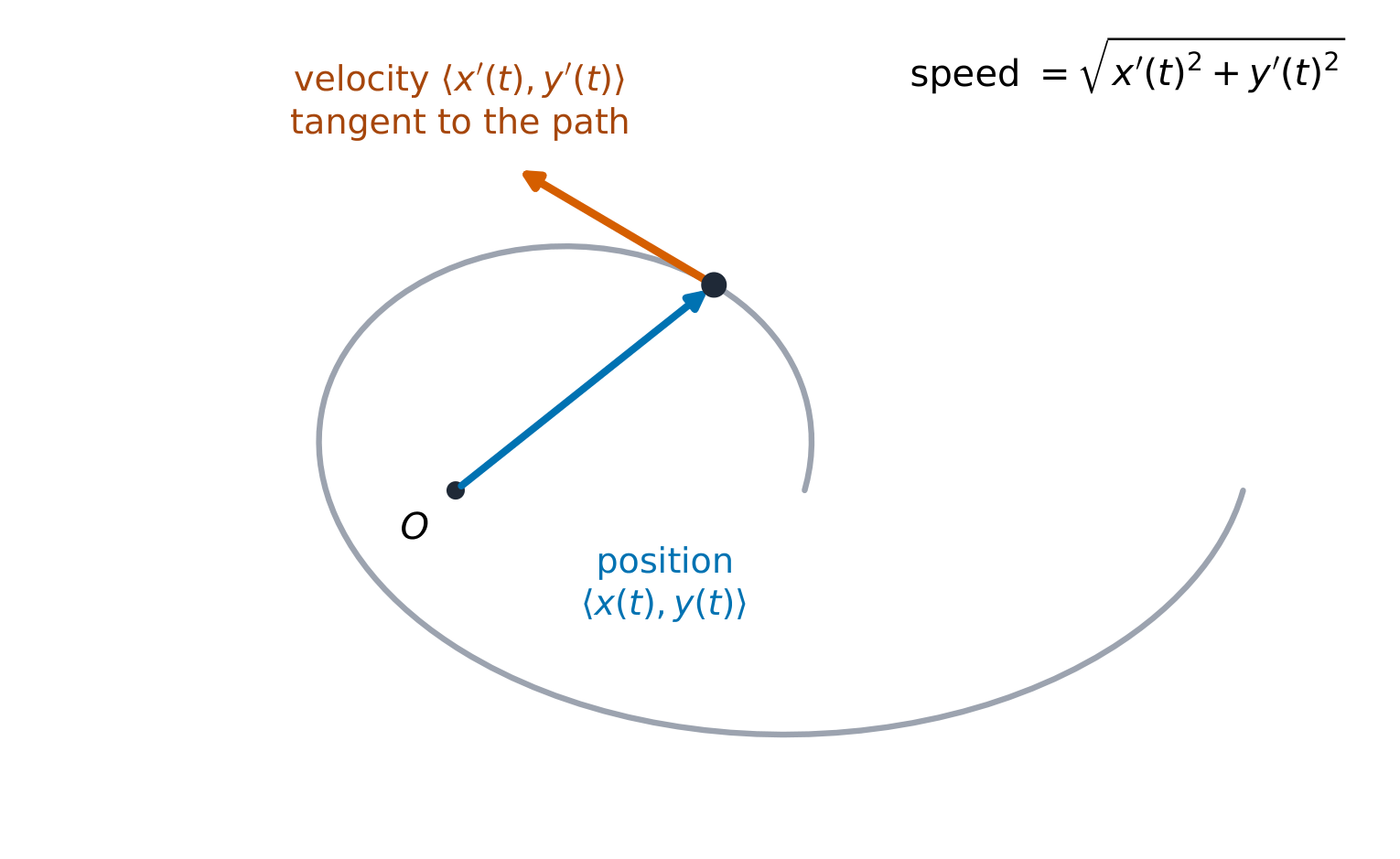
- A robot's velocity tells you how its position changes. To recover its actual position, you also need to know where it was at a stated time.
- Vector integration works component by component. An initial condition 初始条件 selects one particular vector function from the family of antiderivatives.
Give each component its own constant
- If $F'=f$ and $G'=g$, then $\int\langle f(t),g(t)\rangle\,dt=\langle F(t)+C_1,G(t)+C_2\rangle$. The two constants need not be equal.
- The pair $\mathbf C=\langle C_1,C_2\rangle$ is a constant vector 常向量. Integrating acceleration gives velocity; integrating velocity gives position. Each new integration introduces another constant vector.
To integrate $\langle f(t),g(t)\rangle$, you...
Difficulty 1/5 · 100 coins + a small bonus on first completion today
Integrate componentwise, plus a constant vector.
Integrating a vector function introduces a constant vector $\mathbf{C}$.
Difficulty 1/5 · 100 coins + a small bonus on first completion today
One constant per component, bundled into $\mathbf{C}$.
Each component of the integral has its own constant of integration.
Difficulty 1/5 · 100 coins + a small bonus on first completion today
They combine into the constant vector $\mathbf{C}$.
The two components of a constant vector must have the same scalar constant.
Difficulty 1/5 · 100 coins + a small bonus on first completion today
$\mathbf C=\langle C_1,C_2\rangle$ has independently determined components.
Recover the original velocity example
- Given $\mathbf a(t)=\langle2,6t\rangle$, integrate to get $\mathbf v(t)=\langle2t+C_1,3t^2+C_2\rangle$.
- The condition $\mathbf v(0)=\langle1,0\rangle$ gives $C_1=1$, $C_2=0$. Thus $\mathbf v(t)=\langle2t+1,3t^2\rangle$. The integral alone would not determine those constants.
If $\mathbf{a}(t)=\langle 2,6t\rangle$ and $\mathbf{v}(0)=\langle 1,0\rangle$, then $\mathbf{v}(t)=$
Difficulty 1/5 · 100 coins + a small bonus on first completion today
Integrate then apply $\mathbf{v}(0)$: $C_1=1,C_2=0$.
Integrating the acceleration vector recovers the...
Difficulty 1/5 · 100 coins + a small bonus on first completion today
Acceleration integrates to velocity.
For $\mathbf a=\langle2,6t\rangle$, $\mathbf v(0)=\langle1,0\rangle$, find $C_1$ in $v_x=2t+C_1$.
Difficulty 2/5 · 140 coins + a small bonus on first completion today
At t=0, $v_x(0)=C_1=1$.
Continue from velocity to position
- Suppose also $\mathbf r(0)=\langle2,-1\rangle$. Integrating the velocity gives $\mathbf r(t)=\langle t^2+t+C_3,t^3+C_4\rangle$.
- The position condition gives $C_3=2$, $C_4=-1$, so $\mathbf r(t)=\langle t^2+t+2,t^3-1\rangle$. At $t=1$, velocity is $\langle3,3\rangle$ but position is $\langle4,0\rangle$.

For the original two-stage example with $\mathbf r(0)=\langle2,-1\rangle$, what is the first position component at t=1?
Difficulty 2/5 · 140 coins + a small bonus on first completion today
$x(1)=1^2+1+2=4$.
Initial data need not be given at zero
- Keep $\mathbf a(t)=\langle2,6t\rangle$, but use $\mathbf v(1)=\langle4,-2\rangle$. Substituting $t=1$ into $\langle2t+C_1,3t^2+C_2\rangle$ gives $C_1=2$, $C_2=-5$.
- If $\mathbf r(1)=\langle3,7\rangle$, integrate again and apply that condition: $\mathbf r(t)=\langle t^2+2t,t^3-5t+11\rangle$. The constants are not simply copies of the stated initial coordinates.
To determine the constant vector, apply the given ____ condition.
Difficulty 1/5 · 100 coins + a small bonus on first completion today
Plug in the initial velocity or position.
Given $\mathbf a=\langle2,6t\rangle$ and $\mathbf v(1)=\langle4,-2\rangle$, find $C_2$ in $v_y=3t^2+C_2$.
Difficulty 2/5 · 140 coins + a small bonus on first completion today
$3+C_2=-2$, so $C_2=-5$.
For that same velocity function, find $v_y(2)$.
Difficulty 2/5 · 140 coins + a small bonus on first completion today
$3(2)^2-5=7$.
With the additional condition $\mathbf r(1)=\langle3,7\rangle$, what is y(2)?
Difficulty 2/5 · 140 coins + a small bonus on first completion today
$y(t)=t^3-5t+11$, so $y(2)=8-10+11=9$.
Use definite integrals to include the initial value
- The same velocity recovery can be written $\mathbf v(t)=\mathbf v(t_0)+\int_{t_0}^{t}\mathbf a(u)\,du$. The integral is the change in velocity, not the full velocity.
- Likewise $\mathbf r(t)=\mathbf r(t_0)+\int_{t_0}^{t}\mathbf v(u)\,du$. The dummy variable $u$ separates the integration variable from the upper limit $t$; add the correct initial vector after integrating.
Initial vectors select a particular motion
With acceleration⟨2,6 t⟩, initial velocity⟨1,0⟩ and initial position⟨2,−1⟩ at t₀=0, recover velocity⟨3,3⟩ and position⟨4,0⟩ at t=1. Change the initial time and velocity components to see their effects.
What is the first component of $\int_0^1\langle2,6u\rangle\,du$?
Difficulty 2/5 · 140 coins + a small bonus on first completion today
$\int_0^1 2\,du=2$ is the first velocity change, not the full initial-plus-change velocity.
What does $\int_{t_0}^{t}\mathbf a(u)\,du$ give?
Difficulty 1/5 · 100 coins + a small bonus on first completion today
It equals $\mathbf v(t)-\mathbf v(t_0)$.
Displacement is not travelled distance
- The vector $\int_a^b\mathbf v(t)\,dt=\mathbf r(b)-\mathbf r(a)$ is displacement 位移. Its components can be negative or cancel when the point changes direction.
- Total distance for $a\le b$ is the scalar $\int_a^b|\mathbf v(t)|\,dt$. For $\mathbf v(t)=\langle2t,0\rangle$ on $[-1,1]$, displacement is $\langle0,0\rangle$, while travelled distance is $\int_{-1}^1 2|t|\,dt=2$.
The components of a displacement integral can cancel when the point reverses direction.
Difficulty 1/5 · 100 coins + a small bonus on first completion today
A vector integral records signed coordinate changes, rather than adding nonnegative lengths.
For $\mathbf v(t)=\langle2t,0\rangle$ on[-1,1], find the first displacement component.
Difficulty 2/5 · 140 coins + a small bonus on first completion today
$\int_{-1}^1 2t\,dt=0$.
For that same velocity, find the travelled distance.
Difficulty 2/5 · 140 coins + a small bonus on first completion today
Integrate speed: $\int_{-1}^1 2|t|\,dt=2$.
Verify both the derivative and the data
- A candidate position must satisfy $\mathbf r'=\mathbf v$ and the stated initial position. A candidate velocity must satisfy $\mathbf v'=\mathbf a$ and the stated initial velocity.
- A correct derivative alone is not enough: adding a constant vector leaves the derivative unchanged but may violate the initial condition. Check each component at the specified time.
What should you check after recovering position from velocity and an initial position?
Difficulty 1/5 · 100 coins + a small bonus on first completion today
Both the derivative equation and the stated initial value must hold.
Do not copy an initial value blindly
- If $\mathbf v(t)=\langle\cos t,-\sin t\rangle$, an antiderivative is $\mathbf r(t)=\langle\sin t+C_1,\cos t+C_2\rangle$.
- With $\mathbf r(0)=\langle1,2\rangle$, the constants are $C_1=1$, $C_2=1$, because $\cos0=1$. The result is $\langle\sin t+1,\cos t+1\rangle$, not a second component $\cos t+2$.
For $\mathbf v=\langle\cos t,-\sin t\rangle$ and $\mathbf r(0)=\langle1,2\rangle$, find $C_2$ in $y=\cos t+C_2$.
Difficulty 2/5 · 140 coins + a small bonus on first completion today
$1+C_2=2$, so $C_2=1$, not 2.
Match the information to the task
- To determine position from acceleration, you generally need both an initial velocity vector and an initial position vector. Velocity data fix one integration; position data fix the other.
- Scalar speed alone does not determine the velocity vector. For example, $\langle1,0\rangle$ and $\langle0,1\rangle$ both have speed $1$ but lead to different paths from the same starting point.
Initial position and scalar speed alone always determine one unique planar position function.
Difficulty 1/5 · 100 coins + a small bonus on first completion today
Direction is missing: rightward and upward unit velocities have the same speed but different paths.
Try fresh initial-value problems
- Given $\mathbf a(t)=\langle4,6t\rangle$, $\mathbf v(1)=\langle1,-2\rangle$ and $\mathbf r(1)=\langle3,5\rangle$, find $\mathbf v(t)$ and $\mathbf r(t)$, then evaluate position at $t=2$.
- Given $\mathbf v(t)=\langle2\cos t,3t^2\rangle$ and $\mathbf r(0)=\langle1,-2\rangle$, recover position. Then compare displacement and travelled distance for $\mathbf v(t)=\langle2t,0\rangle$ on $[-2,1]$.
Given $\mathbf a(t)=\langle4,6t\rangle$, $\mathbf v(1)=\langle1,-2\rangle$, $\mathbf r(1)=\langle3,5\rangle$, find velocity and position functions, then position at t=2.
Compare your component integrals, initial values and interpretation with the model.
Given $\mathbf v(t)=\langle2\cos t,3t^2\rangle$ and $\mathbf r(0)=\langle1,-2\rangle$, find position and verify it.
Compare your component integrals, initial values and interpretation with the model.
For $\mathbf v(t)=\langle2t,0\rangle$ on[-2,1], find displacement and travelled distance. Is an initial position needed for either?
Compare your component integrals, initial values and interpretation with the model.
Integrate, apply, and check
- Integrate every component with its own constant, apply the initial data at their stated times, and differentiate to check the result. Use a new constant vector at each integration stage.
- A definite integral gives a change; add the initial vector to recover the final state. Keep vector displacement separate from scalar distance, which uses the magnitude of velocity.
Before initial data are applied, how many scalar constants arise from integrating a two-component acceleration vector twice?
Difficulty 2/5 · 140 coins + a small bonus on first completion today
Each integration introduces two independent scalar constants, for four in total.