Solving Motion Problems Using Parametric and Vector-Valued Functions
Introduced| English | Meaning |
|---|---|
| velocity/vəˈlɒsɪti/ | The rate of change of displacement. |
| speed/spiːd/ | The distance travelled per unit time. |
| acceleration/əkˌseləˈreɪʃn/ | The rate of change of velocity. |
| displacement/dɪˈspleɪsmənt/ | The straight-line change in position, including direction. |
| distance traveled | distance traveled |
Where is the particle, and how far has it traveled?
- A tracking system may report a particle's velocity in two directions. From that data, you can find its speed and changes in position, but the actual position also needs a known starting point.
- Planar motion combines differentiation and integration. Keep vector states, scalar magnitudes and accumulated changes distinct throughout the calculation.
Choose the quantity before calculating
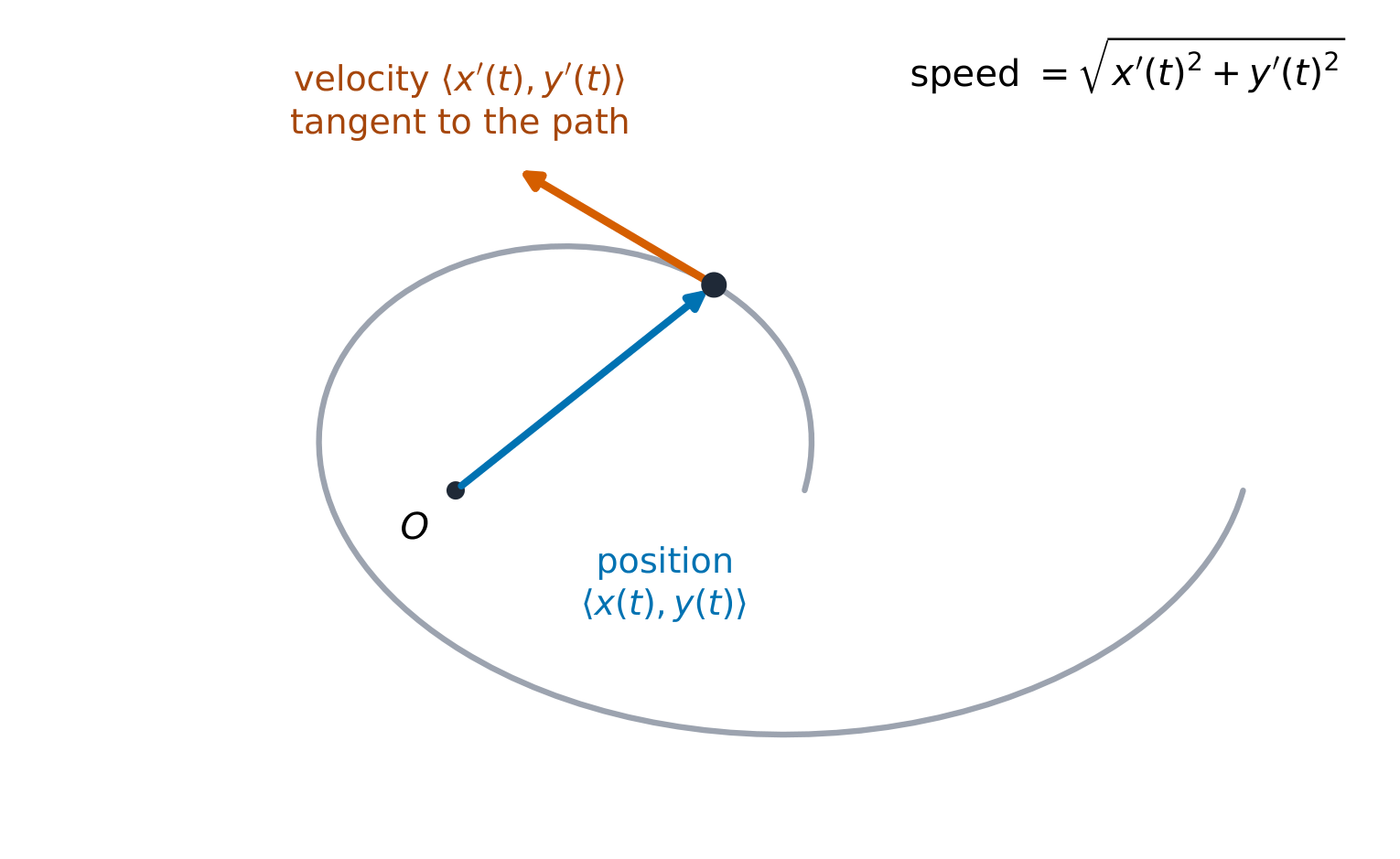
- Velocity 速度 is $\mathbf v=\mathbf r'$, and acceleration 加速度 is $\mathbf a=\mathbf v'$. Both are vectors; speed 速率 is the scalar $|\mathbf v|=\sqrt{v_x^2+v_y^2}$.
- A nonzero velocity gives the tangent direction. Its components show right/left and up/down motion. A zero velocity has no direction at that instant, even when the geometric path has a tangent.
Which of these are vectors (not scalars)?
Difficulty 2/5 · 140 coins + a small bonus on first completion today
Velocity and acceleration are vectors; speed and distance are scalars.
The magnitude of the velocity vector is the ____.
Difficulty 1/5 · 100 coins + a small bonus on first completion today
Speed = magnitude of velocity.
Work the original velocity example
- For $\mathbf v(t)=\langle2t,3\rangle$, differentiate to get $\mathbf a(t)=\langle2,0\rangle$. At $t=2$, velocity is $\langle4,3\rangle$ and speed is $\sqrt{4^2+3^2}=5$.
- The speed function is $s(t)=\sqrt{4t^2+9}$, not $2t+3$. Acceleration is a vector; its magnitude $2$ is not generally the rate of change of speed.
For $\mathbf{v}(t)=\langle 2t,3\rangle$, find the speed at $t=2$.
Difficulty 2/5 · 140 coins + a small bonus on first completion today
$\sqrt{4^2+3^2}=5$.
For $\mathbf v=\langle2t,3\rangle$, what is the first acceleration component?
Difficulty 2/5 · 140 coins + a small bonus on first completion today
Differentiate $2t$ to obtain 2; the acceleration vector is $\langle2,0\rangle$.
Recover a complete position
- Suppose $\mathbf r(0)=\langle1,-2\rangle$. Integrating each velocity component and adding the initial coordinates gives $\mathbf r(t)=\langle1+t^2,-2+3t\rangle$.
- At $t=2$, position is $\langle5,4\rangle$. The integral of velocity on $[0,2]$ is only the displacement 位移 $\langle4,6\rangle$; add the initial position to obtain the final position.
The $x$-position at time $b$ is $x(a)$ plus...
Difficulty 1/5 · 100 coins + a small bonus on first completion today
Final = initial + accumulated change of $x$.
For $\mathbf v=\langle2t,3\rangle$ and $\mathbf r(0)=\langle1,-2\rangle$, find x(2).
Difficulty 2/5 · 140 coins + a small bonus on first completion today
$x(2)=1+\int_0^2 2t\,dt=5$.
For the same motion, find y(2).
Difficulty 2/5 · 140 coins + a small bonus on first completion today
$y(2)=-2+\int_0^2 3\,dt=4$.
For the original motion on [0,2], find the second displacement component.
Difficulty 2/5 · 140 coins + a small bonus on first completion today
$\int_0^2 3\,dt=6$. This is the change in y, not y(2)=4.
Evaluate traveled distance too
- The distance traveled 路程 on $[0,2]$ is $D=\int_0^2\sqrt{4t^2+9}\,dt\approx7.472$. A calculator can evaluate this integral; an exact value is $5+\dfrac94\ln3$.
- The displacement magnitude is $\sqrt{4^2+6^2}=\sqrt{52}\approx7.211$. It measures the straight endpoint chord, which is shorter than this curved route. Neither quantity is the final position $\langle5,4\rangle$.

One motion, several different quantities
For v(t)=⟨2 t,3⟩ and r(0)=⟨1,−2⟩, compare position, velocity, acceleration, speed, displacement and the speed integral. Then compare a reversing route and a circle.
Distance traveled over $[a,b]$ is...
Difficulty 1/5 · 100 coins + a small bonus on first completion today
Integrate the speed (magnitude of velocity).
Evaluate $\int_0^2\sqrt{4t^2+9}\,dt$ to three decimal places.
Difficulty 2/5 · 140 coins + a small bonus on first completion today
The value is $5+(9/4)\ln3\approx7.471878$, giving 7.472.
Use vector and scalar integrals correctly
- For $a\le b$, displacement is $\int_a^b\mathbf v(t)\,dt=\mathbf r(b)-\mathbf r(a)$, while traveled distance is $\int_a^b|\mathbf v(t)|\,dt$. The first is a vector; the second adds nonnegative lengths.
- Distance is at least the displacement magnitude. They can agree for a straight route traced in one direction, but reversals or curvature can make distance larger. Integrating speed does not give a position coordinate.
Distance traveled equals the magnitude of the displacement vector.
Difficulty 1/5 · 100 coins + a small bonus on first completion today
Distance is $\int|\mathbf{v}|\,dt$; displacement magnitude can be smaller.
For every planar route, the speed integral equals the straight-line distance between its endpoints.
Difficulty 1/5 · 100 coins + a small bonus on first completion today
The curved worked route has distance about 7.472, exceeding endpoint distance about 7.211.
Determine whether speed is increasing
- Where $|\mathbf v|>0$, differentiate $s=\sqrt{\mathbf v\cdot\mathbf v}$ to get $s'=\dfrac{\mathbf v\cdot\mathbf a}{|\mathbf v|}$. A positive dot product means speeding up; a negative one means slowing down.
- In the original example at $t=2$, $\mathbf v\cdot\mathbf a=\langle4,3\rangle\cdot\langle2,0\rangle=8$, so $s'=8/5>0$. Merely having a positive acceleration component is not a general speeding-up test.
For the original motion at t=2, find $\mathbf v\cdot\mathbf a$.
Difficulty 2/5 · 140 coins + a small bonus on first completion today
$\langle4,3\rangle\cdot\langle2,0\rangle=4(2)+3(0)=8$.
For that same motion at t=2, find the rate of change of speed.
Difficulty 2/5 · 140 coins + a small bonus on first completion today
$s'=\dfrac{\mathbf v\cdot\mathbf a}{|\mathbf v|}=8/5$.
Work a reversal and a stop
- For $\mathbf r(t)=\langle(t-1)^2,0\rangle$ on $[0,2]$, velocity is $\langle2(t-1),0\rangle$ and acceleration is $\langle2,0\rangle$. The point slows down before $t=1$, stops there, then speeds up after reversing direction.
- It starts and finishes at $(1,0)$, so displacement is zero, but traveled distance is $\int_0^2 2|t-1|\,dt=2$. At the stop, the formula for $s'$ above is unavailable; compare nearby motion rather than dividing by zero.
At a stop with $|\mathbf v|=0$, how should the formula $(\mathbf v\cdot\mathbf a)/|\mathbf v|$ be used?
Difficulty 1/5 · 100 coins + a small bonus on first completion today
The denominator is zero, so this formula is unavailable; inspect nearby motion separately.
For $\mathbf r=\langle(t-1)^2,0\rangle$ on [0,2], when is the particle slowing down?
Difficulty 1/5 · 100 coins + a small bonus on first completion today
On $0\le t<1$, $\mathbf v\cdot\mathbf a=4(t-1)<0$ and speed is positive.
For that reversing motion on [0,2], find total distance.
Difficulty 2/5 · 140 coins + a small bonus on first completion today
The particle travels one unit to x=0 and one unit back; displacement is zero.
Constant speed does not mean zero acceleration
- For $\mathbf r(t)=\langle\cos(\pi t),\sin(\pi t)\rangle$ on $[0,2]$, velocity is $\pi\langle-\sin(\pi t),\cos(\pi t)\rangle$ and acceleration is $-\pi^2\mathbf r(t)$.
- Speed is constantly $\pi$, but acceleration is nonzero because direction changes. One circuit has traveled distance $2\pi$ and zero displacement. A zero value of $\mathbf v\cdot\mathbf a$ at one instant alone does not establish constant speed on an interval.
Uniform circular motion has zero acceleration because its speed is constant.
Difficulty 1/5 · 100 coins + a small bonus on first completion today
Velocity changes direction, so its derivative vector can be nonzero while speed remains constant.
For $\mathbf r=\langle\cos(\pi t),\sin(\pi t)\rangle$ on [0,2], find traveled distance.
Difficulty 2/5 · 140 coins + a small bonus on first completion today
Speed is π, and the interval has length 2, so distance is 2π.
Check components and time together
- At $t=0$ in the original example, velocity is $\langle0,3\rangle$: vertical motion with speed $3$, rather than rest. At $t=2$, both components are positive, so the point moves right and up.
- Differentiate before substituting when rates are needed. For position, add each velocity integral to the matching initial coordinate. State whether the answer is a vector, a scalar, or a line equation.
A zero first velocity component guarantees that the particle is at rest.
Difficulty 1/5 · 100 coins + a small bonus on first completion today
The vector $\langle0,3\rangle$ is a nonzero vertical velocity with speed 3.
For the original motion at t=2, find the tangent slope.
Difficulty 2/5 · 140 coins + a small bonus on first completion today
The nonzero first velocity component allows $v_y/v_x=3/4$.
Try fresh motion problems
- Given $\mathbf v(t)=\langle3t,4\rangle$ and $\mathbf r(1)=\langle2,-1\rangle$, find position, acceleration, speed and the rate of change of speed at $t=2$. Set up traveled distance on $[1,2]$.
- For $\mathbf r(t)=\langle(t-2)^2,0\rangle$ on $[0,3]$, compare displacement and distance, and locate the reversal. Then explain how uniform circular motion can have nonzero acceleration with constant speed.
Given $\mathbf v(t)=\langle3t,4\rangle$ and $\mathbf r(1)=\langle2,-1\rangle$, find position, acceleration, speed and the rate of speed change at t=2. Set up traveled distance on [1,2].
Compare your vector states, scalar quantities and interpretation with the model.
For $\mathbf r(t)=\langle(t-2)^2,0\rangle$ on [0,3], find displacement, traveled distance and reversal time. State where it slows down and speeds up.
Compare your vector states, scalar quantities and interpretation with the model.
Finish with the right interpretation
- Use derivatives for instantaneous rates, vector integrals for displacement, and speed integrals for traveled distance. Include the initial position when a final position is requested.
- Use nonzero velocity for tangent direction and the dot-product test for speed change only where speed is positive. Check stops separately and retain enough digits until the final numerical answer.
For $\mathbf r(t)=\langle2\cos t,2\sin t\rangle$ on [0,2π], find speed, acceleration magnitude, displacement and distance. Explain constant speed with nonzero acceleration.
Compare your vector states, scalar quantities and interpretation with the model.