Find the Area of a Polar Region or the Area Bounded by a Single Polar Curve
Introduced| English | Meaning |
|---|---|
| area/ˈeərɪə/ | The measure of a two-dimensional region, expressed in square units. |
| sectors/ˈsektəz/ | A region of a circle bounded by two radii and the arc between them. |
| petal | petal |
| integration limits | integration limits |
| symmetry/ˈsɪmətri/ | symmetry |
How much ground does a rotating beam cover?
- A rotating scanner may reach farther in some directions than others. To find the area 面积 it covers, add narrow slices between nearby rays rather than rectangles under a graph.
- In polar coordinates, the curve gives a radius for each angle. The same location can be reached more than once, so the angle interval must describe the intended region without repeated coverage.
Build the area from small sectors
- A circular sector of radius R and angle $\Delta\theta$ in radians has area $\dfrac12R^2\Delta\theta$. Thin sectors 扇形 approximate a polar region when the radius changes continuously with angle.
- For $r=f(\theta)$, a narrow slice contributes about $\dfrac12[f(\theta)]^2\Delta\theta$. Adding the slices and taking a limit gives an integral; the factor $\dfrac12$ comes from sector geometry.
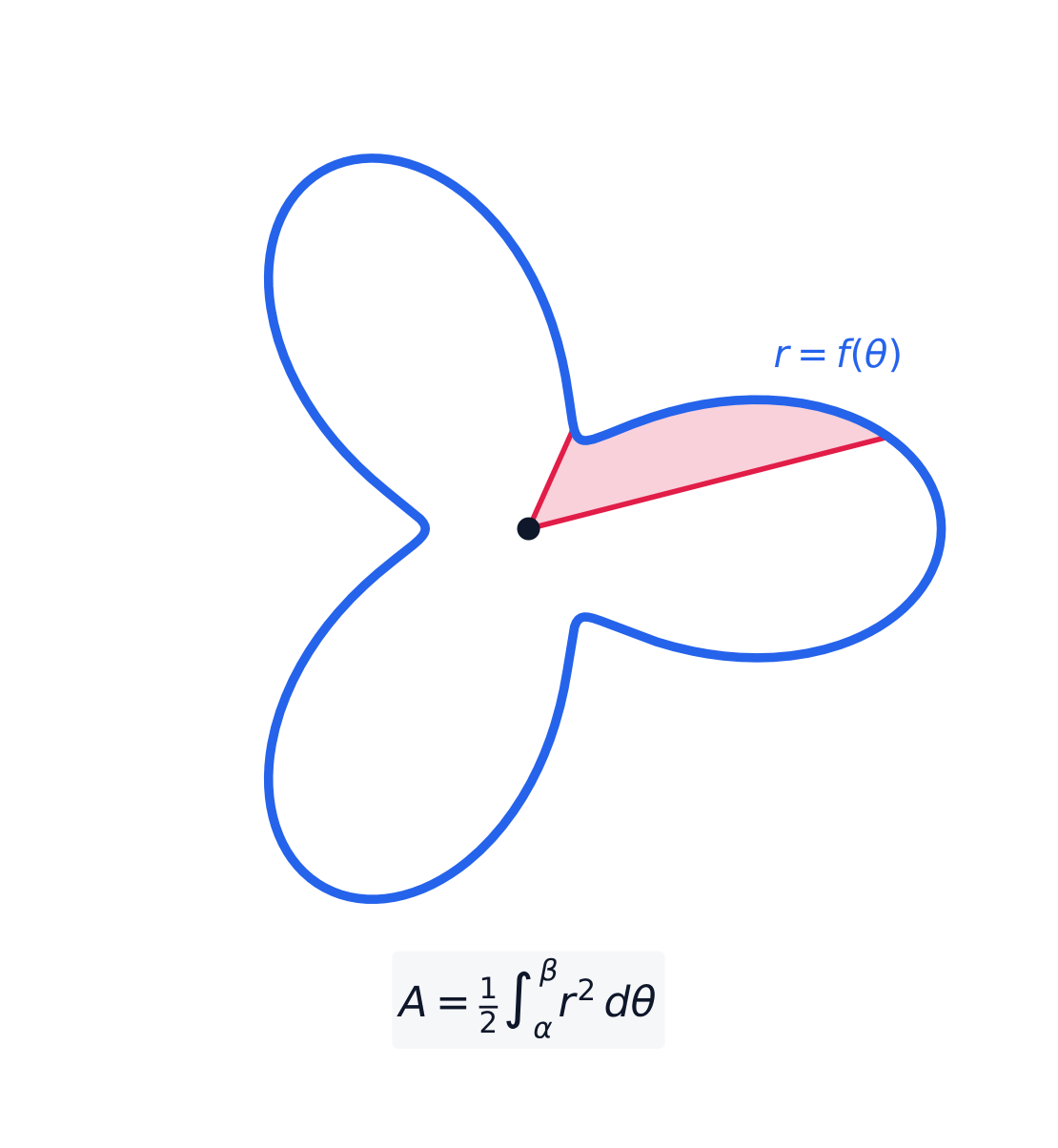
The polar area formula sums the areas of thin circular ____.
Difficulty 1/5 · 100 coins + a small bonus on first completion today
Each sector has area $\tfrac12 r^2\,d\theta$.
A sector has radius 3 and angle $\pi/3$. Its area is $c\pi$. Give c.
Difficulty 2/5 · 140 coins + a small bonus on first completion today
$A=(1/2)(3^2)(\pi/3)=3\pi/2$.
Use the formula with its conditions
- For ordered angles $\alpha\le\beta$, the sweep integral is $A=\dfrac12\int_\alpha^\beta[f(\theta)]^2\,d\theta$. Use radians, square the full radius function, and include the half. The integrand is nonnegative even if r is negative.
- This gives geometric area when the radial sweep covers the intended region once. Repeated coverage is counted repeatedly by the integral. Reversing the bounds changes its sign, which is not a geometric area.
When the ordered angle interval covers the intended polar region once, its area is...
Difficulty 1/5 · 100 coins + a small bonus on first completion today
Half the integral of $r^2$.
The polar area formula includes a factor of $\tfrac12$ and squares $r$.
Difficulty 1/5 · 100 coins + a small bonus on first completion today
$A=\tfrac12\int r^2\,d\theta$.
At an angle where r=−2, what is the value of the area integrand $r^2/2$?
Difficulty 2/5 · 140 coins + a small bonus on first completion today
$(−2)^2/2=2$. The integrand is nonnegative.
Check the original circle example
- For $r=2$, angles $0\le\theta\le2\pi$ sweep the disk once. Its area is $\dfrac12\int_0^{2\pi}4\,d\theta=4\pi$, matching $\pi(2)^2$ square units.
- Its circumference also happens to be $4\pi$, but in length units. That numerical match occurs at this radius; it does not make the area and circumference formulas interchangeable. For radius 3 they give $9\pi$ square units and $6\pi$ length units.
Find the area enclosed by $r=2$: $\tfrac12\int_0^{2\pi}4\,d\theta$ (as a multiple of $\pi$, enter the number).
Difficulty 2/5 · 140 coins + a small bonus on first completion today
$\tfrac12\cdot4\cdot2\pi=4\pi$.
The polar integral gives $4\pi$ square units for $r=2$. Which geometric quantity does this represent?
Difficulty 1/5 · 100 coins + a small bonus on first completion today
Area is $\pi(2)^2=4\pi$ square units. Circumference happens to have the same numerical value at radius 2, but is measured in length units.
The disk $r=3$ has area $c\pi$. Give c.
Difficulty 2/5 · 140 coins + a small bonus on first completion today
$A=(1/2)\int_0^{2\pi}9\,d\theta=9\pi$.
Find an interval that closes the right curve
- For $r=2\cos\theta$, write $x=1+\cos2\theta$ and $y=\sin2\theta$. This is the circle $(x-1)^2+y^2=1$, traced once on $[0,\pi]$ even though r changes sign.
- Its area is $\dfrac12\int_0^\pi4\cos^2\theta\,d\theta=\int_0^\pi(1+\cos2\theta)\,d\theta=\pi$. The radius in this polar equation is not the constant radius of the Cartesian circle.
For $r=2\cos\theta$, find the area of its circle as a multiple of π: give the coefficient.
Difficulty 2/5 · 140 coins + a small bonus on first completion today
$A=\int_0^\pi(1+\cos2\theta)\,d\theta=\pi$.
A nonnegative integral can still overcount
- Using $[0,2\pi]$ for that same curve gives $2\pi$, because it traces the circle twice. The geometric area is still $\pi$. Squaring a negative radius handles its length; it does not remove repeated tracing.
- Check the path as well as the zeros of r. A complete region need not require a full turn, and a chosen interval may cover only part of a region even when both limits look familiar.
The angle limits $\alpha,\beta$ should be chosen so the curve traces the region...
Difficulty 1/5 · 100 coins + a small bonus on first completion today
Tracing more than once double-counts area.
The sweep integral for $r=2\cos\theta$ on [0,2π] is cπ. Give c.
Difficulty 2/5 · 140 coins + a small bonus on first completion today
The circle is traced twice, so the sweep integral is 2π, while geometric area is π.
Squaring r in the area formula automatically prevents repeated coverage from being counted twice.
Difficulty 1/5 · 100 coins + a small bonus on first completion today
Squaring makes the integrand nonnegative; the angle interval still controls repeated coverage.
Choose one rose petal before integrating
- For $r=\cos3\theta$, the right-hand petal 花瓣 starts and ends at the origin. Solve $\cos3\theta=0$ around zero to get integration limits 积分限 $-\pi/6$ and $\pi/6$.
- Between these limits, r is nonnegative and reaches 1 at zero, so this interval traces the complete right-hand petal once. The interval $[0,\pi/6]$ covers only half of it.
The right-hand petal of $r=\cos3\theta$ starts at $c\pi$, with c nearest to zero on the negative side. Give c.
Difficulty 2/5 · 140 coins + a small bonus on first completion today
$3\theta=-\pi/2$, so $\theta=-\pi/6$.
That petal ends at $c\pi$, with c nearest to zero on the positive side. Give c.
Difficulty 2/5 · 140 coins + a small bonus on first completion today
$3\theta=\pi/2$, so $\theta=\pi/6$.
The interval $[0,\pi/6]$ traces the complete right-hand petal of $r=\cos3\theta$.
Difficulty 1/5 · 100 coins + a small bonus on first completion today
It runs from the petal tip to the origin, sweeping half the petal; use −π/6 to π/6 for the complete petal.
Evaluate the petal's area
- Use $\cos^2u=(1+\cos2u)/2$ to write $A=\dfrac14\int_{-\pi/6}^{\pi/6}(1+\cos6\theta)\,d\theta$. An antiderivative is $\theta/4+\sin6\theta/24$.
- At both endpoints the sine term is zero. The difference of the angle terms is $\pi/24-(-\pi/24)=\pi/12$. This is one petal, not the whole rose.

One petal of $r=\cos3\theta$ has area cπ. Give c.
Difficulty 2/5 · 140 coins + a small bonus on first completion today
The antiderivative is $\theta/4+\sin6\theta/24$; the endpoint difference is π/12.
Scale from one petal only after checking symmetry
- Rotational symmetry 对称性 gives three equal petals, so the full rose area is $3(\pi/12)=\pi/4$. Equivalently, $\dfrac12\int_0^\pi\cos^2(3\theta)\,d\theta=\pi/4$ traces all three once.
- The interval $[0,2\pi]$ traces this odd-petal rose twice, giving the sweep integral $\pi/2$. State whether the question requests one petal, the whole rose, or an accumulated sweep with repeated coverage.
The complete three-petal rose $r=\cos3\theta$ has area cπ. Give c.
Difficulty 2/5 · 140 coins + a small bonus on first completion today
There are three equal petals: $3(\pi/12)=\pi/4$.
For $r=\cos3\theta$, what does $\frac12\int_0^{2\pi}r^2\,d\theta=\pi/2$ represent?
Difficulty 1/5 · 100 coins + a small bonus on first completion today
The odd-petal rose is traced twice on this interval.
Work another nonconstant radius
- For $r=1+\cos\theta$, the full cardioid is traced once on $[0,2\pi]$. Expand the square: $(1+\cos\theta)^2=1+2\cos\theta+\cos^2\theta$; dropping the middle term changes partial-region calculations.
- Its area is $\dfrac12\int_0^{2\pi}(1+2\cos\theta+\cos^2\theta)\,d\theta=\dfrac12(2\pi+0+\pi)=3\pi/2$. Reflection symmetry also lets you double the upper-half area $3\pi/4$.
A polar region and its sweep integral
For r=cos 3θ, the bounds −π/6 to π/6 give one petal with area π/12. Compare a full rose, repeated coverage, and other polar curves.
Which expression equals $(1+\cos\theta)^2$?
Difficulty 1/5 · 100 coins + a small bonus on first completion today
The square includes the cross term $2\cos heta$.
The full region $r=1+\cos\theta$ has area cπ. Give c.
Difficulty 2/5 · 140 coins + a small bonus on first completion today
The full-turn integral gives $(1/2)(2\pi+0+\pi)=3\pi/2$.
Try fresh regions and scales
- Find the area for $r=3$ between $\pi/6$ and $2\pi/3$. Then find one right-hand petal and the full rose area for $r=2\cos3\theta$, using bounds you justify.
- For $r=2+2\cos\theta$, find the full area and the part above the x-axis. Check how doubling every radius changes area before evaluating the integral again.
If every radius in a polar region is doubled, by what factor does its area change?
Difficulty 2/5 · 140 coins + a small bonus on first completion today
The area integrand contains r², so a factor 2 in radius gives a factor 4 in area.
Find the area swept by $r=3$ between $\pi/6$ and $2\pi/3$. Justify the angle span.
Compare your region, bounds and integral with the model.
For $r=2\cos3\theta$, find the right-hand petal area and full rose area, stating justified bounds.
Compare your region, bounds and integral with the model.
For $r=2+2\cos\theta$, find the full enclosed area and the part above the x-axis. State integration limits.
Compare your region, bounds and integral with the model.
Finish with region, bounds and square units
- Sketch or trace the intended region, find its start and end angles, and check for repeated coverage. Use known symmetry only when it maps the required pieces onto equal regions.
- Evaluate $\dfrac12\int r^2\,d\theta$ with ordered radian bounds. Check the half, the complete square, and the units; compare the result with a simple shape or a scale check when possible.