Skip to content · ⁨Pular para o conteúdo⁩

Aplicações Contextualizadas da Diferenciação

Cálculo BC do AP · Topic 4 · ⁨Tópico 4⁩

Train · ⁨Treinar⁩
Video lesson for this topic · ⁨Videoaula para este tópico⁩ Open the video page · ⁨Abrir a página do vídeo⁩
8:26

Interpretando a Derivada no Contexto

Um tanque está sendo esvaziado. Uma xícara de café está esfriando. Uma cidade está crescendo. Cada uma dessas frases esconde a mesma expressão. A taxa com que algo muda. E…

English narration · English + 中文 subtitles burned in · ⁨Narração em inglês · Legendas em inglês + 中文 gravadas⁩

4.1

Interpreting the Meaning of the Derivative in Context · ⁨Interpretando o Significado da Derivada em Contexto⁩

Syllabus · ⁨Programa⁩
English

Enduring Understanding (CHA-3): Derivatives allow us to solve real-world problems involving rates of change.

Learning Objective CHA-3.A: Interpret the meaning of a derivative in context.

  • CHA-3.A.1 The derivative of a function can be interpreted as the instantaneous rate of change with respect to its independent variable.
  • CHA-3.A.2 The derivative can be used to express information about rates of change in applied contexts.
  • CHA-3.A.3 The unit for $f'(x)$ is the unit for $f$ divided by the unit for $x$.
Português

Compreensão Duradoura (CHA-3): As derivadas nos permitem resolver problemas do mundo real envolvendo taxas de variação.

Objetivo de Aprendizagem CHA-3.A: Interpretar o significado de uma derivada em contexto.

  • CHA-3.A.1 A derivada de uma função pode ser interpretada como a taxa de variação instantânea em relação à sua variável independente.
  • CHA-3.A.2 A derivada pode ser usada para expressar informações sobre taxas de variação em contextos aplicados.
  • CHA-3.A.3 A unidade para $f'(x)$ é a unidade para $f$ dividida pela unidade para $x$.
Source: College Board AP Course and Exam Description · ⁨Fonte: College Board AP Course and Exam Description⁩

English

Once you can compute derivatives, you use them to describe the real world. The derivative $f'(x)$ is the instantaneous rate of change of $f$ with respect to its input. Reading and reporting this rate correctly is a graded skill.

Units matter. The unit of $f'(x)$ is the unit of $f$ divided by the unit of $x$. If $C(t)$ is a number of acres and $t$ is in weeks, then $C'(t)$ is in acres per week. On the exam, "Using correct units, interpret the meaning of $g'(140)$" wants a full sentence: the value, the quantity, the rate word "per", and the moment. For example: "$g'(140)=2.3$ means that at $x=140$, the quantity is increasing at about $2.3$ units per unit of $x$."

Português

Assim que você consegue calcular derivadas, usa-as para descrever o mundo real. A derivada $f'(x)$ é a taxa de variação instantânea de $f$ em relação à sua entrada. Ler e relatar essa taxa corretamente é uma habilidade avaliada.

As unidades importam. A unidade de $f'(x)$ é a unidade de $f$ dividida pela unidade de $x$. Se $C(t)$ é um número de acres e $t$ está em semanas, então $C'(t)$ está em acres por semana. Na prova, "Usando as unidades corretas, interprete o significado de $g'(140)$" pede uma frase completa: o valor, a quantidade, a palavra de taxa "por", e o momento. Por exemplo: "$g'(140)=2.3$ significa que em $x=140$, a quantidade está aumentando a cerca de $2.3$ unidades por unidade de $x$."

4.2

Straight-Line Motion: Position, Velocity, and Acceleration · ⁨Movimento em Linha Reta: Posição, Velocidade e Aceleração⁩

Syllabus · ⁨Programa⁩
English

Enduring Understanding (CHA-3): Derivatives allow us to solve real-world problems involving rates of change.

Learning Objective CHA-3.B: Calculate rates of change in applied contexts.

  • CHA-3.B.1 The derivative can be used to solve rectilinear motion problems involving position, speed, velocity, and acceleration.
Português

Compreensão Duradoura (CHA-3): As derivadas nos permitem resolver problemas do mundo real envolvendo taxas de variação.

Objetivo de Aprendizagem CHA-3.B: Calcular taxas de variação em contextos aplicados.

  • CHA-3.B.1 A derivada pode ser usada para resolver problemas de movimento retilíneo envolvendo posição, velocidade escalar, velocidade vetorial e aceleração.

Source: College Board AP Course and Exam Description · ⁨Fonte: College Board AP Course and Exam Description⁩

English

For a particle moving on a line, three functions of time are linked by differentiation:

  • position 位置 $s(t)$;
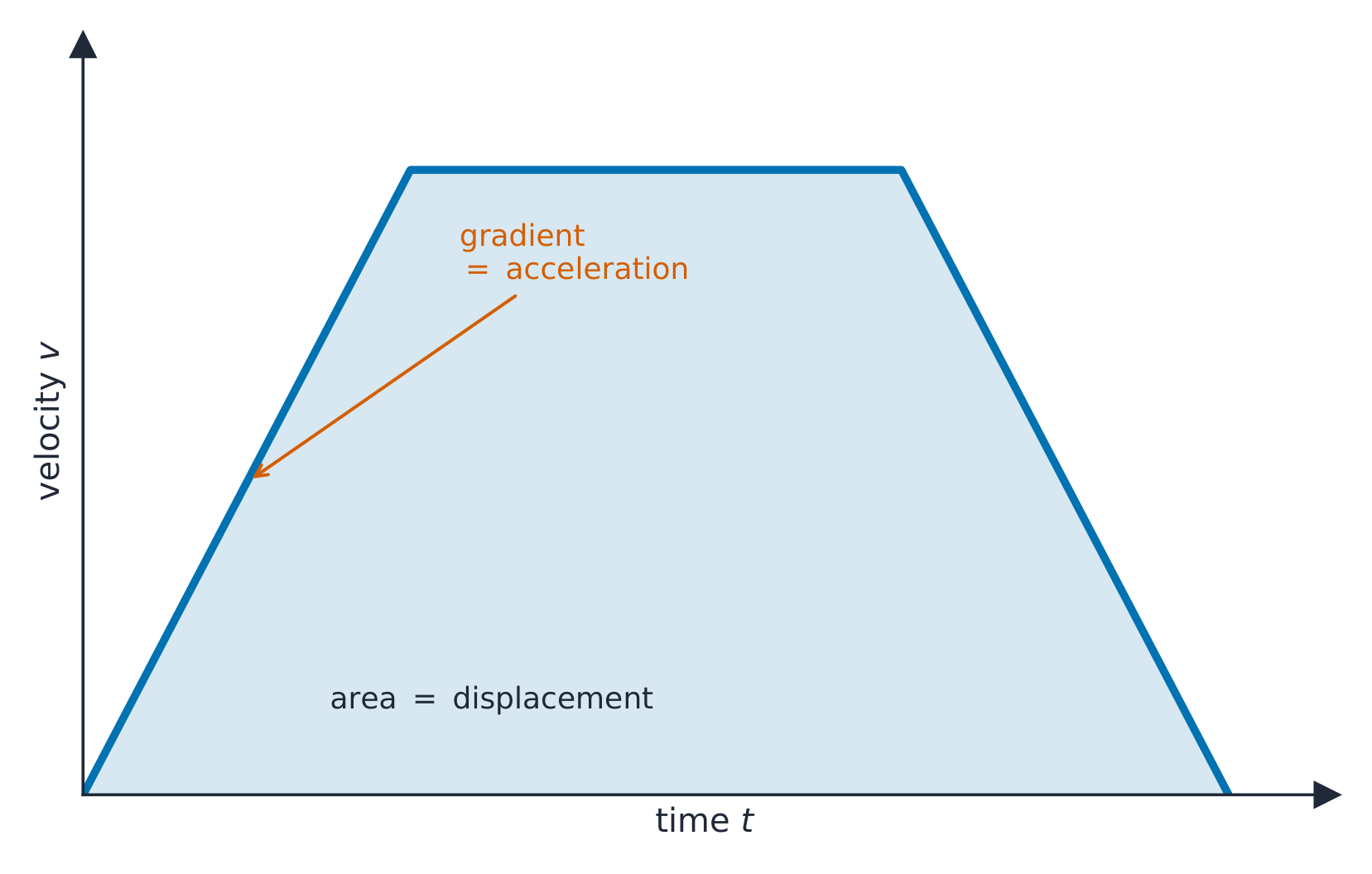
  • velocity 速度 $v(t)=s'(t)$ – signed; its sign gives direction;
  • acceleration 加速度 $a(t)=v'(t)=s''(t)$.

Key readings (frequent exam parts):

  • The particle is at rest 静止 when $v(t)=0$.
  • It moves right/up when $v(t)>0$ and left/down when $v(t)<0$; it changes direction where $v$ changes sign.
  • Speed 速率 is $|v(t)|$. Speed is increasing when $v$ and $a$ have the same sign (the particle is speeding up), and decreasing when they have opposite signs.

Distinguish carefully between velocity (has direction) and speed (does not) – the exam tests this exact difference.

Worked example. A particle moves with $s(t)=t^3-6t^2+9t$. Then $v(t)=3(t-1)(t-3)$, so it is at rest at $t=1$ and $t=3$ and changes direction at each. At $t=2$, $v=-3<0$ and $a(2)=6(2)-12=0$; just after, $a>0$ while $v<0$, so the particle is slowing down there.

Português

Para uma partícula movendo-se em uma linha, três funções do tempo estão ligadas por diferenciação:

Em um gráfico velocidade-tempo, a área é o deslocamento e a inclinação é a aceleração
  • posição 位置 $s(t)$;
  • velocidade 速度 $v(t)=s'(t)$ – com sinal; seu sinal indica a direção;
  • aceleração 加速度 $a(t)=v'(t)=s''(t)$.

Leituras-chave (partes frequentes de exames):

  • A partícula está em repouso 静止 quando $v(t)=0$.
  • Ela se move para a direita/cima quando $v(t)>0$ e para a esquerda/baixo quando $v(t)<0$; ela muda de direção onde $v$ muda de sinal.
  • Velocidade escalar 速率 é $|v(t)|$. A velocidade escalar aumenta quando $v$ e $a$ têm o mesmo sinal (a partícula está acelerando), e diminui quando têm sinais opostos.

Distingua cuidadosamente entre velocidade (tem direção) e rapidez (não tem) – o exame testa exatamente essa diferença.

Exemplo resolvido. Uma partícula move-se com $s(t)=t^3-6t^2+9t$. Então $v(t)=3(t-1)(t-3)$, então ela está em repouso em $t=1$ e $t=3$ e muda de direção em cada um. Em $t=2$, $v=-3<0$ e $a(2)=6(2)-12=0$; logo após, $a>0$ enquanto $v<0$, então a partícula está desacelerando ali.

Explore · ⁨Explorar⁩

Velocidade é a inclinação da posição

y = ax³ + bx² + cx + d

Para movimento em linha reta, a velocidade é a derivada (inclinação) da posição e a aceleração é a derivada da velocidade. Deslize o ponto para ler a velocidade instantânea.

Vocabulary · ⁨Vocabulário⁩ Train · ⁨Treinar⁩
English · ⁨Inglês⁩ Chinese · ⁨Chinês⁩ Pinyin
position/pəˈzɪʃn/ 位置 wèi zhì
velocity/vəˈlɒsɪti/ 速度 sù dù
acceleration/əkˌseləˈreɪʃn/ 加速度 jiā sù dù
at rest/æt rest/ 静止 jìng zhǐ
Speed/spiːd/ 速率 sù lǜ
4.3

Rates of Change in Applied Contexts Other Than Motion · ⁨Taxas de Alteração em Contextos Aplicados Além do Movimento⁩

Syllabus · ⁨Programa⁩
English

Enduring Understanding (CHA-3): Derivatives allow us to solve real-world problems involving rates of change.

Learning Objective CHA-3.C: Interpret rates of change in applied contexts.

  • CHA-3.C.1 The derivative can be used to solve problems involving rates of change in applied contexts.
Português

Compreensão Duradoura (CHA-3): As derivadas nos permitem resolver problemas do mundo real envolvendo taxas de variação.

Objetivo de Aprendizagem CHA-3.C: Interpretar taxas de variação em contextos aplicados.

  • CHA-3.C.1 A derivada pode ser usada para resolver problemas envolvendo taxas de variação em contextos aplicados.

Source: College Board AP Course and Exam Description · ⁨Fonte: College Board AP Course and Exam Description⁩

English

The same derivative idea models any changing quantity: a draining tank, a spreading population, a cooling cup. Whenever a problem says "the rate at which...", it is describing a derivative. Read the units to know which quantity's rate you have, then interpret in context.

Português

A mesma ideia de derivada modela qualquer quantidade que muda: um tanque esvaziando, uma população se espalhando, uma xícara esfriando. Sempre que um problema diz "a taxa na qual...", ele está descrevendo uma derivada. Leia as unidades para saber a taxa de qual quantidade você tem, depois interprete no contexto.

4.4

Introduction to Related Rates · ⁨Introdução a Taxas Relacionadas⁩

Syllabus · ⁨Programa⁩
English

Enduring Understanding (CHA-3): Derivatives allow us to solve real-world problems involving rates of change.

Learning Objective CHA-3.D: Calculate related rates in applied contexts.

  • CHA-3.D.1 The chain rule is the basis for differentiating variables in a related rates problem with respect to the same independent variable.
  • CHA-3.D.2 Other differentiation rules, such as the product rule and the quotient rule, may also be necessary to differentiate all variables with respect to the same independent variable.
Português

Compreensão Duradoura (CHA-3): As derivadas nos permitem resolver problemas do mundo real envolvendo taxas de variação.

Objetivo de Aprendizagem CHA-3.D: Calcular taxas relacionadas em contextos aplicados.

  • CHA-3.D.1 A regra da cadeia é a base para diferenciar variáveis em um problema de taxas relacionadas em relação à mesma variável independente.
  • CHA-3.D.2 Outras regras de diferenciação, como a regra do produto e a regra do quociente, também podem ser necessárias para diferenciar todas as variáveis em relação à mesma variável independente.

Source: College Board AP Course and Exam Description · ⁨Fonte: College Board AP Course and Exam Description⁩

English

In a related rates 相关变化率 problem, several quantities change together over time, and you know some rates but want another. The engine is the chain rule: differentiate a relationship with respect to time $t$. Every variable becomes a function of $t$, so each derivative picks up a "$\,/\,dt$" factor. Product and quotient rules may also be needed.

Português
Uma montanha-russa: taxas relacionadas conectam como quantidades ligadas mudam juntas

Em um problema de taxas relacionadas 相关变化率, várias quantidades mudam juntas ao longo do tempo, e você conhece algumas taxas mas quer outra. O motor é a regra da cadeia: diferencie uma relação em relação ao tempo $t$. Cada variável torna-se uma função de $t$, então cada derivada pega um fator "$\,/\,dt$". Regras do produto e do quociente também podem ser necessárias.

Um balão ascendente: taxas relacionadas vinculam quão rápido raio, volume e altura mudam juntos
Um balão subindo: taxas relacionadas ligam como raio, volume e altura mudam juntos
Vocabulary · ⁨Vocabulário⁩ Train · ⁨Treinar⁩
English · ⁨Inglês⁩ Chinese · ⁨Chinês⁩ Pinyin
related rates/rɪˈleɪtɪd reɪts/ 相关变化率 xiāng guān biàn huà lǜ
local linearity/ˈləʊkl lɪˈnɪərɪti/ 局部线性 jú bù xiàn xìng
linear approximation/ˈlɪnɪə əˌprɒksɪˈmeɪʃn/ 线性近似 xiàn xìng jìn sì
concavity/kənˈkævɪti/ 凹凸性 āo tū xìng
underestimate/ˌʌndəˈrestɪmət/ 低估 dī gū
overestimate/ˌəʊvəˈrestɪmət/ 高估 gāo gū
indeterminate form/ˌɪndɪˈtɜːmɪnət fɔːm/ 未定式 wèi dìng shì
L'Hospital's Rule/ˈelhɒspɪtlz ruːl/ 洛必达法则 luò bì dá fǎ zé
4.5

Solving Related Rates Problems · ⁨Resolvendo Problemas de Taxas Relacionadas⁩

Syllabus · ⁨Programa⁩
English

Enduring Understanding (CHA-3): Derivatives allow us to solve real-world problems involving rates of change.

Learning Objective CHA-3.E: Interpret related rates in applied contexts.

  • CHA-3.E.1 The derivative can be used to solve related rates problems; that is, finding a rate at which one quantity is changing by relating it to other quantities whose rates of change are known.
Português

Compreensão Duradoura (CHA-3): As derivadas nos permitem resolver problemas do mundo real envolvendo taxas de variação.

Objetivo de Aprendizagem CHA-3.E: Interpretar taxas relacionadas em contextos aplicados.

  • CHA-3.E.1 A derivada pode ser usada para resolver problemas de taxas relacionadas; isto é, encontrar uma taxa na qual uma quantidade está mudando relacionando-a a outras quantidades cujas taxas de variação são conhecidas.

Source: College Board AP Course and Exam Description · ⁨Fonte: College Board AP Course and Exam Description⁩

English

A reliable procedure – and a full-credit template on the exam:

  1. Name the variables and write down the given rates and the unknown rate (e.g. "$\dfrac{dh}{dt}=-2$ cm/day, find $\dfrac{dV}{dt}$").
  2. Write an equation relating the quantities (often a geometric or volume formula).
  3. Differentiate both sides with respect to $t$ (chain rule) – before substituting numbers.
  4. Substitute the known values at the instant of interest, and solve for the unknown rate.
  5. State the answer with units and the correct sign (a decreasing quantity has a negative rate).

Substituting numbers too early is the classic error: differentiate the general relationship first, then plug in.

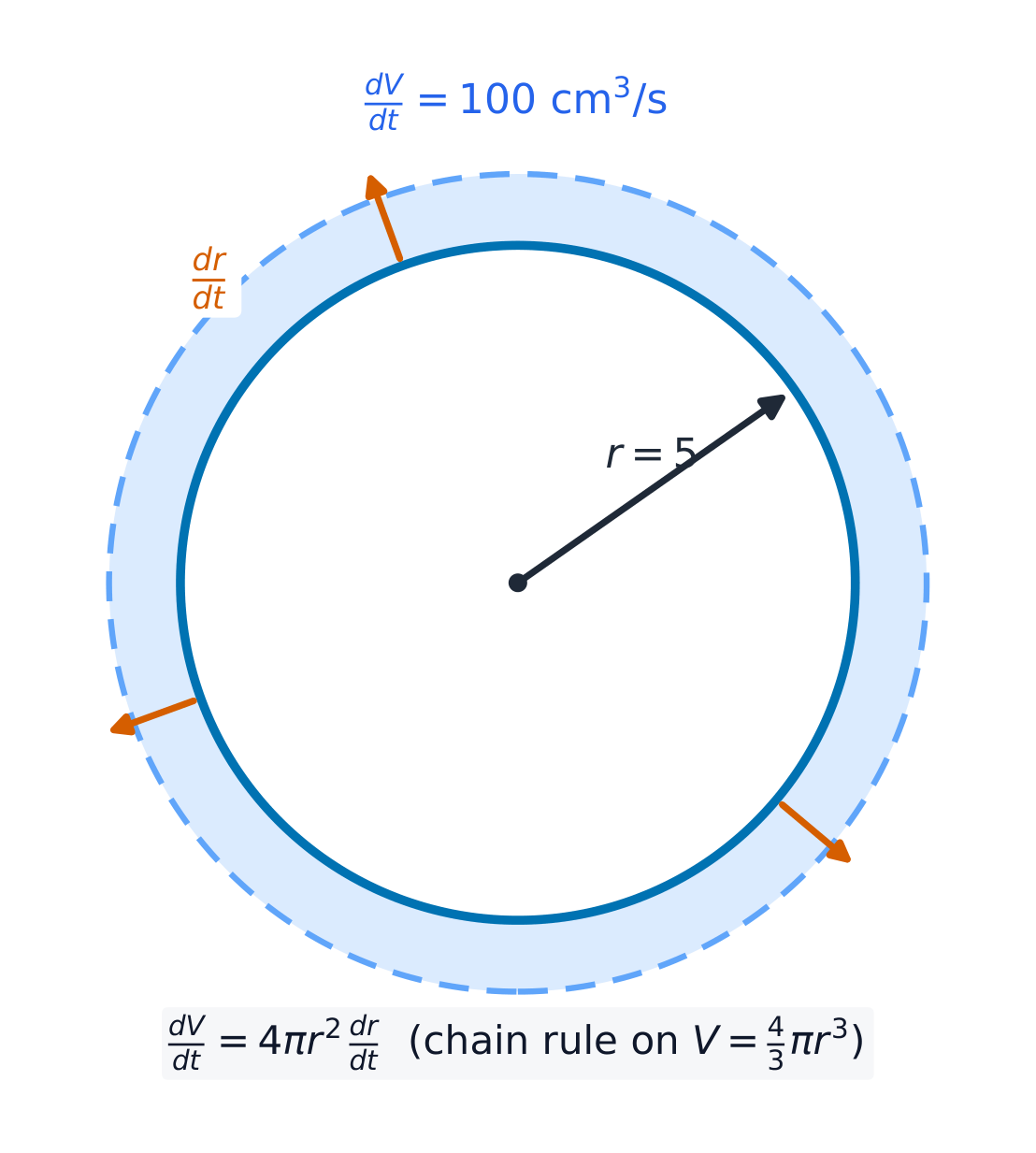
Worked example. A spherical balloon's volume grows at $\dfrac{dV}{dt}=100\ \text{cm}^3/\text{s}$. From $V=\tfrac43\pi r^3$, differentiate first: $\dfrac{dV}{dt}=4\pi r^2\dfrac{dr}{dt}$. At $r=5$, $100=4\pi(25)\dfrac{dr}{dt}$, so $\dfrac{dr}{dt}=\dfrac{1}{\pi}\approx0.32\ \text{cm/s}$.

Português

Um procedimento confiável – e um modelo completo para nota máxima na prova:

  1. Nomeie as variáveis e escreva as taxas dadas e a taxa desconhecida (ex: "$\dfrac{dh}{dt}=-2$ cm/dia, encontre $\dfrac{dV}{dt}$").
  2. Escreva uma equação relacionando as quantidades (muitas vezes uma fórmula geométrica ou de volume).
  3. Diferencie ambos os lados em relação a $t$ (regra da cadeia) – antes de substituir números.
  4. Substitua os valores conhecidos no instante de interesse e resolva para a taxa desconhecida.
  5. Apresente a resposta com unidades e o sinal correto (uma quantidade decrescente tem uma taxa negativa).

Substituir números cedo demais é o erro clássico: diferencie a relação geral primeiro, depois substitua.

Exemplo resolvido. O volume de um balão esférico cresce a $\dfrac{dV}{dt}=100\ \text{cm}^3/\text{s}$. De $V=\tfrac43\pi r^3$, diferencie primeiro: $\dfrac{dV}{dt}=4\pi r^2\dfrac{dr}{dt}$. Em $r=5$, $100=4\pi(25)\dfrac{dr}{dt}$, logo $\dfrac{dr}{dt}=\dfrac{1}{\pi}\approx0.32\ \text{cm/s}$.

Um balão inflando liga dV/dt e dr/dt através da regra da cadeia
Um balão se enchendo liga dV/dt e dr/dt através da regra da cadeia
4.6

Approximating Values Using Local Linearity and Linearization · ⁨Aproximando Valores Usando Linearidade Local e Linearização⁩

Syllabus · ⁨Programa⁩
English

Enduring Understanding (CHA-3): Derivatives allow us to solve real-world problems involving rates of change.

Learning Objective CHA-3.F: Approximate a value on a curve using the equation of a tangent line.

  • CHA-3.F.1 The tangent line is the graph of a locally linear approximation of the function near the point of tangency.
  • CHA-3.F.2 For a tangent line approximation, the function's behavior near the point of tangency may determine whether a tangent line value is an underestimate or an overestimate of the corresponding function value.
Português

Compreensão Duradoura (CHA-3): As derivadas nos permitem resolver problemas do mundo real envolvendo taxas de variação.

Objetivo de Aprendizagem CHA-3.F: Aproximar um valor em uma curva usando a equação de uma reta tangente.

  • CHA-3.F.1 A reta tangente é o gráfico de uma aproximação linear local da função próxima ao ponto de tangência.
  • CHA-3.F.2 Para uma aproximação por reta tangente, o comportamento da função próximo ao ponto de tangência pode determinar se um valor da reta tangente é uma subestimação ou superestimação do valor correspondente da função.

Source: College Board AP Course and Exam Description · ⁨Fonte: College Board AP Course and Exam Description⁩

English
Local linearity and linearisation

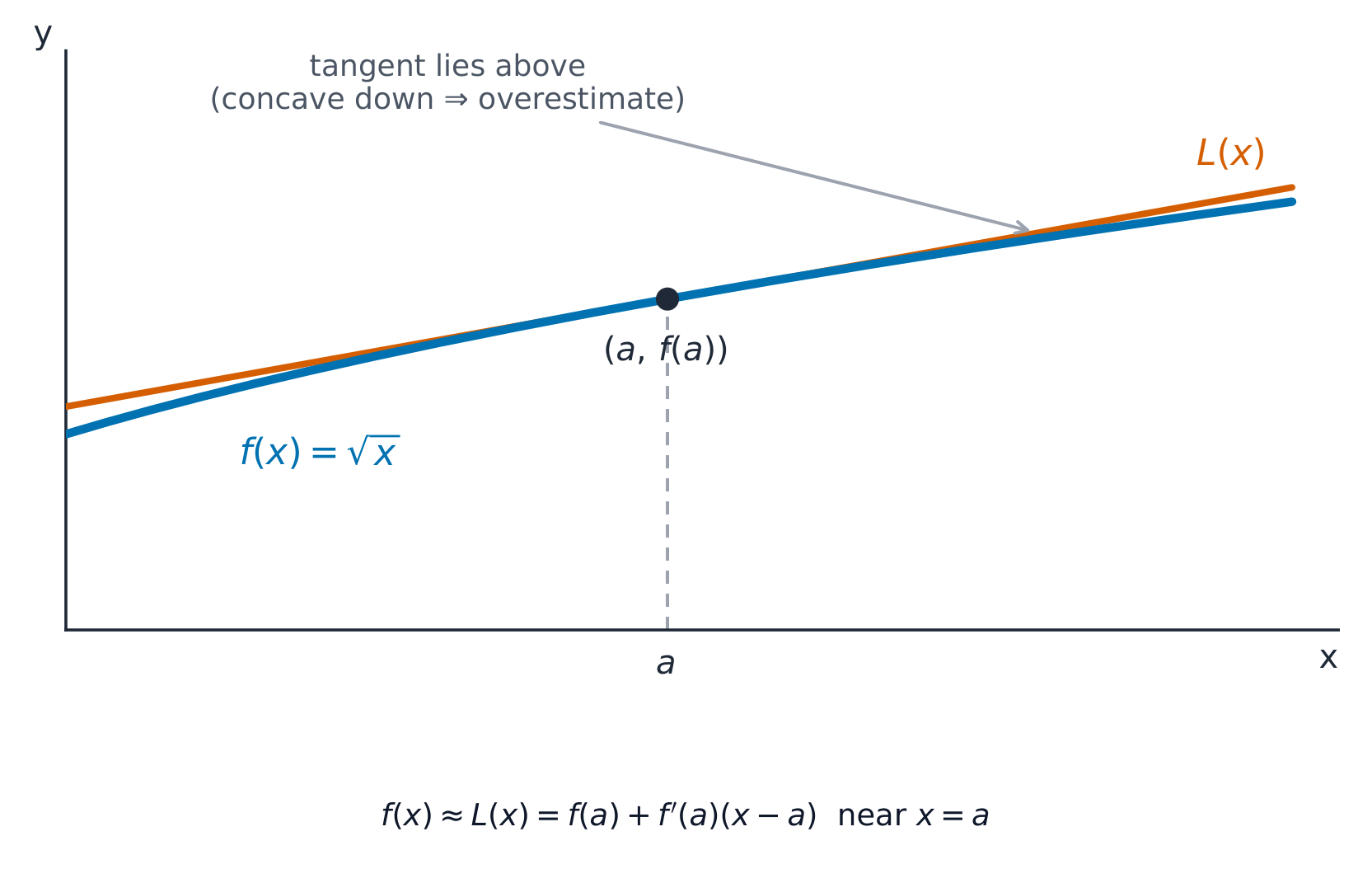
Near a point of tangency, a smooth curve looks like its tangent line – this is local linearity 局部线性. So the tangent line gives a linear approximation 线性近似 (linearization) of the function near that point:

$$f(x) \approx L(x) = f(a) + f'(a)(x-a).$$
Use it to estimate $f$ at an $x$ close to $a$.

Over- or underestimate? The answer follows from concavity 凹凸性. If the graph is concave up near $a$ (it curves above its tangent), the tangent-line value is an underestimate 低估. If it is concave down, the tangent line lies above the curve, giving an overestimate 高估. Exam parts test this reasoning, so justify with the sign of $f''$.

Português
Linearidade local e linearização

Perto de um ponto de tangência, uma curva suave parece sua reta tangente – isso é linearidade local 局部线性. Assim, a reta tangente fornece uma aproximação linear 线性近似 (linearização) da função perto desse ponto:

$$f(x) \approx L(x) = f(a) + f'(a)(x-a).$$
Use-a para estimar $f$ em um $x$ próximo a $a$.

Superestimar ou subestimar? A resposta vem da concavidade 凹凸性. Se o gráfico é ** côncavo para cima** perto de $a$ (ele curva acima da sua tangente), o valor da reta tangente é uma subestimação 低估. Se é ** côncavo para baixo**, a reta tangente fica acima da curva, dando uma superestimação 高估. Partes do exame testam esse raciocínio, então justifique com o sinal de $f''$.

A reta tangente é uma aproximação linear local; a concavidade corrige super ou subestimação
Explore · ⁨Explorar⁩

Aproxime uma curva com sua linha tangente

y = ax³ + bx² + cx + d

Linearidade local: perto de um ponto, uma curva suave parece ser sua linha tangente, então a tangente fornece uma boa aproximação linear dos valores próximos.

4.7

Using L'Hospital's Rule for Indeterminate Forms · ⁨Usando a Regra de L'Hôpital para Formas Indeterminadas⁩

Syllabus · ⁨Programa⁩
English

Enduring Understanding (LIM-4): L'Hospital's Rule allows us to determine the limits of some indeterminate forms.

Learning Objective LIM-4.A: Determine limits of functions that result in indeterminate forms.

  • LIM-4.A.1 When the ratio of two functions tends to $\dfrac{0}{0}$ or $\dfrac{\infty}{\infty}$ in the limit, such forms are said to be indeterminate.
    • Exclusion statement: There are many other indeterminate forms, such as $\infty - \infty$, for example, but these will not be assessed on either the AP Calculus AB or BC Exam. However, teachers may include these topics, if time permits.
  • LIM-4.A.2 Limits of the indeterminate forms $\dfrac{0}{0}$ or $\dfrac{\infty}{\infty}$ may be evaluated using L'Hospital's Rule.
Português

Compreensão Duradoura (LIM-4): A Regra de L'Hospital nos permite determinar os limites de algumas formas indeterminadas.

Objetivo de Aprendizagem LIM-4.A: Determinar limites de funções que resultam em formas indeterminadas.

  • LIM-4.A.1 Quando a razão de duas funções tende a $\dfrac{0}{0}$ ou $\dfrac{\infty}{\infty}$ no limite, tais formas são ditas indeterminadas.
    • Declaração de exclusão: Existem muitas outras formas indeterminadas, como $\infty - \infty$, por exemplo, mas estas não serão avaliadas nem no Exame AP Calculus AB nem no BC. No entanto, os professores podem incluir esses tópicos, se houver tempo disponível.
  • LIM-4.A.2 Limites das formas indeterminadas $\dfrac{0}{0}$ ou $\dfrac{\infty}{\infty}$ podem ser avaliados usando a Regra de L'Hospital.

Source: College Board AP Course and Exam Description · ⁨Fonte: College Board AP Course and Exam Description⁩

English

When direct substitution in a quotient of limits gives the indeterminate form 未定式 $\dfrac{0}{0}$ or $\dfrac{\infty}{\infty}$, you may use L'Hospital's Rule 洛必达法则:

$$\lim_{x\to c}\frac{f(x)}{g(x)} = \lim_{x\to c}\frac{f'(x)}{g'(x)},$$
provided the right-hand limit exists. Differentiate the top and bottom separately (this is not the quotient rule), then try the limit again. First confirm the form really is $\tfrac{0}{0}$ or $\tfrac{\infty}{\infty}$ – applying the rule to any other form is a mistake.

Worked example. $\displaystyle\lim_{x\to0}\frac{\sin x}{x}$ gives $\tfrac00$, so differentiate top and bottom: $\displaystyle\lim_{x\to0}\frac{\cos x}{1}=1$. And $\displaystyle\lim_{x\to0}\frac{e^{2x}-1}{x}$ is also $\tfrac00$; it becomes $\displaystyle\lim_{x\to0}\frac{2e^{2x}}{1}=2$.

Português

Quando a substituição direta em um quociente de limites resulta na forma indeterminada 未定式 $\dfrac{0}{0}$ ou $\dfrac{\infty}{\infty}$, você pode usar a Regra de L'Hospital 洛必达法则:

$$\lim_{x\to c}\frac{f(x)}{g(x)} = \lim_{x\to c}\frac{f'(x)}{g'(x)},$$
desde que o limite à direita exista. Diferencie o numerador e o denominador separadamente (isto não é a regra do quociente), depois tente o limite novamente. Primeiro confirme se a forma realmente é $\tfrac{0}{0}$ ou $\tfrac{\infty}{\infty}$ – aplicar a regra a qualquer outra forma é um erro.

Exemplo resolvido. $\displaystyle\lim_{x\to0}\frac{\sin x}{x}$ dá $\tfrac00$, então derive o topo e o fundo: $\displaystyle\lim_{x\to0}\frac{\cos x}{1}=1$. E $\displaystyle\lim_{x\to0}\frac{e^{2x}-1}{x}$ também é $\tfrac00$; torna-se $\displaystyle\lim_{x\to0}\frac{2e^{2x}}{1}=2$.

4.7

Exam tips · ⁨Dicas de prova⁩

English
  • In motion problems: velocity is the derivative of position, acceleration the derivative of velocity; speed increases when velocity and acceleration share a sign.
  • For related rates, differentiate the relating equation with respect to time, then substitute the given values last.
  • Use the tangent line for a linear approximation near a known point; it is accurate only close by.
  • Read the sign of a rate: positive means the quantities move together, negative means opposite.
  • Always state units and interpret the answer in context.
Português
  • Em problemas de movimento: velocidade é a derivada da posição, aceleração é a derivada da velocidade; a velocidade escalar aumenta quando velocidade e aceleração compartilham um sinal.
  • Para taxas relacionadas, diferencie a equação relacionadora em relação ao tempo, depois substitua os valores dados por último.
  • Use a reta tangente para uma aproximação linear perto de um ponto conhecido; ela é precisa apenas nas proximidades.
  • Leia o sinal de uma taxa: positivo significa que as quantidades se movem juntas, negativo significa oposto.
  • Sempre declare as unidades e interprete a resposta no contexto.

Interactive lessons on this topic · ⁨Aulas interativas sobre este tópico⁩

Work through it step by step, with instant-check exercises. · ⁨Passe por ele passo a passo, com exercícios de verificação instantânea.⁩

Past Papers · ⁨Provas Anteriores⁩

More topics in Cálculo BC do AP · ⁨Mais tópicos em Cálculo BC do AP⁩

Log in or create account · ⁨Entrar ou criar conta⁩

IGCSE, A-Level & AP