Skip to content · ⁨Pular para o conteúdo⁩

Aplicações Analíticas da Diferenciação

Cálculo BC do AP · Topic 5 · ⁨Tópico 5⁩

Train · ⁨Treinar⁩
Video lesson for this topic · ⁨Videoaula para este tópico⁩ Open the video page · ⁨Abrir a página do vídeo⁩
9:33

Usando o Teorema do Valor Médio

Você dirige duzentos quilômetros em duas horas. Sua velocidade média foi cem quilômetros por hora. Agora aqui está uma afirmação. Em algum momento durante essa viagem…

English narration · English + 中文 subtitles burned in · ⁨Narração em inglês · Legendas em inglês + 中文 gravadas⁩

5.1

Using the Mean Value Theorem · ⁨Usando o Teorema do Valor Médio⁩

Syllabus · ⁨Programa⁩
English

Enduring Understanding (FUN-1): Existence theorems allow us to draw conclusions about a function's behavior on an interval without precisely locating that behavior.

Learning Objective FUN-1.B: Justify conclusions about functions by applying the Mean Value Theorem over an interval.

  • FUN-1.B.1 If a function $f$ is continuous over the interval $[a, b]$ and differentiable over the interval $(a, b)$, then the Mean Value Theorem guarantees a point within that open interval where the instantaneous rate of change equals the average rate of change over the interval.
Português

Compreensão Duradoura (FUN-1): Teoremas de existência permitem tirar conclusões sobre o comportamento de uma função em um intervalo sem localizar precisamente esse comportamento.

Objetivo de Aprendizagem FUN-1.B: Justificar conclusões sobre funções aplicando o Teorema do Valor Médio em um intervalo.

  • FUN-1.B.1 Se uma função $f$ for contínua no intervalo $[a, b]$ e diferenciável no intervalo $(a, b)$, então o Teorema do Valor Médio garante um ponto dentro desse intervalo aberto onde a taxa de variação instantânea é igual à taxa de variação média sobre o intervalo.

Source: College Board AP Course and Exam Description · ⁨Fonte: College Board AP Course and Exam Description⁩

English
The Mean Value Theorem

The Mean Value Theorem 中值定理 (MVT) links the average rate of change to an instantaneous one:

If $f$ is continuous on $[a,b]$ and differentiable on $(a,b)$, then there is at least one point $c$ in $(a,b)$ where

$$f'(c) = \frac{f(b)-f(a)}{b-a}.$$

In words: somewhere inside the interval, the instantaneous rate equals the average rate. Geometrically, some tangent line is parallel to the line joining the endpoints.

Exam skill. Like the IVT, the MVT is an existence theorem, and questions ask you to justify. Full credit needs: (1) state $f$ is continuous on $[a,b]$ and differentiable on $(a,b)$; (2) compute the average rate $\frac{f(b)-f(a)}{b-a}$; (3) conclude "by the MVT there is a $c$ in $(a,b)$ with $f'(c)$ equal to that value." Both hypotheses must be named.

Worked example. For $f(x)=x^2$ on $[1,3]$ the average rate is $\dfrac{9-1}{2}=4$; setting $f'(c)=2c=4$ gives $c=2$, which lies in $(1,3)$ – the guaranteed point.

Português
O Teorema do Valor Médio

O Teorema do Valor Médio 中值定理 (MVT) liga a taxa média de variação a uma instantânea:

Se $f$ é contínua em $[a,b]$ e diferenciável em $(a,b)$, então existe pelo menos um ponto $c$ em $(a,b)$ onde

$$f'(c) = \frac{f(b)-f(a)}{b-a}.$$

Em palavras: em algum lugar dentro do intervalo, a taxa instantânea é igual à taxa média. Geometricamente, alguma reta tangente é paralela à reta que une as extremidades.

O Teorema do Valor Médio: alguma tangente é paralela à secante sobre o intervalo

Habilidade de prova. Assim como o TVC, o TVM é um teorema de existência, e questões pedem que você justifique. Nota máxima exige: (1) declare que $f$ é contínua em $[a,b]$ e diferenciável em $(a,b)$; (2) calcule a taxa média $\frac{f(b)-f(a)}{b-a}$; (3) conclua "pelo TVM existe um $c$ em $(a,b)$ com $f'(c)$ igual a esse valor." Ambas as hipóteses devem ser citadas.

Exemplo resolvido. Para $f(x)=x^2$ em $[1,3]$ a taxa média é $\dfrac{9-1}{2}=4$; definindo $f'(c)=2c=4$ resulta em $c=2$, que está em $(1,3)$ – o ponto garantido.

Explore · ⁨Explorar⁩

O Teorema do Valor Médio em ação

y = ax³ + bx² + cx + d

O Teorema do Valor Médio garante um ponto onde a tangente é paralela à secante em um intervalo — a taxa instantânea é igual à taxa média em algum lugar dentro dele.

Vocabulary · ⁨Vocabulário⁩ Train · ⁨Treinar⁩
English · ⁨Inglês⁩ Chinese · ⁨Chinês⁩ Pinyin
Mean Value Theorem/miːn ˈvæljuː ˈθɪərəm/ 中值定理 zhōng zhí dìng lǐ
Extreme Value Theorem/ekˈstriːm ˈvæljuː ˈθɪərəm/ 极值定理 jí zhí dìng lǐ
critical point/ˈkrɪtɪkl pɔɪnt/ 临界点 lín jiè diǎn
local (relative) extrema/ˈləʊkl ekˈstremə/ 局部极值 jú bù jí zhí
increasing/ɪnˈkriːsɪŋ/ 递增 dì zēng
decreasing/ˈdiːkriːsɪŋ/ 递减 dì jiǎn
local maximum/ˈləʊkl ˈmæksɪməm/ 极大值 jí dà zhí
local minimum/ˈləʊkl ˈmɪnɪməm/ 极小值 jí xiǎo zhí
concave up/kɒnˈkeɪv ʌp/ 上凹 shàng āo
concave down/kɒnˈkeɪv daʊn/ 下凹 xià āo
point of inflection/pɔɪnt ɒv ɪnˈflekʃn/ 拐点 guǎi diǎn
5.2

Extreme Values, Global vs Local Extrema, and Critical Points · ⁨Valores Extremos, Extremizadores Globais vs Locais e Pontos Críticos⁩

Syllabus · ⁨Programa⁩
English

Enduring Understanding (FUN-1): Existence theorems allow us to draw conclusions about a function's behavior on an interval without precisely locating that behavior.

Learning Objective FUN-1.C: Justify conclusions about functions by applying the Extreme Value Theorem.

  • FUN-1.C.1 If a function $f$ is continuous over the interval $(a, b)$, then the Extreme Value Theorem guarantees that $f$ has at least one minimum value and at least one maximum value on $[a, b]$.
  • FUN-1.C.2 A point on a function where the first derivative equals zero or fails to exist is a critical point of the function.
  • FUN-1.C.3 All local (relative) extrema occur at critical points of a function, though not all critical points are local extrema.
Português

Compreensão Duradoura (FUN-1): Teoremas de existência permitem tirar conclusões sobre o comportamento de uma função em um intervalo sem localizar precisamente esse comportamento.

Objetivo de Aprendizagem FUN-1.C: Justificar conclusões sobre funções aplicando o Teorema do Valor Extremo.

  • FUN-1.C.1 Se uma função $f$ for contínua no intervalo $(a, b)$, então o Teorema do Valor Extimo garante que $f$ tenha pelo menos um valor mínimo e pelo menos um valor máximo em $[a, b]$.
  • FUN-1.C.2 Um ponto em uma função onde a primeira derivada é igual a zero ou falha em existir é um ponto crítico da função.
  • FUN-1.C.3 Todos os extremos locais (relativos) ocorrem em pontos críticos de uma função, embora nem todos os pontos críticos sejam extremos locais.

Source: College Board AP Course and Exam Description · ⁨Fonte: College Board AP Course and Exam Description⁩

English

The Extreme Value Theorem 极值定理 (EVT) guarantees extremes exist: a function continuous on a closed interval $[a,b]$ attains both an absolute maximum and an absolute minimum on it.

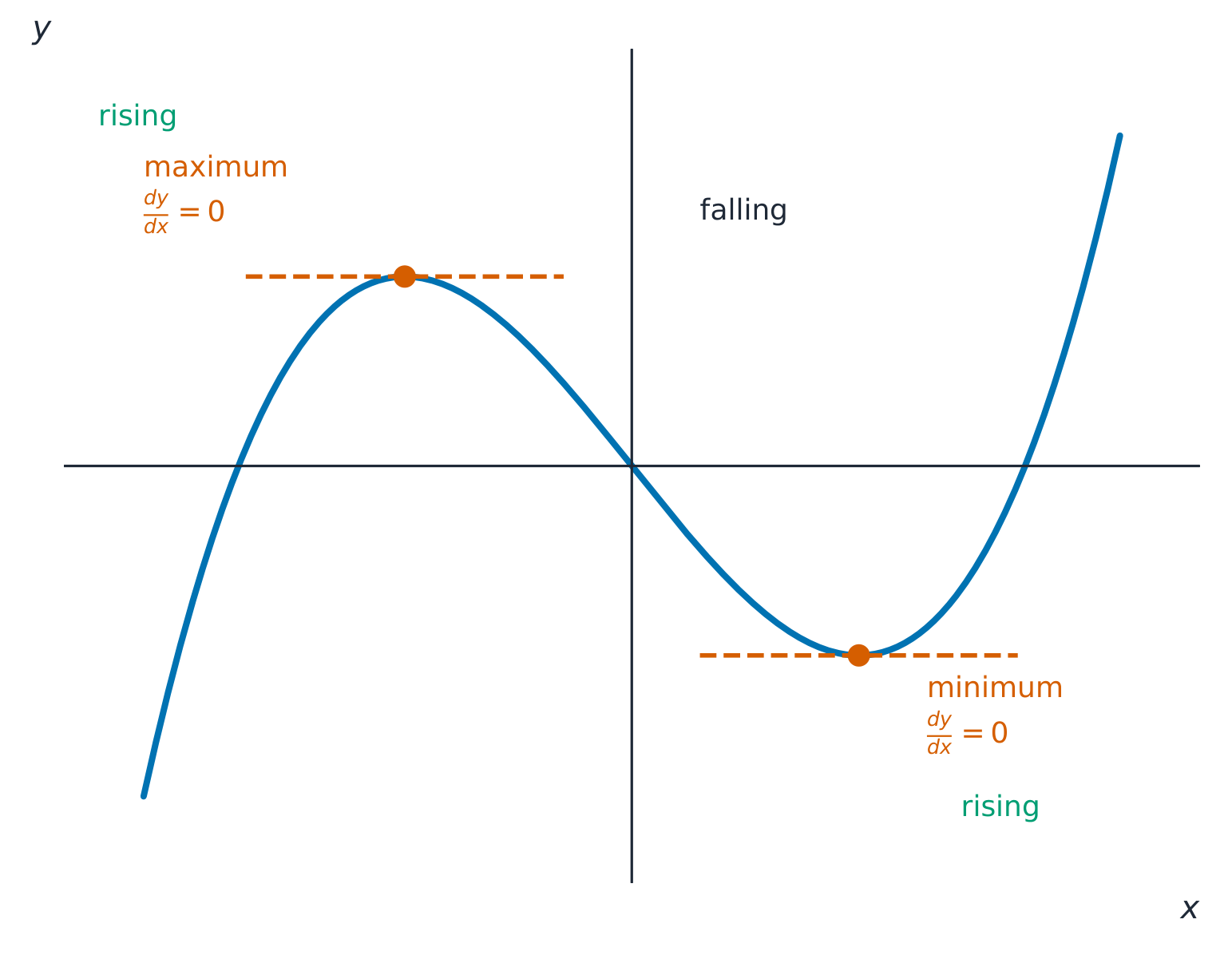
A critical point 临界点 is an interior point where $f'(x)=0$ or $f'(x)$ does not exist. All local (relative) extrema 局部极值 occur at critical points – but not every critical point is an extremum. So critical points are the candidates; you must test each.

Português
Um pico de montanha: extremizadores e pontos críticos marcam valores máximos e mínimos

O Teorema do Valor Extremo 极值定理 (EVT) garante a existência de extremos: uma função contínua em um intervalo fechado $[a,b]$ atinge ambos um máximo absoluto e um mínimo absoluto nele.

Num máximo ou mínimo a derivada é zero
Em um máximo ou mínimo a derivada é zero

Um ponto crítico 临界点是 interior onde $f'(x)=0$ ou $f'(x)$ não existe. Todos os extremos locais (relativos) 局部极值 ocorrem em pontos críticos – mas nem todo ponto crítico é um extremo. Portanto, pontos críticos são os candidatos; você deve testar cada um.

5.3

Where a Function Increases or Decreases · ⁨Onde uma Função Crescente ou Decrescente⁩

Syllabus · ⁨Programa⁩
English

Enduring Understanding (FUN-4): A function's derivative can be used to understand some behaviors of the function.

Learning Objective FUN-4.A: Justify conclusions about the behavior of a function based on the behavior of its derivatives.

  • FUN-4.A.1 The first derivative of a function can provide information about the function and its graph, including intervals where the function is increasing or decreasing.
Português

Compreensão Duradoura (FUN-4): A derivada de uma função pode ser usada para compreender alguns comportamentos da função.

Objetivo de Aprendizagem FUN-4.A: Justificar conclusões sobre o comportamento de uma função com base no comportamento de suas derivadas.

  • FUN-4.A.1 A primeira derivada de uma função pode fornecer informações sobre a função e seu gráfico, incluindo intervalos em que a função é crescente ou decrescente.

Source: College Board AP Course and Exam Description · ⁨Fonte: College Board AP Course and Exam Description⁩

English

The first derivative tells you where $f$ rises or falls:

  • $f'(x) > 0$ on an interval $\Rightarrow$ $f$ is increasing 递增 there;
  • $f'(x) < 0$ $\Rightarrow$ $f$ is decreasing 递减.

On the exam, "find the intervals where $f$ is increasing" means: find the critical points, then test the sign of $f'$ between them, and justify with the sign of $f'$ (a stated reason, not just an interval).

Português

A primeira derivada diz onde $f$ sobe ou desce:

  • $f'(x) > 0$ em um intervalo $\Rightarrow$ $f$ é crescente 递增 ali;
  • $f'(x) < 0$ $\Rightarrow$ $f$ é decrescente 递减.

No exame, "encontre os intervalos onde $f$ está crescendo" significa: encontre os pontos críticos, teste então o sinal de $f'$ entre eles, e justifique com o sinal de $f'$ (uma razão declarada, não apenas um intervalo).

5.4

The First Derivative Test for Local Extrema · ⁨O Teste da Primeira Derivativa para Extremizadores Locais⁩

Syllabus · ⁨Programa⁩
English

Enduring Understanding (FUN-4): A function's derivative can be used to understand some behaviors of the function.

Learning Objective FUN-4.A: Justify conclusions about the behavior of a function based on the behavior of its derivatives.

  • FUN-4.A.2 The first derivative of a function can determine the location of relative (local) extrema of the function.
Português

Compreensão Duradoura (FUN-4): A derivada de uma função pode ser usada para compreender alguns comportamentos da função.

Objetivo de Aprendizagem FUN-4.A: Justificar conclusões sobre o comportamento de uma função com base no comportamento de suas derivadas.

  • FUN-4.A.2 A primeira derivada de uma função pode determinar a localização de extremos relativos (locais) da função.

Source: College Board AP Course and Exam Description · ⁨Fonte: College Board AP Course and Exam Description⁩

English

To classify a critical point $x=c$ as a local max, local min, or neither, check how $f'$ changes sign there:

  • $f'$ changes $+$ to $-$ at $c$ $\Rightarrow$ local maximum 极大值;
  • $f'$ changes $-$ to $+$ at $c$ $\Rightarrow$ local minimum 极小值;
  • $f'$ does not change sign $\Rightarrow$ neither.

Always state the sign change as your justification.

Worked example. For $f(x)=x^3-3x^2$, $f'(x)=3x(x-2)$ is zero at $x=0,2$. Signs give $+,-,+$, so $x=0$ is a local maximum ($f=0$) and $x=2$ a local minimum ($f=-4$).

Português

Para classificar um ponto crítico $x=c$ como máximo local, mínimo local ou nenhum, verifique como $f'$ muda de sinal ali:

  • $f'$ muda de $+$ para $-$ em $c$ $\Rightarrow$ máximo local 极大值;
  • $f'$ muda de $-$ para $+$ em $c$ $\Rightarrow$ mínimo local 极小值;
  • $f'$ não muda de sinal $\Rightarrow$ nem nenhum.

Sempre declare a mudança de sinal como sua justificativa.

Exemplo resolvido. Para $f(x)=x^3-3x^2$, $f'(x)=3x(x-2)$ é zero em $x=0,2$. Os sinais dão $+,-,+$, então $x=0$ é um máximo local ($f=0$) e $x=2$ um mínimo local ($f=-4$).

O sinal da derivada primeira define onde uma função aumenta ou diminui e localiza seus extremos locais
Onde $f' > 0$ o gráfico sobe e onde $f' < 0$ ele desce; um máximo local ocorre quando $f'$ muda de $+$ para $-$, um mínimo local quando muda de $-$ para $+$.
5.5

The Candidates Test for Absolute Extrema · ⁨O Teste dos Candidatos para Extremos Absolutos⁩

Syllabus · ⁨Programa⁩
English

Enduring Understanding (FUN-4): A function's derivative can be used to understand some behaviors of the function.

Learning Objective FUN-4.A: Justify conclusions about the behavior of a function based on the behavior of its derivatives.

  • FUN-4.A.3 Absolute (global) extrema of a function on a closed interval can only occur at critical points or at endpoints.
Português

Compreensão Duradoura (FUN-4): A derivada de uma função pode ser usada para compreender alguns comportamentos da função.

Objetivo de Aprendizagem FUN-4.A: Justificar conclusões sobre o comportamento de uma função com base no comportamento de suas derivadas.

  • FUN-4.A.3 Extremos absolutos (globais) de uma função em um intervalo fechado só podem ocorrer em pontos críticos ou nas extremidades.

Source: College Board AP Course and Exam Description · ⁨Fonte: College Board AP Course and Exam Description⁩

English

On a closed interval, absolute (global) extrema occur only at critical points or endpoints. The candidates test:

  1. List all critical points in $[a,b]$ and the two endpoints.
  2. Evaluate $f$ at each candidate.
  3. The largest output is the absolute maximum; the smallest is the absolute minimum.

Show the table of values – the comparison is the argument.

Português

Em um intervalo fechado, extremos absolutos (globais) ocorrem apenas em pontos críticos ou extremidades. O teste dos candidatos:

  1. Liste todos os pontos críticos em $[a,b]$ e as duas extremidades.
  2. Avalie $f$ em cada candidato.
  3. A maior saída é o máximo absoluto; a menor é o mínimo absoluto.

Mostre a tabela de valores – a comparação é o argumento.

5.6

Concavity and Points of Inflection · ⁨Concavidade e Pontos de Inflexão⁩

Syllabus · ⁨Programa⁩
English

Enduring Understanding (FUN-4): A function's derivative can be used to understand some behaviors of the function.

Learning Objective FUN-4.A: Justify conclusions about the behavior of a function based on the behavior of its derivatives.

  • FUN-4.A.4 The graph of a function is concave up (down) on an open interval if the function's derivative is increasing (decreasing) on that interval.
  • FUN-4.A.5 The second derivative of a function provides information about the function and its graph, including intervals of upward or downward concavity.
  • FUN-4.A.6 The second derivative of a function may be used to locate points of inflection for the graph of the original function.
Português

Compreensão Duradoura (FUN-4): A derivada de uma função pode ser usada para compreender alguns comportamentos da função.

Objetivo de Aprendizagem FUN-4.A: Justificar conclusões sobre o comportamento de uma função com base no comportamento de suas derivadas.

  • FUN-4.A.4 O gráfico de uma função é côncavo para cima (para baixo) em um intervalo aberto se a derivada da função for crescente (decrescente) naquele intervalo.
  • FUN-4.A.5 A segunda derivada de uma função fornece informações sobre a função e seu gráfico, incluindo intervalos de concavidade para cima ou para baixo.
  • FUN-4.A.6 A segunda derivada de uma função pode ser usada para localizar pontos de inflexão para o gráfico da função original.

Source: College Board AP Course and Exam Description · ⁨Fonte: College Board AP Course and Exam Description⁩

English

The second derivative describes bending:

  • $f'' > 0$ $\Rightarrow$ $f$ is concave up 上凹 (curving like a cup; $f'$ is increasing);
  • $f'' < 0$ $\Rightarrow$ $f$ is concave down 下凹 ($f'$ is decreasing).

A point of inflection 拐点 is where concavity changes, i.e. where $f''$ changes sign (not merely where $f''=0$). Report its $x$-coordinate and justify with the sign change of $f''$.

Português

A derivada segunda descreve a curvatura:

  • $f'' > 0$ $\Rightarrow$ $f$ é côncava para cima 上凹 (curvada como uma taça; $f'$ está aumentando);
  • $f'' < 0$ $\Rightarrow$ $f$ é côncava para baixo 下凹 ($f'$ está diminuindo).

Um ponto de inflexão 拐点 é onde a concavidade muda, isto é, onde $f''$ muda de sinal (não meramente onde $f''=0$). Relate sua coordenada-$x$ e justifique com a mudança de sinal de $f''$.

A concavidade vem do sinal da derivada segunda; ela inverte em um ponto de inflexão
Explore · ⁨Explorar⁩

Encontre onde a concavidade muda

y = ax³ + bx² + cx + d

Concavidade é o sinal da segunda derivada: côncava para cima onde a curva retém água, côncava para baixo onde a derrama. Um ponto de inflexão é onde ela muda.

5.7

The Second Derivative Test for Extrema · ⁨O Teste da Segunda Derivativa para Extremizadores⁩

Syllabus · ⁨Programa⁩
English

Enduring Understanding (FUN-4): A function's derivative can be used to understand some behaviors of the function.

Learning Objective FUN-4.A: Justify conclusions about the behavior of a function based on the behavior of its derivatives.

  • FUN-4.A.7 The second derivative of a function may determine whether a critical point is the location of a relative (local) maximum or minimum.
  • FUN-4.A.8 When a continuous function has only one critical point on an interval on its domain and the critical point corresponds to a relative (local) extremum of the function on the interval, then that critical point also corresponds to the absolute (global) extremum of the function on the interval.
Português

Compreensão Duradoura (FUN-4): A derivada de uma função pode ser usada para compreender alguns comportamentos da função.

Objetivo de Aprendizagem FUN-4.A: Justificar conclusões sobre o comportamento de uma função com base no comportamento de suas derivadas.

  • FUN-4.A.7 A segunda derivada de uma função pode determinar se um ponto crítico é a localização de um máximo (local) ou mínimo relativo.
  • FUN-4.A.8 Quando uma função contínua possui apenas um ponto crítico em um intervalo de seu domínio e esse ponto crítico corresponde a um extremo (local) relativo da função no intervalo, então esse ponto crítico também corresponde ao extremo (global) absoluto da função no intervalo.

Source: College Board AP Course and Exam Description · ⁨Fonte: College Board AP Course and Exam Description⁩

English

An alternative way to classify a critical point $c$ where $f'(c)=0$:

  • $f''(c) > 0$ $\Rightarrow$ concave up $\Rightarrow$ local minimum;
  • $f''(c) < 0$ $\Rightarrow$ concave down $\Rightarrow$ local maximum;
  • $f''(c) = 0$ $\Rightarrow$ the test is inconclusive – fall back on the first derivative test.

Special case: if a continuous function has only one critical point on an interval and it is a local extremum, that point is also the absolute extremum there.

Português

Uma alternativa para classificar um ponto crítico $c$ onde $f'(c)=0$:

  • $f''(c) > 0$ $\Rightarrow$ côncava para cima $\Rightarrow$ mínimo local;
  • $f''(c) < 0$ $\Rightarrow$ côncava para baixo $\Rightarrow$ máximo local;
  • $f''(c) = 0$ $\Rightarrow$ o teste é inconclusivo – recorra ao teste da derivada primeira.

Caso especial: se uma função contínua tem apenas um ponto crítico em um intervalo e ele é um extremo local, esse ponto também é o extremo absoluto ali.

5.8

Sketching a Function and Its Derivative · ⁨Esboçando uma Função e Sua Derivada⁩

Syllabus · ⁨Programa⁩
English

Enduring Understanding (FUN-4): A function's derivative can be used to understand some behaviors of the function.

Learning Objective FUN-4.A: Justify conclusions about the behavior of a function based on the behavior of its derivatives.

  • FUN-4.A.9 Key features of functions and their derivatives can be identified and related to their graphical, numerical, and analytical representations.
  • FUN-4.A.10 Graphical, numerical, and analytical information from $f'$ and $f''$ can be used to predict and explain the behavior of $f$.
Português

Compreensão Duradoura (FUN-4): A derivada de uma função pode ser usada para compreender alguns comportamentos da função.

Objetivo de Aprendizagem FUN-4.A: Justificar conclusões sobre o comportamento de uma função com base no comportamento de suas derivadas.

  • FUN-4.A.9 As características principais de funções e suas derivadas podem ser identificadas e relacionadas às suas representações gráfica, numérica e analítica.
  • FUN-4.A.10 Informações gráficas, numéricas e analíticas de $f'$ e $f''$ podem ser usadas para prever e explicar o comportamento de $f$.

Source: College Board AP Course and Exam Description · ⁨Fonte: College Board AP Course and Exam Description⁩

English

Key features of $f$, $f'$, and $f''$ mirror each other. To sketch or read graphs:

  • $f$ increasing $\Leftrightarrow$ $f'$ above the axis; $f$ has a local max $\Leftrightarrow$ $f'$ crosses from $+$ to $-$.
  • $f$ concave up $\Leftrightarrow$ $f'$ increasing $\Leftrightarrow$ $f''$ above the axis; $f$ has an inflection point $\Leftrightarrow$ $f'$ has a local extremum $\Leftrightarrow$ $f''$ crosses zero.
Português

Características-chave de $f$, $f'$ e $f''$ espelham-se mutuamente. Para esboçar ou ler gráficos:

  • $f$ crescente $\Leftrightarrow$ $f'$ acima do eixo; $f$ tem um máximo local $\Leftrightarrow$ $f'$ cruza de $+$ para $-$.
  • $f$ côncava para cima $\Leftrightarrow$ $f'$ crescente $\Leftrightarrow$ $f''$ acima do eixo; $f$ tem um ponto de inflexão $\Leftrightarrow$ $f'$ tem um extremo local $\Leftrightarrow$ $f''$ cruza zero.
5.9

Connecting $f$, $f'$, and $f''$ · ⁨Conectando $f$, $f'$ e $f''$⁩

Syllabus · ⁨Programa⁩
English

Enduring Understanding (FUN-4): A function's derivative can be used to understand some behaviors of the function.

Learning Objective FUN-4.A: Justify conclusions about the behavior of a function based on the behavior of its derivatives.

  • FUN-4.A.11 Key features of the graphs of $f$, $f'$, and $f''$ are related to one another.
Português

Compreensão Duradoura (FUN-4): A derivada de uma função pode ser usada para compreender alguns comportamentos da função.

Objetivo de Aprendizagem FUN-4.A: Justificar conclusões sobre o comportamento de uma função com base no comportamento de suas derivadas.

  • FUN-4.A.11 As características principais dos gráficos de $f$, $f'$ e $f''$ estão relacionadas entre si.

Source: College Board AP Course and Exam Description · ⁨Fonte: College Board AP Course and Exam Description⁩

English

This is the skill of reading one graph to describe another. A very common exam setup gives the graph of $f'$ and asks about $f$: where is $f$ increasing (where $f'>0$), where are $f$'s extrema (where $f'$ crosses zero, with a sign change), where is $f$ concave up (where $f'$ is increasing). Answer questions about $f$ using the height and slope of the $f'$ graph.

Português

Esta é a habilidade de ler um gráfico para descrever outro. Um setup de exame muito comum dá o gráfico de $f'$ e pergunta sobre $f$: onde está $f$ crescendo (onde $f'>0$), onde estão os extremos de $f$ (onde $f'$ cruza zero, com mudança de sinal), onde está $f$ côncava para cima (onde $f'$ está aumentando). Responda perguntas sobre $f$ usando a altura e inclinação do gráfico de $f'$.

Explore · ⁨Explorar⁩

Leia inclinação e curvatura a partir do gráfico

y = ax³ + bx² + cx + d

Onde $f'>0$ a função sobe; onde $f''>0$ ela se dobra para cima. Deslize a tangente para conectar a forma de $f$ aos sinais de suas primeiras e segundas derivadas.

5.10

Introduction to Optimization Problems · ⁨Introdução a Problemas de Otimização⁩

Syllabus · ⁨Programa⁩
English

Enduring Understanding (FUN-4): A function's derivative can be used to understand some behaviors of the function.

Learning Objective FUN-4.B: Calculate minimum and maximum values in applied contexts or analysis of functions.

  • FUN-4.B.1 The derivative can be used to solve optimization problems; that is, finding a minimum or maximum value of a function on a given interval.
Português

Compreensão Duradoura (FUN-4): A derivada de uma função pode ser usada para compreender alguns comportamentos da função.

Objetivo de Aprendizagem FUN-4.B: Calcular valores mínimos e máximos em contextos aplicados ou análise de funções.

  • FUN-4.B.1 A derivada pode ser usada para resolver problemas de otimização; isto é, encontrar um valor mínimo ou máximo de uma função em um intervalo dado.

Source: College Board AP Course and Exam Description · ⁨Fonte: College Board AP Course and Exam Description⁩

English
Optimisation: the best box

Optimization 最优化 uses the derivative to find the largest or smallest value of a quantity on an interval. It is the candidates/derivative-test machinery applied to a real goal.

Português
Otimização: a melhor caixa

Otimização 最优化 usa a derivada para encontrar o valor maior ou menor de uma quantidade em um intervalo. É a maquinaria de candidatos/teste de derivada aplicada a um objetivo real.

Encerramentos com cerca: otimização encontra as dimensões que maximizam a área para um comprimento fixo de cerca
Vocabulary · ⁨Vocabulário⁩ Train · ⁨Treinar⁩
English · ⁨Inglês⁩ Chinese · ⁨Chinês⁩ Pinyin
Optimization/ˌɒptɪmaɪˈzeɪʃn/ 最优化 zuì yōu huà
5.11

Solving Optimization Problems · ⁨Resolvendo Problemas de Otimização⁩

Syllabus · ⁨Programa⁩
English

Enduring Understanding (FUN-4): A function's derivative can be used to understand some behaviors of the function.

Learning Objective FUN-4.C: Interpret minimum and maximum values calculated in applied contexts.

  • FUN-4.C.1 Minimum and maximum values of a function take on specific meanings in applied contexts.
Português

Compreensão Duradoura (FUN-4): A derivada de uma função pode ser usada para compreender alguns comportamentos da função.

Objetivo de Aprendizagem FUN-4.C: Interpretar valores mínimos e máximos calculados em contextos aplicados.

  • FUN-4.C.1 Valores mínimos e máximos de uma função assumem significados específicos em contextos aplicados.

Source: College Board AP Course and Exam Description · ⁨Fonte: College Board AP Course and Exam Description⁩

English

A dependable procedure:

  1. Write the quantity to optimize as a function of one variable (use a constraint equation to eliminate extras).
  2. State the interval of allowed inputs.
  3. Find critical points ($f'=0$ or undefined) and test them (first- or second-derivative test, or candidates test if the interval is closed).
  4. Answer the question asked, with units and interpretation in context – the maximum area, the minimum cost, etc.

Worked example. With $100\ \text{m}$ of fence for a rectangular pen against a wall (only three sides fenced), let the ends be $x$ and the far side $y=100-2x$. The area $A(x)=x(100-2x)=100x-2x^2$ has $A'(x)=100-4x=0$ at $x=25$; since $A''=-4<0$ this is the maximum, giving $y=50$ and $A=1250\ \text{m}^2$.

Português

Um procedimento confiável:

  1. Escreva a quantidade a ser otimizada como uma função de uma variável (use uma equação de restrição para eliminar extras).
  2. Defina o intervalo de entradas permitidas.
  3. Encontre pontos críticos ($f'=0$ ou indefinido) e teste-os (teste da derivada primeira ou segunda, ou teste dos candidatos se o intervalo for fechado).
  4. Responda à pergunta feita, com unidades e interpretação no contexto – a área máxima, o custo mínimo, etc.

Exemplo resolvido. Com $100\ \text{m}$ de cerca para um pen rectangular contra uma parede (apenas três lados cercados), deixe as extremidades serem $x$ e o lado distante $y=100-2x$. A área $A(x)=x(100-2x)=100x-2x^2$ tem $A'(x)=100-4x=0$ em $x=25$; já que $A''=-4<0$ este é o máximo, dando $y=50$ e $A=1250\ \text{m}^2$.

5.12

Exploring Behaviors of Implicit Relations · ⁨Explorando Comportamentos de Relações Implícitas⁩

Syllabus · ⁨Programa⁩
English

Enduring Understanding (FUN-4): A function's derivative can be used to understand some behaviors of the function.

Learning Objective FUN-4.D: Determine critical points of implicit relations.

  • FUN-4.D.1 A point on an implicit relation where the first derivative equals zero or does not exist is a critical point of the function.

Learning Objective FUN-4.E: Justify conclusions about the behavior of an implicitly defined function based on evidence from its derivatives.

  • FUN-4.E.1 Applications of derivatives can be extended to implicitly defined functions.
  • FUN-4.E.2 Second derivatives involving implicit differentiation may be relations of $x$, $y$, and $\dfrac{dy}{dx}$.
Português

Compreensão Duradoura (FUN-4): A derivada de uma função pode ser usada para compreender alguns comportamentos da função.

Objetivo de Aprendizagem FUN-4.D: Determinar pontos críticos de relações implícitas.

  • FUN-4.D.1 Um ponto em uma relação implícita onde a primeira derivada é igual a zero ou não existe é um ponto crítico da função.

Objetivo de Aprendizagem FUN-4.E: Justificar conclusões sobre o comportamento de uma função definida implicitamente com base em evidências de suas derivadas.

  • FUN-4.E.1 Aplicações de derivadas podem ser estendidas a funções definidas implicitamente.
  • FUN-4.E.2 Derivadas segundas envolvendo diferenciação implícita podem ser relações de $x$, $y$ e $\dfrac{dy}{dx}$.

Source: College Board AP Course and Exam Description · ⁨Fonte: College Board AP Course and Exam Description⁩

English

All of this extends to implicitly defined relations. A critical point of an implicit relation is where $\dfrac{dy}{dx}=0$ (horizontal tangent) or is undefined (vertical tangent). Because $\dfrac{dy}{dx}$ is usually a relation in $x$ and $y$, and the second derivative involves $x$, $y$, and $\dfrac{dy}{dx}$, substitute your first-derivative expression back in when finding $\dfrac{d^2y}{dx^2}$, then reason about concavity from its sign.

Português

Tudo isso se estende a relações implicitamente definidas. Um ponto crítico de uma relação implícita é onde $\dfrac{dy}{dx}=0$ (tangente horizontal) ou é indefinido (tangente vertical). Como $\dfrac{dy}{dx}$ geralmente é uma relação em $x$ e $y$, e a derivada segunda envolve $x$, $y$ e $\dfrac{dy}{dx}$, substitua sua expressão de derivada primeira novamente ao encontrar $\dfrac{d^2y}{dx^2}$, então raciocine sobre a concavidade a partir de seu sinal.

5.12

Exam tips · ⁨Dicas de prova⁩

English
  • $f'>0$ means increasing, $f'<0$ decreasing; candidates for extrema are where $f'=0$ or is undefined.
  • Classify a critical point with the first-derivative sign change or the second-derivative test ($f''>0$ minimum, $f''<0$ maximum).
  • $f''>0$ is concave up, $f''<0$ concave down; a point of inflection is where concavity changes ($f''$ changes sign).
  • For an absolute extremum on a closed interval, also check the endpoints.
  • Justify every conclusion by citing the sign of $f'$ or $f''$ — the exam demands the reasoning, not just the answer.
Português
  • $f'>0$ significa aumento, $f'<0$ diminuição; candidatos para extremos são onde $f'=0$ ou é indefinido.
  • Classifique um ponto crítico com a mudança de sinal da derivada primeira ou o teste da derivada segunda ($f''>0$ mínimo, $f''<0$ máximo).
  • $f''>0$ é côncava para cima, $f''<0$ côncava para baixo; um ponto de inflexão é onde a concavidade muda ($f''$ muda de sinal).
  • Para um extremo absoluto em um intervalo fechado, também verifique as extremidades.
  • Justifique toda conclusão citando o sinal de $f'$ ou $f''$ – o exame exige o raciocínio, não apenas a resposta.

Interactive lessons on this topic · ⁨Aulas interativas sobre este tópico⁩

Work through it step by step, with instant-check exercises. · ⁨Passe por ele passo a passo, com exercícios de verificação instantânea.⁩

Past Papers · ⁨Provas Anteriores⁩

More topics in Cálculo BC do AP · ⁨Mais tópicos em Cálculo BC do AP⁩

Log in or create account · ⁨Entrar ou criar conta⁩

IGCSE, A-Level & AP