Defining Polar Coordinates and Differentiating in Polar Form
Introduced| English | Meaning |
|---|---|
| Polar coordinates/ˈpəʊlə kəʊˈɔːdɪnəts/ | Coordinates giving an angle and a signed radial value; a negative radial value places the point in the opposite direction. |
| Cartesian/kɑːˈtiːzɪən/ | Cartesian |
| parametric curve/ˌpærəˈmetrɪk kɜːv/ | parametric curve |
| tangent slope | tangent slope |
| second derivative/ˈsekənd dɪˈrɪvətɪv/ | The derivative of a function's first derivative, describing how its gradient changes. |
Does the angle always point toward the object?
- A radar display can locate an object by angle and distance from its centre. Polar coordinates 极坐标 use a similar pair $(r,\theta)$, but a mathematical curve may also use a negative value of r.
- The angle is measured from the positive x-axis, counterclockwise for positive angles. If $r>0$, move along that ray; if $r<0$, move in the opposite direction. The actual distance from the origin is $|r|$.
For polar coordinates $(-2,\pi/6)$, what is the distance from the origin?
Difficulty 2/5 · 140 coins + a small bonus on first completion today
Distance is $|r|=2$.
Convert a point with two coordinate formulas
- Convert to Cartesian 直角坐标 coordinates using $x=r\cos\theta$ and $y=r\sin\theta$. These formulas work for positive, negative and zero r; use radians when differentiating in $\theta$.
- In the original example, $(2,\pi/3)$ gives $x=2(1/2)=1$ and $y=2(\sqrt3/2)=\sqrt3$. So its Cartesian point is $(1,\sqrt3)$.
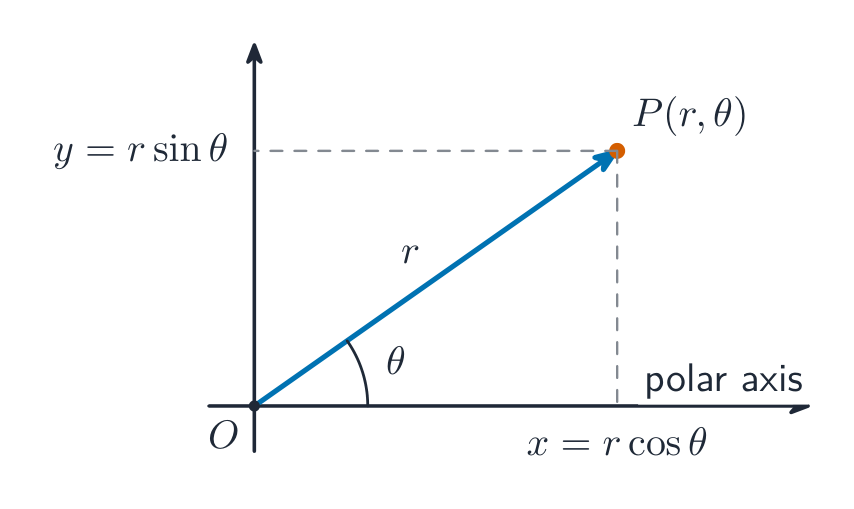
The conversion from polar to Cartesian is...
Difficulty 1/5 · 100 coins + a small bonus on first completion today
$x=r\cos\theta$, $y=r\sin\theta$.
Convert $(2,\tfrac{\pi}{3})$: find the $x$-coordinate.
Difficulty 2/5 · 140 coins + a small bonus on first completion today
$2\cos\tfrac{\pi}{3}=2\cdot\tfrac12=1$.
One point has many polar pairs
- Adding a full turn keeps the point: $(r,\theta+2k\pi)$ represents the same location for every integer k. Reversing the sign and adding a half-turn also works: $(-r,\theta+\pi)$.
- For $(-2,\pi/6)$, the point is $(-\sqrt3,-1)$, opposite the angle ray. A positive-radius pair for it is $(2,7\pi/6)$. Its distance is 2, not −2.

The polar coordinates $(r,\theta)$ and $(r,\theta+2\pi)$ describe the same point.
Difficulty 1/5 · 100 coins + a small bonus on first completion today
Adding a full turn returns to the same point.
For $(-2,\pi/6)$, find the Cartesian y-coordinate.
Difficulty 2/5 · 140 coins + a small bonus on first completion today
$y=-2\sin(\pi/6)=-1$.
An equivalent positive-radius pair for $(-2,\pi/6)$ is $(2,c\pi)$. Give c in [0,2).
Difficulty 2/5 · 140 coins + a small bonus on first completion today
Add a half-turn: $\pi/6+\pi=7\pi/6$.
Recover the angle in the correct quadrant
- To choose a nonnegative radius, use $r=\sqrt{x^2+y^2}$. For $(-1,\sqrt3)$, this gives $r=2$. Since the point is in quadrant II, choose $\theta=2\pi/3$ in $[0,2\pi)$.
- The equation $\tan\theta=y/x$ alone cannot distinguish opposite quadrants. Here $\arctan(-\sqrt3)=-\pi/3$ points into quadrant IV, so it is not the required angle. Use the coordinate signs or a quadrant-aware angle function.
To choose the nonnegative radius, $r=\sqrt{x^2+\ \_\_\_\ }$.
Difficulty 1/5 · 100 coins + a small bonus on first completion today
$r=\sqrt{x^2+y^2}$.
For Cartesian $(-1,\sqrt3)$, choose a nonnegative radius and angle $c\pi$ in $[0,2\pi)$. Give c.
Difficulty 2/5 · 140 coins + a small bonus on first completion today
Quadrant II gives $\theta=2\pi/3$, not $-\pi/3$.
Handle the axes and the origin separately
- On the y-axis, $y/x$ is unavailable. For example, $(0,-3)$ has the positive-radius pair $(3,3\pi/2)$. On the negative x-axis, $(-2,0)$ has $(2,\pi)$, rather than angle zero.
- At the origin, $r=0$ and every angle describes the same point. A requested angle interval selects a representative for a nonzero point; it cannot make the origin's direction unique.
For $(0,-3)$, a positive-radius polar pair has angle $c\pi$ in $[0,2\pi)$. Give c.
Difficulty 2/5 · 140 coins + a small bonus on first completion today
The point is on the negative y-axis, so $\theta=3\pi/2$.
At the origin, requiring an angle in [0,2π) gives a unique polar angle.
Difficulty 1/5 · 100 coins + a small bonus on first completion today
Every angle in that interval works when r=0.
Keep the curve's parameter and interval
- For $r=f(\theta)$, write $x=f(\theta)\cos\theta$ and $y=f(\theta)\sin\theta$. This is a parametric curve 参数曲线 with parameter $\theta$; the chosen interval still controls how much is traced.
- For $r=2\cos\theta$, $x=1+\cos2\theta$ and $y=\sin2\theta$. The path is the circle $(x-1)^2+y^2=1$. It is traced once on $[0,\pi]$ and twice on $[0,2\pi]$, even though r becomes negative.
A polar curve $r=f(\theta)$ can be treated as a parametric curve with parameter...
Difficulty 1/5 · 100 coins + a small bonus on first completion today
$x=f(\theta)\cos\theta$, $y=f(\theta)\sin\theta$ with parameter $\theta$.
How many times does $r=2\cos\theta$ trace its circle on $[0,2\pi]$?
Difficulty 2/5 · 140 coins + a small bonus on first completion today
$x=1+\cos2\theta$, $y=\sin2\theta$ complete two turns.
Differentiate the full coordinate expressions
- Write $r'=dr/d\theta$. The product rule gives $x'=r'\cos\theta-r\sin\theta$ and $y'=r'\sin\theta+r\cos\theta$. Primes here mean derivatives in the angle.
- Where $x'\ne0$, the tangent slope 切线斜率 is $dy/dx=y'/x'$. The radial rate $dr/d\theta$ measures a different change; it is not the Cartesian slope.
The Cartesian slope $dy/dx$ always equals the radial rate $dr/d\theta$.
Difficulty 1/5 · 100 coins + a small bonus on first completion today
Where $dx/d\theta\ne0$, the slope is $(dy/d\theta)/(dx/d\theta)$, using both coordinate rates.
If $r=f(\theta)$, which expression equals $dx/d\theta$?
Difficulty 1/5 · 100 coins + a small bonus on first completion today
Apply the product rule to $r\cos\theta$.
Work a complete polar tangent example
- For $r=2\cos\theta$ at $\theta=\pi/4$, $r=\sqrt2$ and $r'=-\sqrt2$. The point is $(1,1)$. Then $x'=(-\sqrt2)(\sqrt2/2)-(\sqrt2)(\sqrt2/2)=-2$.
- Also $y'=(-\sqrt2)(\sqrt2/2)+(\sqrt2)(\sqrt2/2)=0$. Thus $dy/dx=0$ and the tangent line is $y=1$. The radial rate is $-\sqrt2$, which clearly differs from the slope.
Signed radius, Cartesian point and tangent
For r=2 cos θ at θ=π/4, compare the radius rate with the horizontal tangent. Then examine a negative radius, a vertical tangent and a both-zero case.
For $r=2\cos\theta$ at $\pi/4$, find $dx/d\theta$.
Difficulty 2/5 · 140 coins + a small bonus on first completion today
$x=1+\cos2\theta$, so $x'=-2\sin2\theta=-2$.
For the same curve and angle, find $dy/d\theta$.
Difficulty 2/5 · 140 coins + a small bonus on first completion today
$y=\sin2\theta$, so $y'=2\cos2\theta=0$.
For the same curve and angle, find $dy/dx$.
Difficulty 2/5 · 140 coins + a small bonus on first completion today
The denominator is −2, so the ratio is 0 and the tangent is y=1.
Check zero derivatives before dividing
- A regular horizontal tangent has $y'=0$, $x'\ne0$; a regular vertical tangent has $x'=0$, $y'\ne0$. For $r=2\cos\theta$ at $\pi/2$, the point is the origin, $x'=0$, $y'=-2$, so the tangent is $x=0$.
- If both vanish, investigate further. For $r=1+\cos\theta$ at $\pi$, both are zero, so the ratio test is inconclusive. Radius zero alone does not cause this: for $r=\theta$ at zero, $x'=1$, $y'=0$, giving the horizontal tangent $y=0$.
Every point with r=0 has both coordinate derivatives zero.
Difficulty 1/5 · 100 coins + a small bonus on first completion today
For $r=\theta$ at zero, $x'=1$, $y'=0$.
For $r=2\cos\theta$ at $\pi/2$, which is the tangent line?
Difficulty 1/5 · 100 coins + a small bonus on first completion today
The point is (0,0); $x'=0$, $y'=-2\ne0$.
For $r=1+\cos\theta$ at $\pi$, both coordinate derivatives vanish. What does the regular ratio test establish?
Difficulty 1/5 · 100 coins + a small bonus on first completion today
The ratio is 0/0; further local analysis is required.
Differentiate the slope once more in x
- Where $x'\ne0$, the second derivative 二阶导数 is $d^2y/dx^2=(dm/d\theta)/x'$ for $m=y'/x'$. Equivalently it is $(x'y''-y'x'')/(x')^3$, with $x''=(r''-r)\cos\theta-2r'\sin\theta$ and $y''=(r''-r)\sin\theta+2r'\cos\theta$.
- For $r=2$ at $\theta=\pi/4$, $m=-\cot\theta$ and $dm/d\theta=\csc^2\theta=2$. Divide by $x'=-\sqrt2$ to get $d^2y/dx^2=-\sqrt2$. The upper circle is concave down there; the intermediate derivative 2 has the wrong meaning and sign for concavity in x.
For $r=2$ at $\pi/4$, write $d^2y/dx^2=c\sqrt2$. Give c.
Difficulty 2/5 · 140 coins + a small bonus on first completion today
The angle derivative of the slope is 2. Divide by $x'=-\sqrt2$ to get $-\sqrt2$.
Try three fresh polar problems
- Convert $(-4,5\pi/6)$ to Cartesian and give an equivalent positive-radius pair with angle in $[0,2\pi)$. Then find the point, coordinate rates and tangent for $r=3\sin\theta$ at $\pi/6$.
- For $r=1+\cos\theta$ at $\pi/2$, find $dy/dx$ and $d^2y/dx^2$. Differentiate the functions before substituting; the slope and its derivative need nearby values, not just one fixed point.
Convert $(-4,5\pi/6)$ to Cartesian and give an equivalent positive-radius pair with angle in $[0,2\pi)$.
Compare your calculation with the full model.
For $r=3\sin\theta$ at $\pi/6$, find r, r′, the Cartesian point, both coordinate rates and the tangent line.
Compare your calculation with the full model.
For $r=1+\cos\theta$ at $\pi/2$, find the point, $dy/dx$ and $d^2y/dx^2$.
Compare your calculation with the full model.
Match the answer to the question
- For a point, distinguish signed r, nonnegative distance and a chosen angle representative. For a curve, preserve its parameter interval and check whether the path is retraced.
- For a tangent, evaluate x and y as well as both coordinate rates. Divide only where $x'\ne0$; check regular vertical and both-zero cases separately. For the second x-derivative, divide the angle derivative of the slope by $x'$ again.