Finding Arc Lengths of Curves Given by Parametric Equations
Introduced| English | Meaning |
|---|---|
| arc length/ɑːk leŋθ/ | The distance along a curved part of a circle or another curve. |
| speed/spiːd/ | The distance travelled per unit time. |
A robot's route is longer than its shortcut
- A robot may turn or return over part of its route. The distance between its starting and finishing points does not usually tell you how far it travelled.
- The arc length 弧长 of a parametrized path adds all its small lengths. When the parameter is time, its rate of travel is speed 速率. Integrating this nonnegative rate gives total distance, including repeated travel.
The parametric arc-length integrand equals the point's ____.
Difficulty 1/5 · 100 coins + a small bonus on first completion today
Integral of speed = distance.
Add small hypotenuses
- For a smooth or piecewise smooth path $(x(t),y(t))$ on $a\le t\le b$, the length is $L=\int_a^b\sqrt{(x'(t))^2+(y'(t))^2}\,dt$. The square root is the magnitude of the coordinate-rate vector.
- The limits are parameter values. The formula works even where one coordinate rate is zero; do not divide by either rate. Both squared rates belong under the same square root.
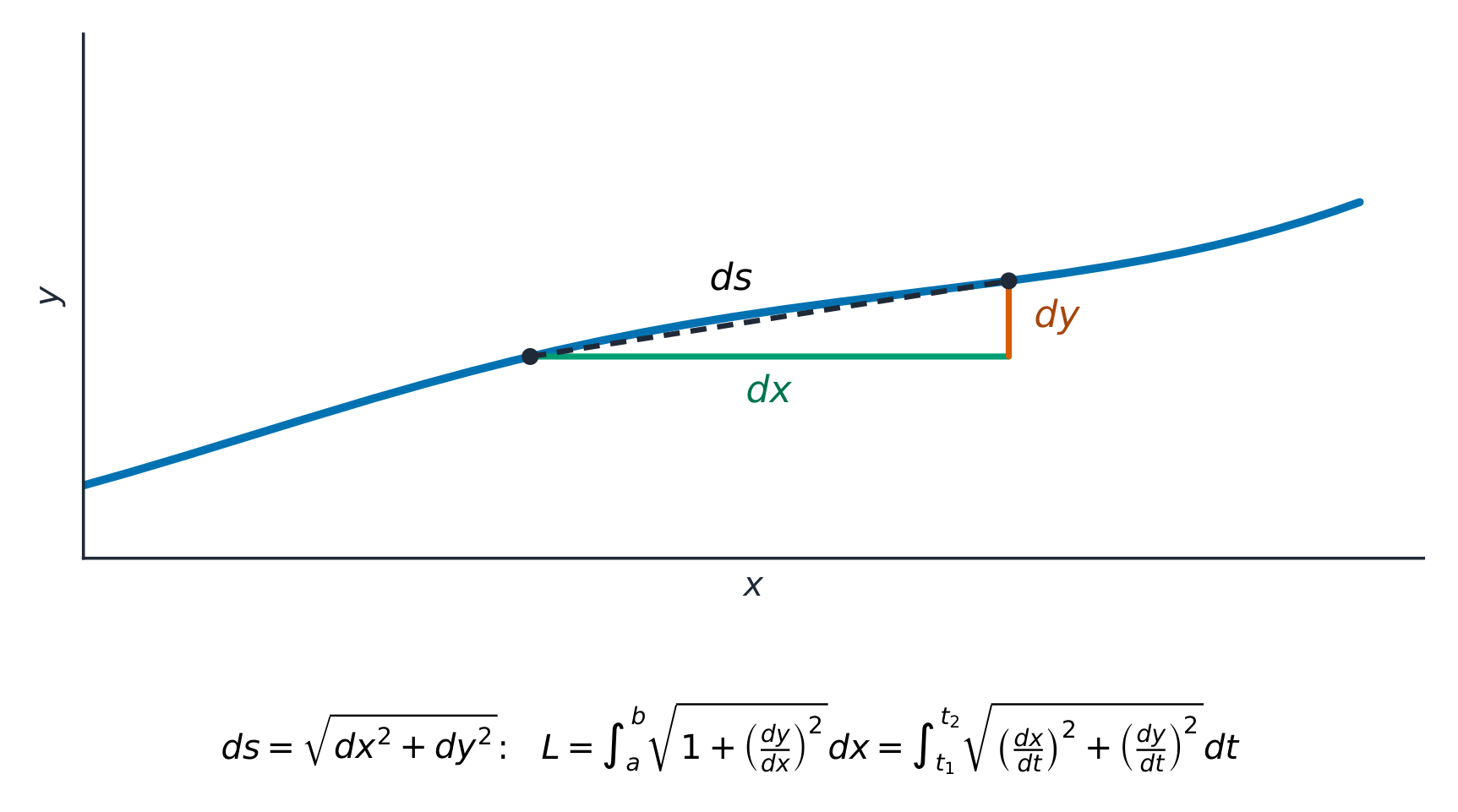
The arc length of a parametric curve is $\int_a^b(\ ?\ )\,dt$ where the integrand is...
Difficulty 1/5 · 100 coins + a small bonus on first completion today
Both derivatives squared, added, under a root.
The limits of integration for parametric arc length are $t$-values.
Difficulty 1/5 · 100 coins + a small bonus on first completion today
Integrate over the time interval.
Check a constant-rate route
- For $x=3t$, $y=4t$, $0\le t\le2$, the coordinate rates are $3$ and $4$. The speed is $\sqrt{3^2+4^2}=5$, so $L=\int_0^2 5\,dt=10$.
- Adding the rates would give $7$, which is wrong. Subtracting their squares would also be wrong. This straight route has endpoint distance $10$ too, but that equality does not hold for every path.
You can drop $\tfrac{dy}{dt}$ if $\tfrac{dx}{dt}$ is larger.
Difficulty 1/5 · 100 coins + a small bonus on first completion today
Both derivatives are needed for the diagonal motion.
For $x=3t,y=4t$, what is the speed?
Difficulty 2/5 · 140 coins + a small bonus on first completion today
$\sqrt{3^2+4^2}=5$.
For that route on $0\le t\le2$, what length is travelled?
Difficulty 2/5 · 140 coins + a small bonus on first completion today
$\int_0^2 5\,dt=10$.
Set up the original curved example
- For $x=t^2$, $y=t^3$, the rates are $2t$ and $3t^2$, giving speed $\sqrt{4t^2+9t^4}=|t|\sqrt{4+9t^2}$.
- On $0\le t\le1$, $|t|=t$, so $L=\int_0^1 t\sqrt{4+9t^2}\,dt$. The absolute value comes from $\sqrt{t^2}=|t|$, even though the original square-root expression is already nonnegative.
For $x=t^2$, $y=t^3$: $(dx/dt)^2+(dy/dt)^2=$
Difficulty 1/5 · 100 coins + a small bonus on first completion today
$(2t)^2+(3t^2)^2=4t^2+9t^4$.
What is $\sqrt{t^2}$ at $t=-2$?
Difficulty 2/5 · 140 coins + a small bonus on first completion today
$\sqrt{t^2}=|t|$, giving 2 rather than-2.
Evaluate and interpret the length
- Put $u=4+9t^2$, so $du=18t\,dt$. The transformed limits are $4$ and $13$, giving $L=\dfrac1{18}\int_4^{13}\sqrt u\,du=\dfrac{13^{3/2}-8}{27}\approx1.440$.
- The endpoint distance is $\sqrt{(1-0)^2+(1-0)^2}=\sqrt2$, which is slightly smaller. The length follows the curved route rather than its straight chord.
Compare a travelled path with its speed integral
For x=t²,y=t³ on[0,1], the speed integral gives length≈1.440, exceeding the endpoint distance√2. Compare constant-rate and retraced routes, including negative parameter intervals.
For $x=t^2,y=t^3$ on[0,1], give the length to five decimal places.
Difficulty 2/5 · 140 coins + a small bonus on first completion today
$(13^{3/2}-8)/27\approx1.43971$.
Every curved route has travelled length equal to the distance between its endpoints.
Difficulty 1/5 · 100 coins + a small bonus on first completion today
The straight chord can be shorter. The speed integral follows the actual route.
Negative parameters still give positive lengths
- On $-1\le t\le0$ for the same curve, $|t|=-t$. Thus $L=\int_{-1}^0(-t)\sqrt{4+9t^2}\,dt$, giving the same positive length as the upper branch on $[0,1]$.
- Replacing $|t|$ with $t$ on this negative interval would make the integrand negative. The mistake is in simplifying the square root, not in the length formula.
For $x=t^2,y=t^3$, what is the speed at $t=-1$?
Difficulty 2/5 · 140 coins + a small bonus on first completion today
$|t|\sqrt{4+9t^2}=\sqrt{13}$; speed is nonnegative.
On $[-1,0]$, the speed for $x=t^2,y=t^3$ simplifies to $t\sqrt{4+9t^2}$.
Difficulty 1/5 · 100 coins + a small bonus on first completion today
It is $(-t)\sqrt{4+9t^2}$ on this interval, because $|t|=-t$.
Split where the simplified speed changes form
- On $-1\le t\le1$, use $|t|=-t$ to the left of $0$ and $|t|=t$ to the right. The two equal lengths add to $\dfrac{2(13^{3/2}-8)}{27}\approx2.879$.
- The two branches are different parts of the path, so this is not retracing. The point passes through a zero rate vector at $t=0$; that single zero speed does not prevent the length integral.
How should $\int_{-1}^1 |t|\sqrt{4+9t^2}\,dt$ be handled?
Difficulty 1/5 · 100 coins + a small bonus on first completion today
The speed is even, so twice the integral on[0,1] works; splitting at 0 works too.
A single parameter value where both coordinate derivatives are zero makes the arc-length formula unusable.
Difficulty 1/5 · 100 coins + a small bonus on first completion today
An isolated zero speed can be integrated; no division by a coordinate derivative is required.
Count a retraced segment twice
- For $x=t^2$, $y=0$, $-1\le t\le1$, the point moves from $x=1$ to $x=0$ and back to $x=1$. Its speed is $2|t|$, so the travelled length is $\int_{-1}^1 2|t|\,dt=2$.
- The geometric segment, counted once, has length $1$. The endpoint distance is $0$. The speed integral counts each traversal, so specify whether the task asks for travelled distance or a curve traced once.

The parametric arc length is the same integral used for a particle's...
Difficulty 1/5 · 100 coins + a small bonus on first completion today
Integral of speed = distance traveled.
For $x=t^2,y=0$ on[-1,1], find the travelled distance.
Difficulty 2/5 · 140 coins + a small bonus on first completion today
The point travels one unit left and one unit right; $\int_{-1}^1 2|t|\,dt=2$.
For that same route, find the distance between the start and finish.
Difficulty 2/5 · 140 coins + a small bonus on first completion today
Both endpoints are $(1,0)$, so their distance is 0.
For that same route, what is the length of the geometric segment counted once?
Difficulty 2/5 · 140 coins + a small bonus on first completion today
The segment is $0\le x\le1$, with length 1.
A new parameter need not change the length
- The straight route $x=3t$, $y=4t$ on $[0,2]$ can also be traced by $x=3u^2$, $y=4u^2$ on $0\le u\le\sqrt2$. The speed in $u$ is $10u$, giving $\int_0^{\sqrt2}10u\,du=10$ again.
- A different rate of tracing changes the integrand and parameter limits together. Reversing a traversal preserves its length; use increasing integration limits with the appropriate nonnegative speed.
For $x=3u^2,y=4u^2$ on $[0,\sqrt2]$, find the length.
Difficulty 2/5 · 140 coins + a small bonus on first completion today
The speed is $10u$ on this nonnegative interval; $\int_0^{\sqrt2}10u\,du=10$.
A closed path can have nonzero length
- For $x=2\cos t$, $y=2\sin t$, $0\le t\le2\pi$, the speed is $\sqrt{4\sin^2t+4\cos^2t}=2$. One full circle has length $4\pi$.
- Start and finish are the same point, but the travelled distance is positive. A second full traversal would double the speed integral, while leaving the same geometric circle.
For $x=2\cos t,y=2\sin t$ on[0,2π], which pair gives travelled length and endpoint distance?
Difficulty 1/5 · 100 coins + a small bonus on first completion today
Speed 2 over an interval of length 2π gives length 4π; the endpoints coincide.
Try fresh routes
- Find the travelled distance for $x=4t$, $y=3t-2$ on $[-1,2]$. Then compare travelled distance, segment length counted once, and endpoint distance for $x=t^2$, $y=0$ on $[-2,1]$.
- For $x=t^2$, $y=t^3$ on $[-2,0]$, write a nonnegative speed integral and evaluate it. Explain where the absolute value enters and why you cannot just integrate $t\sqrt{4+9t^2}$ on this interval.
Find the travelled length for $x=4t,y=3t-2$ on[-1,2]. Compare it with endpoint distance.
Compare your speed integral, interval and interpretation with the model.
For $x=t^2,y=0$ on[-2,1], compare travelled distance, geometric segment length counted once, and endpoint distance.
Compare your speed integral, interval and interpretation with the model.
For $x=t^2,y=t^3$ on[-2,0], set up and evaluate the length. Explain the absolute value.
Compare your speed integral, interval and interpretation with the model.
Check the interval, root and interpretation
- Differentiate both coordinates, square, add, take the nonnegative root, and integrate over the stated parameter interval. Keep absolute values when simplifying square roots of squares; use exact evaluation or a suitable numerical method.
- Report length in coordinate units. Check whether the path retraces, and distinguish travelled length from endpoint distance. A finite drawing illustrates the route; the speed integral computes its length.
Reversing the bounds of a speed integral gives another positive expression for the same travelled distance.
Difficulty 1/5 · 100 coins + a small bonus on first completion today
Swapping bounds negates a definite integral. Use increasing parameter bounds with the appropriate nonnegative speed.