| Enduring Understanding | Learning Objective | Essential Knowledge |
|---|---|---|
LIM-7 | LIM-7.A |
|
Infinite Sequences and Series
AP Calculus BC · Topic 10
 8:20
Infinite Series
Can you add infinitely many numbers and get a finite answer? Surprisingly, yes. Add forever, and sometimes the total runs away to infinity — but sometimes it…
English narration · English + 中文 subtitles burned in
10.1
Defining Convergent and Divergent Infinite Series

Syllabus
Source: College Board AP Course and Exam Description
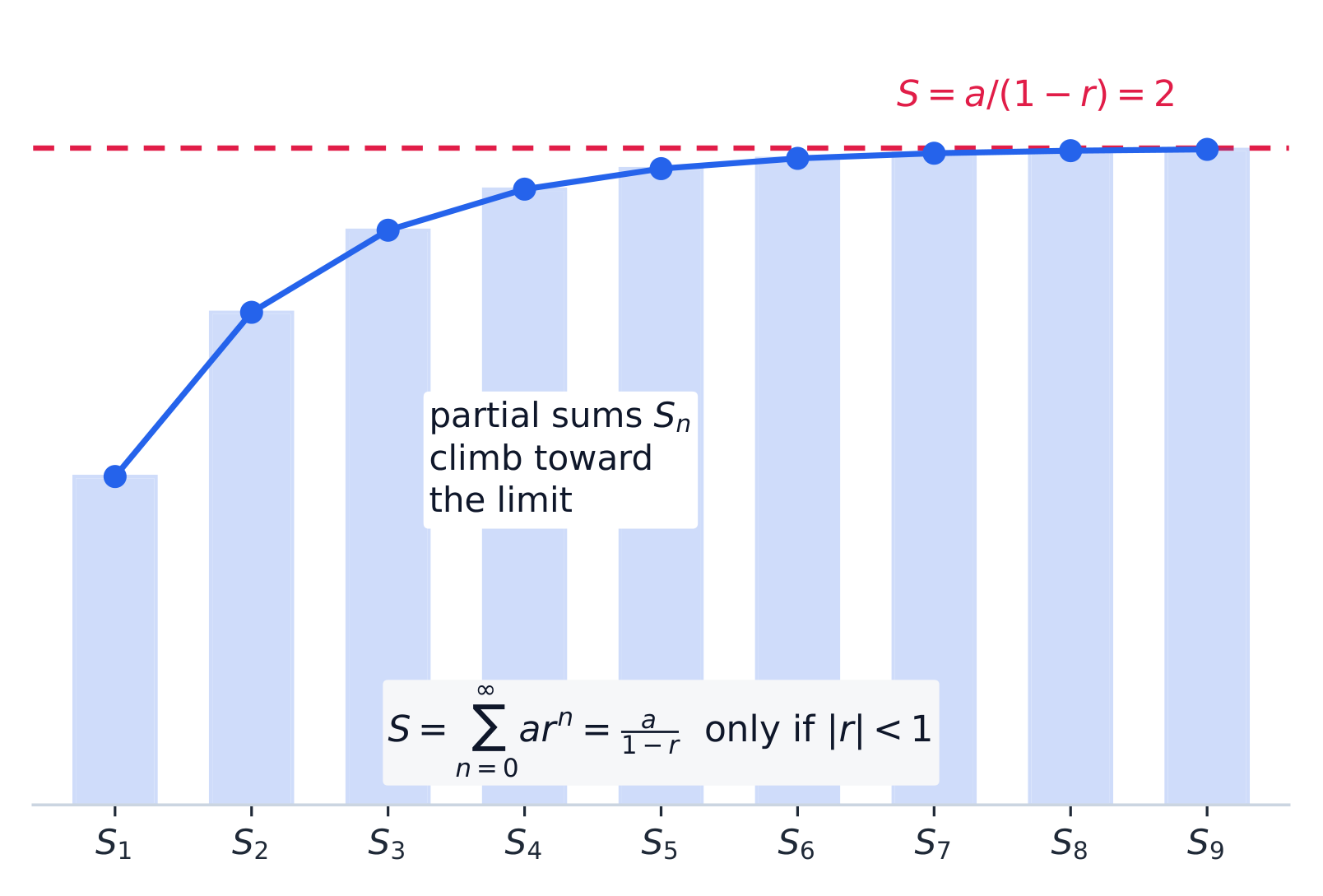
An infinite series 无穷级数 adds infinitely many terms, $\sum_{n=1}^\infty a_n$. Its value is defined as the limit 极限 of the partial sums 部分和 $S_N=a_1+a_2+\cdots+a_N$. If $S_N$ approaches a finite number $L$, the series converges 收敛 to $L$; otherwise it diverges 发散. Every convergence question is really a question about the limit of the partial sums.
Vocabulary
Train
| English |
|---|
| infinite series/ˈɪnfɪnət ˈsɪəriːz/ |
| limit/ˈlɪmɪt/ |
| partial sums/ˈpɑːʃl sʌmz/ |
| converges/kənˈvɜːdʒɪz/ |
| diverges/daɪˈvɜːdʒɪz/ |
10.2
Working with Geometric Series

Syllabus
| Enduring Understanding | Learning Objective | Essential Knowledge |
|---|---|---|
LIM-7 | LIM-7.A |
|
Source: College Board AP Course and Exam Description
A geometric series 几何级数 adds terms obtained by multiplying by a fixed ratio 公比 $r$:
$$a+ar+ar^2+\cdots.$$
Here $a$ is the actual first term. For nonzero terms, dividing a term by the previous one gives $r$. Its first $N$ terms have sum
$$S_N=\sum_{n=0}^{N-1}ar^n=\frac{a(1-r^N)}{1-r}\quad(r\ne1).$$
To derive this, subtract $rS_N$ from $S_N$; the middle terms cancel. When $r=1$, $S_N=Na$ instead. An individual term is not a partial sum.
For $a\ne0$, the infinite series converges exactly when $|r|<1$. Then $r^N\to0$ and
$$S=\lim_{N\to\infty}S_N=\frac{a}{1-r}.$$
The ratio may be negative or irrational; its magnitude is what matters. If $a=0$, every term is zero for any fixed finite $r$, so the sum is $0$. Zero terms do not determine a unique ratio by division. In the case $r=1$, handle the zero series directly rather than evaluating $0/0$.
Worked example: finite versus infinite. For $3+3/2+3/4+\cdots$, $a=3$ and $r=1/2$. The infinite sum is $3/(1-1/2)=6$. The first four-term sum is $3(1-(1/2)^4)/(1-1/2)=5.625$, leaving $0.375$ still to be added.
Worked example: a negative ratio. The series $4-2+1-1/2+\cdots$ has $r=-1/2$ and sum $4/(1+1/2)=8/3$. Its partial sums $4,2,3,2.5,\ldots$ alternate around that limit. Shrinking oscillations can converge. By contrast, with a nonzero first term and $r=-1$, the partial sums alternate between $a$ and $0$ and do not have a limit. At $r=1$, they are $Na$; for $|r|>1$, the terms do not tend to zero.
Worked example: read the starting index. For $\sum_{n=1}^{\infty}3\cdot2^{-n}$, the first term is $3/2$, not $3$. The ratio is $1/2$, so the sum is $3$. For $\sum_{n=2}^{\infty}12(-1/3)^n$, the first term is $4/3$ and the ratio is $-1/3$, giving sum $1$.
A finite sum exists even when the infinite series diverges. For $3+6+12+\cdots$, the first three terms add to $21$, but the infinite series has no finite sum. The formal expression $3/(1-2)=-3$ is not an ordinary infinite sum of these positive terms.
Try it. For $\sum_{k=3}^{\infty}16(1/2)^k$, find the actual first term, infinite sum, first four-term sum and remaining amount.
Answer. The first term is $2$ and the ratio is $1/2$. The infinite sum is $4$. The first four terms are $2,1,1/2,1/4$, with sum $15/4=3.75$. The remaining amount is $1/4$.
Common mistakes. Using $\dfrac{a}{1-r}$ when $|r|\ge 1$ (the series diverges), and taking $a$ from the formula instead of the series: $\displaystyle\sum_{n=1}^{\infty}\left(\tfrac12\right)^n$ starts with $\tfrac12$, so its sum is $\dfrac{1/2}{1-1/2}=1$, not $2$.
Explore
Terms, partial sums and their limit
The default first term 3 and ratio 1/2 give infinite sum 6. Individual terms and finite partial sums are different. The activity handles convergence boundaries and the all-zero case.
Vocabulary
Train
| English |
|---|
| geometric series/ˌdʒiːəʊˈmetrɪk ˈsɪəriːz/ |
| ratio/ˈreɪʃɪəʊ/ |
10.3
The nth Term Test for Divergence
Syllabus
| Enduring Understanding | Learning Objective | Essential Knowledge |
|---|---|---|
LIM-7 | LIM-7.A |
|
Source: College Board AP Course and Exam Description
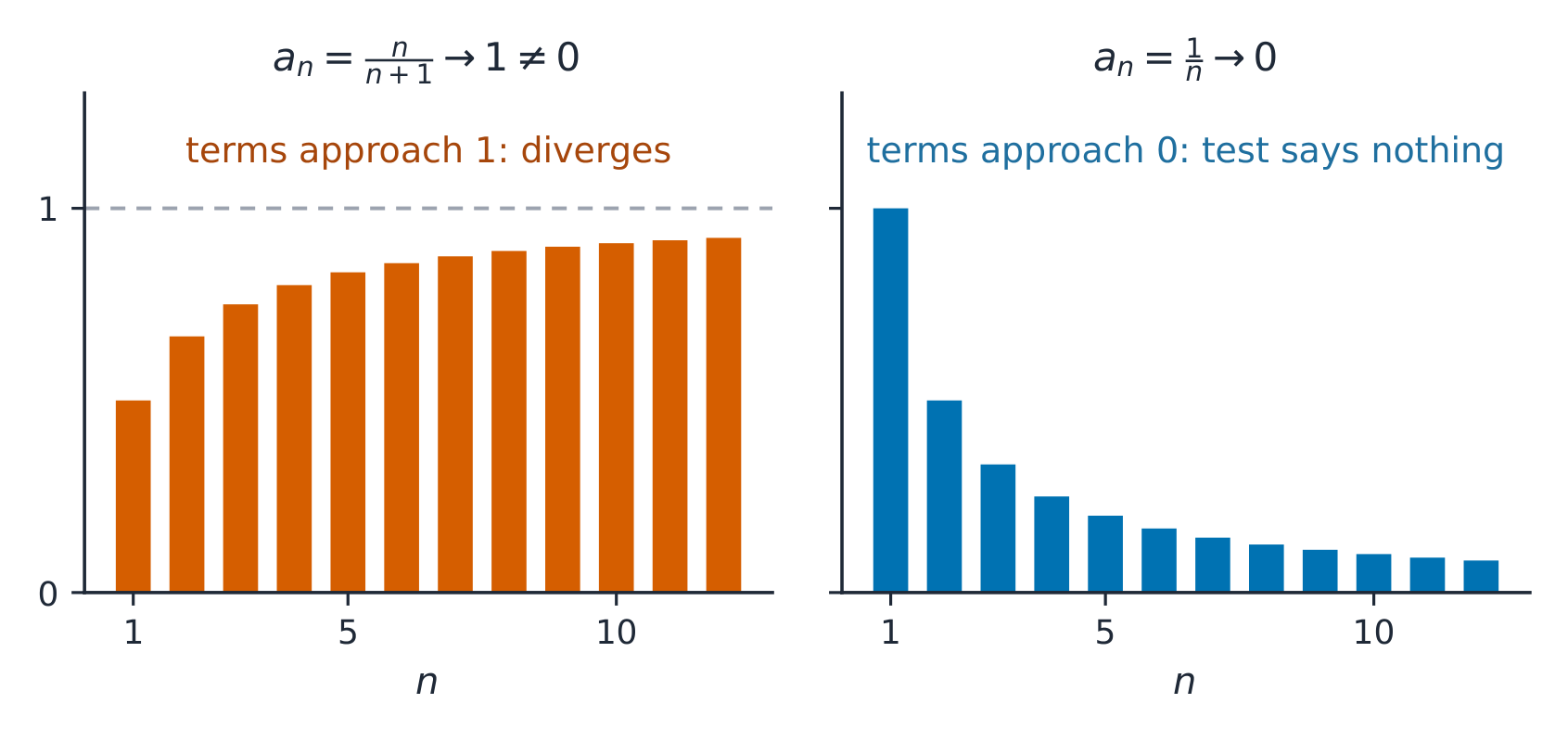
A series converges when its partial sums $S_n=a_1+\cdots+a_n$ tend to a finite limit $S$. Since $a_n=S_n-S_{n-1}$, convergence gives $a_n\to S-S=0$. Therefore if the terms do not tend to zero, the series diverges. This includes a nonzero finite term limit, unbounded terms or a term limit that does not exist.
Worked example: a nonzero limit. For $a_n=n/(2n+1)$, divide by $n$ to obtain $a_n=1/(2+1/n)\to1/2$. Thus $\sum n/(2n+1)$ diverges by the nth Term Test. The number $1/2$ is the term limit, not the series sum.
Worked example: no term limit. For $a_n=(-1)^{n-1}$, odd terms equal $1$ and even terms equal $-1$. The terms have no single limit, so the series diverges. Its partial sums alternate between $1$ and $0$: bounded partial sums need not converge.
A zero term limit makes this test inconclusive 无法判定. Both $\sum1/n$ and $\sum1/2^{n-1}$ have terms tending to zero, yet the first diverges and the second converges to $2$. For the harmonic series, the block from $n=2^{k-1}+1$ to $2^k$ contains $2^{k-1}$ terms each at least $1/2^k$, so each block adds at least $1/2$. The geometric-series theorem gives the second series' sum. These are separate arguments; the nth Term Test alone decides neither.
Alternating signs alone do not make the term limit fail: $(-1)^{n-1}/n\to0$ because its absolute value tends to zero. The nth Term Test is inconclusive for this series too. Changing finitely many finite terms does not change convergence.
Try it. Apply only the nth Term Test to $\sum 3n^2/(n^2+4)$, $\sum[2+(-1)^n]$ and $\sum 2/(n+1)$, with $n\ge1$.
Answer. The first has term limit $3\ne0$, so it diverges. The second has odd terms $1$ and even terms $3$, so its term limit does not exist and the series diverges. The third has term limit $0$, so this test is inconclusive; another argument is needed for its classification.
Vocabulary
Train
| English |
|---|
| inconclusive/ɪŋkənˈkluːsɪv/ |
| inconclusive/ɪŋkənˈkluːsɪv/ |
10.4
Integral Test for Convergence
Syllabus
| Enduring Understanding | Learning Objective | Essential Knowledge |
|---|---|---|
LIM-7 | LIM-7.A |
|
Source: College Board AP Course and Exam Description
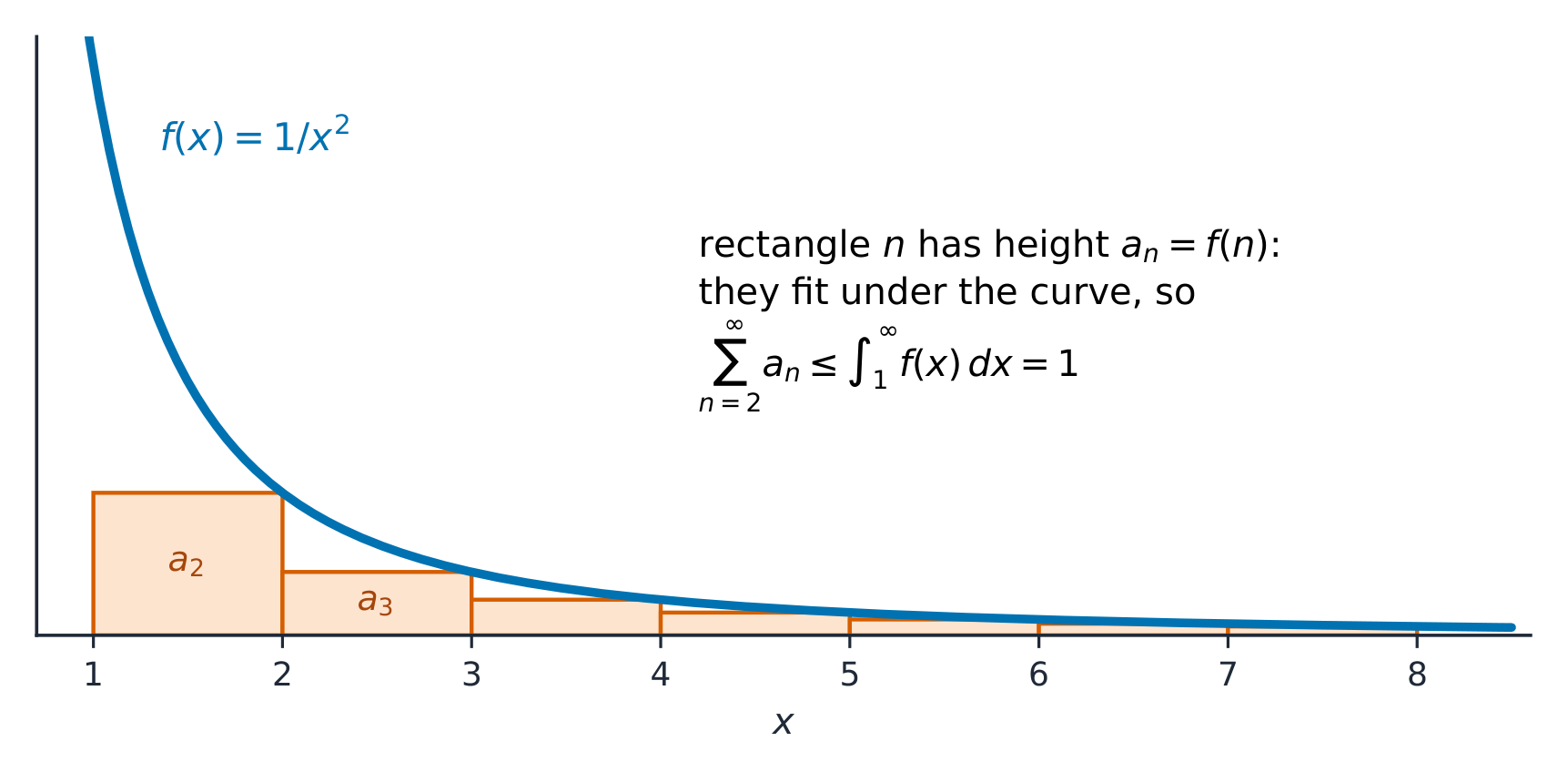
The integral test 积分判别法 compares a series tail with a matching improper integral 反常积分. Choose $f$ with $a_n=f(n)$, and an integer $N$ such that $f$ is positive, continuous and non-increasing (decreasing 递减 in the non-strict sense) on $[N,\infty)$. Flat parts are allowed. Then
$$\sum_{n=N}^{\infty}a_n\quad\text{and}\quad\int_N^{\infty}f(x)\,dx$$
converge or diverge together. Their values are not the same quantity. Finitely many finite terms before the valid tail do not affect convergence. Do not automatically use lower limit $1$: the function may be undefined there.
Rectangle comparison. On $[N,N+m]$, unit-width left rectangles have total $U=\sum_{k=N}^{N+m-1}f(k)$ and lie above the area. Right rectangles have total $L=\sum_{k=N+1}^{N+m}f(k)$ and lie below. Thus $L\le I\le U$, where $I=\int_N^{N+m}f(x)\,dx$. This comparison bounds the positive partial sums when the improper integral is finite; if the integral grows without bound, so does the series.
Worked example: a finite integral. For $\sum_{n=1}^{\infty}1/n^2$, $f(x)=1/x^2$ is positive and continuous on $[1,\infty)$, with $f'(x)=-2/x^3<0$. Compute the improper integral as a limit:
$$\begin{aligned}
\int_1^{\infty}\frac{1}{x^2}\,dx
&=\lim_{b\to\infty}\left[-\frac1x\right]_1^b\\
&=\lim_{b\to\infty}\left(1-\frac1b\right)=1.
\end{aligned}$$
The series converges. Its sum is not $1$, since its first two terms already add to $1.25$. For comparison, $\int_1^b dx/x=\ln b\to\infty$, so the harmonic series diverges despite its terms tending to zero.
Worked example: a shifted function. For $\sum_{n=1}^{\infty}1/(n+2)^2$, use $f(x)=1/(x+2)^2$. It meets the conditions for $x\ge1$, and its improper integral is $[-1/(x+2)]_1^{\infty}=1/3$. The series converges; $1/3$ is the integral value, not the exact series sum.
Worked example: choose the lower limit. For $\sum_{n=2}^{\infty}1/(n\ln n)$, the matching function is positive and continuous for $x\ge2$. Its derivative is $-(\ln x+1)/[x^2(\ln x)^2]<0$. Since
$$\int_2^b\frac{dx}{x\ln x}
=\ln(\ln b)-\ln(\ln2)\to\infty,$$
the series diverges. Lower limit $1$ would be invalid because the denominator is zero there. If a chosen matching function fails a test condition, that failure alone does not prove divergence.
Try it. Use the Integral Test for $\sum_{n=2}^{\infty}1/[n(\ln n)^2]$. Explain the conditions and the integral.
Answer. The matching function is positive and continuous on $[2,\infty)$, with derivative $-(\ln x+2)/[x^2(\ln x)^3]<0$. Its antiderivative is $-1/\ln x$, so the improper integral from $2$ is $1/\ln2$, finite. The series converges. Changing any finite prefix of finite terms does not change this conclusion.
Explore
Two rectangle bounds on the same area
For 1/x², left rectangles lie above and right rectangles below the same finite area. The separate improper integral proves convergence without giving the exact series sum.
Vocabulary
Train
| English |
|---|
| decreasing/ˈdiːkriːsɪŋ/ |
| integral test/ˈɪntɪɡrəl test/ |
| improper integral/ɪmˈprɒpə ˈɪntɪɡrəl/ |
10.5
Harmonic Series and p-Series
Syllabus
| Enduring Understanding | Learning Objective | Essential Knowledge |
|---|---|---|
LIM-7 | LIM-7.A |
|
Source: College Board AP Course and Exam Description
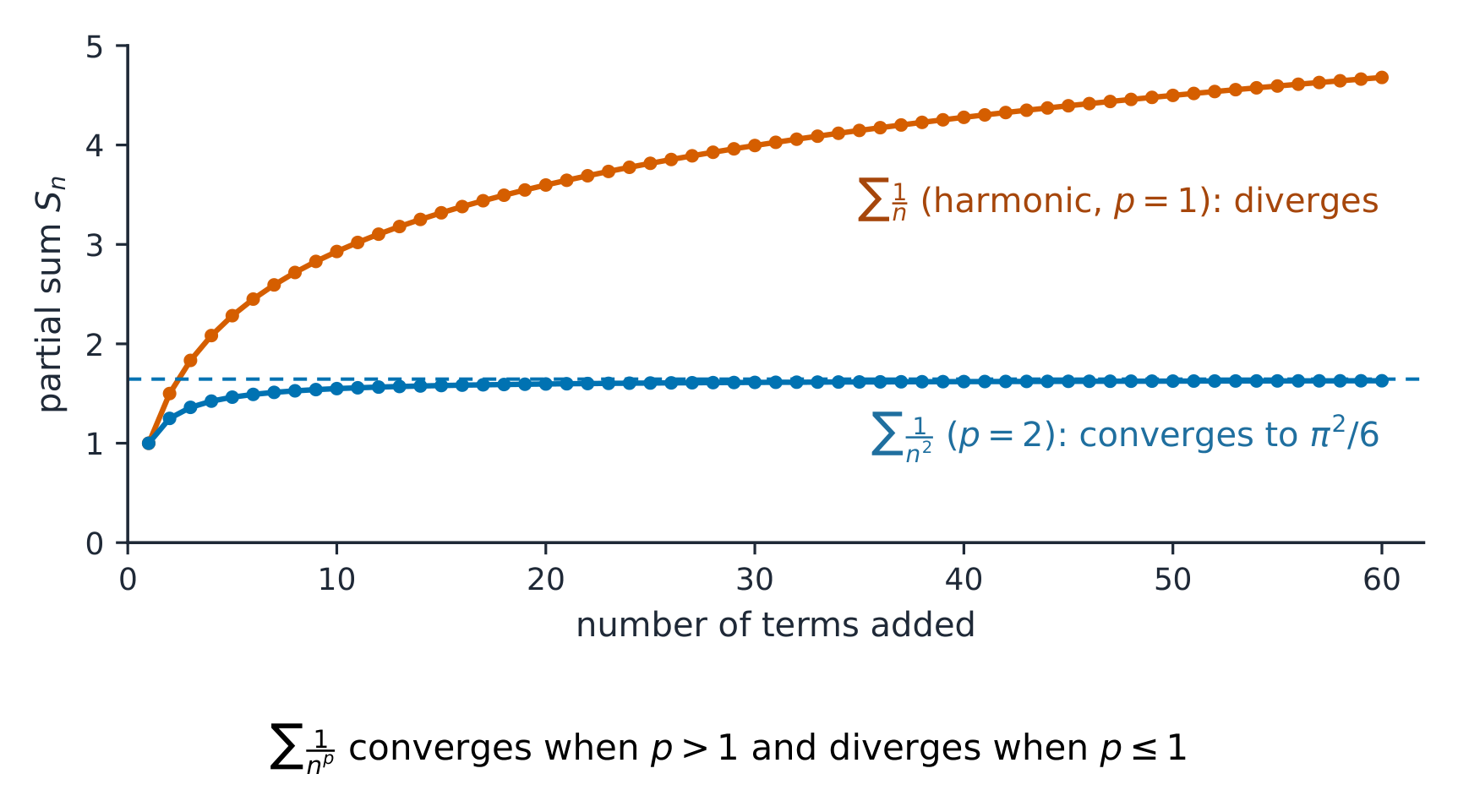
A p-series p级数 $\sum_{n=1}^{\infty}1/n^p$, with fixed real $p$, converges exactly when $p>1$ and diverges for $p\le1$. The harmonic series 调和级数 is the boundary $p=1$ and diverges despite its terms tending to zero.
Why the rule holds. For $p>0$, $f(x)=x^{-p}$ is positive, continuous and decreasing on $[1,\infty)$. If $p\ne1$,
$$\int_1^b x^{-p}\,dx=\frac{b^{1-p}-1}{1-p}.$$
For $p>1$, the improper integral is $1/(p-1)$, finite, so the series converges. For $0<p<1$, the integral grows without bound, so the series diverges. At $p=1$, use $\int_1^b dx/x=\ln b\to\infty$ separately. An integral's value is not the exact series sum.
For $p=0$, the terms equal $1$; for $p<0$, they grow without bound. These terms do not tend to zero, so the nth Term Test proves divergence. For negative $p$, the matching function is increasing, so the decreasing-function Integral Test has not been justified.
Recognise the power. Since $n\sqrt n=n^{3/2}$, $\sum1/(n\sqrt n)$ converges. Since $\sqrt[3]{n^2}=n^{2/3}$, $\sum1/\sqrt[3]{n^2}$ diverges. A fixed nonzero factor and a finite change in the starting index preserve convergence. For example,
$$\sum_{n=1}^{\infty}\frac{3}{(n+2)^{3/2}}=3\sum_{k=3}^{\infty}\frac{1}{k^{3/2}}$$
converges. A zero factor gives the all-zero series directly. The expression $1/(n^2+1)$ is not exactly a p-series term; use comparison rather than deleting the $+1$.
The series $\sum1/2^n$ is geometric, with the changing index in the exponent.
Alternating harmonic series. The signed series $\sum_{n=1}^{\infty}(-1)^{n-1}/n$ converges by the Alternating Series Test because its positive magnitudes decrease to zero. Its magnitude series $\sum1/n$ diverges. The positive p-series rule alone does not classify signed series; the alternating test is explained below.
Try it. Classify $\sum_{n=4}^{\infty}5/(n\sqrt n)$, and find all real $q$ for which $\sum_{n=1}^{\infty}1/n^{2q-1}$ converges.
Answer. The first has power $3/2>1$ and converges; factor $5$ and the finite omitted prefix do not change this. The second requires $2q-1>1$, hence $q>1$. At $q=1$ it is harmonic and diverges.
Explore
Actual terms and partial sums across the power threshold
Default p=1 plots the harmonic terms and partial sums. The strict p>1 convergence threshold comes from the theorem, not a finite plot.
Vocabulary
Train
| English |
|---|
| p-series/piː ˈsɪəriːz/ |
| harmonic series/hɑːˈmɒnɪk ˈsɪəriːz/ |
10.6
Comparison Tests for Convergence
Syllabus
| Enduring Understanding | Learning Objective | Essential Knowledge |
|---|---|---|
LIM-7 | LIM-7.A |
|
Source: College Board AP Course and Exam Description
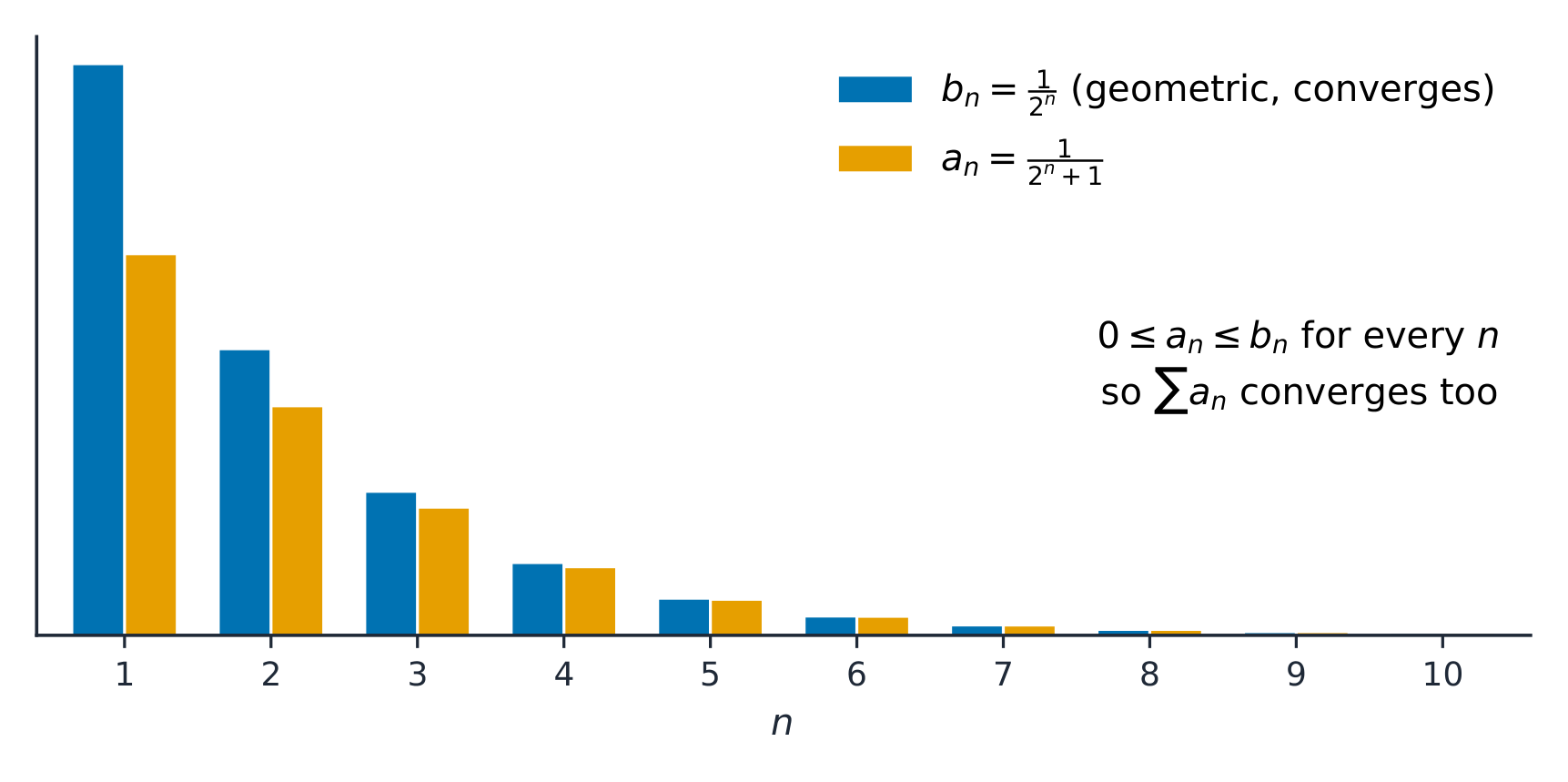
Comparison relates an unfamiliar series to a known p-series or geometric series. Check the terms and the direction of the inequality on a valid tail.
- Direct comparison 直接比较: if $0\le a_n\le b_n$ eventually and $\sum b_n$ converges, the smaller $\sum a_n$ converges. If $a_n\ge b_n\ge0$ eventually and $\sum b_n$ diverges, the larger $\sum a_n$ diverges.
- Limit comparison 极限比较: for eventually positive terms, if $\lim a_n/b_n=L$ with $0<L<\infty$, both series have the same convergence behaviour. Classify the known series first; the limit does not by itself say that both converge.
Convergent upper bound. Since $0<1/(n^2+1)<1/n^2$ for $n\ge1$ and the p-series with power $2$ converges, $\sum1/(n^2+1)$ converges.
Divergent lower bound. For $n\ge1$, $n+1\le2n$, so $1/(n+1)\ge1/(2n)>0$. Half the harmonic series diverges, and therefore so does $\sum1/(n+1)$.
Worked example. Does $\displaystyle\sum_{n=2}^{\infty}\frac{1}{n^2-1}$ converge? For large $n$ the terms behave like $\dfrac{1}{n^2}$. Direct comparison points the wrong way here ($\tfrac{1}{n^2-1}>\tfrac{1}{n^2}$, and being bigger than a convergent series proves nothing). Use the limit comparison test with $b_n=\dfrac{1}{n^2}$:
$$\lim_{n\to\infty}\frac{a_n}{b_n}=\lim_{n\to\infty}\frac{n^2}{n^2-1}=1,$$
a finite positive number. Since $\sum\dfrac{1}{n^2}$ converges ($p=2>1$), $\displaystyle\sum\frac{1}{n^2-1}$ converges too.
Avoid the wrong direction. Being smaller than a divergent series does not establish divergence: $1/n^2\le1/n$, but the smaller series converges. Being larger than a convergent series does not establish convergence. A finite picture does not prove a bound for every later index.
Evaluate the full ratio. For $a_n=(3n^2+1)/(n^4+5)$ and $b_n=1/n^2$,
$$\frac{a_n}{b_n}=\frac{3n^4+n^2}{n^4+5}=\frac{3+1/n^2}{1+5/n^4}\longrightarrow3.$$
The terms are positive and the comparison p-series converges, so the given series converges. For $a_n=(2n+1)/(n^2+4)$ and $b_n=1/n$, the ratio is $(2+1/n)/(1+4/n^2)\to2$. Positivity and harmonic divergence give divergence of the latter series.
Check the tail. For $n\ge3$, $n^2-4\ge n^2/2$, so $0<1/(n^2-4)\le2/n^2$. Thus the series starting at $n=3$ converges. A term at $n=2$ would be undefined: finite-prefix invariance requires finite, defined terms. Signed terms need a separate argument or study of their absolute values.
If a ratio limit is $0$ or infinity, the finite-positive Limit Comparison theorem does not justify equal convergence behaviour. For example, $(1/n^2)/(1/n)\to0$ even though the numerator series converges and the denominator series diverges. Choose another comparison or a valid direct bound; these limits are not automatic divergence verdicts. Comparison also does not equate exact sums.
Try it. Classify $\sum_{n=2}^{\infty}1/(n^2-1)$, $\sum\sqrt n/(n^2+1)$ and $\sum(4n^2+3)/(n^3+2)$.
Answer. The first is bounded above by $2/n^2$ for $n\ge2$, so it converges. For the second, comparison with $1/n^{3/2}$ gives ratio $n^2/(n^2+1)\to1$ and convergence. For the third, comparison with $1/n$ gives ratio $(4+3/n^2)/(1+2/n^3)\to4$ and divergence. All the chosen tails are positive.
Explore
Two-series bounds and full ratios
A convergent upper bound proves convergence; a divergent lower bound proves divergence. A smaller series below a divergent bound is not classified by that bound.
Vocabulary
Train
| English |
|---|
| direct comparison/daɪˈrekt kəmˈpærɪsn/ |
| limit comparison/ˈlɪmɪt kəmˈpærɪsn/ |
10.7
Alternating Series Test for Convergence

Syllabus
| Enduring Understanding | Learning Objective | Essential Knowledge |
|---|---|---|
LIM-7 | LIM-7.A |
|
Source: College Board AP Course and Exam Description
An alternating series 交错级数 has signs that switch. Write $a_n=(-1)^{n-1}b_n$ for a positive first sign, or $a_n=(-1)^n b_n$ for a negative first sign. The magnitudes $b_n$ are positive.
The Alternating Series Test gives sufficient conditions: if, from some index onward, $b_{n+1}\le b_n$ and $b_n\to0$, the series converges. Equal consecutive magnitudes are allowed. A finite prefix of finite terms does not affect convergence.
Why it works. In the positive-first case with non-increasing magnitudes from the start, the even partial sums increase and the odd partial sums decrease; each group bounds the other. The gap $S_{2k-1}-S_{2k}=b_{2k}$ tends to zero, so both groups approach the same finite limit. Apply this reasoning to a valid tail for eventual conditions.
Alternating harmonic example. For $b_n=1/n$, positivity, decrease and the zero limit all hold for $n\ge1$, so $\sum(-1)^{n-1}/n$ converges.
The positive harmonic series diverges. Starting with $(-1)^n$ multiplies the signed series by $-1$ and preserves convergence. A zero term limit is not the exact series sum.
Eventually decreasing example. For $b_n=n/(n^2+9)$, $f(x)=x/(x^2+9)$ has derivative $(9-x^2)/(x^2+9)^2\le0$ for $x\ge3$. Also $b_n=(1/n)/(1+9/n^2)\to0$. The alternating series converges although the first magnitudes increase.
Separate two failures. If $b_n=1+1/n$, the magnitudes decrease but tend to $1$; the signed terms do not approach zero, and the nth Term Test proves divergence. If only eventual non-increase fails, the Alternating Series Test is not justified; that failure alone does not prove divergence.
For example, let $b_{2k-1}=1/k$ and $b_{2k}=1/k+1/k^2$. There is a magnitude increase in every pair. Yet the positive-first adjacent signed pairs sum to $-1/k^2$. Their even partial sums converge, and the difference to the next odd sum tends to zero, so the original series converges by this separate argument. Adjacent pairing keeps the original order.
The test does not by itself classify convergence of $\sum b_n$ or calculate an exact sum. Absolute/conditional convergence and numerical error bounds are separate topics below.
Try it. Test the alternating series with positive magnitudes $2/\sqrt{n+3}$, $n/(n^2+16)$ and $(3n+1)/(n+2)$, for $n\ge1$.
Answer. The first decreases to zero and gives convergence. The second tends to zero and has derivative $(16-x^2)/(x^2+16)^2\le0$ from $x=4$, so its alternating series converges. The third has magnitude limit $3$, so its signed terms fail to tend to zero and the nth Term Test gives divergence.
Explore
Magnitudes and odd/even partial sums
The default alternating harmonic series has odd/even partial sums approaching one limit. Distinguish eventual decrease, a nonzero magnitude limit and a separate pairing proof.
Vocabulary
Train
| English |
|---|
| alternating series/ˈɔːltəneɪtɪŋ ˈsɪəriːz/ |
10.8
Ratio Test for Convergence
Syllabus
| Enduring Understanding | Learning Objective | Essential Knowledge |
|---|---|---|
LIM-7 | LIM-7.A |
|
Source: College Board AP Course and Exam Description
The ratio test 比值判别法 uses the absolute next/current ratio $q_n=|a_{n+1}/a_n|$. The terms must be nonzero eventually so that the quotient is defined on a tail. When $L=\lim q_n$ exists:
- $L<1$: the series converges absolutely, because the tail magnitudes are eventually bounded by a convergent geometric series.
- $L>1$, including $+\infty$: the series diverges.
- $L=1$: the test is inconclusive; another test is needed.
Finitely many finite early terms, including zeros, do not affect convergence. An all-zero tail converges directly; do not evaluate $0/0$. Recurring zero denominators or a nonexistent ratio limit require another argument, rather than an automatic divergence verdict.
It is the go-to test for series with factorials 阶乘 or $n$th powers, and it is exactly how you find the radius of convergence of a power series.
Factorial cancellation. For $a_n=2^n/n!$, first write $a_{n+1}=2^{n+1}/(n+1)!$. Then
$$q_n=\left|\frac{2^{n+1}}{(n+1)!}\cdot\frac{n!}{2^n}\right|=\frac{2}{n+1}\longrightarrow0.$$
The series converges absolutely. Use $(n+1)!=(n+1)n!$, not $n!+1$. Early ratios need not all be below $1$: for $4^n/n!$, the first ratio is $2$, but $4/(n+1)\to0$ still proves absolute convergence.
Signs and quotient direction. For $(-2)^n/n!$, the signed ratio is $-2/(n+1)$; its absolute value tends to zero. For $(-3)^n$, the absolute ratio is $3>1$, so the series diverges despite its negative signed ratio. For $n!/2^n$, use the correct quotient $(n+1)/2\to+\infty$, proving divergence. Its reciprocal is not the Ratio Test quotient.
A changing exponent. For $a_n=n!/n^n$,
$$\frac{a_{n+1}}{a_n}=\frac{(n+1)!}{(n+1)^{n+1}}\cdot\frac{n^n}{n!}=\left(\frac{n}{n+1}\right)^n=\left(1+\frac1n\right)^{-n}\longrightarrow e^{-1}<1.$$
Hence the series converges absolutely. Both the base and the exponent change in the next denominator.
The boundary is inconclusive. The harmonic terms have $q_n=n/(n+1)\to1$ and their series diverges. The terms $1/n^2$ have $q_n=(n/(n+1))^2\to1$ and their series converges. The p-series theorem supplies these classifications. In particular, a finite ratio below $1$ at every index is not enough; the harmonic series is a counterexample. The ratio limit is not the series sum.
For fixed real $c\ne0$, $\sum_{n=1}^{\infty}c^n/n!$ has absolute-ratio limit $0$ and converges absolutely. For $c=0$, it is an all-zero series and converges directly, without a ratio calculation.
Try it. Apply the Ratio Test to $\sum3^n/(n+2)!$, $\sum n^3/5^n$ and $\sum(n+1)!/3^n$, starting at $n=1$.
Answer. Their absolute ratios are $3/(n+3)\to0$, $((n+1)/n)^3/5\to1/5$ and $(n+2)/3\to+\infty$. The first two series converge absolutely; the third diverges. Each next term changes every occurrence of the index.
Common mistake. Reading a ratio-test limit of exactly $1$ as convergence. Both $\sum\frac1n$ (diverges) and $\sum\frac1{n^2}$ (converges) give a limit of $1$: the test is inconclusive there, so use another test.
Explore
Changing absolute next/current ratios
Default2^n/n! has ratio2/(n+1) tending to0. Compare signs, reciprocal factorial growth, n!/n^n and the inconclusive p-series boundary.
Vocabulary
Train
| English |
|---|
| ratio test/ˈreɪʃɪəʊ test/ |
| factorial/fækˈtɔːrɪəl/ |
10.9
Determining Absolute or Conditional Convergence
Syllabus
| Enduring Understanding | Learning Objective | Essential Knowledge |
|---|---|---|
LIM-7 | LIM-7.A |
|
Source: College Board AP Course and Exam Description
A series converges absolutely 绝对收敛 if $\sum|a_n|$ converges. It converges conditionally 条件收敛 if $\sum a_n$ converges but $\sum|a_n|$ diverges. A divergent signed series is neither of these convergent categories.
Two separate questions. A useful procedure is to test the magnitude series first. If it converges, absolute convergence guarantees convergence of the original series. If it diverges, test the signed series separately: signed convergence gives conditional convergence; signed divergence gives divergence. Divergence of $\sum|a_n|$ alone does not distinguish these last two outcomes.
For real terms, $a_n^+=\max(a_n,0)$ and $a_n^-=\max(-a_n,0)$ satisfy $0\le a_n^\pm\le|a_n|$. If the magnitude series converges, both series of parts converge by comparison. Since $a_n=a_n^+-a_n^-$, their finite limits give convergence of the signed series.
Conditional example. For $\sum(-1)^n/n$, the magnitude series is divergent harmonic. The signed series passes the Alternating Series Test because its positive magnitudes decrease to zero. These two facts together establish conditional convergence.
Absolute example. For $\sum(-1)^n/n^2$, the magnitude p-series converges. Therefore the signed series is absolutely convergent; its alternating signs do not make it conditional, and no extra convergence proof is needed.
Divergent example. For $(-1)^n n/(n+1)$, the magnitudes tend to $1$, so the signed terms do not tend to zero. The nth Term Test gives divergence, not conditional convergence. This and the conditional harmonic example both have divergent magnitude series.
A shifted example is $\sum_{n=1}^{\infty}(-1)^{n-1}2/\sqrt{n+3}$. Its magnitude series is twice a divergent p-series tail with power $1/2$; its signed series passes the Alternating Series Test. Thus it is conditionally convergent. A Ratio Test result of $L=1$ does not establish conditional convergence: both the harmonic and squared-denominator alternating examples have that ratio limit.
Rearrangement and finite changes. Any regrouping or rearrangement of an absolutely convergent series has the same sum. A conditionally convergent series has no such rearrangement guarantee; a new order may change the sum or fail to converge. Use the stated order when classifying. Changing finitely many finite terms, or multiplying by a fixed nonzero constant, preserves the classification. A zero multiplier gives an absolutely convergent all-zero series directly.
Try it. Classify $\sum(-1)^{n-1}/n^{3/2}$, $\sum(-1)^n/\sqrt{n+1}$ and $\sum(-1)^n(2n+1)/(n+4)$, for $n\ge1$.
Worked answers
The first is absolutely convergent because its magnitude p-series has power $3/2>1$. The second is conditional: the magnitude p-series tail has power $1/2$ and diverges, while the signed series passes the Alternating Series Test. The third diverges by the nth Term Test since its magnitudes tend to $2$. Give both signed and magnitude arguments when claiming conditional convergence.
Explore
Signed and magnitude sums: three outcomes
Compare a signed series with its magnitude series. The default alternating harmonic example is conditional; powers above1 give absolute convergence and nonzero term limits give divergence.
Vocabulary
Train
| English |
|---|
| converges absolutely/kənˈvɜːdʒɪz ˌæbsəˈluːtli/ |
| converges conditionally/kənˈvɜːdʒɪz kənˈdɪʃənəli/ |
10.10
Alternating Series Error Bound
Syllabus
| Enduring Understanding | Learning Objective | Essential Knowledge |
|---|---|---|
LIM-7 | LIM-7.B |
|
Source: College Board AP Course and Exam Description
For a series starting at $n=1$, let $S_N$ contain its first $N$ terms. If the omitted tail alternates with positive, non-increasing magnitudes tending to zero, then
$$|S-S_N|\le b_{N+1}.$$
The bound uses the first omitted term 第一个略去的项 (its magnitude), not the last included one. The exact sum lies between $S_N$ and $S_{N+1}$. A positive next term makes $S_N$ a lower estimate; a negative next term makes it an upper estimate. Convergence alone, without the omitted-tail conditions, does not justify this theorem.
Exact harmonic example. For $1-1/2+1/3-\cdots$, $S_3=5/6$ and the next term is $-1/4$. Thus the bound is $1/4$ and $7/12\le S\le5/6$. The bound is not the actual error, and the exact infinite sum is not needed to certify this enclosure.
Match the target inequality. A sufficient next-term condition for error at most $\varepsilon$ is $b_{N+1}\le\varepsilon$. For a strict certificate using the non-strict bound alone, use $b_{N+1}<\varepsilon$. With harmonic magnitudes and target $0.01$, these conditions give N≥99 and N≥100 respectively. Stop before the omitted term, whose index is 100 or 101. These are certificate counts, not claims about the smallest possible actual-error count.
Keep the coefficient. For magnitudes $3/n^2$, requiring $3/(N+1)^2\le0.001$ gives $(N+1)^2\ge3000$. The smallest integer satisfying this condition is N=54: the omitted term has index 55.
Count from the actual start. If the series begins at index $m$, N included terms end at $K=m+N-1$, and the omitted index is $m+N$. For $\sum_{n=3}^{\infty}(-1)^{n-3}/n^2$, four terms end at index 6. Their sum is $73/1200$, the omitted magnitude is 1/49 at index 7, and the next term is positive. Hence $73/1200\le S\le73/1200+1/49$.
Include rounding error. For a reported rounded value $r$,
$$|S-r|\le|S-S_N|+|S_N-r|.$$
For example, rounding $5/6$ to 0.833 adds 1/3000 to its truncation bound 1/4. Round an enclosure outward: $[0.583333,0.833334]$ contains the exact interval $[7/12,5/6]$; inward rounding is not generally safe.
An eventual tail can suffice. For magnitudes $b_n=n/(n^2+9)$, the derivative $(9-x^2)/(x^2+9)^2$ is non-positive for x≥3 and $b_n\to0$. After two included terms, the omitted tail starts at index 3 and meets the conditions, giving bound $b_3=1/6$. Earlier increases do not invalidate this particular tail argument.
Try it. For magnitudes $2/(n+1)^2$ starting at n=1, find the smallest counts satisfying next-term conditions for error at most 0.005 and strictly below 0.005. Then give the omitted index and enclosure for $\sum_{n=4}^{\infty}(-1)^{n-4}/n$ after five terms.
Error-bound worked answers
The shifted next magnitude is $2/(N+2)^2$. Its non-strict condition gives N≥18; its strict condition gives N≥19. In the second series, the last included index is 8 and the omitted index is 9. The five-term sum is $167/840$, the bound is 1/9 and the next sign is negative, so $221/2520\le S\le167/840$. Combining truncation bound $0.004$ with rounding to three decimal places gives $0.004+0.0005=0.0045$.
Worked example. Estimate $S=\displaystyle\sum_{n=1}^{\infty}\frac{(-1)^{n+1}}{n^2}$ with four terms, and bound the error.
$$S_4=1-\frac14+\frac19-\frac1{16}\approx 0.7986.$$
The terms $\tfrac{1}{n^2}$ are positive, decreasing and tend to $0$, so $|S-S_4|\le b_5=\dfrac{1}{25}=0.04$. (The true sum is $\tfrac{\pi^2}{12}\approx 0.8225$; the actual error, about $0.024$, is inside the bound.) Use the first omitted term, $b_5$, not the last term used.
Explore
Consecutive-sum enclosure and omitted term
Default S_3=5/6 and S_4=7/12 enclose the harmonic sum. Read the omitted magnitude, direction and conservative decimal endpoints; keep rounding separate.
Vocabulary
Train
| English |
|---|
| first omitted term |
10.11
Finding Taylor Polynomial Approximations of Functions
Syllabus
| Enduring Understanding | Learning Objective | Essential Knowledge |
|---|---|---|
LIM-8 | LIM-8.A |
|
LIM-8.B |
|
Source: College Board AP Course and Exam Description
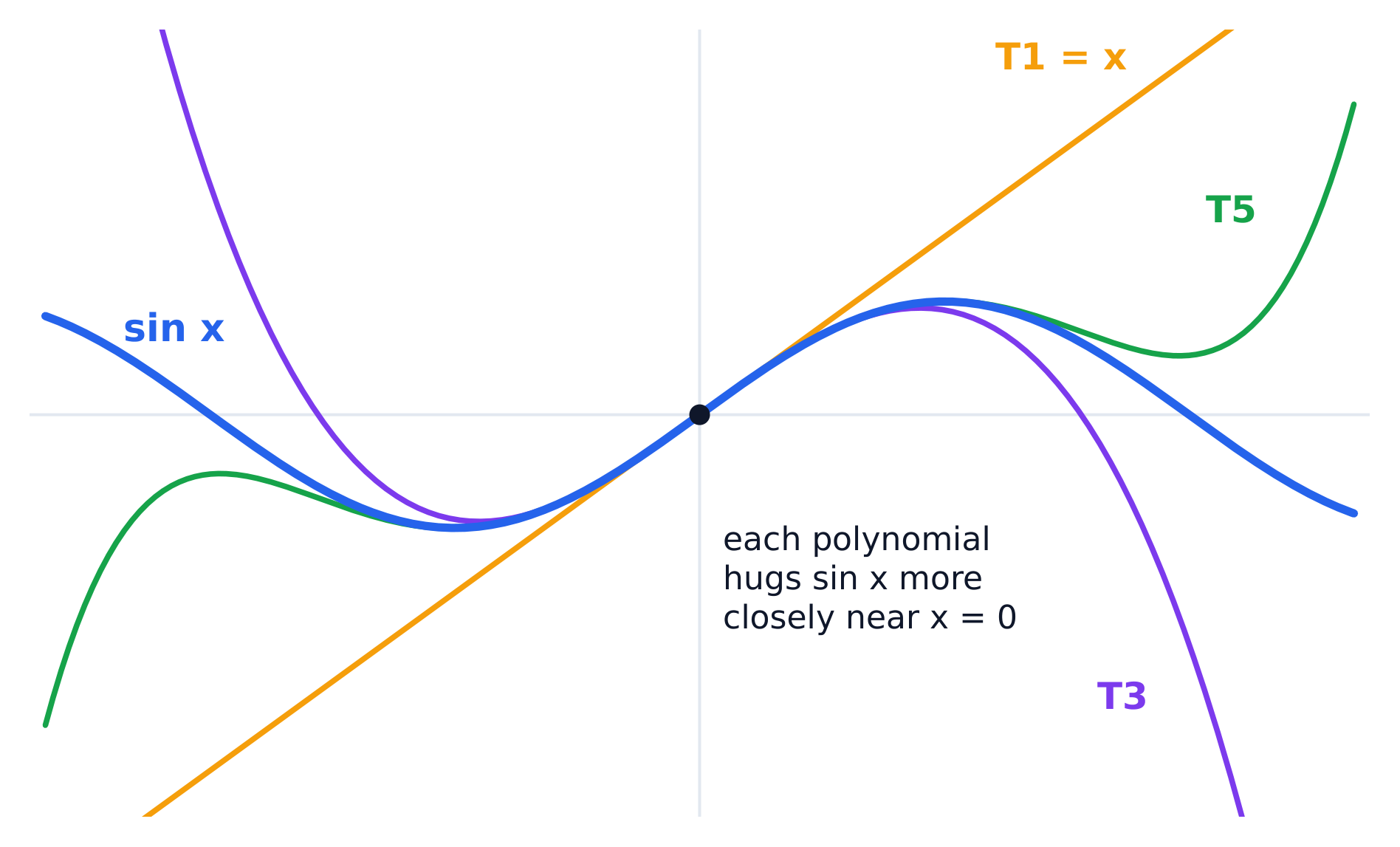
A Taylor polynomial 泰勒多项式 uses derivatives 导数 evaluated at a center 中心 $a$ to build a finite approximation. Through order $n$, it is
$$P_n(x)=\sum_{k=0}^{n}\frac{f^{(k)}(a)}{k!}(x-a)^k.$$
It matches $f(a)$ and the derivatives through order $n$ at $a$. The coefficient of $(x-a)^k$ is $f^{(k)}(a)/k!$. Use derivative values at the center, not expressions still depending on $x$. Centered at $a=0$, this is a Maclaurin polynomial 麦克劳林多项式. Its degree can be below $n$ if a coefficient is zero.
Worked example: use a derivative table. At $a=1$, suppose the derivative values through order $3$ are $2,-3,8,12$. Divide by $0!,1!,2!,3!$ to get coefficients $2,-3,4,2$. Thus
$$\begin{aligned}
P_3(x)&=2-3(x-1)+4(x-1)^2+2(x-1)^3,\\
P_3(0.9)&=2+0.3+0.04-0.002=2.338.
\end{aligned}$$
The change is $x-a=-0.1$, so the odd powers keep their negative sign. This gives $f(0.9)\approx2.338$. A finite table alone does not supply a numerical error guarantee.
Worked example: Maclaurin for the exponential. Every derivative of $e^x$ at $0$ equals $1$. Divide these values by their factorials to get $P_2(x)=1+x+x^2/2$. Hence $e^{0.1}\approx P_2(0.1)=1.105$. The polynomial value is exact for $P_2$, while its use for the exponential is an approximation.
Worked example: a useful nonzero center. For $\ln x$ about $1$, the derivative values are $0,1,-1,2$ through order $3$. Let $h=x-1$. Then
$$P_3(x)=h-\frac{h^2}{2}+\frac{h^3}{3}.$$
At $x=1.1$, use $h=0.1$, giving $\ln(1.1)\approx0.0953333\ldots$. Using $h=1.1$ would evaluate at the wrong shifted input.
Order and degree. For cosine about $0$, $P_2=P_3=1-x^2/2$ has degree $2$ and matches derivatives through order $3$.
Worked example: a higher order can be worse. For $e^x$ at $-2$, $P_0=1$ has error about $0.8647$, while $P_1=-1$ has error about $1.1353$. More terms do not guarantee a smaller error at every point.
Try it. At $a=-1$, suppose the derivative values through order $3$ are $4,2,-6,24$. Build $P_3$ and estimate $f(-0.8)$.
Answer. Divide by factorials to get coefficients $4,2,-3,4$. Then
$$P_3(x)=4+2(x+1)-3(x+1)^2+4(x+1)^3.$$
At $x=-0.8$, the change is $0.2$, giving $f(-0.8)\approx4+0.4-0.12+0.032=4.312$.
Worked example. $f(2)=3$, $f'(2)=-1$, $f''(2)=4$ and $f'''(2)=12$. Write the third-degree 次数 Taylor polynomial about $x=2$ and estimate $f(2.1)$.
Divide each derivative by its factorial: $\dfrac{4}{2!}=2$ and $\dfrac{12}{3!}=2$. So
$$P_3(x)=3-(x-2)+2(x-2)^2+2(x-2)^3,$$
$$f(2.1)\approx P_3(2.1)=3-0.1+2(0.01)+2(0.001)=2.922.$$
Forgetting the factorials (writing $4(x-2)^2$ instead of $\tfrac{4}{2!}(x-2)^2$) is the most common error.
Vocabulary
Train
| English |
|---|
| Taylor polynomial/ˈteɪlə ˌpɒlɪˈnəʊmɪəl/ |
| center/ˈsentə/ |
| derivative/dɪˈrɪvətɪv/ |
| Maclaurin polynomial/məˈklɔːrɪn ˌpɒlɪˈnəʊmɪəl/ |
| degree/dɪˈɡriː/ |
10.12
Lagrange Error Bound
Syllabus
| Enduring Understanding | Learning Objective | Essential Knowledge |
|---|---|---|
LIM-8 | LIM-8.C |
|
Source: College Board AP Course and Exam Description
The Lagrange error bound 拉格朗日误差界 gives an upper limit for the absolute error of a Taylor approximation. Let $P_n$ include the terms through order $n$ about $a$ and write $R_n(x)=f(x)-P_n(x)$. If the derivatives through order $n+1$ are continuous on the closed interval joining $a$ and $x$, and $|f^{(n+1)}(t)|\le M$ throughout that interval, then
$$|R_n(x)|\le B_n(x)=\frac{M}{(n+1)!}|x-a|^{n+1}.$$
The constant $M$ may be any justified upper bound; it need not be the exact maximum. Check the whole interval, not only the center or target. When $x<a$, use the interval $[x,a]$ and the positive distance $|x-a|$.
Worked example: certify a value. For $e^x$ at $x=0.1$, $P_2=1+x+x^2/2$ gives $1.105$. On $[0,0.1]$, the third derivative satisfies $e^t\le e^{0.1}<1.2$, so choose $M=1.2$. Then
$$|R_2(0.1)|\le\frac{1.2}{3!}(0.1)^3=0.0002.$$
This certifies error at most $0.001$. It does not say that the actual error equals $0.0002$. The value $M=1$ would be too small, since $e^t>1$ for $t>0$.
Worked example: a uniform interval. On $[-1,1]$, every derivative of $e^x$ is at most $e<3$. For the same $P_2$, choose the fixed bound $M=3$. Requiring error at most $0.0005$ gives
$$\frac{3}{3!}|x|^3\le0.0005
\quad\Longrightarrow\quad |x|\le0.1.$$
Thus $[-0.1,0.1]$ is certified by this bound and lies inside the interval where $M$ is valid. It is not necessarily the largest interval where the actual approximation meets the tolerance.
Compare two bounds. For $\cos(0.2)$, $P_2=1-x^2/2=0.98$. The third derivative has magnitude at most $1$, giving $B_2=0.2^3/3!=0.001333\ldots$. This does not certify tolerance $0.001$, but it does not prove failure. The cosine series at this point alternates with decreasing term sizes tending to $0$. Its first omitted nonzero term gives the sharper bound
$$|R_2(0.2)|\le\frac{0.2^4}{4!}=0.000066666\ldots<0.001.$$
Here $P_2=P_3$ because the cubic coefficient is zero. The fourth-derivative Lagrange bound with $n=3$ and $M=1$ gives the same sharper estimate. Taylor order can be greater than the polynomial's actual degree.
Try it. Suppose $|f^{(4)}(t)|\le9$ on $[1.8,2]$, with continuous derivatives through order $4$. Bound the error of its third-order Taylor approximation about $2$ at $x=1.8$. Does it meet tolerance $0.001$?
Answer. Use distance $0.2$ and denominator $4!$. The bound is $9(0.2)^4/24=0.0006\le0.001$, so the tolerance is certified.
Order is not a guarantee of a smaller bound. Recheck both the derivative bound and distance when increasing the order. For sine at $x=4$, centered at $0$, $M=1$ works for every derivative. The order-$0$ bound is $4$, but the order-$1$ bound is $4^2/2!=8$. A larger factorial alone does not settle the comparison.
Worked example. Continue the example above: suppose $|f^{(4)}(x)|\le 30$ for $2\le x\le 2.1$. Then, with $n=3$,
$$|f(2.1)-P_3(2.1)|\le\frac{30}{4!}\,|2.1-2|^{4}=\frac{30}{24}(0.0001)=0.000125.$$
So $P_3(2.1)=2.922$ is within $0.000125$ of $f(2.1)$. Use the next derivative after the polynomial's degree: a degree-$3$ polynomial uses $f^{(4)}$ and $4!$.
Vocabulary
Train
| English |
|---|
| Lagrange error bound/ˈlæɡreɪndʒ ˈerə baʊnd/ |
10.13
Radius and Interval of Convergence of Power Series

Syllabus
| Enduring Understanding | Learning Objective | Essential Knowledge |
|---|---|---|
LIM-8 | LIM-8.D |
|
Source: College Board AP Course and Exam Description
A power series 幂级数 is a sum of terms $c_n(x-a)^n$, where the numbers $c_n$ do not depend on $x$. Its radius of convergence 收敛半径 $R$ measures a distance from the center $a$. For $0<R<\infty$, it converges absolutely for $|x-a|<R$ and diverges for $|x-a|>R$. Test the two endpoints 端点 separately to finish the interval of convergence 收敛区间. The center itself is always included; positive-power terms vanish there.
Use the ratio test on the complete terms when its limit is available. Keep the factor involving $x$, solve for a distance, and check the center directly if the ratio expression is undefined there. A limit of $1$ is inconclusive, not proof of divergence.
Worked example: a shifted center. For $\displaystyle\sum_{n=1}^{\infty}\frac{(x-2)^n}{3^n n}$, the absolute ratio, away from the center, is
$$\left|\frac{u_{n+1}}{u_n}\right|=\frac{|x-2|}{3}\frac{n}{n+1}\longrightarrow\frac{|x-2|}{3}.$$
Thus $|x-2|<3$, or $-1<x<5$. The center is $2$ and $R=3$, not the right boundary $5$ or the width $6$. At $x=2$, every term is $0$. At $x=-1$, the original series becomes $\sum(-1)^n/n$, which converges by the alternating-series test: $1/n$ decreases to $0$. At $x=5$, it becomes the divergent harmonic series $\sum1/n$. The full interval is $[-1,5)$.
The same radius can give different brackets. With $t=(x-2)/3$ and $n\ge1$, these families all have center $2$, radius $3$ and absolute ratio limit $|t|$.
| Terms | Left boundary, $t=-1$ | Right boundary, $t=1$ | Interval |
|---|---|---|---|
| $t^n$ | Terms do not tend to $0$: diverges | Terms are $1$: diverges | $(-1,5)$ |
| $t^n/n$ | Alternating harmonic: converges | Harmonic: diverges | $[-1,5)$ |
| $t^n/n^2$ | Absolute convergence | $p$-series, $p=2$: converges | $[-1,5]$ |
| $(-1)^nt^n/n$ | Harmonic: diverges | Alternating harmonic: converges | $(-1,5]$ |
Worked example: reverse the included end. For $\sum_{n=1}^{\infty}(-1)^n(x+1)^n/(2^n n)$, the absolute ratio limit is $|x+1|/2$. Hence $a=-1$, $R=2$ and the candidate bounds are $-3$ and $1$. At $-3$, the two factors $(-1)^n$ cancel and give the divergent harmonic series. At $1$, the alternating harmonic series converges. The interval is $(-3,1]$.
Special radii. For $\sum_{n=1}^{\infty}n!(x-2)^n$, the absolute ratio $(n+1)|x-2|$ grows without bound for every $x\ne2$. Only $x=2$ converges, so $R=0$ and the set is $\{2\}$. For $\sum_{n=1}^{\infty}(x-2)^n/n!$, the ratio $|x-2|/(n+1)$ tends to $0$ for every fixed real $x$, so $R=\infty$ and the interval is $(-\infty,\infty)$. These cases do not have two distinct finite boundary values to test.
Worked example: the radius stays the same. On the open interval, a positive-radius power series is the Taylor series of its sum function. Differentiating or integrating preserves its radius but may change the boundary results. The series $\sum_{n=1}^{\infty}x^n/n$ has interval $[-1,1)$. Differentiating gives $\sum_{n=1}^{\infty}x^{n-1}$, with interval $(-1,1)$: the terms do not tend to $0$ at either end. Integrating from $0$ to $x$ gives $\sum_{n=1}^{\infty}x^{n+1}/[n(n+1)]$, with interval $[-1,1]$: the absolute boundary terms are at most $1/n^2$, so comparison applies. All three radii are $1$.
Try it. Find the center, radius and interval for $\sum_{n=1}^{\infty}(x+2)^n/(4^n n^2)$, with a reason for each boundary result.
Answer. The ratio limit is $|x+2|/4$, so the center is $-2$, the radius is $4$ and the candidate bounds are $-6$ and $2$. Both boundary series converge absolutely by the $p$-series test with $p=2$. The interval is $[-6,2]$.
Vocabulary
Train
| English |
|---|
| power series/ˈpaʊə ˈsɪəriːz/ |
| radius of convergence/ˈreɪdɪəs ɒv kənˈvɜːdʒəns/ |
| endpoint |
| interval of convergence/ˈɪntəvl ɒv kənˈvɜːdʒəns/ |
10.14
Finding Taylor or Maclaurin Series for a Function

Syllabus
| Enduring Understanding | Learning Objective | Essential Knowledge |
|---|---|---|
LIM-8 | LIM-8.E |
|
LIM-8.F |
|
Source: College Board AP Course and Exam Description
Extending the Taylor-polynomial formula to infinitely many terms gives a Taylor (or Maclaurin) series. At a center $a$, its formula is
$$\sum_{n=0}^{\infty}\frac{f^{(n)}(a)}{n!}(x-a)^n.$$
A finite Taylor polynomial is a partial sum. To represent $f(x)$ exactly, the difference $f(x)-P_N(x)$ must tend to $0$ as $N$ grows. Convergence of the series alone does not establish equality to the original function. For the four standard identities below, the intervals where equality holds are known.
Derive the cosine pattern. The derivatives of $\cos x$ repeat every four steps. Their values at $0$ are $1,0,-1,0,1,\ldots$. Dividing each by the factorial of its order gives coefficients $1,0,-1/2!,0,1/4!,\ldots$. The odd powers have zero coefficients; the even powers alternate signs.
$$\begin{aligned}
e^x&=\sum_{n=0}^{\infty}\frac{x^n}{n!}\\
\sin x&=\sum_{n=0}^{\infty}\frac{(-1)^n x^{2n+1}}{(2n+1)!}\\
\cos x&=\sum_{n=0}^{\infty}\frac{(-1)^n x^{2n}}{(2n)!}\\
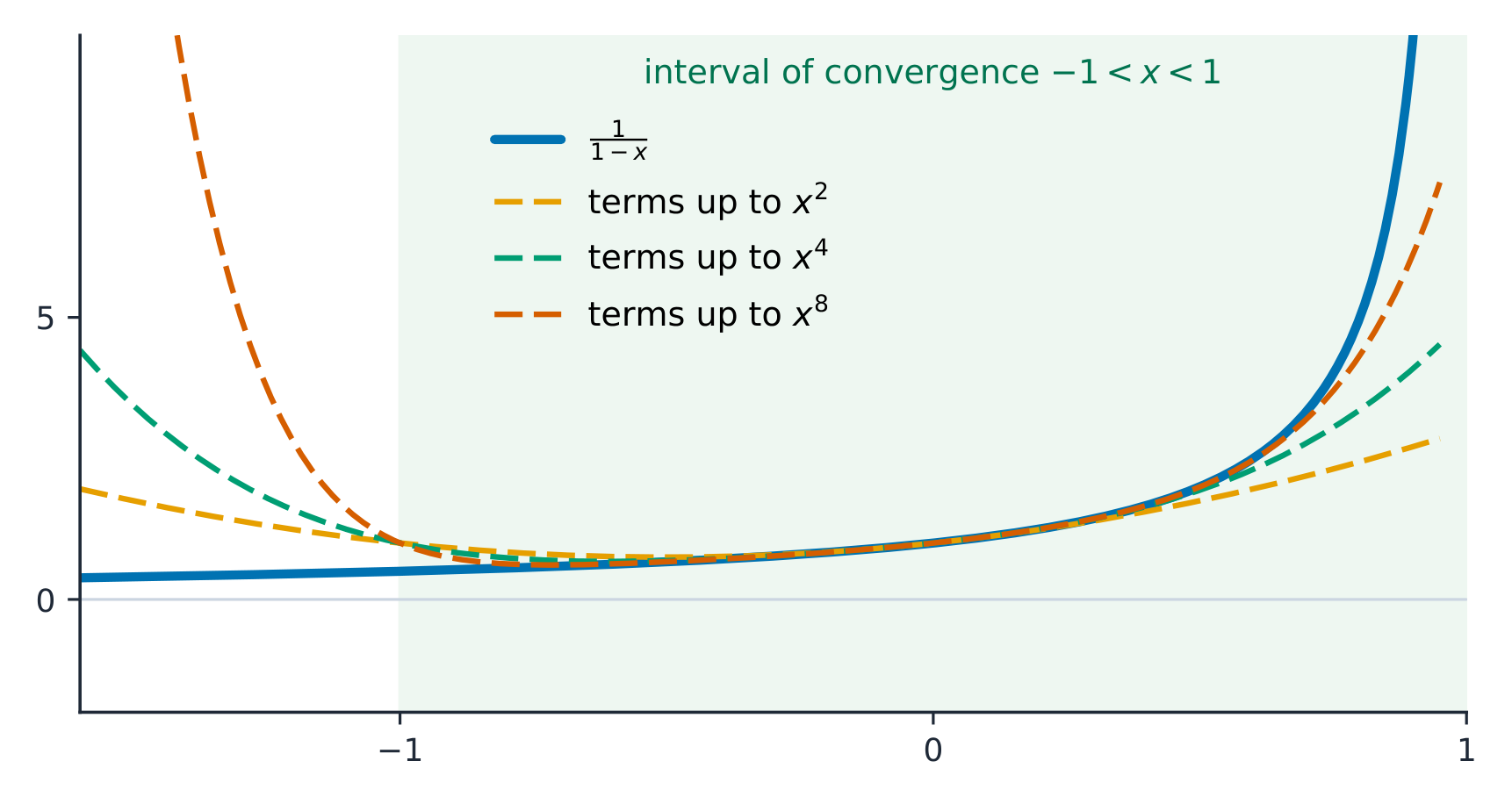
\frac{1}{1-x}&=\sum_{n=0}^{\infty}x^n\quad (|x|<1)
\end{aligned}$$
These sine, cosine and exponential identities hold for all real $x$.
Use radians for sine and cosine. The geometric identity requires $-1<x<1$: at either endpoint its terms do not tend to $0$. Its coefficients are $1$, without factorial denominators.
Worked example: change the center. For $e^x$ centered at $1$, every derivative value is $e$. Thus
$$\begin{aligned}
e^x&=\sum_{n=0}^{\infty}\frac{e}{n!}(x-1)^n\\
&=e+e(x-1)+\frac{e}{2!}(x-1)^2+\cdots
\end{aligned}$$
This identity holds for every real $x$. At $x=1$, all positive powers vanish and leave the correct value $e$. Using $x^n$ instead would put the expansion at the wrong center.
Terms and degree. The first three nonzero cosine terms give $1-x^2/2+x^4/24$. This is degree $4$, not degree $3$. The first three nonzero sine terms have highest power $5$. A finite table of derivative values determines a finite Taylor polynomial; without a pattern, it does not determine all higher terms.
Try it. Use $h=x-\pi/2$ and $\sin(\pi/2+h)=\cos(h)$ to find the Taylor series for $\sin x$ centered at $\pi/2$.
Answer. Replace $h$ in the cosine identity:
$$\sin x=\sum_{n=0}^{\infty}
\frac{(-1)^n(x-\pi/2)^{2n}}{(2n)!}.$$
It is valid for every real $x$. The first three nonzero terms are $1-(x-\pi/2)^2/2!+(x-\pi/2)^4/4!$. The powers are even powers of the shifted input, although the sine Maclaurin series uses odd powers of $x$.
New series come from manipulating these – substituting, differentiating, integrating, or multiplying.
Worked example. Find the Maclaurin series for $e^{x^2}$. Substitute $x^2$ for $x$ in $e^x=\sum\dfrac{x^n}{n!}$:
$$\begin{aligned}
e^{x^2}&=\sum_{n=0}^{\infty}\frac{(x^2)^n}{n!}\\
&=1+x^2+\frac{x^4}{2!}+\frac{x^6}{3!}+\cdots
\end{aligned}$$
which converges for all $x$. This substitution trick is far faster than differentiating $e^{x^2}$ six times.
Explore
Maclaurin partial sums and their functions
Two nonzero cosine terms give 1−x²/2, degree 2. The activity compares functions with actual finite Maclaurin sums; the geometric family also has a bounded convergence interval.
10.15
Representing Functions as Power Series
Syllabus
| Enduring Understanding | Learning Objective | Essential Knowledge |
|---|---|---|
LIM-8 | LIM-8.G |
|
Source: College Board AP Course and Exam Description
Because a power series can be differentiated and integrated term by term (within its radius), you can build new series from known ones – e.g. integrate the geometric series for $\dfrac{1}{1-x}$ to get the series for $-\ln(1-x)=\sum_{n\ge 1}\dfrac{x^n}{n}$, or substitute $-x^2$ to get the series for $\dfrac{1}{1+x^2}$. Representing a function as a power series lets you approximate values and integrals that have no elementary antiderivative.
Exam skill: the BC series free-response usually asks you to derive a new Maclaurin series from a known one, find its interval of convergence, and use the alternating-series or Lagrange bound to estimate the error – the capstone skills of the course.
10.15
Exam tips
- Test a series for convergence with the right tool: geometric ($|r|<1$, sum $\tfrac{a}{1-r}$), $n$th-term, ratio, integral, comparison, or alternating-series test.
- A geometric series with nonzero first term converges exactly when $|r|<1$. Handle the all-zero series directly.
- Build a Taylor/Maclaurin series to approximate a function; more terms give a better fit near the centre.
- Know the standard Maclaurin series for $e^x$, $\sin x$, $\cos x$, and $\tfrac{1}{1-x}$.
- Find the radius/interval of convergence with the ratio test, then check the endpoints separately.
Interactive lessons on this topic
Work through it step by step, with instant-check exercises.
- Defining Convergent and Divergent Infinite Series
- Working with Geometric Series
- The nth Term Test for Divergence
- Integral Test for Convergence
- Harmonic Series and p-Series
- Comparison Tests for Convergence
- Alternating Series Test for Convergence
- Ratio Test for Convergence
- Determining Absolute or Conditional Convergence
- Alternating Series Error Bound
- Finding Taylor Polynomial Approximations of Functions
- Lagrange Error Bound
- Radius and Interval of Convergence of Power Series
- Finding Taylor or Maclaurin Series for a Function
- Representing Functions as Power Series