Integral Test for Convergence
Introduced| English | Meaning |
|---|---|
| Integral Test/ˈɪntɪɡrəl test/ | Integral Test |
| positive/ˈpɒzɪtɪv/ | positive |
| continuous/kənˈtɪnjuːəs/ | At an interior point, the function value is defined and equals its finite two-sided limit; use the appropriate one-sided limit at a domain endpoint. |
| decreasing/ˈdiːkriːsɪŋ/ | Describing a function or sequence whose values fall as its input or index increases over a specified range. |
| improper integral/ɪmˈprɒpə ˈɪntɪɡrəl/ | An integral defined by a limit because an integration interval is unbounded or the integrand is unbounded at a boundary or interior point. |
| partial sum/ˈpɑːʃl sʌm/ | partial sum |
Can infinitely many small costs have a finite total?
- A model assigns cost $1/n^2$ to step $n$: $1,1/4,1/9,\ldots$. The ratio changes, so this is not a geometric series.
- The Integral Test 积分判别法 compares the series with an area under a matching function. It can establish convergence without finding the exact sum.
Match the terms and check the conditions
- Choose $f$ with $a_n=f(n)$ at the integer inputs. On a tail interval $[N,\infty)$, require $f$ to be positive 正, continuous 连续 and decreasing 递减, allowing flat parts.
- These conditions are about the chosen function on the whole interval, not just a few plotted points. A curve with the wrong integer values does not test this series.
For the Integral Test on a chosen tail interval, which properties of f are sufficient?
Difficulty 2/5 · 140 coins + a small bonus on first completion today
The function must also satisfy a_n=f(n) at the relevant integers.
The matching function is sampled at integer input ____ to give a_n.
Difficulty 1/5 · 100 coins + a small bonus on first completion today
The series terms must equal the function values at the same integer indices.
For $a_n=1/(n+2)^2$, choose a matching function.
Difficulty 1/5 · 100 coins + a small bonus on first completion today
Replace n with x while keeping the shift.
Start where the test is valid
- The lower limit need not be $1$. Choose an integer $N$ where the terms are defined and the function satisfies the conditions for every $x\ge N$.
- For $1/(n\ln n)$, start at $n=2$: the expression is undefined at $n=1$. Compare with an integral from $2$, not across the singular point $x=1$.
What is the smallest integer start N>1 for testing $1/(n\ln n)$ on a valid positive tail?
Difficulty 2/5 · 140 coins + a small bonus on first completion today
At n=1 the denominator contains ln 1=0.
The Integral Test always requires an improper integral starting at 1.
Difficulty 1/5 · 100 coins + a small bonus on first completion today
Use a lower limit where the matching function is defined and meets the conditions.
Compare rectangles with the same finite area
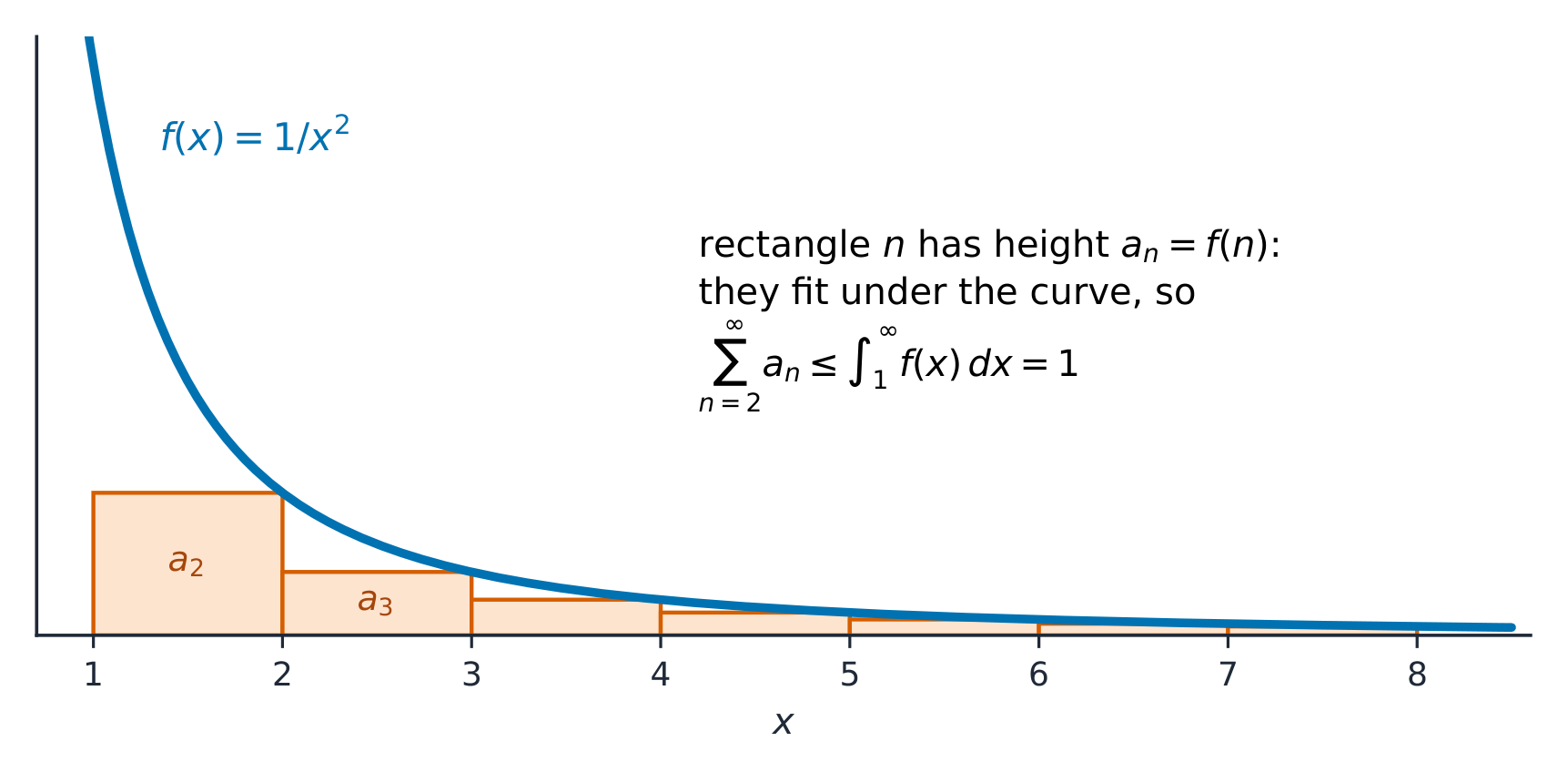
- On $[N,N+m]$, left-endpoint rectangles have total $U=\sum_{k=N}^{N+m-1}f(k)$ and lie above the curve. Right-endpoint rectangles have total $L=\sum_{k=N+1}^{N+m}f(k)$ and lie below it.
- Both sets have width $1$. Their totals bound the same integral:

For a positive decreasing f and unit-width rectangles, the left-endpoint total lies...
Difficulty 1/5 · 100 coins + a small bonus on first completion today
The left endpoint has the largest function value on each interval.
On the same finite interval, a right-endpoint rectangle total is at most the area under a non-increasing positive curve.
Difficulty 1/5 · 100 coins + a small bonus on first completion today
Each right-endpoint height is at most the function value throughout its unit interval.
For $f(x)=1/x^2$ on [1,3], calculate the two left-endpoint rectangle areas added together.
Difficulty 2/5 · 140 coins + a small bonus on first completion today
The heights are 1 and 1/4; each width is 1.
For $f(x)=1/x^2$ on [1,3], calculate the two right-endpoint rectangle areas added together.
Difficulty 2/5 · 140 coins + a small bonus on first completion today
The total is 1/4+1/9=13/36.
Extend the comparison to infinity
- Under the conditions, $\sum_{n=N}^{\infty}f(n)$ and the improper integral 反常积分 $\int_N^{\infty}f(x)\,dx$ either both converge or both diverge.
- A finite integral bounds the positive partial sums 部分和. If the integral grows without bound, the series cannot have a finite sum either.
When the Integral Test conditions hold on $[N,\infty)$, the series tail and $\int_N^\infty f(x)\,dx$...
Difficulty 1/5 · 100 coins + a small bonus on first completion today
Only their convergence behaviour is transferred.
The Integral Test lets you report the improper integral value as the exact series sum.
Difficulty 1/5 · 100 coins + a small bonus on first completion today
A finite integral can prove convergence without evaluating the series sum.
Evaluate a convergent improper integral
- For $f(x)=1/x^2$ on $[1,\infty)$, $f$ is positive and continuous, and $f'(x)=-2/x^3<0$.
- Write a finite upper limit $b$ first, then take the limit. The finite result proves convergence of the series.
Therefore $\sum_{n=1}^{\infty}1/n^2$ converges. Its sum is not $1$: just its first two terms already add to $1.25$.
Rectangles and the same finite area
For the default 1/x² on [1,6], compare left and right unit rectangles with area 5/6. The improper integral from 1 is 1, proving series convergence without giving its sum.
Evaluate $\int_1^{\infty}x^{-2}\,dx$.
Difficulty 2/5 · 140 coins + a small bonus on first completion today
The limit of 1−1/b is 1.
The function $f(x)=1/x^2$ satisfies the test on [1,∞), and its improper integral is 1. What follows for $\sum_{n=1}^{\infty}1/n^2$?
Difficulty 1/5 · 100 coins + a small bonus on first completion today
The finite integral proves convergence; it is not the series sum.
What is the sum of the first two terms of $\sum_{n=1}^{\infty}1/n^2$?
Difficulty 2/5 · 140 coins + a small bonus on first completion today
1+1/4=1.25, already larger than the integral value 1.
An integral can prove divergence too
- For $\sum_{n=1}^{\infty}1/n$, use $f(x)=1/x$. The required conditions hold for $x\ge1$.
- Here $\int_1^b dx/x=\ln b\to\infty$, so the series diverges. Its terms tending to zero do not establish convergence.
If the Integral Test conditions hold and the matching tail integral diverges to infinity, then the series...
Difficulty 1/5 · 100 coins + a small bonus on first completion today
The positive series and improper integral have the same convergence behaviour.
Which limit decides the Integral Test for $\sum_{n=1}^{\infty}1/n$?
Difficulty 1/5 · 100 coins + a small bonus on first completion today
The integral from 1 to b is ln b.
Keep a shift inside the matching function
- For $\sum_{n=1}^{\infty}1/(n+2)^2$, choose $f(x)=1/(x+2)^2$. It is positive, continuous and decreasing for $x\ge1$.
- Its improper integral is $\lim_{b\to\infty}[-1/(x+2)]_1^b=1/3$. Thus the series converges, without claiming that its sum equals $1/3$.
Find $\int_1^{\infty}1/(x+2)^2\,dx$.
Difficulty 2/5 · 140 coins + a small bonus on first completion today
The antiderivative is −1/(x+2), giving 1/3.
A logarithm changes the integral
- For $\sum_{n=2}^{\infty}1/(n\ln n)$, $f(x)=1/(x\ln x)$ is positive and continuous on $[2,\infty)$. Its derivative is $-(\ln x+1)/(x^2(\ln x)^2)<0$ there.
- Substituting $u=\ln x$ gives an antiderivative $\ln(\ln x)$. Therefore $\int_2^b dx/(x\ln x)=\ln(\ln b)-\ln(\ln2)\to\infty$, so the series diverges.
For x>1, an antiderivative of $1/(x\ln x)$ is...
Difficulty 1/5 · 100 coins + a small bonus on first completion today
Differentiate ln(ln x) using the chain rule.
A finite prefix does not decide convergence
- Adding, removing or changing finitely many finite terms does not change convergence. Apply the test to a valid tail, then include the finite prefix in the conclusion.
- If the chosen $f$ fails a condition, this test has not been justified. That failure alone does not prove the series diverges.
Check $a_n=f(n)$, the domain, the lower limit and the three conditions before evaluating the integral. The Integral Test compares convergence; it does not equate a series sum with an integral value. A finite picture is not the improper-integral limit.
Changing four finite initial terms can turn a divergent positive harmonic tail into a convergent series.
Difficulty 1/5 · 100 coins + a small bonus on first completion today
A finite total added to a divergent tail cannot change its convergence classification.
If the chosen function fails the Integral Test conditions, the series must diverge.
Difficulty 1/5 · 100 coins + a small bonus on first completion today
The test is not justified for that function; another argument may be needed.
Practise a shifted tail and a squared logarithm
- Test $\sum_{n=3}^{\infty}2/(n+1)^2$ and $\sum_{n=2}^{\infty}1/(n(\ln n)^2)$. Give the conditions, a valid lower limit and the improper-integral calculation.
- Then consider a series with four stated finite terms followed by the harmonic tail from $n=5$. Explain why changing those four terms cannot rescue convergence.
Use the Integral Test for $\sum_{n=3}^{\infty}2/(n+1)^2$. State a matching function, conditions, integral and conclusion.
Keep the shift and the starting value 3.
Test $\sum_{n=2}^{\infty}1/(n(\ln n)^2)$ using an improper integral. Explain the lower limit.
The logarithm is squared, so its antiderivative differs from ln(ln x).
A series has initial terms 7,−2,0,9, followed by $1/n$ for n≥5. Does it converge? Apply the Integral Test to a valid tail.
The first four terms have finite total 14; the remaining harmonic tail decides convergence.
State a convergence conclusion
- Name the matching function and the interval where the conditions hold. Evaluate the improper integral as a limit and state whether it is finite.
- Transfer convergence or divergence to the series. Keep the integral value separate from the series sum.
If $a_n=f(n)$ and $f$ is positive, continuous and non-increasing for $x\ge N$, then $\sum_{n=N}^{\infty}a_n$ and $\int_N^{\infty}f(x)\,dx$ converge or diverge together. A finite prefix does not affect this conclusion. Their values are different quantities.
A valid matching tail integral has finite value 0.7. Which conclusion is justified?
Difficulty 1/5 · 100 coins + a small bonus on first completion today
The test proves convergence, not the exact sum.