Harmonic Series and p-Series
Introduced| English | Meaning |
|---|---|
| p-series/piː ˈsɪəriːz/ | p-series |
| harmonic series/hɑːˈmɒnɪk ˈsɪəriːz/ | The infinite series 1 + 1/2 + 1/3 + 1/4 + ..., whose partial sums grow without bound. |
| coefficient/ˌkəʊɪˈfɪʃənt/ | A numerical or constant factor multiplying a term in an expression. |
| alternating harmonic series | alternating harmonic series |
| partial sum/ˈpɑːʃl sʌm/ | partial sum |
How fast must repeated costs shrink?
- A model assigns cost $1/n^p$ to step $n$. With $p=1$, the costs are $1,1/2,1/3,\ldots$; with $p=2$, they are $1,1/4,1/9,\ldots$.
- Both costs approach zero. Whether their total is finite depends on the power, not just on the individual costs becoming small.
State the p-series rule
- A p-series p-级数 is $\sum_{n=1}^{\infty}1/n^p$, where $p$ is a fixed real number. It converges exactly when $p>1$ and diverges when $p\le1$.
- The harmonic series 调和级数 is the boundary case $p=1$. The inequality is strict: this boundary diverges.
The positive p-series $\sum_{n=1}^{\infty}1/n^p$ converges exactly when...
Difficulty 1/5 · 100 coins + a small bonus on first completion today
The boundary p=1 diverges.
The p-series convergence boundary is p = ____.
Difficulty 1/5 · 100 coins + a small bonus on first completion today
Convergence requires a power strictly greater than 1.
Prove the positive-power cases with an integral
- When $p>0$, $f(x)=x^{-p}$ is positive, continuous and decreasing on $[1,\infty)$, so the Integral Test applies.
- For $p\ne1$, first integrate to a finite upper limit $b$. If $p>1$, the limit is $1/(p-1)$; if $0<p<1$, the result grows without bound.
The finite integral value $1/(p-1)$ for $p>1$ proves convergence. It is not the exact series sum. For example, at $p=2$ the integral is $1$, but the first two series terms already add to $1.25$.
For $p=2$, the integral from 1 to infinity equals 1, so $\sum 1/n^2=1$.
Difficulty 1/5 · 100 coins + a small bonus on first completion today
The integral proves convergence but does not give the series sum; just the first two terms add to 1.25.
For $p=2$, find the improper integral $\int_1^{\infty}x^{-2}\,dx$.
Difficulty 2/5 · 140 coins + a small bonus on first completion today
The value is1/(p−1)=1. It is separate from the series sum.
For $p>0$, which Integral Test hypotheses hold for $f(x)=x^{-p}$ on $[1,\infty)$? Select all.
Difficulty 2/5 · 140 coins + a small bonus on first completion today
The derivative−p x^(−p−1) is negative, and the function is positive and continuous.
Handle the harmonic boundary separately
- At $p=1$, the power antiderivative above divides by zero and cannot be used. Instead, $\int_1^b dx/x=\ln b\to\infty$, so the harmonic series diverges.
- Grouping also explains its growth: each block from $n=2^{k-1}+1$ to $2^k$ adds at least $1/2$. Infinitely many such blocks prevent a finite total.
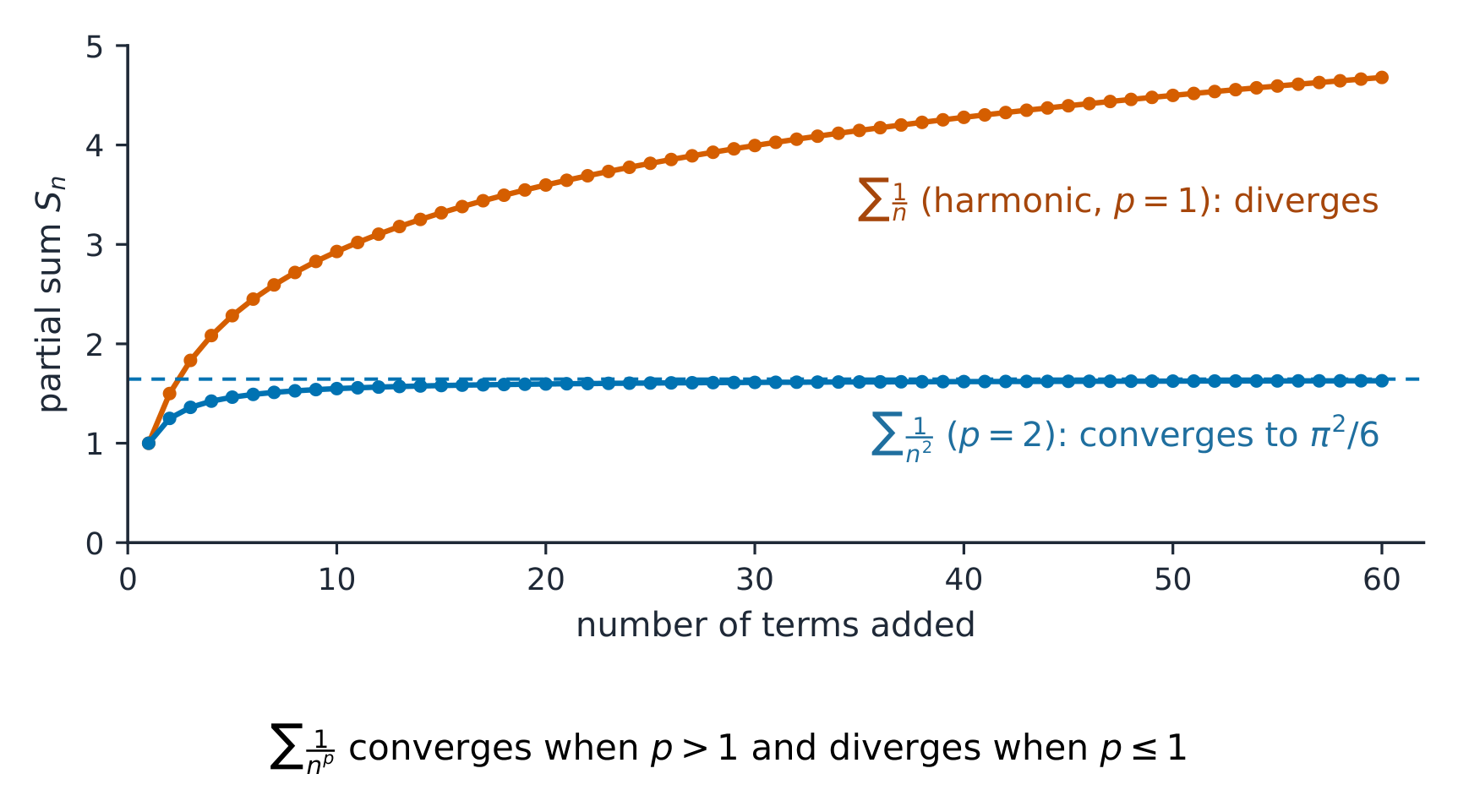
Actual p-series terms and partial sums
Default p=1 shows harmonic terms tending to 0 but growing partial sums. Changing p crosses the strict convergence threshold 1, including zero and negative powers.
The harmonic series $\sum 1/n$...
Difficulty 1/5 · 100 coins + a small bonus on first completion today
The integral ln b grows without bound.
The harmonic series shows that terms approaching0 do not guarantee convergence.
Difficulty 1/5 · 100 coins + a small bonus on first completion today
Its terms tend to 0 but its partial sums have no finite limit.
At $p=1$, which finite integral is correct?
Difficulty 1/5 · 100 coins + a small bonus on first completion today
Use the logarithm instead of dividing by 1−p.
Use the term test for non-positive powers
- If $p=0$, every term is $1$. If $p<0$, then $1/n^p=n^{-p}$ grows without bound. In both cases the terms do not approach zero, so the series diverges by the nth Term Test.
- For $p<0$, $x^{-p}$ is increasing, so the decreasing-function version of the Integral Test has not been justified. The term test gives a direct argument.

For $p=0$, what is $1/n^p$ at every positive integer n?
Difficulty 2/5 · 140 coins + a small bonus on first completion today
Every positive n has n^0=1.
For $p=-1$, $1/n^p=n$. Which argument proves series divergence?
Difficulty 1/5 · 100 coins + a small bonus on first completion today
The terms grow without bound and do not tend to 0.
Rewrite roots before reading the power
- Since $n\sqrt n=n^{3/2}$, $\sum1/(n\sqrt n)$ has $p=3/2>1$ and converges.
- Since $\sqrt[3]{n^2}=n^{2/3}$, $\sum1/\sqrt[3]{n^2}$ has $p=2/3<1$ and diverges. A root in the denominator does not always give the same outcome.
Rewrite $1/(n\sqrt n)$ as $1/n^p$. Find p.
Difficulty 2/5 · 140 coins + a small bonus on first completion today
The denominator is n^(1+1/2)=n^(3/2).
$\sum 1/\sqrt n$ has $p=1/2$. It...
Difficulty 1/5 · 100 coins + a small bonus on first completion today
A positive power below 1 gives divergence.
Select all convergent positive series.
Difficulty 2/5 · 140 coins + a small bonus on first completion today
The powers 2 and3/2 exceed1; the powers1/2 and1 do not.
Keep coefficients and starting indices clear
- A fixed nonzero coefficient 系数 multiplying a series does not change convergence. Thus $\sum_{n=4}^{\infty}5/n^{3/2}$ converges; removing finitely many initial terms does not change the result.
- For $\sum_{n=1}^{\infty}3/(n+2)^{3/2}$, let $k=n+2$: it becomes $3\sum_{k=3}^{\infty}1/k^{3/2}$, which converges. A zero coefficient gives an all-zero series directly, whatever $p$ is.
Multiplying every term by a fixed nonzero constant changes whether a series converges.
Difficulty 1/5 · 100 coins + a small bonus on first completion today
The partial sums are multiplied by the same nonzero constant, preserving existence or nonexistence of a finite limit.
In $\sum_{n=1}^{\infty}3/(n+2)^{3/2}$, use k=n+2. What is the first value of k?
Difficulty 2/5 · 140 coins + a small bonus on first completion today
At n=1, k=3.
The all-zero series $\sum0/n^{1/2}$ diverges because $p=1/2$.
Difficulty 1/5 · 100 coins + a small bonus on first completion today
Every term and partial sum is 0; the all-zero series converges.
Recognise the exact family
- A p-series has the variable $n$ in the base and a fixed power $p$. By contrast, $\sum1/2^n$ has $n$ in the exponent and is geometric.
- The term $1/(n^2+1)$ is not exactly $1/n^p$. It can be studied by a comparison test; do not erase the $+1$ as an algebraic equality.
Which series is geometric rather than a p-series?
Difficulty 1/5 · 100 coins + a small bonus on first completion today
The changing index is in the exponent of the fixed base2.
$1/(n^2+1)=1/n^2$ for all positive integers n.
Difficulty 1/5 · 100 coins + a small bonus on first completion today
The expressions are different; a comparison argument may relate their series without making them equal.
Distinguish the alternating harmonic series
- The alternating harmonic series 交错调和级数 is $1-1/2+1/3-1/4+\cdots=\sum_{n=1}^{\infty}(-1)^{n-1}/n$. Its signs matter: it is not the positive harmonic series.
- Its positive magnitudes decrease to zero, so the Alternating Series Test proves convergence. Their sum $\sum1/n$ diverges. The alternating test is developed in lesson 10.7; the positive p-series rule alone does not classify a signed series.
Which statement correctly compares the two harmonic series?
Difficulty 1/5 · 100 coins + a small bonus on first completion today
The Alternating Series Test applies only after checking the decreasing magnitudes and their zero limit.
A finite graph does not establish the limit
- The activity plots actual terms $a_n=1/n^p$ and partial sums 部分和 $S_N=\sum_{n=1}^N1/n^p$. At its default $p=1$, the terms shrink but the totals keep growing.
- A convergent series with $p$ just above $1$ can grow slowly toward its limit, and a divergent harmonic plot can look nearly flat. The displayed classification uses the mathematical rule, not a finite visual guess.
A plot of 40 slowly changing partial sums proves that the infinite series converges.
Difficulty 1/5 · 100 coins + a small bonus on first completion today
A finite plot cannot establish the infinite limit.
Practise rewriting and parameter conditions
- Classify $\sum_{n=4}^{\infty}5/(n\sqrt n)$ and $\sum_{n=1}^{\infty}1/\sqrt[3]{n^2}$. Show the equivalent powers and explain the starting index or coefficient where relevant.
- Find all real $q$ for which $\sum_{n=1}^{\infty}1/n^{2q-1}$ converges. State the strict boundary and explain why equality is excluded.
Classify $\sum_{n=4}^{\infty}5/(n\sqrt n)$. Explain the power, coefficient and starting index.
Compare the rewritten power, threshold and conclusion with the model.
Classify $\sum_{n=1}^{\infty}1/\sqrt[3]{n^2}$. Explain why a zero term limit is not enough.
Compare the rewritten power, threshold and conclusion with the model.
Find all real q for which $\sum_{n=1}^{\infty}1/n^{2q-1}$ converges. Check the boundary.
Compare the rewritten power, threshold and conclusion with the model.
Match the argument to the terms
- First check that the series is a p-series or a constant multiple of a valid shifted tail. Rewrite powers, then compare $p$ with $1$.
- Conclude convergence for $p>1$ and divergence for $p\le1$. Keep signed series, finite partial sums and improper-integral values separate from this positive-series theorem.
For $\sum_{n=1}^{\infty}1/n^p$, convergence holds exactly when $p>1$. The harmonic boundary $p=1$ diverges. Positive powers use the Integral Test; non-positive powers are settled directly by the nth Term Test. Small terms alone do not prove a finite total.
The p-series rule includes $p=1$ among the convergent powers.
Difficulty 1/5 · 100 coins + a small bonus on first completion today
Convergence requires p>1, not p≥1.