Ratio Test for Convergence
Introduced| English | Meaning |
|---|---|
| factorial/fækˈtɔːrɪəl/ | The product of the positive integers up to a given positive integer; zero factorial is defined as one. |
| Ratio Test/ˈreɪʃɪəʊ test/ | Ratio Test |
| absolute convergence/ˈæbsəluːt kənˈvɜːdʒəns/ | absolute convergence |
| inconclusive/ɪŋkənˈkluːsɪv/ | Describing a test result that does not determine the answer, so another method or more information is needed. |
Compare the next contribution with the current one
- A model assigns step $n$ a contribution $a_n=2^n/n!$. The factorial 阶乘 $n!=1\times2\times\cdots\times n$ grows differently from the exponential numerator, so this is not a geometric sequence.
- The Ratio Test 比值判别法 studies $q_n=|a_{n+1}/a_n|$. It compares the next term with the current term, then takes the limit as $n$ grows.
The Ratio Test uses the absolute value of the next/current term ratio.
Difficulty 1/5 · 100 coins + a small bonus on first completion today
The ratio is |a_(n+1)/a_n|, not just its signed value.
Make sure the ratio is defined
- For the usual Ratio Test, the terms must be nonzero from some index onward, so division by $a_n$ is valid on a tail. Compute $L=\lim_{n\to\infty}|a_{n+1}/a_n|$ when this limit exists, including the possibility $+\infty$.
- Finitely many finite early terms, including zeros, do not change convergence. If the terms are eventually all zero, the series converges directly; do not try to evaluate $0/0$. Infinitely many zero denominators or a nonexistent ratio limit need another argument.
The usual Ratio Test needs a_n to be nonzero eventually so that the quotient is defined on a tail.
Difficulty 1/5 · 100 coins + a small bonus on first completion today
A finite number of early zeros can be bypassed; recurring zero denominators need another argument.
A series whose terms are all zero from some index onward converges directly.
Difficulty 1/5 · 100 coins + a small bonus on first completion today
Its partial sums are eventually constant; evaluating 0/0 is unnecessary and invalid.
State what the limit proves
- If $L<1$, the series has absolute convergence 绝对收敛: $\sum|a_n|$ converges, and therefore $\sum a_n$ converges. If $L>1$, including $L=+\infty$, the series diverges.
- If $L=1$, this test is inconclusive 无法判定. It has not proved convergence or divergence; choose another suitable test.
In the Ratio Test, if $L=\lim|a_{n+1}/a_n|<1$, the series...
Difficulty 1/5 · 100 coins + a small bonus on first completion today
The theorem proves convergence of the absolute-value series.
If the Ratio Test gives L=1, then...
Difficulty 1/5 · 100 coins + a small bonus on first completion today
A different test is needed.
Build the whole next term before cancelling
- For $a_n=2^n/n!$, replace every $n$ by $n+1$: $a_{n+1}=2^{n+1}/(n+1)!$. In particular, $(n+1)!=(n+1)n!$, not $n!+1$.
- Divide next by current, multiply by the reciprocal of the current term, and cancel. The limit is $0<1$, so the series converges absolutely.

For $a_n=2^n/n!$, the ratio $a_{n+1}/a_n$ is...
Difficulty 1/5 · 100 coins + a small bonus on first completion today
Write (n+1)!=(n+1)n! before cancelling.
At n=3, the next factorial is (n+1)!. Enter its value.
Difficulty 2/5 · 140 coins + a small bonus on first completion today
The next factorial is 4!=24, not 3!+1=7.
Since $\lim2/(n+1)=0<1$, $\sum_{n=1}^{\infty}2^n/n!$...
Difficulty 1/5 · 100 coins + a small bonus on first completion today
The absolute-ratio limit is below 1.
The Ratio Test often simplifies series involving which structures? Select all.
Difficulty 2/5 · 140 coins + a small bonus on first completion today
Factorials and fixed-base exponentials have useful next/current cancellation.
Why a limit below one is enough
- If $L<1$, choose a fixed $r$ with $L<r<1$. Eventually $|a_{n+1}/a_n|\le r$, so later magnitudes are bounded by a convergent geometric tail.
- The ratio need not be below $1$ at every early index. For example, $4^n/n!$ has $q_n=4/(n+1)$, initially above $1$, but its limit is still zero.
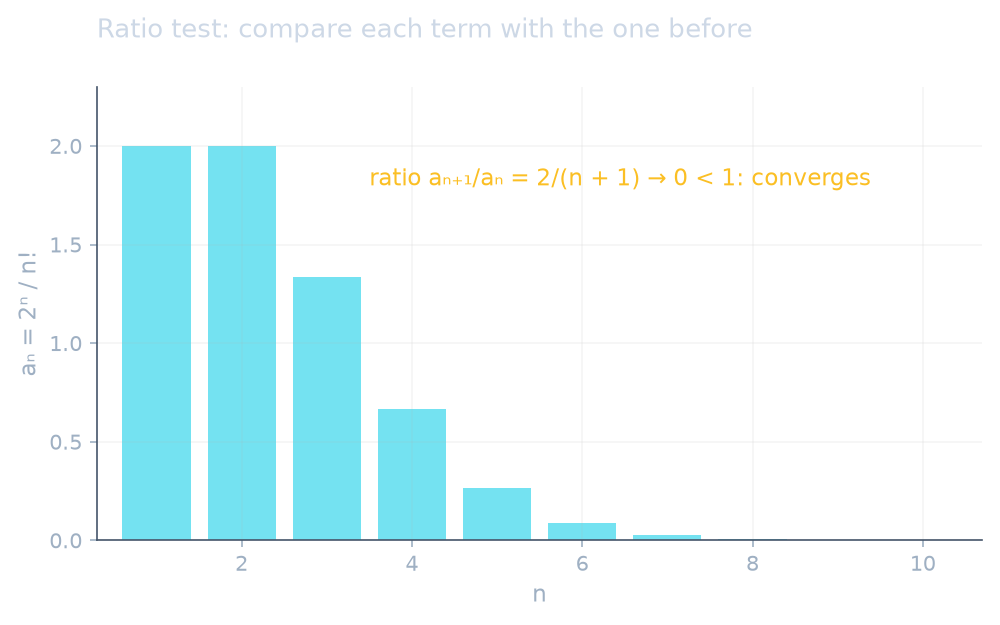
Changing next/current ratios
Default 2^n/n! has absolute ratio 2/(n+1) tending to 0. Compare signed ratios, factorial growth, n!/n^n and p-series whose ratio limit 1 is inconclusive.
A few early absolute ratios above 1 prevent use of the Ratio Test even when their limit is 0.
Difficulty 1/5 · 100 coins + a small bonus on first completion today
A finite prefix does not change convergence; the eventual ratio behaviour matters.
Take the absolute value for signed terms
- For $a_n=(-2)^n/n!$, the signed ratio is $-2/(n+1)$, but $q_n=2/(n+1)\to0$. The series converges absolutely.
- Comparing a negative signed ratio directly with $1$ is invalid. For $a_n=(-3)^n$, the signed ratio is $-3$, while its absolute value is $3>1$; this series diverges.
For $a_n=(-2)^n/n!$, find the signed ratio $a_{n+1}/a_n$ at n=3.
Difficulty 2/5 · 140 coins + a small bonus on first completion today
The signed ratio is −2/(n+1), so at n=3 it is −1/2.
For the same series at n=3, find the absolute value of the ratio.
Difficulty 2/5 · 140 coins + a small bonus on first completion today
The absolute value of −1/2 is 1/2.
Because the signed ratio for $(-3)^n$ is $-3<1$, the Ratio Test proves convergence.
Difficulty 1/5 · 100 coins + a small bonus on first completion today
Take the absolute value first: 3>1, so the series diverges.
A reversed ratio gives the wrong test
- For $a_n=n!/2^n$, the correct next/current ratio is $(n+1)/2\to+\infty$. Thus the series diverges.
- The reciprocal $a_n/a_{n+1}=2/(n+1)$ is not the ratio used by this theorem. Switching the quotient would reverse the conclusion incorrectly.
For $a_n=n!/2^n$, the correct Ratio Test quotient is...
Difficulty 1/5 · 100 coins + a small bonus on first completion today
The numerator is the next term, giving a factor (n+1)/2.
An absolute-ratio limit of +∞ proves divergence.
Difficulty 1/5 · 100 coins + a small bonus on first completion today
This is included in the L>1 case.
A changing power also needs careful indexing
- For $a_n=n!/n^n$, the next denominator is $(n+1)^{n+1}$. Cancelling gives the ratio below, not $1/(n+1)$.
- Using $(1+1/n)^n\to e$, the ratio tends to $e^{-1}<1$. Therefore $\sum n!/n^n$ converges absolutely.
For $a_n=n!/n^n$, simplify $a_{n+1}/a_n$.
Difficulty 1/5 · 100 coins + a small bonus on first completion today
The next denominator is (n+1)^(n+1); cancellation gives (n/(n+1))^n.
The boundary needs two contrasting examples
- For $a_n=1/n$, $q_n=n/(n+1)\to1$, but the harmonic series diverges. For $a_n=1/n^2$, $q_n=(n/(n+1))^2\to1$, but the p-series converges.
- The Ratio Test is inconclusive for both. A finite ratio below $1$ is not enough: the harmonic example has $q_n<1$ at every index and still diverges.
If every finite absolute ratio q_n is below 1, the infinite series must converge.
Difficulty 1/5 · 100 coins + a small bonus on first completion today
The harmonic series has q_n=n/(n+1)<1 but diverges; its ratio limit is 1.
For $a_n=1/n^2$, find $\lim|a_{n+1}/a_n|$.
Difficulty 2/5 · 140 coins + a small bonus on first completion today
The ratio(n/(n+1))² tends to 1; the Ratio Test is inconclusive.
Treat a zero parameter directly
- For fixed real $c\ne0$, $a_n=c^n/n!$ has $q_n=|c|/(n+1)\to0$, so the series converges absolutely.
- If $c=0$ and the series starts at $n=1$, every term is zero, and the series converges directly. This case must not be justified by an undefined ratio $0/0$.
For $\sum_{n=1}^{\infty}c^n/n!$ at c=0, the correct justification is...
Difficulty 1/5 · 100 coins + a small bonus on first completion today
Every term is zero, so partial sums are zero.
Practise shifted factorials and full next terms
- Test $\sum_{n=1}^{\infty}3^n/(n+2)!$ and $\sum_{n=1}^{\infty}n^3/5^n$. Write the whole next term before simplifying the absolute ratio.
- Then test $\sum_{n=1}^{\infty}(n+1)!/3^n$. State the ratio limit and distinguish a divergence conclusion from an inconclusive result.
Use the Ratio Test for $\sum_{n=1}^{\infty}3^n/(n+2)!$. Show the whole next term.
Compare the whole next term, absolute ratio, limit and conclusion with the model.
Use the Ratio Test for $\sum_{n=1}^{\infty}n^3/5^n$. Show every index change.
Compare the whole next term, absolute ratio, limit and conclusion with the model.
Use the Ratio Test for $\sum_{n=1}^{\infty}(n+1)!/3^n$. Distinguish divergence from an inconclusive result.
Compare the whole next term, absolute ratio, limit and conclusion with the model.
Keep the ratio limit separate from the sum
- Check a valid tail, form next/current, take its absolute value and evaluate its limit. Use the correct $L<1$, $L>1$ or $L=1$ conclusion.
- The limit of the ratios is not the infinite series sum. A finite plot illustrates the changing ratios; the condition is about their limit.
For eventually nonzero terms and an existing absolute-ratio limit, $L<1$ proves absolute convergence and $L>1$ proves divergence. The boundary $L=1$ is inconclusive. Use $|a_{n+1}/a_n|$, preserve every index change, and handle an all-zero tail directly.
The ratio limit L is the exact infinite sum of the original series.
Difficulty 1/5 · 100 coins + a small bonus on first completion today
L describes consecutive-term ratios; it is separate from the partial-sum limit.
If the absolute-ratio limit does not exist, the usual Ratio Test automatically proves divergence.
Difficulty 1/5 · 100 coins + a small bonus on first completion today
The stated limit-based theorem has not been justified; use another argument.