Lagrange Error Bound
Introduced| English | Meaning |
|---|---|
| Lagrange error bound/ˈlæɡreɪndʒ ˈerə baʊnd/ | An upper bound for the error of a degree-n Taylor polynomial: M times |x - a| to the power n + 1, divided by (n + 1)!, where M bounds the absolute value of the next derivative between a and x. |
| remainder/rɪˈmeɪndə/ | remainder |
| tolerance/ˈtɒlərəns/ | tolerance |
| alternating series error bound/ˈɔːltəneɪtɪŋ ˈsɪəriːz ˈerə baʊnd/ | alternating series error bound |
Is 1.105 accurate enough?
- The quadratic Maclaurin approximation to $e^{0.1}$ is $1+0.1+0.1^2/2=1.105$. How can you guarantee its accuracy without knowing the exact value?
- The Lagrange error bound 拉格朗日误差界 gives an upper limit for the error. Compare that limit with the accuracy you need.
Name the error and the Taylor order
- Let $P_n$ include the Taylor terms through order $n$. The remainder 余项 is $R_n(x)=f(x)-P_n(x)$; the absolute error is $|R_n(x)|$.
- The polynomial can have degree below $n$ if some coefficients are zero. Use the order through which derivatives match, not the number of nonzero terms.
A Taylor polynomial through order 3 must contain four nonzero terms.
Difficulty 1/5 · 100 coins + a small bonus on first completion today
Some derivative values may be zero, so their coefficients vanish.
Bound the next derivative over an interval
- A sufficient condition is that $f$ has continuous derivatives through order $n+1$ on the closed interval joining $a$ and $x$.
- Choose $M\ge0$ so $|f^{(n+1)}(t)|\le M$ at every point of that interval. Then:
For a Taylor polynomial through order n, which expression bounds $|R_n(x)|$ when $|f^{(n+1)}|\le M$ throughout the interval?
Difficulty 1/5 · 100 coins + a small bonus on first completion today
Use the next derivative order, its factorial and the absolute distance.
For Taylor order n=3, which derivative must M bound in the Lagrange formula?
Difficulty 1/5 · 100 coins + a small bonus on first completion today
The order is n+1=4, even if the cubic coefficient is zero.
A safe upper bound need not be the exact maximum
- For $e^x$ with $n=2$, the next derivative is $f'''(t)=e^t$. On $[0,0.1]$, $e^t\le e^{0.1}<1.2$, so choose $M=1.2$.
- Taking only the value at the center would give $1$. That is too small: $e^t>1$ for $0<t\le0.1$. Check the whole interval.

Which statement correctly describes a permitted M?
Difficulty 1/5 · 100 coins + a small bonus on first completion today
The exact maximum is sufficient, but any justified upper bound also works.
On $[0,0.1]$, $e^t\le e^{0.1}\approx 1.10517$. Which choices are valid upper bounds M?
Difficulty 2/5 · 140 coins + a small bonus on first completion today
Each chosen M must be at least the largest derivative magnitude on the interval.
Calculate and compare with the tolerance
- With $a=0$, $x=0.1$, $n=2$ and $M=1.2$, use distance $0.1$ and denominator $3!$.
- A tolerance 容许误差 of $0.001$ is met because the upper bound is smaller. State both the approximation and the guarantee.
Thus $1.105$ approximates $e^{0.1}$ with absolute error at most $0.0002$. This is an inequality, not a claim that the error equals $0.0002$.
Computed error and certified bound
For eˣ at x=0.1 with Taylor order 2, M=1.2 gives the worked bound 0.0002. Compare the bound with the numerical error and a chosen tolerance; cosine also shows zero coefficients and order versus degree.
With M=1.2, n=2, a=0 and x=0.1, calculate $M|x-a|^{n+1}/(n+1)!$.
Difficulty 2/5 · 140 coins + a small bonus on first completion today
$1.2(0.1)^3/6=0.0002$.
If a valid Lagrange bound is 0.0002, the actual absolute error must equal 0.0002.
Difficulty 1/5 · 100 coins + a small bonus on first completion today
The actual error is at most the bound; equality is not required.
A valid error bound is 0.0002. Which requested tolerance is certified?
Difficulty 1/5 · 100 coins + a small bonus on first completion today
The bound must be at or below the tolerance.
For Taylor order n=2, what positive integer divides M times the distance cubed in the Lagrange formula?
Difficulty 2/5 · 140 coins + a small bonus on first completion today
The denominator is 3!=6.
Use the distance from the actual center
- Suppose $|f'''(t)|\le6$ on $[0.8,1]$. For $P_2$ centered at $a=1$, estimating $f(0.8)$ uses distance $|0.8-1|=0.2$.
- The bound is $6(0.2)^3/3!=0.008$. Use $[x,a]$ when $x<a$; the error bound stays nonnegative.
The center is 1 and the target point is 0.8. What distance appears in the bound?
Difficulty 2/5 · 140 coins + a small bonus on first completion today
$|0.8-1|=0.2$.
Which interval must contain the derivative bound for a=1 and x=0.8?
Difficulty 1/5 · 100 coins + a small bonus on first completion today
Use the closed interval joining the center and target.
Given $|f^{(3)}|\le 6$ on $[0.8,1]$, what bound applies to the order 2 Taylor approximation about 1 at x=0.8?
Difficulty 2/5 · 140 coins + a small bonus on first completion today
$6(0.2)^3/3!=0.008$.
Find an interval with a uniform guarantee
- On $[-1,1]$, every derivative of $e^x$ is at most $e<3$. For $P_2$ centered at $0$, use the fixed bound $M=3$ throughout that interval.
- To guarantee error at most $0.0005$, solve $3|x|^3/6\le0.0005$. This gives $|x|\le0.1$, so $[-0.1,0.1]$ is certified by this bound.
The largest interval allowed by a chosen bound is not necessarily the largest interval where the actual approximation meets the tolerance. Keep the derivative-bound interval in view when solving for $x$.
With n=2, a=0 and M=3 on $[-1,1]$, solve $3r^3/6=0.0005$ for the nonnegative radius r.
Difficulty 2/5 · 140 coins + a small bonus on first completion today
$r^3=0.001$, so r=0.1.
If M was justified only on [−1,1], a radius calculation of 2 automatically guarantees the error bound on [−2,2].
Difficulty 1/5 · 100 coins + a small bonus on first completion today
The formula needs a valid derivative bound on every interval from the center to the target.
A large bound can be inconclusive
- For $\cos(0.2)$, use $P_2=1-x^2/2$ and $|f'''(t)|=|\sin t|\le1$. Lagrange gives $|R_2(0.2)|\le0.2^3/3!=0.001333\ldots$.
- This bound does not certify tolerance $0.001$. It does not prove failure: the actual error is about $0.00006658$, which is smaller than $0.001$.
A computed valid bound larger than the tolerance proves that the approximation fails the tolerance.
Difficulty 1/5 · 100 coins + a small bonus on first completion today
It only means this bound does not certify the requested accuracy.
Compare with an alternating-series bound
- The cosine terms at $x=0.2$ alternate, with positive sizes decreasing to $0$. The alternating series error bound 交错级数误差界 uses the first omitted nonzero term.
- After $1-x^2/2$, that term is $x^4/4!$. Thus the error is at most $0.2^4/24=0.000066666\ldots$, which certifies tolerance $0.001$.
After $1-x^2/2$ in the cosine Maclaurin series, what is the first omitted nonzero term?
Difficulty 1/5 · 100 coins + a small bonus on first completion today
The cubic coefficient is zero, so the next nonzero term is fourth order.
Which conditions justify the alternating-series error estimate for the omitted tail?
Difficulty 2/5 · 140 coins + a small bonus on first completion today
Alternation alone does not give the next-term bound.
Calculate the alternating bound $0.2^4/4!$ for the two-nonzero-term cosine approximation.
Difficulty 2/5 · 140 coins + a small bonus on first completion today
The value is about 0.0000666667.
Zero coefficients can give a stronger order choice
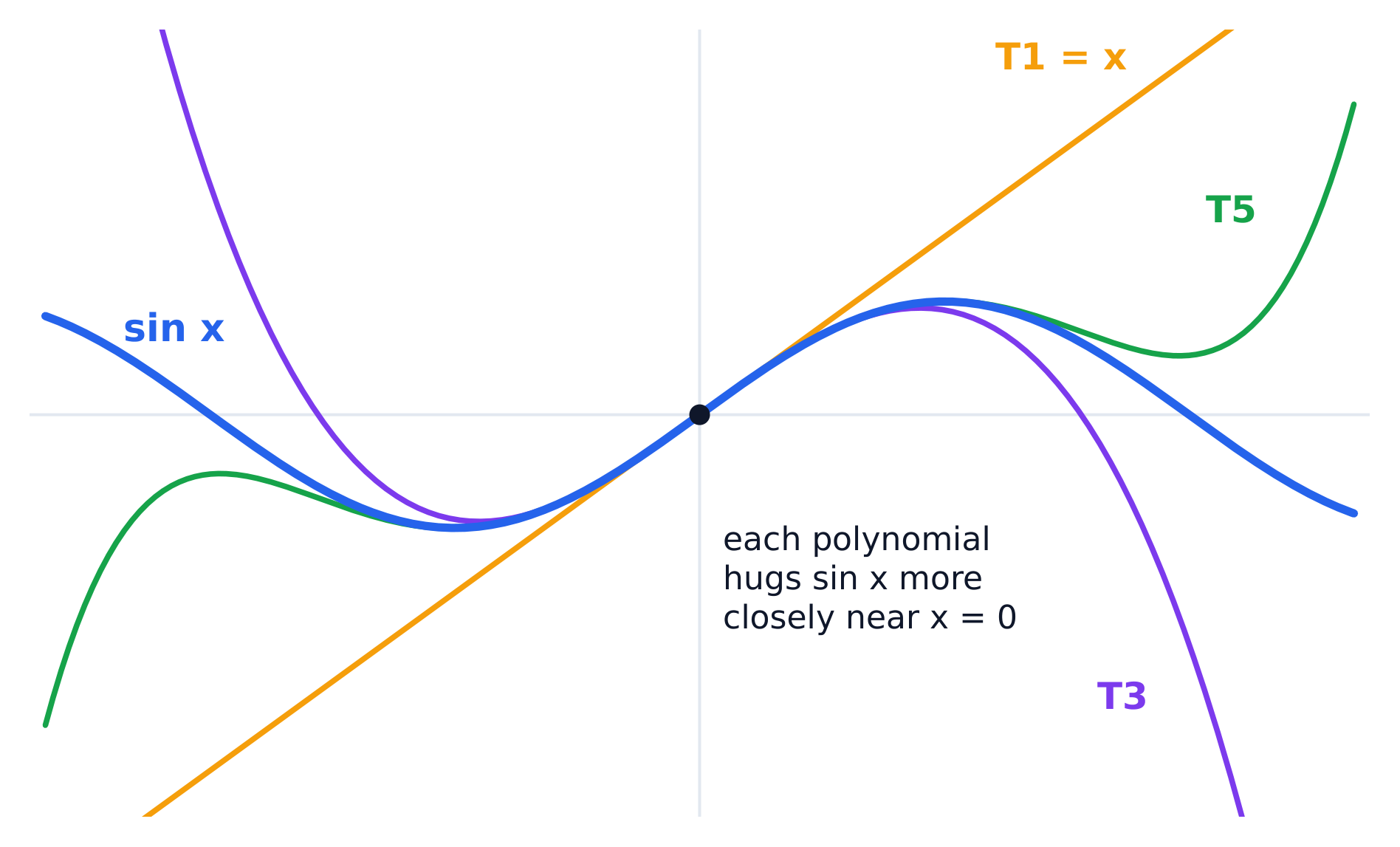
- Cosine has zero cubic coefficient, so $P_2=P_3=1-x^2/2$. The same polynomial matches derivatives through order $3$ at $0$.
- Use $n=3$ and $|f^{(4)}(t)|=|\cos t|\le1$. Lagrange now gives $|R_3(0.2)|\le0.2^4/4!$, matching the alternating bound here.
For cosine about 0, $P_2=P_3$ because the third-order coefficient is zero.
Difficulty 1/5 · 100 coins + a small bonus on first completion today
The same polynomial can use the stronger fourth-derivative Lagrange estimate as P₃.
When bounding the cosine P₃ error with Lagrange, which derivative order is used?
Difficulty 2/5 · 140 coins + a small bonus on first completion today
Use n+1=4.
Apply the method to fresh data
- Use a bound on $f^{(4)}$ to estimate the error of a third-order Taylor polynomial at a point left of its center.
- Then solve for a whole interval with a stated tolerance. Compare a loose Lagrange estimate with an alternating estimate for cosine at a new point.
A function has continuous derivatives through order 4 on $[1.8,2]$ and $|f^{(4)}(t)|\le 9$ there. Bound the error of its Taylor polynomial through order 3 about 2 at x=1.8. Does the bound certify tolerance 0.001?
Use distance 0.2, derivative order 4 and denominator 4!.
For a Taylor polynomial through order 3 about a=2, suppose $|f^{(4)}(t)|\le 24$ on $[1,3]$. Find the largest symmetric interval certified by this fixed M for error at most 0.0001.
Solve the error inequality, then stay inside the interval where M is valid.
Use $1-x^2/2$ to approximate $\cos(0.3)$. Compare the order 2 Lagrange bound with M=1 and the alternating-series bound. Which certifies tolerance 0.0005?
One loose bound can fail to certify a tolerance that a sharper bound meets.
Recheck the derivative bound when the order changes
- A larger factorial does not by itself guarantee a smaller bound. For sine at $x=4$, $a=0$ and $M=1$, order $0$ gives bound $4$, while order $1$ gives bound $8$.
- For every estimate, identify the Taylor order, derivative bound, interval, distance and factorial. Compare the final upper bound with the requested tolerance.
If $|f^{(n+1)}|\le M$ throughout the interval from $a$ to $x$, the Lagrange bound is $M|x-a|^{n+1}/(n+1)!$. A bound at or below the tolerance certifies accuracy. A larger bound is inconclusive. An alternating-series bound is available only when its conditions hold.
For sine at x=4 about 0, take M=1 for every derivative. The order 0 bound is 4. What is the order 1 bound?
Difficulty 1/5 · 100 coins + a small bonus on first completion today
The next bound is 4²/2!=8, so increasing order need not decrease this bound.
Review: to use Lagrange with Taylor order n=4, which derivative order must M bound?
Difficulty 2/5 · 140 coins + a small bonus on first completion today
Use n+1=5.