The nth Term Test for Divergence
Introduced| English | Meaning |
|---|---|
| nth Term Test/ˌenˌtiːˈeɪtʃ tɜːm test/ | nth Term Test |
| partial sum/ˈpɑːʃl sʌm/ | partial sum |
| necessary condition | necessary condition |
| inconclusive/ɪŋkənˈkluːsɪv/ | Describing a test result that does not determine the answer, so another method or more information is needed. |
Does a running balance settle?
- A model account receives $1$, pays $1$, receives $1$, pays $1$, and repeats. Its balance alternates between $1$ and $0$; staying bounded does not mean settling at one value.
- The nth Term Test 通项判别法 checks whether the individual changes approach zero. It can prove that a series diverges without finding its sum.
Separate a term from a running total
- A partial sum 部分和 is $S_n=a_1+\cdots+a_n$, with $S_0=0$. The series converges when these running totals approach one finite number.
- The new term is the change between consecutive totals: $a_n=S_n-S_{n-1}$. A term $a_n$ and a total $S_n$ are different quantities.

Which expression is the nth partial sum?
Difficulty 1/5 · 100 coins + a small bonus on first completion today
A partial sum adds the terms up to the stated index.
If $S_3=7/4$ and $S_4=15/8$, what is $a_4$?
Difficulty 2/5 · 140 coins + a small bonus on first completion today
Subtract: $15/8-14/8=1/8$.
Why convergent series need small terms
- If $S_n\to S$, then $S_{n-1}\to S$ too. Subtracting the two limits gives $a_n=S_n-S_{n-1}\to S-S=0$.
- Thus $a_n\to0$ is a necessary condition 必要条件 for convergence. It is not a sufficient condition: small changes can still build a total that never settles.
If $S_n\to S$, then $a_n=S_n-S_{n-1}$ tends to ____.
Difficulty 1/5 · 100 coins + a small bonus on first completion today
Both partial sums tend to the same finite S.
A zero term limit is necessary for series convergence but is not sufficient.
Difficulty 1/5 · 100 coins + a small bonus on first completion today
Convergence implies a_n→0; the harmonic series disproves the converse.
Use the test in the correct direction
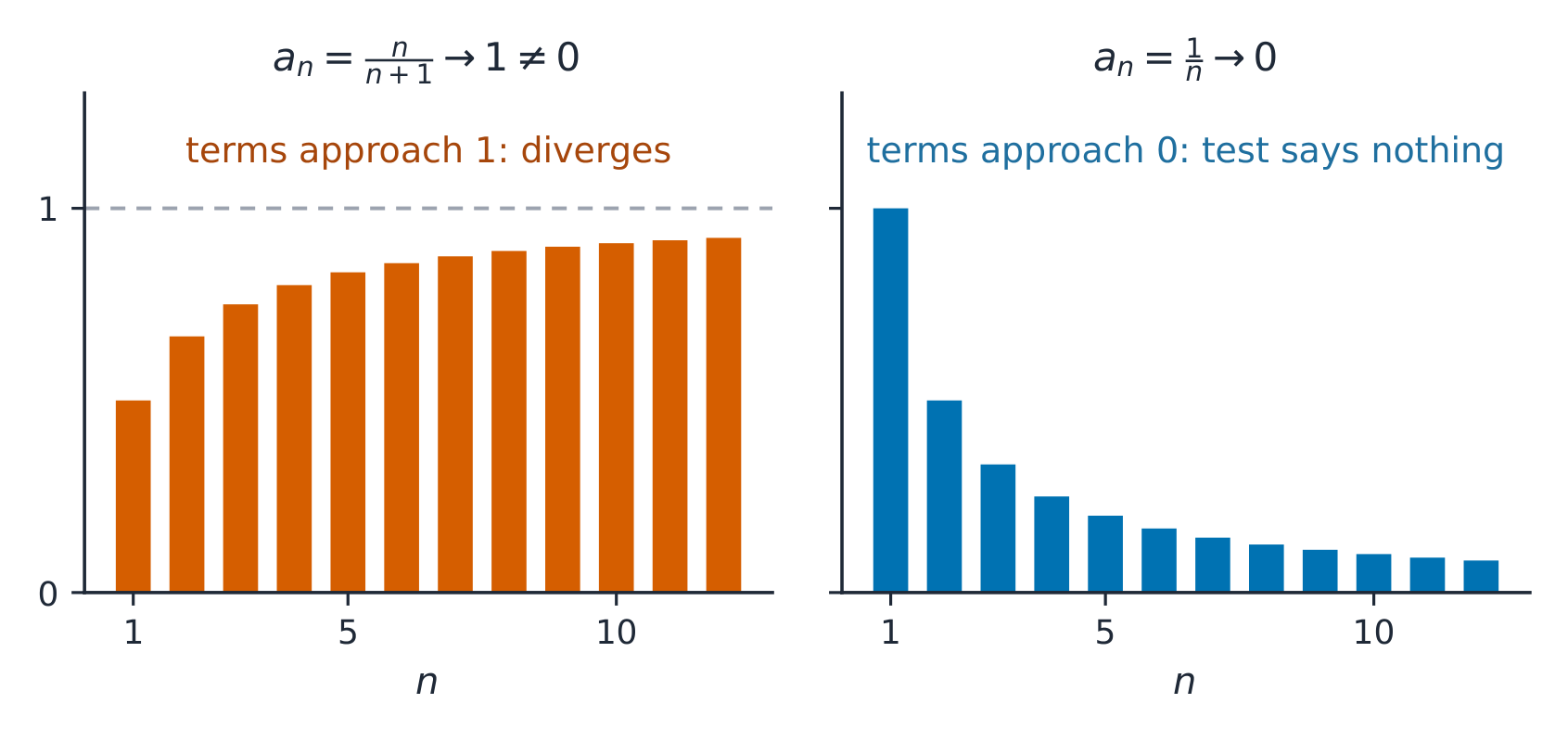
- If $a_n$ does not approach $0$, then $\sum a_n$ diverges. This includes a nonzero finite term limit, unbounded terms and terms with no limit.
- If $a_n\to0$, the test is inconclusive 无法判定. Choose another suitable test; the nth Term Test has not proved convergence or divergence.
If $\lim_{n\to\infty}a_n=2$, then $\sum a_n$...
Difficulty 1/5 · 100 coins + a small bonus on first completion today
The term limit is nonzero, so the series diverges by the nth Term Test.
If $\lim_{n\to\infty}a_n=0$, the nth Term Test is...
Difficulty 1/5 · 100 coins + a small bonus on first completion today
Zero is necessary but does not determine convergence.
The nth Term Test can prove a series converges.
Difficulty 1/5 · 100 coins + a small bonus on first completion today
Its conclusive outcome is divergence only.
A nonzero limit proves divergence
- For $a_n=n/(2n+1)$, divide numerator and denominator by $n$. Then $a_n=1/(2+1/n)\to1/2$.
- Since $1/2\ne0$, the series $\sum_{n=1}^{\infty}n/(2n+1)$ diverges. The number $1/2$ is a term limit, not the series sum.
Find $\lim_{n\to\infty} n/(2n+1)$.
Difficulty 2/5 · 140 coins + a small bonus on first completion today
Divide numerator and denominator by $n$ to get $1/(2+1/n)$.
For $\sum n/(2n+1)$, the term limit is $1/2$. Therefore the series...
Difficulty 1/5 · 100 coins + a small bonus on first completion today
A nonzero term limit proves divergence;1/2 is not the sum.
No term limit can also prove divergence
- For $a_n=(-1)^{n-1}$, odd-index terms are $1$ and even-index terms are $-1$. These two groups approach different values, so $a_n$ has no limit.
- The nth Term Test proves divergence. Here $S_n=1$ for odd $n$ and $S_n=0$ for even $n$: bounded partial sums can still fail to converge.
In the activity, $a=1$ and $r=-1$ give this alternating example. Blue values are individual terms; amber values are running totals. Changing to $r=0.5$ gives a convergent geometric series, but its convergence needs the geometric-series result.
Terms and running totals: an oscillating case
The default a=1,r=−1 gives odd terms 1/even terms−1 and partial sums1/0. Neither sequence has a limit. A finite plot illustrates the odd/even proof.
For $a_n=(-1)^{n-1}$, what is $a_{101}$?
Difficulty 2/5 · 140 coins + a small bonus on first completion today
The exponent 100 is even.
For $a_n=(-1)^{n-1}$, what is $S_8$?
Difficulty 2/5 · 140 coins + a small bonus on first completion today
Each consecutive pair $1-1$ adds to 0.
A bounded sequence of partial sums must converge.
Difficulty 1/5 · 100 coins + a small bonus on first completion today
The alternating example has partial sums1,0,1,0,... and no single limit.
The terms $(-1)^{n-1}$ have no limit. What does the nth Term Test establish?
Difficulty 1/5 · 100 coins + a small bonus on first completion today
Odd terms are1 and even terms are−1, so the terms do not tend to 0.
Unbounded terms fail the same check
- For $a_n=n^2/(n+1)$ and $n\ge1$, the inequality $n+1\le2n$ gives $a_n\ge n/2\to\infty$.
- Therefore the series diverges by the nth Term Test. There is no need to calculate its partial-sum formula first.
If $a_n\to+\infty$, the series $\sum a_n$ diverges by the nth Term Test.
Difficulty 1/5 · 100 coins + a small bonus on first completion today
Unbounded terms do not tend to 0.
A zero term limit leaves two possibilities
- Both $a_n=1/n$ and $b_n=1/2^{n-1}$ approach $0$. Their series behave differently: the harmonic series diverges, while the geometric series converges to $2$.
- For the harmonic series, each block $1/(2^{k-1}+1)+\cdots+1/2^k$ contains $2^{k-1}$ terms, each at least $1/2^k$. Every block adds at least $1/2$, so the totals keep growing.
The nth Term Test is inconclusive for both series. The harmonic grouping argument and the geometric-series theorem supply their final classifications.
The series $\sum 1/n$ has $a_n\to 0$ but diverges. This shows the nth Term Test...
Difficulty 1/5 · 100 coins + a small bonus on first completion today
Small terms do not guarantee a finite limit of the partial sums.
For which series is the nth Term Test inconclusive? Select all.
Difficulty 2/5 · 140 coins + a small bonus on first completion today
All three term sequences tend to zero; their sums require other reasoning.
Using the geometric-series theorem, find $\sum_{n=1}^{\infty}1/2^{n-1}$.
Difficulty 2/5 · 140 coins + a small bonus on first completion today
First term 1 and ratio 1/2 give 1/(1−1/2)=2. The nth Term Test alone does not give this sum.
Alternating signs do not always prevent a limit
- For $a_n=(-1)^{n-1}/n$, the signs alternate but $|a_n|=1/n\to0$. Squeezing between $-1/n$ and $1/n$ shows $a_n\to0$.
- The nth Term Test is inconclusive here. Alternation alone does not mean that the term limit fails to exist; check the size as well as the signs.
Because $(-1)^{n-1}/n$ alternates in sign, its term limit does not exist.
Difficulty 1/5 · 100 coins + a small bonus on first completion today
Its absolute value $1/n$ tends to 0, so the terms also tend to 0.
Keep finite prefixes and order clear
- Changing finitely many finite terms changes later partial sums by a fixed finite amount. It does not change whether the series converges.
- Use the terms in their stated order. A finite plot suggests behaviour, but a limit calculation or argument is needed to justify the conclusion.
Changing the first four finite terms can make a divergent series converge.
Difficulty 1/5 · 100 coins + a small bonus on first completion today
A finite prefix changes later partial sums by only one fixed finite amount.
A graph of the first20 partial sums is a proof that an infinite series converges.
Difficulty 1/5 · 100 coins + a small bonus on first completion today
A finite graph does not establish an infinite limit.
Practise three different outcomes
- Apply the nth Term Test to $\sum 3n^2/(n^2+4)$ and $\sum[2+(-1)^n]$, starting at $n=1$. Show the term-limit calculation or the odd/even argument.
- Then apply this test to $\sum 2/(n+1)$. State exactly what this test establishes, without treating a zero term limit as a convergence proof.
Apply the nth Term Test to $\sum_{n=1}^{\infty}3n^2/(n^2+4)$. Show the term limit and state what it proves.
Compare the limit argument and the precise conclusion with the model.
Apply the nth Term Test to $\sum_{n=1}^{\infty}[2+(-1)^n]$. Explain the term behaviour rather than writing only DNE.
Compare the limit argument and the precise conclusion with the model.
Apply the nth Term Test to $\sum_{n=1}^{\infty}2/(n+1)$. State exactly what this test establishes. Explain why a zero term limit is not enough.
Compare the limit argument and the precise conclusion with the model.
Write the term limit before the conclusion
- Identify $a_n$ and calculate its limit, or explain why it does not exist. If the terms do not tend to zero, state divergence by the nth Term Test.
- If the limit is zero, state that this test is inconclusive and select another test when a full classification is required.
A convergent series must have $a_n\to0$. If its terms do not tend to zero, it diverges. The converse is false: $a_n\to0$ alone cannot establish convergence. Keep the term limit separate from the limit of the partial sums.
As a fast initial check, inspect the individual ____ before choosing a more detailed series test.
Difficulty 1/5 · 100 coins + a small bonus on first completion today
The nth Term Test begins with a_n, not an assumed sum.