| Enduring Understanding | Learning Objective | Essential Knowledge |
|---|---|---|
FUN-1 | FUN-1.B |
|
Analytical Applications of Differentiation
AP Calculus BC · Topic 5
 9:33
Using the Mean Value Theorem
You drive two hundred kilometres in two hours. Your average speed was one hundred kilometres per hour. Now here is a claim. At some moment during that drive…
English narration · English + 中文 subtitles burned in
5.1
Using the Mean Value Theorem

Syllabus
Source: College Board AP Course and Exam Description
The Mean Value Theorem 中值定理 (MVT) links the average rate of change 平均变化率 to an instantaneous one:
If $f$ is continuous 连续 on $[a,b]$ and differentiable 可导 on $(a,b)$, then there is at least one point $c$ in $(a,b)$ where
$$f'(c) = \frac{f(b)-f(a)}{b-a}.$$
In words: somewhere inside the interval 区间, the instantaneous rate equals the average rate. Geometrically, some tangent line 切线 is parallel 平行 to the line joining the endpoints 端点.
Exam skill. Like the IVT, the MVT is an existence theorem, and questions ask you to justify. Full credit needs: (1) state $f$ is continuous on $[a,b]$ and differentiable on $(a,b)$; (2) compute the average rate $\frac{f(b)-f(a)}{b-a}$; (3) conclude “by the MVT there is a $c$ in $(a,b)$ with $f'(c)$ equal to that value.” Both hypotheses must be named.
Worked example. For $f(x)=x^2$ on $[1,3]$ the average rate is $\dfrac{9-1}{2}=4$; setting $f'(c)=2c=4$ gives $c=2$, which lies in $(1,3)$ – the guaranteed point.
Why both hypotheses matter. Take $f(x)=|x|$ on $[-1,1]$. It is continuous, and the average rate is $\dfrac{f(1)-f(-1)}{1-(-1)}=\dfrac{1-1}{2}=0$. But $f'(x)$ is $-1$ or $1$ everywhere it exists, never $0$. The MVT does not apply, because $f$ is not differentiable at $x=0$, which is inside $(-1,1)$.
Explore
The Mean Value Theorem in action
y = ax³ + bx² + cx + d
The Mean Value Theorem guarantees a point where the tangent is parallel to the secant across an interval — the instantaneous rate equals the average rate somewhere inside.
Vocabulary
Train
| English |
|---|
| Mean Value Theorem/miːn ˈvæljuː ˈθɪərəm/ |
| average rate of change/ˈævrɪdʒ reɪt ɒv tʃeɪndʒ/ |
| continuous/kənˈtɪnjuːəs/ |
| differentiable/ˈdɪfərenʃɪəbl/ |
| interval/ˈɪntəvl/ |
| tangent line/ˈtændʒənt laɪn/ |
| parallel/ˈpærəlel/ |
| endpoints |
5.2
Extreme Values, Global vs Local Extrema, and Critical Points

Syllabus
| Enduring Understanding | Learning Objective | Essential Knowledge |
|---|---|---|
FUN-1 | FUN-1.C |
|
Source: College Board AP Course and Exam Description
The Extreme Value Theorem 极值定理 (EVT) guarantees extremes exist: a function continuous on a closed interval 闭区间 $[a,b]$ attains both an absolute maximum 最大值 and an absolute minimum 最小值 on it.
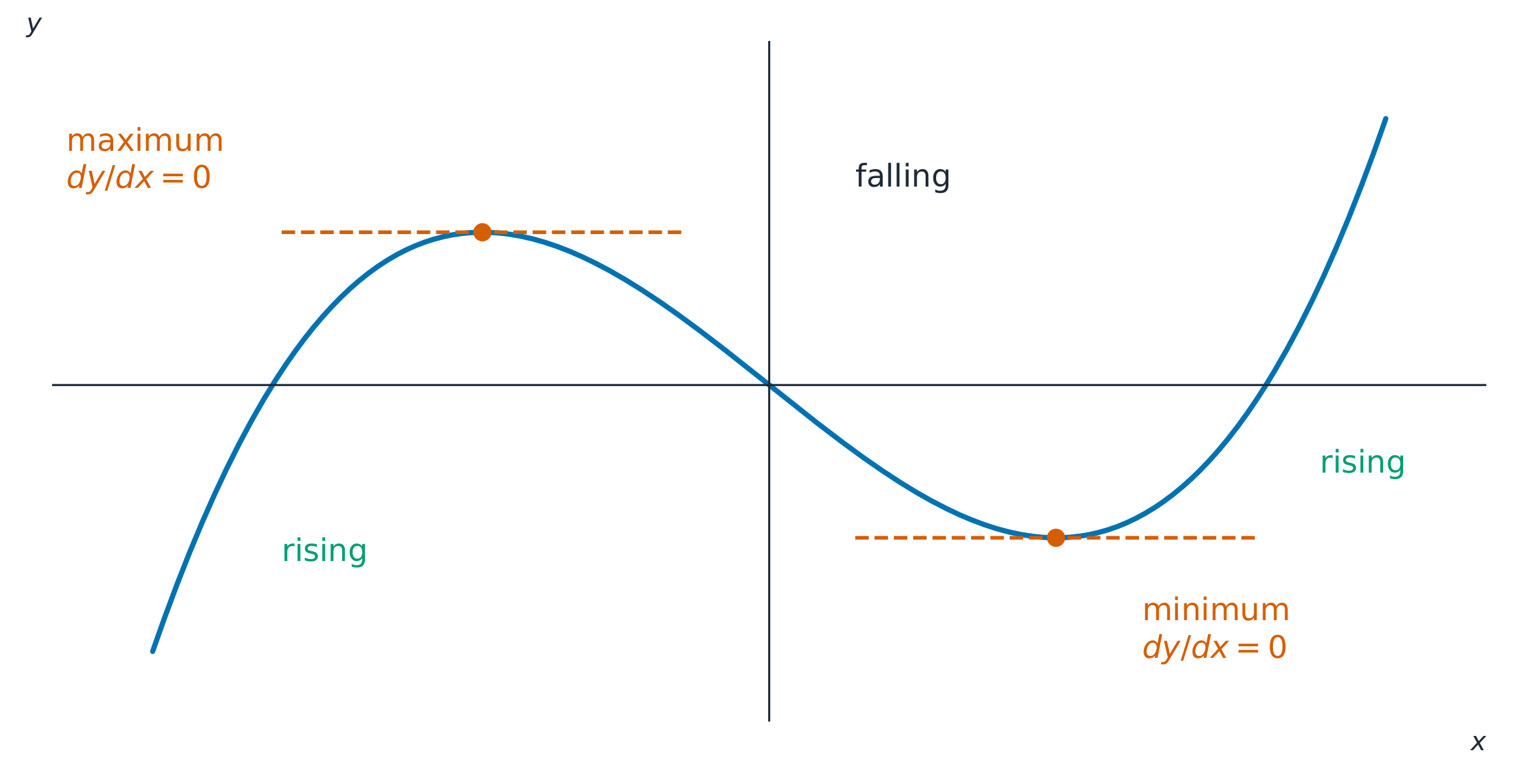
A critical point 临界点 is an interior point 内点 of the function's domain 定义域 where $f'(x)=0$ or $f'(x)$ does not exist. All local (relative) extrema 局部极值 occur at critical points – but not every critical point is an extremum 极值. So critical points are the candidates 候选点; you must test each.
Vocabulary
Train
| English |
|---|
| Extreme Value Theorem/ekˈstriːm ˈvæljuː ˈθɪərəm/ |
| closed interval |
| absolute maximum |
| absolute minimum |
| critical point/ˈkrɪtɪkl pɔɪnt/ |
| interior point |
| domain/dəˈmeɪn/ |
| local (relative) extrema/ˈləʊkl ekˈstremə/ |
| extremum |
| candidates |
5.3
Where a Function Increases or Decreases
Syllabus
| Enduring Understanding | Learning Objective | Essential Knowledge |
|---|---|---|
FUN-4 | FUN-4.A |
|
Source: College Board AP Course and Exam Description
The first derivative 一阶导数 tells you where $f$ rises or falls:
- $f'(x) > 0$ on an interval $\Rightarrow$ $f$ is increasing 递增 there;
- $f'(x) < 0$ $\Rightarrow$ $f$ is decreasing 递减.
On the exam, “find the intervals where $f$ is increasing” means: find the critical points, then test the sign of $f'$ between them, and justify with the sign of $f'$ (a stated reason, not just an interval).
Vocabulary
Train
| English |
|---|
| first derivative |
| increasing/ɪnˈkriːsɪŋ/ |
| decreasing/ˈdiːkriːsɪŋ/ |
5.4
The First Derivative Test for Local Extrema

Syllabus
| Enduring Understanding | Learning Objective | Essential Knowledge |
|---|---|---|
FUN-4 | FUN-4.A |
|
Source: College Board AP Course and Exam Description
To classify a critical point $x=c$ as a local max, local min, or neither, check how $f'$ changes sign there:
- $f'$ changes $+$ to $-$ at $c$ $\Rightarrow$ local maximum 极大值;
- $f'$ changes $-$ to $+$ at $c$ $\Rightarrow$ local minimum 极小值;
- $f'$ does not change sign $\Rightarrow$ neither.
Always state the sign change 符号变化 as your justification 理由.
Worked example. For $f(x)=x^3-3x^2$, $f'(x)=3x(x-2)$ is zero at $x=0,2$. Signs give $+,-,+$, so $x=0$ is a local maximum ($f=0$) and $x=2$ a local minimum ($f=-4$).
Common mistakes. Justifying with “$f'(0)=0$” alone: a zero of $f'$ only makes $x=0$ a candidate; the reason is the sign change of $f'$. Testing the sign of $f$ instead of $f'$. Giving the $x$-value when the question asks for the maximum value ($f(0)=0$), or the reverse.
Vocabulary
Train
| English |
|---|
| local maximum/ˈləʊkl ˈmæksɪməm/ |
| local minimum/ˈləʊkl ˈmɪnɪməm/ |
| sign change/saɪn tʃeɪndʒ/ |
| justification |
5.5
The Candidates Test for Absolute Extrema
Syllabus
| Enduring Understanding | Learning Objective | Essential Knowledge |
|---|---|---|
FUN-4 | FUN-4.A |
|
Source: College Board AP Course and Exam Description
On a closed interval, absolute (global) extrema occur only at critical points or endpoints. The candidates test 候选点判别法:
- List all critical points in $[a,b]$ and the two endpoints.
- Evaluate $f$ at each candidate.
- The largest output is the absolute maximum; the smallest is the absolute minimum.
Show the table of values – the comparison is the argument.
Worked example. Find the absolute maximum and minimum of $f(x)=x^3-3x^2$ on $[1,4]$.
$f'(x)=3x(x-2)$ is zero at $x=0$ and $x=2$. Only $x=2$ lies in $[1,4]$, so the candidates are $x=1$, $x=2$ and $x=4$:
| $x$ | $1$ (endpoint) | $2$ (critical point) | $4$ (endpoint) |
|---|---|---|---|
| $f(x)$ | $1-3=-2$ | $8-12=-4$ | $64-48=16$ |
The absolute maximum is $16$, at $x=4$; the absolute minimum is $-4$, at $x=2$. The maximum is at an endpoint where $f'(4)=24\neq 0$: this is why the endpoints must be on the list.
Vocabulary
Train
| English |
|---|
| candidates test/ˈkændɪdeɪts test/ |
5.6
Concavity and Points of Inflection
Syllabus
| Enduring Understanding | Learning Objective | Essential Knowledge |
|---|---|---|
FUN-4 | FUN-4.A |
|
Source: College Board AP Course and Exam Description
The second derivative 二阶导数 describes bending:
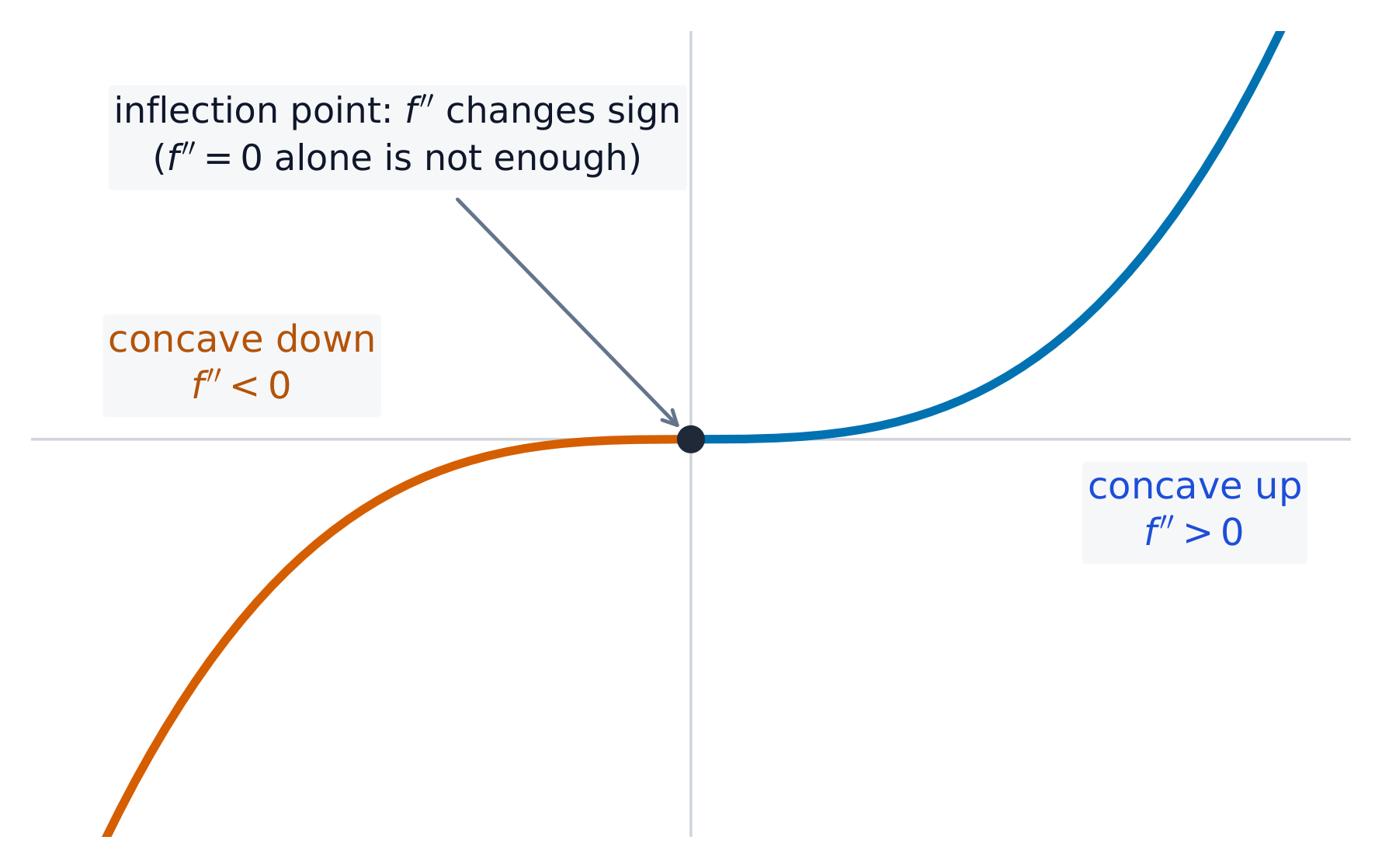
- $f'' > 0$ $\Rightarrow$ $f$ is concave up 上凹 (curving like a cup; $f'$ is increasing);
- $f'' < 0$ $\Rightarrow$ $f$ is concave down 下凹 ($f'$ is decreasing).
A point of inflection 拐点 is where concavity changes, i.e. where $f''$ changes sign (not merely where $f''=0$). Report its $x$-coordinate and justify with the sign change of $f''$.
Explore
Find where concavity flips
y = ax³ + bx² + cx + d
Concavity is the sign of the second derivative: concave up where the curve holds water, concave down where it spills. A point of inflection is where it switches.
Vocabulary
Train
| English |
|---|
| second derivative/ˈsekənd dɪˈrɪvətɪv/ |
| concave up/kɒnˈkeɪv ʌp/ |
| concave down/kɒnˈkeɪv daʊn/ |
| point of inflection/pɔɪnt ɒv ɪnˈflekʃn/ |
5.7
The Second Derivative Test for Extrema
Syllabus
| Enduring Understanding | Learning Objective | Essential Knowledge |
|---|---|---|
FUN-4 | FUN-4.A |
|
Source: College Board AP Course and Exam Description
An alternative way to classify a critical point $c$ where $f'(c)=0$:
- $f''(c) > 0$ $\Rightarrow$ concave up $\Rightarrow$ local minimum;
- $f''(c) < 0$ $\Rightarrow$ concave down $\Rightarrow$ local maximum;
- $f''(c) = 0$ $\Rightarrow$ the test is inconclusive 无法判定 – fall back on the first derivative test 一阶导数判别法.
Special case: if a continuous function has only one critical point on an interval and it is a local extremum, that point is also the absolute extremum there.
Vocabulary
Train
| English |
|---|
| inconclusive/ɪŋkənˈkluːsɪv/ |
| first derivative test/fɜːst dɪˈrɪvətɪv test/ |
5.8
Sketching a Function and Its Derivative
Syllabus
| Enduring Understanding | Learning Objective | Essential Knowledge |
|---|---|---|
FUN-4 | FUN-4.A |
|
Source: College Board AP Course and Exam Description
Key features of $f$, $f'$, and $f''$ mirror each other. To sketch or read graphs:
- $f$ increasing $\Leftrightarrow$ $f'$ above the axis; $f$ has a local max $\Leftrightarrow$ $f'$ crosses from $+$ to $-$.
- $f$ concave up $\Leftrightarrow$ $f'$ increasing $\Leftrightarrow$ $f''$ above the axis; $f$ has an inflection point $\Leftrightarrow$ $f'$ has a local extremum $\Leftrightarrow$ $f''$ crosses zero.
5.9
Connecting $f$, $f'$, and $f''$
Syllabus
| Enduring Understanding | Learning Objective | Essential Knowledge |
|---|---|---|
FUN-4 | FUN-4.A |
|
Source: College Board AP Course and Exam Description
This is the skill of reading one graph to describe another. A very common exam setup gives the graph of $f'$ and asks about $f$: where is $f$ increasing (where $f'>0$), where are $f$'s extrema (where $f'$ crosses zero, with a sign change), where is $f$ concave up (where $f'$ is increasing). Answer questions about $f$ using the height and slope of the $f'$ graph.
Common mistake. Reading a graph of $f'$ as if it were $f$: “$f$ is increasing where the graph rises” is wrong. $f$ increases where the graph of $f'$ lies above the axis, and $f$ has an inflection point where the graph of $f'$ turns.
Explore
Read slope and bend off the graph
y = ax³ + bx² + cx + d
Where $f'>0$ the function rises; where $f''>0$ it bends upward. Slide the tangent to connect the shape of $f$ to the signs of its first and second derivatives.
5.10
Introduction to Optimization Problems

Syllabus
| Enduring Understanding | Learning Objective | Essential Knowledge |
|---|---|---|
FUN-4 | FUN-4.B |
|
Source: College Board AP Course and Exam Description
Optimization 最优化 uses the derivative to find the largest or smallest value of a quantity on an interval. It is the candidates/derivative-test machinery applied to a real goal.
Explore
Area as one downward parabola
y = ax² + bx
After using the constraint, area becomes $A=10x-x^2$ — a downward parabola with a single peak to find.
Vocabulary
Train
| English |
|---|
| Optimization/ˌɒptɪmaɪˈzeɪʃn/ |
5.11
Solving Optimization Problems
Syllabus
| Enduring Understanding | Learning Objective | Essential Knowledge |
|---|---|---|
FUN-4 | FUN-4.C |
|
Source: College Board AP Course and Exam Description
A dependable procedure:
- Write the quantity to optimize as a function of one variable (use a constraint 约束条件 equation to eliminate extras).
- State the interval of allowed inputs.
- Find critical points ($f'=0$ or undefined) and test them (first- or second-derivative test, or candidates test if the interval is closed).
- Answer the question asked, with units and interpretation in context – the maximum area, the minimum cost, etc.
Worked example. With $100\ \text{m}$ of fence for a rectangular pen against a wall (only three sides fenced), let the ends be $x$ and the far side $y=100-2x$. The area $A(x)=x(100-2x)=100x-2x^2$ has $A'(x)=100-4x=0$ at $x=25$; since $A''=-4<0$ this is the maximum, giving $y=50$ and $A=1250\ \text{m}^2$.
Common mistakes. Trying to optimize a function of two variables without using the constraint to remove one; skipping the justification that $x=25$ gives a maximum (here $A''<0$); and stopping at $x=25$ when the question asks for the largest area.
Explore
The area has a single peak
y = ax² + bx
The area parabola opens downward with a single peak — the derivative is zero at the vertex, a maximum.
Vocabulary
Train
| English |
|---|
| constraint/kənˈstreɪnt/ |
5.12
Exploring Behaviors of Implicit Relations
Syllabus
| Enduring Understanding | Learning Objective | Essential Knowledge |
|---|---|---|
FUN-4 | FUN-4.D |
|
FUN-4.E |
|
Source: College Board AP Course and Exam Description
All of this extends to implicitly defined 隐式定义 relations. A critical point of an implicit relation is where $\dfrac{dy}{dx}=0$ (horizontal tangent 水平切线) or is undefined 无定义 (vertical tangent 竖直切线). Because $\dfrac{dy}{dx}$ is usually a relation in $x$ and $y$, and the second derivative involves $x$, $y$, and $\dfrac{dy}{dx}$, substitute your first-derivative expression back in when finding $\dfrac{d^2y}{dx^2}$, then reason about concavity from its sign.
Explore
Tangents on a circle
y = √(25 − x²) (upper half)
On $x^2+y^2=25$ the top and bottom have horizontal tangents; the left and right have vertical tangents.
Vocabulary
Train
| English |
|---|
| implicitly defined/ɪmˈplɪsɪtli dɪˈfaɪnd/ |
| horizontal tangent |
| undefined |
| vertical tangent/ˈvɜːtɪkl ˈtændʒənt/ |
5.12
Exam tips
- $f'>0$ means increasing, $f'<0$ decreasing; candidates for extrema are where $f'=0$ or is undefined.
- Classify a critical point with the first-derivative sign change or the second-derivative test 二阶导数判别法 ($f''>0$ minimum, $f''<0$ maximum).
- $f''>0$ is concave up, $f''<0$ concave down; a point of inflection is where concavity changes ($f''$ changes sign).
- For an absolute extremum on a closed interval, also check the endpoints.
- Justify every conclusion by citing the sign of $f'$ or $f''$ — the exam demands the reasoning, not just the answer.
Vocabulary
Train
| English |
|---|
| second-derivative test |
Interactive lessons on this topic
Work through it step by step, with instant-check exercises.
- Using the Mean Value Theorem
- Extreme Value Theorem, Global Versus Local Extrema, and Critical Points
- Determining Intervals on Which a Function Is Increasing or Decreasing
- Using the First Derivative Test to Determine Relative (Local) Extrema
- Using the Candidates Test to Determine Absolute (Global) Extrema
- Determining Concavity of Functions over Their Domains
- Using the Second Derivative Test to Determine Extrema
- Sketching Graphs of Functions and Their Derivatives
- Connecting a Function, Its First Derivative, and Its Second Derivative
- Introduction to Optimization Problems
- Solving Optimization Problems
- Exploring Behaviors of Implicit Relations