Defining Convergent and Divergent Infinite Series
Introduced| English | Meaning |
|---|---|
| infinite series/ˈɪnfɪnət ˈsɪəriːz/ | A sum of infinitely many terms, interpreted through the limit of its partial sums when that limit exists. |
| partial sum/ˈpɑːʃl sʌm/ | partial sum |
| converges/kənˈvɜːdʒɪz/ | Approaches a finite limit as the relevant variable or sequence index increases or approaches a specified value. |
| diverges/daɪˈvɜːdʒɪz/ | An improper integral, sequence or sequence of series partial sums does not approach a finite limit. |
Can infinitely many moves cover a finite distance?
- A robot moves $1$ metre, then $1/2$ metre, then $1/4$ metre, and keeps halving its next move. The total distance can approach $2$ metres even though there is always another move.
- An infinite series 无穷级数 adds the terms of a sequence: $\sum_{n=1}^{\infty}a_n=a_1+a_2+\cdots$. To give this a value, study its finite running totals.
Build the partial sums
- The $N$th partial sum 部分和 is $S_N=\sum_{n=1}^{N}a_n=a_1+\cdots+a_N$. For the robot, $S_1=1$, $S_2=3/2$, $S_3=7/4$ and $S_4=15/8$.
- The terms $a_1,a_2,\ldots$ and the partial sums $S_1,S_2,\ldots$ are different sequences. Here $a_3=1/4$, but $S_3=7/4$.
The sum of the first $n$ terms, $S_n$, is called the $n$th ____ sum.
Difficulty 1/5 · 100 coins + a small bonus on first completion today
The series is the limit of these partial sums.
For $1+1/2+1/4+\cdots$, what is $a_3$?
Difficulty 2/5 · 140 coins + a small bonus on first completion today
The third individual term is $1/4$. It is not $S_3=7/4$.
For the same series, what is $S_3$?
Difficulty 2/5 · 140 coins + a small bonus on first completion today
$S_3=1+1/2+1/4=7/4$.
Define convergence using a limit
- A series converges 收敛 to $L$ exactly when $\lim_{N\to\infty}S_N=L$ exists and is finite. Then write $\sum_{n=1}^{\infty}a_n=L$.
- Otherwise the series diverges 发散. A few totals or a finite graph can suggest a pattern, but do not prove an infinite limit.
The value of an infinite series is defined as the limit of its...
Difficulty 1/5 · 100 coins + a small bonus on first completion today
$\sum a_n=\lim_{n\to\infty}S_n$.
A series converges when its partial sums...
Difficulty 1/5 · 100 coins + a small bonus on first completion today
Convergence = partial sums approach a finite $L$.
Prove the robot's total
- Its first $N$ moves add to $S_N=1+1/2+\cdots+1/2^{N-1}=2(1-2^{-N})$. Subtracting half this finite sum from itself gives $S_N/2=1-2^{-N}$.
- Hence $2-S_N=2^{1-N}\to0$, so $S_N\to2$. Each finite total is below $2$; the infinite sum is $2$ even though no finite total equals it.
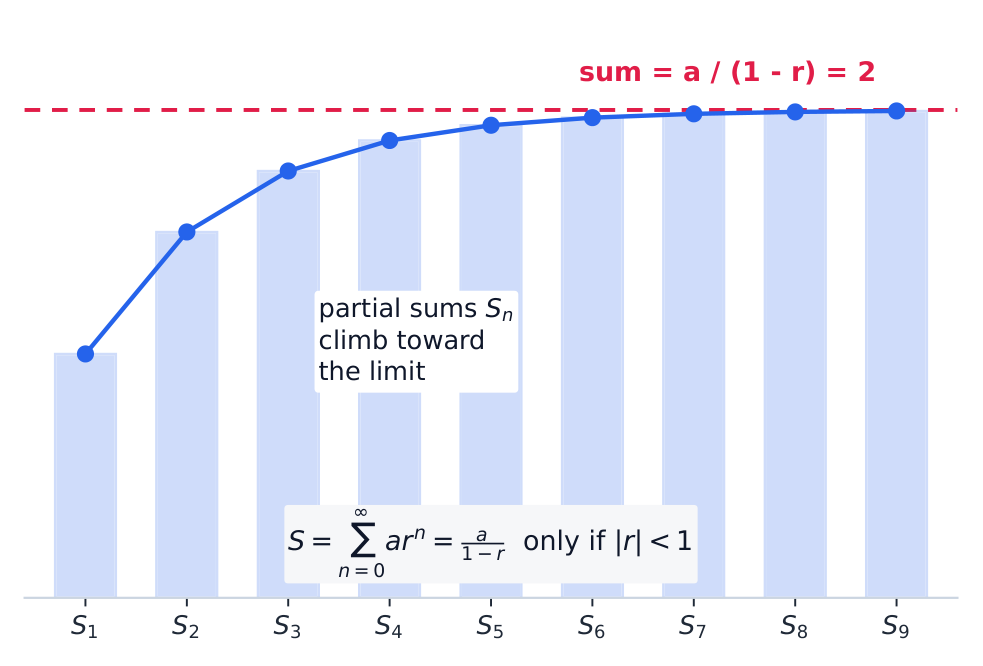
The exact formula explains the pattern shown by these first nine totals.
The partial sums of $1+\tfrac12+\tfrac14+\cdots$ climb toward what limit?
Difficulty 2/5 · 140 coins + a small bonus on first completion today
A geometric series with ratio $\tfrac12$ sums to $2$.
Each finite partial sum of $1+1/2+1/4+\cdots$ equals the infinite sum $2$.
Difficulty 1/5 · 100 coins + a small bonus on first completion today
$S_N=2-2^{1-N}<2$ for every finite positive integer $N$.
After eight robot moves, what distance remains before $2$ metres?
Difficulty 2/5 · 140 coins + a small bonus on first completion today
$2-S_8=2^{1-8}=1/128$ metre.
Oscillation can still converge
- For $1-1/2+1/4-1/8+\cdots$, the partial sums are $1,1/2,3/4,5/8,\ldots$. They move above and below a common limit.
- Their formula is $S_N=\dfrac23\left(1-(-1/2)^N\right)$. Since $(-1/2)^N\to0$, the series converges to $2/3$. Convergent partial sums need not increase or decrease throughout.
Terms and partial sums have different limits
Compare individual moves with their accumulated distance. For a=1 and r=1/2, the terms approach 0 while the partial sums approach 2. A finite graph illustrates the limit argument; it does not prove it.
The partial sums are $S_N=\frac23(1-(-1/2)^N)$. What is the series sum?
Difficulty 2/5 · 140 coins + a small bonus on first completion today
The power tends to 0, leaving the finite limit $2/3$.
A convergent series must have partial sums that increase at every step.
Difficulty 1/5 · 100 coins + a small bonus on first completion today
The totals of $1-1/2+1/4-\cdots$ alternate around $2/3$ and still converge.
Bounded totals can fail to converge
- For $1-1+1-1+\cdots$, odd partial sums equal $1$ and even partial sums equal $0$. These two groups approach different values, so there is no single limit.
- Every total lies between $0$ and $1$, yet the series diverges. Staying bounded or alternating signs alone does not prove convergence.

For $1-1+1-1+\cdots$, why does the ordinary series diverge?
Difficulty 1/5 · 100 coins + a small bonus on first completion today
Odd totals equal 1 and even totals equal 0. A single sequence limit cannot equal both.
If all partial sums lie between 0 and 1, the series must converge.
Difficulty 1/5 · 100 coins + a small bonus on first completion today
The totals 1,0,1,0,... stay in that interval without approaching one common limit.
Divergence need not mean oscillation
- For $1+1+1+\cdots$, $S_N=N\to+\infty$. There is no finite series sum, so this series diverges too.
- Compare the reasons: unbounded growth for this series, and two distinct odd/even limits for $1-1+1-1+\cdots$. Both fail the same finite-limit definition.
Which series clearly diverges?
Difficulty 1/5 · 100 coins + a small bonus on first completion today
Here $S_N=N$, so the partial sums have no finite limit. The individual terms also fail to tend to $0$.
If $S_N=5N$, what does the series do?
Difficulty 1/5 · 100 coins + a small bonus on first completion today
$5N\to+\infty$, so there is no finite series sum.
Recover terms from running totals
- Set $S_0=0$. Then $a_1=S_1$ and $a_N=S_N-S_{N-1}$ for $N\ge2$: subtract the previous total to find the new contribution.
- Suppose $S_N=4-\dfrac1{N+1}$ for $N\ge1$. The series sums to $4$, while $a_1=7/2$ and $a_N=\dfrac1N-\dfrac1{N+1}=\dfrac1{N(N+1)}$ for $N\ge2$.
Given $S_N=4-1/(N+1)$ only for $N\ge1$, find $a_1$.
Difficulty 2/5 · 140 coins + a small bonus on first completion today
$a_1=S_1=4-1/2=7/2$. The formula is not specified at $N=0$.
For that same partial-sum formula, find $a_2$.
Difficulty 2/5 · 140 coins + a small bonus on first completion today
$a_2=S_2-S_1=11/3-7/2=1/6$.
Terms must tend to zero
- If $S_N\to L$, then $S_{N-1}\to L$, so $a_N=S_N-S_{N-1}\to L-L=0$. This is a necessary condition for convergence.
- This says the terms tend to zero, not that their magnitudes must decrease at every step. A nonzero term limit rules out convergence; a zero term limit alone does not prove it.
Which equation explains why convergent partial sums imply $a_N\to0$?
Difficulty 1/5 · 100 coins + a small bonus on first completion today
$a_N=S_N-S_{N-1}$; both totals tend to the same finite limit.
A zero term limit is not enough
- The harmonic series $\sum_{n=1}^{\infty}1/n$ has terms tending to zero but divergent partial sums. In each block $n=2^{k-1}+1,\ldots,2^k$, the terms add to at least $1/2$.
- For example, $1/3+1/4\ge1/2$ and $1/5+\cdots+1/8\ge1/2$. Infinitely many such blocks force unbounded totals. Compare the robot's series: its terms also tend to zero, but its totals tend to $2$.
If the terms $a_n\to 0$, the series must converge.
Difficulty 1/5 · 100 coins + a small bonus on first completion today
Necessary but not sufficient — e.g. $\sum\tfrac1n$ diverges.
What lower bound is obtained for the block $1/9+1/10+\cdots+1/16$ by replacing every term with $1/16$?
Difficulty 2/5 · 140 coins + a small bonus on first completion today
There are 8 terms, so the block is at least $8/16=1/2$.
Try fresh partial-sum models
- For a series with $S_N=2-\dfrac3{N+1}$ for $N\ge1$, find $a_1$, $a_2$, a formula for $a_N$ when $N\ge2$, and the series sum. State why you use a separate first term.
- Decide what happens when $S_N=3+\dfrac{(-1)^N}{N}$, and when $S_N=3+(-1)^N$. Explain using limits of the totals, rather than just the word “oscillates”.
If $S_N=3+(-1)^N/N$ for $N\ge1$, what is the series sum?
Difficulty 2/5 · 140 coins + a small bonus on first completion today
$|(-1)^N/N|=1/N\to0$, so $S_N\to3$.
For $S_N=2-3/(N+1)$, find $a_1$, $a_2$, $a_N$ for $N\ge2$, and the infinite sum. Explain the first-term exception.
Compare your limit argument, calculations and conclusion with the model.
Compare $S_N=3+(-1)^N/N$ with $S_N=3+(-1)^N$. Explain whether each associated series converges.
Compare your limit argument, calculations and conclusion with the model.
Choose the sequence you need
- To find the value of a series, take the limit of $S_N$, not $a_N$. If only $a_N$ is given, build the totals or use a suitable convergence argument.
- A finite partial-sum limit gives convergence. Unbounded totals or different odd/even limits give divergence. Terms tending to zero and bounded totals are each insufficient on their own.
A series has $a_N\to0$. What can you conclude from this fact alone?
Difficulty 1/5 · 100 coins + a small bonus on first completion today
The necessary condition holds, but partial sums may converge or diverge.
A robot moves $3,1,1/3,\ldots$ metres. Its first $N$ moves total $S_N=\frac92(1-3^{-N})$. Find the total distance and the amount remaining after four moves. Explain why four plotted totals are insufficient proof.
Compare your limit argument, calculations and conclusion with the model.