| Enduring Understanding | Learning Objective | Essential Knowledge |
|---|---|---|
CHA-3 | CHA-3.G |
|
Parametric Equations, Polar Coordinates, and Vector-Valued Functions
AP Calculus BC · Topic 9
 6:04
Parametric, Vector & Polar
Some curves cannot be written as y equals a function of x. Think of a particle looping around, or a path that crosses itself — for one x there would be two y…
English narration · English + 中文 subtitles burned in
9.1
Defining and Differentiating Parametric Equations

Syllabus
Source: College Board AP Course and Exam Description
Parametric equations 参数方程 give coordinates $x=f(t)$ and $y=g(t)$ in terms of a parameter 参数 $t$. A robot's position needs both coordinates at the same time. For $x=t^2$, $y=t^3$, increasing $t$ through $-1,0,1,2$ gives $(1,-1),(0,0),(1,1),(4,8)$. The same x-coordinate can have different y-coordinates, so the whole curve need not be one function $y=f(x)$.
Keep the parameter interval and direction. For $x=\cos t$, $y=\sin t$, $0\le t\le\pi$ traces only the upper semicircle, from $(1,0)$ to $(-1,0)$. The interval $[0,2\pi]$ traces a full circle counterclockwise. Eliminating $t$ gives $x^2+y^2=1$ but loses this interval and travel order.
Where $dx/dt\ne0$, the chain rule gives the slope 斜率
$$\frac{dy}{dx}=\frac{dy/dt}{dx/dt}.$$
Differentiate both coordinates, then evaluate at the same parameter. This is not the derivative of $y/x$ or the product of the coordinate rates.
Worked example: slope and tangent. For $x=t^2$, $y=t^3$ at $t=2$, the point is $(4,8)$ and the derivatives are $4$ and $12$. The slope is $3$, so the tangent is $y-8=3(x-4)$. For the related curve $x=t^2$, $y=t^3-t$, the slope is $(3t^2-1)/(2t)$ for $t\ne0$; at $t=2$ it is $11/4$.
A regular horizontal tangent has $dy/dt=0$ and $dx/dt\ne0$; a regular vertical tangent has $dx/dt=0$ and $dy/dt\ne0$. If both derivatives vanish, these tests do not decide the tangent. For $x=t^3$, $y=t^3$ at zero, both vanish but the path is the line $y=x$. Zero coordinate rates do not prove that no geometric tangent exists.
Try it. For $x=t^2+2$, $y=t^3-12t$, $-3\le t\le3$, find the regular horizontal and vertical tangent lines.
Answer. The derivatives are $2t$ and $3t^2-12$. Horizontal tangents occur at $t=\pm2$, with points $(6,-16)$ and $(6,16)$ and lines $y=-16$, $y=16$. At $t=0$, the y-coordinate rate is $-12\ne0$, so the vertical tangent is $x=2$ at $(2,0)$. All three parameters lie in the stated interval.
Explore
Trace the parameter and inspect the tangent
For x=t² and y=t³ at t=2, locate (4,8), compare the two coordinate derivatives and see slope 3. Compare regular horizontal/vertical tangents with a both-zero derivative ratio.
Vocabulary
Train
| English |
|---|
| parametric equations/ˌpærəˈmetrɪk ɪˈkweɪʒnz/ |
| parameter/pəˈræmɪtə/ |
| slope/sləʊp/ |
9.2
Second Derivatives of Parametric Equations
Syllabus
| Enduring Understanding | Learning Objective | Essential Knowledge |
|---|---|---|
CHA-3 | CHA-3.G |
|
Source: College Board AP Course and Exam Description
The second derivative 二阶导数 measures change of slope with x. Write the first slope as $m(t)=dy/dx$. Where $dx/dt\ne0$,
$$\frac{d^2y}{dx^2}=\frac{dm/dt}{dx/dt}.$$
Differentiate the first slope in t, then divide by $dx/dt$ again. It is not generally the ratio of the second coordinate derivatives. Simplify first when helpful; a quotient rule is needed only if the remaining expression requires it. The equivalent formula is
$$\frac{d^2y}{dx^2}=\frac{x'y''-y'x''}{(x')^3},\qquad x'\ne0.$$
Here primes on x and y denote derivatives in t.
Worked example: two different derivatives. For $x=t^2$, $y=t^3$ and $t\ne0$, the first slope is $3t/2$, whose t-derivative is $3/2$. Dividing by $2t$ gives $3/(4t)$. At $t=1$ the second x-derivative is $3/4$, rather than the intermediate value $3/2$ or the incorrect ratio $6t/2=3$.
Its sign gives concavity 凹凸性 on a smooth local graph: positive means concave up, negative means concave down. The upper branch of this curve is concave up for $t>0$; the lower branch is concave down for $t<0$. At zero the formula is unavailable, and the branches meet at a cusp. A sign change across that singular parameter does not by itself establish an inflection of one smooth graph.
Worked example: decreasing x. For $x=-t$, $y=t^2$, the slope is $-2t$ and its t-derivative is $-2$. Dividing by $dx/dt=-1$ gives $d^2y/dx^2=2$. The graph is $y=x^2$, concave up despite the negative intermediate derivative.
Try it. For $x=t^3+2t$, $y=t^2$, find the second x-derivative and its sign at $t=1$.
Answer. The first slope is $2t/(3t^2+2)$; its t-derivative is $2(2-3t^2)/(3t^2+2)^2$. Divide again to obtain $2(2-3t^2)/(3t^2+2)^3$. At $t=1$ this is $-2/125$, so the curve is locally concave down at $(3,1)$. The denominator $3t^2+2$ is always positive.
A zero second derivative alone is not an inflection test: $y=x^4$ has second derivative zero at the origin but is concave up on both sides. Check a change of concavity and the regularity of the graph.
Worked example. For the curve $x=t^2$, $y=t^3-t$, find $\dfrac{d^2y}{dx^2}$ at $t=2$. First write $\dfrac{dy}{dx}=\dfrac{3t^2-1}{2t}=\dfrac32 t-\dfrac12 t^{-1}$, and differentiate with respect to $t$:
$$\frac{d}{dt}\left(\frac{dy}{dx}\right)=\frac32+\frac{1}{2t^2}.$$
Then divide by $\dfrac{dx}{dt}=2t$:
$$\frac{d^2y}{dx^2}=\frac{\frac32+\frac{1}{2t^2}}{2t}, \qquad\text{at } t=2:\quad \frac{1.5+0.125}{4}=\frac{13}{32}.$$
It is positive, so the curve is concave up at $t=2$. Forgetting the final division by $\dfrac{dx}{dt}$ is the usual error.
Explore
Concavity on a parametric path
At t=1 for x=t²,y=t³, compare slope 3/2, its t-derivative 3/2, and second x-derivative 3/4. Compare reversed travel, zero second derivatives and a singular parameter value.
Vocabulary
Train
| English |
|---|
| second derivative/ˈsekənd dɪˈrɪvətɪv/ |
| concavity/kənˈkævɪti/ |
9.3
Finding Arc Lengths of Curves Given by Parametric Equations
Syllabus
| Enduring Understanding | Learning Objective | Essential Knowledge |
|---|---|---|
CHA-6 | CHA-6.B |
|
Source: College Board AP Course and Exam Description
For a smooth or piecewise smooth path on $a\le t\le b$, its arc length 弧长 is
$$L=\int_a^b\sqrt{\left(\frac{dx}{dt}\right)^2+\left(\frac{dy}{dt}\right)^2}\,dt.$$
The integrand is speed 速率 when t is time. Square and add both coordinate rates under a nonnegative root. Use parameter bounds; a zero component or isolated zero speed is allowed because no rate is in a denominator.
Worked example: a curved route. For $x=t^2$, $y=t^3$, the speed is
$$\sqrt{4t^2+9t^4}=|t|\sqrt{4+9t^2}.$$
On $[0,1]$, use $|t|=t$. Substitution $u=4+9t^2$ gives
$$L=\int_0^1t\sqrt{4+9t^2}\,dt=\frac{13^{3/2}-8}{27}\approx1.440.$$
On $[-1,0]$, use $|t|=-t$ to obtain the same positive length. On $[-1,1]$, double the half-interval length to get approximately $2.879$. Always retain $\sqrt{t^2}=|t|$ when simplifying.
Worked example: retracing. For $x=t^2$, $y=0$ on $[-1,1]$, moving from x=1 to 0 and back gives $\int_{-1}^1 2|t|\,dt=2$. The segment counted once has length 1; endpoint distance is 0. The integral counts repeated traversals.
Try it. Find the length for $x=t^2$, $y=t^3$ on $[-2,0]$.
Answer. Integrate $(-t)\sqrt{4+9t^2}$ on this interval. The length is $(40^{3/2}-8)/27$. Using t instead of -t would incorrectly produce a negative integrand.
Worked example. Find the length of $x=\tfrac13 t^3$, $y=\tfrac12 t^2$ for $0\le t\le\sqrt3$. Here $\dfrac{dx}{dt}=t^2$ and $\dfrac{dy}{dt}=t$, so for $t\ge 0$
$$\sqrt{t^4+t^2}=t\sqrt{t^2+1}, \qquad L=\int_0^{\sqrt3}t\sqrt{t^2+1}\,dt=\left[\frac13\big(t^2+1\big)^{3/2}\right]_0^{\sqrt3}=\frac13(8-1)=\frac73.$$
Most exam arc lengths need a calculator; this one was chosen so the integral works by hand ($u=t^2+1$).
Explore
Compare a travelled path with its speed integral
For x=t²,y=t³ on[0,1], the speed integral gives length≈1.440, exceeding the endpoint distance√2. Compare constant-rate and retraced routes, including negative parameter intervals.
Vocabulary
Train
| English |
|---|
| arc length/ɑːk leŋθ/ |
| speed/spiːd/ |
9.4
Defining and Differentiating Vector-Valued Functions
Syllabus
| Enduring Understanding | Learning Objective | Essential Knowledge |
|---|---|---|
CHA-3 | CHA-3.H |
|
Source: College Board AP Course and Exam Description
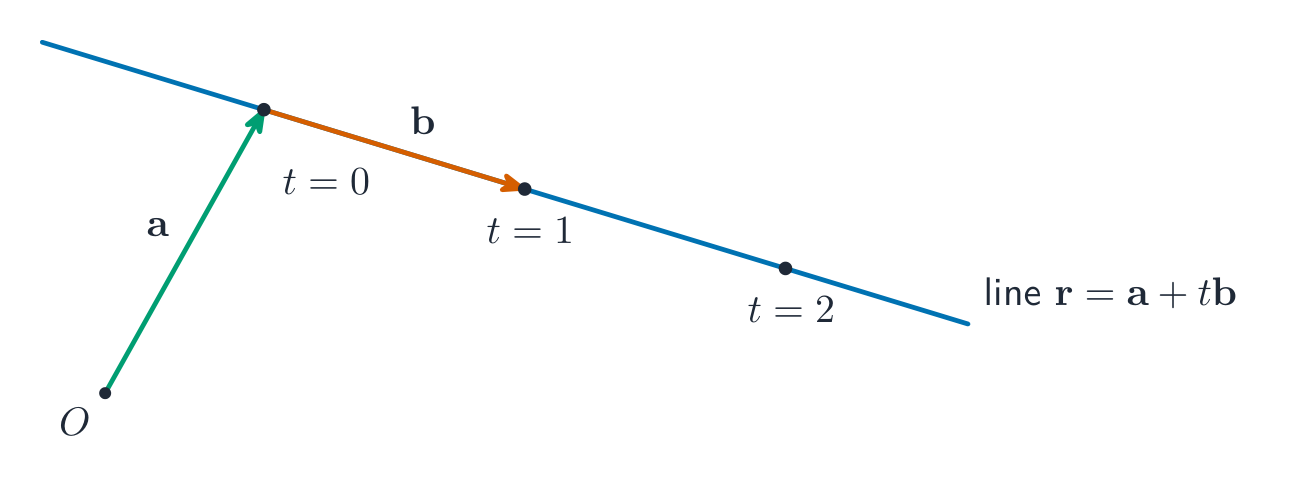
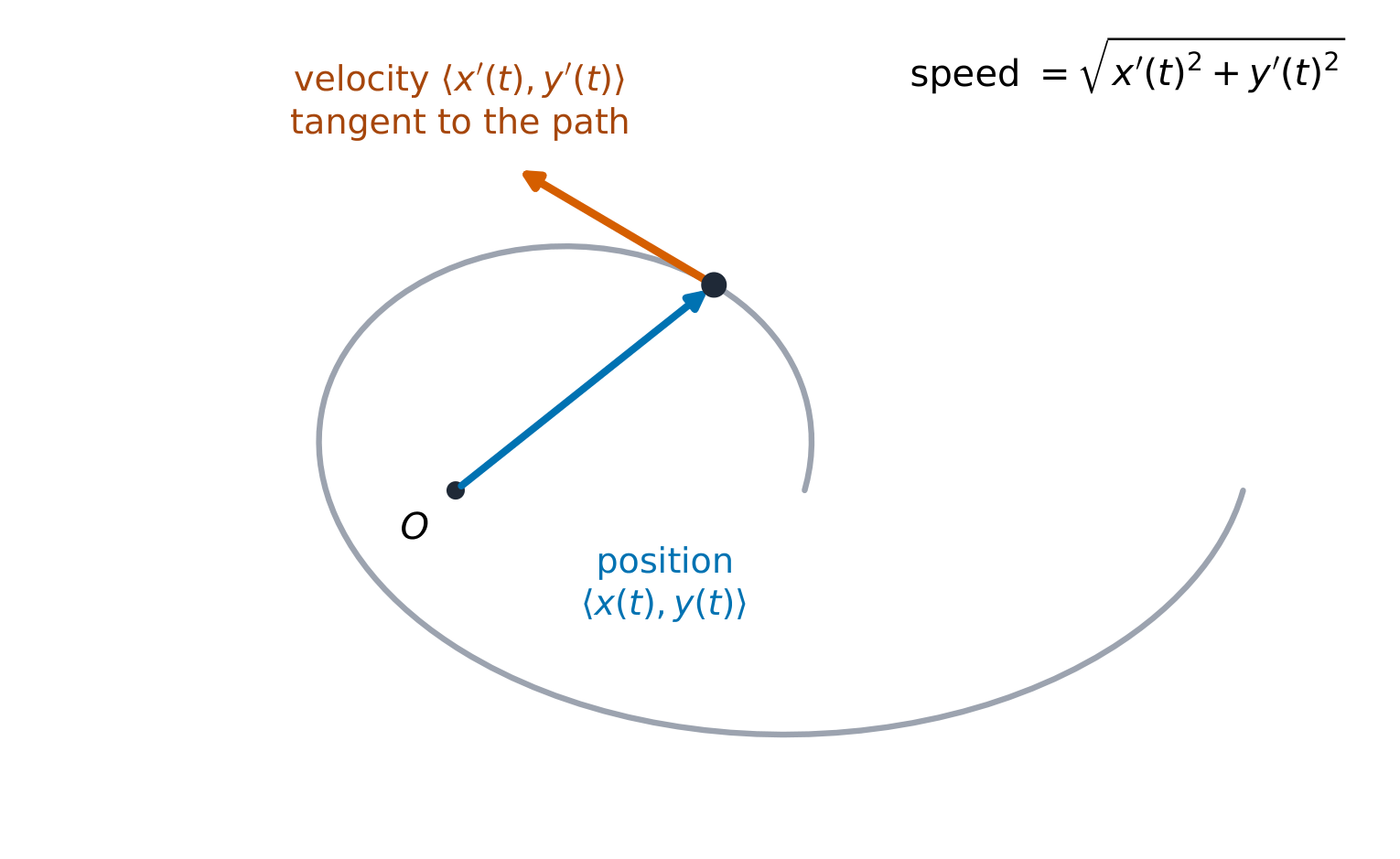
A vector-valued function 向量值函数 $\mathbf r(t)=\langle x(t),y(t)\rangle$ gives a vector for each parameter value. A position vector 位置向量 is a vector from the chosen origin to a point, giving its coordinates. Differentiate component by component:
$$\mathbf v(t)=\mathbf r'(t)=\langle x'(t),y'(t)\rangle,\qquad
\mathbf a(t)=\mathbf r''(t)=\langle x''(t),y''(t)\rangle.$$
The velocity 速度 and acceleration 加速度 are vectors. Speed is the scalar magnitude 模长 $|\mathbf v|=\sqrt{x'^2+y'^2}$. Differentiate the functions before substituting a parameter value; differentiating a fixed position vector loses the nearby change information.
Worked example: the complete chain. For $\mathbf r(t)=\langle t^2,\sin t\rangle$, velocity is $\langle2t,\cos t\rangle$ and acceleration is $\langle2,-\sin t\rangle$. At zero, position is $\langle0,0\rangle$, velocity is $\langle0,1\rangle$, acceleration is $\langle2,0\rangle$ and speed is 1. Being at the origin does not mean being stationary.
Nonzero velocity gives the tangent direction. A zero velocity vector has no direction, but does not rule out a geometric tangent: $\mathbf r(t)=\langle t^3,t^3\rangle$ has zero velocity at zero while its path is the line $y=x$. Position and velocity vectors need not point in the same direction.
Worked example: nontrivial speed. For $\mathbf r(t)=\langle t^2,t^3-t\rangle$, velocity is $\langle2t,3t^2-1\rangle$ and acceleration is $\langle2,6t\rangle$. At $t=1$, the point is $(1,0)$, velocity is $\langle2,2\rangle$, acceleration is $\langle2,6\rangle$ and speed is $2\sqrt2$. At $t=-1$, the point is again $(1,0)$ but velocity $\langle-2,2\rangle$ points left and up.
Try it. For $\mathbf r(t)=\langle3t^2+1,t^3-2t\rangle$, find position, velocity, acceleration and speed at $t=1$.
Answer. The values are $\langle4,-1\rangle$, $\langle6,1\rangle$, $\langle6,6\rangle$ and $\sqrt{37}$. Motion is right and up, determined by velocity rather than the negative y-coordinate.
Explore
Position and its vector derivatives
For r(t)=⟨t²,sin t⟩ at t=0, compare position⟨0,0⟩, velocity⟨0,1⟩, acceleration⟨2,0⟩ and speed 1. The derivative arrows are shown from a common origin for comparison.
Vocabulary
Train
| English |
|---|
| vector-valued function/ˈvektə ˈvæljuːd ˈfʌŋkʃn/ |
| position vector/pəˈzɪʃn ˈvektə/ |
| velocity/vəˈlɒsɪti/ |
| acceleration/əkˌseləˈreɪʃn/ |
| magnitude/ˈmæɡnɪtjuːd/ |
9.5
Integrating Vector-Valued Functions
Syllabus
| Enduring Understanding | Learning Objective | Essential Knowledge |
|---|---|---|
FUN-8 | FUN-8.A |
|
Source: College Board AP Course and Exam Description
A constant vector 常向量 is a vector whose components do not vary with the parameter. Integrate each component and retain an independent constant in each component: $\int\langle f,g\rangle\,dt=\langle F+C_1,G+C_2\rangle$ when $F'=f$, $G'=g$. An initial condition 初始条件 fixes each component's constant independently. Each new integration introduces another constant vector.
Worked example: recover velocity and position. Given $\mathbf a(t)=\langle2,6t\rangle$ and $\mathbf v(0)=\langle1,0\rangle$, integration gives $\mathbf v(t)=\langle2t+1,3t^2\rangle$. If also $\mathbf r(0)=\langle2,-1\rangle$, integrate again to obtain $\mathbf r(t)=\langle t^2+t+2,t^3-1\rangle$. The velocity condition and position condition fix different constants.
Equivalently, include the initial values with definite integrals:
$$\mathbf v(t)=\mathbf v(t_0)+\int_{t_0}^{t}\mathbf a(u)\,du,\qquad
\mathbf r(t)=\mathbf r(t_0)+\int_{t_0}^{t}\mathbf v(u)\,du.$$
The vector integrals give changes; add the initial vector to recover the state. The dummy variable u is distinct from the upper limit t. These signed integrals can also recover an earlier state when $t<t_0$.
Worked example: data at a nonzero time. Keep acceleration $\langle2,6t\rangle$ but use $\mathbf v(1)=\langle4,-2\rangle$, $\mathbf r(1)=\langle3,7\rangle$. The resulting functions are $\mathbf v(t)=\langle2t+2,3t^2-5\rangle$ and $\mathbf r(t)=\langle t^2+2t,t^3-5t+11\rangle$. Substitute t=1 into both and differentiate to verify. The constants are not simply the initial coordinates copied into the antiderivative.
Try it. Given $\mathbf a(t)=\langle4,6t\rangle$, $\mathbf v(1)=\langle1,-2\rangle$, $\mathbf r(1)=\langle3,5\rangle$, recover velocity and position, then find position at $t=2$.
Answer. Velocity is $\langle4t-3,3t^2-5\rangle$, position is $\langle2t^2-3t+4,t^3-5t+9\rangle$, and position at 2 is $\langle6,7\rangle$. Check both derivative equations and both initial vectors.
Worked example. A particle 质点 has velocity $\vec v(t)=\langle 2t,\ 3t^2-1\rangle$ and is at $(1,-2)$ when $t=0$. Find its position at $t=2$. Add the integral of each component to its starting value:
$$x(2)=1+\int_0^2 2t\,dt=1+4=5,\qquad y(2)=-2+\int_0^2(3t^2-1)\,dt=-2+(8-2)=4.$$
The particle is at $(5,4)$. Leaving out the starting point is the classic lost mark.
Explore
Initial vectors select a particular motion
With acceleration⟨2,6 t⟩, initial velocity⟨1,0⟩ and initial position⟨2,−1⟩ at t₀=0, recover velocity⟨3,3⟩ and position⟨4,0⟩ at t=1. Change the initial time and velocity components to see their effects.
Vocabulary
Train
| English |
|---|
| constant vector |
| initial condition/ɪˈnɪʃl kənˈdɪʃn/ |
| particle/ˈpɑːtɪkl/ |
9.6
Solving Motion Problems Using Parametric and Vector-Valued Functions
Syllabus
| Enduring Understanding | Learning Objective | Essential Knowledge |
|---|---|---|
FUN-8 | FUN-8.B |
|
Source: College Board AP Course and Exam Description
Displacement 位移 is the vector change in position, $\int_a^b\mathbf v(t)\,dt=\mathbf r(b)-\mathbf r(a)$. Distance traveled 路程 is the total length of the route, found by integrating its nonnegative speed. For $a\le b$, this scalar is $\int_a^b|\mathbf v(t)|\,dt$. Final position is initial position plus displacement. Distance is at least the displacement magnitude, with equality possible on a straight route traced in one direction.
Worked example: compare the quantities. For $\mathbf v(t)=\langle2t,3\rangle$ and $\mathbf r(0)=\langle1,-2\rangle$, position is $\langle1+t^2,-2+3t\rangle$ and acceleration is $\langle2,0\rangle$. At t=2, position is $\langle5,4\rangle$, velocity is $\langle4,3\rangle$ and speed is 5. On $[0,2]$, displacement is $\langle4,6\rangle$.
The traveled distance is $D=\int_0^2\sqrt{4t^2+9}\,dt=5+\frac94\ln3\approx7.472$.
The endpoint distance is $\sqrt{52}\approx7.211$, shorter than this curved route. Keep position, velocity, acceleration, speed, displacement and total distance distinct.
Where speed is positive, its derivative is $(\mathbf v\cdot\mathbf a)/|\mathbf v|$. A positive dot product means speeding up; a negative one means slowing down. At t=2 in the example, the rate is $8/5>0$. At zero speed, investigate separately instead of dividing by zero. Constant speed can coexist with nonzero acceleration when velocity changes direction, as on a circle.
Worked position example. For $\mathbf r(t)=\langle t^2,t^3-t\rangle$, velocity at 1 is $\langle2,2\rangle$, speed is $2\sqrt2$, and position at 2 is $\langle4,6\rangle$.
Common mistake. Adding the components for the speed ($2+2=4$). Speed is the length of the velocity vector, $\sqrt{(dx/dt)^2+(dy/dt)^2}$.
Try it. For $\mathbf r(t)=\langle(t-2)^2,0\rangle$ on $[0,3]$, find displacement, traveled distance and the reversal time.
Answer. The endpoints are $(4,0)$ and $(1,0)$, giving displacement $\langle-3,0\rangle$. Speed is $2|t-2|$; splitting its integral at 2 gives distance 4+1=5. The point slows down before t=2, stops and reverses there, then speeds up afterward.
Explore
One motion, several different quantities
For v(t)=⟨2 t,3⟩ and r(0)=⟨1,−2⟩, compare position, velocity, acceleration, speed, displacement and the speed integral. Then compare a reversing route and a circle.
Vocabulary
Train
| English |
|---|
| displacement/dɪˈspleɪsmənt/ |
| distance traveled |
9.7
Defining Polar Coordinates and Differentiating in Polar Form
Syllabus
| Enduring Understanding | Learning Objective | Essential Knowledge |
|---|---|---|
FUN-3 | FUN-3.G |
|
Source: College Board AP Course and Exam Description
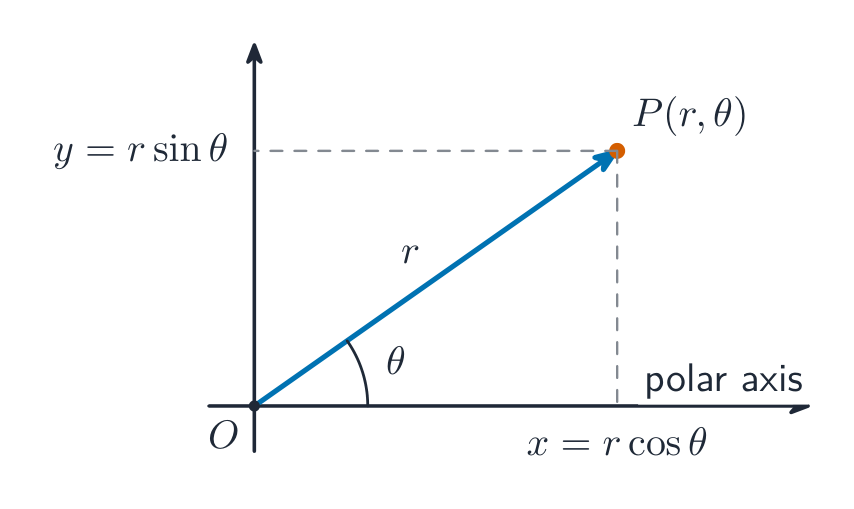
Polar coordinates 极坐标 locate a point by a signed radius r and an angle $\theta$, measured from the positive x-axis. A positive radius moves along that ray; a negative radius moves in the opposite direction. The distance from the origin is $|r|$. The pole 极点 is the origin of the polar coordinate system.
Cartesian 直角坐标 refers to a coordinate system with perpendicular axes. Convert with $x=r\cos\theta$, $y=r\sin\theta$. These formulas also work for negative r.
Worked example: converting points. $(2,\pi/3)$ gives $(1,\sqrt3)$, while $(-2,\pi/6)$ gives $(-\sqrt3,-1)$.
Polar representations are not unique. Adding a full turn leaves a point unchanged, and $(-r,\theta+\pi)$ gives the same point as $(r,\theta)$. To choose a nonnegative radius from x and y, use $r=\sqrt{x^2+y^2}$ and select an angle in the correct quadrant. The point $(-1,\sqrt3)$ has angle $2\pi/3$ in $[0,2\pi)$; $\arctan(y/x)=-\pi/3$ would choose the wrong quadrant. Handle axes without dividing by x; at the pole every angle represents the same point.
For $r=f(\theta)$, use radians and treat the angle as a parameter. With primes denoting angle derivatives,
$$x'=r'\cos\theta-r\sin\theta,\qquad y'=r'\sin\theta+r\cos\theta.$$
The tangent slope 切线斜率 is the rate of change of y with x along a curve, where that derivative is finite. Where $x'\ne0$, it is $dy/dx=y'/x'$, not $dr/d\theta$.
Worked example: point and tangent. For $r=2\cos\theta$ at $\pi/4$, $r=\sqrt2$ and $r'=-\sqrt2$. The point is $(1,1)$, and the coordinate rates are $x'=-2$, $y'=0$. Hence the slope is 0 and the tangent is $y=1$, although the radial rate is $-\sqrt2$. At $\pi/2$, the point is the pole with $x'=0$, $y'=-2$, so the tangent is $x=0$.
Regular horizontal and vertical tangents require the complementary coordinate rate to be nonzero. If both vanish, investigate further: for $r=1+\cos\theta$ at $\pi$, $x'=y'=0$, so the regular ratio test is inconclusive. A zero radius alone does not cause this; for $r=\theta$ at zero, $x'=1$, $y'=0$ and the tangent is $y=0$.
For the second x-derivative, differentiate the slope in the angle and divide by $x'$ again:
$$\frac{d^2y}{dx^2}=\frac{d(y'/x')/d\theta}{x'}=\frac{x'y''-y'x''}{(x')^3},\qquad x'\ne0.$$
Here $x''=(r''-r)\cos\theta-2r'\sin\theta$ and $y''=(r''-r)\sin\theta+2r'\cos\theta$. For $r=2$ at $\pi/4$, the slope is $-\cot\theta$, whose angle derivative is 2 at that point. Dividing by $x'=-\sqrt2$ gives $d^2y/dx^2=-\sqrt2$, consistent with the upper circle being concave down.
Try it. For $r=3\sin\theta$ at $\pi/6$, find the Cartesian point, coordinate rates and tangent line.
Answer. Here $r=3/2$, $r'=3\sqrt3/2$ and $(x,y)=(3\sqrt3/4,3/4)$. The rates are $x'=3/2$, $y'=3\sqrt3/2$, so the slope is $\sqrt3$ and the tangent is $y-3/4=\sqrt3(x-3\sqrt3/4)$.
Explore
Signed radius, Cartesian point and tangent
For r=2 cos θ at θ=π/4, compare the radial rate with the horizontal tangent. Then examine negative radii, a vertical tangent and a both-zero case.
Vocabulary
Train
| English |
|---|
| polar coordinates/ˈpəʊlə kəʊˈɔːdɪnəts/ |
| pole/pəʊl/ |
| Cartesian/kɑːˈtiːzɪən/ |
| tangent slope |
9.8
Finding the Area of a Polar Region
Syllabus
| Enduring Understanding | Learning Objective | Essential Knowledge |
|---|---|---|
CHA-5 | CHA-5.D |
|
Source: College Board AP Course and Exam Description
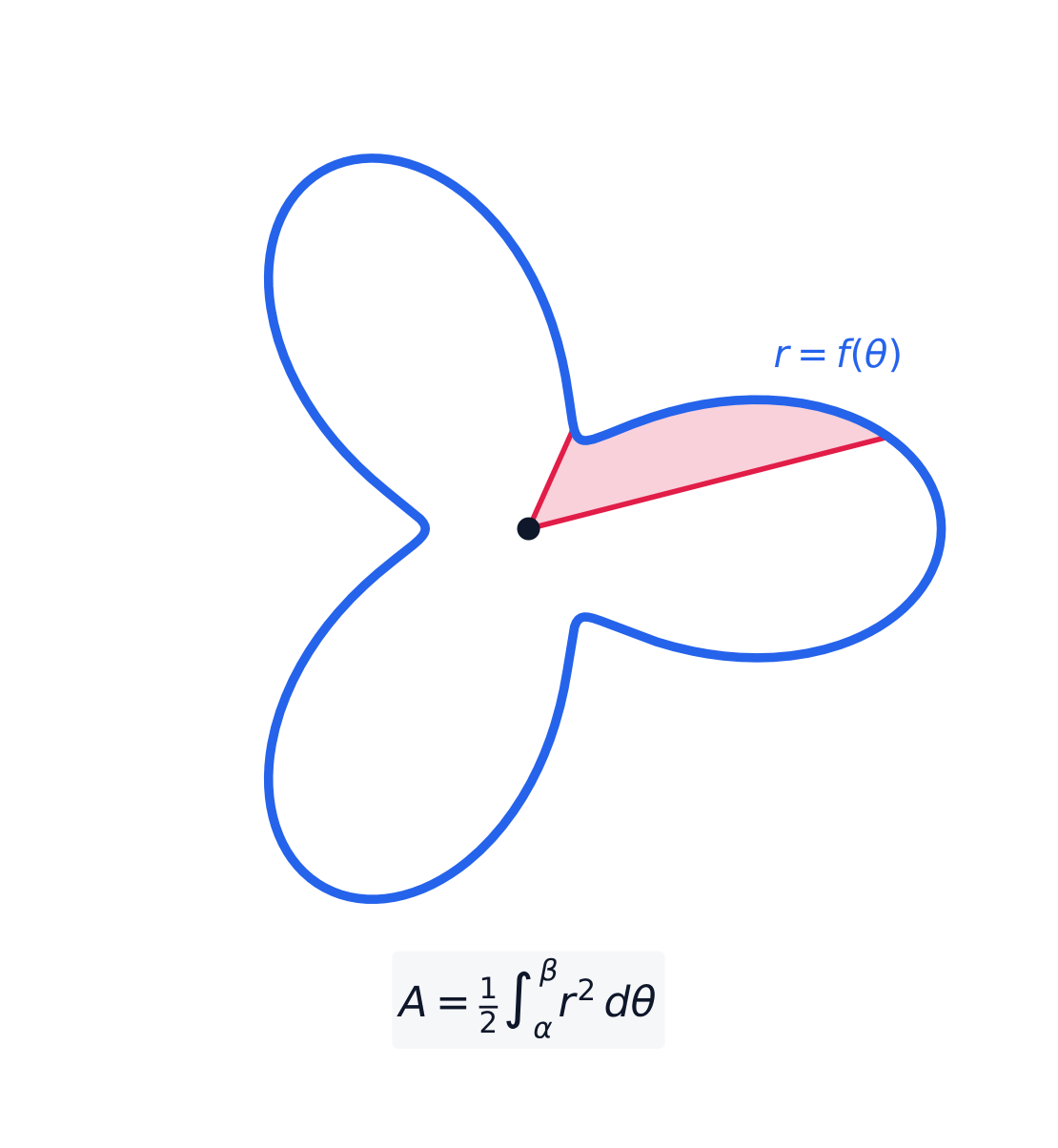
A sector 扇形 is a circular region bounded by two radii and the arc joining their endpoints. Its area is $R^2\Delta\theta/2$ for a radian angle $\Delta\theta$. Thin sectors lead to the sweep integral
$$A=\frac12\int_\alpha^\beta \big(f(\theta)\big)^2\,d\theta,\qquad\alpha\le\beta.$$
The integrand is nonnegative even for negative r. It gives geometric area when the radial sweep covers the intended region once; repeated coverage is counted repeatedly. Use ordered radian bounds, the complete squared radius and square units.
A petal 花瓣 is a loop of a rose curve 玫瑰线 from the pole back to the pole. Find its start and end angles, rather than automatically integrating through a full turn.
Worked example. Find the area of one petal of the rose curve $r=2\sin(2\theta)$ (traced for $\theta$ from $0$ to $\tfrac{\pi}{2}$). Using $\sin^2 u=\tfrac12(1-\cos 2u)$,
$$A=\frac12\int_0^{\pi/2}(2\sin 2\theta)^2\,d\theta=\int_0^{\pi/2}(1-\cos 4\theta)\,d\theta=\left[\theta-\tfrac{\sin 4\theta}{4}\right]_0^{\pi/2}=\frac{\pi}{2}.$$
Worked example: a different rose. For $r=\cos3\theta$, the right-hand petal is traced from $-\pi/6$ to $\pi/6$, where r is nonnegative. Its area is
$$\frac14\int_{-\pi/6}^{\pi/6}(1+\cos6\theta)\,d\theta=\left[\frac\theta4+\frac{\sin6\theta}{24}\right]_{-\pi/6}^{\pi/6}=\frac\pi{12}.$$
Symmetry 对称性 is a property in which a shape matches itself after a reflection or rotation. This rose has three equal petals, giving total area $\pi/4$. It is traced once on $[0,\pi]$; the integral on $[0,2\pi]$ is $\pi/2$ because it counts the rose twice. Likewise, $r=2\cos\theta$ traces its circle once on $[0,\pi]$, with area $\pi$, and twice on $[0,2\pi]$.
Try it. Find the full area and upper-half area for $r=2+2\cos\theta$.
Answer. Use $[0,2\pi]$ for the full cardioid. Expanding its square gives
$$\frac12\int_0^{2\pi}(4+8\cos\theta+4\cos^2\theta)\,d\theta=6\pi.$$
On $[0,\pi]$, r is nonnegative and y is nonnegative, so this interval sweeps the upper half once. Reflection symmetry gives upper-half area $3\pi$. All radii are twice those of $r=1+\cos\theta$, so the full area is four times $3\pi/2$, not twice it.
Explore
A polar region and its sweep integral
For r=cos 3θ, the bounds −π/6 to π/6 give one petal with area π/12. Compare a full rose and repeated coverage.
Vocabulary
Train
| English |
|---|
| sector/ˈsektə/ |
| petal |
| symmetry/ˈsɪmətri/ |
| rose curve |
9.9
Finding the Area of the Region Bounded by Two Polar Curves

Syllabus
| Enduring Understanding | Learning Objective | Essential Knowledge |
|---|---|---|
CHA-5 | CHA-5.D |
|
Source: College Board AP Course and Exam Description
An outer polar radius 外极径 is the nonnegative distance to the farther boundary on a common ray. An inner polar radius 内极径 is the nonnegative distance to the nearer boundary on that ray. For a radial band with $r_{\mathrm{out}}\ge r_{\mathrm{in}}\ge0$, subtract the sectors:
$$A=\frac12\int_\alpha^\beta\big(r_{\mathrm{out}}^2-r_{\mathrm{in}}^2\big)\,d\theta.$$
Square each radius before subtracting; this is not $(r_{\mathrm{out}}-r_{\mathrm{in}})^2/2$. Use common physical rays and nonnegative distances, rather than comparing signed parameters at unrelated angles.
An intersection 交点 is a point shared by two curves. Equating radii at the same angle finds candidates; also check the pole and other parameter representations.
Bounds can come from given rays or a full turn. The concentric circles $r=2$ and $r=1$ never cross, yet their ring has area $\tfrac12\int_0^{2\pi}(4-1)\,d\theta=3\pi$.
Worked example: the pictured region. For $r_A=3\cos\theta$ and $r_B=1+\cos\theta$, common nonnegative crossing radii satisfy $\cos\theta=1/2$, giving angles $\pm\pi/3$ and radius $3/2$. Both curves also reach the pole, but at different parameters: A at $\pi/2$ and B at $\pi$.
Inside A but outside B requires $3\cos\theta\ge1+\cos\theta\ge0$, so keep $[-\pi/3,\pi/3]$. The area is
$$\frac12\int_{-\pi/3}^{\pi/3}\left[9\cos^2\theta-(1+\cos\theta)^2\right]d\theta=\left[\frac{3\theta}{2}+\sin2\theta-\sin\theta\right]_{-\pi/3}^{\pi/3}=\pi.$$
Where A is nearer than B, that requested radial band is empty. Taking an absolute difference there would add the opposite region, inside B but outside A. Do not use an absolute value to repair bounds chosen for a different request.
Worked example: switching outer boundary. For the band between $r_A=1+\cos\theta$ and $r_B=1$ on $[0,2\pi]$, split at $\pi/2$ and $3\pi/2$. A is outer on the first and last intervals; B is outer in the middle. Let
$$f(\theta)=\frac12\left[(1+\cos\theta)^2-1\right],\qquad F(\theta)=\sin\theta+\frac\theta4+\frac{\sin2\theta}{8}.$$
The two A-outer pieces total $2+\pi/4$; the middle B-outer area is $2-\pi/4$. Their sum is 4 square units, while the unsplit signed integral of f is only $\pi/2$. For this band, integrate $|f|$, or reverse the subtraction on the middle interval.
For inside both radial regions, use the smaller nonnegative reach and integrate $\tfrac12\min(r_A,r_B)^2$. For the concentric circles 2 and 1, the common disk has area $\pi$, rather than the ring area $3\pi$.
Try it. Find the area inside $r=3$, outside $r=1$, between the rays $\pi/6$ and $5\pi/6$.
Answer. The given rays supply the limits. The angle span is $2\pi/3$, so the area is $\tfrac12(9-1)(2\pi/3)=8\pi/3$ square units. No intersection calculation is needed for these concentric circles.
Explore
Two boundaries, one requested region
For A=3 cos θ and B=1+cos θ, bounds −π/3 to π/3 give area π. Compare omitted rays, an annulus and a band whose outer boundary switches.
Vocabulary
Train
| English |
|---|
| outer polar radius |
| inner polar radius |
| intersection/ˌɪntəˈsekʃn/ |
9.9
Exam tips
- For parametric curves, $\tfrac{dy}{dx}=\tfrac{dy/dt}{dx/dt}$ where $dx/dt\ne0$; speed is $\sqrt{(dx/dt)^2+(dy/dt)^2}$.
- A vector-valued function carries the same information — differentiate/integrate it component by component.
- In polar, distance is $|r|$; convert with $x=r\cos\theta$, $y=r\sin\theta$. The slope ratio needs $dx/d\theta\ne0$, and geometric area needs a once-only radial sweep.
- Watch the direction of tracing using both coordinate rates and set correct $\theta$-limits for polar area.
- Eliminate the parameter to recover the ordinary $y$-vs-$x$ shape when it helps.
Interactive lessons on this topic
Work through it step by step, with instant-check exercises.
- Defining and Differentiating Parametric Equations
- Second Derivatives of Parametric Equations
- Finding Arc Lengths of Curves Given by Parametric Equations
- Defining and Differentiating Vector-Valued Functions
- Integrating Vector-Valued Functions
- Solving Motion Problems Using Parametric and Vector-Valued Functions
- Defining Polar Coordinates and Differentiating in Polar Form
- Find the Area of a Polar Region or the Area Bounded by a Single Polar Curve
- Finding the Area of the Region Bounded by Two Polar Curves