Comparison Tests for Convergence
Introduced| English | Meaning |
|---|---|
| comparison tests/kəmˈpærɪsn tests/ | comparison tests |
| Limit Comparison Test | Limit Comparison Test |
Bound a total without finding it exactly
- A model has non-negative costs $a_n$ that never exceed $1/n^2$. Since the larger costs have a finite total, the smaller total must also be finite.
- The comparison tests 比较判别法 turn this idea into a convergence argument. The direction of the bound and the known series' behaviour both matter.
Check the terms on a valid tail
- Direct comparison uses non-negative terms from some index $N$ onward. The comparison need not hold for every early term, because finitely many finite terms do not change convergence.
- For a ratio in Limit Comparison, both term sequences must be positive on the tail. A signed series needs another argument or a separate study of its absolute values.
For finite-positive Limit Comparison, both term sequences must be positive on the chosen tail.
Difficulty 1/5 · 100 coins + a small bonus on first completion today
Positivity makes the ratio comparison valid; in particular the denominator terms must not be zero.
A comparison may be valid only after some index, provided all earlier terms are finite and defined.
Difficulty 1/5 · 100 coins + a small bonus on first completion today
A finite prefix does not change convergence.
Prove convergence with an upper bound
- If $0\le a_n\le b_n$ for all $n\ge N$ and $\sum b_n$ converges, then $\sum a_n$ converges. Its increasing tail partial sums are bounded above by the larger series' sums.
- For $a_n=1/(n^2+1)$, the larger denominator gives $0<a_n<1/n^2$. The p-series with power $2$ converges, so the smaller series converges too.
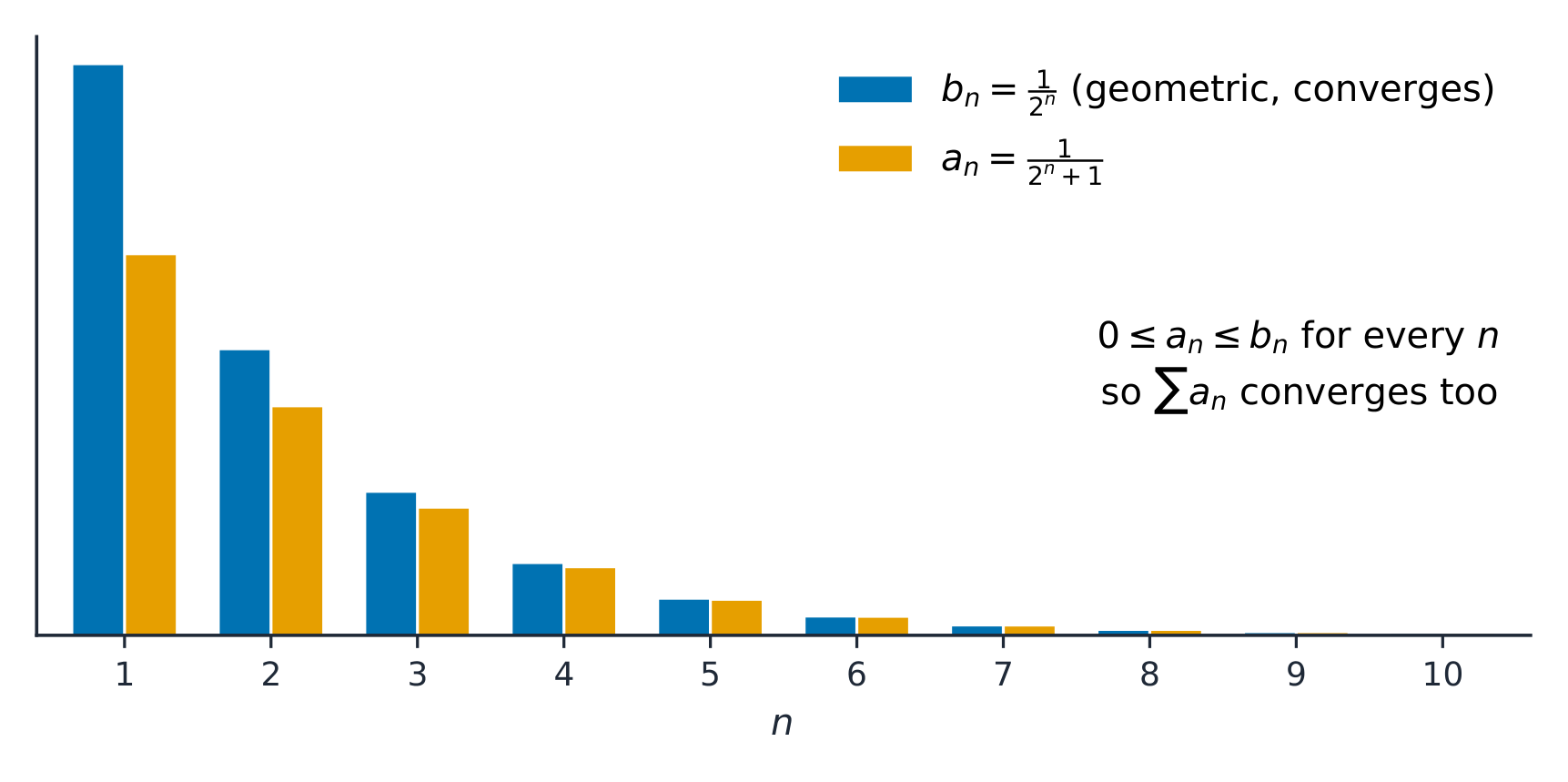
If $0\le a_n\le b_n$ eventually and $\sum b_n$ converges, then $\sum a_n$...
Difficulty 1/5 · 100 coins + a small bonus on first completion today
An upper bound by a convergent non-negative series bounds the smaller partial sums.
Since $0<1/(n^2+1)<1/n^2$, the series $\sum1/(n^2+1)$...
Difficulty 1/5 · 100 coins + a small bonus on first completion today
The larger p-series with power 2 converges.
Two series that converge by comparison must have equal sums.
Difficulty 1/5 · 100 coins + a small bonus on first completion today
The comparison establishes convergence, not equality of the individual terms or sums.
Prove divergence with a lower bound
- If $a_n\ge b_n\ge0$ for all $n\ge N$ and $\sum b_n$ diverges, then $\sum a_n$ diverges. The smaller positive partial sums already grow without bound.
- For $n\ge1$, $n+1\le2n$, so $1/(n+1)\ge1/(2n)$. The latter series is half the divergent harmonic series; therefore $\sum1/(n+1)$ diverges.

If $a_n\ge b_n\ge0$ eventually and $\sum b_n$ diverges, what follows?
Difficulty 1/5 · 100 coins + a small bonus on first completion today
The larger positive partial sums also grow without bound.
For $n\ge1$, $1/(n+1)\ge c/n$ with c=1/2. Enter c.
Difficulty 2/5 · 140 coins + a small bonus on first completion today
The inequality n+1≤2n reverses when taking positive reciprocals.
A true inequality can still be unhelpful
- Being smaller than a divergent series does not prove divergence: $1/n^2\le1/n$, yet the smaller series converges. Being larger than a convergent series does not prove convergence either.
- Choose a bound that supports the required conclusion. Convergence is transferred to a smaller non-negative series; divergence is transferred to a larger one.
Compare two series: bounds and ratios
Default 1/(n²+1)≤1/n² proves convergence. Other cases show a divergent lower bound, a positive finite limit ratio and an upper bound that gives no conclusion.
A non-negative series smaller term by term than a divergent series must diverge.
Difficulty 1/5 · 100 coins + a small bonus on first completion today
The convergent series Σ1/n² is smaller than the divergent harmonic series.
A non-negative series larger term by term than a convergent series must converge.
Difficulty 1/5 · 100 coins + a small bonus on first completion today
The divergent harmonic series is larger than the convergent series Σ1/n².
State where an inequality is valid
- For $n\ge3$, $n^2-4\ge n^2/2$, so $0<1/(n^2-4)\le2/n^2$. Hence $\sum_{n=3}^{\infty}1/(n^2-4)$ converges by comparison with a convergent p-series multiple.
- The lower limit matters: a supposed term at $n=2$ would be undefined. A finite prefix may be ignored for convergence only when its terms are finite and defined.
For the displayed bound on $1/(n^2-4)$, the lesson starts at n=3. What integer lower limit is used?
Difficulty 2/5 · 140 coins + a small bonus on first completion today
At n=2 the expression is undefined; all n≥3 give positive terms and the stated bound.
An undefined term at n=2 can always be ignored by calling it a finite prefix.
Difficulty 1/5 · 100 coins + a small bonus on first completion today
Finite-prefix invariance requires finite, defined terms.
Compare a ratio when bounds are awkward
- The Limit Comparison Test 极限比较判别法 uses $L=\lim_{n\to\infty}a_n/b_n$. If both sequences are positive eventually and $0<L<\infty$, their series either both converge or both diverge.
- First classify the known series $\sum b_n$, then transfer that result. A finite positive ratio does not by itself say which behaviour occurs, and it does not equate the sums.
For eventually positive terms, $\lim a_n/b_n=L$ with $0<L<\infty$ means...
Difficulty 1/5 · 100 coins + a small bonus on first completion today
First classify the known comparison series, then transfer its behaviour.
For the finite-positive Limit Comparison theorem, L must be finite and ____.
Difficulty 1/5 · 100 coins + a small bonus on first completion today
The condition is 0<L<∞, not merely that the limit exists.
A finite positive term-ratio limit by itself proves convergence, without classifying the comparison series.
Difficulty 1/5 · 100 coins + a small bonus on first completion today
The comparison series may diverge; the ratio transfers its behaviour.
Work a convergent limit comparison
- For $a_n=(3n^2+1)/(n^4+5)$, choose $b_n=1/n^2$ from the leading powers. Both are positive for $n\ge1$.
- Form the complete ratio and take its limit. The known p-series converges, so the given series converges.
A suitable comparison for $a_n=(3n^2+1)/(n^4+5)$ is...
Difficulty 1/5 · 100 coins + a small bonus on first completion today
The leading powers give 3/n², suggesting a p-series with power 2.
For $a_n=(3n^2+1)/(n^4+5)$ and $b_n=1/n^2$, find $\lim a_n/b_n$.
Difficulty 2/5 · 140 coins + a small bonus on first completion today
The complete ratio is (3+1/n²)/(1+5/n⁴), which tends to 3.
Work a divergent limit comparison
- For $a_n=(2n+1)/(n^2+4)$, choose $b_n=1/n$, the harmonic term. Both sequences are positive.
- Now $a_n/b_n=(2+1/n)/(1+4/n^2)\to2$. This positive finite limit transfers harmonic divergence to the given series.
For $a_n=(2n+1)/(n^2+4)$ and $b_n=1/n$, find $\lim a_n/b_n$.
Difficulty 2/5 · 140 coins + a small bonus on first completion today
The complete ratio is (2+1/n)/(1+4/n²), which tends to 2.
The previous ratio limit is 2 and the comparison series is harmonic. The given series...
Difficulty 1/5 · 100 coins + a small bonus on first completion today
A positive finite ratio transfers harmonic divergence.
Keep zero and infinite ratio limits separate
- If $L=0$ or $L=\infty$, the finite-positive form of Limit Comparison does not justify the same-behaviour conclusion. It is not a proof that the unknown series diverges.
- For example, $(1/n^2)/(1/n)\to0$, and the series have different behaviours. Choose a better comparison or a valid direct bound; do not treat the ratio limit as the series sum.
A zero ratio limit automatically proves that the numerator series diverges.
Difficulty 1/5 · 100 coins + a small bonus on first completion today
The finite-positive same-behaviour theorem does not apply, and zero is not a divergence verdict.
Find $\lim_{n\to\infty}(1/n^2)/(1/n)$.
Difficulty 2/5 · 140 coins + a small bonus on first completion today
The ratio simplifies to 1/n and tends to 0.
Practise bounds and full ratios
- Classify $\sum_{n=2}^{\infty}1/(n^2-1)$ with a justified bound, then classify $\sum_{n=1}^{\infty}\sqrt n/(n^2+1)$ using a limit comparison.
- Use a separate limit comparison for $\sum_{n=1}^{\infty}(4n^2+3)/(n^3+2)$. State the known series and show why its convergence or divergence transfers.
Classify $\sum_{n=2}^{\infty}1/(n^2-1)$ by a direct comparison. Show why the bound is valid.
Compare the valid tail, inequality or ratio, and final conclusion with the model.
Use Limit Comparison for $\sum_{n=1}^{\infty}\sqrt n/(n^2+1)$. Show the complete ratio.
Compare the valid tail, inequality or ratio, and final conclusion with the model.
Use Limit Comparison for $\sum_{n=1}^{\infty}(4n^2+3)/(n^3+2)$. Name the known series.
Compare the valid tail, inequality or ratio, and final conclusion with the model.
Write a complete comparison argument
- Name the comparison series and classify it. Give a valid starting index and either the correctly directed inequality or a positive finite ratio limit.
- Conclude convergence or divergence of the requested series. Approximate leading behaviour helps choose a comparison; it does not replace the justification or give an exact sum.
For non-negative tails, an upper bound by a convergent series proves convergence; a lower bound by a divergent series proves divergence. For eventually positive terms, a ratio limit strictly between $0$ and infinity transfers the known series' behaviour. A finite picture illustrates these arguments but does not prove an infinite limit.
Which direct bounds give the stated conclusions for non-negative tails? Select all.
Difficulty 2/5 · 140 coins + a small bonus on first completion today
Only a convergent upper bound or a divergent lower bound has the required direction.