This handout covers Topic 3: Further Mechanics 进阶力学. It extends mechanics to projectiles, rigid bodies, circular motion, elastic strings, variable forces and collisions. Take $g=10\ \text{m s}^{-2}$ unless stated otherwise.
Further Mechanics
A-Level Further Mathematics · Topic 3
 8:04
Further Mechanics
Throw a ball, fire a jet of water, launch anything into the air — and it traces the same elegant curve: a parabola. The secret is to split the motion in two.…
English narration · English + 中文 subtitles burned in
3.1
Motion of a projectile

Syllabus
| Candidates should be able to: | Notes and examples |
|---|---|
| • model the motion of a projectile as a particle moving with constant acceleration and understand any limitations of the model | Vector methods are not required |
| • use horizontal and vertical equations of motion to solve problems on the motion of projectiles, including finding the magnitude and direction of the velocity at a given time or position, the range on a horizontal plane and the greatest height reached | |
| • derive and use the Cartesian equation of the trajectory of a projectile, including problems in which the initial speed and/or angle of projection may be unknown. | Knowledge of the 'bounding parabola' for accessible points is not included. |
Source: Cambridge International syllabus
Predict where a thrown ball will go
A ball is thrown across a court. Its position, speed and direction change during the flight. We need a model that predicts all three, including a landing point below the thrower's hand. A projectile 抛射体 moves freely under gravity 重力. Model it as a particle 质点, ignore air resistance 空气阻力 and take gravity as constant. These assumptions become less accurate for a light shuttlecock, strong wind or a very long flight.
The water arcs suggest the model; drag and interactions between water drops limit its accuracy.
Set the origin and resolve the launch velocity
Put the origin at launch, with horizontal 水平 displacement 位移 $x$ to the right and vertical 竖直 displacement $y$ upwards. Let the angle of projection 抛射角 $\alpha$ be measured above the horizontal. The initial velocity component 速度分量 in each direction is $u_x=u\cos\alpha$, $u_y=u\sin\alpha$. For $u=20\ \dfrac{\text{m}}{\text{s}}$ and $\tan\alpha=4/3$, a $3$–$4$–$5$ triangle gives $u_x=12$, $u_y=16$, in metres per second.
Use the same time in both directions
There is no horizontal force. The constant acceleration 匀加速 is $0$ horizontally and $-g$ vertically. With displacement measured from launch, the position and velocity equations are:
$$\begin{aligned}
x&=u_xt,&y&=u_yt-\frac12gt^2,\\
v_x&=u_x,&v_y&=u_y-gt.
\end{aligned}$$
Both equations use the same $t$. Unless a question states otherwise, take $g=10\ \dfrac{\text{m}}{\text{s}^2}$ in the worked projectile examples.
Find position and speed at a stated time
For $u_x=12$, $u_y=16$, $g=10$ and $t=1.5\ \text{s}$, the position is $x=18\ \text{m}$, $y=24-11.25=12.75\ \text{m}$. The velocity components are $12$ and $1$, in metres per second. Speed is the magnitude of velocity: $v=\sqrt{12^2+1^2}=\sqrt{145}\ \dfrac{\text{m}}{\text{s}}$. Its direction is $\tan^{-1}(1/12)\approx4.76^\circ$ above the horizontal. Position coordinates are not velocity components.
Translate a direction into signed components
Later the same ball travels at $45^\circ$ to the downward vertical. It is descending, so $v_y<0$ and $|v_y|=v_x=12$. Thus $16-10t=-12$ and $t=2.8\ \text{s}$. Then $(x,y)=(33.6,5.6)\ \text{m}$ and $v=12\sqrt2\ \dfrac{\text{m}}{\text{s}}$. For a downward angle $\beta$ to the horizontal use $v_y=-v_x\tan\beta$; for angle $\gamma$ to the downward vertical use $v_y=-v_x\cot\gamma$.
A height may be reached twice
At height $10\ \text{m}$, $16t-5t^2=10$ gives $t=(8\pm\sqrt{14})/5\ \text{s}$. Both times are positive: one on the way up, one on the way down. The corresponding $x$ values are $(96\pm12\sqrt{14})/5\ \text{m}$. The vertical velocities are $\pm2\sqrt{14}\ \dfrac{\text{m}}{\text{s}}$, with the positive velocity at the earlier time. Both speeds are $\sqrt{144+56}=10\sqrt2\ \dfrac{\text{m}}{\text{s}}$. Keep both roots until the event wording selects one.
Derive the greatest height
For an upward launch, the greatest height 最大高度 above launch occurs when $v_y=0$. Therefore $t_{\rm top}=u_y/g$ and $H=u_y^2/(2g)=u^2\sin^2\alpha/(2g)$. For $u=20\ \dfrac{\text{m}}{\text{s}}$, $\alpha=30^\circ$ and $g=10$, $u_y=10$, so $t_{\rm top}=1\ \text{s}$ and $H=5\ \text{m}$. The horizontal speed is still $10\sqrt3\ \dfrac{\text{m}}{\text{s}}$; the velocity is not zero.
Derive the level-ground range
If landing is at the launch height, set $y=0$: $t(u_y-gt/2)=0$. The root $t=0$ is launch; the positive time of flight 飞行时间 is $T=2u_y/g$ for $u_y>0$. The range 射程 on that horizontal plane is $R=u_xT=u^2\sin2\alpha/g$. For the $20\ \dfrac{\text{m}}{\text{s}}$, $30^\circ$ example, $T=2\ \text{s}$ and $R=20\sqrt3\approx34.6\ \text{m}$. The formula does not apply unchanged when landing height differs.
State the conditions for a maximum range
For fixed $u$ and $g$, no air resistance, level ground and an upward launch, $\sin2\alpha\le1$ gives the largest range at $\alpha=45^\circ$. Complementary angles such as $30^\circ$ and $60^\circ$ give the same range, but different heights and flight times. A vertical throw has zero horizontal range. A horizontal or downward launch from a raised platform needs its actual landing height; the $45^\circ$ conclusion cannot simply be carried over.
Land below the launch point
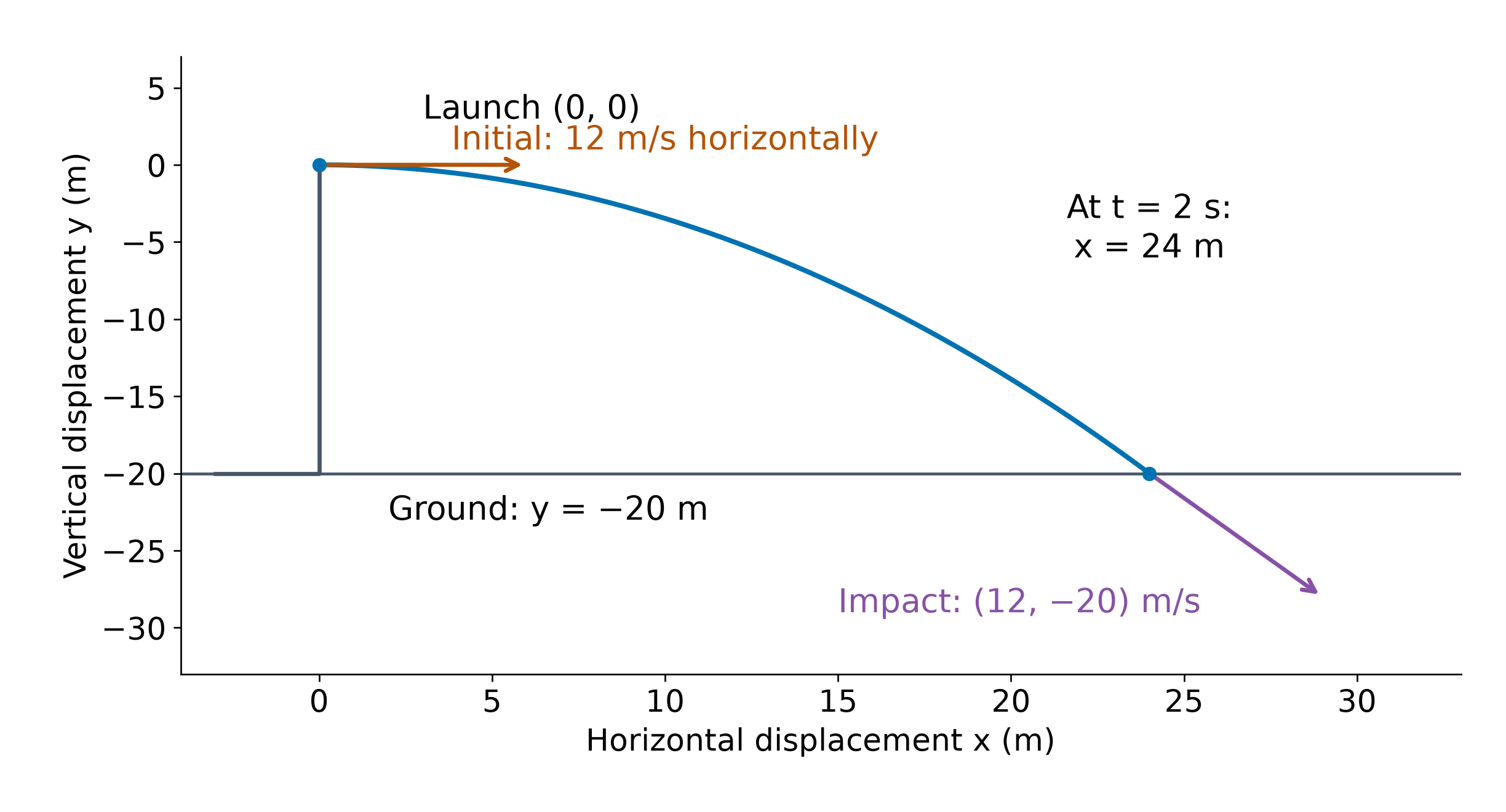
A ball leaves a $20\ \text{m}$ platform horizontally at $12\ \dfrac{\text{m}}{\text{s}}$. With the origin at launch, the ground is $y=-20$, not $y=0$. Thus $-5t^2=-20$ gives the physical root $t=2\ \text{s}$ and horizontal distance $24\ \text{m}$. At impact, $v_x=12$, $v_y=-20$, so speed is $4\sqrt{34}\ \dfrac{\text{m}}{\text{s}}$ and direction is $\tan^{-1}(20/12)\approx59.0^\circ$ below horizontal. Reject $t=-2$ because it precedes launch.
Eliminate time to obtain the trajectory
The trajectory 轨迹 is the path. For $u_x\ne0$, substitute $t=x/(u\cos\alpha)$ into the vertical equation. This gives its Cartesian equation 直角坐标方程:
$$\begin{aligned}
y&=u\sin\alpha\frac{x}{u\cos\alpha}-\frac g2\left(\frac{x}{u\cos\alpha}\right)^2\\
&=x\tan\alpha-\frac{gx^2}{2u^2\cos^2\alpha}.
\end{aligned}$$
It is a parabola 抛物线 for a non-vertical launch. The equation describes the mathematical curve; keep only positions reached after launch and before the first impact. A vertical throw has $x=0$ throughout, so this division is not allowed.
Use a known direction to find an unknown speed
Suppose $\tan\alpha=3/2$ and the projectile passes through $(10,10)\ \text{m}$. Write $T=\tan\alpha$ and $1/\cos^2\alpha=1+T^2$. The trajectory equation gives
$$u^2=\frac{gX^2(1+T^2)}{2(XT-Y)}=\frac{10(100)(13/4)}{2(15-10)}=325.$$
Hence $u=5\sqrt{13}\ \dfrac{\text{m}}{\text{s}}$, $u_x=10$, $u_y=15$ and $y=3x/2-x^2/20$. For a target to the right, $X>0$ and a finite positive speed requires $XT>Y$: the initial straight direction must point above the target.
Find two launch angles for one target
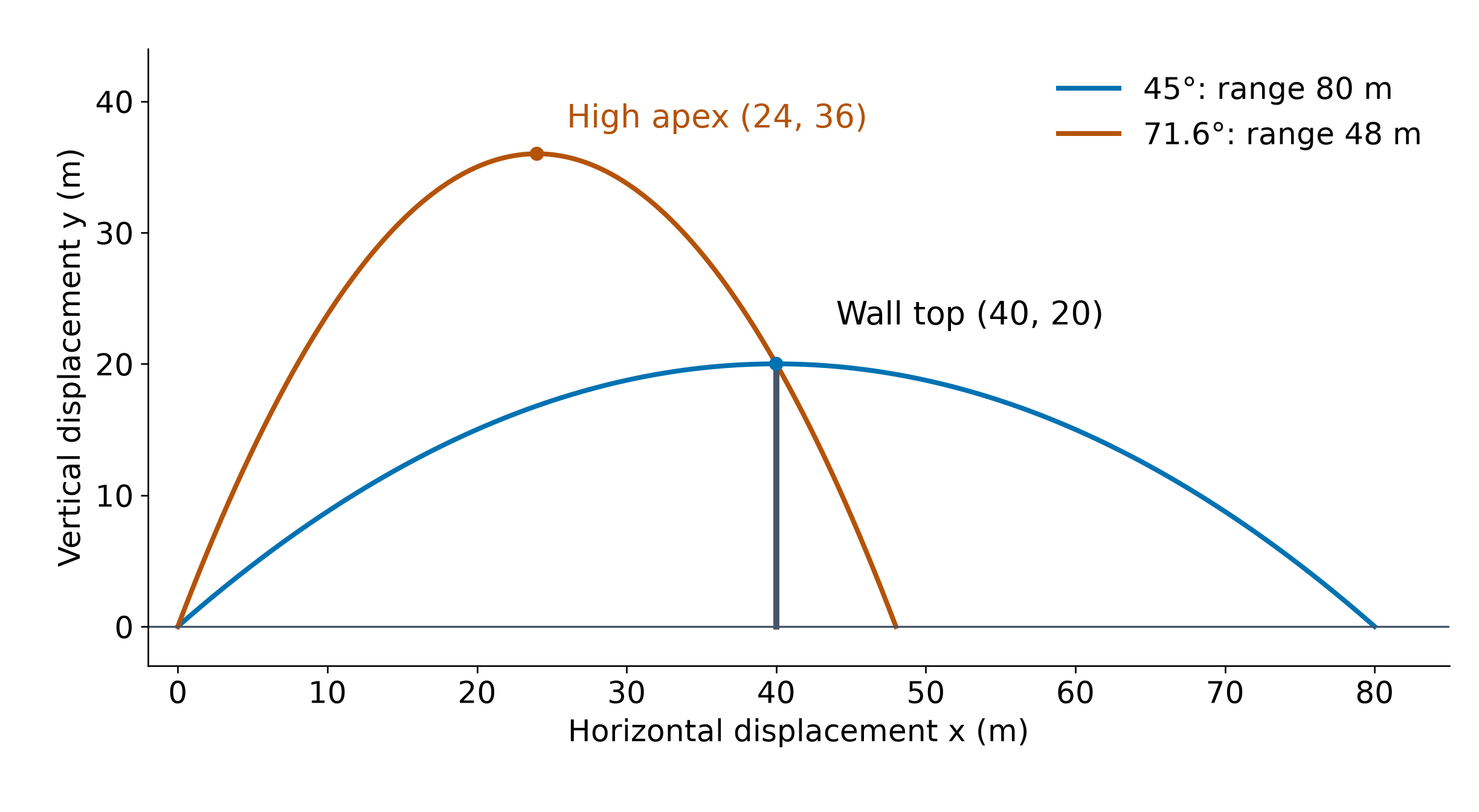
Now fix $u=20\sqrt2\ \dfrac{\text{m}}{\text{s}}$ and require the path to pass through the top $(40,20)\ \text{m}$ of a wall. With $T=\tan\alpha$ and $g=10$:
$$20=40T-10(1+T^2)\quad\Rightarrow\quad (T-1)(T-3)=0.$$
Both are positive launch angles: $\alpha=45^\circ$ or $\tan^{-1}3\approx71.6^\circ$. The higher-angle path does not have the longer range. Substitute each root back into the target equation before accepting it.
Compare the two flights
The low-angle path is $y=x-x^2/80$: its vertex is $(40,20)$ and range is $80\ \text{m}$. The high-angle path is $y=3x-x^2/16$: its vertex is $(24,36)$ and range is $48\ \text{m}$. Both pass through $(40,20)$. The second is already descending at the wall. A larger angle raises the path but reduces the horizontal component; do not rank ranges by height alone.
Turn a clearance condition into an interval
To reach or pass above that wall top, require $40T-10(1+T^2)\ge20$. Thus $(T-1)(T-3)\le0$ and $1\le T\le3$. The level-ground range is $R=160T/(1+T^2)$. Its derivative is $160(1-T^2)/(1+T^2)^2$, so it decreases on $1\le T\le3$. The smallest landing distance is $48\ \text{m}$ at $T=3$. If touching the wall top is forbidden, the endpoints are excluded and $48$ is an unattained lower bound.
Apply the event order after solving a height inequality
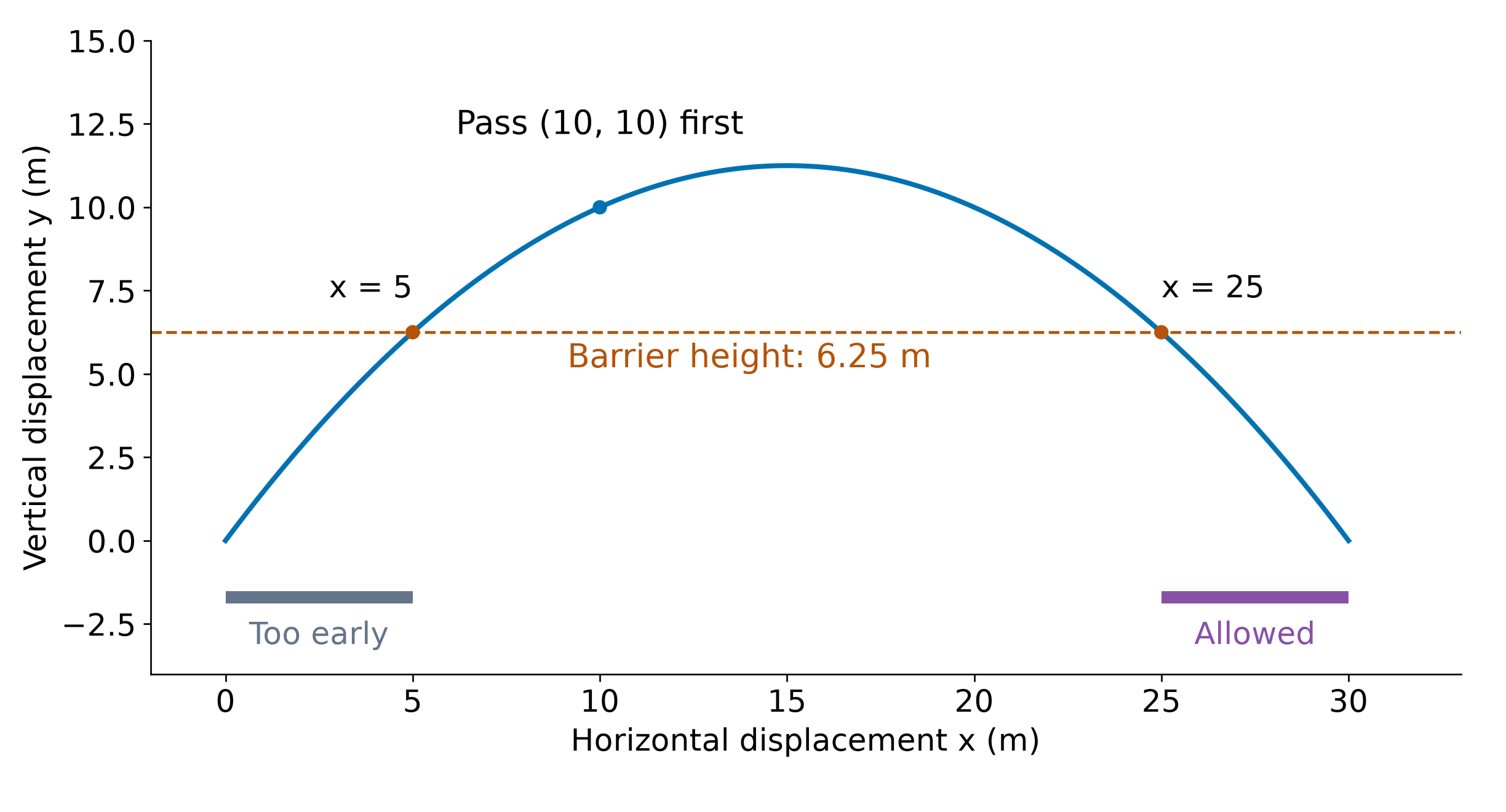
Return to $y=3x/2-x^2/20$. After passing $(10,10)$, the ball hits a vertical barrier of height $25/4\ \text{m}$ at $x=D$. It is above ground for $0\le D\le30$. Hitting the barrier means $y(D)\le25/4$, giving $(D-5)(D-25)\ge0$. On the ground interval this gives $D\le5$ or $D\ge25$. But the barrier is reached after $x=10$, so only $25\le D\le30$ remains, with boundary contact allowed. “After”, “descending” and “before landing” are mathematical restrictions.
Recover both launch conditions from two points
Suppose an unknown launch passes through $(10,15)$ and $(20,20)$ in metres. Write $y=Ax-Bx^2$, with $A=\tan\alpha$ and $B=g/(2u_x^2)>0$. The two points give $10A-100B=15$ and $20A-400B=20$. Subtract twice the first equation from the second: $-200B=-10$, so $B=1/20$ and $A=2$. Therefore $u_x=10$, $u_y=20$, $u=10\sqrt5\ \dfrac{\text{m}}{\text{s}}$ and $\alpha=\tan^{-1}2$. The range is $40\ \text{m}$ and greatest height $20\ \text{m}$.
Choose the method from the event
Given a time, use the component equations. Given a direction, first relate the signed velocity components. Given a height, solve for time and check both roots. Given a target or unknown launch conditions, eliminate time and substitute coordinates. Check units, the coordinate origin, $t\ge0$, the direction of travel and the first collision. For an upward launch, only the vertical component vanishes at the top; for a purely vertical throw the whole velocity does vanish there. The same-height range formula always needs its same-height assumption.
Explore
Launch a projectile
Fire the ball, then change the angle and speed. The horizontal motion is steady while gravity pulls it down — together they trace a parabola. Find the angle for the longest range, and try the Moon.
Vocabulary
Train
| English |
|---|
| projectile/prəˈdʒektaɪl/ |
| horizontal/ˌhɒrɪˈzɒntl/ |
| vertical/ˈvɜːtɪkl/ |
| gravity/ˈɡrævɪti/ |
| particle/ˈpɑːtɪkl/ |
| air resistance/eə rɪˈzɪstəns/ |
| displacement/dɪˈspleɪsmənt/ |
| angle of projection/ˈæŋɡl ɒv prəˈdʒekʃn/ |
| velocity component/vəˈlɒsɪti kəmˈpəʊnənt/ |
| constant acceleration/ˈkɒnstənt əkˌseləˈreɪʃn/ |
| greatest height/ˈɡreɪtɪst haɪt/ |
| range/reɪndʒ/ |
| time of flight/taɪm ɒv flaɪt/ |
| trajectory/trəˈdʒektəri/ |
| Cartesian equation/kɑːˈtiːzɪən ɪˈkweɪʒn/ |
| parabola/pəˈræbələ/ |
3.2
Equilibrium of a rigid body
Syllabus
| Candidates should be able to: | Notes and examples |
|---|---|
| • calculate the moment of a force about a point | For questions involving coplanar forces only; understanding of the vector nature of moments is not required. |
| • use the result that the effect of gravity on a rigid body is equivalent to a single force acting at the centre of mass of the body, and identify the position of the centre of mass of a uniform body using considerations of symmetry | |
| • use given information about the position of the centre of mass of a triangular lamina and other simple shapes | Proofs of results given in the MF19 List of formulae are not required. |
| • determine the position of the centre of mass of a composite body by considering an equivalent system of particles | Simple cases only, e.g. a uniform L-shaped lamina, or a uniform cone joined at its base to a uniform hemisphere of the same radius. |
| • use the principle that if a rigid body is in equilibrium under the action of coplanar forces then the vector sum of the forces is zero and the sum of the moments of the forces about any point is zero, and the converse of this | |
| • solve problems involving the equilibrium of a single rigid body under the action of coplanar forces, including those involving toppling or sliding. |
Source: Cambridge International syllabus
Why a handle is far from the hinge
Push near a door hinge and you need a large force. Push at the handle and the same force has a larger turning effect 转动效应. To predict balance we must know both the forces and where they act. Model the object as a rigid body 刚体: its shape and the distances between its parts stay fixed. We consider coplanar forces 共面力, all in one plane. A particle model would lose the information needed to predict turning.
Measure a moment from the line of action
The moment 力矩 of a force about a point is force multiplied by the perpendicular distance 垂直距离 from that point to the force's line of action 作用线. The unit is $\text{N m}$. Choose a sign, such as anticlockwise positive. A $20\ \text{N}$ upward force acting $0.6\ \text{m}$ to the right of a pivot 支点 has moment $+12\ \text{N m}$. If the line of action passes through the pivot, its moment is zero even when the force itself is not zero.
An angled force needs its perpendicular arm
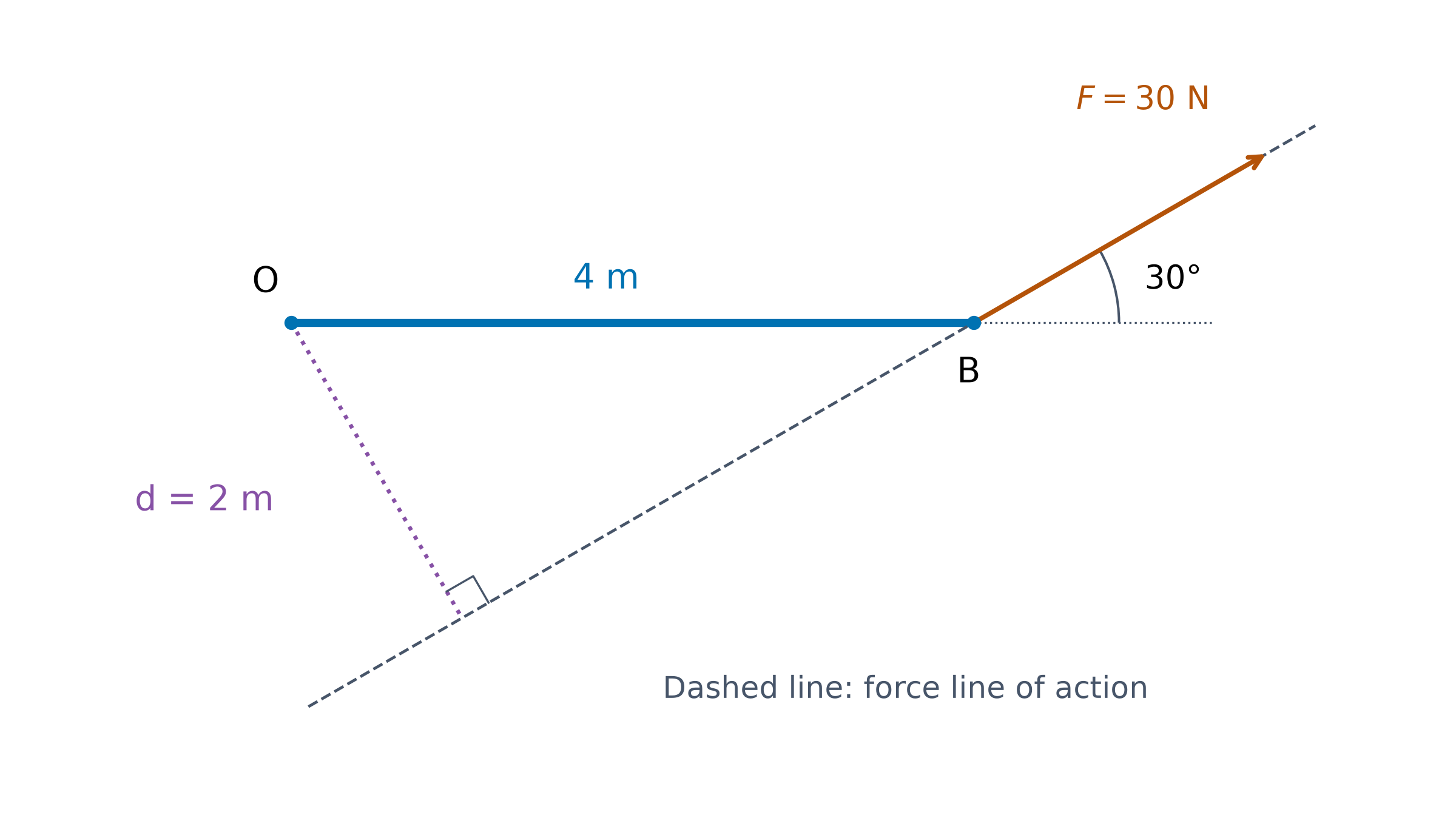
A force of $30\ \text{N}$ acts at $30^\circ$ above a horizontal rod, $4\ \text{m}$ from the pivot. Its perpendicular 垂直 component is $30\sin30^\circ=15\ \text{N}$, giving moment $15(4)=60\ \text{N m}$ anticlockwise. Equivalently use the full force and arm $4\sin30^\circ=2\ \text{m}$. These are two ways to calculate the same moment; do not insert the sine factor twice.
Equilibrium needs two separate balances
For a body in equilibrium 平衡, the resultant force 合力 is zero and the total moment about any point is zero. For coplanar forces, resolve in two perpendicular directions and take moments about one chosen point. These conditions are also sufficient for equilibrium in this model. Equal opposite $10\ \text{N}$ forces on different parallel lines $0.4\ \text{m}$ apart have zero resultant but a moment of $4\ \text{N m}$. They do not balance rotationally. Zero resultant means no translational acceleration; it does not make an already moving body stop. For static equilibrium, the body starts at rest.
Replace gravity by one force at the centre of mass
In a uniform gravitational field, the weight $F_W=mg$ acts through the centre of mass 质心. A uniform 均匀 body has mass distributed evenly over its length, area or volume, as appropriate. Use symmetry 对称: a uniform rod has its centre of mass at its midpoint; a uniform rectangle has it where its diagonals meet. The centre of mass lies on every symmetry axis of the mass distribution. Shape symmetry alone is not enough if the density 密度 varies, and a centre of mass may lie in a hole outside the material.
Locate the centre of a triangular lamina
A lamina 薄片 is a thin plate. For a uniform triangular lamina, the centre of mass lies two-thirds of the way along each median 中线 from its vertex, or one-third from the opposite side. The MF19 formula is given; a proof is not required here. For vertices $(0,0)$, $(6,0)$ and $(0,3)$ in metres, the midpoint opposite the origin is $(3,1.5)$. Two-thirds of this displacement gives $(\bar x,\bar y)=(2,1)\ \text{m}$. Equivalently, average the three vertex coordinates for a uniform triangle.
Read the reference point in a solid-body formula
The formula list places the centre of mass of a uniform solid cone or pyramid $3h/4$ from its vertex, hence $h/4$ from its base. For a solid hemisphere of radius $r$, it is $3r/8$ from the base-circle centre along the axis towards the curved surface. A thin hemispherical shell 半球壳 instead has distance $r/2$. A shell is not a solid hemisphere. Convert every position to the same origin and signed axis before combining bodies.
Distinguish an arc from a sector
For a uniform circular arc 圆弧 of radius $r$ and angle $2\alpha$, MF19 gives centre-of-mass distance $r\sin\alpha/\alpha$ from the circle centre on the symmetry axis. For a uniform circular sector 扇形 lamina, the distance is $2r\sin\alpha/(3\alpha)$. Here $\alpha$ is the half-angle in radians. A semicircle has $\alpha=\pi/2$: the wire arc gives $2r/\pi$, while the sector plate gives $4r/(3\pi)$. Use length for the mass of a uniform wire and area for a uniform plate of fixed thickness; these objects do not have the same mass model.
Replace each component by one particle
A composite body 复合物体 consists of simpler parts. Replace each part by a particle of mass $m_i$ at its own centre of mass $(x_i,y_i)$. Taking moments of the weights gives
$$\bar x=\frac{\sum m_ix_i}{\sum m_i},\qquad \bar y=\frac{\sum m_iy_i}{\sum m_i}.$$
Mass is proportional to length for a uniform wire, area for a uniform lamina of fixed thickness, or volume for a uniform solid. Use an area or volume ratio only when the relevant densities are equal. A plain average of component positions works only for equal component masses.
Add a rectangle and a triangle
Join a rectangle $0\le x\le4$, $0\le y\le2$ to a triangular plate with vertices $(4,0)$, $(4,2)$ and $(7,0)$, with lengths in metres. Both have the same thickness and density. Their areas are $8$ and $3$, and their centres are $(2,1)$ and $(5,2/3)$. Therefore $\bar x=(8\cdot2+3\cdot5)/11=31/11\ \text{m}$ and $\bar y=(8\cdot1+3\cdot2/3)/11=10/11\ \text{m}$. The larger part contributes more to each moment.
Subtract a removed part from both mass and moments
Start with a $6\ \text{m}$ by $4\ \text{m}$ uniform rectangular plate. Remove the upper-right $4\ \text{m}$ by $2\ \text{m}$ rectangle, leaving an L-shape. Using the lower-left corner as origin, the original area is $24$ at $(3,2)$ and the removed area is $8$ at $(4,3)$. Subtract the hole's area and both its moments:
$$\bar x=\frac{24(3)-8(4)}{24-8}=2.5\ \text{m},\qquad
\bar y=\frac{24(2)-8(3)}{24-8}=1.5\ \text{m}.$$
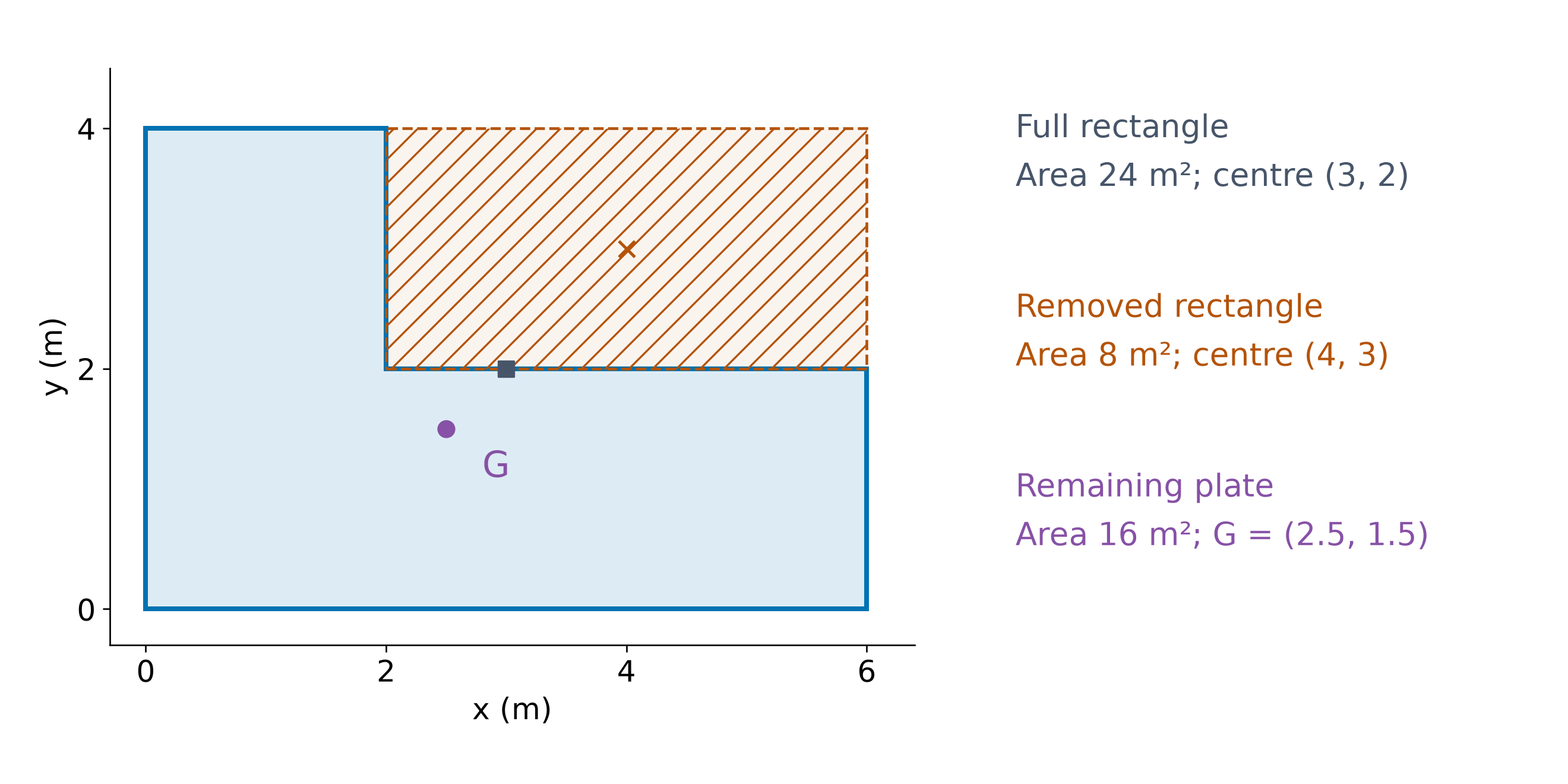
Change the mass weights when the material changes
Two uniform thin rods of the same material and cross-section form an L: a $6\ \text{m}$ horizontal rod from the origin, and a $4\ \text{m}$ vertical rod. Use lengths $6$ and $4$ as mass weights. Their centres are $(3,0)$ and $(0,2)$, giving $(\bar x,\bar y)=(1.8,0.8)\ \text{m}$. If the vertical rod has twice the mass per unit length, the weights become $6$ and $8$, giving $(9/7,8/7)\ \text{m}$. Do not use the area of the empty region between the rods.
Join solids with a signed common axis
Join a uniform solid cone of radius $r$, height $4r$, to a uniform solid hemisphere of radius $r$ at their circular bases. They have the same density. Put the common base at $z=0$ and take positive $z$ towards the cone's vertex. The cone has volume $4\pi r^3/3$ and centre $z=r$. The hemisphere has volume $2\pi r^3/3$ and centre $z=-3r/8$. Thus
$$\bar z=\frac{2(r)+1(-3r/8)}{2+1}=\frac{13r}{24}.$$
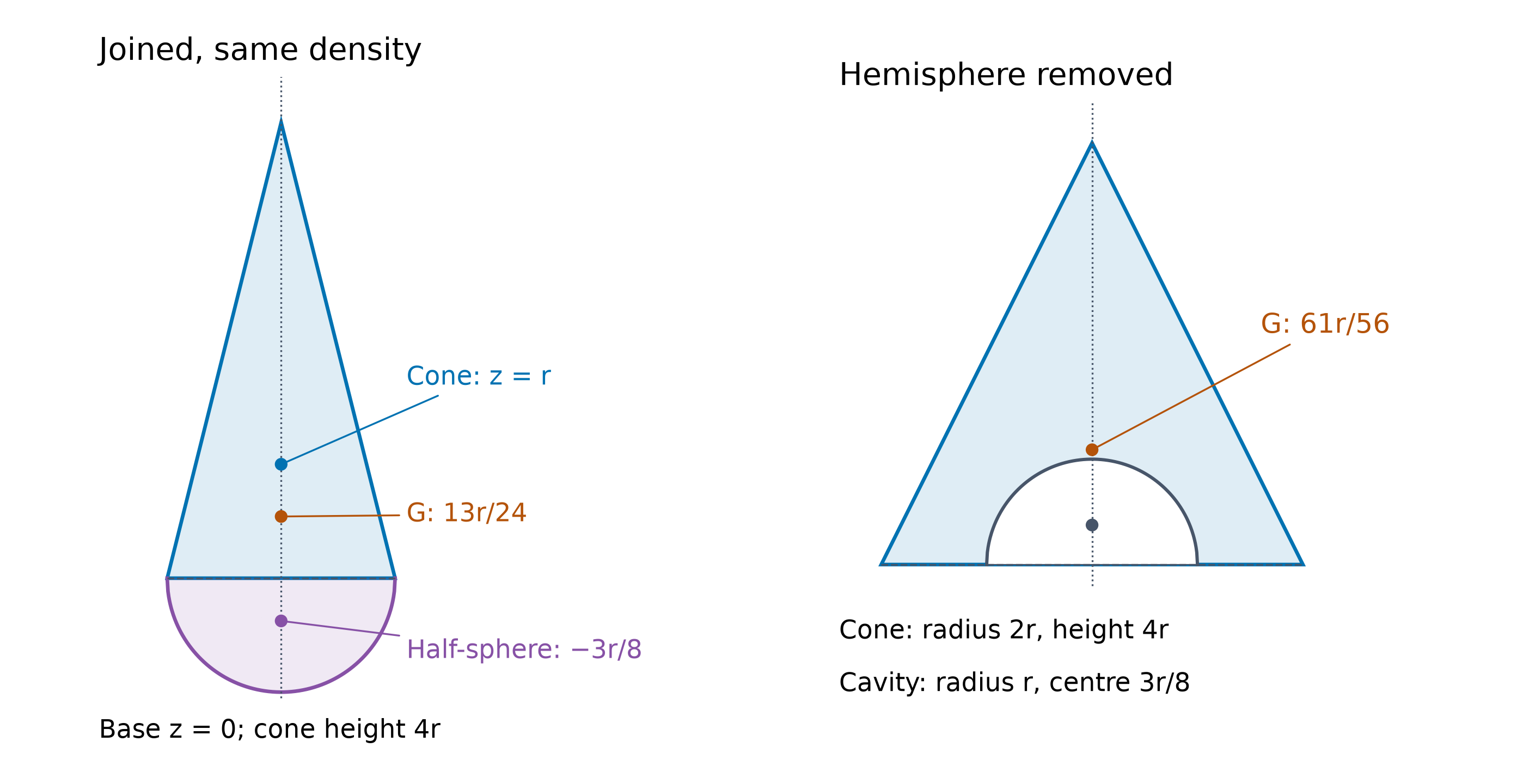
Axial sections of the solids; use their volumes as mass weights, rather than the drawn triangle and semicircle areas.
Remove a cavity without changing its original centre
A uniform cone has base radius $2r$ and height $4r$. Remove a solid hemisphere of radius $r$ whose base lies in the cone's base plane, with the same axis and its curved surface inside the cone. The original cone's volume and centre are $16\pi r^3/3$ and $z=r$; the removed hemisphere's are $2\pi r^3/3$ and $z=3r/8$. With $z$ measured upwards from that base, the remaining centre is
$$\bar z=\frac{16(r)-2(3r/8)}{16-2}=\frac{61r}{56}.$$
Removing material near the base moves the centre upwards. A hole has a negative mass contribution in the calculation; it does not have an unknown new centre.
A freely suspended body puts its centre below the support
When a body hangs freely from a smooth pivot, the support force and weight must share a vertical line. For stable rest, the centre of mass is vertically below the support. A vertical line with the centre above the support is the unstable orientation. Suspend our L-shaped plate from its upper-left corner $D=(0,4)$. In the plate's original coordinates, $G-D=(2.5,-2.5)$. The angle between the downward edge direction and $DG$ is $\tan^{-1}(2.5/2.5)=45^\circ$. The plate rotates until $DG$ points vertically down.
Check whether a parameter root leaves a real support point
A $4$ by $6$ uniform plate has an upper-right rectangle of width $h$ and height $2$ removed, where $0<h<4$. Distances are in metres; the support is its surviving upper-left corner $D=(0,6)$. The area method gives
$$\bar x=\frac{h^2-8h+48}{24-2h},\qquad
\bar y=\frac{72-10h}{24-2h}.$$
If the original downward edge makes angle $\theta$ with the hanging vertical and $\tan\theta=1/2$, use $\bar x/(6-\bar y)=1/2$. This gives $(h-3)(h-4)=0$. Only $h=3$ is allowed: at $h=4$ the entire top strip, including $D$, has been removed. Algebraic roots must obey the body's geometry.
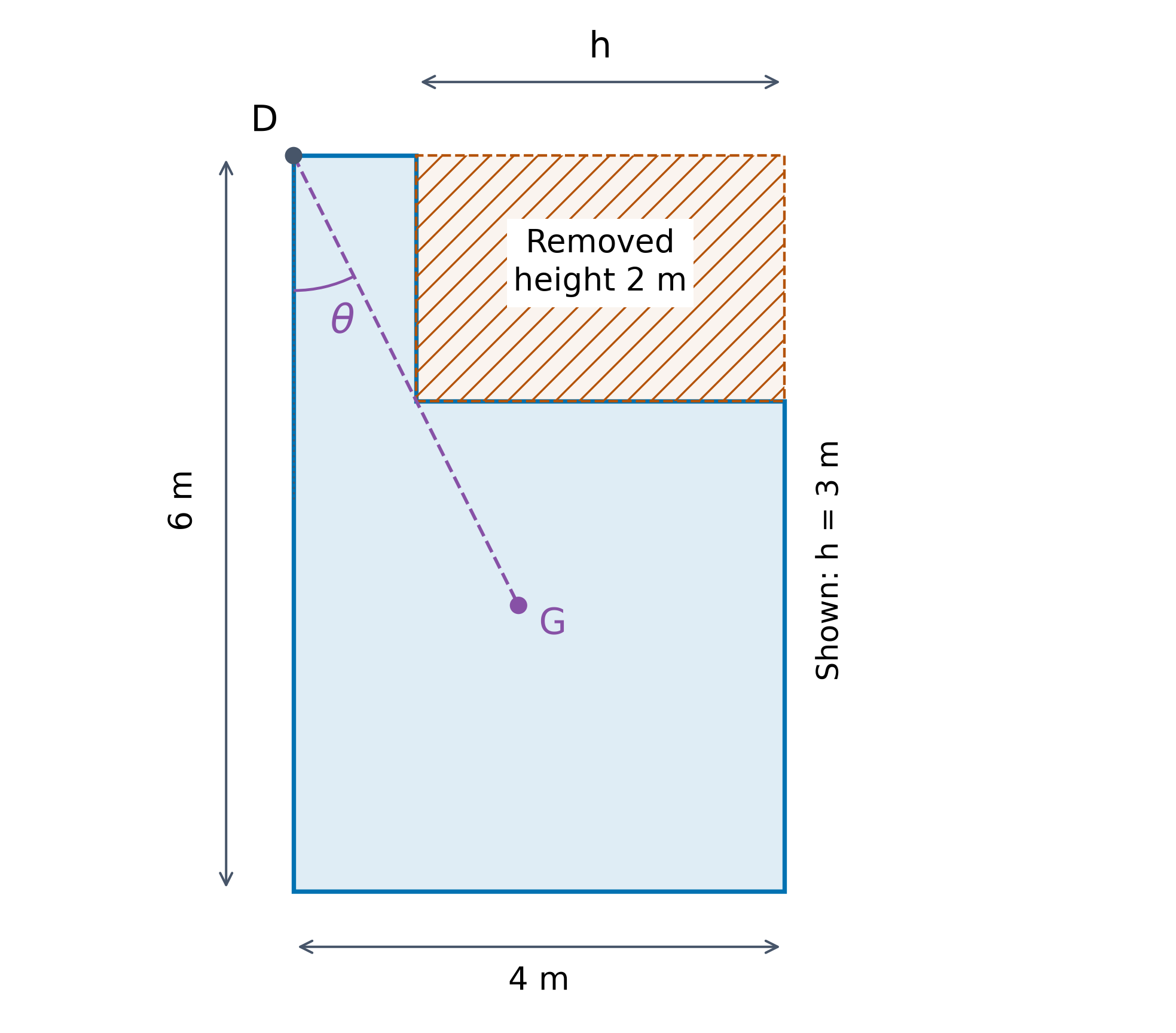
Draw every external force before choosing equations
A free-body diagram 受力图 contains the body and the forces acting on it. Weight acts at the centre of mass; a light string pulls along itself; a normal reaction 法向反力 is perpendicular to a contact surface. A smooth contact has no friction. A hinge can exert horizontal and vertical reaction components. At a rough contact, friction 摩擦力 opposes the direction of impending relative sliding 滑动. Static friction obeys $|F_f|\le\mu F_N$, where $\mu$ is the coefficient of friction 摩擦系数. The limiting friction 最大静摩擦 is $\mu F_N$. Equality holds at limiting equilibrium 极限平衡, not at every resting contact. A support that can only push must also have $F_N\ge0$.
Balance a beam and then find its reaction
A uniform horizontal beam $AB$ is $4\ \text{m}$ long and weighs $100\ \text{N}$. It is pivoted at $A$, with an upward vertical force $F$ at $B$. The weight acts $2\ \text{m}$ from $A$. Moments about $A$ give $4F=100(2)$, so $F=50\ \text{N}$. Vertical force balance then gives the upward pivot reaction $R_A=100-50=50\ \text{N}$. Taking moments removed that reaction from one equation; it did not make the reaction zero.

A loaded beam needs the load positions
A uniform horizontal beam $AB$ of length $6\ \text{m}$ and weight $120\ \text{N}$ rests on supports at its ends. A $60\ \text{N}$ load is $5\ \text{m}$ from $A$. The upward reactions satisfy $R_A+R_B=180$. Moments about $A$: $6R_B=120(3)+60(5)=660$, giving $R_B=110\ \text{N}$ and $R_A=70\ \text{N}$. Both reactions are positive. If a calculated reaction at a simple support is negative, the assumed contact cannot supply it; check whether the body loses contact or topples 倾倒.
Resolve an angled rod and its hinge reaction
A uniform rod of length $4\ \text{m}$ and weight $100\ \text{N}$ is hinged at $A$ and held at $30^\circ$ above horizontal by a horizontal light string attached at its other end. The string pulls towards the wall through $A$. Moments about $A$ use the vertical arm for the horizontal tension and horizontal arm for the weight:
$$F_T(4\sin30^\circ)=100(2\cos30^\circ),\qquad F_T=50\sqrt3\ \text{N}.$$
The hinge reaction components are $50\sqrt3\ \text{N}$ rightwards and $100\ \text{N}$ upwards. Its magnitude is $50\sqrt7\ \text{N}$, not their sum.
Set up the geometry of a rough-wall rod
A uniform rod $AB$ has length $4a$ and weight $F_W$, with its lower end $A$ against a rough vertical wall. Its midpoint is $C$. A light string of length $2a$ joins $C$ to a point $D$ higher on the wall, so $AC=CD$. The rod makes angle $\theta$ with the wall, where $\tan\theta=4/3$. A particle of weight $2F_W$ is attached at $AE=ka$, between $C$ and $B$. The coefficient of friction at $A$ is $1/4$, and the rod is about to slip down. The unknowns are the string tension, contact forces and position parameter $k$.
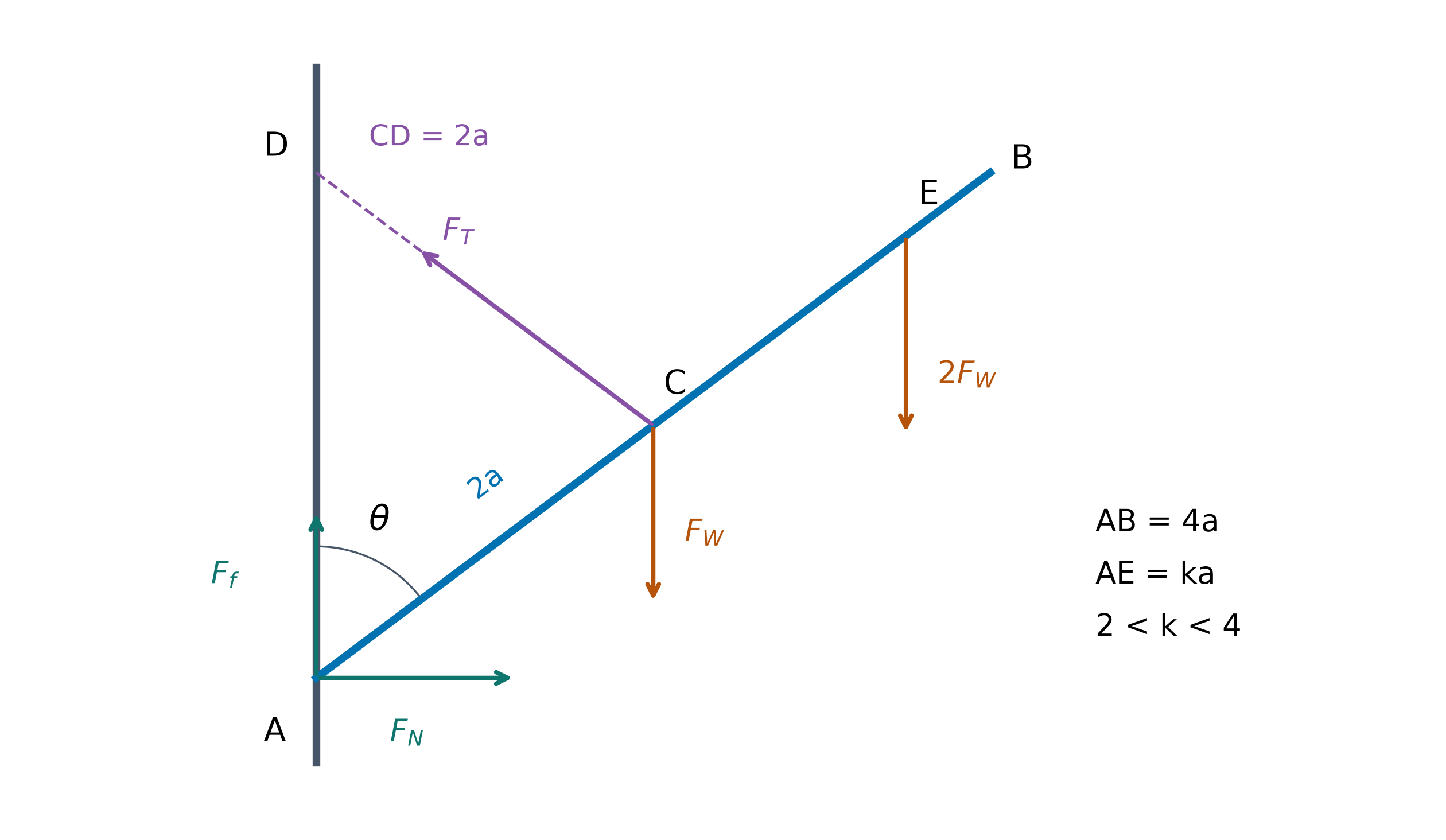
Resolve the rough-wall forces first
The isosceles triangle $ACD$ makes the string's angle with the vertical equal to $\theta$. Friction acts upwards against impending downward slipping. Using $\sin\theta=4/5$, $\cos\theta=3/5$ and the limiting relation $F_f=F_N/4$ gives
$$F_N=\frac45F_T,\qquad \frac35F_T+\frac14F_N=3F_W.$$
Substitute the first equation into the second: $4F_T/5=3F_W$. Hence $F_T=15F_W/4$, $F_N=3F_W$ and $F_f=3F_W/4$. The extra particle doubles its own weight contribution; the total downward weight is $3F_W$.
Finish the rough-wall problem with one moment equation
Taking moments about $A$ removes both contact forces. Resolve the tension at $C$, or use its perpendicular arm. The moment equation is
$$F_T(2a\sin2\theta)=F_W(2a\sin\theta)+2F_W(ka\sin\theta).$$
Substitute $F_T=15F_W/4$, $\sin2\theta=24/25$ and $\sin\theta=4/5$. This gives $36/5=(8/5)(1+k)$, hence $k=7/2$. Check $2<k<4$: the particle is between $C$ and $B$, as the model requires.
A ring can need friction even when its centre is stationary
A ring of radius $r$ and weight $F_W$ rests on a rough plane inclined at $\alpha$, with $\tan\alpha=3/4$. A horizontal string pulls rightwards at a point $P$ whose radius $OP$ points uphill, parallel to the plane. Let $F_f$ act uphill and $F_N$ normal to the plane. Moments about the centre give $F_fr=F_Tr\sin\alpha$. Resolving along the plane gives $F_f+F_T\cos\alpha=F_W\sin\alpha$. Using $\sin\alpha=3/5$, $\cos\alpha=4/5$, obtain $F_T=3F_W/7$ and $F_f=9F_W/35$.
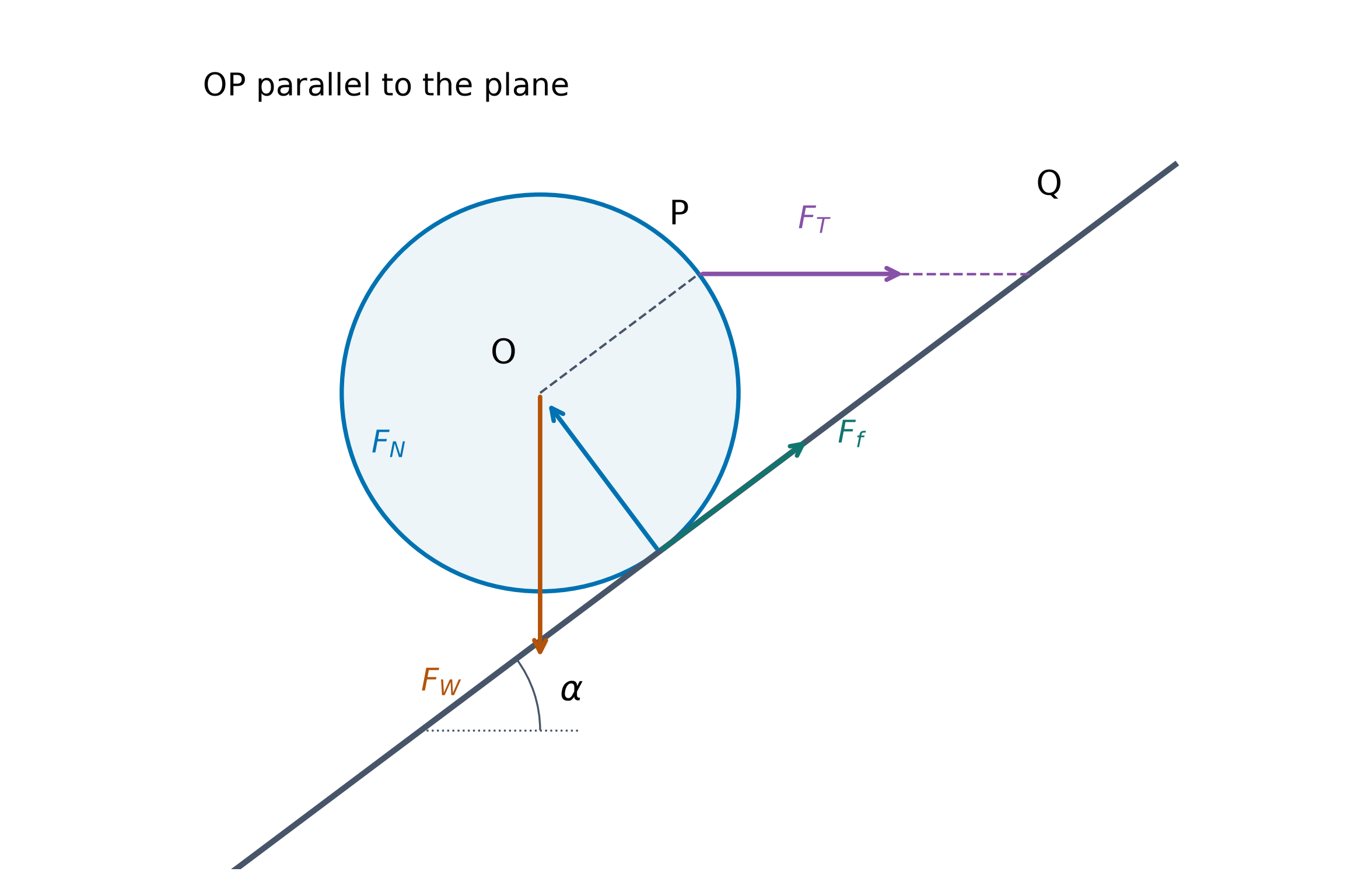
Use the normal force before applying a friction limit
In the ring example, normal balance gives $F_N=F_W\cos\alpha+F_T\sin\alpha=37F_W/35$. The horizontal string pushes into the plane as well as pulling uphill; the normal reaction is not simply $F_W\cos\alpha$. At limiting equilibrium, $\mu=F_f/F_N=9/37$. If the plane has a larger coefficient, the ring can rest with the same required friction; friction does not automatically increase to its maximum value.
Find the support interval before testing toppling
A body resting under its weight and contact forces alone can remain upright while the vertical through its centre of mass meets its base of support 支撑底面. At the point of toppling 翻倒, the contact resultant reaches an edge; the weight's line passes through that edge. Beyond it there is an unbalanced turning moment. The L-shaped plate has $\bar x=2.5\ \text{m}$. On its full $6\ \text{m}$ lower edge it can balance. If turned over to stand on its short $2\ \text{m}$ top edge, its weight line lies outside the support interval, so it topples. An extra applied force changes the moment balance: weight inside the base alone is then not a sufficient test.
A horizontal push can move the contact resultant to an edge
A uniform rectangular block of weight $F_W$ rests on a horizontal rough floor. Its base half-width is $b$, and a horizontal push $P$ acts at height $h$ above the floor. Before motion, $F_N=F_W$ and the required friction is $F_f=P$. Moments show that the normal reaction shifts a distance $\delta=Ph/F_W$ from the base centre towards the leading edge. Toppling begins at $\delta=b$, so $P_{\rm topple}=F_Wb/h$. Sliding begins when $P_{\rm slide}=\mu F_W$. Compare these thresholds; do not assume both limits occur together.
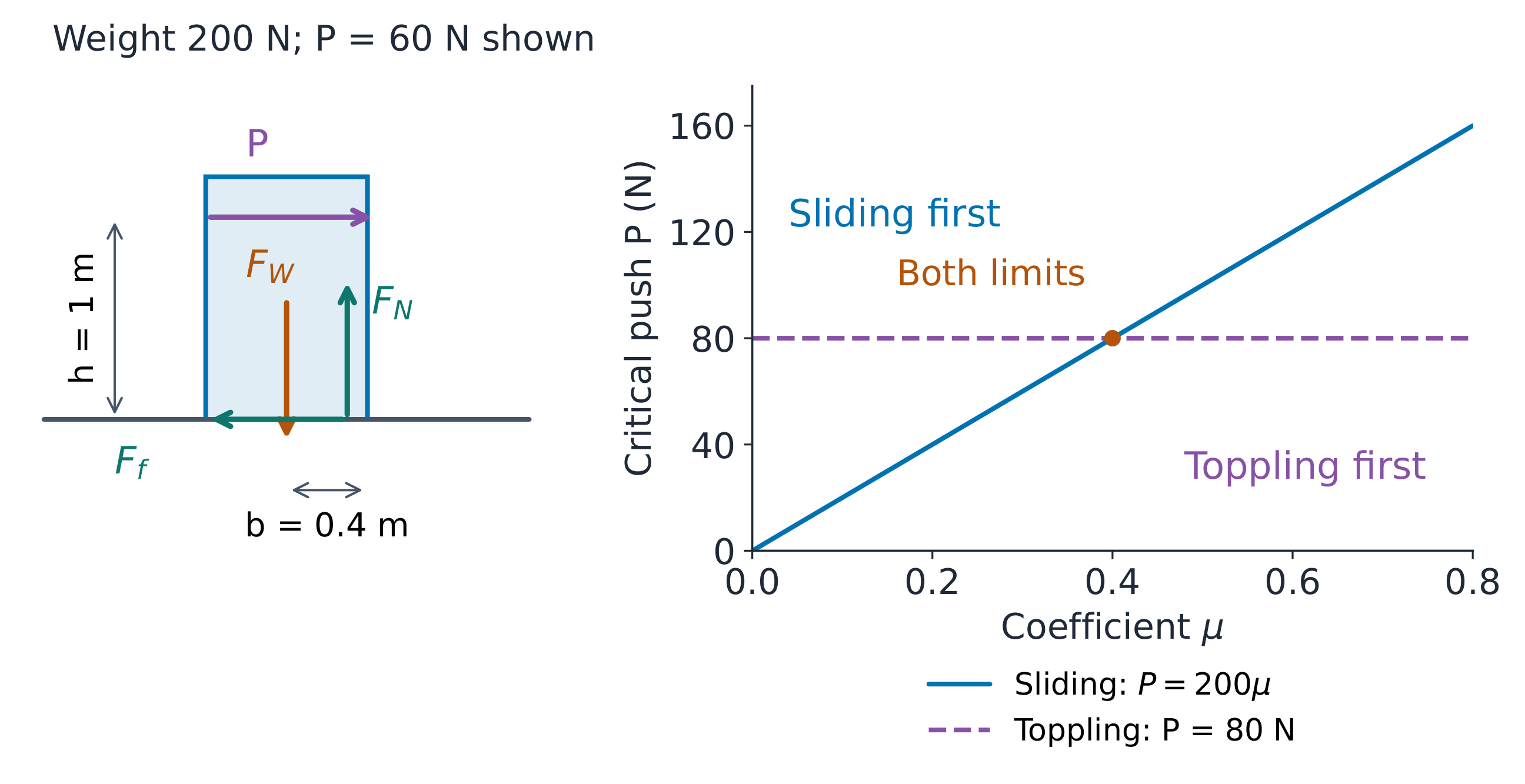
Decide which loss of equilibrium happens first
For $F_W=200\ \text{N}$, $b=0.4\ \text{m}$ and $h=1\ \text{m}$, the toppling threshold is $80\ \text{N}$. With $\mu=0.3$, the sliding threshold is $60\ \text{N}$, so sliding begins first. With $\mu=0.5$, sliding would require $100\ \text{N}$, so toppling begins first. The thresholds coincide at $\mu=b/h=0.4$. Increasing the push height makes toppling easier, but does not change the horizontal sliding threshold in this model. These predictions concern the first motion; the subsequent motion needs a different model.
On an incline, compare two critical angles
For a body with a symmetric base of half-width $b$ and centre of mass a perpendicular distance $c$ above its centre, the weight line reaches the downhill edge when $\tan\alpha=b/c$. With no other applied forces, impending sliding gives $\tan\alpha=\mu$. The smaller critical angle occurs first. For $b=0.4\ \text{m}$, $c=0.6\ \text{m}$ and $\mu=0.5$, sliding occurs at $\tan^{-1}(0.5)\approx26.6^\circ$, before toppling at $\tan^{-1}(2/3)\approx33.7^\circ$. For the cone with a hemispherical cavity, $c=61r/56$, $b=2r$, so the toppling angle satisfies $\tan\alpha=112/61$, provided the plane is sufficiently rough to prevent earlier sliding.
Keep the geometry and the force model together
Find each component's mass and centre from the stated material and given formula. Use one origin, signed coordinates and weighted moments; subtract removed material from both the total mass and every moment. Check the geometric domain of an unknown length before accepting a root. Draw every external force. Resolve twice, take moments once and then check contact and friction restrictions. A freely hanging body's centre is below its support. For standing or pushed bodies, identify the actual support edge and compare toppling and sliding limits. Neither zero resultant alone nor zero moment alone proves equilibrium.
Explore
Equilibrium of forces
resultant = 0
A body is in equilibrium when the forces add tip-to-tail back to zero.
Vocabulary
Train
| English |
|---|
| equilibrium/ˌiːkwɪˈlɪbrɪəm/ |
| rigid body/ˈrɪdʒɪd ˈbɒdi/ |
| turning effect/ˈtɜːnɪŋ ɪˈfekt/ |
| coplanar forces/ˌkəʊˈpleɪnə ˈfɔːsɪz/ |
| moment/ˈməʊmənt/ |
| line of action/laɪn ɒv ˈækʃn/ |
| perpendicular distance/ˌpɜːpənˈdɪkjʊlə ˈdɪstəns/ |
| perpendicular/ˌpɜːpənˈdɪkjʊlə/ |
| pivot/ˈpɪvət/ |
| resultant force/rɪˈzʌltənt fɔːs/ |
| centre of mass/ˈsentə ɒv mæs/ |
| uniform/ˈjuːnɪfɔːm/ |
| symmetry/ˈsɪmətri/ |
| density/ˈdensɪti/ |
| lamina/ˈlæmɪnə/ |
| median/ˈmiːdiːən/ |
| hemispherical shell/ˌhemɪsˈferɪkl ʃel/ |
| circular arc/ˈsɜːkjʊlə ɑːk/ |
| circular sector/ˈsɜːkjʊlə ˈsektə/ |
| composite body/ˈkɒmpəzɪt ˈbɒdi/ |
| free-body diagram/friː ˈbɒdi ˈdaɪəɡræm/ |
| normal reaction/ˈnɔːml rɪˈækʃn/ |
| friction/ˈfrɪkʃn/ |
| sliding/ˈslaɪdɪŋ/ |
| coefficient of friction/ˌkəʊɪˈfɪʃənt ɒv ˈfrɪkʃn/ |
| limiting friction/ˈlɪmɪtɪŋ ˈfrɪkʃn/ |
| limiting equilibrium/ˈlɪmɪtɪŋ ˌiːkwɪˈlɪbrɪəm/ |
| toppling/ˈtɒplɪŋ/ |
| base of support/beɪs ɒv səˈpɔːt/ |
| topple/ˈtɒpl/ |
3.3
Circular motion

Syllabus
| Candidates should be able to: | Notes and examples |
|---|---|
| understand the concept of angular speed for a particle moving in a circle, and use the relation $v = r\omega$ | |
| understand that the acceleration of a particle moving in a circle with constant speed is directed towards the centre of the circle, and use the formulae $r\omega^2$ and $\frac{v^2}{r}$. | Proof of the acceleration formulae is not required. |
| solve problems which can be modelled by the motion of a particle moving in a horizontal circle with constant speed | |
| solve problems which can be modelled by the motion of a particle in a vertical circle without loss of energy. | Including finding a normal contact force or the tension in a string, locating points at which these are zero, and conditions for complete circular motion. |
Source: Cambridge International syllabus
A turn needs a change in velocity
A ball on a string changes direction even when its speed stays the same. The string pulls the ball inwards. Your hand feels the ball's pull outwards: those two forces act on different objects. In a frame fixed to the ground, draw the real forces on the ball. Its inertia 惯性 does not supply an extra outward force. The name centrifugal 离心 force belongs to a rotating-frame description, which we do not need here.
Link angular speed to distance along the circle
An angle of $\theta$ radians 弧度 sweeps arc length $s=r\theta$. For fixed radius, angular speed 角速度 is the rate of turning; linear speed 线速度 is distance travelled per second. Therefore $v=r\omega$. A point farther from the axis has greater speed at the same $\omega$. Use radians per second in this formula; degrees per second must first be multiplied by $\pi/180$.
Convert a period or a revolution rate
The period 周期 $\tau$ is the time for one full turn. The frequency 频率 $f$ is turns per second. Hence $\omega=2\pi/\tau=2\pi f$. At $30$ revolutions per minute, $f=1/2$ turn per second and $\omega=\pi\ \dfrac{\text{rad}}{\text{s}}$. At radius $0.4\ \text{m}$, $v=0.4\pi\ \dfrac{\text{m}}{\text{s}}$. Do not put $30$ straight into $v=r\omega$.
Separate inward acceleration from changing speed
Velocity is along the tangent 切线. The radial 径向 component of acceleration points towards the centre and has magnitude $a_r=v^2/r=r\omega^2$. This inward component is the centripetal acceleration 向心加速度. A proof of the acceleration formulae is not required here. At constant speed this is the whole acceleration. If speed changes, there is also a tangential 切向 component. In a vertical circle under gravity, the full acceleration need not point exactly towards the centre.
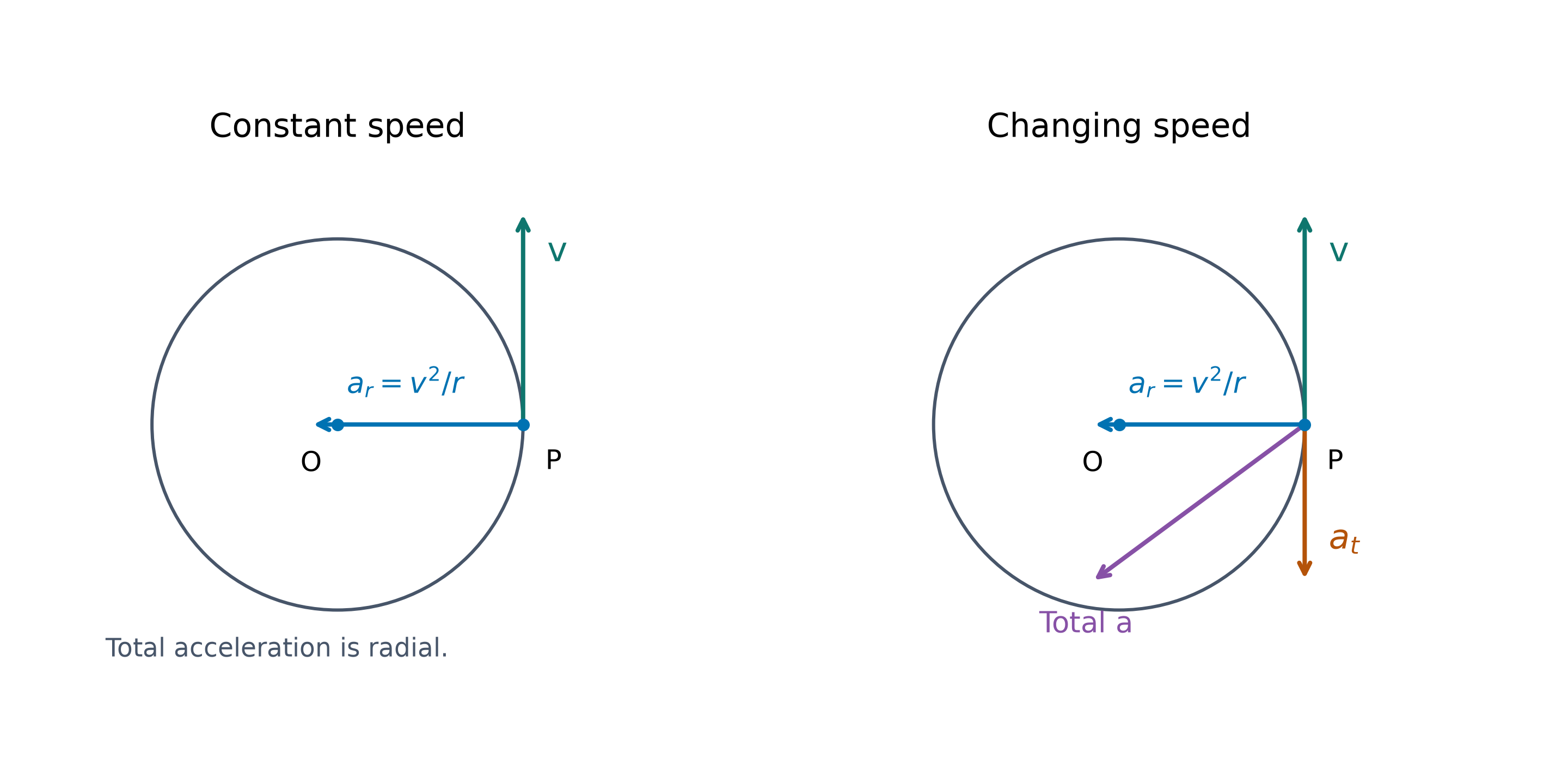
Use both forms of the acceleration formula
For $r=2\ \text{m}$ and constant $\omega=3\ \dfrac{\text{rad}}{\text{s}}$, the speed is $v=2(3)=6\ \dfrac{\text{m}}{\text{s}}$ and $a_r=2(3^2)=18\ \dfrac{\text{m}}{\text{s}^2}$. Checking with $v^2/r=6^2/2=18$ gives the same result. At fixed speed, doubling the radius halves $a_r$; at fixed angular speed, doubling the radius doubles it. State which quantity is fixed.

Resolve real forces towards the centre
Draw a free-body diagram and choose inwards as positive. Newton's law gives $\sum F_{\rm inward}=mv^2/r$. A centripetal force 向心力 is the inward resultant needed for the motion, not another arrow to add beside weight, tension or contact forces. A horizontal circle 水平圆 need not have constant speed. In this syllabus's steady horizontal-circle problems, vertical acceleration and tangential acceleration are zero; the inward acceleration is not zero. Resolve vertically and radially as separate equations.
Friction can provide the inward resultant
A particle on a rough horizontal rotating disc has normal reaction $N=mg$. If friction is the only horizontal force, the required friction is $F_f=mr\omega^2$. It must satisfy $F_f\leq\mu N$. Therefore $\omega^2\leq\mu g/r$. For $r=1.2\ \text{m}$, $\mu=0.3$ and $g=10\ \dfrac{\text{m}}{\text{s}^2}$, the greatest angular speed is $\sqrt{2.5}\ \dfrac{\text{rad}}{\text{s}}$, about $15.1$ revolutions per minute. Below the limit, friction is not automatically $\mu N$.
An inclined string changes the disc reaction
A $2\ \text{kg}$ particle moves at radius $1.5\ \text{m}$ on a rough disc. A string pulls towards a point above the axis, with tension 张力 $T=10\ \text{N}$, $\sin\alpha=3/5$ and $\cos\alpha=4/5$, where $\alpha$ is measured from vertical. Take $g=10\ \dfrac{\text{m}}{\text{s}^2}$. Vertical balance gives $N=20-10(4/5)=12\ \text{N}$. With $\mu=1/4$ and impending outward slipping, limiting friction is $3\ \text{N}$ inwards. Thus $10(3/5)+3=2(1.5)\omega^2$, giving $\omega=\sqrt3\ \dfrac{\text{rad}}{\text{s}}$.
Friction may reverse when the speed changes
Keep that particle, tension and geometry fixed. The string already supplies $6\ \text{N}$ inwards. Required signed inward friction is $F_f=3\omega^2-6$, while $|F_f|\leq3$. Hence $1\leq\omega^2\leq3$. At the lower limit friction acts outwards to reduce the inward resultant; at the upper limit it acts inwards. An outward real friction force is possible even though the net radial force is inwards.

A conical pendulum has two useful directions
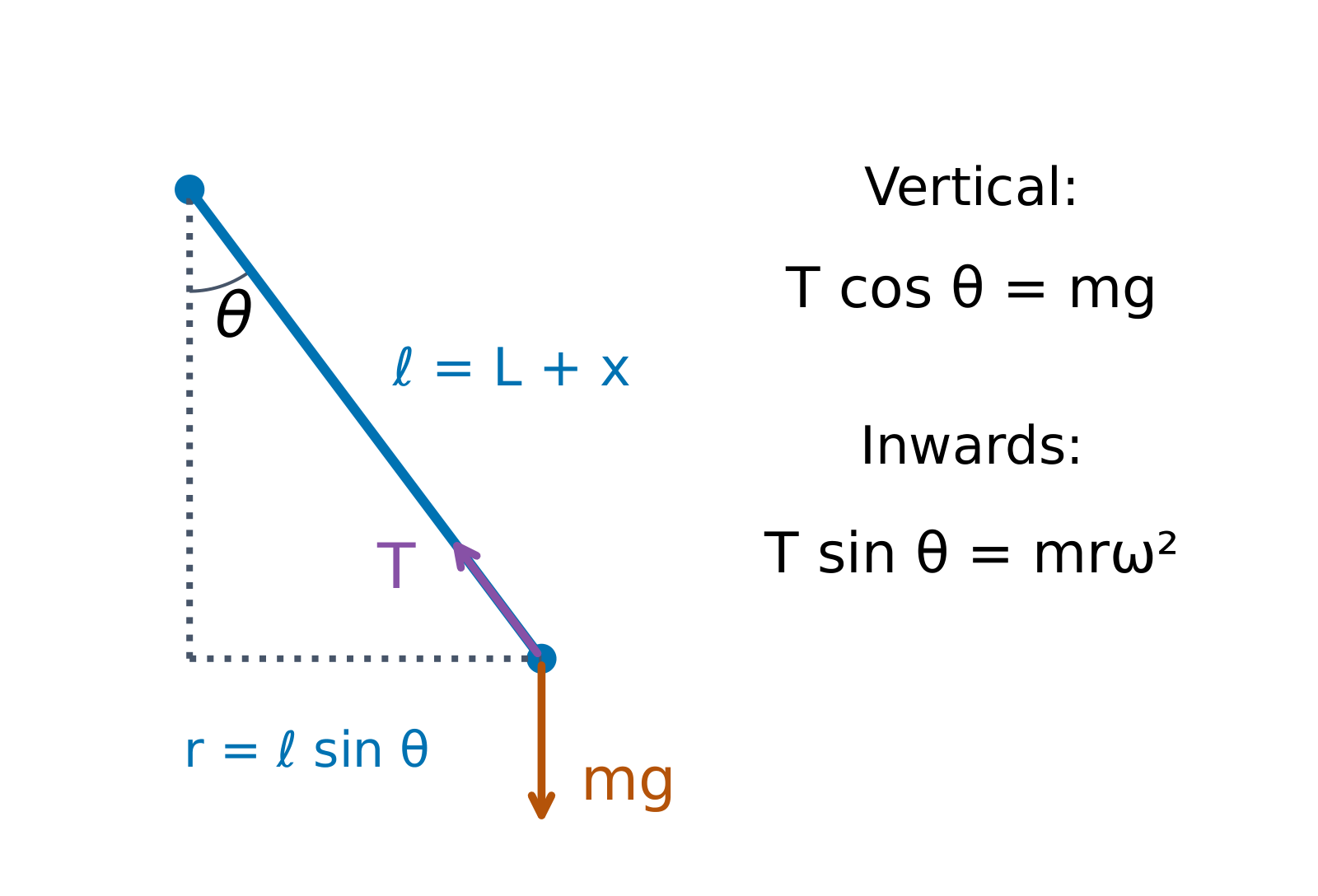
A conical pendulum 圆锥摆 has a light inextensible string of length $L$ making angle $\theta$ with the vertical. Its orbit radius is $r=L\sin\theta$, not $L$. The bob stays at one height. Resolve tension: $T\cos\theta=mg$ and $T\sin\theta=mr\omega^2$. For a non-zero orbit, substitution gives $\omega^2=g/(L\cos\theta)$. The tension has both vertical and inward components.
Find the orbit before finding its speed
Let $L=2.5\ \text{m}$, $m=0.4\ \text{kg}$, $\cos\theta=4/5$, $\sin\theta=3/5$ and $g=10\ \dfrac{\text{m}}{\text{s}^2}$. Then $r=1.5\ \text{m}$ and $T=mg/\cos\theta=5\ \text{N}$. Now $\omega^2=10/[2.5(4/5)]=5$, so $v=1.5\sqrt5\ \dfrac{\text{m}}{\text{s}}$ and the period is $2\pi/\sqrt5\ \text{s}$. Using the string length as the orbit radius would give the wrong speed.
A second particle can fix the tension
A string of total length $9a$ passes through a fixed smooth ring $R$. Particle $A$ of mass $2m$ hangs below it. Particle $B$ of mass $m$ moves in a horizontal circle whose centre is $A$. Let $RB=L$ and let $RB$ make angle $\theta$ with the vertical. For $A$, $T=2mg$. For $B$, $T\cos\theta=mg$, so $\cos\theta=1/2$. Geometry gives $RA=L\cos\theta=L/2$ and $RA+RB=9a$, so $L=6a$. Then $\omega^2=g/(L\cos\theta)=g/(3a)$.
A bowl radius is not the orbit radius
On the smooth inner surface of a hemispherical bowl of radius $a$, let the normal make angle $\theta$ with upward vertical. The orbit radius is $a\sin\theta$. Vertical and inward equations are $N\cos\theta=mg$ and $N\sin\theta=m(a\sin\theta)\omega^2$. Therefore $\omega^2=g/(a\cos\theta)$. If $\cos\theta$ changes from $4/5$ to $5/13$, the angular-speed ratio is $\omega_1/\omega_2=\sqrt{(5/13)/(4/5)}=5/(2\sqrt{13})$. Compare squared speeds first, then take the square root.
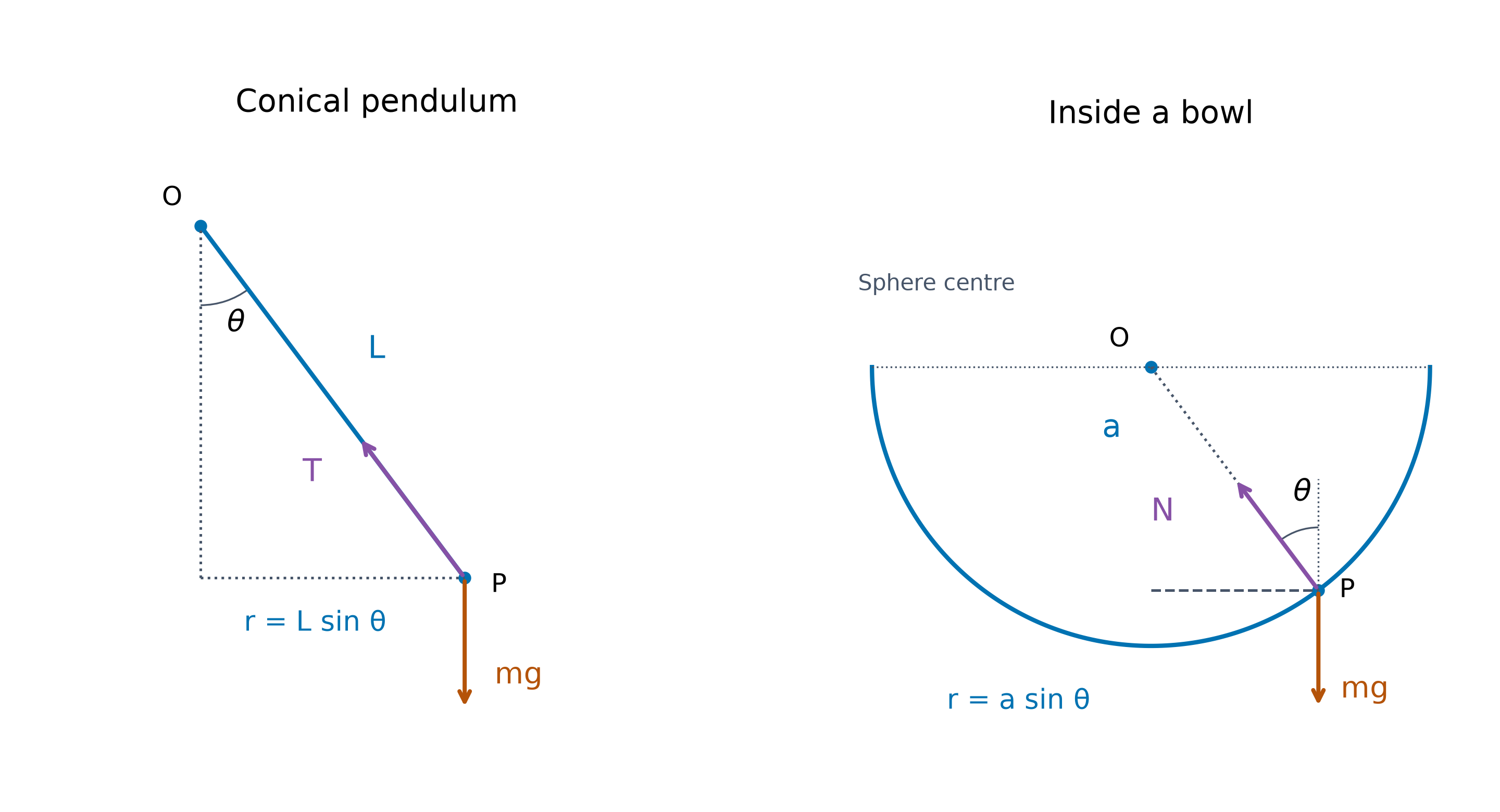
A cone needs its own geometry
A smooth hollow cone has its vertex downwards and semi-vertical angle $\alpha$. At height $h$ above the vertex the orbit radius is $r=h\tan\alpha$. The normal points upwards and inwards, making angle $\alpha$ above horizontal. With only gravity and contact, $N\sin\alpha=mg$ and $N\cos\alpha=mr\omega^2$. These give $\omega^2=g\cot^2\alpha/h$. A cone's radius is set by height; do not borrow the bowl's radius formula.
Add a string through the cone vertex
Now attach the particle of mass $m$ to another mass $m$ hanging below the vertex through a smooth hole. The string pulls down the sloping surface towards the vertex. Take $\tan\alpha=4/3$, so $\sin\alpha=4/5$, $\cos\alpha=3/5$ and $r=4h/3$. The hanging mass gives $T=mg$. Then $N(4/5)=mg+T(3/5)$ gives $N=2mg$. Radially, $N(3/5)+T(4/5)=mr\omega^2$, hence $\omega^2=3g/(2h)$. The string's downward component increases the reaction.

Measure height in a vertical circle
For a vertical circle 竖直圆 of radius $r$, take angle $\theta$ from the downward vertical and measure height from the bottom. At the right-hand point of the circle, $x=r\sin\theta$ and height $h=r(1-\cos\theta)$. At the bottom $\theta=0$ and $h=0$; at the side $\theta=\pi/2$ and $h=r$; at the top $\theta=\pi$ and $h=2r$. Mark the angle's reference direction before writing an energy equation.
Energy gives the speed at each height
For a light inextensible string or a fixed smooth circular surface, the constraint force is perpendicular to velocity and does no work. With no resistance, energy conservation 能量守恒 gives $\tfrac12mu^2=\tfrac12mv^2+mgr(1-\cos\theta)$, where $u$ is bottom speed. Therefore $v^2=u^2-2gr(1-\cos\theta)$. This formula applies while the particle follows the circle. It finds speed, not tension; and $v^2\geq0$ alone does not prove the circular path is possible.
Take inward components of weight and tension
For a string pulling towards the centre, the inward equation is $T-mg\cos\theta=mv^2/r$. At the bottom, weight acts outwards; at the top, weight acts inwards. The changing sign is already in $\cos\theta$. Combining with energy gives $T/m=u^2/r-2g+3g\cos\theta$. At the bottom $T=mu^2/r+mg$; at the top $T=m(u^2/r-5g)$. These tensions use different speeds at the two heights.
Work from a specified bottom speed
Suppose $u^2=6gr$. At $\cos\theta=1/2$, energy gives $v^2=5gr$, and the inward equation gives $T=5mg+mg/2=11mg/2$. At the bottom the tension is $7mg$; at the top it is $mg$. The particle moves fastest and needs the greatest tension at the bottom. In between, gravity also changes its speed, so the full acceleration has a tangential component.

A complete loop needs a feasible top force
A string can pull, not push: a taut 绷紧 string needs $T\geq0$. The top has the least tension. There $T+mg=mv_{\rm top}^2/r$, so $v_{\rm top}^2\geq gr$. Energy then gives the complete-loop condition $u^2\geq5gr$. Equality is the limiting complete loop, with zero tension at the top. Merely reaching top height by energy would require $u^2\geq4gr$; that weaker test allows a negative calculated tension before the top. The string would already have gone slack 松弛.
Start at a point other than the bottom
If the starting radius makes angle $\phi$ with the upward vertical, its height above the bottom is $r(1+\cos\phi)$. The climb to the top is $r(1-\cos\phi)$. A complete loop requires $v^2\geq gr+2gr(1-\cos\phi)=gr(3-2\cos\phi)$. At $\cos\phi=1/4$, the minimum starting squared speed is $5gr/2$. At equality the bottom squared speed is $5gr$ and the greatest tension is $6mg$.
Use a tension ratio with two energy states
In a complete loop, bottom tension exceeds top tension by $6mg$. If their ratio is $9:1$, write $T_{\rm bottom}=9T_{\rm top}$. Then $T_{\rm top}=3mg/4$, so $v_{\rm top}^2=7gr/4$ and bottom squared speed is $23gr/4$. If the speed at angle $\theta$ from downward vertical is $\sqrt{4gr}$, energy gives $4gr=23gr/4-2gr+2gr\cos\theta$. Thus $\cos\theta=1/8$. Equal top and bottom speeds would violate energy conservation.
A turning point and a slack point are different
If bottom squared speed is $gr$, the equation $v=0$ gives $\cos\theta=1/2$: the particle turns back at $60^\circ$, with tension $mg/2>0$. It never reaches the horizontal level. If bottom squared speed is $3gr$, the equation $T=0$ instead gives $\cos\theta=-1/3$, about $109.5^\circ$. Here $v^2=gr/3>0$: the string slackens while the particle is still moving. Stop using the string's circular-motion equation beyond this point.
An inner surface can push only inwards
On the smooth inner surface of a spherical shell, the normal reaction, or normal contact force 法向接触力 $N$, points towards the sphere centre. Its radial equation is $N-mg\cos\theta=mv^2/r$ with $\theta$ measured from downward vertical. The same energy and complete-loop results apply, replacing $T$ by $N$. Require $N\geq0$; a negative answer means the surface would have to pull. For loss of contact 脱离接触, test the boundary $N=0$: the particle leaves if continuing the circle would require $N<0$. A limiting complete loop can have $N=0$ at the top without separating.

A reaction ratio can locate a rim
A particle starts vertically downwards from the side of a smooth inner shell with squared speed $u^2=2gr$. A rim is at height $kr$ above the centre. At the start, $N_A=mu^2/r=2mg$; at the rim, energy gives $v_B^2=(2-2k)gr$. The inward weight component there is $mgk$, so $N_B/m=v_B^2/r-gk=(2-3k)g$. If $N_B=N_A/4$, then $k=1/2$. Keeping contact as far as this rim requires $u^2\geq3gr/2$, not just the energy test $u^2\geq gr$.
An outer surface has the opposite normal direction
A particle starts at the top of a smooth fixed sphere with tangential squared speed $gr/2$. Let $\phi$ be its angle from upward vertical. Energy gives $v^2=gr/2+2gr(1-\cos\phi)$. On the outside, the normal points outwards. The inward equation is $mg\cos\phi-N=mv^2/r$, giving $N=mg(3\cos\phi-5/2)$. It loses contact at $\cos\phi=5/6$, with $v^2=5gr/6>0$. Do not copy the inner-surface sign.
Release gives a tangent velocity, then a curved path
At release, position and velocity remain continuous. The initial free-flight velocity is tangent to the circle. Gravity still acts, so the later path is a projectile parabola, not a straight tangent line. For the string that slackens at $\cos\theta=-1/3$ with bottom squared speed $3gr$, take centre $O$ as origin. At release, $(x,y)=(2\sqrt2r/3,r/3)$ and speed is $\sqrt{gr/3}$. On the upward trip along the right side, velocity components are $(-v/3,2\sqrt2v/3)$.

Join circular motion to a flight across a rim
Cut an inner shell at height $r/2$ above its centre. To fly from the right rim to the left rim at the same height, let speed at release be $v$. The horizontal gap is $\sqrt3r$; velocity components are $(-v/2,\sqrt3v/2)$. The non-zero return time is $t=\sqrt3v/g$. Horizontal motion gives $\sqrt3r=(v/2)t$, so $v^2=2gr$. If the launch began at the side at centre height, energy gives side squared speed $u^2=3gr$. The rim reaction just before exit is $3mg/2>0$: the surface ends before contact is lost.

Check the model before accepting a root
Draw forces and identify the orbit radius. For steady horizontal motion, resolve vertically and inwards. For vertical motion, combine height-based energy with one inward force equation. Check $v^2\geq0$ and the sign of tension or reaction along the route. State which event happens first: a turning point, slack string, loss of contact, or the end of the surface. Then use the next model. A collision changes the motion through an impulse; do not carry the no-loss circular energy equation through an impact without a separate collision argument.
Keep the direction and constraint together
$v=r\omega$ links speed and angular speed; $a_r=v^2/r$ is the inward component of acceleration. The inward resultant comes from real forces. A horizontal path alone does not guarantee constant speed. For a light inextensible string in a lossless vertical loop, bottom squared speed must be at least $5gr$. At a zero-tension or zero-reaction boundary, test whether the constraint can continue. If release occurs, its velocity is initially tangent; gravity controls the following flight.
Explore
Angle in radians
Circular motion is measured in radians: drag the angle θ and radius r to see the arc swept — angular speed ω turns this into v = rω.
Vocabulary
Train
| English |
|---|
| tension/ˈtenʃn/ |
| inertia/ɪˈnɜːʃə/ |
| centrifugal/ˌsentrɪˈfjuːɡl/ |
| taut/tɔːt/ |
| tangent/ˈtændʒənt/ |
| angular speed/ˈæŋɡjʊlə spiːd/ |
| linear speed/ˈlɪnɪə spiːd/ |
| period/ˈpɪərɪəd/ |
| frequency/ˈfriːkwənsi/ |
| radial/ˈreɪdɪəl/ |
| centripetal acceleration/senˈtrɪpɪtl əkˌseləˈreɪʃn/ |
| tangential/tænˈdʒenʃl/ |
| vertical circle/ˈvɜːtɪkl ˈsɜːkl/ |
| centripetal force/senˈtrɪpɪtl fɔːs/ |
| horizontal circle/ˌhɒrɪˈzɒntl ˈsɜːkl/ |
| conical pendulum/ˈkɒnɪkl ˈpendjʊləm/ |
| energy conservation/ˈenədʒi ˌkɒnsəˈveɪʃn/ |
| slack/slæk/ |
| normal contact force/ˈnɔːml ˈkɒntækt fɔːs/ |
| loss of contact/lɒs ɒv ˈkɒntækt/ |
| radian/ˈreɪdɪən/ |
3.4
Hooke's law
Syllabus
| Candidates should be able to: | Notes and examples |
|---|---|
| use Hooke’s law as a model relating the force in an elastic string or spring to the extension or compression, and understand the term modulus of elasticity | |
| use the formula for the elastic potential energy stored in a string or spring | Proof of the formula is not required. |
| solve problems involving forces due to elastic strings or springs, including those where considerations of work and energy are needed. | e.g. a particle moving horizontally or vertically or on an inclined plane while attached to one or more strings or springs, or a particle attached to an elastic string acting as a 'conical pendulum'. |
Source: Cambridge International syllabus
Why a jump needs a model
A bungee rope stores energy as it stretches. Its pull changes during the jump, so constant-acceleration formulae are usually unsuitable. Hooke's law 胡克定律 models force proportional to extension within a stated range. Real ropes need not follow it over a whole jump. Here use ideal light elastic 弹性 strings and springs with no energy loss unless stated.
Measure extension from natural length
The natural length 自然长度 $L$ is the unloaded length. If the actual length is $\ell$, the extension 伸长量 is $x=\ell-L$, not $\ell$. A taut elastic string has tension $T=kx$. With modulus of elasticity 弹性模量 $\lambda$, write $k=\lambda/L$, so $T=\lambda x/L$. For a spring the signed restoring force opposes displacement from its natural length.
Modulus and stiffness have different units
Stiffness 劲度系数 $k$ is measured in $\dfrac{\text{N}}{\text{m}}$; this string model's $\lambda$ is measured in newtons. It includes material and cross-section effects; it is not Young modulus, whose unit is pascals. Cut a uniform string into two equal pieces: each has the same $\lambda$ but half the natural length, so each piece has twice the stiffness. Do not keep $k$ fixed when changing $L$ in this way.
A string and a spring have different branches
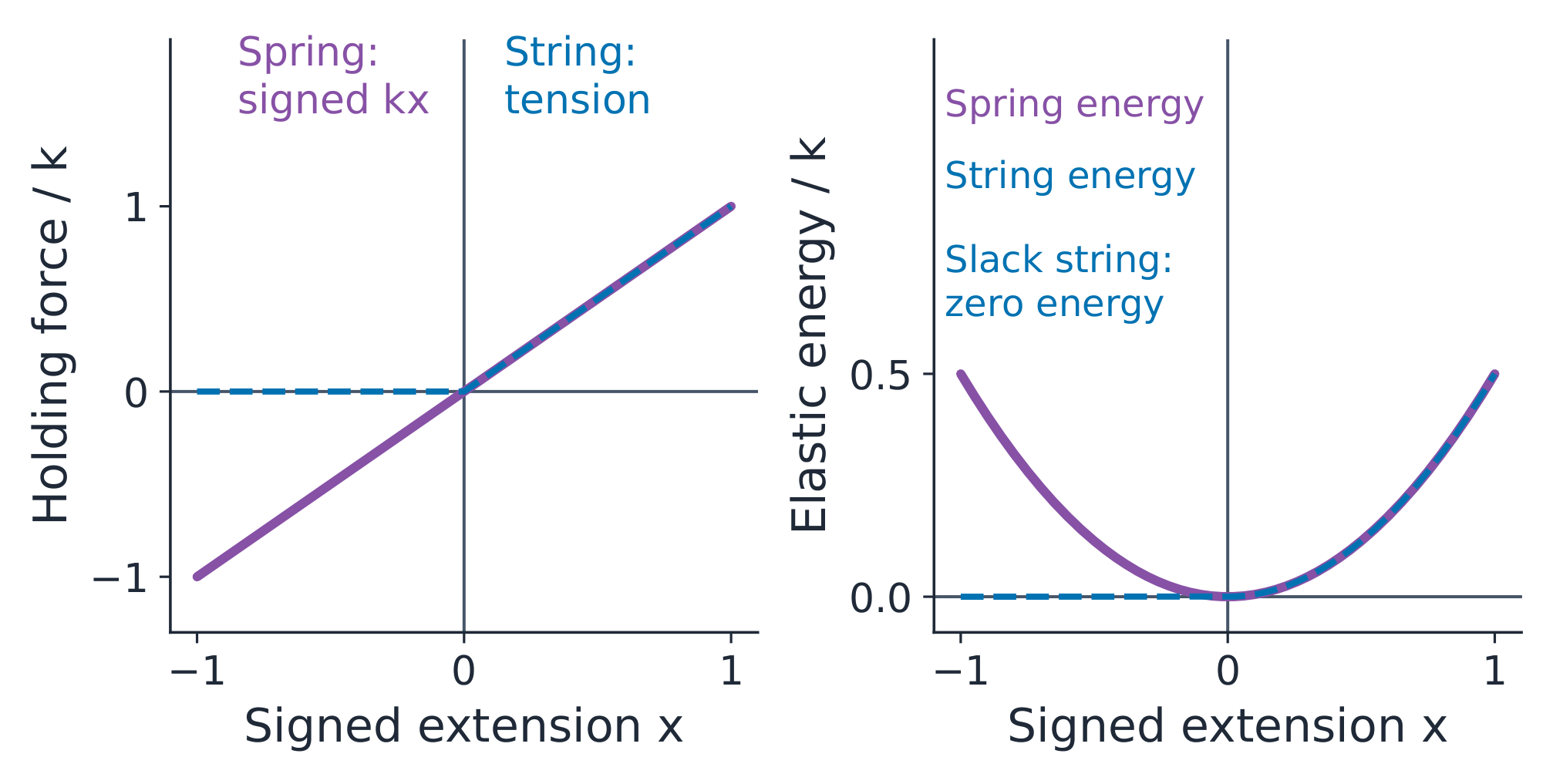
A string pulls only when taut. For $\ell\leq L$ it is slack: $T=0$ and its stored elastic energy is zero. A negative value of $\ell-L$ is not a negative string tension. An ideal spring can pull in extension and push in compression 压缩. Its signed $x$ may be negative, while the force magnitude is $k|x|$. Continue to use the spring law only within the stated model range.
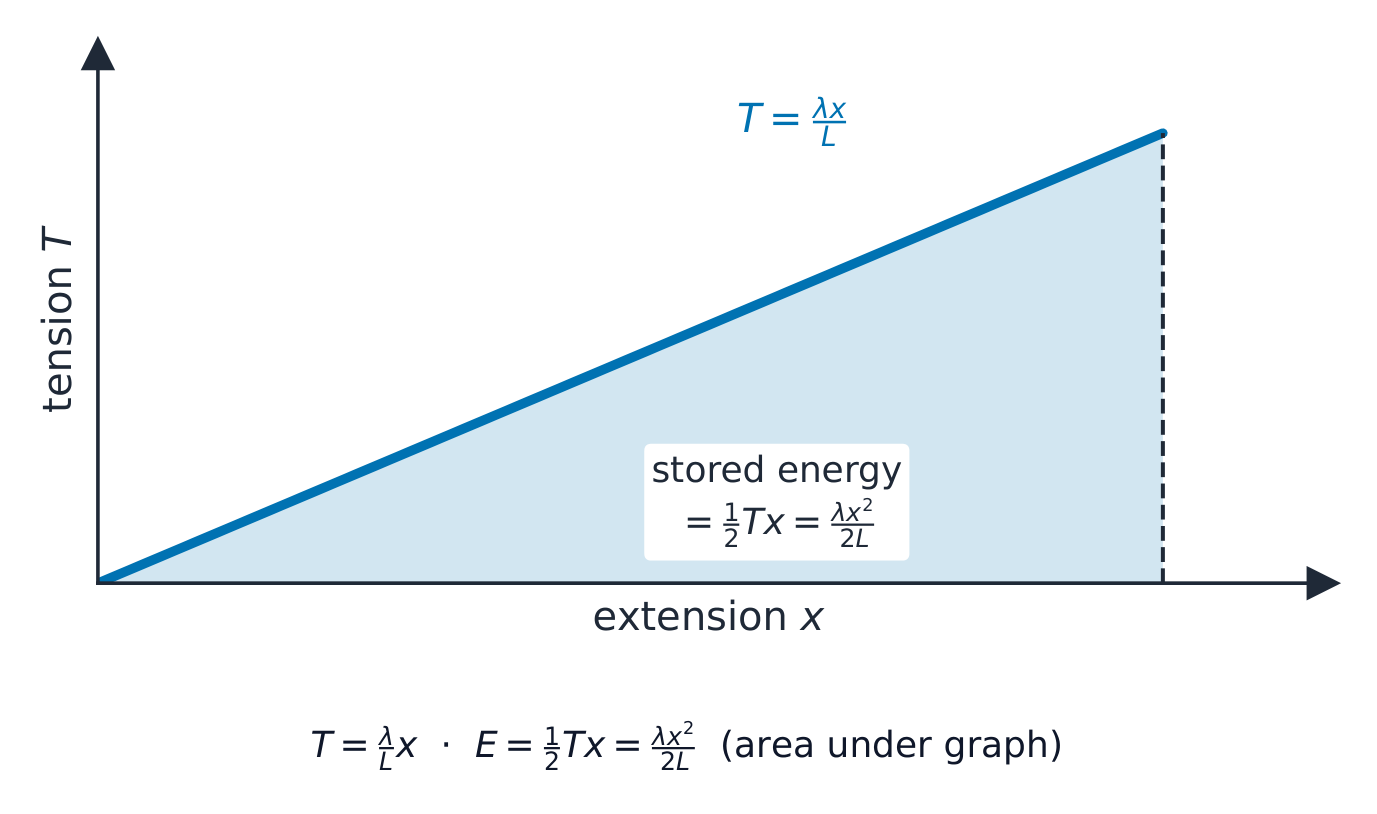
Store the area under the graph
Stretching slowly from natural length does work equal to the triangular area under the force–extension line. The stored elastic potential energy 弹性势能 is
$$E_e=\frac12kx^2=\frac{\lambda x^2}{2L}.$$
For a spring this also applies in compression. For a string use it only when $x\geq0$; the slack branch has zero energy. Doubling extension doubles tension but multiplies energy by four. A proof of the energy formula is not required.
Use force and energy on the same string
A string has $L=2\ \text{m}$, $\lambda=50\ \text{N}$ and extension $0.5\ \text{m}$. Its actual length is $2.5\ \text{m}$. First use $T=\lambda x/L$, giving $T=50(0.5)/2=12.5\ \text{N}$. For stored energy use $E_e=\lambda x^2/(2L)$, giving $E_e=50(0.5)^2/4=3.125\ \text{J}$. Force and energy have different units; do not substitute actual length for extension.
Infer a natural length from measurements
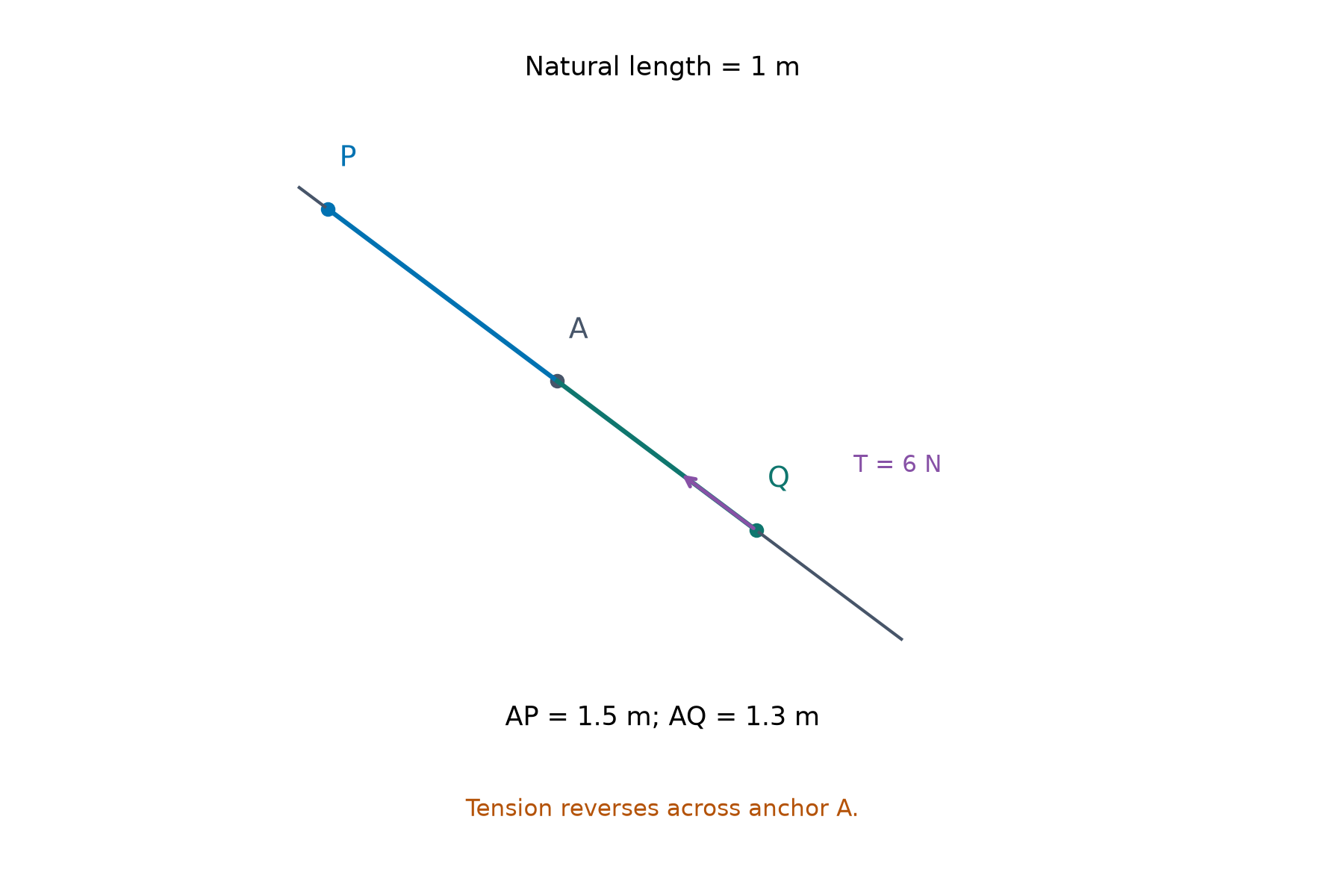
A string has tension $6\ \text{N}$ at length $1.3\ \text{m}$ and $10\ \text{N}$ at length $1.5\ \text{m}$. Since $T=k(\ell-L)$, the gradient is $k=(10-6)/(1.5-1.3)=20\ \dfrac{\text{N}}{\text{m}}$. Then $L=\ell-T/k=1.3-6/20=1\ \text{m}$ and $\lambda=kL=20\ \text{N}$. Check the other measurement: $20(1.5-1)=10\ \text{N}$. The line's horizontal intercept gives natural length, not zero length.
Find a hanging equilibrium
A mass $m$ hangs at rest from one vertical string attached above it. Equilibrium requires $T=mg$, so its equilibrium extension is $e=mg/k=mgL/\lambda$. A $0.6\ \text{kg}$ mass on $k=30\ \dfrac{\text{N}}{\text{m}}$ has $e=0.2\ \text{m}$ when $g=10\ \dfrac{\text{m}}{\text{s}^2}$. If the mass is moving through that position, acceleration is momentarily zero; speed need not be zero.
Release at natural length is not slow loading
Attach a mass to the lower end at natural length and release it from rest, with no resistance. After a downward extension $x$, energy gives $mgx=\tfrac12mv^2+\tfrac12kx^2$. At maximum stretch $v=0$, so the non-zero root is $x=2mg/k=2e$. Maximum speed occurs earlier at $x=e$, where $mg-kx=0$; $v_{\max}^2=g^2m/k$. Slow loading instead ends at $e$ and removes energy from the system.
A horizontal spring can pass natural length
A $2\ \text{kg}$ particle on a smooth horizontal line is attached to a spring with $k=50\ \dfrac{\text{N}}{\text{m}}$. Release it from rest at extension $0.4\ \text{m}$. Its initial energy is $\tfrac12k(0.4)^2=4\ \text{J}$. At natural length the energy is all kinetic: $\tfrac12mv^2=4$, so $v=2\ \dfrac{\text{m}}{\text{s}}$. The particle continues into compression and first stops at $x=-0.4\ \text{m}$, provided no other physical constraint intervenes.
A horizontal string changes model at natural length
Replace that spring by an elastic string with the same $k$ and initial extension. It has the same speed at natural length, but beyond that point it has no tension and no elastic energy. On the smooth horizontal surface the particle then moves at constant velocity until another constraint acts. Do not predict spring-like compression and reversal. Specify geometry before following a particle past its anchor.
Release a compressed vertical spring
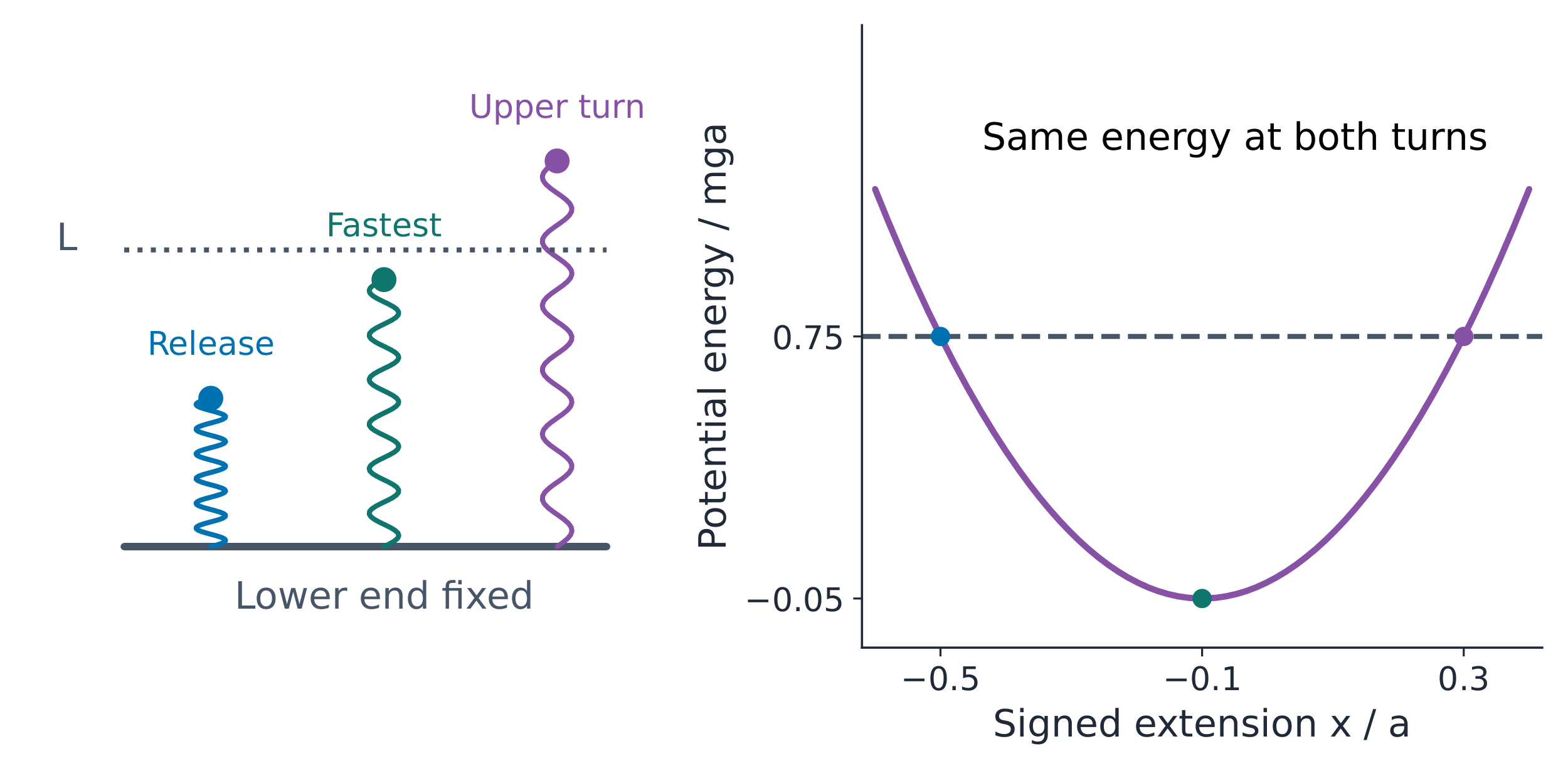
A spring has lower end fixed, natural length $a$, and $\lambda=10mg$. A mass $m$ is attached to its top and released from rest with compression $a/2$. Let $x$ be signed extension upwards. Relative to natural length, total potential energy is $U=5mgx^2/a+mgx$. Initially $x=-a/2$ and $U=3mga/4$. At the next rest point, put $z=x/a$: $5z^2+z=3/4$. The roots are $-1/2$ and $3/10$. The first is the initial state; the maximum extension is $3a/10$.
Maximum speed is not a turning point
In that spring example, $-kx-mg=0$ at $x=-a/10$. Potential energy there is $-mga/20$, so the maximum kinetic energy is $3mga/4+mga/20=4mga/5$. Hence $v_{\max}^2=8ag/5$. At maximum extension $3a/10$, the mass is instantaneously at rest but the acceleration is $-4g$, downwards. A turning point 转折点 has $v=0$; it need not have zero resultant force.
Record both end states before writing energy
Choose one height reference. Write kinetic energy, gravitational potential energy $mgh$, and every active elastic energy at the initial and final positions. With no resistance their total is conserved; with friction include its negative work. Use actual lengths to find each extension independently. A string at or below natural length contributes zero energy, not $\lambda(\ell-L)^2/(2L)$. If a path crosses a slack boundary, use the right force law in each interval.
Free fall can come before stretching
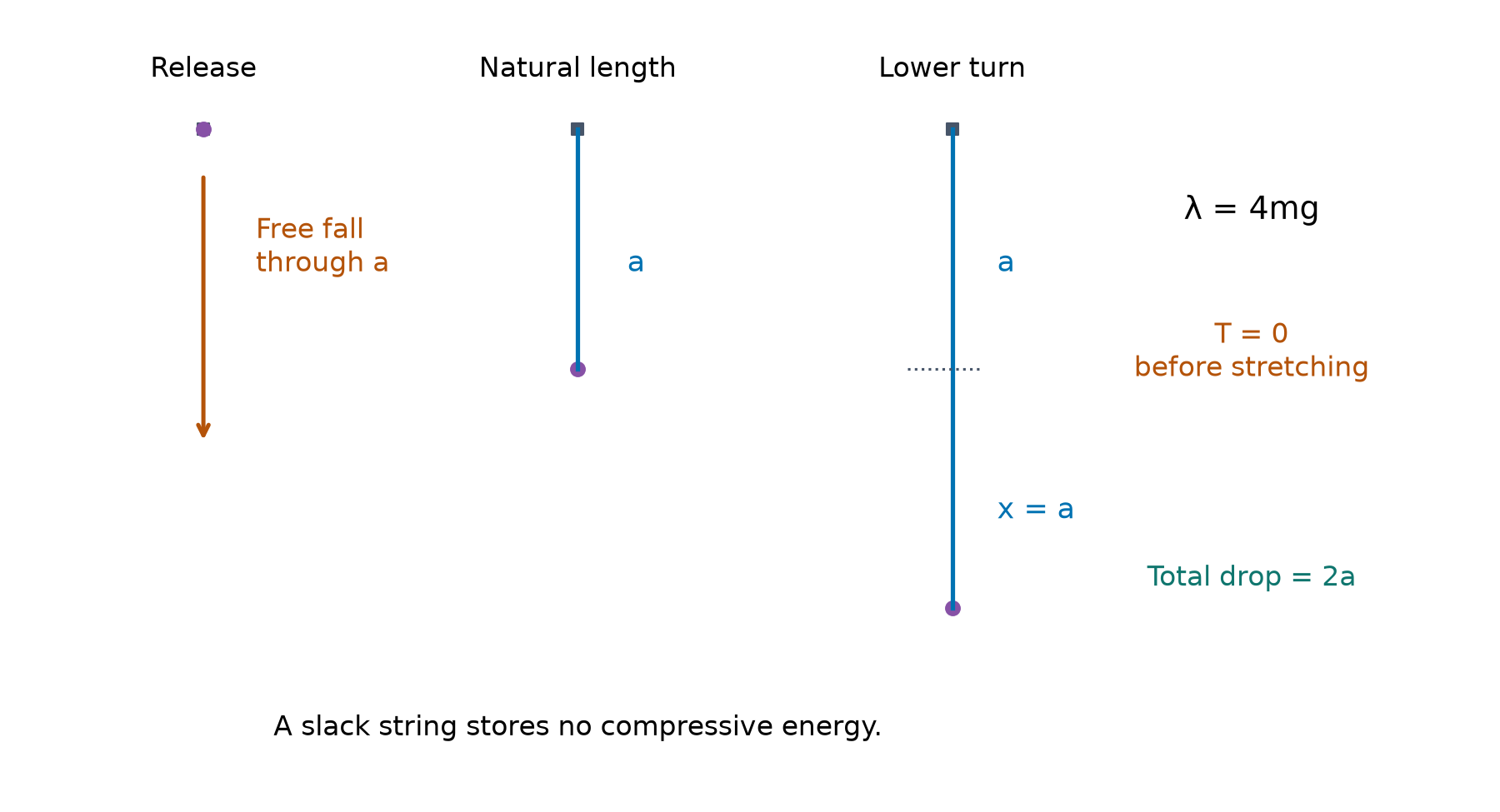
A mass $m$ is released from rest at its anchor, on a vertical string with natural length $a$ and $\lambda=4mg$. It first falls freely through $a$; the string then begins stretching. At later extension $x$, energy gives $mg(a+x)=\tfrac12mv^2+2mgx^2/a$. At the lowest point let $z=x/a$. Then $2z^2-z-1=0$, so $z=1$; the negative root is outside the stretched branch. The total drop is $2a$. Maximum speed is at $x=a/4$, giving $v_{\max}^2=9ag/4$.
Removing a mass changes the equilibrium
A vertical string has natural length $a$ and $\lambda=4mg$. Masses $m$ and $3m$ first hang at equilibrium, so the extension is $a$. Remove $3m$ without an impulse. The remaining mass starts at rest at length $2a$. On its taut branch put $z=x/a$ and take height zero at natural length. Energy becomes $\tfrac12mv^2+mga(2z^2-z)=mga$. To find the first position where $v^2=ag$, solve $2z^2-z=1/2$. The valid root gives $\ell=(5+\sqrt5)a/4$; the other root has negative extension.
A rejected root does not describe the slack flight
At natural length in that example, $v^2=2ag$ upwards. After that the string is slack; gravity alone acts until the next event. The taut-string quadratic cannot describe this phase. After rising a further distance $s$, use $v^2=2ag-2gs$. The later position with $v^2=ag$ is $s=a/2$, so the length is $a/2$. The negative-extension root from the old formula gives a different value because it invents compressive string energy.
Resolve along an inclined plane
A mass $m$ rests on a smooth plane inclined at $\beta$ to horizontal, attached to an anchor upslope by a string along the plane. Normal reaction is $mg\cos\beta$; downslope weight is $mg\sin\beta$. Equilibrium requires $kx=mg\sin\beta$. With $m=1\ \text{kg}$, $g=10\ \dfrac{\text{m}}{\text{s}^2}$, $\sin\beta=3/5$ and $k=20\ \dfrac{\text{N}}{\text{m}}$, $x=0.3\ \text{m}$. Friction, if present, must be included with its actual direction.
Follow a string past its anchor
Use that smooth plane and particle with natural length $1\ \text{m}$. Release from rest $1.5\ \text{m}$ above the anchor. Initially the string pulls downslope; it then goes slack around the anchor and becomes taut again below it. Maximum speed is below the anchor at extension $0.3\ \text{m}$, where tension balances the $6\ \text{N}$ downslope weight. Total travel to that point is $1.5+1+0.3=2.8\ \text{m}$. Work–energy gives $\tfrac12mv^2=\tfrac12k(0.5)^2+mg\sin\beta(2.8)-\tfrac12k(0.3)^2=18.4\ \text{J}$. Thus $v_{\max}^2=36.8\ \dfrac{\text{m}^2}{\text{s}^2}$. Before this point the downslope resultant stays positive.
Friction removes mechanical energy
On the same incline let $\mu=1/4$, and release the particle from natural length below the anchor. For the first downslope motion, normal reaction is $8\ \text{N}$ and friction is $2\ \text{N}$ upslope. Net driving force before elasticity is $6-2=4\ \text{N}$. Work–energy gives $\tfrac12mv^2=4x-10x^2$. The first maximum extension is $0.4\ \text{m}$, and maximum speed occurs at $x=0.2\ \text{m}$ with $v_{\max}^2=0.8\ \dfrac{\text{m}^2}{\text{s}^2}$. Recheck friction's direction on any return journey; this equation describes the first descent.
Two opposing strings need two extensions
Fix anchors $6\ \text{m}$ apart on a smooth horizontal line. Both strings have natural length $2\ \text{m}$; the left has $\lambda=20\ \text{N}$ and the right $40\ \text{N}$. At coordinate $q$ from the left, both are taut only when $2<q<4$. Balance $10(q-2)=20(4-q)$ to find equilibrium $q=10/3\ \text{m}$. Total elastic energy is $U=5(q-2)^2+10(4-q)^2$. A $2\ \text{kg}$ mass released from $q=3\ \text{m}$ has $U=15\ \text{J}$; at equilibrium $U=40/3\ \text{J}$, giving $v_{\max}^2=5/3\ \dfrac{\text{m}^2}{\text{s}^2}$. The other turn is $q=11/3\ \text{m}$, still in the same branch.
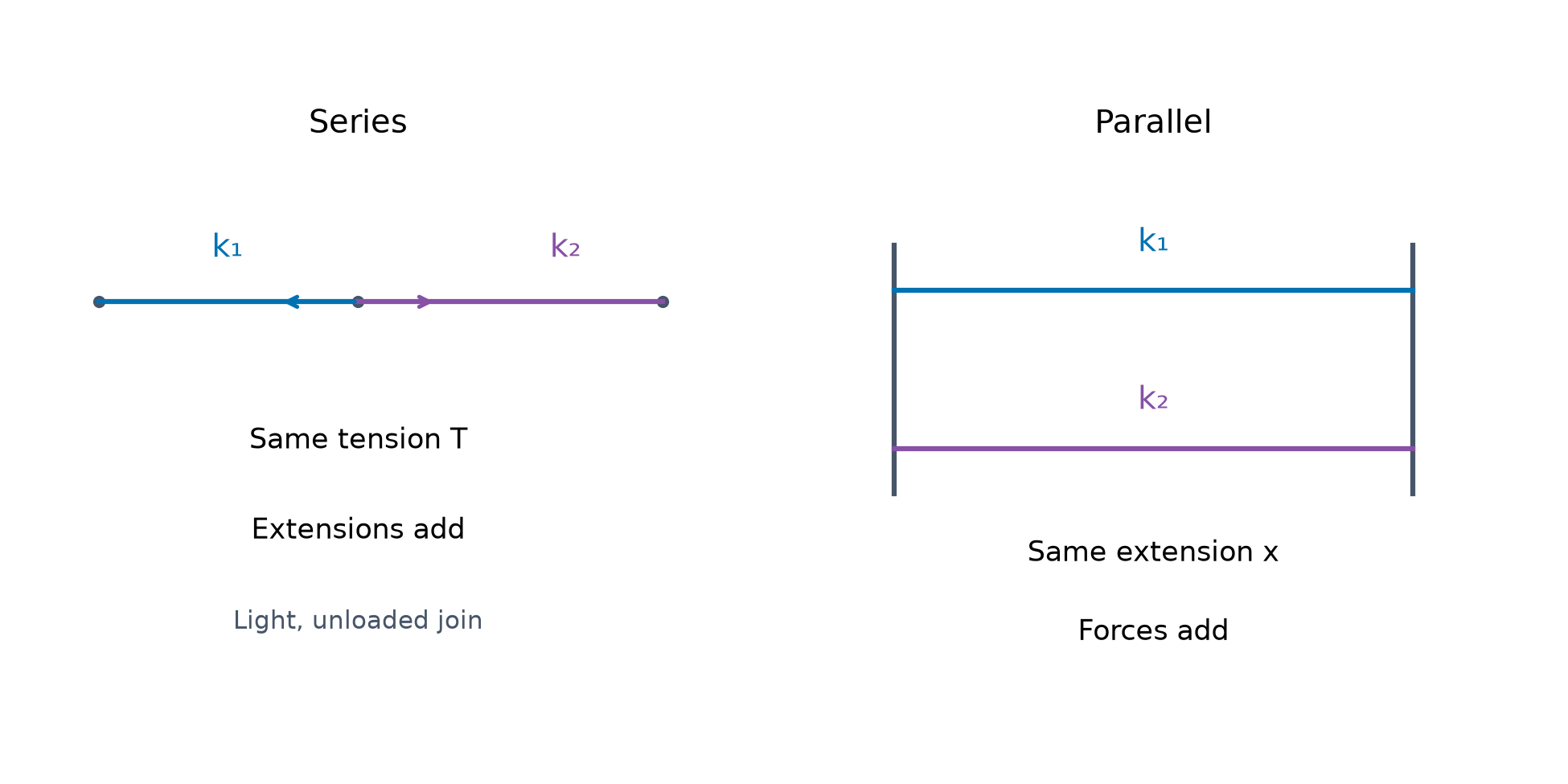
Series strings carry a common tension
For two strings in series 串联 with a light unloaded joining point, tensions are equal and extensions add. Use $x_i=T/k_i$ for each. The equivalent stiffness satisfies $1/k_{\rm eq}=1/k_1+1/k_2$. Natural lengths $1,2\ \text{m}$ and moduli $20,30\ \text{N}$ give $k_1=20$, $k_2=15\ \dfrac{\text{N}}{\text{m}}$. Under $6\ \text{N}$ tension their extensions are $0.3,0.4\ \text{m}$. Total extension is $0.7\ \text{m}$; energy is $\tfrac12T(x_1+x_2)=2.1\ \text{J}$.
Parallel springs share an extension
Two springs in parallel 并联 between the same moving and fixed supports have the same extension if their natural lengths and geometry match. Their forces add: $T=(k_1+k_2)x$, so $k_{\rm eq}=k_1+k_2$. For $k_1=20$ and $k_2=30\ \dfrac{\text{N}}{\text{m}}$ at $x=0.2\ \text{m}$, the forces are $4$ and $6\ \text{N}$; total force is $10\ \text{N}$ and total energy $1\ \text{J}$. Equal extensions do not require equal tensions.
A lower string pulls downwards
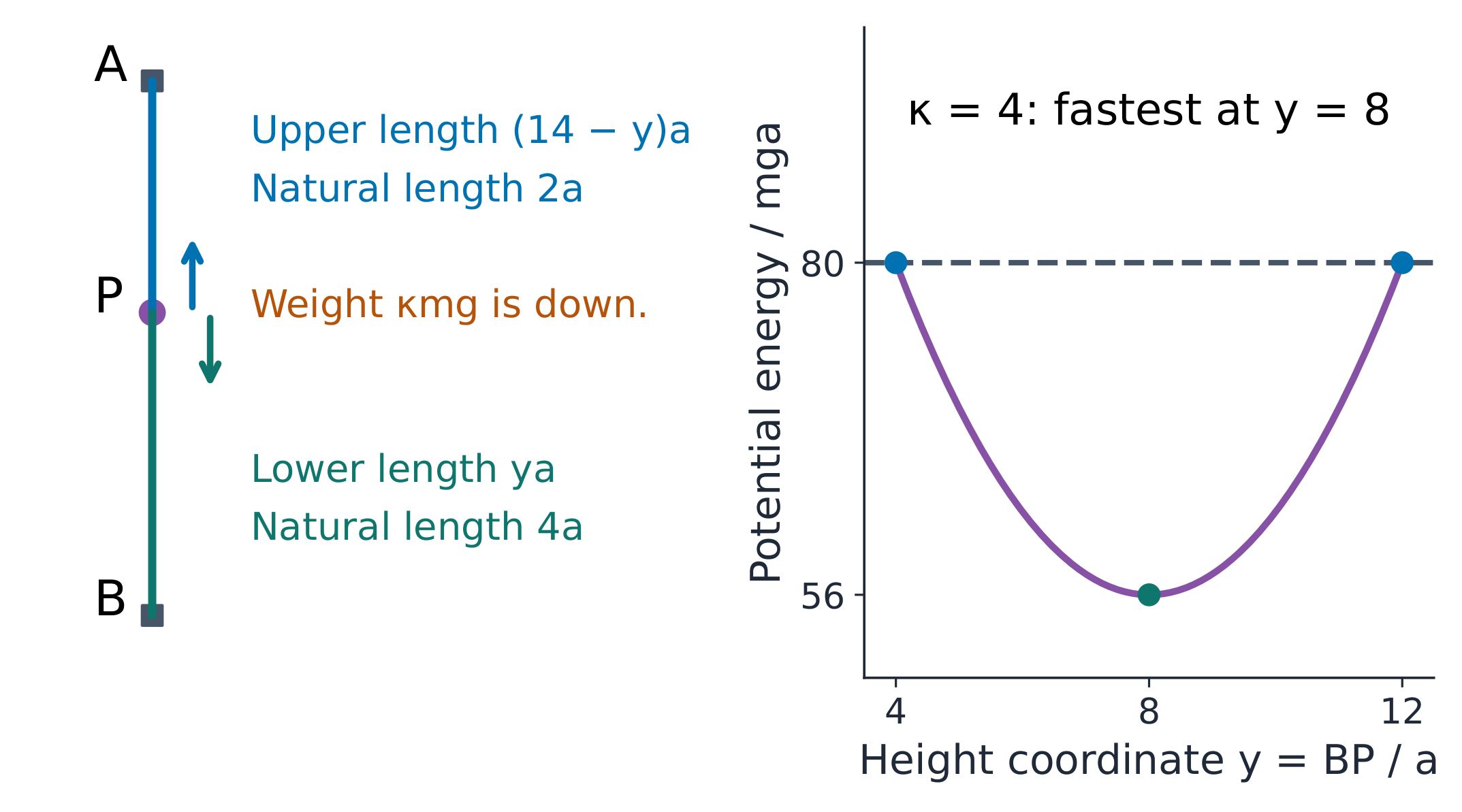
Two vertical anchors $A$ above $B$ are $14a$ apart. A particle of mass $\kappa m$ is joined to $A$ by a string of natural length $2a$, and to $B$ by one of natural length $4a$. Both moduli are $4mg$. Let $BP=ya$; then upper and lower extensions are $(12-y)a$ and $(y-4)a$. Both are taut for $4<y<12$. Their tensions are $2mg(12-y)$ upwards and $mg(y-4)$ downwards. Equilibrium gives $2(12-y)-(y-4)-\kappa=0$, so $y=(28-\kappa)/3$. Do not add both tensions in the same direction.
Two rest positions can determine the mass
Release the particle from rest at $y=12$, and suppose its first lower turning point is $y=4$. Take gravitational potential zero at $B$. Total potential energy divided by $mga$ is $V=(12-y)^2+\tfrac12(y-4)^2+\kappa y$. The endpoints give $32+12\kappa=64+4\kappa$, hence $\kappa=4$. Between them both extensions are nonnegative. With $\kappa=4$, $V-80=\tfrac32(y-4)(y-12)\leq0$, so the intermediate kinetic energy is feasible.
Use both strings to find maximum speed
With $\kappa=4$, equilibrium in that example is $y=8$. At release the total energy is $80mga$; at $y=8$ the potential energy is $(16+8+32)mga=56mga$. Therefore $\tfrac12(4m)v_{\max}^2=24mga$, giving $v_{\max}^2=12ag$. Use the actual moving mass $4m$ in kinetic energy; the symbol $m$ in the moduli is only the reference mass.
An elastic conical pendulum stretches
A mass $0.6\ \text{kg}$ rotates steadily with a string of natural length $1.5\ \text{m}$ and modulus $30\ \text{N}$. Let its angle to vertical have $\cos\theta=4/5$, $\sin\theta=3/5$, and take $g=10\ \dfrac{\text{m}}{\text{s}^2}$. Vertical balance gives $T\cos\theta=mg$, hence $T=7.5\ \text{N}$. Hooke's law gives $x=TL/\lambda=0.375\ \text{m}$, so actual length $\ell=1.875\ \text{m}$ and orbit radius $r=\ell\sin\theta=1.125\ \text{m}$. The radial equation $T\sin\theta=mr\omega^2$ gives $\omega^2=20/3\ \dfrac{\text{rad}^2}{\text{s}^2}$. Use stretched length in the geometry.
A positive length need not give a possible orbit
For a non-zero elastic conical orbit, $T=m\ell\omega^2$ and $T=\lambda(\ell-L)/L$. Therefore $\ell=\lambda L/(\lambda-mL\omega^2)$. Its denominator must be positive. Vertical balance also needs $\ell\cos\theta=g/\omega^2$, with $0<\cos\theta<1$. Take $L=1\ \text{m}$, $\lambda=20\ \text{N}$, $m=1\ \text{kg}$ and $g=10\ \dfrac{\text{m}}{\text{s}^2}$. If $\omega^2=5$, $\ell=4/3\ \text{m}$ but the required vertical height is $2\ \text{m}$: impossible. If $\omega^2=10$, $\ell=2\ \text{m}$ and $r=\sqrt3\ \text{m}$: possible. At $\omega^2=20$ no finite length solves the equations.
Select a physically valid event
Mark the initial state, natural-length boundaries, equilibrium positions and candidate turning points. State the active model in each interval: a taut string pulls, a slack string has no force, and a spring may compress. Find roots, then check lengths, nonnegative string tensions, nonnegative kinetic energy and the order of events. Maximum speed requires zero tangential resultant within a smooth branch, or comparison with a boundary; instantaneous rest requires $v=0$.
Connect force, energy and geometry
First find $x=\ell-L$ for every element. Hooke's law gives force; $\lambda x^2/(2L)$ gives energy on its valid branch. Resolve directions before adding forces, and keep one height reference throughout energy calculations. Use original data to practise both one-element and connected systems. In circular motion, stretching determines actual length before orbit geometry. Check each final answer against its branch and units.
Explore
Hooke's law
F = k·x
Force is proportional to extension — the gradient is the stiffness k.
Vocabulary
Train
| English |
|---|
| Further Mechanics/ˈfɜːðə mɪˈkænɪks/ |
| elastic/ɪˈlæstɪk/ |
| parallel/ˈpærəlel/ |
| turning point/ˈtɜːnɪŋ pɔɪnt/ |
| Hooke's law/hʊks lɔː/ |
| extension/ekˈstenʃn/ |
| natural length/ˈnætʃərəl leŋθ/ |
| modulus of elasticity/ˈmɒdjʊləs ɒv ɪlæˈstɪsɪti/ |
| stiffness/ˈstɪfnəs/ |
| compression/kəmˈpreʃn/ |
| elastic potential energy/ɪˈlæstɪk pəˈtenʃl ˈenədʒi/ |
| series/ˈsɪəriːz/ |
| compress/kəmˈpres/ |
3.5
Linear motion under a variable force
Syllabus
| Candidates should be able to: | Notes and examples |
|---|---|
| solve problems which can be modelled as the linear motion of a particle under the action of a variable force, by setting up and solving an appropriate differential equation. | Including use of $v \frac{\mathrm{d}v}{\mathrm{d}x}$ for acceleration, where appropriate. Calculus required is restricted to content from Pure Mathematics 3 in Cambridge International A Level Mathematics (9709). Only differential equations in which the variables are separable are included. |
Source: Cambridge International syllabus
Why a fast object slows differently
A bicycle usually feels more air resistance when it moves faster. Its drag 阻力 may depend on speed 速率. A different force might depend on position 位置 or time; these are different models. A variable force 变力 can produce changing acceleration. Start with Newton's law and set up a differential equation 微分方程 for the motion; constant-acceleration formulae need not apply.
Choose a positive direction first
Take displacement $x$ positive to the right, and write velocity 速度 $v=dx/dt$. It can be negative. Speed is $|v|$, so a negative velocity does not mean a negative speed. Add signed forces on the particle: $m\,dv/dt=\sum F$. For motion to the right, resistance is negative. After reversal, ordinary resistance reverses too; a prescribed force towards a fixed point follows its own direction rule.
Change the variable using the chain rule
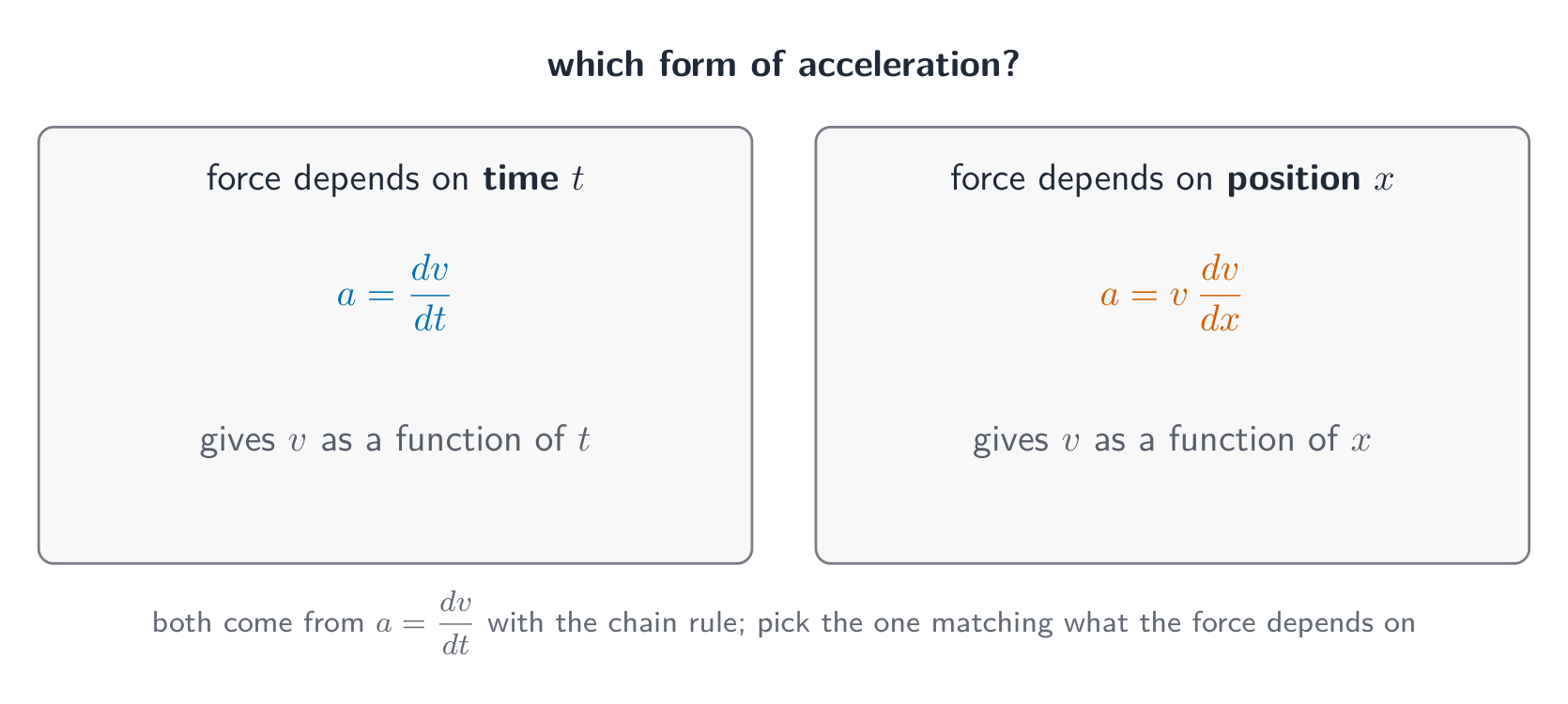
If velocity is written as a function of position along a branch of the motion, the chain rule 链式法则 gives
$$a=\frac{dv}{dt}=\frac{dv}{dx}\frac{dx}{dt}=v\frac{dv}{dx}.$$
This is useful for finding $v$ at a position without first finding time. At a turning point $v(x)$ may have a vertical tangent; do not assume $a=0$ merely because $v=0$. Use the original force law there.
Choose the variables for the requested answer
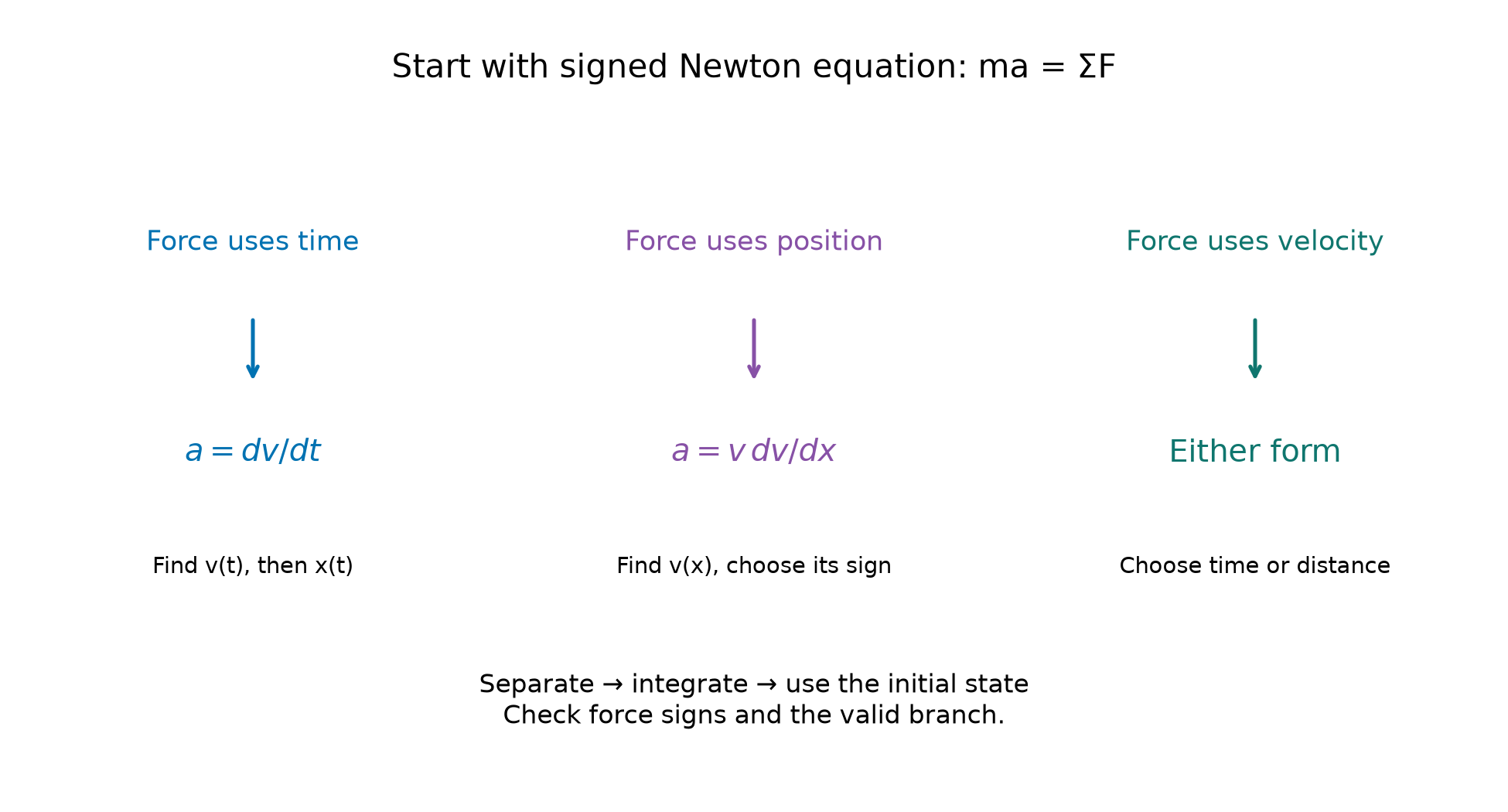
For a time-dependent force, $m\,dv/dt=F(t)$ often gives $v(t)$ directly. For a position-dependent force, $mv\,dv/dx=F(x)$ often gives $v(x)$ directly. If force depends on velocity, either form may help: use $dv/dt$ for a time question and $v\,dv/dx$ for a distance question. These are choices of variables for the same Newton equation, not different laws.
Use each stated condition
A separable differential equation 可分离微分方程 can be rearranged so each side contains one variable and its differential. Separate 分离 the variables, integrate 积分, include a constant, then use an initial condition 初始条件 to determine it. A condition at a specified position is often called a boundary condition 边界条件. Here use only separable 可分离 equations and Pure Mathematics 3 calculus. Check any value divided out: division by a factor that can be zero may remove a constant solution.
A force depending on time can reverse the velocity
A $2\ \text{kg}$ particle has resultant force $6t\ \text{N}$ to the right. At $t=0$, $v=-1\ \dfrac{\text{m}}{\text{s}}$ and $x=0$. Newton's law gives $2\,dv/dt=6t$, so $v=\tfrac32t^2+C$; the initial velocity gives $C=-1$. Now integrate $dx/dt=-1+\tfrac32t^2$. The initial position gives $x=-t+\tfrac12t^3$. There are two integrations and two initial conditions. The particle initially moves left even though acceleration is to the right for $t>0$.
Displacement and distance differ across a turn
In that example, $v=0$ first at $t_* =\sqrt{2/3}\ \text{s}$. Its position is $x_*=-2t_*/3\ \text{m}$. At $t=2\ \text{s}$, displacement is $x=2\ \text{m}$. Total distance is the leftward distance $-x_*$ plus the rightward distance $2-x_*$. Thus distance is $2+4\sqrt{2/3}/3\ \text{m}$, greater than the displacement. Integrating signed velocity gives displacement; split at each reversal to find distance.
A position-dependent force links work to speed
With $F=mv\,dv/dx$, separation gives $mv\,dv=F(x)\,dx$. Integrating between two known states gives
$$\frac12m(v^2-u^2)=\int_{x_0}^{x}F(s)\,ds.$$
The signed area under a force–position graph is work 功. It equals the change in kinetic energy for the resultant force. This relation determines squared speed; use the direction of motion to choose the sign of velocity.
Work through a polynomial force
A particle of mass $8\ \text{kg}$ starts at $x=0$ with $v=1\ \dfrac{\text{m}}{\text{s}}$. For its outward motion the force is $(x^3+4x)\ \text{N}$. Newton's law gives $8v\,dv/dx=x^3+4x$. Separate and integrate: $4v^2=x^4/4+2x^2+C$. Initially $C=4$, so $v^2=x^4/16+x^2/2+1=(x^2/4+1)^2$. The outward velocity is $v=x^2/4+1$; the negative square root would describe a different direction.
A second separation can give position in time
For that outward branch, $dx/dt=1+x^2/4$. Separate as $dt=4\,dx/(x^2+4)$ and integrate: $t=2\tan^{-1}(x/2)+C$. The initial position gives $C=0$. Hence $x=2\tan(t/2)$ on the branch $0\leq t<\pi$. The mathematical model predicts unbounded position as $t\to\pi$ from below. Do not continue the periodic tangent formula across that boundary or assume a real system can sustain the force model indefinitely.

A turning root limits a position formula
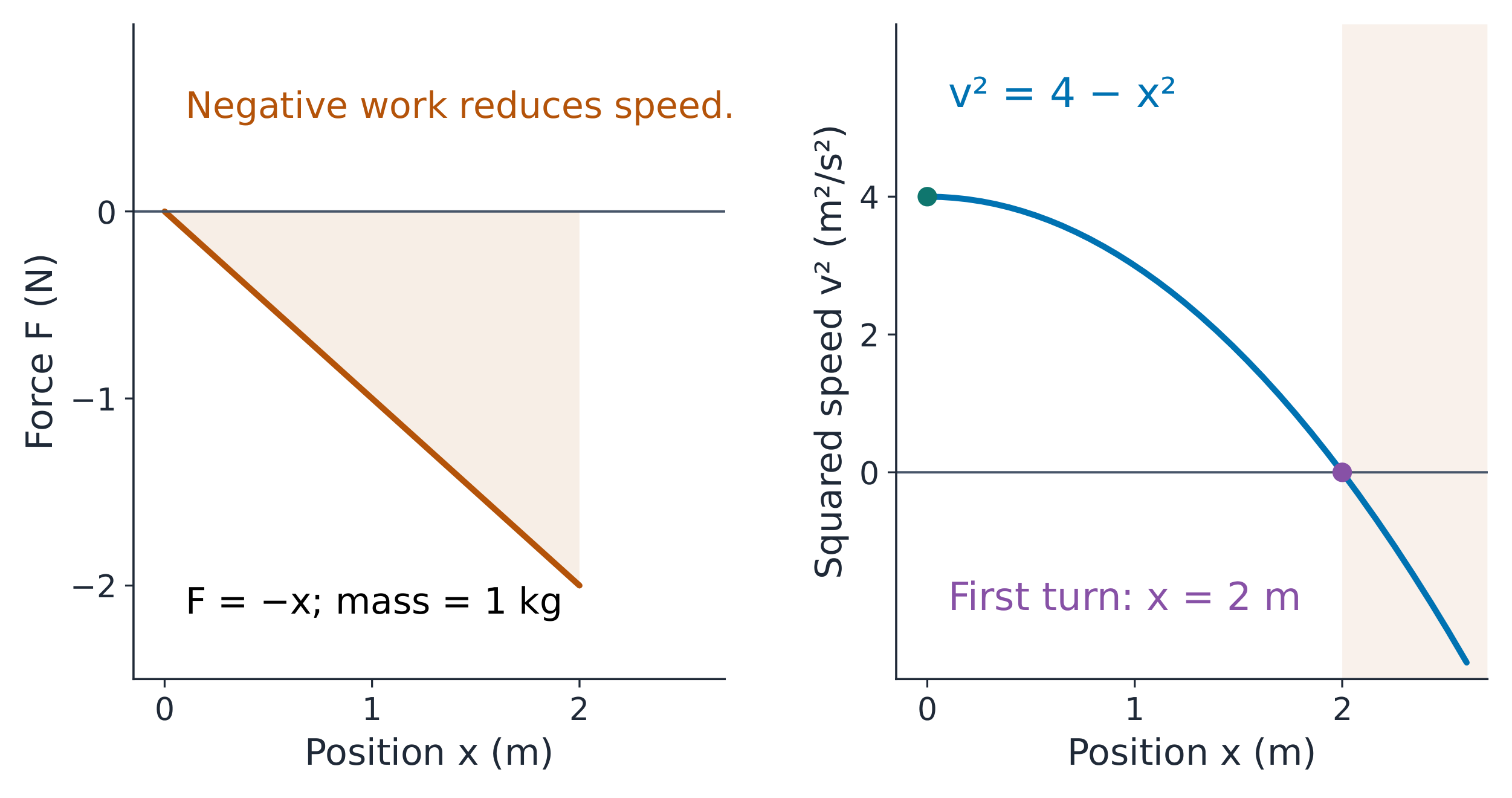
A $1\ \text{kg}$ particle starts at $x=0$ with velocity $2\ \dfrac{\text{m}}{\text{s}}$, under force $-x\ \text{N}$. Newton's law gives $v\,dv/dx=-x$, hence $v^2=4-x^2$ from the initial state. It first stops at $x=2\ \text{m}$, where acceleration is $-2\ \dfrac{\text{m}}{\text{s}^2}$, so it turns back. Use $v=+\sqrt{4-x^2}$ before that turn and $v=-\sqrt{4-x^2}$ immediately afterwards. The region $|x|>2\ \text{m}$ would require negative squared speed and is inaccessible at this energy.
Linear resistance gives an exponential speed
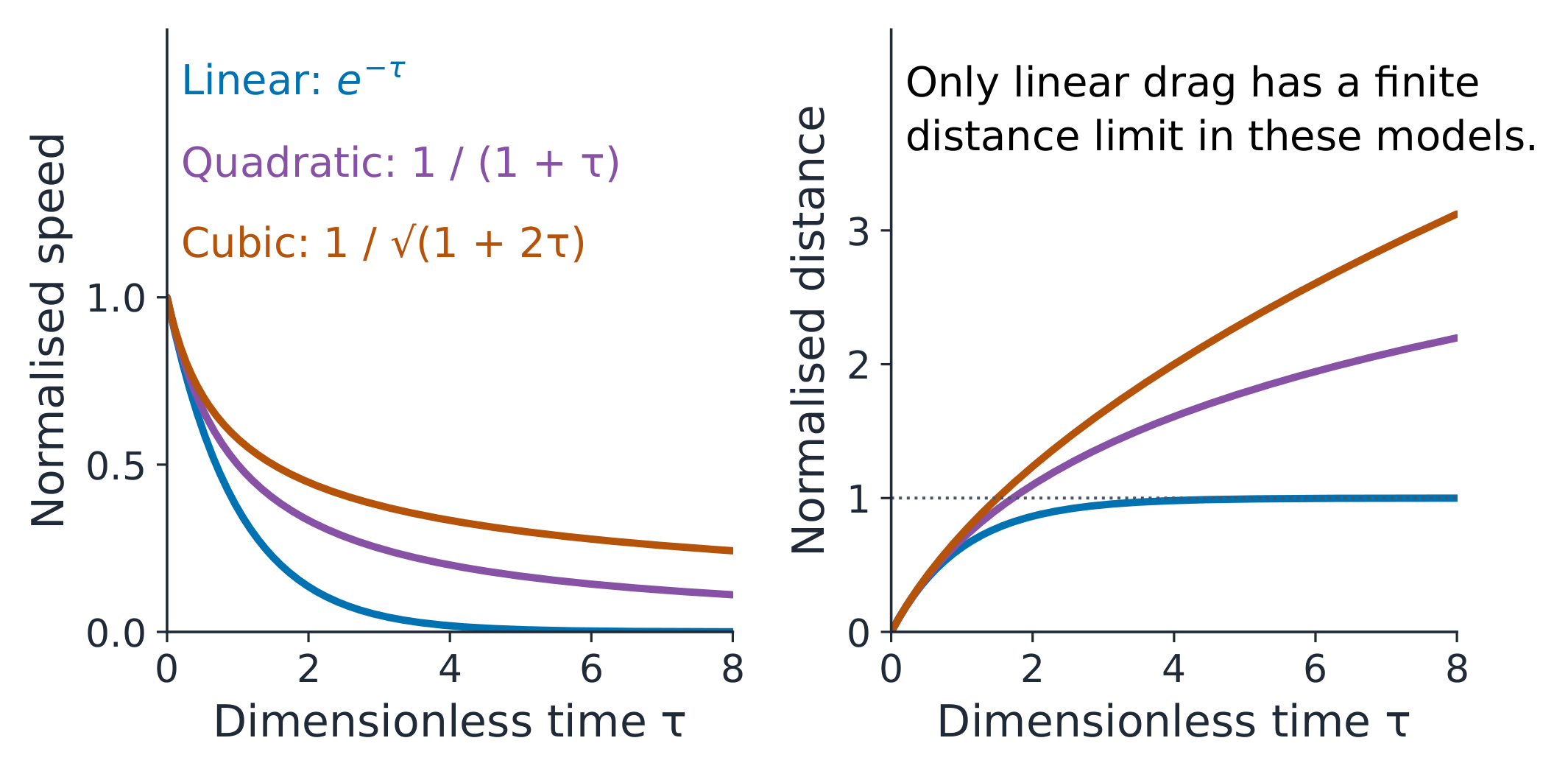
A $2\ \text{kg}$ particle moves horizontally with initial velocity $3\ \dfrac{\text{m}}{\text{s}}$, opposed by resistance of magnitude $4v\ \text{N}$ while $v>0$. Newton's law gives $2\,dv/dt=-4v$, so $dv/v=-2\,dt$. Integration gives $\ln v=-2t+C$. The initial value gives $v=3e^{-2t}$. It remains positive for every finite $t\geq0$ and tends to zero as time grows. An exponential is not zero merely because a calculator rounds it to zero.
A limiting distance is not a finite stopping point
Integrating $v=3e^{-2t}$ with $x(0)=0$ gives $x=\tfrac32(1-e^{-2t})$. Thus the particle travels towards a limiting displacement of $1.5\ \text{m}$. It never reaches that limit in finite time under this ideal model. Equivalently $v=3-2x$ on the moving branch, but putting $v=0$ in that relation gives a limit, not a finite arrival time. Check the time law before describing a stop.
Quadratic resistance has a different distance limit
Suppose horizontal motion satisfies $dv/dt=-v^2/2$ with $v(0)=4$. Separation gives $-1/v=-t/2+C$, so $v=4/(1+2t)$ for $t\geq0$. With $x(0)=0$, integration gives $x=2\ln(1+2t)$. Speed tends to zero, but displacement has no finite upper limit. A decreasing speed does not by itself imply a finite total distance.
A cubic resistance gives another power law
Suppose $dv/dt=-3v^3$ with $v(0)=2$. Separate as $v^{-3}\,dv=-3\,dt$. Integration and the initial value give $1/v^2=6t+1/4$. Choose the positive branch: $v=2/\sqrt{1+24t}$. With $x(0)=0$, integration gives $x=(\sqrt{1+24t}-1)/6$. Both this model and the quadratic model slow forever while covering an unbounded distance; their rates of slowing differ.
Falling with linear drag approaches a balance
Take downward as positive. A mass $m$ falling under gravity and linear resistance $kv$ obeys $m\,dv/dt=mg-kv$. Its terminal velocity 终端速度 is $V=mg/k$, where the resultant is zero. For $m=2\ \text{kg}$, $k=4\ \dfrac{\text{N}\,\text{s}}{\text{m}}$ and $g=10\ \dfrac{\text{m}}{\text{s}^2}$, $V=5\ \dfrac{\text{m}}{\text{s}}$. Released from rest, separation gives $v=5(1-e^{-2t})$ and downward distance $y=5t-\tfrac52(1-e^{-2t})$.
Check a constant solution before dividing
In $dv/dt=(k/m)(V-v)$, dividing by $V-v$ excludes $v=V$. Test it in the original equation: it is a valid constant-velocity solution if that is the initial velocity. An initial downward velocity below $V$ increases towards $V$; one above $V$ decreases towards it. At terminal velocity the particle is moving with zero acceleration. It is not at rest, and the model need not reach the limit in finite time.
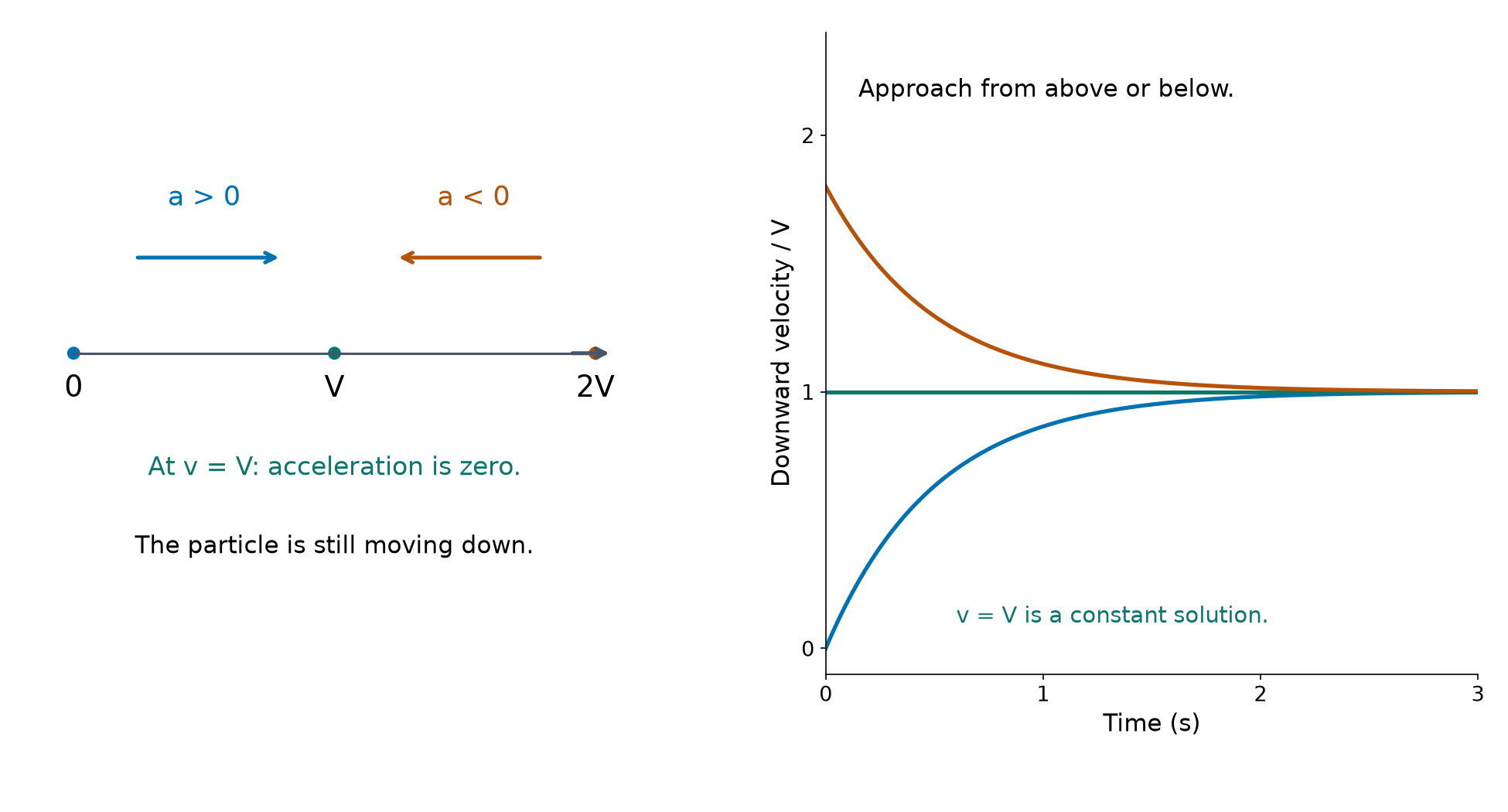
Separate the falling quadratic-drag equation
Take downward speed $v\geq0$ with resistance per unit mass $gv^2/V^2$. Then $dv/dt=g(1-v^2/V^2)$. From rest, $0\leq v<V$, so separation gives $dv/(V^2-v^2)=(g/V^2)\,dt$.
$$\frac{1}{V^2-v^2}=\frac{1}{2V}\left(\frac{1}{V+v}+\frac{1}{V-v}\right).$$
Partial fractions 部分分式 give $\ln[(V+v)/(V-v)]=2gt/V$ after using $v(0)=0$. Rearranging gives $v=V(e^{2gt/V}-1)/(e^{2gt/V}+1)$. The formula approaches $V$ from below; keep logarithm arguments and the initial branch consistent.
Falling speed can be found from distance instead
For the same quadratic-drag fall from rest, choose $v\,dv/dy=g(1-v^2/V^2)$ with downward distance $y$. Separation and the initial state give
$$v^2=V^2\bigl(1-e^{-2gy/V^2}\bigr).$$
With $g=10\ \dfrac{\text{m}}{\text{s}^2}$ and $V=10\ \dfrac{\text{m}}{\text{s}}$, this is $v^2=100(1-e^{-y/5})$. Gravity's lost potential energy does not all become kinetic energy: resistance does negative work.
Upward motion puts gravity and drag together
Launch a particle vertically upwards with speed $u$. Take upwards as positive on the ascent, so $v>0$. Gravity and resistance both act downwards. For quadratic resistance per unit mass $kv^2$, the equation is $dv/dt=-g-kv^2$. Define $V^2=g/k$ to simplify the algebra. Here $V$ is the terminal speed for a later downward fall, not a possible steady upward speed. Using $g-kv^2$ during ascent would reverse the resistance incorrectly.
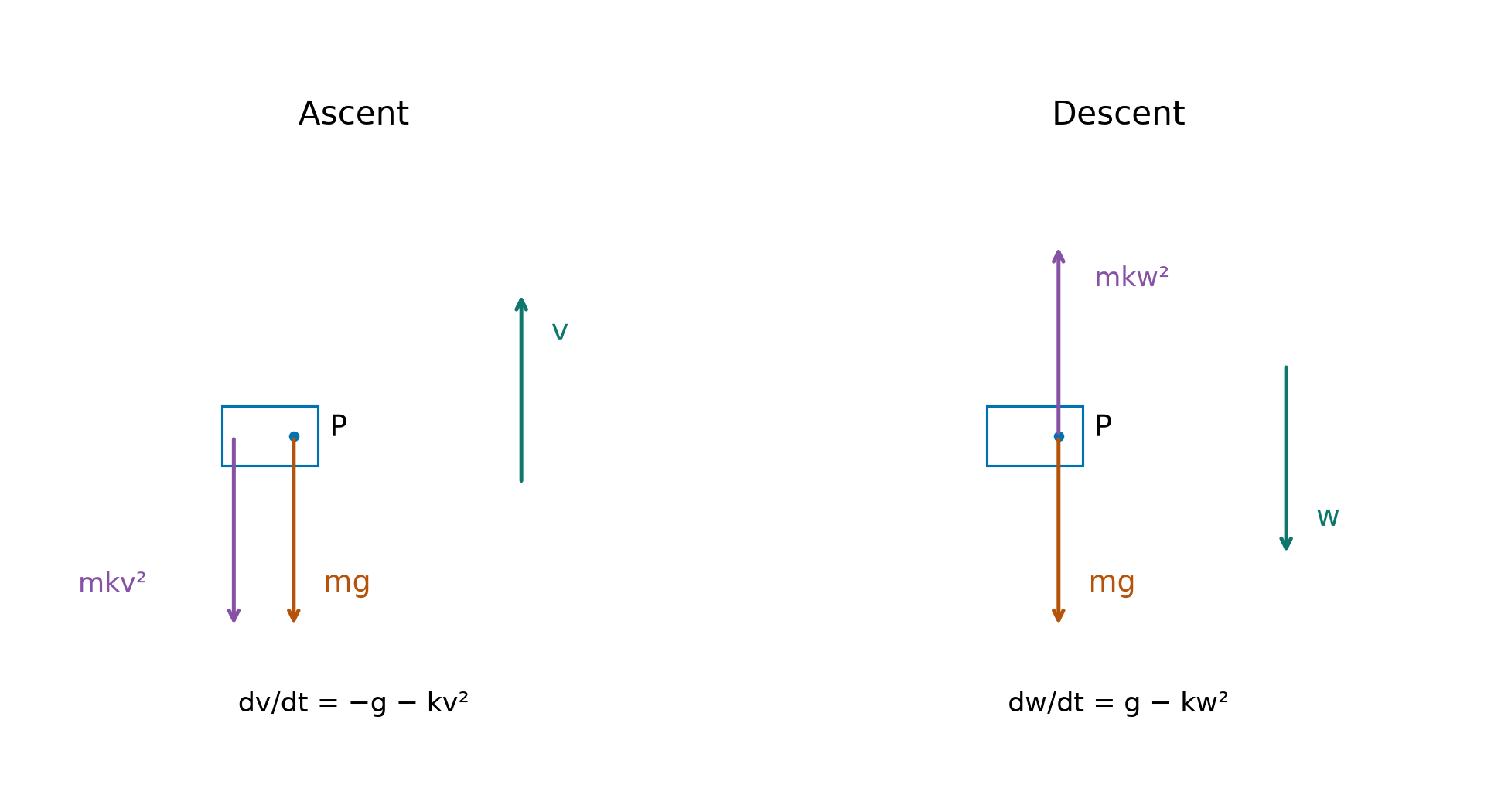
Find maximum height from the position equation
On ascent use $v\,dv/dx=-g-kv^2$. Separate and use the launch state in the integration:
$$\int_u^v\frac{w}{g+kw^2}\,dw=-\int_0^x ds.$$
$$\ln\left(\frac{g+kv^2}{g+ku^2}\right)=-2kx.$$
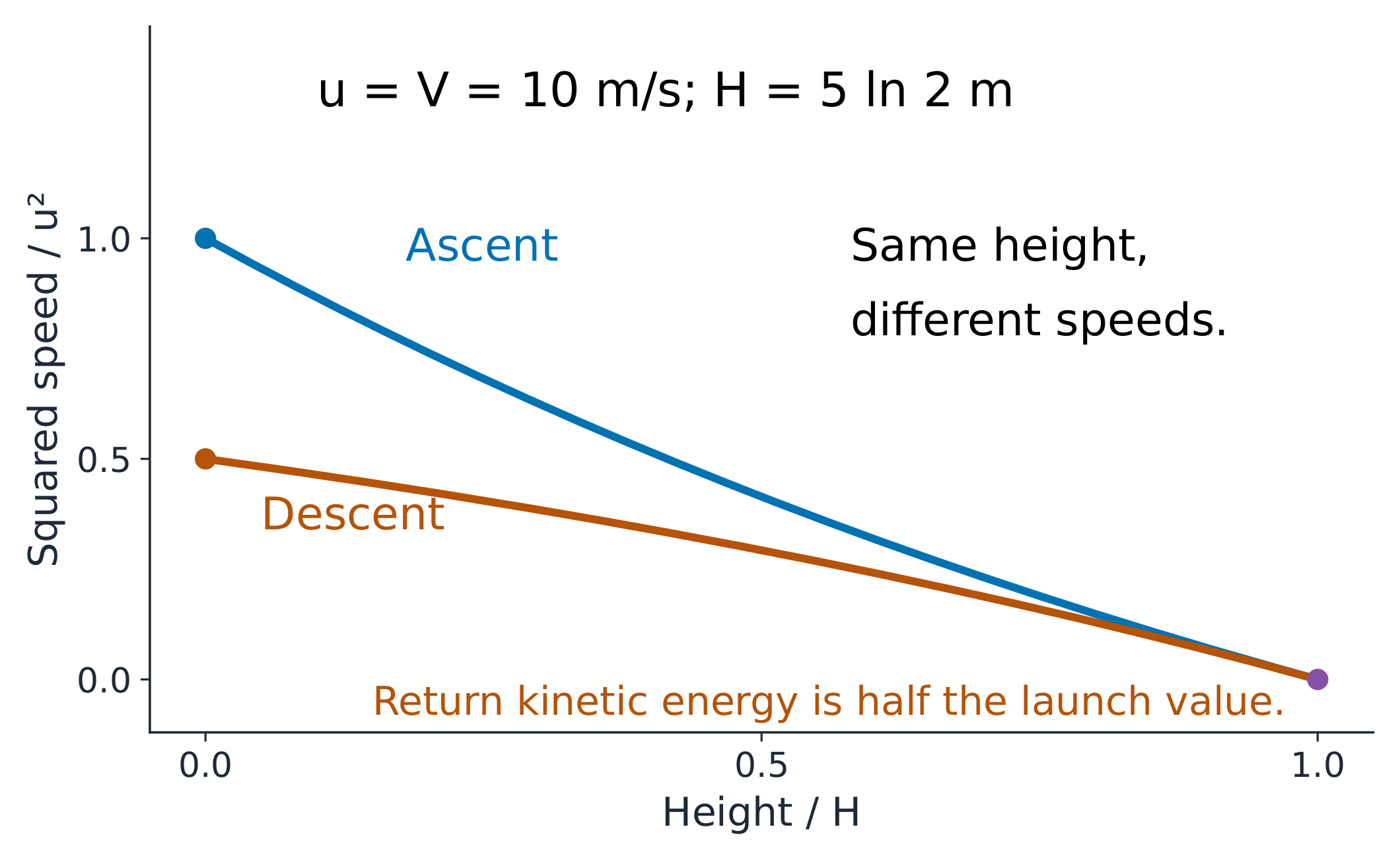
Rearranging gives $v^2=(u^2+V^2)e^{-2kx}-V^2$ on ascent until its first zero. For $g=10$, $k=1/10$ and $u=10$ in consistent SI units, $V=10$ and $v^2=200e^{-x/5}-100$. Maximum height is $H=5\ln2\ \text{m}$. It is less than the no-drag height $u^2/(2g)=5\ \text{m}$.
Find ascent time by an inverse tangent
Separate $dv/dt=-k(V^2+v^2)$. Integration gives $\tan^{-1}(v/V)=\tan^{-1}(u/V)-gt/V$. Use radians for the inverse tangent in this calculus calculation. In the example $u=V=10$ and $g=10$, $v=10\tan(\pi/4-t)$. The first zero gives ascent time $t=\pi/4\ \text{s}$. Stop using this ascent equation at the top; resistance reverses during the descent.
Join the descent to the top state
At the top, velocity is continuous and equals zero. Restart a downward coordinate $y$ from the top, with downward speed $w\geq0$. The new equation is $dw/dt=g-kw^2$, because resistance now acts upwards. The falling-distance result gives $w^2=V^2(1-e^{-2ky})$. The ascent and descent each have a consistent sign convention; record the new initial state rather than carrying a negative ascent speed into an unchanged force equation.
Compare the return speed with the launch speed
In the example $u=V=10$, $k=1/10$ and $H=5\ln2$, the particle returns to launch height after falling distance $H$. Its downward squared speed is $w^2=100(1-e^{-H/5})=50$. The return speed is $5\sqrt2\ \dfrac{\text{m}}{\text{s}}$, less than the launch speed $10\ \dfrac{\text{m}}{\text{s}}$. Gravity has the same potential energy at both endpoints, but resistance has removed mechanical energy during both parts.
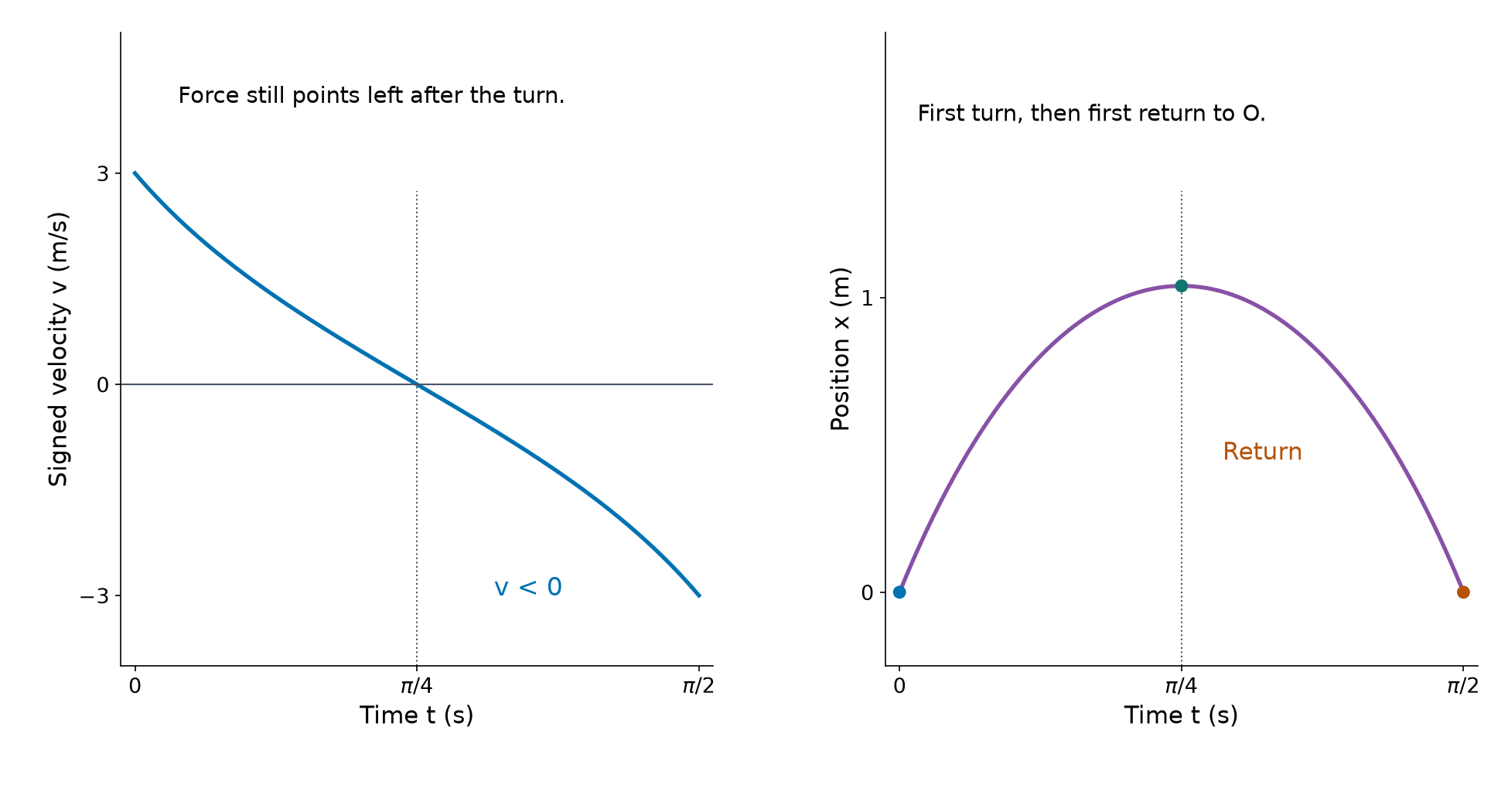
A force towards a point is not always drag
Suppose acceleration is $-(v^2+9)/3$ while a particle is to the right of $O$. It is prescribed to point towards $O$, even after the particle reverses and moves left. It then speeds up leftwards rather than resisting that motion. With $x(0)=0$ and $v(0)=3$, separation gives $\tan^{-1}(v/3)=\pi/4-t$, so $v=3\tan(\pi/4-t)$. The particle first stops at $t=\pi/4$. A negative velocity after this time correctly describes the return towards $O$.
Integrate the return branch with its domain
Integrating that velocity and using $x(0)=0$ gives $x=3\ln[\cos(t-\pi/4)]+\tfrac32\ln2$ before the next return to $O$. At the turn the maximum displacement is $\tfrac32\ln2$. The next zero of $x$ is $t=\pi/2$, found from the first return branch, not a later periodic tangent value. At $O$ the direction rule changes; a formula derived for $x>0$ is not automatically valid beyond that event.
Infer a force from a velocity relation
If a $2\ \text{kg}$ particle has velocity $v=1+x^2$ on its outward branch, then $a=v\,dv/dx=(1+x^2)(2x)$. Its resultant force is $F=ma=4x(1+x^2)$ in consistent SI units. To infer unknown parameters, substitute measured states into the integrated model and solve for the constants. Then check another state when available. A force coefficient has units chosen so the whole expression is a force, not necessarily newtons alone.
Check a proposed solution in the original equation
Differentiate the proposed $v(t)$ or $v(x)$, substitute into Newton's law, and check the initial value. For $v=4/(1+2t)$, differentiation gives $dv/dt=-8/(1+2t)^2=-v^2/2$, as required. Check signs, units and domains as well as algebra. A positive drag magnitude must oppose velocity; a squared-speed expression must stay nonnegative; logarithms need valid arguments; a new branch needs its own physical assumptions.
Decide which event ends the current model
Mark any turning point, crossing of a force-direction boundary, change of resistance law, or endpoint of the allowed motion. Decide whether a zero-speed state occurs at a finite time or only as a limit. A terminal solution can disappear when dividing by a zero factor, and a square root can hide a return branch. Restore such possibilities by checking the original equation and the order of events.
Keep the force law tied to the motion
Choose a signed direction, add the real forces, then select $a=dv/dt$ or $a=v\,dv/dx$ to suit the variables. Separate, integrate and apply the initial conditions at every stage. Distinguish force, acceleration, velocity and speed. Check each answer against the original equation, its branch and its limits; after a physical event, reconsider the model before continuing.
Explore
Work from a variable force
W = ∫ F dx
When the force changes, the work done is the area under the force–distance graph.
Vocabulary
Train
| English |
|---|
| position/pəˈzɪʃn/ |
| speed/spiːd/ |
| drag/dræɡ/ |
| velocity/vəˈlɒsɪti/ |
| separate/ˈsepəreɪt/ |
| work/wɜːk/ |
| variable force/ˈveərɪəbl fɔːs/ |
| differential equation/ˌdɪfəˈrenʃl ɪˈkweɪʒn/ |
| chain rule/tʃeɪn ruːl/ |
| separable differential equation/ˈsepərəbl ˌdɪfəˈrenʃl ɪˈkweɪʒn/ |
| separable/ˈsepərəbl/ |
| integrate/ˈɪntɪɡreɪt/ |
| initial condition/ɪˈnɪʃl kənˈdɪʃn/ |
| boundary condition/ˈbaʊndəri kənˈdɪʃn/ |
| terminal velocity/ˈtɜːmɪnl vəˈlɒsɪti/ |
| partial fractions/ˈpɑːʃl ˈfrækʃnz/ |
3.6
Momentum

Syllabus
| Candidates should be able to: | Notes and examples |
|---|---|
| recall Newton’s experimental law and the definition of the coefficient of restitution, the property $0 \leqslant e \leqslant 1$, and the meaning of the terms ‘perfectly elastic’ ($e = 1$) and ‘inelastic’ ($e = 0$) | |
| use conservation of linear momentum and/or Newton’s experimental law to solve problems that may be modelled as the direct or oblique impact of two smooth spheres, or the direct or oblique impact of a smooth sphere with a fixed surface. |
Source: Cambridge International syllabus
A bounce needs a system and a direction
A collision 碰撞 brings two low-friction carts into contact. Their velocities change, but their combined momentum 动量 stays constant if the external impulse during contact is negligible. A ball hitting a fixed wall is different: the wall gives the ball an impulse. Define your system before writing a conservation equation.
Decide which momentum is conserved
Linear momentum 线动量 is a vector: $\mathbf p=m\mathbf v$. The law is conservation of linear momentum 动量守恒, often shortened to conservation of momentum. It applies to a system with zero resultant external impulse, or to a component with zero external impulse in that direction. For two smooth spheres on a smooth horizontal plane, their mutual impulses cancel. For the sphere alone at a fixed wall, normal momentum changes; the wall belongs outside that one-sphere system.
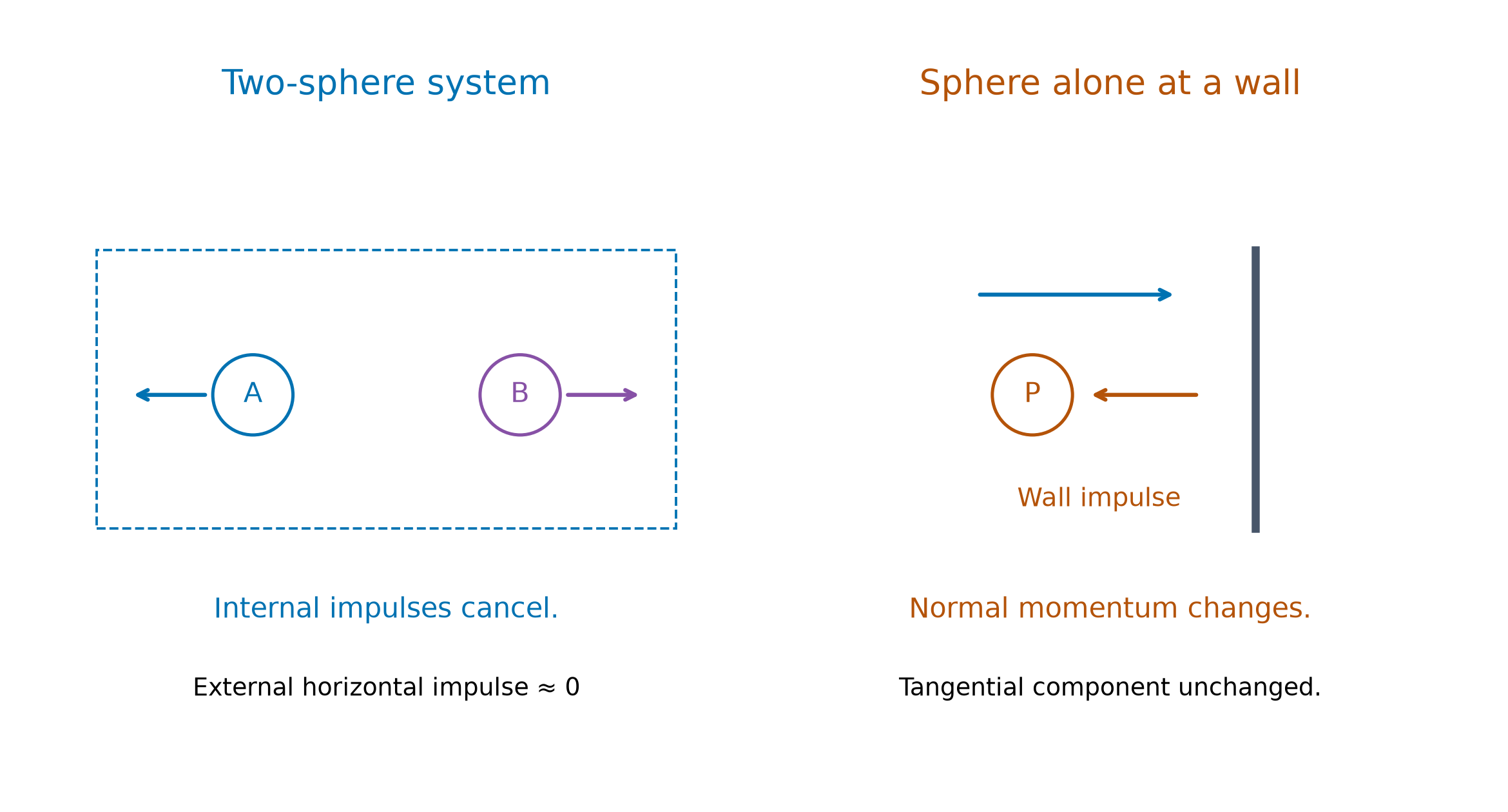
Draw the line of impact
For two smooth spheres, the line of impact 碰撞线 is their line of centres 球心连线 at contact. The collision impulse acts along it. Call that direction normal, $n$, and a perpendicular direction tangent, $t$. A direct impact 正碰撞 has motion along $n$; an oblique impact 斜碰撞 also has tangential motion.
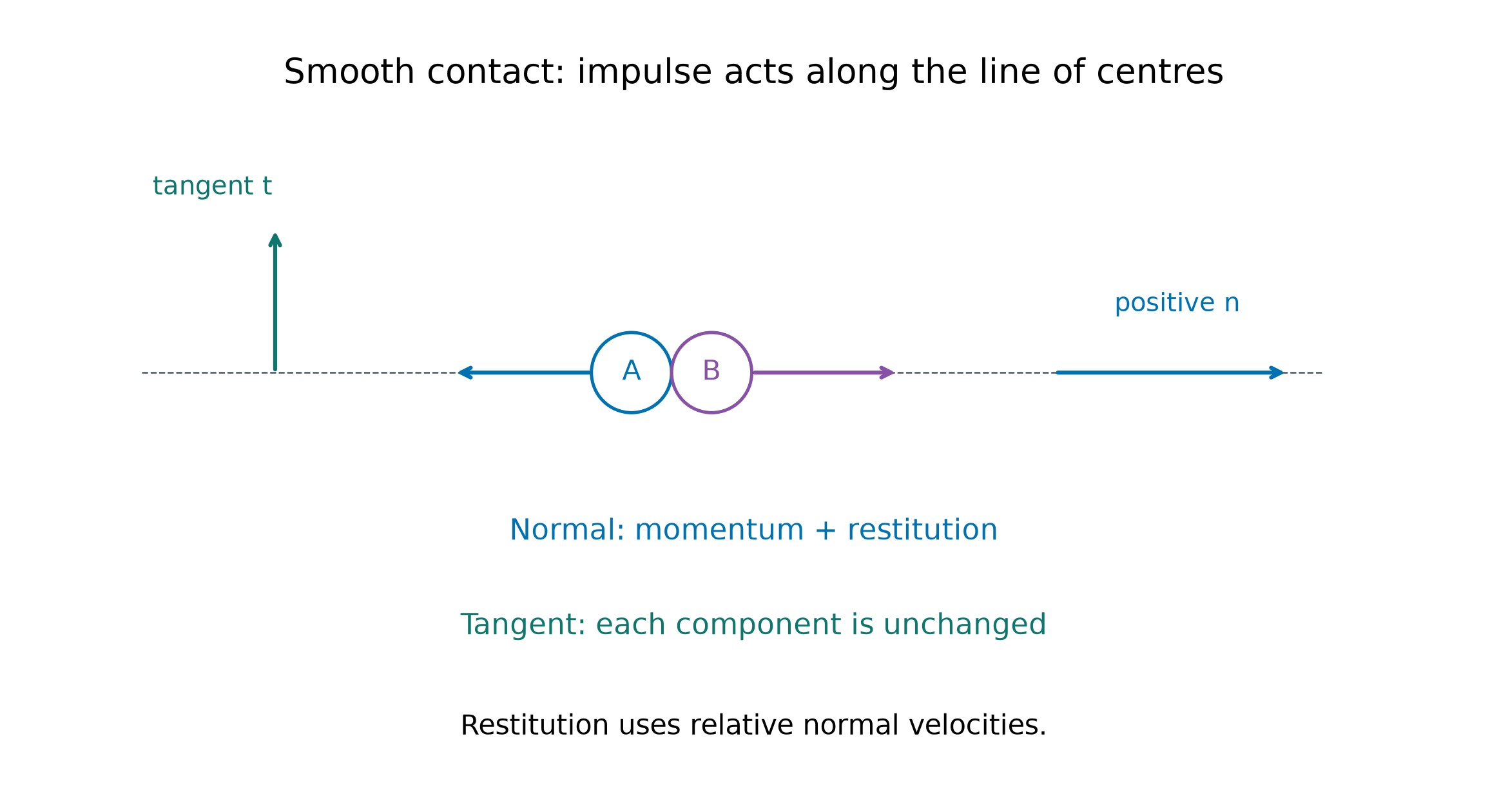
Write restitution with signed components
Choose positive $n$ from $A$ towards $B$, with $u_{An}>u_{Bn}$ before contact. Newton's experimental law 牛顿实验定律 is
$$v_{Bn}-v_{An}=e(u_{An}-u_{Bn}).$$
The coefficient of restitution 恢复系数 $e$ is normal separation speed divided by normal approach speed. In this syllabus model, $0\leq e\leq1$; use relative components, not the two objects' separate speed magnitudes.
Interpret the two limiting cases
A perfectly elastic 完全弹性 impact has $e=1$: kinetic energy 动能 is conserved for the ideal smooth collision. An inelastic 非弹性 impact with $e=0$, also called perfectly inelastic 完全非弹性, gives equal final normal velocities. In a direct collision, $e=0$ gives a common velocity. In an oblique collision, tangential velocities can differ, so equal normal velocities do not mean that the spheres become glued together.
A particle glancing along a smooth wall with $e=0$ may keep moving along it. Apply the law to the normal component first.
Solve the original direct-collision example
A sphere $A$ of mass $2\ \text{kg}$ moves at $5\ \dfrac{\text{m}}{\text{s}}$ into stationary $B$ of mass $3\ \text{kg}$ on a smooth horizontal plane. Take rightwards positive and $e=0.5$. Momentum gives $2v_A+3v_B=10$; restitution gives $v_B-v_A=2.5$. Thus $v_A=0.5\ \dfrac{\text{m}}{\text{s}}$ and $v_B=3\ \dfrac{\text{m}}{\text{s}}$, both rightwards.

A head-on collision needs negative velocities
Let $A$ have mass $2\ \text{kg}$ and velocity $+3\ \dfrac{\text{m}}{\text{s}}$, while $B$ has mass $1\ \text{kg}$ and velocity $-3\ \dfrac{\text{m}}{\text{s}}$. They approach at $6\ \dfrac{\text{m}}{\text{s}}$, not zero. With $e=0.5$, $2v_A+v_B=3$ and $v_B-v_A=3$. Hence $v_A=0$ and $v_B=3\ \dfrac{\text{m}}{\text{s}}$; $A$ is instantaneously at rest after impact.
Check whether contact can occur
If $A$ is left of $B$ and both move right, a first collision requires $u_A>u_B$. A negative answer for $v_A$ means rebound, not a negative speed. After contact, check $v_B-v_A\geq0$. With $e>0$ the bodies separate; with $e=0$ their normal separation speed is zero at that instant.
Derive a reusable direct-impact result
Solving normal momentum and restitution gives
$$v_A=\frac{(m_A-em_B)u_A+(1+e)m_Bu_B}{m_A+m_B}.$$
Then $v_B=v_A+e(u_A-u_B)$. If $B$ starts at rest, $v_B=\dfrac{(1+e)m_Au_A}{m_A+m_B}$; use the equations to check any memorised formula.
Infer a mass ratio from rebound
A sphere of mass $m$ hits a stationary sphere of mass $km$ in a perfectly elastic direct impact. If its final velocity is $-u/3$, restitution gives $v_B=2u/3$. Momentum gives $mu=-mu/3+km(2u/3)$, so $k=2$. The sign of the rebound matters in both equations.
A momentum ratio is not a speed ratio
A sphere of mass $3m$ moving at $u$ hits a stationary sphere of mass $m$. Afterwards $p_A=2p_B$, both rightwards. Since total momentum is $3mu$, $p_A=2mu$ and $p_B=mu$. Thus $v_A=2u/3$, $v_B=u$ and $e=1/3$. Dividing momenta without accounting for the masses would give the wrong velocity ratio.
Keep energy loss separate from momentum
In the original $2\ \text{kg}$ and $3\ \text{kg}$ example, initial kinetic energy is $25\ \text{J}$ and final kinetic energy is $13.75\ \text{J}$. The loss is $11.25\ \text{J}$, although momentum is conserved. For an isolated smooth two-sphere collision, the loss is $\tfrac12\mu(1-e^2)(u_{An}-u_{Bn})^2$, where the reduced mass 约化质量 is $\mu=m_Am_B/(m_A+m_B)$. This checks a calculation; it does not replace the signed impact equations.
Resolve an oblique sphere impact
Smooth spheres exert no tangential impulse on each other. Therefore $v_{At}=u_{At}$ and $v_{Bt}=u_{Bt}$ separately; normal momentum and restitution determine $v_{An},v_{Bn}$. Draw a component table before solving. Recombine each sphere's own components using $v=\sqrt{v_n^2+v_t^2}$; the final normal component alone is usually not its speed.
Work through an oblique example
Sphere $A$ has mass $2\ \text{kg}$ and initial components $(3,4)\ \dfrac{\text{m}}{\text{s}}$ in $(n,t)$. Stationary $B$ has mass $1\ \text{kg}$. For $e=0.5$, $2v_{An}+v_{Bn}=6$ and $v_{Bn}-v_{An}=1.5$. Hence $\mathbf v_A=(1.5,4)$ and $\mathbf v_B=(3,0)$ in the same units. Their speeds are $\sqrt{73}/2$ and $3\ \dfrac{\text{m}}{\text{s}}$; $A$ keeps its tangential component.
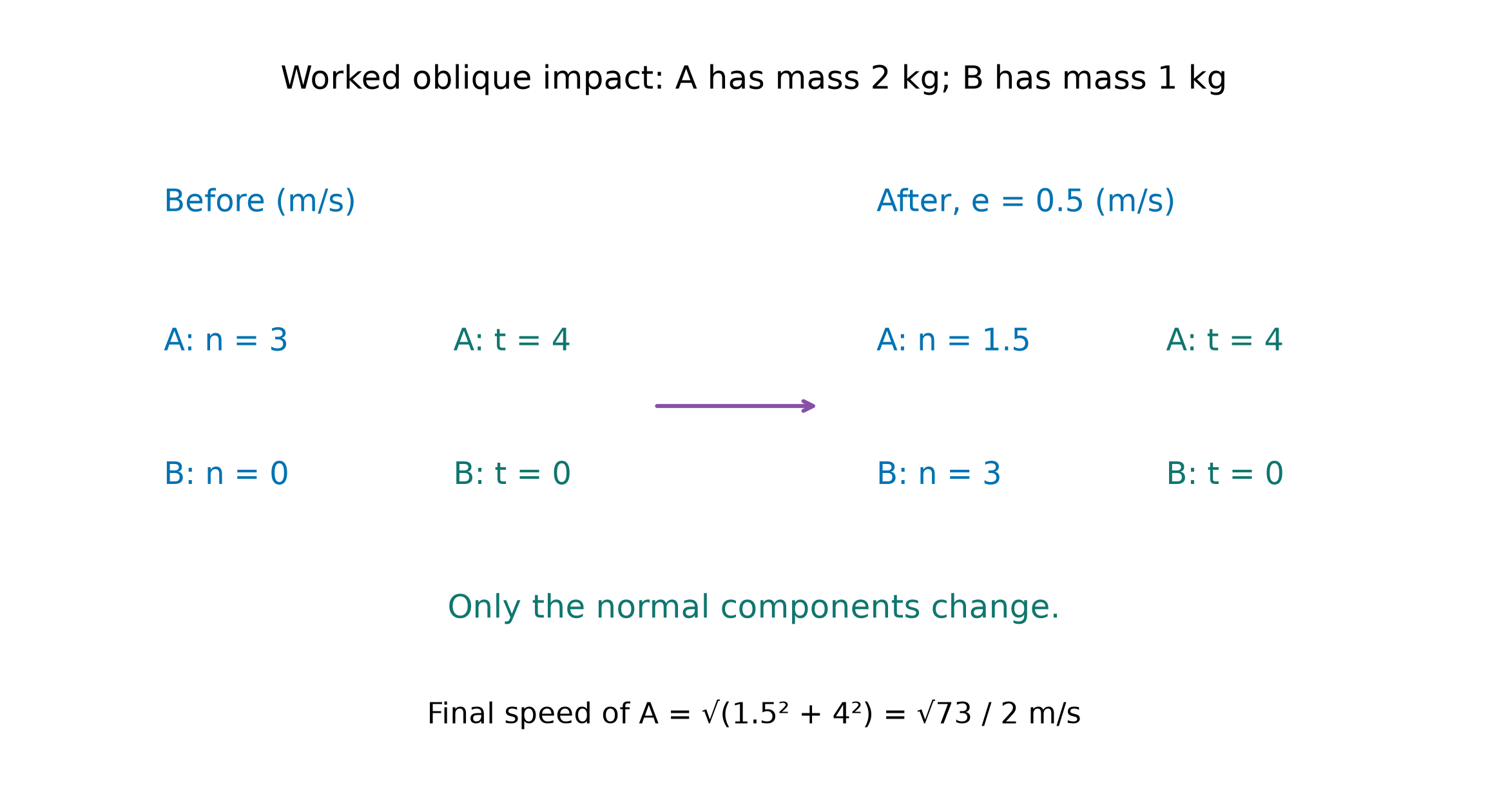
Zero restitution does not remove tangential motion
Two equal-mass smooth spheres have initial components $\mathbf u_A=(4,3)$ and $\mathbf u_B=(0,-1)$, with positive normal from $A$ to $B$. If $e=0$, both final normal velocities are $2$. Their final vectors are $(2,3)$ and $(2,-1)$ in the stated SI units. They have equal normal velocities but different tangential velocities; the particles do not move as a single rigid object.
Recover direction and deflection
For final components $(v_n,v_t)$ with $v_n>0$, the angle to positive normal satisfies $\tan\phi=v_t/v_n$. If $v_n<0$, draw the quadrant; a calculator's acute angle alone can hide a rebound. In the previous $A=(1.5,4)$ example, $\tan\phi=8/3$. The deflection 偏转 is the change from its incoming direction, whose angle satisfies $\tan\theta=4/3$, not simply $\phi$ itself.
Infer restitution from final kinetic energies
Equal-mass spheres collide with $\mathbf u_A=(4,3)$ and $\mathbf u_B=(0,0)$. The final normal velocities are $2(1-e)$ and $2(1+e)$, while their tangential velocities remain $3$ and $0$. Equal final kinetic energies require $4(1-e)^2+9=4(1+e)^2$, so $e=9/16$. Both final speeds are $25/8\ \dfrac{\text{m}}{\text{s}}$; keep both components in the energy equation.
A fixed wall changes the sphere's momentum
At a smooth fixed surface 固定表面, take positive normal towards the wall. The surface has zero velocity, so the sphere's final component is $v_n=-eu_n$ and its tangential component is $v_t=u_t$. Do not conserve the sphere's normal momentum. The wall's impulse supplies the change: $\Delta p_n=-m(1+e)u_n$. The wall–Earth system can take momentum while its speed is negligible.
Recombine components after a wall impact
A $2\ \text{kg}$ sphere approaches a smooth fixed wall with components $(6,8)\ \dfrac{\text{m}}{\text{s}}$ in normal/tangent directions. For $e=0.5$, the outgoing components are $(-3,8)$. Speed changes from $10$ to $\sqrt{73}\ \dfrac{\text{m}}{\text{s}}$. Kinetic energy loss is $100-73=27\ \text{J}$; the overall speed ratio is not $e$.
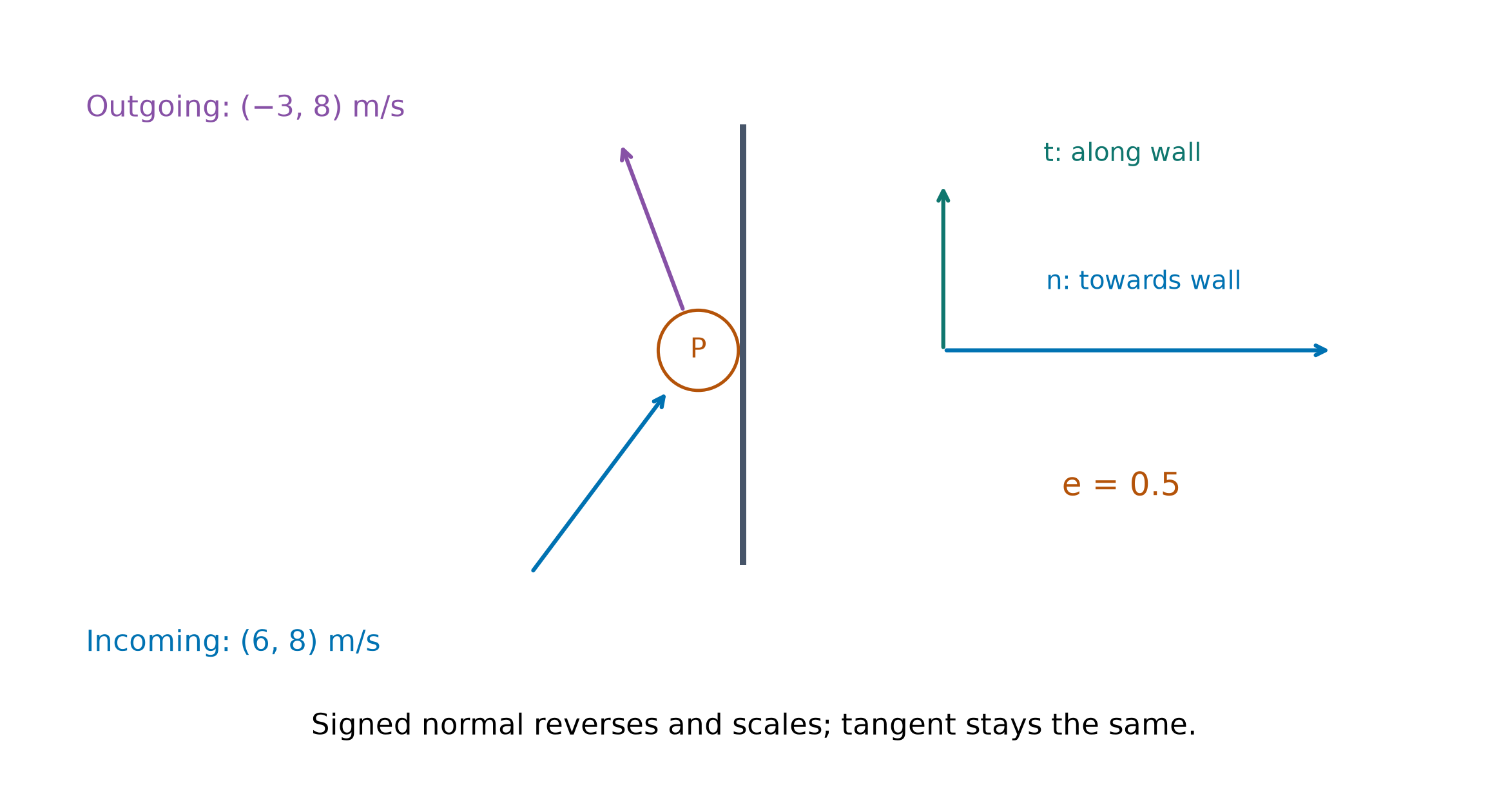
State which line an angle uses
If incoming and outgoing acute angles $\alpha,\beta$ are measured from the wall, $u_n=u\sin\alpha$ and $u_t=u\cos\alpha$. Thus $\tan\beta=e\tan\alpha$. If $\theta,\phi$ are measured from the normal, $\tan\phi=\tan\theta/e$ for $e>0$. At $e=0$, use components directly; a nonzero tangent component leaves motion parallel to the wall.
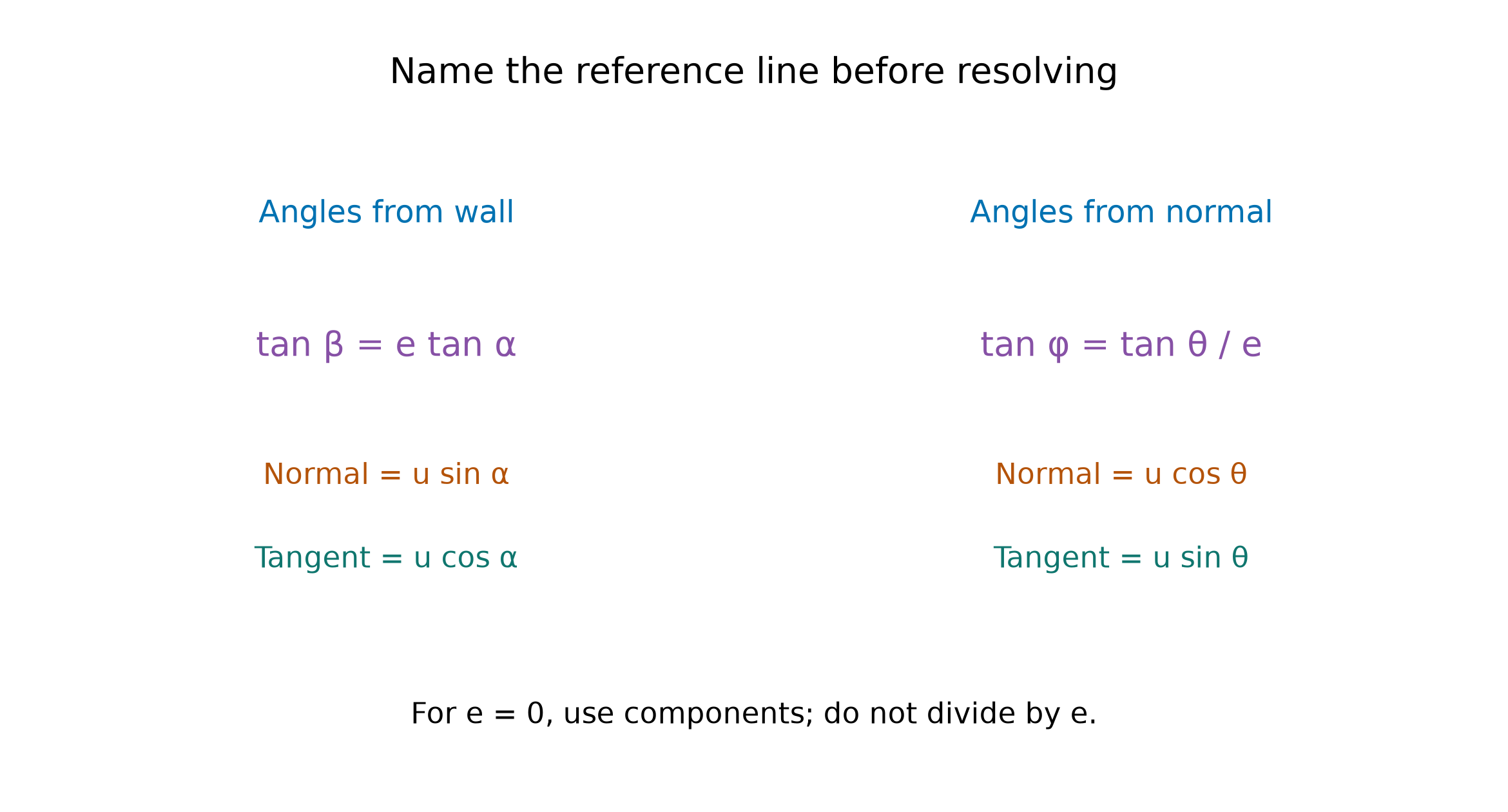
Infer a wall coefficient from angles
A sphere strikes a smooth fixed wall at $45^\circ$ to the wall and leaves at angle $\beta$, with $\tan\beta=1/3$. Then $e=\tan\beta/\tan45^\circ=1/3$. Its final speed is $u\sqrt{\cos^2 45^\circ+e^2\sin^2 45^\circ}=u\sqrt5/3$. A change in direction is why the speed ratio differs from $1/3$.
Check wall-impact energy and limits
At a smooth fixed wall, lost kinetic energy is $\tfrac12m(1-e^2)u_n^2$. Only the normal contribution changes; at $e=1$, speed is unchanged and the normal component reverses. At $e=0$, normal speed becomes zero. If $u_t\ne0$, the sphere continues along the wall; if both final components are zero, it is at rest immediately after contact.
A time ratio can reveal restitution
A particle travels between two parallel smooth fixed walls separated by $d$. If its first flight takes $T$, its normal speed is $d/T$. After a bounce with coefficient $e>0$, the next flight takes $T/e$. Thus if the second time is $kT$, $e=1/k$ and $k\geq1$. The case $e=0$ gives no finite second crossing; do not cancel a zero normal speed as though a return occurs.
Treat successive impacts as separate events
Equal-mass particles collide directly: $A$ initially has velocity $6\ \dfrac{\text{m}}{\text{s}}$, $B$ is at rest and $e_{AB}=0.5$. They leave with velocities $1.5$ and $4.5\ \dfrac{\text{m}}{\text{s}}$. If $B$ then hits a smooth wall with $e_{BW}=1/3$, its velocity becomes $-1.5\ \dfrac{\text{m}}{\text{s}}$. Their next mutual impact uses incoming velocities $+1.5,-1.5$ and $e_{AB}$, giving $v_A=-0.75$, $v_B=+0.75\ \dfrac{\text{m}}{\text{s}}$.
Check the next event using distances
In that example, put the first mutual collision at $x=0$ and the wall at $x=9\ \text{m}$. Particle $B$ reaches the wall at $t=2\ \text{s}$; then $A$ is at $x=3\ \text{m}$. The gap is $6\ \text{m}$ and their closing speed after the wall bounce is $3\ \dfrac{\text{m}}{\text{s}}$. They meet $2\ \text{s}$ later at $x=6\ \text{m}$, before $A$ can reach the wall. Different pairs can have different restitution coefficients.
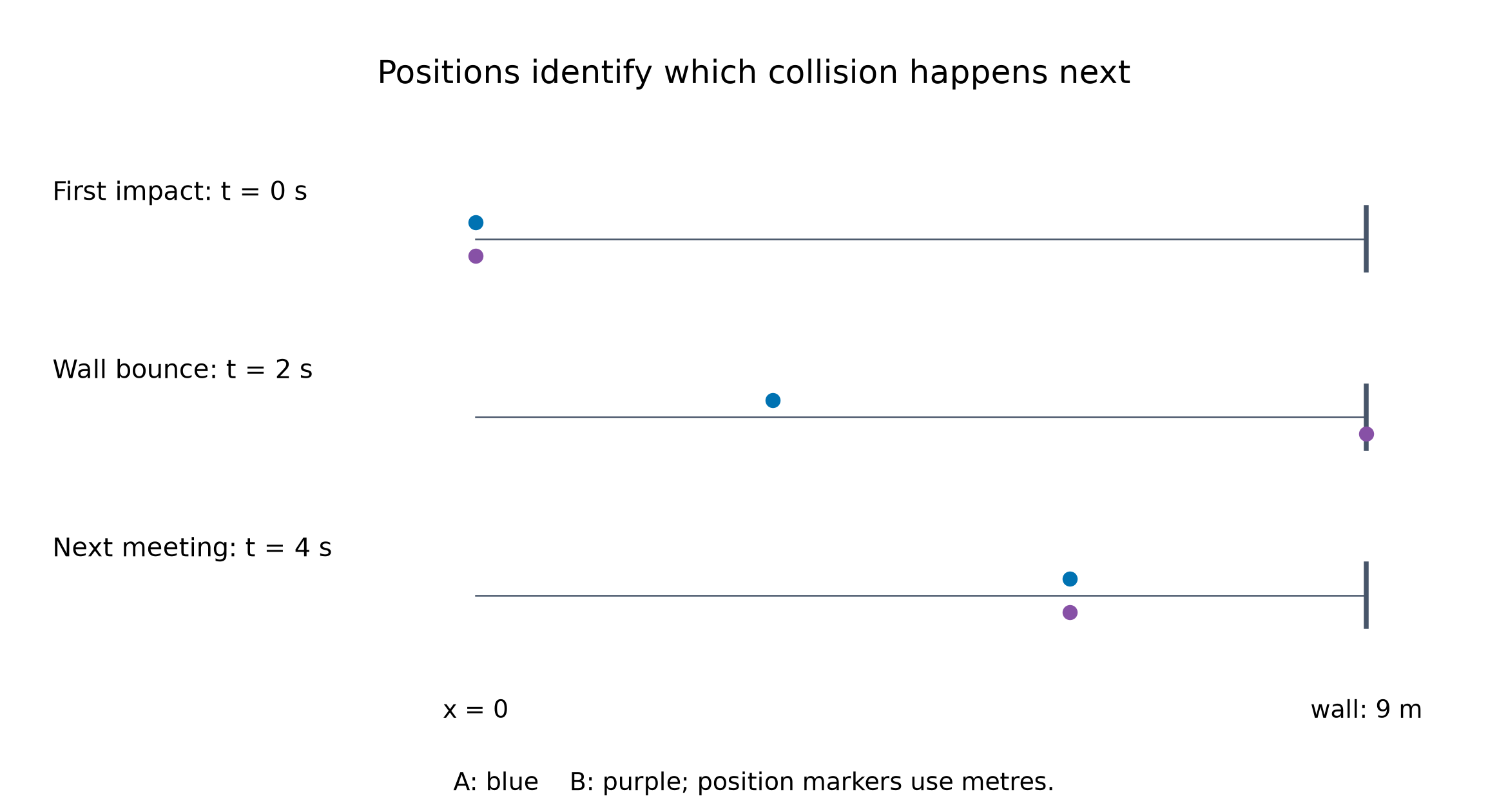
Use a fresh projectile segment after a barrier
A particle has incoming velocity $(4,-4)\ \dfrac{\text{m}}{\text{s}}$ at a smooth barrier inclined at $45^\circ$ upwards to the right. Its velocity is purely normal to the barrier; $e=0.5$ gives outgoing velocity $(-2,2)\ \dfrac{\text{m}}{\text{s}}$. If impact is $4\ \text{m}$ above horizontal ground and $g=10\ \dfrac{\text{m}}{\text{s}^2}$, solve $0=4+2t-5t^2$. The positive flight time is $(1+\sqrt{21})/5\ \text{s}$ and horizontal distance is $2(1+\sqrt{21})/5\ \text{m}$ to the left.
Link a collision to a vertical circle
At a circle's bottom, a particle of mass $m$ and incoming speed $3\sqrt{5ag}$ hits a stationary particle of mass $2m$ in a perfectly elastic direct impact. Momentum and restitution give signed velocities $-\sqrt{5ag}$ and $2\sqrt{5ag}$. The first particle rebounds with squared speed $5ag$. Its later energy equation gives top squared speed $ag$, the limiting $T=0$ condition for a taut string. Use energy on the smooth arcs and collision laws at contact; zero tension is a boundary test, not by itself proof of subsequent separation.
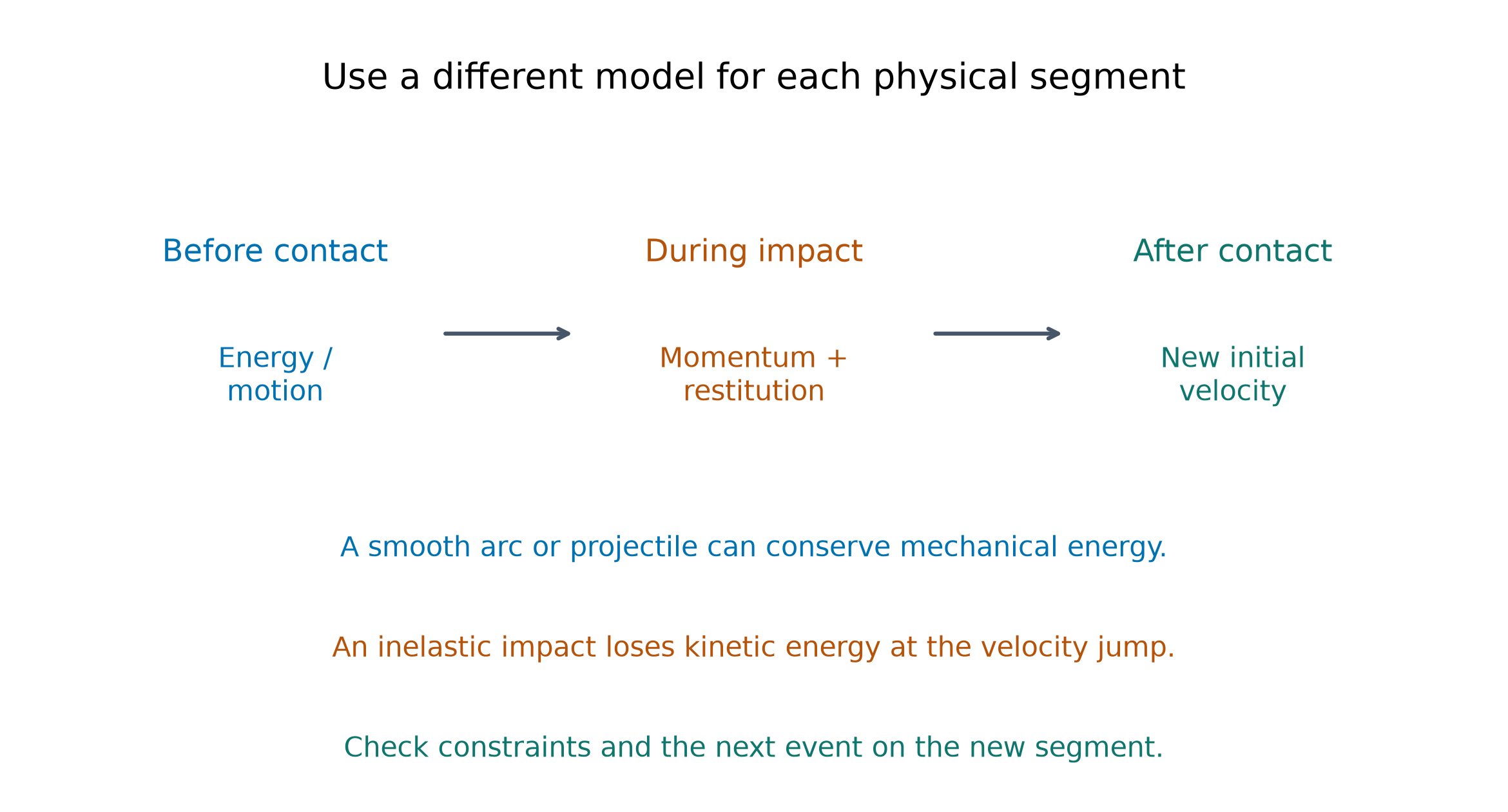
Reject a physically impossible model
An algebraic candidate must satisfy $0\leq e\leq1$, the stated incoming approach and outgoing directions. Reject inadmissible roots with a reason; do not turn a negative signed velocity into a positive one midway through the equations. Check momentum for the correct system, the restitution relation, unchanged smooth tangential components and nonnegative kinetic-energy loss. A fixed wall can violate one-sphere momentum conservation without violating the model.
Organise an independent impact solution
Draw the contact normal, define signed components and label the system. Write the normal momentum equation only where justified, then restitution and unchanged tangential components. Recombine velocities, state directions and check the next physical event. For a question combining topics, carry the outgoing velocity into a new motion segment with its own initial state.
Retrieve the model before calculating
Direct and oblique impacts use the same normal equations; tangential components survive smooth contact unchanged. For a fixed surface, $v_n=-eu_n$, not conservation of the sphere's normal momentum. Always define the system, the angle convention and the event order. Distinguish normal separation from total speed, equal normal velocity from sticking, and energy between impacts from energy across them.
Common mistakes.
- Using the same sign for $g$ in both directions: horizontal acceleration is $0$, vertical is $-g$ with up positive.
- Treating speed and a velocity component as the same: speed needs both components.
- Taking moments with the full force instead of its perpendicular component, or about a point and then forgetting the forces through it.
- Subtracting a removed part's area but not its moment when finding a centre of mass.
- Adding a separate “centripetal force” to the force diagram; it is the resultant of the real forces.
- Using $v^2=gr$ at the top of a vertical circle for a particle on a rod, which can have zero speed at the top.
- Confusing natural length with stretched length in Hooke's law: $T=\dfrac{\lambda x}{l}$ uses the extension $x$.
- Writing restitution as $v_A-v_B$: it is speed of separation over speed of approach, with signs fixed by one positive direction.
Explore
A collision
Set each mass and speed, then collide them. Total momentum is conserved — see how the velocities come out.
Vocabulary
Train
| English |
|---|
| collision/kəˈlɪʒn/ |
| kinetic energy/kɪˈnetɪk ˈenədʒi/ |
| momentum/məʊˈmentəm/ |
| linear momentum/ˈlɪnɪə məʊˈmentəm/ |
| conservation of momentum/ˌkɒnsəˈveɪʃn ɒv məʊˈmentəm/ |
| conservation of linear momentum/ˌkɒnsəˈveɪʃn ɒv ˈlɪnɪə məʊˈmentəm/ |
| line of impact/laɪn ɒv ˈɪmpækt/ |
| line of centres/laɪn ɒv ˈsentəz/ |
| direct impact/daɪˈrekt ˈɪmpækt/ |
| oblique impact/əˈbliːk ˈɪmpækt/ |
| Newton's experimental law/ˈnjuːtnz ekˌsperɪˈmentl lɔː/ |
| coefficient of restitution/ˌkəʊɪˈfɪʃənt ɒv rɪstɪˈtjuːʃn/ |
| perfectly elastic/ˈpɜːfektlɪ ɪˈlæstɪk/ |
| inelastic/ɪnɪˈlæstɪk/ |
| perfectly inelastic/ˈpɜːfektlɪ ɪnɪˈlæstɪk/ |
| reduced mass/rɪˈdjuːst mæs/ |
| deflection/dɪˈflekʃn/ |
| fixed surface/fɪkst ˈsɜːfɪs/ |
3.6
Practice
Answer each before reading the answers below.
- A ball is projected from level ground at $25\ \text{m s}^{-1}$ at an angle $\alpha$ above the horizontal, where $\tan\alpha=\tfrac34$. Find the time of flight, the range and the greatest height.
- A stone is thrown horizontally at $12\ \text{m s}^{-1}$ from the top of a cliff $45$ m high. Find the time to reach the sea, the horizontal distance travelled and the speed on impact.
- Find the equation of the trajectory of a particle projected from the origin at $20\ \text{m s}^{-1}$ at $45^\circ$ above the horizontal.
- A uniform rod $AB$, of length $4$ m and weight $60$ N, is hinged to a wall at $A$. It is held horizontal by a light string attached at $B$, which makes an angle of $30^\circ$ with the rod. Find the tension and the horizontal and vertical components of the force at the hinge.
- A uniform lamina is a $6$ by $4$ rectangle with corners $(0,0)$ and $(6,4)$, from which the square with corners $(4,2)$ and $(6,4)$ is removed. Find its centre of mass.
- A particle of mass $0.2$ kg on a light string of length $0.5$ m moves in a horizontal circle with the string at $60^\circ$ to the vertical. Find the tension and the angular speed.
- A particle on a light string of length $0.8$ m moves in a vertical circle. Find the least speed at the top for the string to stay taut, and the speed at the bottom in that case.
- A particle of mass $1.2$ kg hangs in equilibrium on an elastic string of natural length $0.6$ m and modulus $30$ N. Find the extension and the elastic potential energy stored.
- A particle of mass $2$ kg starts from rest and is acted on by a force $6t$ N in a fixed direction. Find its speed and the distance travelled when $t=2$.
- Sphere $A$, of mass $2$ kg and speed $6\ \text{m s}^{-1}$, hits sphere $B$, of mass $3$ kg, at rest, directly. The coefficient of restitution is $0.5$. Find the speeds after impact and the loss of kinetic energy.
3.6
Answers
- $u_x=20$, $u_y=15$. Time of flight: $15t-5t^2=0$, so $t=3$ s. Range $=20\times3=60$ m. Greatest height $=\dfrac{15^2}{2\times10}=11.25$ m.
- $5t^2=45$, so $t=3$ s. Distance $=12\times3=36$ m. At impact $v_y=30$, so speed $=\sqrt{12^2+30^2}=\sqrt{1044}\approx32.3\ \text{m s}^{-1}$.
- $y=x\tan\alpha-\dfrac{gx^2}{2u^2\cos^2\alpha}=x-\dfrac{10x^2}{2\times400\times\tfrac12}=x-\dfrac{x^2}{40}$.
- Moments about $A$: $T\sin30^\circ\times4=60\times2$, so $T=60$ N. The string's horizontal pull on the rod, $T\cos30^\circ$, points towards the wall, so the hinge pushes the rod away from the wall with $30\sqrt3\approx52.0$ N. Vertical component $=60-T\sin30^\circ=30$ N upwards.
- Areas: rectangle $24$, square $4$, lamina $20$. $\bar x=\dfrac{24(3)-4(5)}{20}=2.6$ and $\bar y=\dfrac{24(2)-4(3)}{20}=1.8$, so the centre of mass is at $(2.6,1.8)$.
- Vertically: $T\cos60^\circ=0.2\times10$, so $T=4$ N. Radius $r=0.5\sin60^\circ$. Horizontally: $T\sin60^\circ=0.2\,\omega^2(0.5\sin60^\circ)$, so $4=0.1\,\omega^2$, $\omega^2=40$ and $\omega\approx6.32\ \text{rad s}^{-1}$.
- At the top the tension can just be zero: $mg=\dfrac{mv^2}{r}$, so $v^2=gr=8$ and $v=2\sqrt2\approx2.83\ \text{m s}^{-1}$. Energy: $v_{\text{bottom}}^2=8+2(10)(1.6)=40$, so $v\approx6.32\ \text{m s}^{-1}$.
- $T=mg=12$ N and $T=\dfrac{\lambda x}{l}=\dfrac{30x}{0.6}$, so $x=0.24$ m. EPE $=\dfrac{\lambda x^2}{2l}=\dfrac{30\times0.24^2}{1.2}=1.44$ J.
- $a=3t$, so $v=\tfrac32t^2$ (from rest) and $x=\tfrac12t^3$. At $t=2$: $v=6\ \text{m s}^{-1}$ and $x=4$ m.
- Momentum: $12=2v_A+3v_B$. Restitution: $v_B-v_A=0.5\times6=3$. So $12=5v_A+9$, $v_A=0.6\ \text{m s}^{-1}$ and $v_B=3.6\ \text{m s}^{-1}$, both in the original direction. KE before $=36$ J; after $=0.36+19.44=19.8$ J; loss $=16.2$ J.
3.6
Exam tips
- For projectiles, resolve into horizontal (constant velocity) and vertical ($a = g$) motion, linked by the same time.
- For a rigid body in equilibrium, take moments about a point that removes an unknown force.
- For circular motion, use $F = mv^2/r = m\omega^2 r$ towards the centre; in a vertical circle check the minimum speed at the top.
- With a variable force, use $a = v\,\frac{dv}{dx}$ and integrate; elastic PE $= \frac{\lambda x^2}{2L}$.
Interactive lessons on this topic
Work through it step by step, with instant-check exercises.