Hooke's law
Introduced| English | Meaning |
|---|---|
| Hooke's law/hʊks lɔː/ | The rule that extension is proportional to applied force while a spring remains within its limit of proportionality. |
| extension/ekˈstenʃn/ | The increase in length of an object. |
| elastic/ɪˈlæstɪk/ | Able to recover its original shape or length after the load is removed, within the elastic range. |
| natural length/ˈnætʃərəl leŋθ/ | The length of a string or spring when no load stretches or compresses it. |
| taut/tɔːt/ | Stretched tight; an elastic string can pull only when extended and cannot supply a negative tension. |
| modulus of elasticity/ˈmɒdjʊləs ɒv ɪlæˈstɪsɪti/ | For the elastic-string model, the force-valued constant lambda in T = lambda times extension divided by natural length; it is not Young modulus. |
| stiffness/ˈstɪfnəs/ | Force per unit extension in a linear elastic model; for an elastic string it is modulus divided by natural length. |
| slack/slæk/ | Loose rather than stretched tight, so a string supplies no tension. |
| compression/kəmˈpreʃn/ | A decrease in length below the unloaded natural length; an ideal spring can store energy and push in this state. |
| elastic potential energy/ɪˈlæstɪk pəˈtenʃl ˈenədʒi/ | Energy stored by deformation; in an ideal spring it equals half stiffness times squared signed extension, while a slack string stores none. |
| equilibrium/ˌiːkwɪˈlɪbrɪəm/ | A state with no resultant force or resultant moment. |
| compress/kəmˈpres/ | To reduce an object’s length below its natural length; a compressed ideal spring pushes back. |
| turning point/ˈtɜːnɪŋ pɔɪnt/ | A position where velocity becomes zero and the direction of motion reverses; the resultant force need not be zero. |
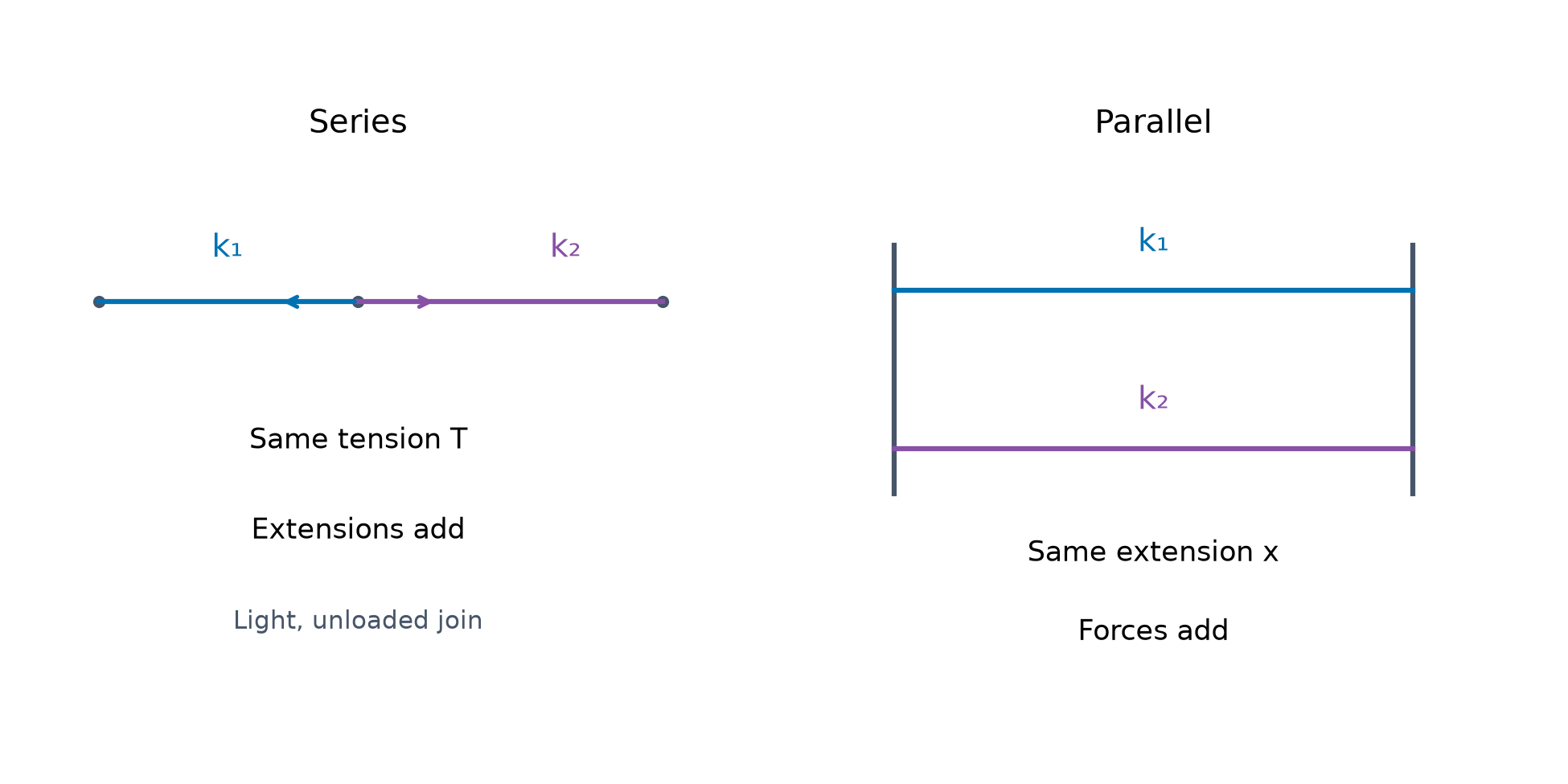
| series/ˈsɪəriːz/ | An end-to-end connection; elastic elements joined by a light unloaded point share tension and their extensions add. |
| parallel/ˈpærəlel/ | A side-by-side connection in which matching support geometry gives equal extensions and the elastic forces add. |
Why a jump needs a model
- A bungee rope stores energy as it stretches. Its pull changes during the jump, so constant-acceleration formulae are usually unsuitable.
- Hooke's law 胡克定律 models force proportional to extension within a stated range. Real ropes need not follow it over a whole jump. Here use ideal light elastic 弹性 strings and springs with no energy loss unless stated.
By Hooke's law, the tension is proportional to the extension.
Difficulty 1/5 · 100 coins + a small bonus on first completion today
T = (λ/L)x, so tension is proportional to extension within the ideal Hookean model or a real material’s proportional range. Reversible elastic behaviour alone does not guarantee proportionality.
A rope returns to its original length when unloaded, but its force–extension graph is curved. Does that alone justify using T = kx over the whole measured range?
Compare your own equations and branch checks with the model. Correct the reasoning as well as the final value.
Measure extension from natural length
- The natural length 自然长度 $L$ is the unloaded length. If the actual length is $\ell$, the extension 伸长量 is $x=\ell-L$, not $\ell$. A taut elastic string has tension $T=kx$.
- With modulus of elasticity 弹性模量 $\lambda$, write $k=\lambda/L$, so $T=\lambda x/L$. For a spring the signed restoring force opposes displacement from its natural length.
Hooke's law
F = k·x
Force is proportional to extension — the gradient is the stiffness k.
An elastic string of natural length 2 m and modulus 50 N is stretched by 0.5 m. Find the tension T = λx/L (N).
Difficulty 2/5 · 140 coins + a small bonus on first completion today
T = 50 × 0.5 / 2 = 12.5 N.
A string has natural length 1.2 m and modulus 36 N. Its actual length is 1.5 m. Find extension, stiffness and tension.
Compare your own equations and branch checks with the model. Correct the reasoning as well as the final value.
Modulus and stiffness have different units
- Stiffness 劲度系数 $k$ is measured in $\dfrac{\text{N}}{\text{m}}$; this string model's $\lambda$ is measured in newtons. It includes material and cross-section effects; it is not Young modulus, whose unit is pascals.
- Cut a uniform string into two equal pieces: each has the same $\lambda$ but half the natural length, so each piece has twice the stiffness. Do not keep $k$ fixed when changing $L$ in this way.
A uniform string has natural length 3 m and modulus 24 N. Cut off a 1 m piece. Find the piece’s modulus, stiffness and tension when extended by 0.15 m.
Compare your own equations and branch checks with the model. Correct the reasoning as well as the final value.
A string and a spring have different branches
- A string pulls only when taut 绷紧. For $\ell\leq L$ it is slack 松弛: $T=0$ and its stored elastic energy is zero. A negative value of $\ell-L$ is not a negative string tension.
- An ideal spring can pull in extension and push in compression 压缩. Its signed $x$ may be negative, while the force magnitude is $k|x|$. Continue to use the spring law only within the stated model range.
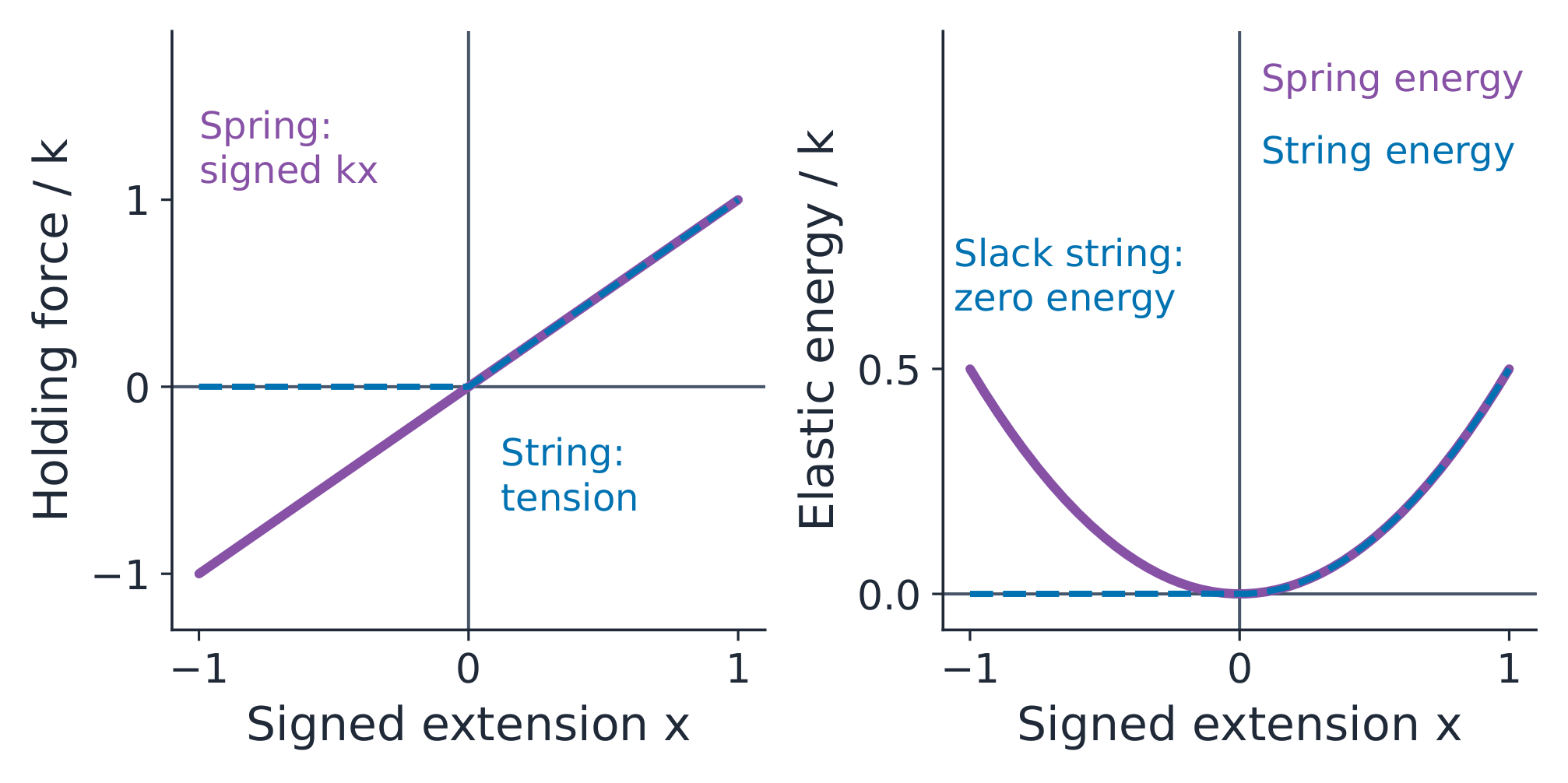
An elastic string (not a spring):
Difficulty 1/5 · 100 coins + a small bonus on first completion today
A string only pulls; when slack its tension is zero. Only a spring pushes when compressed.
An ideal string and ideal spring each have natural length 1 m and k = 40 N/m. Their ends are 0.8 m apart. Compare force and stored energy.
Compare your own equations and branch checks with the model. Correct the reasoning as well as the final value.
Store the area under the graph
- Stretching slowly from natural length does work equal to the triangular area under the force–extension line. The stored elastic potential energy 弹性势能 is
- For a spring this also applies in compression. For a string use it only when $x\geq0$; the slack branch has zero energy. Doubling extension doubles tension but multiplies energy by four. A proof of the energy formula is not required.
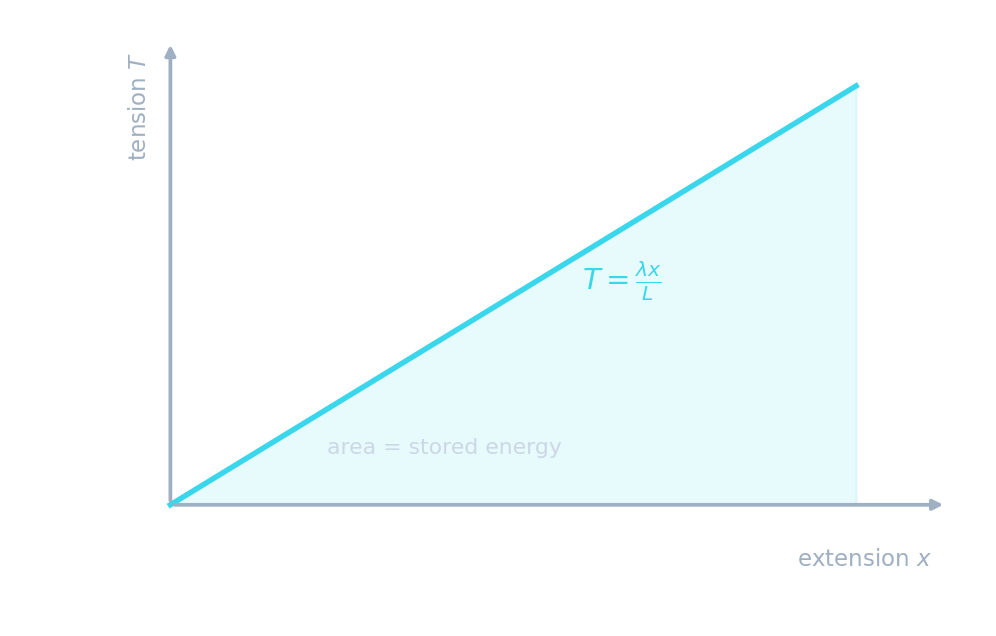
An elastic string has modulus 50 N, natural length 2 m and extension 0.5 m. Find its stored elastic energy (J).
Difficulty 2/5 · 140 coins + a small bonus on first completion today
E = 50 × 0.25 / 4 = 12.5/4 = 3.125 J.
The elastic energy equals the ______ under the force–extension graph.
Difficulty 1/5 · 100 coins + a small bonus on first completion today
Work done stretching = area under the T–x line = ½ × x × (λx/L) = λx²/(2L).
The extension of a taut Hookean string increases from x to 3x. Compare the new tension and elastic energy with the originals. Find the extra stored energy as a multiple of the original energy E.
Compare your own equations and branch checks with the model. Correct the reasoning as well as the final value.
Use force and energy on the same string
- A string has $L=2\ \text{m}$, $\lambda=50\ \text{N}$ and extension $0.5\ \text{m}$. Its actual length is $2.5\ \text{m}$. First use $T=\lambda x/L$, giving $T=50(0.5)/2=12.5\ \text{N}$.
- For stored energy use $E_e=\lambda x^2/(2L)$, giving $E_e=50(0.5)^2/4=3.125\ \text{J}$. Force and energy have different units; do not substitute actual length for extension.
An elastic string has natural length 2 m and modulus 40 N, and it is stretched by 0.5 m. What are the tension and the stored energy, and why can the string not push?
Tension is modulus times extension divided by natural length. Energy is modulus times extension squared divided by twice the natural length.
Infer a natural length from measurements
- A string has tension $6\ \text{N}$ at length $1.3\ \text{m}$ and $10\ \text{N}$ at length $1.5\ \text{m}$. Since $T=k(\ell-L)$, the gradient is $k=(10-6)/(1.5-1.3)=20\ \dfrac{\text{N}}{\text{m}}$.
- Then $L=\ell-T/k=1.3-6/20=1\ \text{m}$ and $\lambda=kL=20\ \text{N}$. Check the other measurement: $20(1.5-1)=10\ \text{N}$. The line's horizontal intercept gives natural length, not zero length.
A string has tension 8 N at actual length 1.4 m and 14 N at 1.7 m. Find its natural length and modulus, then predict the tension at 1.5 m.
Compare your own equations and branch checks with the model. Correct the reasoning as well as the final value.
Find a hanging equilibrium
- A mass $m$ hangs at rest from one vertical string attached above it. Equilibrium 平衡 requires $T=mg$, so its equilibrium extension is $e=mg/k=mgL/\lambda$.
- A $0.6\ \text{kg}$ mass on $k=30\ \dfrac{\text{N}}{\text{m}}$ has $e=0.2\ \text{m}$ when $g=10\ \dfrac{\text{m}}{\text{s}^2}$. If the mass is moving through that position, acceleration is momentarily zero; speed need not be zero.
A 0.8 kg particle hangs from a string with natural length 1.5 m and modulus 60 N. Take g = 10 m/s². Find its equilibrium actual length. Does passing through that position imply zero speed?
Compare your own equations and branch checks with the model. Correct the reasoning as well as the final value.
Release at natural length is not slow loading
- Attach a mass to the lower end at natural length and release it from rest, with no resistance. After a downward extension $x$, energy gives $mgx=\tfrac12mv^2+\tfrac12kx^2$.
- At maximum stretch $v=0$, so the non-zero root is $x=2mg/k=2e$. Maximum speed occurs earlier at $x=e$, where $mg-kx=0$; $v_{\max}^2=g^2m/k$. Slow loading instead ends at $e$ and removes energy from the system.
A mass 0.5 kg is released from rest with a vertical string at natural length. The string has k = 25 N/m. Take g = 10 m/s². Find maximum extension and maximum speed.
Compare your own equations and branch checks with the model. Correct the reasoning as well as the final value.
A horizontal spring can pass natural length
- A $2\ \text{kg}$ particle on a smooth horizontal line is attached to a spring with $k=50\ \dfrac{\text{N}}{\text{m}}$. Release it from rest at extension $0.4\ \text{m}$. Its initial energy is $\tfrac12k(0.4)^2=4\ \text{J}$.
- At natural length the energy is all kinetic: $\tfrac12mv^2=4$, so $v=2\ \dfrac{\text{m}}{\text{s}}$. The particle continues into compression and first stops at $x=-0.4\ \text{m}$, provided no other physical constraint intervenes.
A 1 kg particle on a smooth horizontal line is attached to a spring with k = 80 N/m. It starts from rest at compression 0.3 m. Find its speed when the extension is 0.1 m and its next turning extension, assuming the geometry allows both.
Compare your own equations and branch checks with the model. Correct the reasoning as well as the final value.
A horizontal string changes model at natural length
- Replace that spring by an elastic string with the same $k$ and initial extension. It has the same speed at natural length, but beyond that point it has no tension and no elastic energy.
- On the smooth horizontal surface the particle then moves at constant velocity until another constraint acts. Do not predict spring-like compression and reversal. Specify geometry before following a particle past its anchor.
A 0.5 kg particle moves towards a fixed anchor on a smooth horizontal line, attached by a taut string with k = 10 N/m. It begins at rest at extension 0.2 m. Find its speed at natural length and describe the motion immediately afterwards.
Compare your own equations and branch checks with the model. Correct the reasoning as well as the final value.
Release a compressed vertical spring
- A spring has lower end fixed, natural length $a$, and $\lambda=10mg$. A mass $m$ is attached to its top and released from rest with compression $a/2$. Let $x$ be signed extension upwards. Relative to natural length, total potential energy is $U=5mgx^2/a+mgx$.
- Initially $x=-a/2$ and $U=3mga/4$. At the next rest point, put $z=x/a$: $5z^2+z=3/4$. The roots are $-1/2$ and $3/10$. The first is the initial state; the maximum extension is $3a/10$.
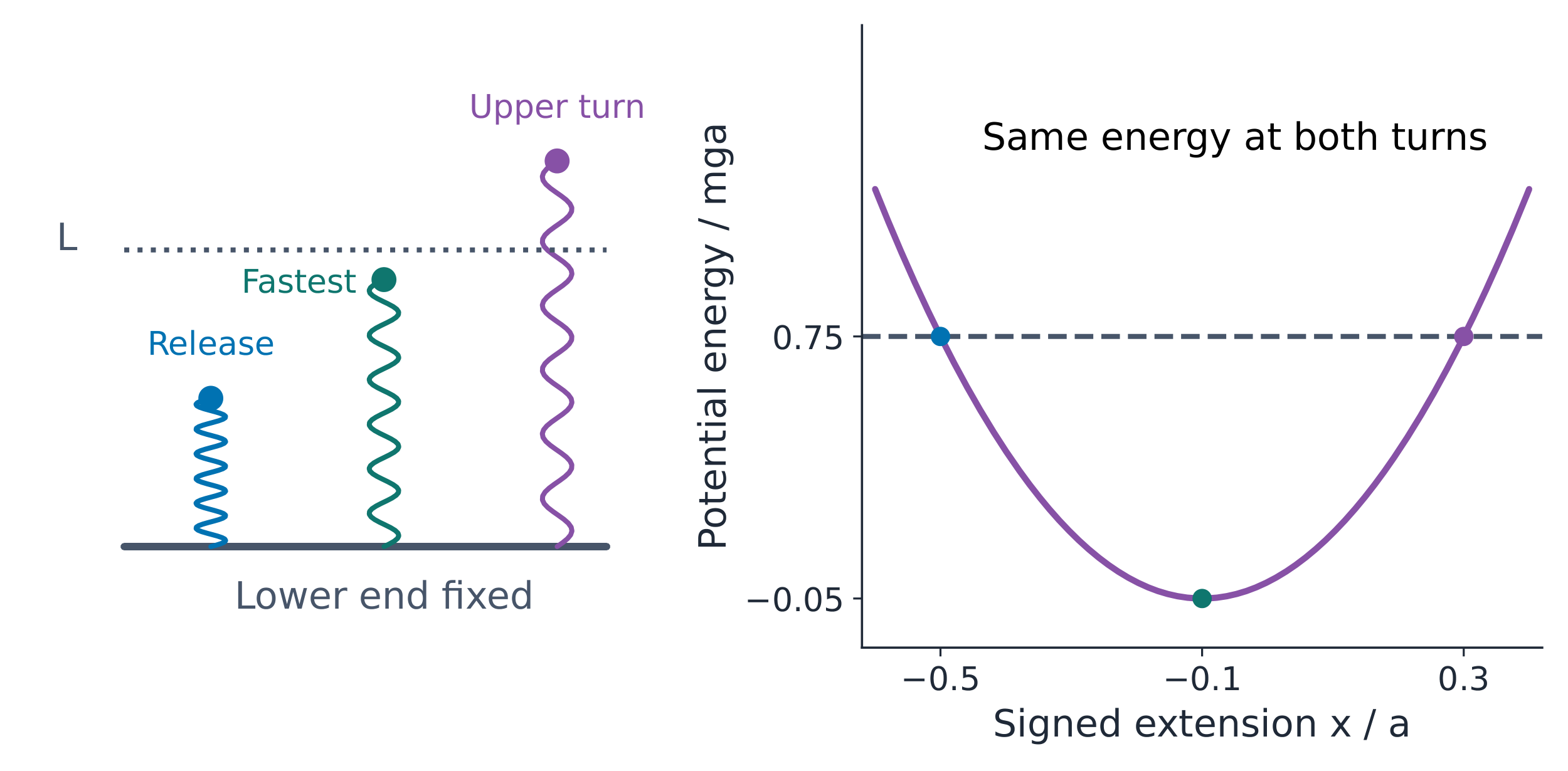
A vertical spring has its lower end fixed, natural length a and modulus 8mg. A mass m is attached to its upper end and released at rest with compression a/2. Find its other turning extension.
Compare your own equations and branch checks with the model. Correct the reasoning as well as the final value.
Maximum speed is not a turning point
- In that spring example, $-kx-mg=0$ at $x=-a/10$. Potential energy there is $-mga/20$, so the maximum kinetic energy is $3mga/4+mga/20=4mga/5$.
- Hence $v_{\max}^2=8ag/5$. At maximum extension $3a/10$, the mass is instantaneously at rest but the acceleration is $-4g$, downwards. A turning point 转折点 has $v=0$; it need not have zero resultant force.
For the spring with lower end fixed, modulus 8mg, mass m and release compression a/2, find maximum speed and the acceleration at the upper turning extension a/4.
Compare your own equations and branch checks with the model. Correct the reasoning as well as the final value.
Record both end states before writing energy
- Choose one height reference. Write kinetic energy, gravitational potential energy $mgh$, and every active elastic energy at the initial and final positions. With no resistance their total is conserved; with friction include its negative work.
- Use actual lengths to find each extension independently. A string at or below natural length contributes zero energy, not $\lambda(\ell-L)^2/(2L)$. If a path crosses a slack boundary, use the right force law in each interval.
A particle is connected to two elastic strings and changes height. A solution equates only the upper string’s initial and final elastic energies. Name the missing terms and the branch checks.
Compare your own equations and branch checks with the model. Correct the reasoning as well as the final value.
Free fall can come before stretching
- A mass $m$ is released from rest at its anchor, on a vertical string with natural length $a$ and $\lambda=4mg$. It first falls freely through $a$; the string then begins stretching. At later extension $x$, energy gives $mg(a+x)=\tfrac12mv^2+2mgx^2/a$.
- At the lowest point let $z=x/a$. Then $2z^2-z-1=0$, so $z=1$; the negative root is outside the stretched branch. The total drop is $2a$. Maximum speed is at $x=a/4$, giving $v_{\max}^2=9ag/4$.
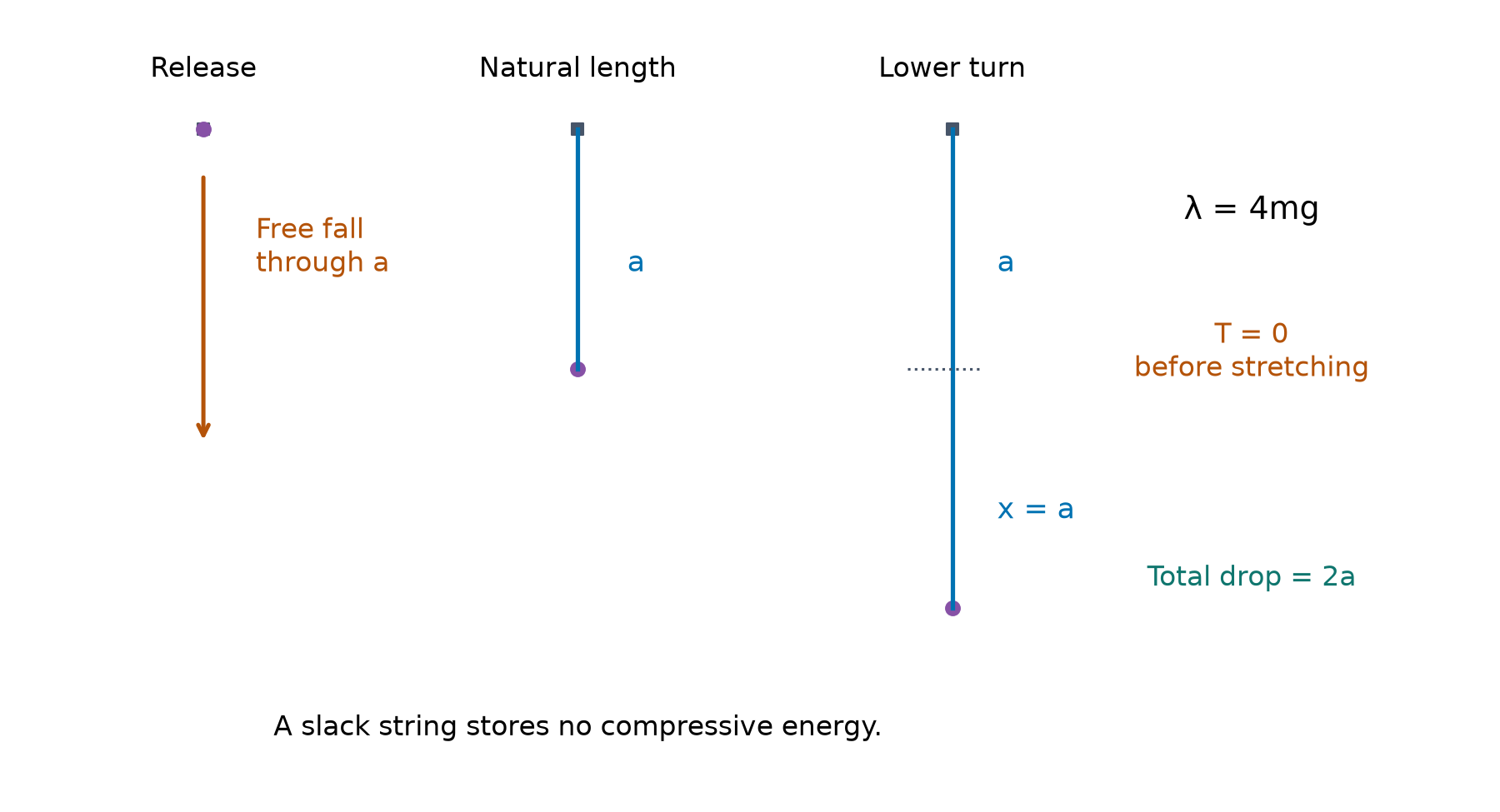
A mass m is released from rest at its anchor on a vertical string of natural length a and modulus 6mg. Find maximum extension and maximum squared speed.
Compare your own equations and branch checks with the model. Correct the reasoning as well as the final value.
Removing a mass changes the equilibrium
- A vertical string has natural length $a$ and $\lambda=4mg$. Masses $m$ and $3m$ first hang at equilibrium, so the extension is $a$. Remove $3m$ without an impulse. The remaining mass starts at rest at length $2a$.
- On its taut branch put $z=x/a$ and take height zero at natural length. Energy becomes $\tfrac12mv^2+mga(2z^2-z)=mga$. To find the first position where $v^2=ag$, solve $2z^2-z=1/2$. The valid root gives $\ell=(5+\sqrt5)a/4$; the other root has negative extension.
A vertical string has natural length a and modulus 3mg. Masses m and 2m first hang at equilibrium. Remove 2m without an impulse. Find the first actual length where the remaining mass has squared speed ag/2.
Compare your own equations and branch checks with the model. Correct the reasoning as well as the final value.
A rejected root does not describe the slack flight
- At natural length in that example, $v^2=2ag$ upwards. After that the string is slack; gravity alone acts until the next event. The taut-string quadratic cannot describe this phase.
- After rising a further distance $s$, use $v^2=2ag-2gs$. The later position with $v^2=ag$ is $s=a/2$, so the length is $a/2$. The negative-extension root from the old formula gives a different value because it invents compressive string energy.
A mass m is at rest at extension a on a vertical string of natural length a and modulus 3mg, just after another mass has been removed without an impulse. It then moves under gravity and the string force. Find its squared speed at natural length and the later actual length where squared speed is ag/2, before its first upper turn.
Compare your own equations and branch checks with the model. Correct the reasoning as well as the final value.
Resolve along an inclined plane
- A mass $m$ rests on a smooth plane inclined at $\beta$ to horizontal, attached to an anchor upslope by a string along the plane. Normal reaction is $mg\cos\beta$; downslope weight is $mg\sin\beta$.
- Equilibrium requires $kx=mg\sin\beta$. With $m=1\ \text{kg}$, $g=10\ \dfrac{\text{m}}{\text{s}^2}$, $\sin\beta=3/5$ and $k=20\ \dfrac{\text{N}}{\text{m}}$, $x=0.3\ \text{m}$. Friction, if present, must be included with its actual direction.
A 2 kg particle rests on a smooth incline with sinβ = 5/13, attached by a string along the slope to an anchor above it. Natural length is 1 m and modulus 50 N; g = 10 m/s². Find tension, actual length and normal reaction.
Compare your own equations and branch checks with the model. Correct the reasoning as well as the final value.
Follow a string past its anchor
- Use that smooth plane and particle with natural length $1\ \text{m}$. Release from rest $1.5\ \text{m}$ above the anchor. Initially the string pulls downslope; it then goes slack around the anchor and becomes taut again below it. Maximum speed is below the anchor at extension $0.3\ \text{m}$, where tension balances the $6\ \text{N}$ downslope weight.
- Total travel to that point is $1.5+1+0.3=2.8\ \text{m}$. Work–energy gives $\tfrac12mv^2=\tfrac12k(0.5)^2+mg\sin\beta(2.8)-\tfrac12k(0.3)^2=18.4\ \text{J}$. Thus $v_{\max}^2=36.8\ \dfrac{\text{m}^2}{\text{s}^2}$. Before this point the downslope resultant stays positive.
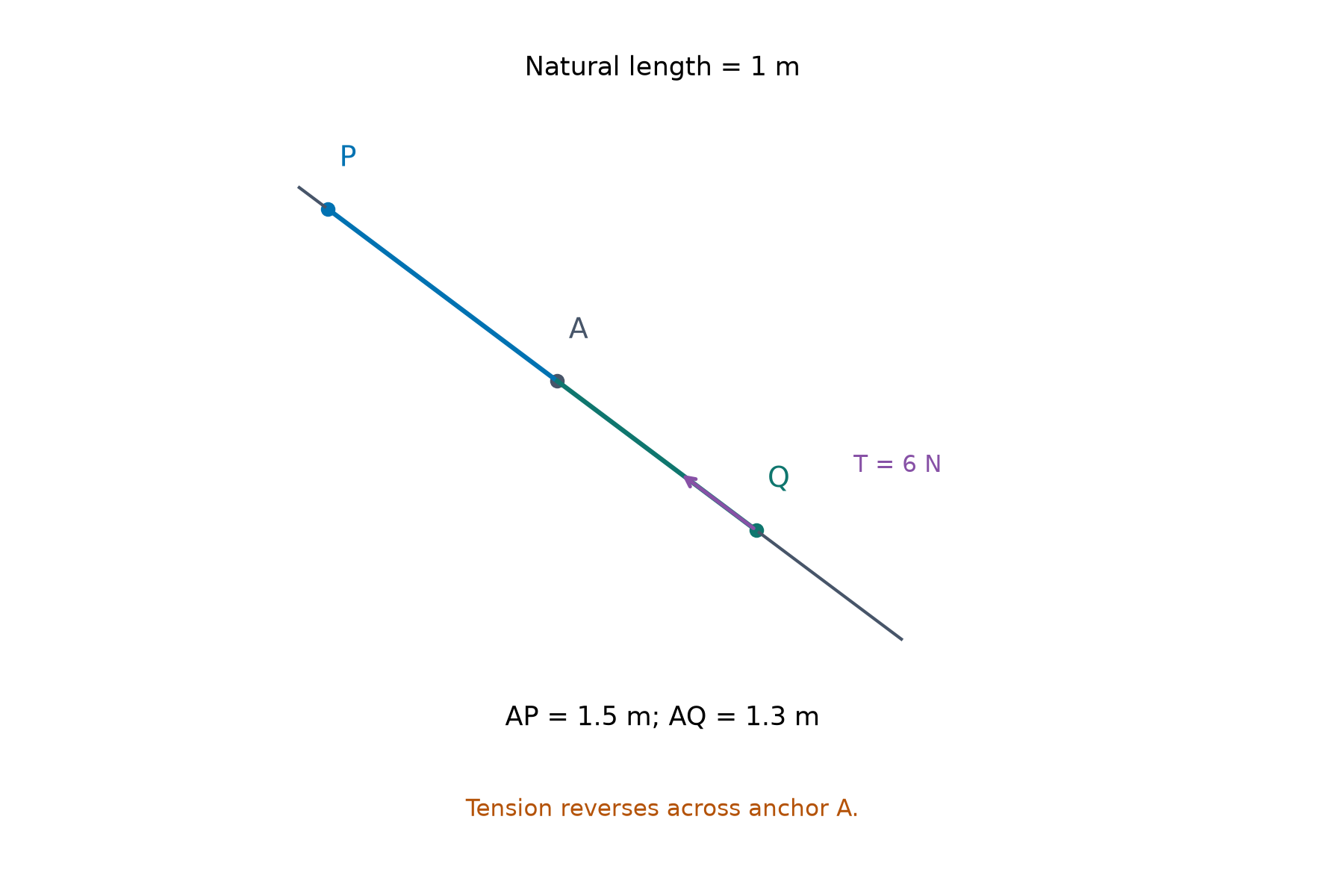
A 1 kg particle moves on a smooth incline with sinβ = 1/2 and g = 10 m/s². A string of natural length 1 m and k = 10 N/m connects it to a fixed anchor. It starts at rest 1.2 m above the anchor. Find the position and squared speed of its global maximum speed on its first descent.
Compare your own equations and branch checks with the model. Correct the reasoning as well as the final value.
Friction removes mechanical energy
- On the same incline let $\mu=1/4$, and release the particle from natural length below the anchor. For the first downslope motion, normal reaction is $8\ \text{N}$ and friction is $2\ \text{N}$ upslope. Net driving force before elasticity is $6-2=4\ \text{N}$.
- Work–energy gives $\tfrac12mv^2=4x-10x^2$. The first maximum extension is $0.4\ \text{m}$, and maximum speed occurs at $x=0.2\ \text{m}$ with $v_{\max}^2=0.8\ \dfrac{\text{m}^2}{\text{s}^2}$. Recheck friction's direction on any return journey; this equation describes the first descent.
A 1 kg particle is released from rest at natural length below its anchor on a rough plane. Take g = 10 m/s², sinβ = 3/5, cosβ = 4/5, μ = 1/8 and k = 20 N/m. Find the first maximum extension and maximum squared speed.
Compare your own equations and branch checks with the model. Correct the reasoning as well as the final value.
Two opposing strings need two extensions
- Fix anchors $6\ \text{m}$ apart on a smooth horizontal line. Both strings have natural length $2\ \text{m}$; the left has $\lambda=20\ \text{N}$ and the right $40\ \text{N}$. At coordinate $q$ from the left, both are taut only when $2<q<4$.
- Balance $10(q-2)=20(4-q)$ to find equilibrium $q=10/3\ \text{m}$. Total elastic energy is $U=5(q-2)^2+10(4-q)^2$. A $2\ \text{kg}$ mass released from $q=3\ \text{m}$ has $U=15\ \text{J}$; at equilibrium $U=40/3\ \text{J}$, giving $v_{\max}^2=5/3\ \dfrac{\text{m}^2}{\text{s}^2}$. The other turn is $q=11/3\ \text{m}$, still in the same branch.
Anchors 5 m apart are connected to a 1 kg particle on a smooth horizontal line by strings of natural length 2 m each. The left and right stiffnesses are 10 and 30 N/m. Find equilibrium q from the left anchor and maximum squared speed when released from rest at q = 2.5 m. Check the branch.
Compare your own equations and branch checks with the model. Correct the reasoning as well as the final value.
Series strings carry a common tension
- For two strings in series 串联 with a light unloaded joining point, tensions are equal and extensions add. Use $x_i=T/k_i$ for each. The equivalent stiffness satisfies $1/k_{\rm eq}=1/k_1+1/k_2$.
- Natural lengths $1,2\ \text{m}$ and moduli $20,30\ \text{N}$ give $k_1=20$, $k_2=15\ \dfrac{\text{N}}{\text{m}}$. Under $6\ \text{N}$ tension their extensions are $0.3,0.4\ \text{m}$. Total extension is $0.7\ \text{m}$; energy is $\tfrac12T(x_1+x_2)=2.1\ \text{J}$.
Two strings in series have natural lengths 0.5 m and 1.5 m, and moduli 20 N and 30 N. The join is light and unloaded. Under tension 4 N, find each extension, total actual length and stored energy.
Compare your own equations and branch checks with the model. Correct the reasoning as well as the final value.
Parallel springs share an extension
- Two springs in parallel 并联 between the same moving and fixed supports have the same extension if their natural lengths and geometry match. Their forces add: $T=(k_1+k_2)x$, so $k_{\rm eq}=k_1+k_2$.
- For $k_1=20$ and $k_2=30\ \dfrac{\text{N}}{\text{m}}$ at $x=0.2\ \text{m}$, the forces are $4$ and $6\ \text{N}$; total force is $10\ \text{N}$ and total energy $1\ \text{J}$. Equal extensions do not require equal tensions.
Two parallel springs with matching natural lengths have stiffnesses 30 and 50 N/m and total extension 0.15 m. Find their separate forces, total force and total energy.
Compare your own equations and branch checks with the model. Correct the reasoning as well as the final value.
A lower string pulls downwards
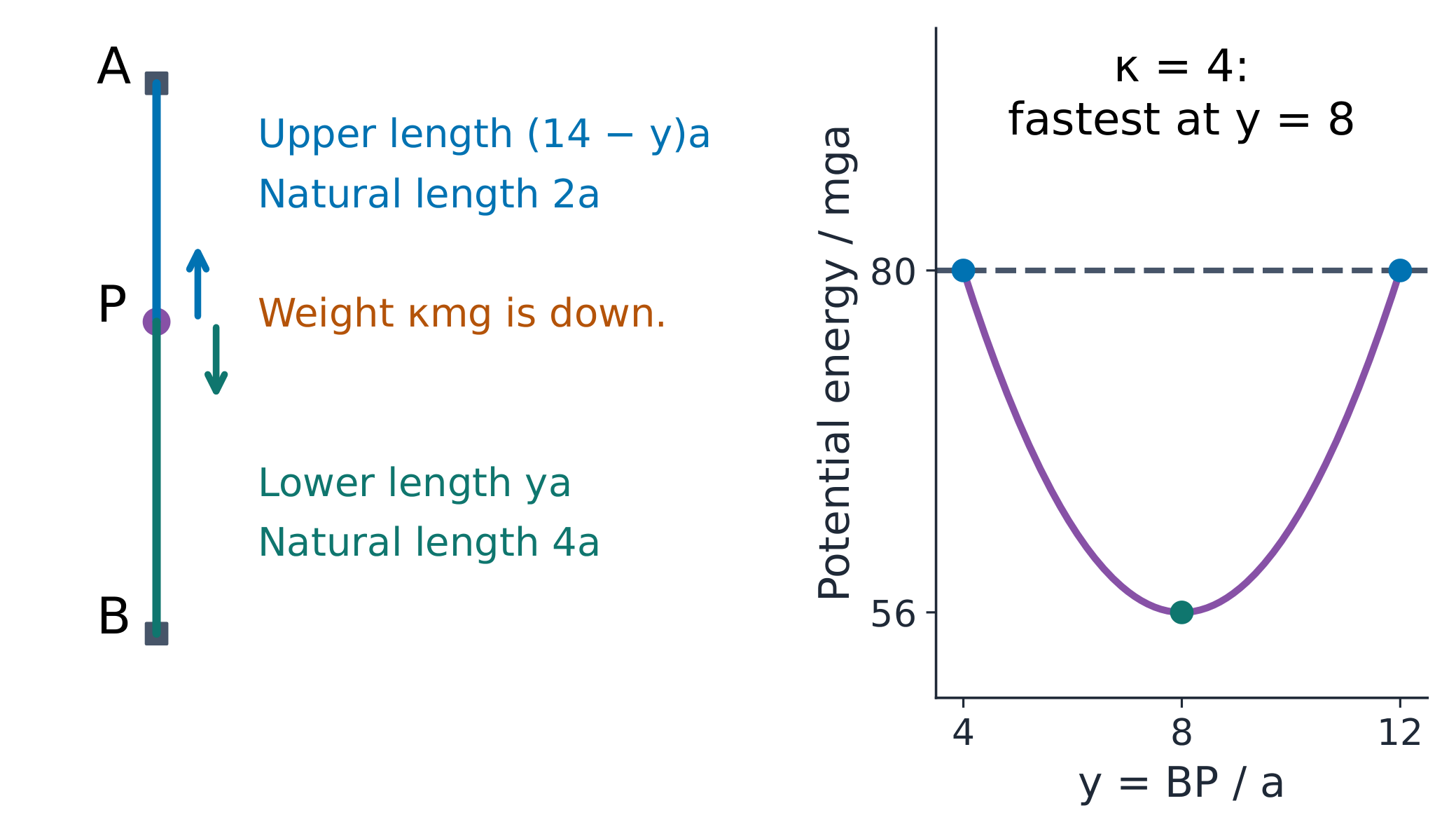
- Two vertical anchors $A$ above $B$ are $14a$ apart. A particle of mass $\kappa m$ is joined to $A$ by a string of natural length $2a$, and to $B$ by one of natural length $4a$. Both moduli are $4mg$. Let $BP=ya$; then upper and lower extensions are $(12-y)a$ and $(y-4)a$.
- Both are taut for $4<y<12$. Their tensions are $2mg(12-y)$ upwards and $mg(y-4)$ downwards. Equilibrium gives $2(12-y)-(y-4)-\kappa=0$, so $y=(28-\kappa)/3$. Do not add both tensions in the same direction.
Vertical anchors A above B are 12a apart. The upper string has natural length 2a and stiffness 3mg/a; the lower has natural length 3a and stiffness mg/a. A particle of mass κm lies between them at BP = ya. Find the both-taut interval and its equilibrium position.
Compare your own equations and branch checks with the model. Correct the reasoning as well as the final value.
Two rest positions can determine the mass
- Release the particle from rest at $y=12$, and suppose its first lower turning point is $y=4$. Take gravitational potential zero at $B$. Total potential energy divided by $mga$ is $V=(12-y)^2+\tfrac12(y-4)^2+\kappa y$.
- The endpoints give $32+12\kappa=64+4\kappa$, hence $\kappa=4$. Between them both extensions are nonnegative. With $\kappa=4$, $V-80=\tfrac32(y-4)(y-12)\leq0$, so the intermediate kinetic energy is feasible.
Vertical anchors A above B are 12a apart. A particle of mass κm is joined to A by a string of natural length 2a and stiffness 3mg/a, and to B by a string of natural length 3a and stiffness mg/a. It is released from rest at BP = 10a and first turns below at BP = 3a. Find κ and check that intermediate kinetic energy is feasible.
Compare your own equations and branch checks with the model. Correct the reasoning as well as the final value.
Use both strings to find maximum speed
- With $\kappa=4$, equilibrium in that example is $y=8$. At release the total energy is $80mga$; at $y=8$ the potential energy is $(16+8+32)mga=56mga$.
- Therefore $\tfrac12(4m)v_{\max}^2=24mga$, giving $v_{\max}^2=12ag$. Use the actual moving mass $4m$ in kinetic energy; the symbol $m$ in the moduli is only the reference mass.
Vertical anchors A above B are 12a apart. A particle of mass 7m is joined to A by a string of natural length 2a and stiffness 3mg/a, and to B by a string of natural length 3a and stiffness mg/a. It is released from rest at BP = 10a. Find the position and squared value of its maximum speed.
Compare your own equations and branch checks with the model. Correct the reasoning as well as the final value.
An elastic conical pendulum stretches
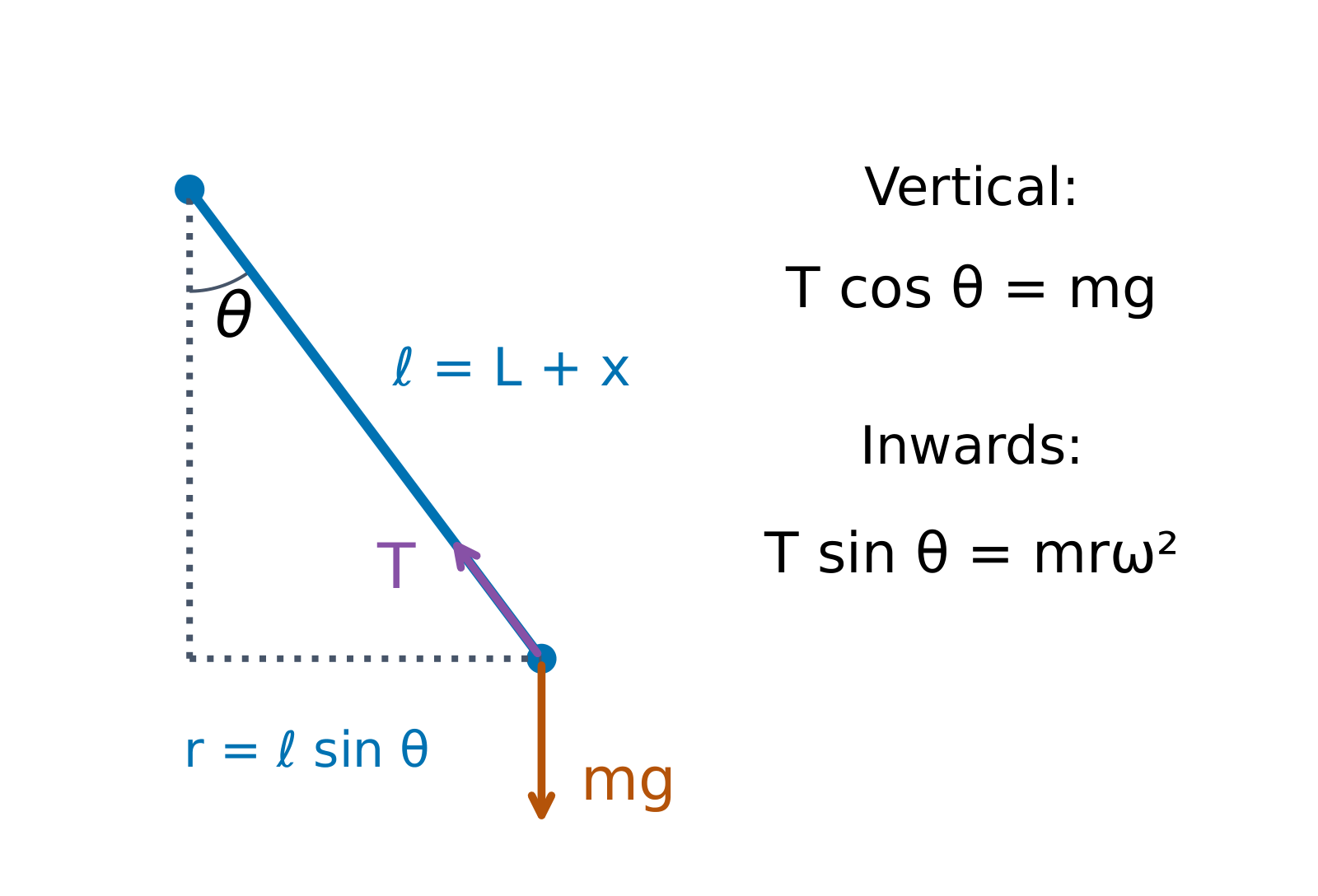
- A mass $0.6\ \text{kg}$ rotates steadily with a string of natural length $1.5\ \text{m}$ and modulus $30\ \text{N}$. Let its angle to vertical have $\cos\theta=4/5$, $\sin\theta=3/5$, and take $g=10\ \dfrac{\text{m}}{\text{s}^2}$. Vertical balance gives $T\cos\theta=mg$, hence $T=7.5\ \text{N}$.
- Hooke's law gives $x=TL/\lambda=0.375\ \text{m}$, so actual length $\ell=1.875\ \text{m}$ and orbit radius $r=\ell\sin\theta=1.125\ \text{m}$. The radial equation $T\sin\theta=mr\omega^2$ gives $\omega^2=20/3\ \dfrac{\text{rad}^2}{\text{s}^2}$. Use stretched length in the geometry.
A 0.5 kg mass rotates steadily with a string of natural length 1 m and modulus 20 N, making an angle to vertical with cosθ = 4/5 and sinθ = 3/5. Take g = 10 m/s². Find tension, actual length, orbit radius and squared angular speed.
Compare your own equations and branch checks with the model. Correct the reasoning as well as the final value.
A positive length need not give a possible orbit
- For a non-zero elastic conical orbit, $T=m\ell\omega^2$ and $T=\lambda(\ell-L)/L$. Therefore $\ell=\lambda L/(\lambda-mL\omega^2)$. Its denominator must be positive. Vertical balance also needs $\ell\cos\theta=g/\omega^2$, with $0<\cos\theta<1$.
- Take $L=1\ \text{m}$, $\lambda=20\ \text{N}$, $m=1\ \text{kg}$ and $g=10\ \dfrac{\text{m}}{\text{s}^2}$. If $\omega^2=5$, $\ell=4/3\ \text{m}$ but the required vertical height is $2\ \text{m}$: impossible. If $\omega^2=10$, $\ell=2\ \text{m}$ and $r=\sqrt3\ \text{m}$: possible. At $\omega^2=20$ no finite length solves the equations.
An elastic conical pendulum has L = 1 m, λ = 12 N, mass 1 kg and g = 10 m/s². Test proposed squared angular speeds 4, 6 and 12 rad²/s² for a non-zero steady orbit.
Compare your own equations and branch checks with the model. Correct the reasoning as well as the final value.
Select a physically valid event
- Mark the initial state, natural-length boundaries, equilibrium positions and candidate turning points. State the active model in each interval: a taut string pulls, a slack string has no force, and a spring may compress.
- Find roots, then check lengths, nonnegative string tensions, nonnegative kinetic energy and the order of events. Maximum speed requires zero tangential resultant within a smooth branch, or comparison with a boundary; instantaneous rest requires $v=0$.
A solver uses string energy kx²/2 to obtain a root x < 0, then calls it a later compressed-string position. Explain how to repair the method and how to identify maximum speed versus a turning point.
Compare your own equations and branch checks with the model. Correct the reasoning as well as the final value.
Connect force, energy and geometry
- First find $x=\ell-L$ for every element. Hooke's law gives force; $\lambda x^2/(2L)$ gives energy on its valid branch. Resolve directions before adding forces, and keep one height reference throughout energy calculations.
- Use original data to practise both one-element and connected systems. In circular motion, stretching determines actual length before orbit geometry. Check each final answer against its branch and units.
An elastic string has natural length 2 m, modulus 40 N and extension 0.5 m. What is its tension?
Difficulty 1/5 · 100 coins + a small bonus on first completion today
40 times 0.5 divided by 2 is 10 N. Other options — 12.5 N (the lesson tension for modulus 50 N); 2.5 J (the stored energy).