Motion of a projectile
Introduced| English | Meaning |
|---|---|
| projectile/prəˈdʒektaɪl/ | An object moving after being launched, typically modelled under gravity with air resistance neglected. |
| gravity/ˈɡrævɪti/ | The attractive interaction between objects with mass. |
| particle/ˈpɑːtɪkl/ | An idealised object whose size and shape are ignored so its mass can be treated as concentrated at a point. |
| air resistance/eə rɪˈzɪstəns/ | A drag force opposing motion through air. |
| horizontal/ˌhɒrɪˈzɒntl/ | Parallel to the horizon or perpendicular to the local vertical direction. |
| displacement/dɪˈspleɪsmənt/ | The straight-line change in position, including direction. |
| vertical/ˈvɜːtɪkl/ | Along the local direction of gravity, or perpendicular to a horizontal reference. |
| angle of projection/ˈæŋɡl ɒv prəˈdʒekʃn/ | The angle between the initial velocity and the horizontal. |
| velocity component/vəˈlɒsɪti kəmˈpəʊnənt/ | The signed part of velocity in a chosen direction. |
| constant acceleration/ˈkɒnstənt əkˌseləˈreɪʃn/ | Motion in which velocity changes by equal amounts over equal time intervals. |
| range/reɪndʒ/ | The horizontal distance travelled by a projectile between its launch and a specified landing level or point. |
| greatest height/ˈɡreɪtɪst haɪt/ | The highest vertical position reached, measured from the stated level. |
| time of flight/taɪm ɒv flaɪt/ | The time between launch and the stated landing or impact. |
| trajectory/trəˈdʒektəri/ | The path followed by a moving object; a non-vertical projectile follows a parabola under uniform gravity alone. |
| Cartesian equation/kɑːˈtiːzɪən ɪˈkweɪʒn/ | A relation in x and y, as distinct from parametric or polar forms. |
| parabola/pəˈræbələ/ | The curve formed by points equally distant from a fixed point and a fixed straight line. |
Predict where a thrown ball will go
- A ball is thrown across a court. Its position, speed and direction change during the flight. We need a model that predicts all three, including a landing point below the thrower's hand.
- A projectile 抛射体 moves freely under gravity 重力. Model it as a particle 质点, ignore air resistance 空气阻力 and take gravity as constant. These assumptions become less accurate for a light shuttlecock, strong wind or a very long flight.

The water arcs suggest the model; drag and interactions between water drops limit its accuracy.
Explain why a heavy ball and a shuttlecock need not follow the same ideal projectile prediction. State two assumptions of the model.
Treat each object as a particle under constant gravity and ignore air resistance. Drag matters more for the light shuttlecock, so its horizontal velocity need not remain constant in real flight.
Set the origin and resolve the launch velocity
- Put the origin at launch, with horizontal 水平 displacement 位移 $x$ to the right and vertical 竖直 displacement $y$ upwards. Let the angle of projection 抛射角 $\alpha$ be measured above the horizontal.
- The initial velocity component 速度分量 in each direction is $u_x=u\cos\alpha$, $u_y=u\sin\alpha$. For $u=20\ \dfrac{\text{m}}{\text{s}}$ and $\tan\alpha=4/3$, a $3$–$4$–$5$ triangle gives $u_x=12$, $u_y=16$, in metres per second.
The initial horizontal velocity of a projectile launched at speed u and angle α is u ______ α.
Difficulty 1/5 · 100 coins + a small bonus on first completion today
Horizontal component = u cos α; vertical = u sin α.
A projectile has speed $26\ \dfrac{\text{m}}{\text{s}}$ and $\tan\alpha=5/12$, upwards and to the right. Find its initial velocity components.
A 5–12–13 triangle gives $u_x=24$, $u_y=10$, in metres per second. Both are positive for the chosen directions.
Use the same time in both directions
- There is no horizontal force. The constant acceleration 匀加速 is $0$ horizontally and $-g$ vertically. With displacement measured from launch, the position and velocity equations are:
- Both equations use the same $t$. Unless a question states otherwise, take $g=10\ \dfrac{\text{m}}{\text{s}^2}$ in this lesson. The interactive Earth model below uses its own Earth gravity value; its numerical ranges need not equal our rounded-$g$ examples.
Launch a projectile
Compare horizontal and vertical motion. Keep launch speed fixed and landing at launch height to investigate the best angle for range. The Earth widget uses its own gravity value, rather than the rounded g = 10 in our worked examples.
During the flight, the horizontal velocity of a projectile (ignoring air resistance):
Difficulty 1/5 · 100 coins + a small bonus on first completion today
There is no horizontal force, so u cos α is constant throughout.
A projectile has $u_x=9$, $u_y=12$ in metres per second. With $g=10$, write $x,y,v_x,v_y$ at time $t$ and find the time at $x=18\ \text{m}$.
$x=9t$, $y=12t-5t^2$, $v_x=9$, $v_y=12-10t$. At $x=18$, $t=2\ \text{s}$; the vertical equation must use this same time.
Find position and speed at a stated time
- For $u_x=12$, $u_y=16$, $g=10$ and $t=1.5\ \text{s}$, the position is $x=18\ \text{m}$, $y=24-11.25=12.75\ \text{m}$. The velocity components are $12$ and $1$, in metres per second.
- Speed is the magnitude of velocity: $v=\sqrt{12^2+1^2}=\sqrt{145}\ \dfrac{\text{m}}{\text{s}}$. Its direction is $\tan^{-1}(1/12)\approx4.76^\circ$ above the horizontal. Position coordinates are not velocity components.
For $u_x=9$, $u_y=12$, $g=10$, find the position, speed and direction at $t=2\ \text{s}$.
Position $(18,4)\ \text{m}$. Velocity components $(9,-8)$ in metres per second. Speed $\sqrt{145}\ \dfrac{\text{m}}{\text{s}}$, direction $\tan^{-1}(8/9)\approx41.6^\circ$ below horizontal.
Translate a direction into signed components
- Later the same ball travels at $45^\circ$ to the downward vertical. It is descending, so $v_y<0$ and $|v_y|=v_x=12$. Thus $16-10t=-12$ and $t=2.8\ \text{s}$.
- Then $(x,y)=(33.6,5.6)\ \text{m}$ and $v=12\sqrt2\ \dfrac{\text{m}}{\text{s}}$. For a downward angle $\beta$ to the horizontal use $v_y=-v_x\tan\beta$; for angle $\gamma$ to the downward vertical use $v_y=-v_x\cot\gamma$.
For $u_x=12$, $u_y=16$, $g=10$, when is the velocity $30^\circ$ below horizontal? Give an exact time.
$16-10t=-12\tan30^\circ=-4\sqrt3$, so $t=(8+2\sqrt3)/5\ \text{s}$.
A projectile has $u_x=8$, $u_y=15$, $g=10$. Find its time, position and speed when moving at $45^\circ$ to the downward vertical.
$v_y=-8$ gives $t=23/10\ \text{s}$. Then $x=92/5=18.4$, $y=161/20=8.05$ metres, and speed $8\sqrt2\ \dfrac{\text{m}}{\text{s}}$.
A height may be reached twice
- At height $10\ \text{m}$, $16t-5t^2=10$ gives $t=(8\pm\sqrt{14})/5\ \text{s}$. Both times are positive: one on the way up, one on the way down.
- The corresponding $x$ values are $(96\pm12\sqrt{14})/5\ \text{m}$. The vertical velocities are $\pm2\sqrt{14}\ \dfrac{\text{m}}{\text{s}}$, with the positive velocity at the earlier time. Both speeds are $\sqrt{144+56}=10\sqrt2\ \dfrac{\text{m}}{\text{s}}$. Keep both roots until the event wording selects one.
A projectile has $u_x=10$, $u_y=15$, $g=10$. Find both times and horizontal positions at height $10\ \text{m}$. State which is descending.
$15t-5t^2=10$ gives $(t-1)(t-2)=0$. Positions are $x=10,20\ \text{m}$. At $t=1$, $v_y=5$ upwards; at $t=2$, $v_y=-5$ descending.
With $u_y=15\ \dfrac{\text{m}}{\text{s}}$ and $g=10$, can the projectile reach height $12\ \text{m}$ above launch? Justify without guessing a time.
No. The greatest height is $15^2/20=11.25\ \text{m}$, below 12. Equivalently $5t^2-15t+12=0$ has discriminant $225-240=-15<0$.
Derive the greatest height
- For an upward launch, the greatest height 最大高度 above launch occurs when $v_y=0$. Therefore $t_{\rm top}=u_y/g$ and $H=u_y^2/(2g)=u^2\sin^2\alpha/(2g)$.
- For $u=20\ \dfrac{\text{m}}{\text{s}}$, $\alpha=30^\circ$ and $g=10$, $u_y=10$, so $t_{\rm top}=1\ \text{s}$ and $H=5\ \text{m}$. The horizontal speed is still $10\sqrt3\ \dfrac{\text{m}}{\text{s}}$; the velocity is not zero.
A ball is thrown at u = 20 m/s at 30°. Using height = u²sin²α/(2g) with g = 10, find the greatest height (m).
Difficulty 2/5 · 140 coins + a small bonus on first completion today
400 × sin²30° / 20 = 400 × 0.25 / 20 = 5 m.
A projectile has a non-zero horizontal velocity component. At its highest point its whole velocity is zero.
Difficulty 1/5 · 100 coins + a small bonus on first completion today
False. Only the vertical component is zero at the top; the horizontal component is unchanged, so the speed is not zero.
For an upward launch with components $a>0,b>0$, derive the apex time, horizontal position, height and speed. Use gravity $g$.
$v_y=b-gt=0$ gives $t=b/g$. Hence $x=ab/g$, $H=b^2/(2g)$, and speed $a$ because horizontal velocity remains $a$.
Derive the level-ground range
- If landing is at the launch height, set $y=0$: $t(u_y-gt/2)=0$. The root $t=0$ is launch; the positive time of flight 飞行时间 is $T=2u_y/g$ for $u_y>0$.
- The range 射程 on that horizontal plane is $R=u_xT=u^2\sin2\alpha/g$. For the $20\ \dfrac{\text{m}}{\text{s}}$, $30^\circ$ example, $T=2\ \text{s}$ and $R=20\sqrt3\approx34.6\ \text{m}$. The formula does not apply unchanged when landing height differs.
A ball is launched at $25\ \dfrac{\text{m}}{\text{s}}$ with $\tan\alpha=3/4$ and lands at the launch height. With $g=10$, find flight time, range and greatest height.
$u_x=20$, $u_y=15$. Thus $T=3\ \text{s}$, $R=60\ \text{m}$ and $H=11.25\ \text{m}$.
State the conditions for a maximum range
- For fixed $u$ and $g$, no air resistance, level ground and an upward launch, $\sin2\alpha\le1$ gives the largest range at $\alpha=45^\circ$. Complementary angles such as $30^\circ$ and $60^\circ$ give the same range, but different heights and flight times.
- A vertical throw has zero horizontal range. A horizontal or downward launch from a raised platform needs its actual landing height; the $45^\circ$ conclusion cannot simply be carried over.
With fixed launch speed, constant gravity, no air resistance and landing at the launch height, which upward launch angle (degrees) gives the greatest range?
Difficulty 2/5 · 140 coins + a small bonus on first completion today
Range ∝ sin 2α, which is largest when 2α = 90°, i.e. α = 45°.
A ball is thrown at 40 metres per second at 30 degrees above horizontal, with g = 10. Find its greatest height above launch. For fixed speed and landing at launch height, explain why the range is not greatest at 90 degrees.
The greatest height is u squared sin squared alpha divided by 2g. The range formula peaks when the double angle is 90 degrees.
At a fixed speed, compare $30^\circ$ and $60^\circ$ launches that land at launch height. Are their range, flight time and greatest height equal?
The ranges are equal because $\sin60^\circ=\sin120^\circ$. The $60^\circ$ flight lasts $\sqrt3$ times as long and reaches three times the greatest height, since its vertical component is $\sqrt3$ times as large.
Land below the launch point
- A ball leaves a $20\ \text{m}$ platform horizontally at $12\ \dfrac{\text{m}}{\text{s}}$. With the origin at launch, the ground is $y=-20$, not $y=0$. Thus $-5t^2=-20$ gives the physical root $t=2\ \text{s}$ and horizontal distance $24\ \text{m}$.
- At impact, $v_x=12$, $v_y=-20$, so speed is $4\sqrt{34}\ \dfrac{\text{m}}{\text{s}}$ and direction is $\tan^{-1}(20/12)\approx59.0^\circ$ below horizontal. Reject $t=-2$ because it precedes launch.
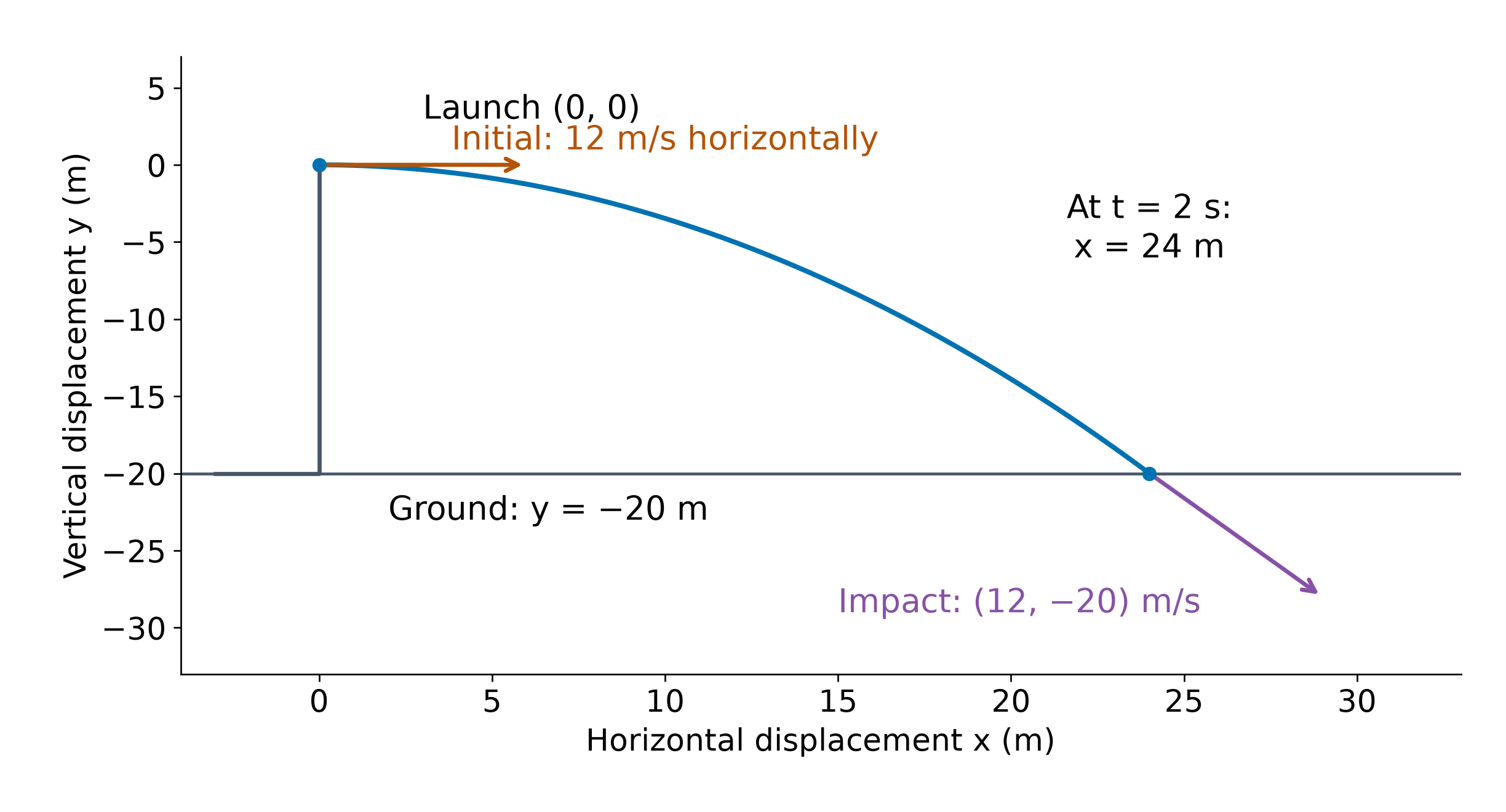
A ball leaves a $45\ \text{m}$ platform horizontally at $8\ \dfrac{\text{m}}{\text{s}}$. Use $g=10$. Find landing time, horizontal distance, speed and direction.
$-45=-5t^2$ gives $t=3\ \text{s}$. Distance is $24\ \text{m}$. Impact components are $(8,-30)$, so speed is $2\sqrt{241}\ \dfrac{\text{m}}{\text{s}}$, direction $\tan^{-1}(30/8)\approx75.1^\circ$ below horizontal.
A ball starts $20\ \text{m}$ above ground with $u_x=12$, $u_y=-5$ in metres per second. Use $g=10$. Find its landing time and horizontal distance.
$-20=-5t-5t^2$ gives $t=(-1+\sqrt{17})/2\ \text{s}$, rejecting the negative root. The distance is $6(\sqrt{17}-1)\ \text{m}$.
Eliminate time to obtain the trajectory
- The trajectory 轨迹 is the path. For $u_x\ne0$, substitute $t=x/(u\cos\alpha)$ into the vertical equation. This gives its Cartesian equation 直角坐标方程:
- It is a parabola 抛物线 for a non-vertical launch. The equation describes the mathematical curve; keep only positions reached after launch and before the first impact. A vertical throw has $x=0$ throughout, so this division is not allowed.
For a non-vertical launch under constant gravity, with no air resistance, the trajectory is a:
Difficulty 1/5 · 100 coins + a small bonus on first completion today
Eliminating t gives y as a quadratic in x — a parabola.
Derive the Cartesian projectile equation from the two position equations. State when the elimination is invalid.
From $x=u\cos\alpha\,t$, $t=x/(u\cos\alpha)$. Substitute in $y=u\sin\alpha\,t-gt^2/2$ to obtain $y=x\tan\alpha-gx^2/(2u^2\cos^2\alpha)$. This requires $u\cos\alpha\ne0$; a vertical throw has $x=0$.
With $u_x=12$, $u_y=16$, $g=10$, obtain $y$ in terms of $x$. Find its non-zero ground intercept.
$t=x/12$ gives $y=4x/3-5x^2/144$. Setting $y=0$ and taking the non-zero root gives $x=192/5=38.4\ \text{m}$.
Use a known direction to find an unknown speed
- Suppose $\tan\alpha=3/2$ and the projectile passes through $(10,10)\ \text{m}$. Write $T=\tan\alpha$ and $1/\cos^2\alpha=1+T^2$. The trajectory equation gives
- Hence $u=5\sqrt{13}\ \dfrac{\text{m}}{\text{s}}$, $u_x=10$, $u_y=15$ and $y=3x/2-x^2/20$. For a target to the right, $X>0$ and a finite positive speed requires $XT>Y$: the initial straight direction must point above the target.
A launch has $\tan\alpha=1$ and passes through $(12,9)\ \text{m}$. With $g=10$, find $u$ and the trajectory.
$9=12-10(144)(2)/(2u^2)$ gives $u^2=480$, so $u=4\sqrt{30}\ \dfrac{\text{m}}{\text{s}}$. The trajectory is $y=x-x^2/48$.
A projectile is aimed at angle $\alpha$ toward a target $(X,Y)$ with $X>0$. Explain why $X\tan\alpha\le Y$ cannot give a finite positive launch speed under gravity.
The path is $y=x\tan\alpha-gx^2/(2u^2\cos^2\alpha)$, strictly below the initial straight ray for $x>0$. Thus reaching the target requires $Y<X\tan\alpha$. Equality would need the gravity term to vanish, impossible for finite positive speed.
Find two launch angles for one target
- Now fix $u=20\sqrt2\ \dfrac{\text{m}}{\text{s}}$ and require the path to pass through the top $(40,20)\ \text{m}$ of a wall. With $T=\tan\alpha$ and $g=10$:
- Both are positive launch angles: $\alpha=45^\circ$ or $\tan^{-1}3\approx71.6^\circ$. The higher-angle path does not have the longer range. Substitute each root back into the target equation before accepting it.
With $g=10$ and speed $20\sqrt2\ \dfrac{\text{m}}{\text{s}}$, find both upward launch angles that reach $(32,8)\ \text{m}$.
$8=32T-(32/5)(1+T^2)$ gives $4T^2-20T+9=0$. Therefore $T=1/2$ or $9/2$, and angles are $\tan^{-1}(1/2)$ or $\tan^{-1}(9/2)$, about $26.6^\circ,77.5^\circ$.
Compare the two flights
- The low-angle path is $y=x-x^2/80$: its vertex is $(40,20)$ and range is $80\ \text{m}$. The high-angle path is $y=3x-x^2/16$: its vertex is $(24,36)$ and range is $48\ \text{m}$.
- Both pass through $(40,20)$. The second is already descending at the wall. A larger angle raises the path but reduces the horizontal component; do not rank ranges by height alone.
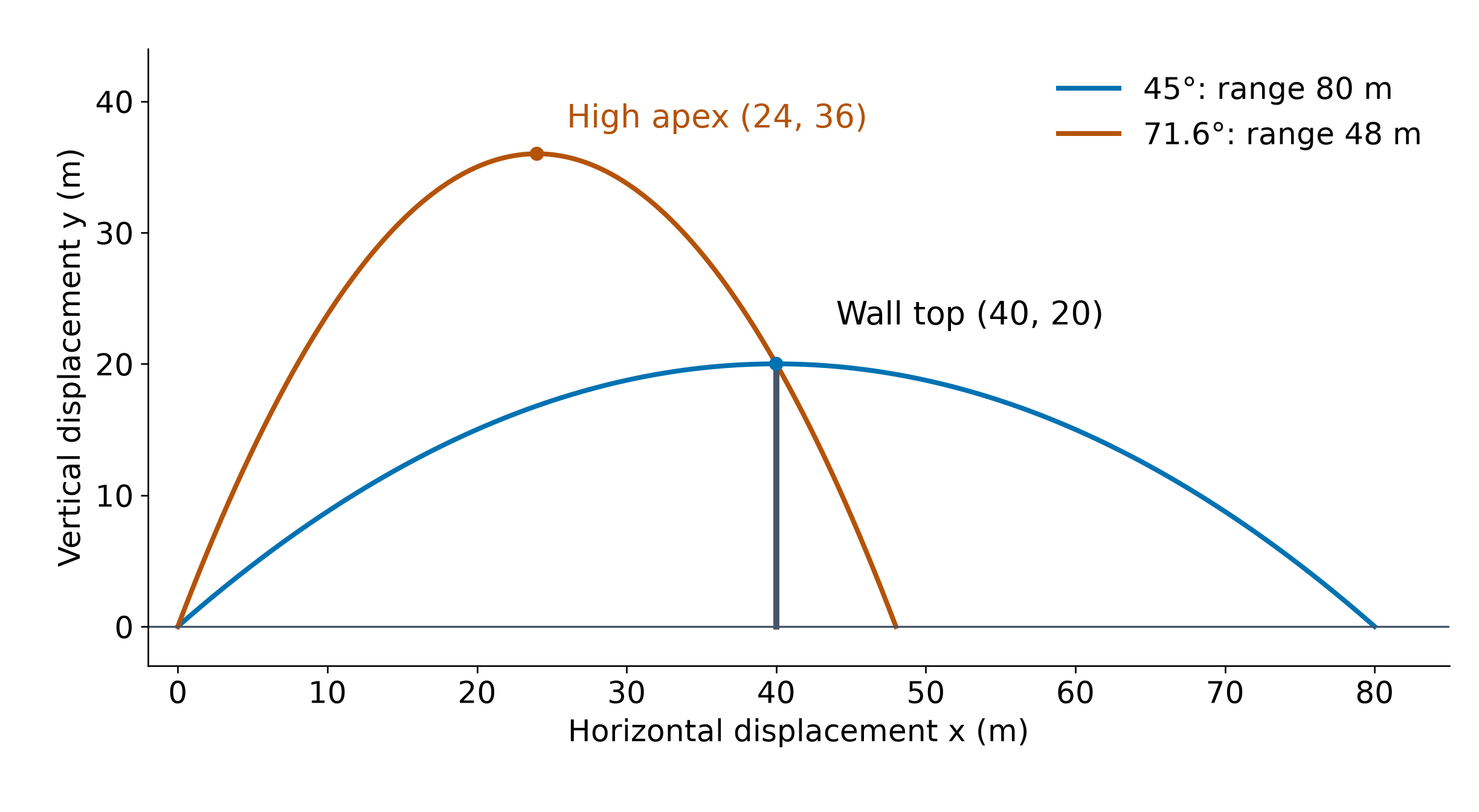
For the two paths $y=x-x^2/80$ and $y=3x-x^2/16$, verify the common point $(40,20)$ and find each range and apex.
Both give $y=20$ at $x=40$. Their ranges are 80 and 48 metres. Completing the square or differentiating gives vertices $(40,20)$ and $(24,36)$.
Turn a clearance condition into an interval
- To reach or pass above that wall top, require $40T-10(1+T^2)\ge20$. Thus $(T-1)(T-3)\le0$ and $1\le T\le3$.
- The level-ground range is $R=160T/(1+T^2)$. Its derivative is $160(1-T^2)/(1+T^2)^2$, so it decreases on $1\le T\le3$. The smallest landing distance is $48\ \text{m}$ at $T=3$. If touching the wall top is forbidden, the endpoints are excluded and $48$ is an unattained lower bound.
At fixed speed $20\sqrt2\ \dfrac{\text{m}}{\text{s}}$ and $g=10$, a launch must reach or pass above $(32,8)\ \text{m}$. Find the interval of $T=\tan\alpha$ and the smallest level-ground range.
$4T^2-20T+9\le0$ gives $1/2\le T\le9/2$. The range $160T/(1+T^2)$ rises to $T=1$ then falls, so compare endpoints: $R(1/2)=64$, $R(9/2)=576/17\approx33.9$ metres. The minimum is $576/17\ \text{m}$.
Apply the event order after solving a height inequality
- Return to $y=3x/2-x^2/20$. After passing $(10,10)$, the ball hits a vertical barrier of height $25/4\ \text{m}$ at $x=D$. It is above ground for $0\le D\le30$. Hitting the barrier means $y(D)\le25/4$, giving $(D-5)(D-25)\ge0$.
- On the ground interval this gives $D\le5$ or $D\ge25$. But the barrier is reached after $x=10$, so only $25\le D\le30$ remains, with boundary contact allowed. “After”, “descending” and “before landing” are mathematical restrictions.
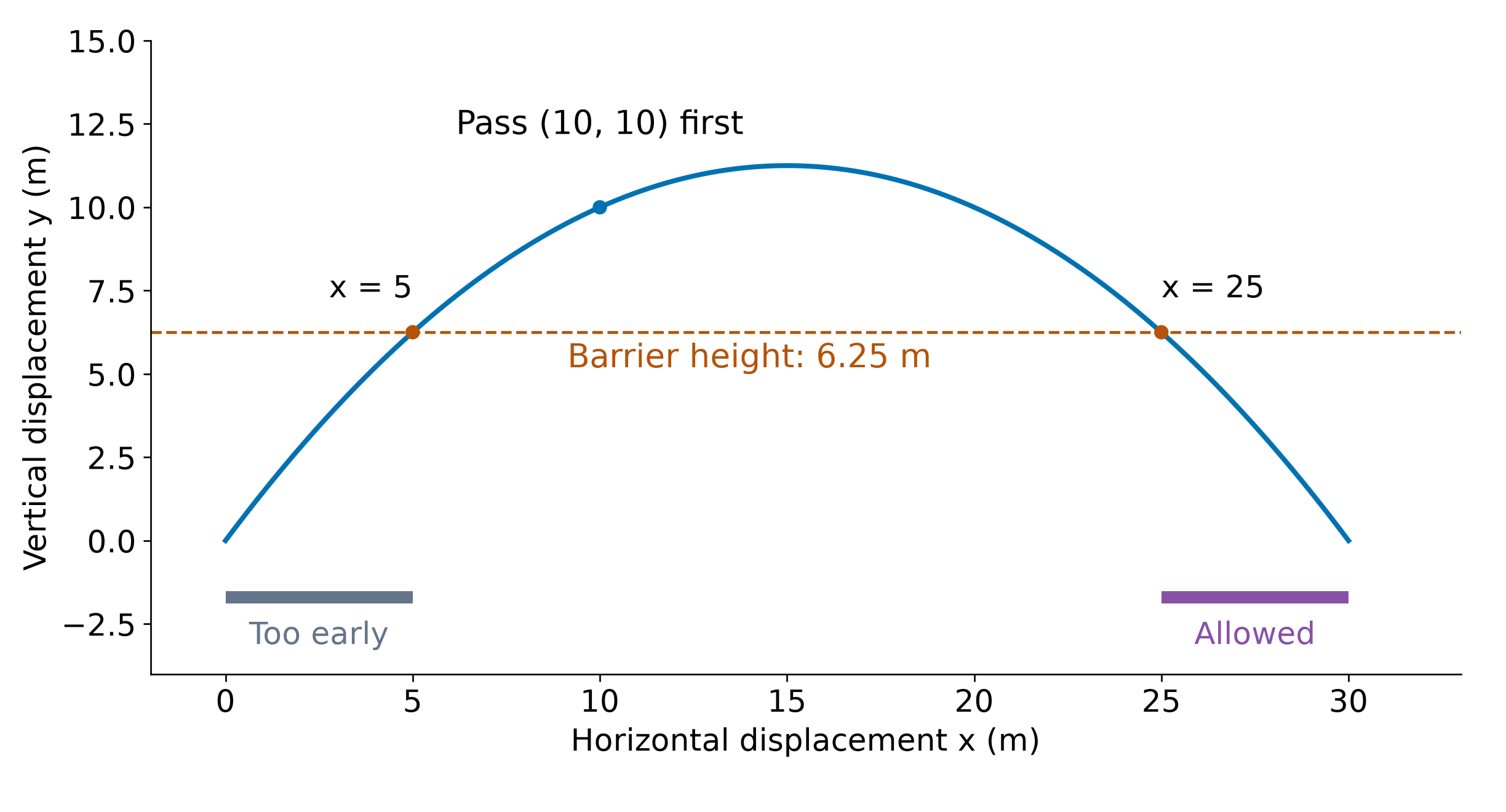
A ball follows $y=2x-x^2/20$. After passing $(10,15)$, it meets a barrier of height $35/4\ \text{m}$ at $x=D$. Find all possible barrier positions, including boundary contact.
Ground interval is $0\le D\le40$. The condition $2D-D^2/20\le35/4$ gives $(D-5)(D-35)\ge0$, hence $D\le5$ or $D\ge35$. Since it passes $x=10$ first, the answer is $35\le D\le40$.
Recover both launch conditions from two points
- Suppose an unknown launch passes through $(10,15)$ and $(20,20)$ in metres. Write $y=Ax-Bx^2$, with $A=\tan\alpha$ and $B=g/(2u_x^2)>0$. The two points give $10A-100B=15$ and $20A-400B=20$.
- Subtract twice the first equation from the second: $-200B=-10$, so $B=1/20$ and $A=2$. Therefore $u_x=10$, $u_y=20$, $u=10\sqrt5\ \dfrac{\text{m}}{\text{s}}$ and $\alpha=\tan^{-1}2$. The range is $40\ \text{m}$ and greatest height $20\ \text{m}$.
With $g=10$, an unknown launch passes through $(10,10)$ and $(20,10)$ in metres. Find its speed, angle, range and greatest height.
Write $y=Ax-Bx^2$. The points give $A=3/2$, $B=1/20$, hence $u_x=10$, $u_y=15$, $u=5\sqrt{13}\ \dfrac{\text{m}}{\text{s}}$ and $\alpha=\tan^{-1}(3/2)$. Range 30 metres, greatest height $45/4$ metres.
Choose the method from the event
- Given a time, use the component equations. Given a direction, first relate the signed velocity components. Given a height, solve for time and check both roots. Given a target or unknown launch conditions, eliminate time and substitute coordinates.
- Check units, the coordinate origin, $t\ge0$, the direction of travel and the first collision. For an upward launch, only the vertical component vanishes at the top; for a purely vertical throw the whole velocity does vanish there. The same-height range formula always needs its same-height assumption.
A ball is thrown at 40 metres per second at 30 degrees above horizontal. With g = 10 metres per second squared, what is its greatest height above launch?
Difficulty 1/5 · 100 coins + a small bonus on first completion today
1600 divided by 4 is 400, and 400 divided by 20 is 20 metres. Other options — 5 metres (the lesson height for 20 metres per second); 45 degrees (the angle for the greatest range).
A launch has $u_x=10$, $u_y=15$, $g=10$. Find the time and position when its velocity is $45^\circ$ below horizontal. Explain why using the displacement ratio $y/x$ for this direction is wrong.
$v_y=-10$ gives $t=2.5\ \text{s}$, position $(25,6.25)\ \text{m}$. Velocity direction is the tangent to the path, using $v_y/v_x$; $y/x$ is the direction from the origin to the current position.
A ball is thrown vertically upwards at $20\ \dfrac{\text{m}}{\text{s}}$ with $g=10$. Find the apex time, greatest height and speed at the apex. Explain why the Cartesian parabola derivation is invalid.
Apex time is 2 seconds, height 20 metres and speed zero. Both horizontal and vertical velocity components vanish there. The derivation divides by $u\cos\alpha=0$; the actual path is the vertical line $x=0$.