Equilibrium of a rigid body
Introduced| English | Meaning |
|---|---|
| turning effect/ˈtɜːnɪŋ ɪˈfekt/ | A force’s tendency to turn a body about a point or axis. |
| rigid body/ˈrɪdʒɪd ˈbɒdi/ | An idealised object whose shape and distances between its particles do not change. |
| coplanar forces/ˌkəʊˈpleɪnə ˈfɔːsɪz/ | Forces whose lines of action all lie in the same plane; rigid-body equilibrium requires both balanced forces and balanced moments. |
| moment/ˈməʊmənt/ | The turning effect of a force about a pivot. |
| line of action/laɪn ɒv ˈækʃn/ | The straight line passing through a force's point of application in the direction of that force. |
| perpendicular distance/ˌpɜːpənˈdɪkjʊlə ˈdɪstəns/ | The shortest distance from a point to a line or plane, measured at right angles to it. |
| pivot/ˈpɪvət/ | A fixed point about which an object can turn. |
| perpendicular/ˌpɜːpənˈdɪkjʊlə/ | Meeting at a right angle of 90 degrees. |
| equilibrium/ˌiːkwɪˈlɪbrɪəm/ | A state with no resultant force or resultant moment. |
| resultant force/rɪˈzʌltənt fɔːs/ | The single force equivalent to all the forces acting together. |
| centre of mass/ˈsentə ɒv mæs/ | The point representing an object's or system's mass-weighted average position. |
| uniform/ˈjuːnɪfɔːm/ | Constant or the same throughout the relevant interval. |
| symmetry/ˈsɪmətri/ | A property by which a shape or pattern matches itself under a transformation such as reflection or rotation. |
| density/ˈdensɪti/ | Mass per unit volume. |
| lamina/ˈlæmɪnə/ | A thin, flat sheet of material. |
| median/ˈmiːdiːən/ | A line segment from a triangle vertex to the midpoint of the opposite side. |
| hemispherical shell/ˌhemɪsˈferɪkl ʃel/ | A thin shell forming half of a sphere. |
| circular arc/ˈsɜːkjʊlə ɑːk/ | A part of a circle’s circumference. |
| circular sector/ˈsɜːkjʊlə ˈsektə/ | A region bounded by two radii of a circle and the arc between them. |
| composite body/ˈkɒmpəzɪt ˈbɒdi/ | A body modelled using several simpler parts. |
| free-body diagram/friː ˈbɒdi ˈdaɪəɡræm/ | A diagram showing all external forces acting on a selected object. |
| normal reaction/ˈnɔːml rɪˈækʃn/ | The contact force component perpendicular to a surface. |
| friction/ˈfrɪkʃn/ | A contact force opposing relative sliding or its tendency between surfaces. |
| sliding/ˈslaɪdɪŋ/ | Relative motion of two surfaces along their contact, possibly while an object also rotates; friction opposes the relative slipping. |
| coefficient of friction/ˌkəʊɪˈfɪʃənt ɒv ˈfrɪkʃn/ | The ratio of frictional force to normal contact force, at limiting friction for the static case. |
| limiting friction/ˈlɪmɪtɪŋ ˈfrɪkʃn/ | The greatest available static friction for the stated normal force. |
| limiting equilibrium/ˈlɪmɪtɪŋ ˌiːkwɪˈlɪbrɪəm/ | The boundary of static equilibrium, just before sliding or toppling begins. |
| topple/ˈtɒpl/ | To turn over about a supporting edge after losing balance. |
| toppling/ˈtɒplɪŋ/ | Losing balance and rotating about a support edge when the applied forces produce an unbalanced turning effect. |
| base of support/beɪs ɒv səˈpɔːt/ | The region between the outermost support contacts. |
Why a handle is far from the hinge
- Push near a door hinge and you need a large force. Push at the handle and the same force has a larger turning effect 转动效应. To predict balance we must know both the forces and where they act.
- Model the object as a rigid body 刚体: its shape and the distances between its parts stay fixed. We consider coplanar forces 共面力, all in one plane. A particle model would lose the information needed to predict turning.
Measure a moment from the line of action
- The moment 力矩 of a force about a point is force multiplied by the perpendicular distance 垂直距离 from that point to the force's line of action 作用线. The unit is $\text{N m}$. Choose a sign, such as anticlockwise positive.
- A $20\ \text{N}$ upward force acting $0.6\ \text{m}$ to the right of a pivot 支点 has moment $+12\ \text{N m}$. If the line of action passes through the pivot, its moment is zero even when the force itself is not zero.
The moment of a force about a point is:
Difficulty 1/5 · 100 coins + a small bonus on first completion today
Moment = force × perpendicular distance — the turning effect.
A $16\ \text{N}$ force has a perpendicular distance of $0.75\ \text{m}$ from a pivot. It tends to turn clockwise. Find its signed moment with anticlockwise positive.
The magnitude is $16(0.75)=12\ \text{N m}$. Clockwise is negative, so the moment is $-12\ \text{N m}$.
An angled force needs its perpendicular arm
- A force of $30\ \text{N}$ acts at $30^\circ$ above a horizontal rod, $4\ \text{m}$ from the pivot. Its perpendicular 垂直 component is $30\sin30^\circ=15\ \text{N}$, giving moment $15(4)=60\ \text{N m}$ anticlockwise.
- Equivalently use the full force and arm $4\sin30^\circ=2\ \text{m}$. These are two ways to calculate the same moment; do not insert the sine factor twice.
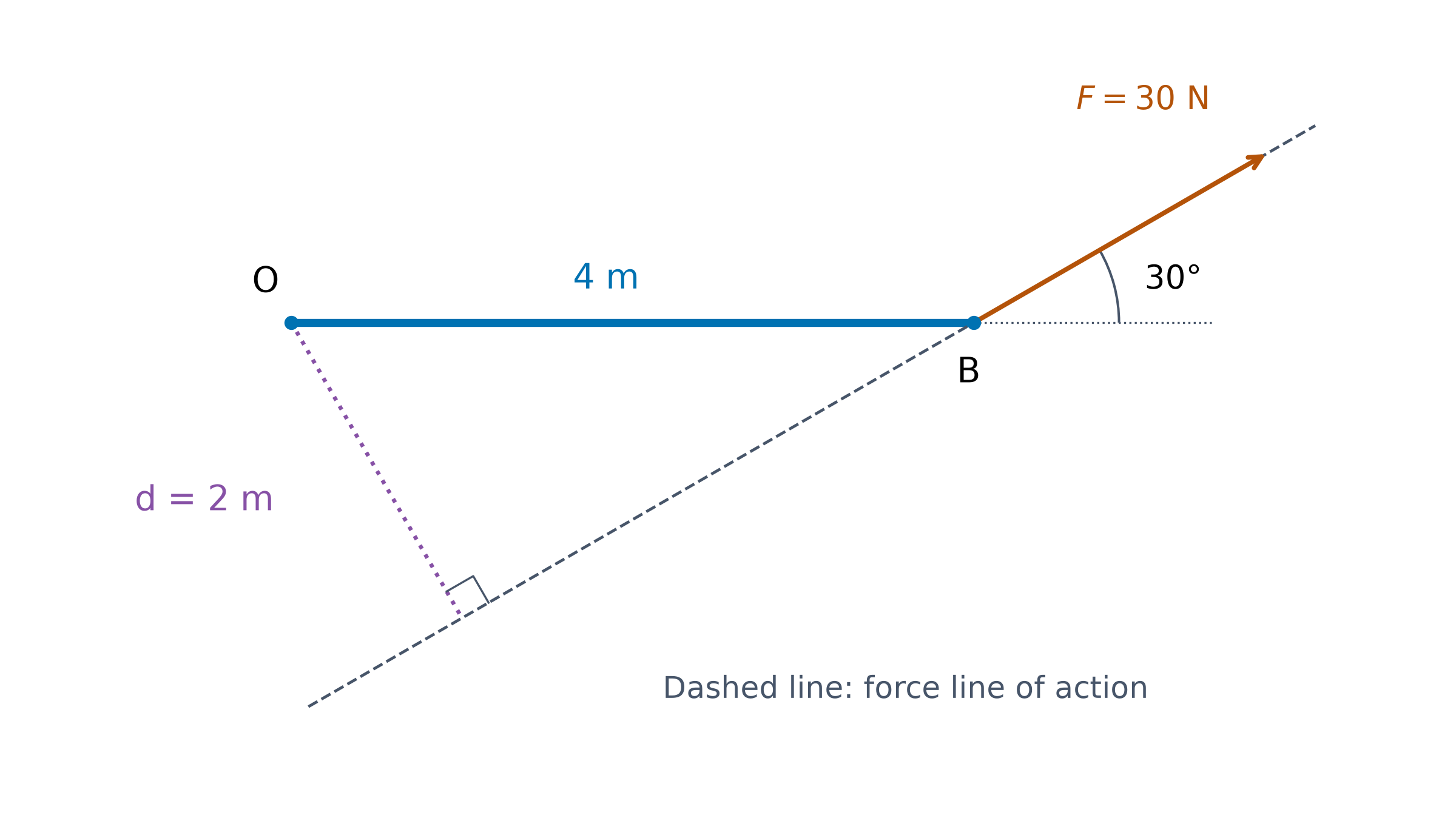
A horizontal rod is pivoted at its left end. A $40\ \text{N}$ force acts $3\ \text{m}$ to the right, at $30^\circ$ above horizontal. Find its moment in two equivalent ways.
The vertical component is $40\sin30^\circ=20\ \text{N}$, so moment is $20(3)=60\ \text{N m}$ anticlockwise. Alternatively the perpendicular arm is $3\sin30^\circ=1.5\ \text{m}$, so the full force gives $40(1.5)=60\ \text{N m}$.
Equilibrium needs two separate balances
- For a body in equilibrium 平衡, the resultant force 合力 is zero and the total moment about any point is zero. For coplanar forces, resolve in two perpendicular directions and take moments about one chosen point. These conditions are also sufficient for equilibrium in this model.
- Equal opposite $10\ \text{N}$ forces on different parallel lines $0.4\ \text{m}$ apart have zero resultant but a moment of $4\ \text{N m}$. They do not balance rotationally. Zero resultant means no translational acceleration; it does not make an already moving body stop. For static equilibrium, the body starts at rest.
Check the force balance
resultant = 0
Tip-to-tail closure checks whether the resultant force is zero. For a rigid body, also check moments: equal opposite forces on different lines can still turn the body.
For a rigid body in equilibrium, both the resultant force and the total moment must be zero.
Difficulty 1/5 · 100 coins + a small bonus on first completion today
Zero resultant force means no translational acceleration; zero total moment means no angular acceleration. For static equilibrium the body is initially at rest.
Two opposite parallel forces of magnitude $15\ \text{N}$ act on a rigid body, on lines $0.2\ \text{m}$ apart. Is zero resultant force enough to prove equilibrium?
No. Their resultant force is zero, but the moment magnitude is $15(0.2)=3\ \text{N m}$. The forces cause a turning effect. Both resultant force and total moment must vanish.
Replace gravity by one force at the centre of mass
- In a uniform gravitational field, the weight $F_W=mg$ acts through the centre of mass 质心. A uniform 均匀 body has mass distributed evenly over its length, area or volume, as appropriate.
- Use symmetry 对称: a uniform rod has its centre of mass at its midpoint; a uniform rectangle has it where its diagonals meet. The centre of mass lies on every symmetry axis of the mass distribution. Shape symmetry alone is not enough if the density 密度 varies, and a centre of mass may lie in a hole outside the material.
For a uniform beam, the weight is taken to act at the ______ of mass.
Difficulty 1/5 · 100 coins + a small bonus on first completion today
The weight acts through the centre of mass. For the uniform beam in this question, that point is its midpoint.
A rod has a symmetric shape but is denser near its right end. Can symmetry alone place its centre of mass at its midpoint? Explain.
No. The relevant symmetry is that of the mass distribution. The extra mass near the right end moves the centre of mass rightwards; the uniform-rod midpoint result does not apply.
Locate the centre of a triangular lamina
- A lamina 薄片 is a thin plate. For a uniform triangular lamina, the centre of mass lies two-thirds of the way along each median 中线 from its vertex, or one-third from the opposite side. The MF19 formula is given; a proof is not required here.
- For vertices $(0,0)$, $(6,0)$ and $(0,3)$ in metres, the midpoint opposite the origin is $(3,1.5)$. Two-thirds of this displacement gives $(\bar x,\bar y)=(2,1)\ \text{m}$. Equivalently, average the three vertex coordinates for a uniform triangle.
A uniform triangular lamina has vertices $(2,1)$, $(8,1)$ and $(2,7)$ in centimetres. Find its centre of mass relative to the same origin.
The coordinate means are $(2+8+2)/3=4$ and $(1+1+7)/3=3$. The centre of mass is $(4,3)\ \text{cm}$. Equivalently it is two-thirds along a median from a vertex.
Read the reference point in a solid-body formula
- The formula list places the centre of mass of a uniform solid cone or pyramid $3h/4$ from its vertex, hence $h/4$ from its base. For a solid hemisphere of radius $r$, it is $3r/8$ from the base-circle centre along the axis towards the curved surface.
- A thin hemispherical shell 半球壳 instead has distance $r/2$. A shell is not a solid hemisphere. Convert every position to the same origin and signed axis before combining bodies.
A uniform solid cone has height $8\ \text{cm}$. A uniform solid hemisphere and a hemispherical shell each have radius $4\ \text{cm}$. State the cone centre distance from its base, and each hemisphere centre distance from its base-circle centre.
Cone: $8/4=2\ \text{cm}$ from the base. Solid hemisphere: $3(4)/8=1.5\ \text{cm}$ from the base-circle centre. Shell: $4/2=2\ \text{cm}$. The solid and shell formulae differ.
Distinguish an arc from a sector
- For a uniform circular arc 圆弧 of radius $r$ and angle $2\alpha$, MF19 gives centre-of-mass distance $r\sin\alpha/\alpha$ from the circle centre on the symmetry axis. For a uniform circular sector 扇形 lamina, the distance is $2r\sin\alpha/(3\alpha)$. Here $\alpha$ is the half-angle in radians.
- A semicircle has $\alpha=\pi/2$: the wire arc gives $2r/\pi$, while the sector plate gives $4r/(3\pi)$. Use length for the mass of a uniform wire and area for a uniform plate of fixed thickness; these objects do not have the same mass model.
Find the centre-of-mass distance from the circle centre for a uniform semicircular wire arc and a uniform semicircular plate, both of radius $3\ \text{cm}$. Use the given MF19 formulae.
The half-angle is $\alpha=\pi/2$. The arc gives $r\sin\alpha/\alpha=6/\pi\ \text{cm}$; the plate gives $2r\sin\alpha/(3\alpha)=4/\pi\ \text{cm}$. Both lie on the symmetry axis towards the material.
Replace each component by one particle
- A composite body 复合物体 consists of simpler parts. Replace each part by a particle of mass $m_i$ at its own centre of mass $(x_i,y_i)$. Taking moments of the weights gives
- Mass is proportional to length for a uniform wire, area for a uniform lamina of fixed thickness, or volume for a uniform solid. Use an area or volume ratio only when the relevant densities are equal. A plain average of component positions works only for equal component masses.
Two particles have masses $2\ \text{kg}$ and $3\ \text{kg}$ at $x=0$ and $x=10\ \text{m}$. Find their combined centre of mass and explain why averaging the two positions fails.
$\bar x=(2(0)+3(10))/(2+3)=6\ \text{m}$. The arithmetic mean 5 metres would assume equal masses; the actual centre lies nearer the heavier particle.
Add a rectangle and a triangle
- Join a rectangle $0\le x\le4$, $0\le y\le2$ to a triangular plate with vertices $(4,0)$, $(4,2)$ and $(7,0)$, with lengths in metres. Both have the same thickness and density. Their areas are $8$ and $3$, and their centres are $(2,1)$ and $(5,2/3)$.
- Therefore $\bar x=(8\cdot2+3\cdot5)/11=31/11\ \text{m}$ and $\bar y=(8\cdot1+3\cdot2/3)/11=10/11\ \text{m}$. The larger part contributes more to each moment.
A uniform plate consists of a rectangle with corners $(0,0)$, $(6,0)$, $(6,2)$, $(0,2)$ and an attached triangle with vertices $(6,0)$, $(6,2)$, $(9,0)$. Coordinates are metres; thickness and density are constant. Find its centre of mass.
The rectangle has area 12 and centre $(3,1)$. The triangle has area 3 and centre $(7,2/3)$. Total area is 15. Thus $\bar x=(36+21)/15=19/5\ \text{m}$ and $\bar y=(12+2)/15=14/15\ \text{m}$.
Subtract a removed part from both mass and moments
- Start with a $6\ \text{m}$ by $4\ \text{m}$ uniform rectangular plate. Remove the upper-right $4\ \text{m}$ by $2\ \text{m}$ rectangle, leaving an L-shape. Using the lower-left corner as origin, the original area is $24$ at $(3,2)$ and the removed area is $8$ at $(4,3)$.
- Subtract the hole's area and both its moments:
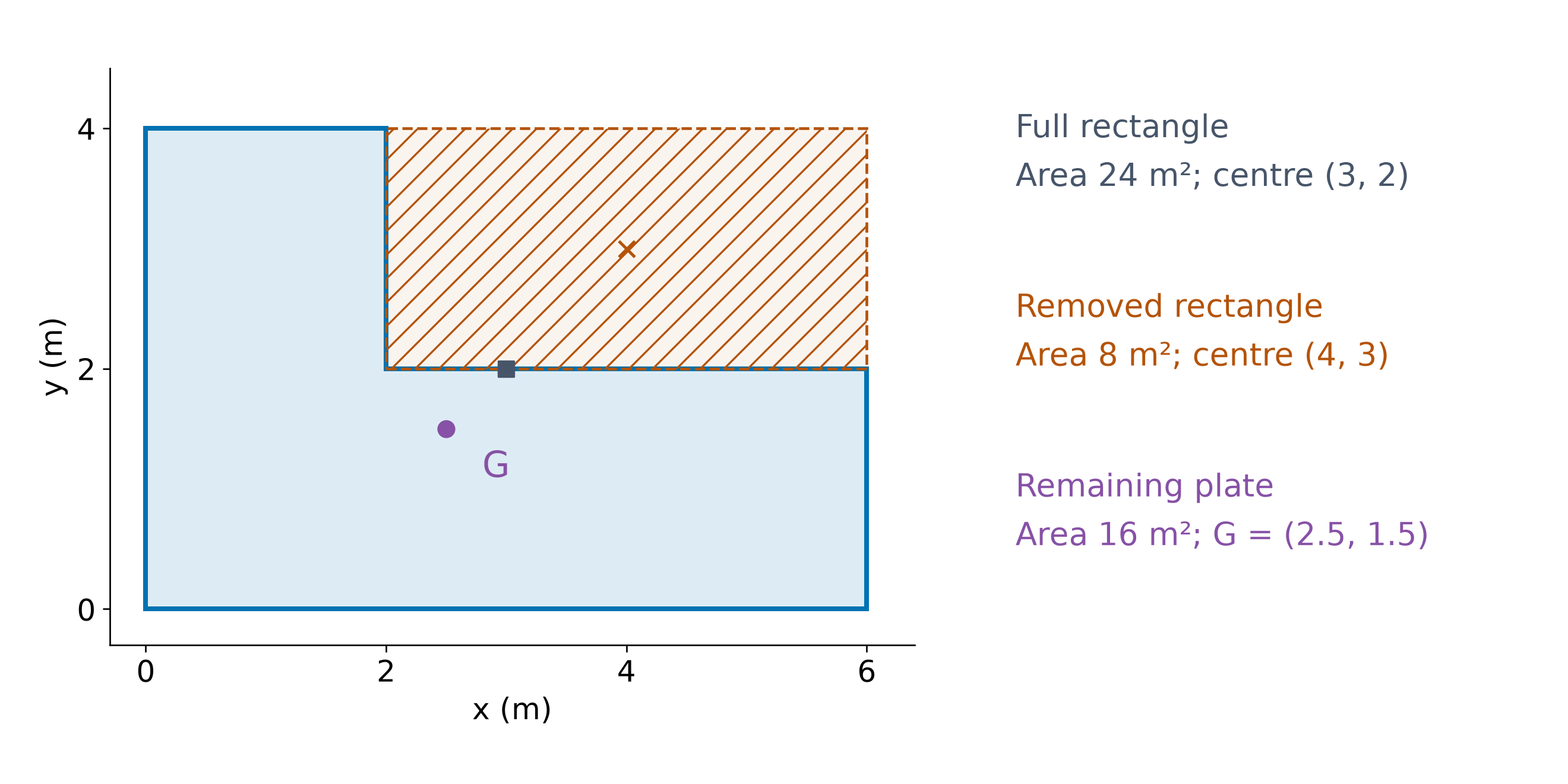
Remove the upper-right $4\ \text{cm}$ square from a uniform $6\ \text{cm}$ square: the removed square is $2\le x\le6$, $2\le y\le6$. Find the remaining centre of mass. Must it lie in the material?
The full square has area 36 at $(3,3)$; the removed square has area 16 at $(4,4)$. Both remaining coordinates are $(36(3)-16(4))/20=11/5\ \text{cm}$. Since both exceed 2, the centre lies in the removed region. A centre of mass need not lie inside the material.
Change the mass weights when the material changes
- Two uniform thin rods of the same material and cross-section form an L: a $6\ \text{m}$ horizontal rod from the origin, and a $4\ \text{m}$ vertical rod. Use lengths $6$ and $4$ as mass weights. Their centres are $(3,0)$ and $(0,2)$, giving $(\bar x,\bar y)=(1.8,0.8)\ \text{m}$.
- If the vertical rod has twice the mass per unit length, the weights become $6$ and $8$, giving $(9/7,8/7)\ \text{m}$. Do not use the area of the empty region between the rods.
Two uniform thin rods of equal mass per unit length run from the origin: one $8\ \text{m}$ along positive x, the other $6\ \text{m}$ along positive y. Find their combined centre of mass.
The mass ratio is $8:6$ and component centres are $(4,0)$ and $(0,3)$. Hence $\bar x=32/14=16/7\ \text{m}$ and $\bar y=18/14=9/7\ \text{m}$.
A $6\ \text{m}$ horizontal rod and a $4\ \text{m}$ vertical rod meet at the origin and extend along positive axes. The vertical rod has three times the mass per unit length of the horizontal rod. Find the combined centre.
The mass weights are 6 and 12, at $(3,0)$ and $(0,2)$. Therefore $\bar x=18/18=1\ \text{m}$ and $\bar y=24/18=4/3\ \text{m}$.
Join solids with a signed common axis
- Join a uniform solid cone of radius $r$, height $4r$, to a uniform solid hemisphere of radius $r$ at their circular bases. They have the same density. Put the common base at $z=0$ and take positive $z$ towards the cone's vertex.
- The cone has volume $4\pi r^3/3$ and centre $z=r$. The hemisphere has volume $2\pi r^3/3$ and centre $z=-3r/8$. Thus
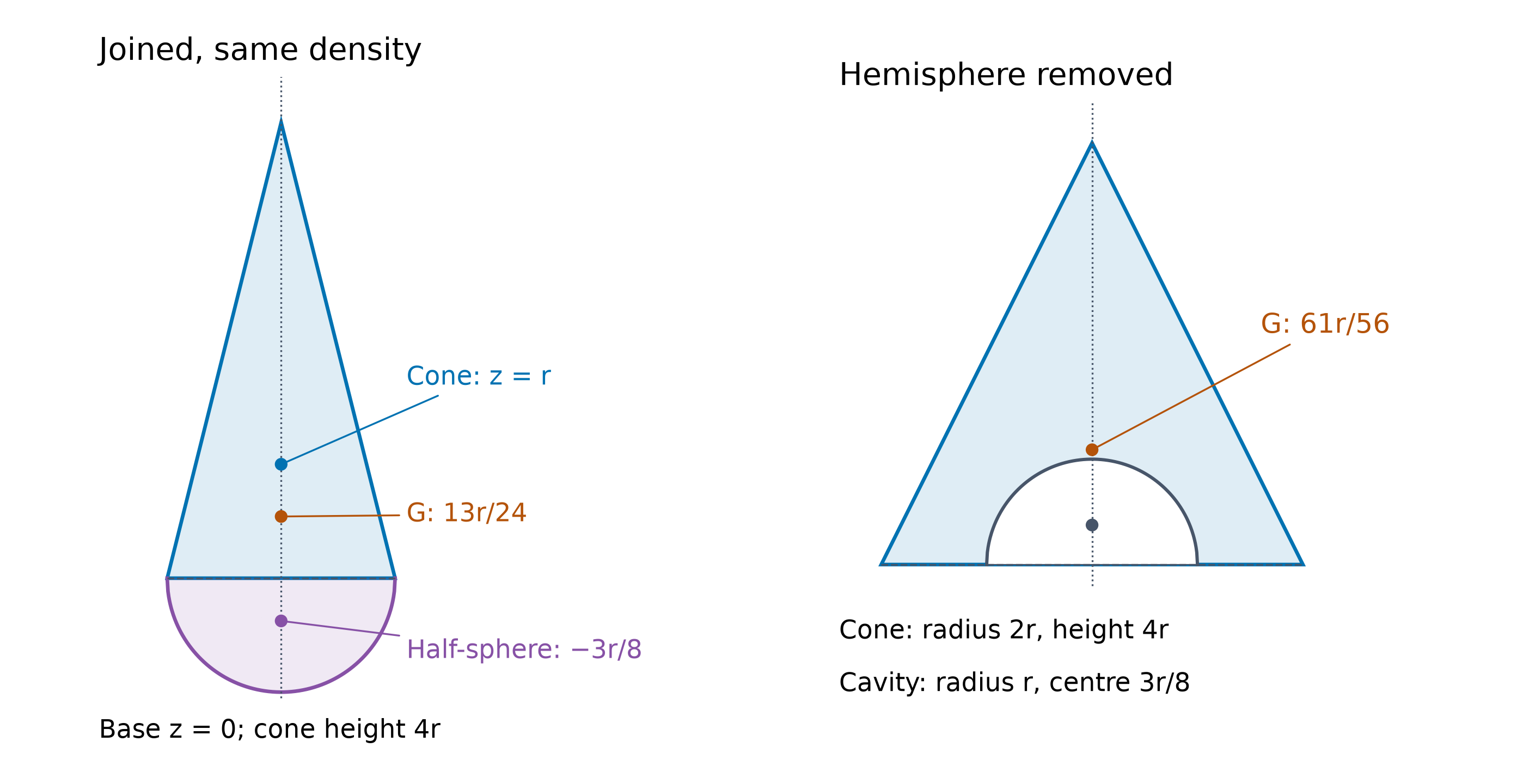
Axial sections of the solids; use their volumes as mass weights, rather than the drawn triangle and semicircle areas.
A solid cone of height $2r$ and base radius $r$ is joined to a solid hemisphere of radius $r$ at their bases. The cone density is twice the hemisphere density. Take z positive into the cone from the common base. Find the combined centre.
The two volumes are equal, so their mass ratio is $2:1$. The cone centre is $z=r/2$ and the hemisphere centre $z=-3r/8$. Thus $\bar z=(2(r/2)-3r/8)/3=5r/24$, towards the cone.
Remove a cavity without changing its original centre
- A uniform cone has base radius $2r$ and height $4r$. Remove a solid hemisphere of radius $r$ whose base lies in the cone's base plane, with the same axis and its curved surface inside the cone. The original cone's volume and centre are $16\pi r^3/3$ and $z=r$; the removed hemisphere's are $2\pi r^3/3$ and $z=3r/8$.
- With $z$ measured upwards from that base, the remaining centre is
Removing material near the base moves the centre upwards. A hole has a negative mass contribution in the calculation; it does not have an unknown new centre.
A uniform cone has base radius $2r$ and height $6r$. A hemispherical cavity of radius $r$ is removed, its base in the cone base plane and curved side inside the cone. Find the remaining centre-of-mass height above the base.
Cone and cavity volume weights are 24 and 2 after cancelling $\pi r^3/3$. Their centre heights are $3r/2$ and $3r/8$. The remaining height is $(24(3r/2)-2(3r/8))/(24-2)=141r/88$. It exceeds the original height $3r/2$.
A freely suspended body puts its centre below the support
- When a body hangs freely from a smooth pivot, the support force and weight must share a vertical line. For stable rest, the centre of mass is vertically below the support. A vertical line with the centre above the support is the unstable orientation.
- Suspend our L-shaped plate from its upper-left corner $D=(0,4)$. In the plate's original coordinates, $G-D=(2.5,-2.5)$. The angle between the downward edge direction and $DG$ is $\tan^{-1}(2.5/2.5)=45^\circ$. The plate rotates until $DG$ points vertically down.
A lamina has centre of mass $(3,2)\ \text{cm}$ and hangs freely from $D=(0,6)\ \text{cm}$. Find the angle between its original downward edge direction and the hanging vertical. Which orientation is stable?
$G-D=(3,-4)$, so the angle is $\tan^{-1}(3/4)\approx36.9^\circ$. The body rotates until DG is vertical, with G below D. The opposite orientation with G above D is unstable.
Check whether a parameter root leaves a real support point
- A $4$ by $6$ uniform plate has an upper-right rectangle of width $h$ and height $2$ removed, where $0<h<4$. Distances are in metres; the support is its surviving upper-left corner $D=(0,6)$. The area method gives
- If the original downward edge makes angle $\theta$ with the hanging vertical and $\tan\theta=1/2$, use $\bar x/(6-\bar y)=1/2$. This gives $(h-3)(h-4)=0$. Only $h=3$ is allowed: at $h=4$ the entire top strip, including $D$, has been removed. Algebraic roots must obey the body's geometry.
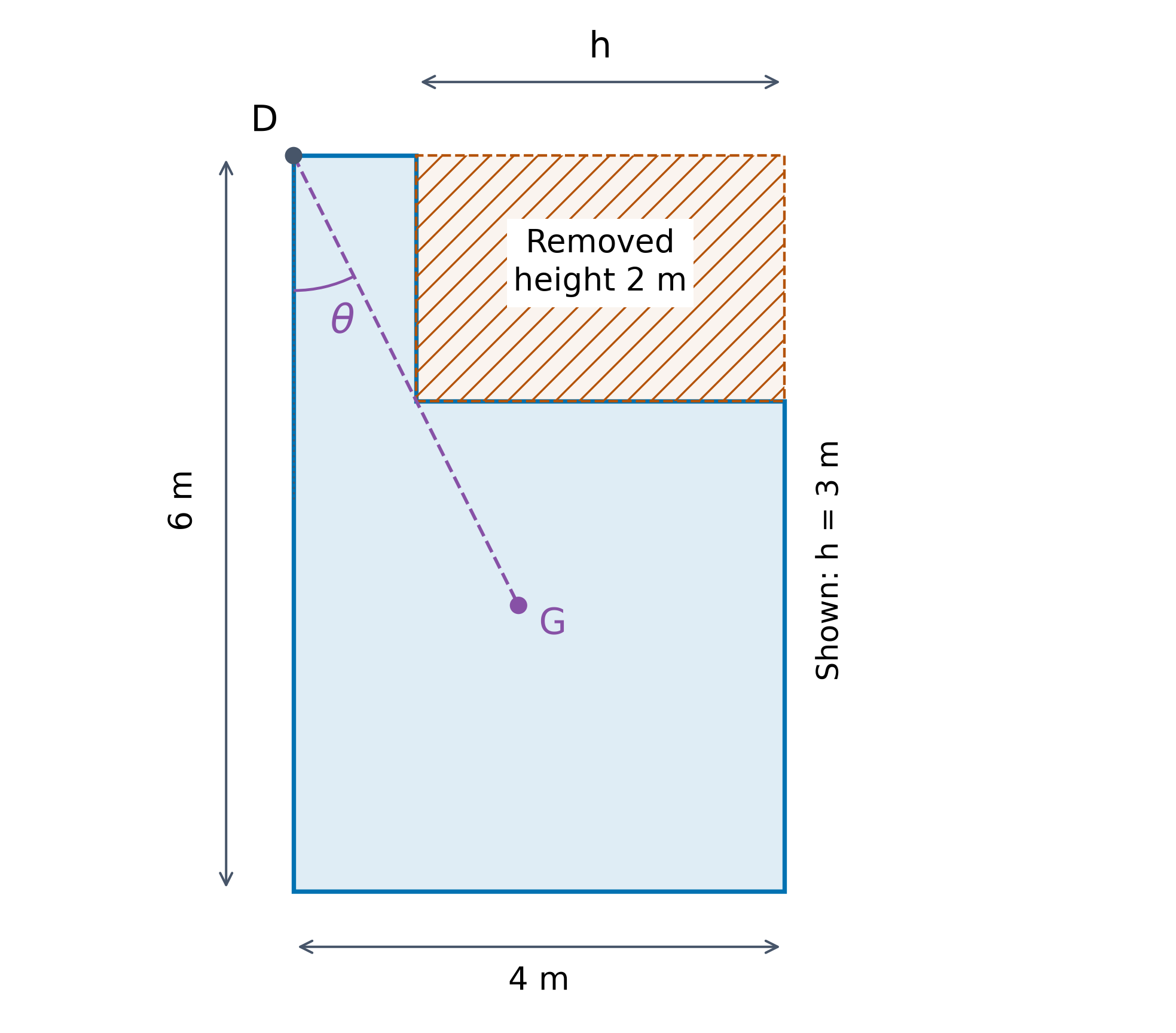
A uniform $4$ by $6$ metre plate has an upper-right rectangle of width $h$ and height $2$ removed, with $0<h<4$. It hangs from the surviving upper-left corner $D=(0,6)$. Its centre is $\bar x=(h^2-8h+48)/(24-2h)$, $\bar y=(72-10h)/(24-2h)$. The hanging-angle condition gives $h=3$ or $4$. Explain which root survives and find its centre coordinates.
Only $h=3$ survives. At $h=4$ the support corner D has been removed; it is also outside the given strict interval. For $h=3$, $\bar x=(9-24+48)/18=11/6$ and $\bar y=(72-30)/18=7/3$, in metres. The ratio $(11/6)/(6-7/3)=1/2$ verifies the hanging angle.
Draw every external force before choosing equations
- A free-body diagram 受力图 contains the body and the forces acting on it. Weight acts at the centre of mass; a light string pulls along itself; a normal reaction 法向反力 is perpendicular to a contact surface. A smooth contact has no friction. A hinge can exert horizontal and vertical reaction components.
- At a rough contact, friction 摩擦力 opposes the direction of impending relative sliding 滑动. Static friction obeys $|F_f|\le\mu F_N$, where $\mu$ is the coefficient of friction 摩擦系数. The limiting friction 最大静摩擦 is $\mu F_N$. Equality holds at limiting equilibrium 极限平衡, not at every resting contact. A support that can only push must also have $F_N\ge0$.
A $100\ \text{N}$ block rests on a horizontal rough floor with coefficient of friction 0.4. A $20\ \text{N}$ horizontal force is applied low enough that toppling is not an issue. Find the normal force and actual friction.
Normal force is 100 N. Horizontal equilibrium requires friction 20 N opposite the push. Its maximum is $0.4(100)=40$ N, but it does not take that value until limiting equilibrium.
Balance a beam and then find its reaction
- A uniform horizontal beam $AB$ is $4\ \text{m}$ long and weighs $100\ \text{N}$. It is pivoted at $A$, with an upward vertical force $F$ at $B$. The weight acts $2\ \text{m}$ from $A$.
- Moments about $A$ give $4F=100(2)$, so $F=50\ \text{N}$. Vertical force balance then gives the upward pivot reaction $R_A=100-50=50\ \text{N}$. Taking moments removed that reaction from one equation; it did not make the reaction zero.

A uniform horizontal 4 m beam of weight 100 N is pivoted at A; an upward vertical force F at B (4 m away) balances it. Taking moments about A (weight acts at the 2 m centre), find F (N).
Difficulty 2/5 · 140 coins + a small bonus on first completion today
F × 4 = 100 × 2, so F = 200/4 = 50 N.
A uniform horizontal 6 m beam of weight 80 N is pivoted at A, and an upward vertical force F at the other end balances it. What is F, and what else must be zero for equilibrium?
Moment is force times perpendicular distance. The weight of a uniform beam acts at its centre.
A uniform horizontal beam of length $8\ \text{m}$ and weight $90\ \text{N}$ is pivoted at its left end. An upward vertical force at its right end balances it. Find that force and the pivot reaction.
Moments give $8F=90(4)$, so $F=45\ \text{N}$. Vertical balance gives pivot reaction $90-45=45\ \text{N}$ upwards.
A loaded beam needs the load positions
- A uniform horizontal beam $AB$ of length $6\ \text{m}$ and weight $120\ \text{N}$ rests on supports at its ends. A $60\ \text{N}$ load is $5\ \text{m}$ from $A$. The upward reactions satisfy $R_A+R_B=180$.
- Moments about $A$: $6R_B=120(3)+60(5)=660$, giving $R_B=110\ \text{N}$ and $R_A=70\ \text{N}$. Both reactions are positive. If a calculated reaction at a simple support is negative, the assumed contact cannot supply it; check whether the body loses contact or topples 倾倒.
A uniform horizontal beam of length $8\ \text{m}$ and weight $80\ \text{N}$ rests on end supports A and B. A $40\ \text{N}$ load is $6\ \text{m}$ from A. Find both reactions.
$R_A+R_B=120$ and $8R_B=80(4)+40(6)=560$. Thus $R_B=70\ \text{N}$ and $R_A=50\ \text{N}$, both upwards.
Resolve an angled rod and its hinge reaction
- A uniform rod of length $4\ \text{m}$ and weight $100\ \text{N}$ is hinged at $A$ and held at $30^\circ$ above horizontal by a horizontal light string attached at its other end. The string pulls towards the wall through $A$.
- Moments about $A$ use the vertical arm for the horizontal tension and horizontal arm for the weight:
The hinge reaction components are $50\sqrt3\ \text{N}$ rightwards and $100\ \text{N}$ upwards. Its magnitude is $50\sqrt7\ \text{N}$, not their sum.
A uniform rod of length $6\ \text{m}$ and weight $60\ \text{N}$ is hinged at A, at $45^\circ$ above horizontal. A horizontal string from its far end pulls towards the wall through A. Find tension and the hinge reaction magnitude.
$F_T(6\sin45^\circ)=60(3\cos45^\circ)$ gives $F_T=30\ \text{N}$. The hinge components are 30 N horizontally away from the wall and 60 N upwards, giving magnitude $30\sqrt5\ \text{N}$.
Set up the geometry of a rough-wall rod
- A uniform rod $AB$ has length $4a$ and weight $F_W$, with its lower end $A$ against a rough vertical wall. Its midpoint is $C$. A light string of length $2a$ joins $C$ to a point $D$ higher on the wall, so $AC=CD$. The rod makes angle $\theta$ with the wall, where $\tan\theta=4/3$.
- A particle of weight $2F_W$ is attached at $AE=ka$, between $C$ and $B$. The coefficient of friction at $A$ is $1/4$, and the rod is about to slip down. The unknowns are the string tension, contact forces and position parameter $k$.
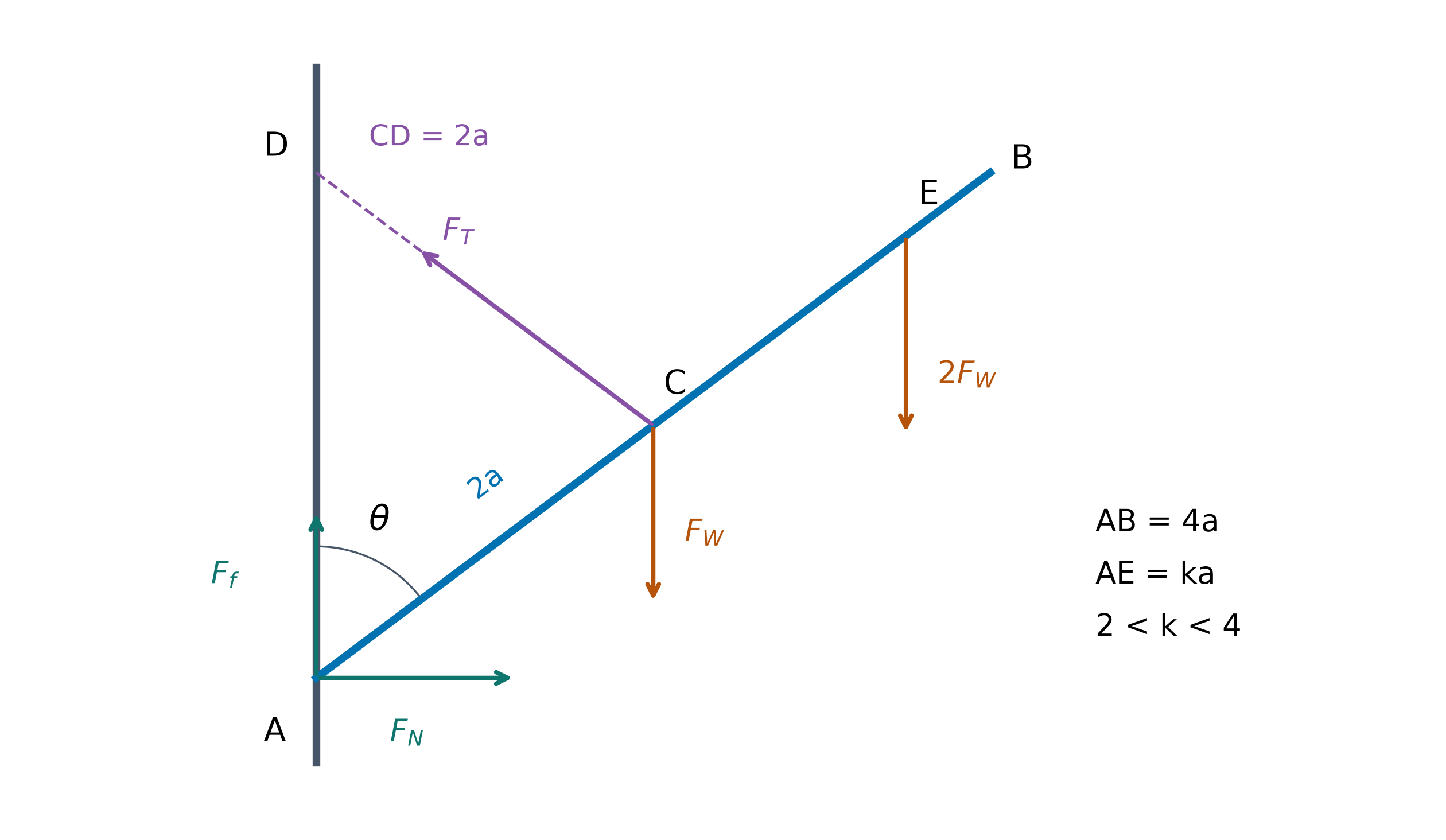
Resolve the rough-wall forces first
- The isosceles triangle $ACD$ makes the string's angle with the vertical equal to $\theta$. Friction acts upwards against impending downward slipping. Using $\sin\theta=4/5$, $\cos\theta=3/5$ and the limiting relation $F_f=F_N/4$ gives
- Substitute the first equation into the second: $4F_T/5=3F_W$. Hence $F_T=15F_W/4$, $F_N=3F_W$ and $F_f=3F_W/4$. The extra particle doubles its own weight contribution; the total downward weight is $3F_W$.
A rod rests against a rough vertical wall at A. Its midpoint C is joined by a string to a higher wall point D, with AC = CD. The rod is about to slip down and the coefficient of friction is $1/4$. Explain the direction of friction, the relation between the rod and string angles to the wall, and which force enters the limiting-friction equation.
The rod is about to slip down, so friction at A is upwards. Since AC = CD, triangle ACD has equal base angles at A and D. Both rod and string therefore make angle theta with the wall. The normal reaction is horizontal and $F_f=F_N/4$; it is not a quarter of the total weight.
Finish the rough-wall problem with one moment equation
- Taking moments about $A$ removes both contact forces. Resolve the tension at $C$, or use its perpendicular arm. The moment equation is
- Substitute $F_T=15F_W/4$, $\sin2\theta=24/25$ and $\sin\theta=4/5$. This gives $36/5=(8/5)(1+k)$, hence $k=7/2$. Check $2<k<4$: the particle is between $C$ and $B$, as the model requires.
A uniform rod AB of length $4a$ and weight $F_W$ has A against a rough vertical wall. Its midpoint C is joined to a higher point D on the wall by a string of length $2a$, so AC = CD. The rod makes angle $\theta$ with the wall, where $\tan\theta=4/3$. A particle of weight $3F_W$ is at $AE=ka$, between C and B. With coefficient $1/4$, the rod is about to slip down. Find tension, normal force, friction and k.
Total weight is $4F_W$. Force balance gives $F_T=5F_W$, $F_N=4F_W$, $F_f=F_W$. Moments about A give $4F_T\cos\theta=(2+3k)F_W$. With $\cos\theta=3/5$, this is $12=2+3k$, so $k=10/3$, between 2 and 4.
A ring can need friction even when its centre is stationary
- A ring of radius $r$ and weight $F_W$ rests on a rough plane inclined at $\alpha$, with $\tan\alpha=3/4$. A horizontal string pulls rightwards at a point $P$ whose radius $OP$ points uphill, parallel to the plane. Let $F_f$ act uphill and $F_N$ normal to the plane.
- Moments about the centre give $F_fr=F_Tr\sin\alpha$. Resolving along the plane gives $F_f+F_T\cos\alpha=F_W\sin\alpha$. Using $\sin\alpha=3/5$, $\cos\alpha=4/5$, obtain $F_T=3F_W/7$ and $F_f=9F_W/35$.
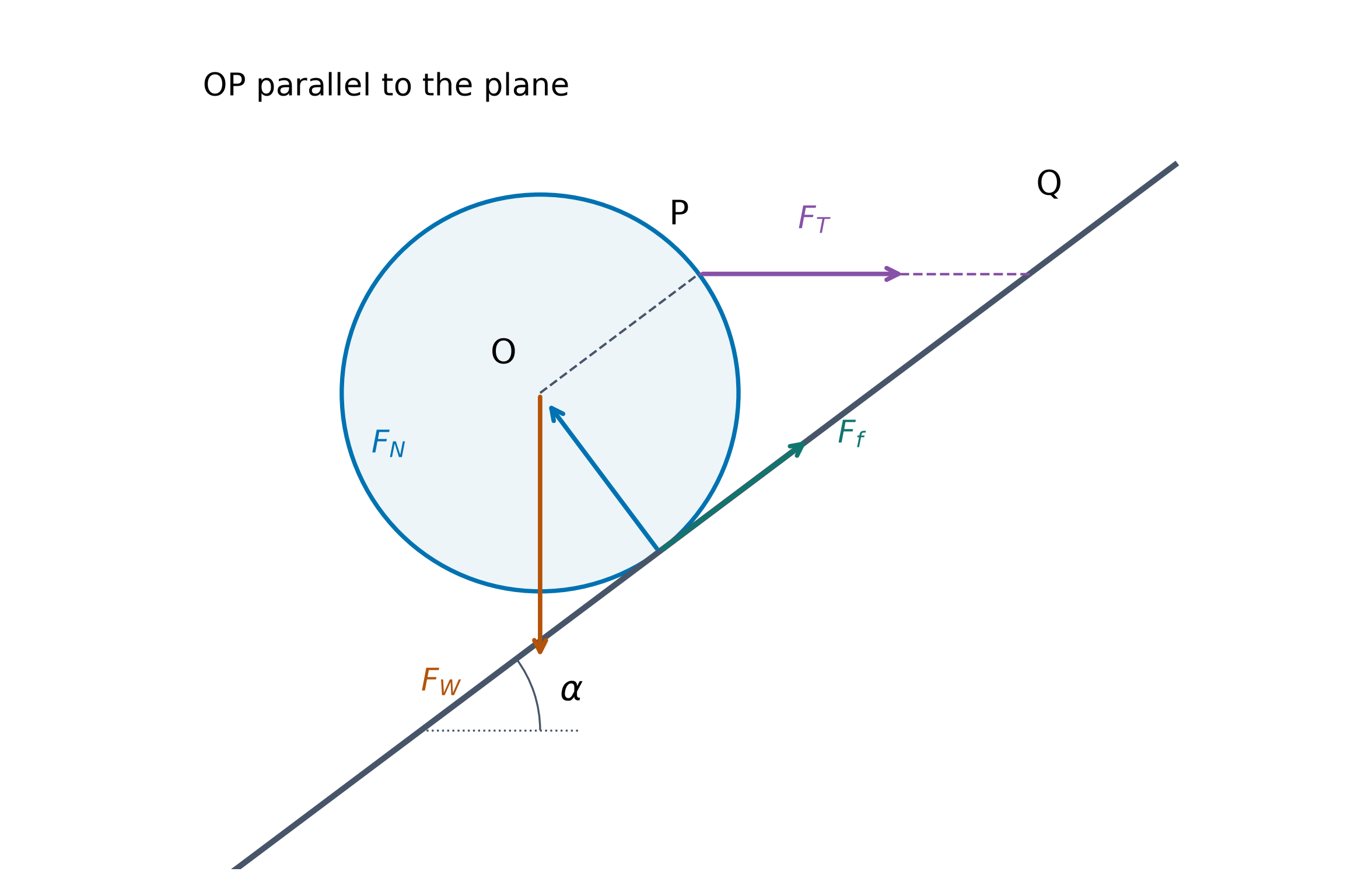
Use the normal force before applying a friction limit
- In the ring example, normal balance gives $F_N=F_W\cos\alpha+F_T\sin\alpha=37F_W/35$. The horizontal string pushes into the plane as well as pulling uphill; the normal reaction is not simply $F_W\cos\alpha$.
- At limiting equilibrium, $\mu=F_f/F_N=9/37$. If the plane has a larger coefficient, the ring can rest with the same required friction; friction does not automatically increase to its maximum value.
A ring rests on a rough plane with $\tan\alpha=5/12$. A horizontal string pulls uphill at P, where OP is an uphill radius parallel to the plane. Its weight is $F_W$. Find tension, required friction and normal force; then find the coefficient for limiting equilibrium.
Use $\sin\alpha=5/13$, $\cos\alpha=12/13$. Moments give $F_f=F_T\sin\alpha$; slope balance gives $F_f+F_T\cos\alpha=F_W\sin\alpha$. Thus $F_T=5F_W/17$, $F_f=25F_W/221$. Normal balance gives $F_N=F_W\cos\alpha+F_T\sin\alpha=229F_W/221$. Therefore $\mu=25/229$.
The worked ring requires friction $9F_W/35$ and normal force $37F_W/35$. Can it remain at rest with coefficient 0.2? Explain without assuming a later motion.
No. It needs $F_f/F_N=9/37\approx0.243$, greater than 0.2. The maximum available friction is too small. This shows the proposed static equilibrium is impossible; it does not by itself describe the subsequent motion.
Find the support interval before testing toppling
- A body resting under its weight and contact forces alone can remain upright while the vertical through its centre of mass meets its base of support 支撑底面. At the point of toppling 翻倒, the contact resultant reaches an edge; the weight's line passes through that edge. Beyond it there is an unbalanced turning moment.
- The L-shaped plate has $\bar x=2.5\ \text{m}$. On its full $6\ \text{m}$ lower edge it can balance. If turned over to stand on its short $2\ \text{m}$ top edge, its weight line lies outside the support interval, so it topples. An extra applied force changes the moment balance: weight inside the base alone is then not a sufficient test.
A standing body is acted on only by gravity and its support contact forces. It topples once the vertical line through its centre of mass falls:
Difficulty 1/5 · 100 coins + a small bonus on first completion today
Once the weight line passes outside the base, the moment tips it over.
A plate rests under gravity and contact forces alone. Its centre projects 2.5 cm from the left endpoint of a horizontal supporting edge. Compare edge lengths 6 cm and 2 cm, assuming both begin at that endpoint.
For the 6 cm edge, the projection lies within the support interval, so static balance is possible. For the 2 cm edge, the projection lies outside it and the plate topples. Boundary projection is the limiting case.
A horizontal push can move the contact resultant to an edge
- A uniform rectangular block of weight $F_W$ rests on a horizontal rough floor. Its base half-width is $b$, and a horizontal push $P$ acts at height $h$ above the floor. Before motion, $F_N=F_W$ and the required friction is $F_f=P$.
- Moments show that the normal reaction shifts a distance $\delta=Ph/F_W$ from the base centre towards the leading edge. Toppling begins at $\delta=b$, so $P_{\rm topple}=F_Wb/h$. Sliding begins when $P_{\rm slide}=\mu F_W$. Compare these thresholds; do not assume both limits occur together.
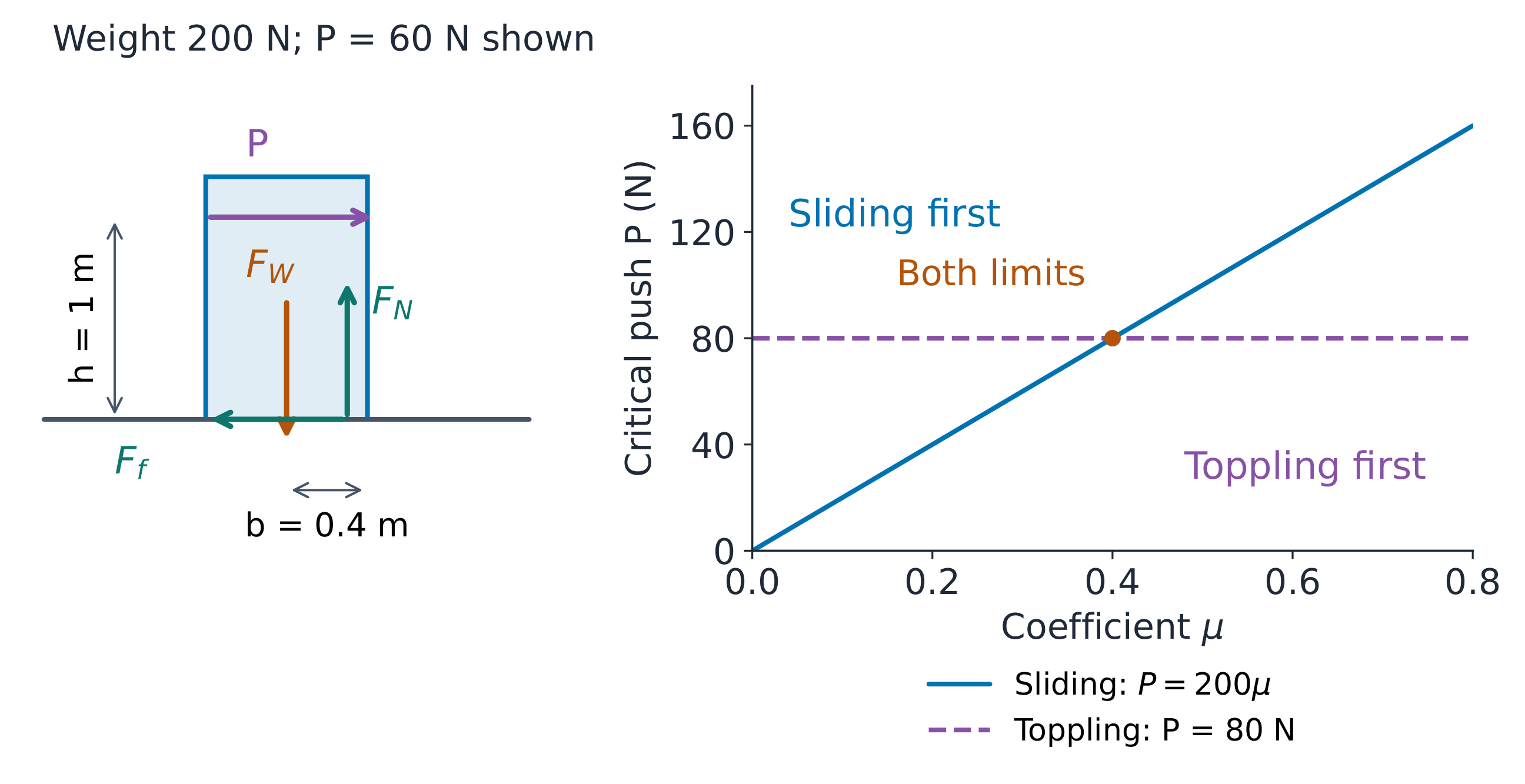
Decide which loss of equilibrium happens first
- For $F_W=200\ \text{N}$, $b=0.4\ \text{m}$ and $h=1\ \text{m}$, the toppling threshold is $80\ \text{N}$. With $\mu=0.3$, the sliding threshold is $60\ \text{N}$, so sliding begins first. With $\mu=0.5$, sliding would require $100\ \text{N}$, so toppling begins first.
- The thresholds coincide at $\mu=b/h=0.4$. Increasing the push height makes toppling easier, but does not change the horizontal sliding threshold in this model. These predictions concern the first motion; the subsequent motion needs a different model.
A uniform rectangular block weighs $300\ \text{N}$, has base half-width $0.3\ \text{m}$ and is pushed horizontally at height $0.9\ \text{m}$. Compare the first motion for coefficients 0.2 and 0.5. At what coefficient would both thresholds coincide?
Toppling threshold is $300(0.3)/0.9=100\ \text{N}$. At coefficient 0.2 the sliding threshold is 60 N, so it slides first. At 0.5 the sliding threshold is 150 N, so it topples first. They coincide when $\mu=b/h=1/3$.
On an incline, compare two critical angles
- For a body with a symmetric base of half-width $b$ and centre of mass a perpendicular distance $c$ above its centre, the weight line reaches the downhill edge when $\tan\alpha=b/c$. With no other applied forces, impending sliding gives $\tan\alpha=\mu$. The smaller critical angle occurs first.
- For $b=0.4\ \text{m}$, $c=0.6\ \text{m}$ and $\mu=0.5$, sliding occurs at $\tan^{-1}(0.5)\approx26.6^\circ$, before toppling at $\tan^{-1}(2/3)\approx33.7^\circ$. For the cone with a hemispherical cavity, $c=61r/56$, $b=2r$, so the toppling angle satisfies $\tan\alpha=112/61$, provided the plane is sufficiently rough to prevent earlier sliding.
A body rests on a rough incline with base half-width $0.5\ \text{m}$ and centre of mass $1\ \text{m}$ perpendicularly above the base centre. The coefficient of friction is 0.6. As the slope increases from zero, which limit is reached first and at what angle?
Toppling occurs at $\tan\alpha=0.5$, giving about $26.6^\circ$. Sliding would occur at $\tan\alpha=0.6$, about $31.0^\circ$. Toppling comes first because its critical angle is smaller.
Keep the geometry and the force model together
- Find each component's mass and centre from the stated material and given formula. Use one origin, signed coordinates and weighted moments; subtract removed material from both the total mass and every moment. Check the geometric domain of an unknown length before accepting a root.
- Draw every external force. Resolve twice, take moments once and then check contact and friction restrictions. A freely hanging body's centre is below its support. For standing or pushed bodies, identify the actual support edge and compare toppling and sliding limits. Neither zero resultant alone nor zero moment alone proves equilibrium.
A uniform horizontal beam is 6 m long and weighs 80 N. It is pivoted at one end, and an upward vertical force F at the other end holds it in equilibrium. What is F?
Difficulty 1/5 · 100 coins + a small bonus on first completion today
80 times 3 is 240, and 240 divided by 6 is 40 N. Other options — 50 N (the lesson force for a 100 N beam of length 4 m); 80 N (the weight).
A uniform $6\ \text{m}$ ladder of weight $120\ \text{N}$ leans at $60^\circ$ above a rough horizontal floor against a smooth vertical wall. Find the wall reaction and the least coefficient of friction at the floor that permits equilibrium.
The wall reaction is horizontal because the wall is smooth. Moments about the foot give $F_{N,B}(6\sin60^\circ)=120(3\cos60^\circ)$, so $F_{N,B}=20\sqrt3\ \text{N}$. Horizontal balance requires floor friction of the same magnitude; vertical balance gives floor normal force 120 N. The least coefficient is $(20\sqrt3)/120=\sqrt3/6$.