This handout covers Topic 2: Further Pure Mathematics 进阶纯数学 2. It adds hyperbolic functions, eigenvalues, new differentiation and integration, de Moivre's theorem, and methods for differential equations.
Further Pure Mathematics 2
A-Level Further Mathematics · Topic 2
 11:29
Further Pure Mathematics 2
Look at any hanging chain, any power line, any suspension cable. It always settles into one special curve. You might guess a parabola — but it is not. It is…
English narration · English + 中文 subtitles burned in
2.1
Hyperbolic functions

Syllabus
| Candidates should be able to: | Notes and examples |
|---|---|
| understand the definitions of the hyperbolic functions $\sinh x$, $\cosh x$, $\tanh x$, $\text{sech } x$, $\text{cosech } x$, $\text{coth } x$ in terms of the exponential function | |
| sketch the graphs of hyperbolic functions | |
| prove and use identities involving hyperbolic functions | e.g. $\cosh^2 x - \sinh^2 x \equiv 1$, $\sinh 2x \equiv 2 \sinh x \cosh x$, and similar results corresponding to the standard trigonometric identities. |
| understand and use the definitions of the inverse hyperbolic functions and derive and use the logarithmic forms |
Source: Cambridge International syllabus
A cable needs the right curve
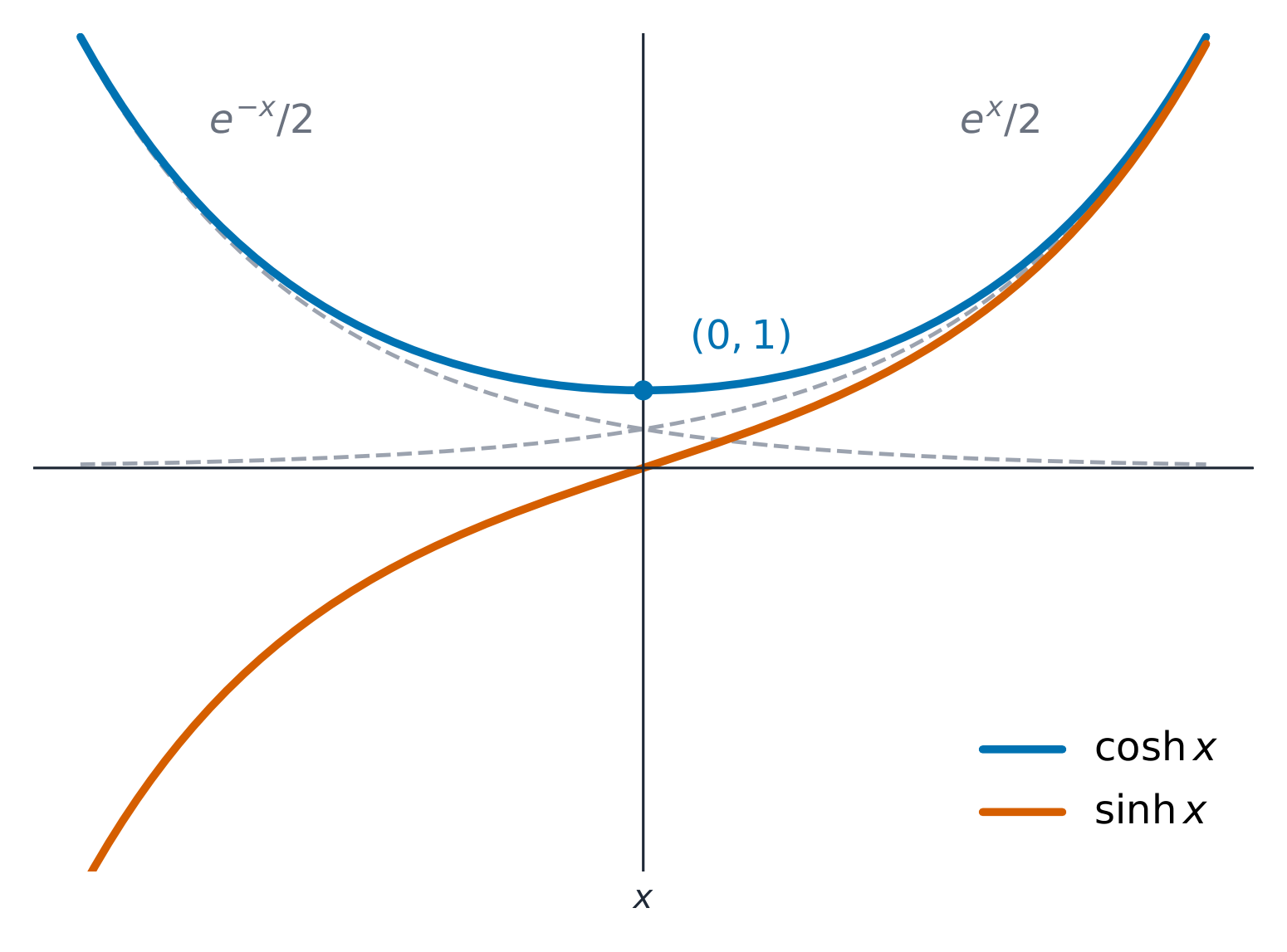
A freely hanging, flexible chain with uniform weight per unit length forms a catenary 悬链线 under gravity. Its shape uses hyperbolic functions 双曲函数. A shifted and scaled model is $y=a\cosh((x-h)/a)+k$, with $a>0$. Its lowest point is $(h,a+k)$. The graph of $\cosh x$ is the normalised example; a general hanging chain need not pass through $(0,1)$.
Build all six functions from exponentials
An exponential 指数 expression uses $e^x>0$. Define
$$\sinh x=\frac{e^x-e^{-x}}2,\qquad
\cosh x=\frac{e^x+e^{-x}}2,$$
$$\tanh x=\frac{\sinh x}{\cosh x}
=\frac{e^x-e^{-x}}{e^x+e^{-x}}.$$
The three reciprocals 倒数 are
$$\operatorname{sech}x=\frac2{e^x+e^{-x}},\qquad
\operatorname{cosech}x=\frac2{e^x-e^{-x}},$$
$$\coth x=\frac{e^x+e^{-x}}{e^x-e^{-x}}.$$
The sum $e^x+e^{-x}$ is always positive. The difference is zero only at $x=0$. Thus sinh, cosh, tanh and sech are defined for every real input; cosech and coth exclude zero.
Worked example. At $x=\ln2$, the two exponentials are $2$ and $1/2$. Hence $\sinh x=3/4$, $\cosh x=5/4$ and $\tanh x=3/5$. The reciprocal values are $\operatorname{cosech}x=4/3$, $\operatorname{sech}x=4/5$ and $\coth x=5/3$. At zero, sinh and tanh are zero; cosh and sech are one; cosech and coth are undefined.
Sketch domains, ranges and limiting lines
The domain 定义域 lists allowed inputs; the range 值域 lists outputs actually reached. Use intercepts, symmetry and asymptotes 渐近线 to draw a complete sketch.
- Sinh is an odd function 奇函数 and increases through $(0,0)$. Its range is all real numbers. It has no horizontal asymptote.
- Cosh is an even function 偶函数. It decreases up to $(0,1)$, then increases. Its minimum gives range $[1,\infty)$; it has no x-intercept or horizontal asymptote.
- Tanh is odd and increases through $(0,0)$. Its range is $(-1,1)$. The horizontal asymptotes $y=-1$ and $y=1$ are not attained.
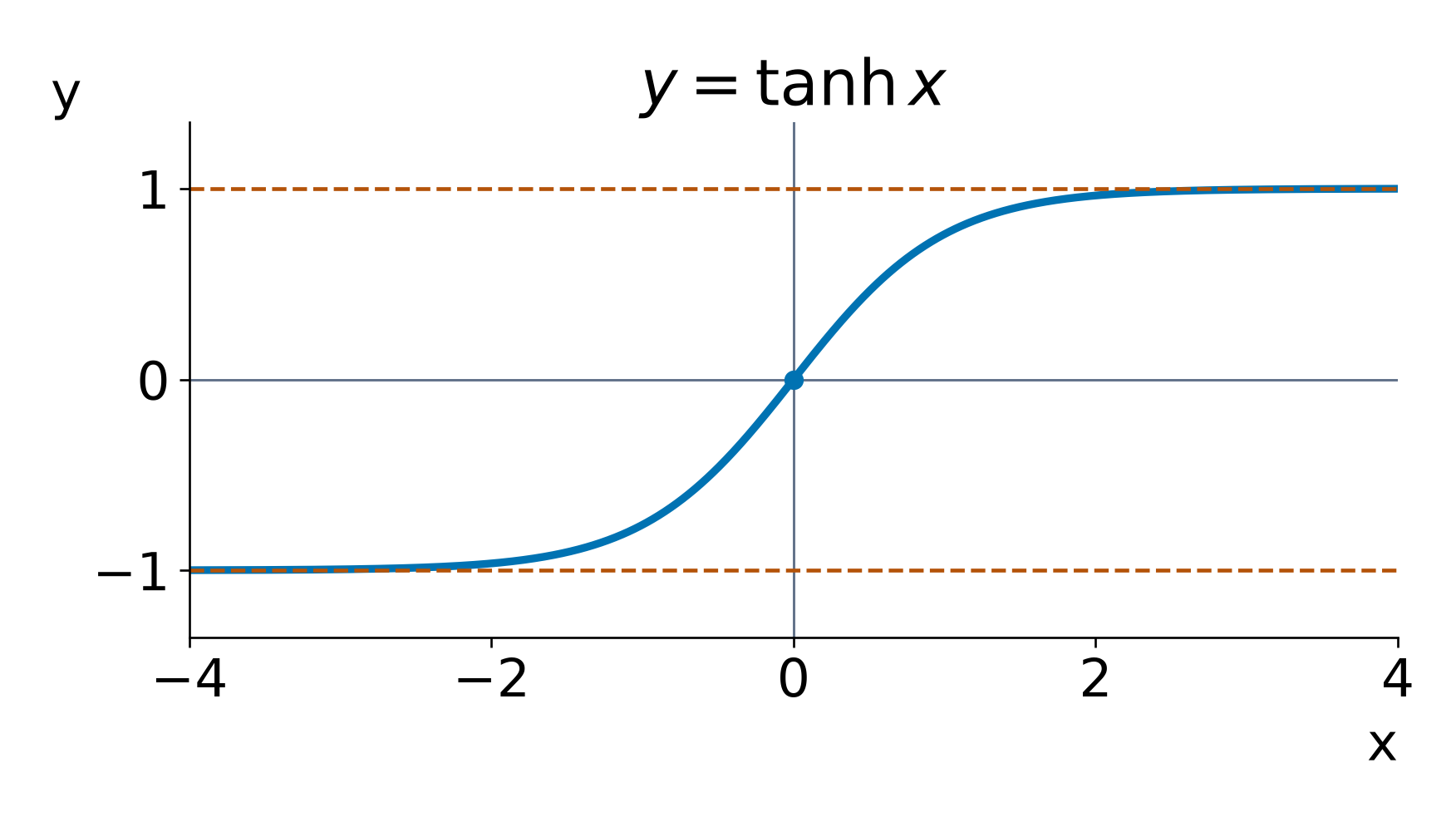
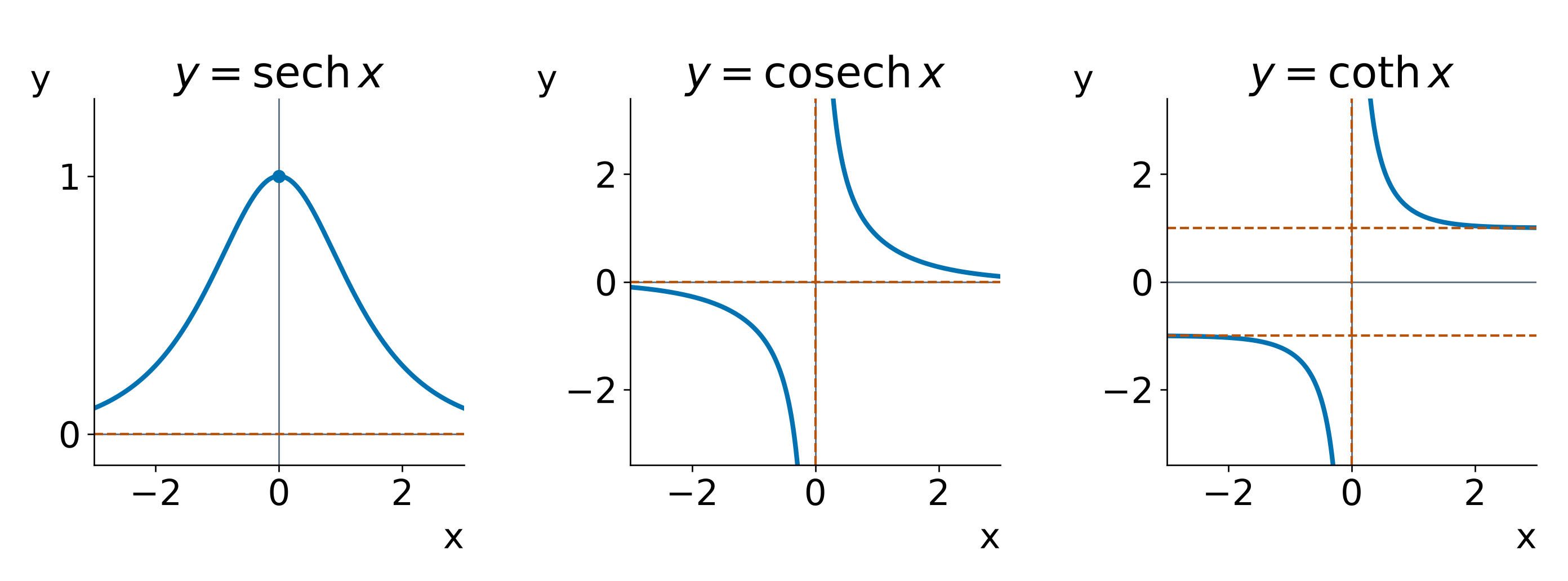
For the reciprocal graphs:
- Sech is even, positive and defined for every real input. Its maximum is $(0,1)$, its range is $(0,1]$, and its horizontal asymptote is $y=0$.
- Cosech is odd, with vertical asymptote $x=0$ and horizontal asymptote $y=0$. Its range is $\mathbb R\setminus\{0\}$. Each separate branch decreases.
- Coth is odd, with vertical asymptote $x=0$. It approaches $1$ as $x\to\infty$ and $-1$ as $x\to-\infty$. Its range is $(-\infty,-1)\cup(1,\infty)$; each branch decreases.
Prove an identity from the requested starting point
An identity 恒等式 is true for every allowed value of its variable. Expanding the exponential squares gives
$$\cosh^2x-\sinh^2x
=\frac{(e^x+e^{-x})^2-(e^x-e^{-x})^2}4
=1.$$
Dividing by $\cosh^2x>0$ gives $1-\tanh^2x=\operatorname{sech}^2x$. Dividing by $\sinh^2x$ gives $\coth^2x-\operatorname{cosech}^2x=1$ for $x\ne0$. The restriction remains part of the identity.
If a question requires exponential definitions, start with those definitions rather than quoting a derived identity. Work from one side and keep the same variable throughout.
Worked example. Starting from the definitions,
$$\begin{aligned}
1-\tanh^2u
&=\frac{(e^u+e^{-u})^2-(e^u-e^{-u})^2}{(e^u+e^{-u})^2}\\
&=\frac4{(e^u+e^{-u})^2}
=\operatorname{sech}^2u.
\end{aligned}$$
The denominator is non-zero for every real $u$. Quoting the result to prove itself would be circular.
Derive addition and double-angle results
Multiplying the exponential definitions gives
$$\begin{aligned}
\sinh(u+v)&=\sinh u\cosh v+\cosh u\sinh v,\\
\cosh(u+v)&=\cosh u\cosh v+\sinh u\sinh v.
\end{aligned}$$
For example, the right side of the cosh formula is
$$\frac{(e^u+e^{-u})(e^v+e^{-v})+(e^u-e^{-u})(e^v-e^{-v})}4
=\frac{e^{u+v}+e^{-u-v}}2.$$
This is the definition of $\cosh(u+v)$. The mixed terms cancel. Replace $v$ by $-v$, using odd sinh and even cosh, for the subtraction formulas.
Putting both arguments equal to $x$ gives
$$\sinh2x=2\sinh x\cosh x,$$
$$\cosh2x=\cosh^2x+\sinh^2x
=1+2\sinh^2x=2\cosh^2x-1.$$
Unlike the cosine addition formula, the cosh addition formula has a plus sign between the two products.
Solve equations and check both intersections
Use an identity to reduce an equation to a polynomial in sinh or cosh. Alternatively put $t=e^x>0$, clear the non-zero denominator and solve for $t$. Reject roots outside the substitution's range.
Worked example. Solve $\cosh2x=4\sinh^2x$. Since $\cosh2x=1+2\sinh^2x$,
$$\sinh^2x=\frac12\quad\Longrightarrow\quad\sinh x=\pm\frac1{\sqrt2}.$$
Both signs are valid. Using the inverse formula below gives
$$x=\pm\ln\left(\frac{1+\sqrt3}{\sqrt2}\right).$$
Both curves are even, and both intersections have height $2$. Their minima are different: $(0,1)$ for $\cosh2x$ and $(0,0)$ for $4\sinh^2x$. This helps check a shared-axis sketch.
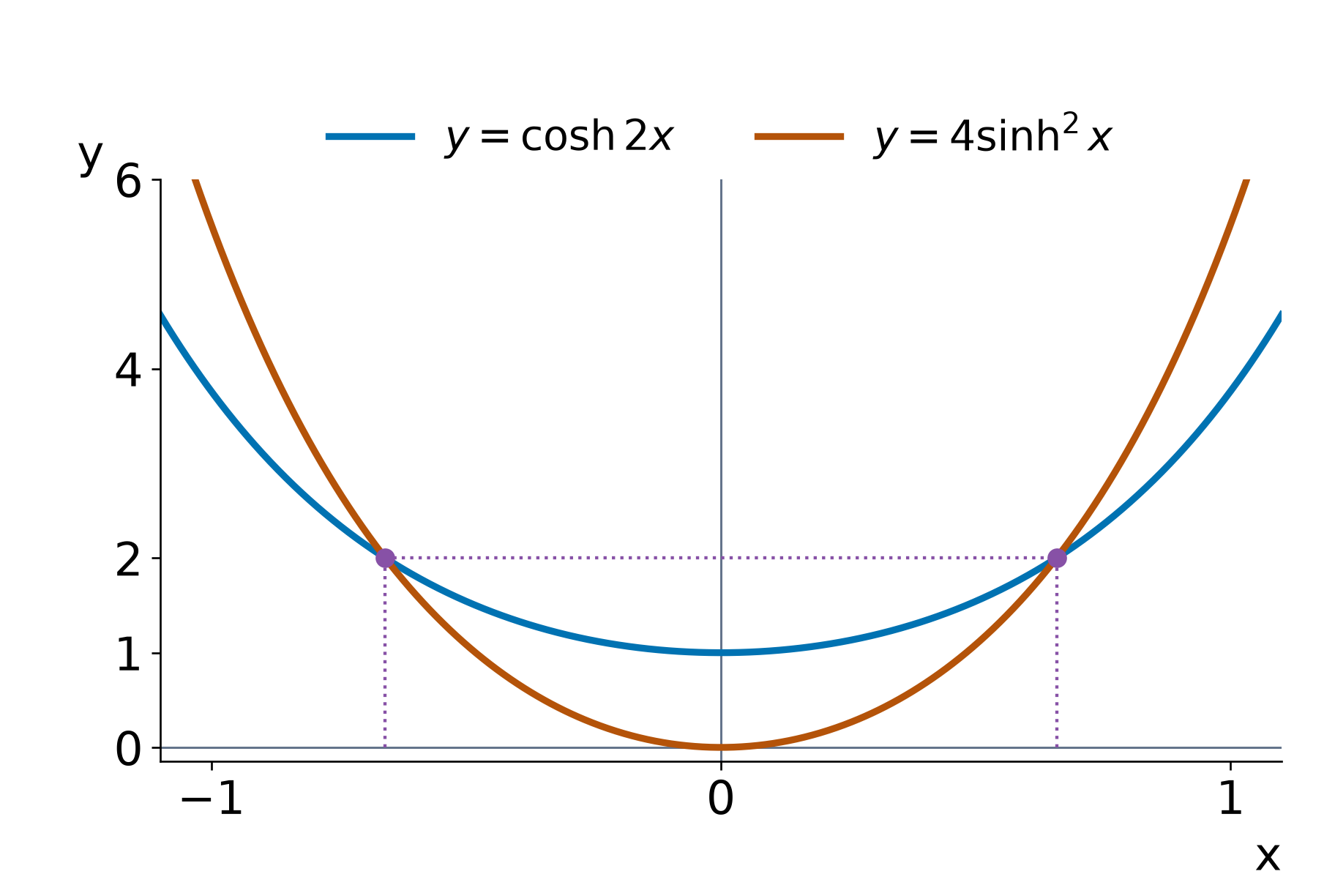
A different substitution. For $2\cosh x+3\sinh x=1$, put $t=e^x>0$. The equation becomes
$$\frac{5t-t^{-1}}2=1
\quad\Longrightarrow\quad5t^2-2t-1=0.$$
The roots are $(1\pm\sqrt6)/5$, but only the plus choice is positive. Thus $x=\ln((1+\sqrt6)/5)$. A negative quadratic root cannot equal $e^x$ for real $x$.
Define an inverse before deriving its formula
An inverse function 反函数 reverses a one-to-one function. Its graph is reflected in $y=x$, exchanging domain and range. Inverse hyperbolic functions 反双曲函数 can be written in logarithmic form 对数形式.
Sinh is one-to-one on all real inputs. Tanh is one-to-one, with range $(-1,1)$. Cosh needs a principal branch 主值分支: choose original inputs at least zero. Therefore $\cosh^{-1}x$ takes inputs $x\ge1$ and gives outputs $\ge0$.
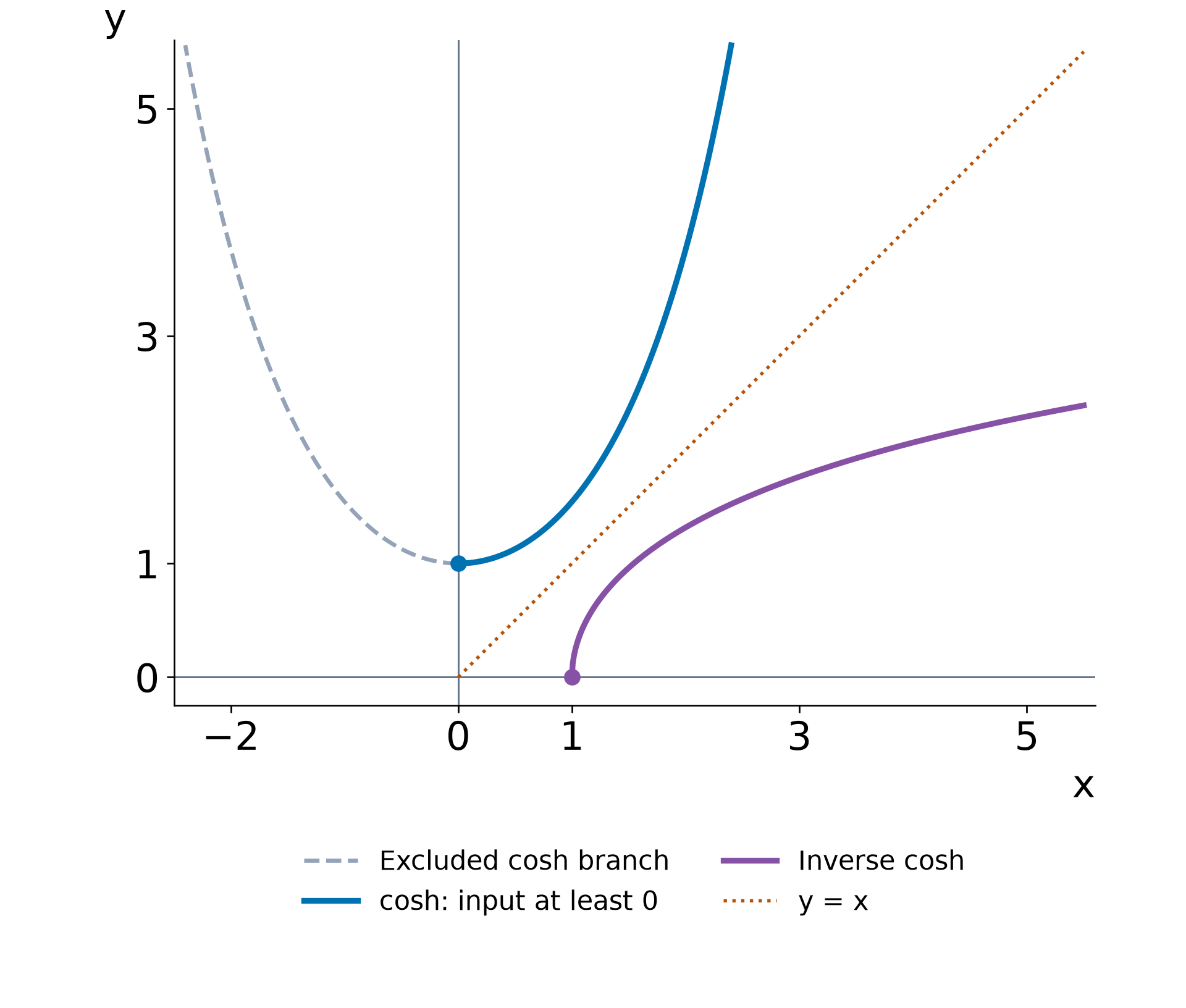
The notation $\sinh^{-1}x$ means inverse sinh, not $1/\sinh x$. Also, $\cosh^{-1}(\cosh x)=|x|$ for real $x$; a negative original input cannot be returned by the nonnegative principal inverse.
Derive inverse sinh through a positive exponential
Let $y=\sinh^{-1}x$. Then $x=(e^y-e^{-y})/2$. Put $t=e^y>0$:
$$t^2-2xt-1=0\quad\Longrightarrow\quad t=x\pm\sqrt{x^2+1}.$$
Since $\sqrt{x^2+1}>|x|$, only the plus root is positive. Therefore
$$\sinh^{-1}x=\ln\left(x+\sqrt{x^2+1}\right),\qquad x\in\mathbb R.$$
The logarithm argument is positive even when $x<0$. For example, $\sinh^{-1}(-3/4)=\ln(1/2)=-\ln2$. The inverse sinh range is all real numbers.
Derive inverse cosh with the branch condition
Let $y=\cosh^{-1}x\ge0$. Then $x\ge1$ and $t=e^y\ge1$. The quadratic is
$$t^2-2xt+1=0\quad\Longrightarrow\quad t=x\pm\sqrt{x^2-1}.$$
For $x>1$, both roots are positive, but the minus root is below $1$. It would give negative $y$, outside the chosen branch. At $x=1$ both roots equal $1$. Hence
$$\cosh^{-1}x=\ln\left(x+\sqrt{x^2-1}\right),\qquad x\ge1.$$
For $x=5/4$, the inverse value is $\ln2$. In contrast, the full equation $\cosh y=5/4$ has $y=\pm\ln2$. More generally, $\cosh y=k$ has no real solutions for $k<1$, one for $k=1$, and two for $k>1$.
Derive inverse tanh on its open interval
Let $y=\tanh^{-1}x$, with $-1<x<1$. Multiplying its exponential definition by $e^y/e^y$ gives
$$x=\frac{e^{2y}-1}{e^{2y}+1}
\quad\Longrightarrow\quad e^{2y}=\frac{1+x}{1-x}.$$
Both $1+x$ and $1-x$ are positive on this interval. Taking logarithms gives
$$\tanh^{-1}x=\frac12\ln\left(\frac{1+x}{1-x}\right),\qquad |x|<1.$$
For example, $\tanh^{-1}(3/5)=\tfrac12\ln4=\ln2$. The inverse has all real outputs but excludes inputs $\pm1$. An unattained horizontal asymptote is not a finite inverse input.
Use inverses of reciprocal functions carefully
For the principal inverse sech, choose the original branch $y\ge0$:
$$\operatorname{sech}^{-1}x=\cosh^{-1}(1/x)
=\ln\left(\frac{1+\sqrt{1-x^2}}x\right),\qquad 0<x\le1.$$
Cosech is one-to-one across its two sign-separated branches, giving
$$\operatorname{cosech}^{-1}x=\sinh^{-1}(1/x)
=\ln\left(\frac1x+\sqrt{1+\frac1{x^2}}\right),\qquad x\ne0.$$
For coth, the reciprocal input must lie inside $(-1,1)$:
$$\coth^{-1}x=\tanh^{-1}(1/x)
=\frac12\ln\left(\frac{x+1}{x-1}\right),\qquad |x|>1.$$
For instance, $\operatorname{sech}^{-1}(3/5)=\ln3$, but $\operatorname{sech}y=3/5$ has both signs $y=\pm\ln3$. Also, $\operatorname{cosech}^{-1}(-3/4)=-\ln3$ and $\coth^{-1}2=\tfrac12\ln3$. A reciprocal of a function and its inverse function perform different operations.
Check the original restrictions
State the real domain and chosen branch before using an inverse. Keep both signs when the full equation allows them. Check every polynomial root against a substitution such as $t=e^x>0$.
For proofs, begin from the requested definitions and show the algebra. For sketches, mark actual intercepts, symmetry, excluded inputs and limiting lines. Exact logarithmic answers should still satisfy the original hyperbolic equation.
Explore
Hyperbolic functions
y = a cosh(x)
For positive a, y = a cosh(x) has minimum (0, a). A negative a reflects the graph and gives a maximum there.
Vocabulary
Train
| English |
|---|
| Further Pure Mathematics/ˈfɜːðə pjʊə ˌmæθɪˈmætɪks/ |
| hyperbolic functions/ˌhaɪpəˈbɒlɪk ˈfʌŋkʃnz/ |
| inverse hyperbolic functions/ɪnˈvɜːs ˌhaɪpəˈbɒlɪk ˈfʌŋkʃnz/ |
| logarithmic form/ˌlɒɡəˈrɪθmɪk fɔːm/ |
| catenary/kəˈtiːnəri/ |
| exponential/ˌekspəˈnenʃl/ |
| reciprocal/rɪˈsɪprəkl/ |
| identity/aɪˈdentɪti/ |
| domain/dəˈmeɪn/ |
| range/reɪndʒ/ |
| even function/ˈiːvən ˈfʌŋkʃən/ |
| odd function/ɒd ˈfʌŋkʃən/ |
| asymptote/ˈæsɪmptəʊt/ |
| inverse function/ɪnˈvɜːs ˈfʌŋkʃn/ |
| principal branch/ˈprɪnsəpl brɑːntʃ/ |
2.2
Matrices
Syllabus
| Candidates should be able to: | Notes and examples |
|---|---|
| formulate a problem involving the solution of 3 linear simultaneous equations in 3 unknowns as a problem involving the solution of a matrix equation, or vice versa | |
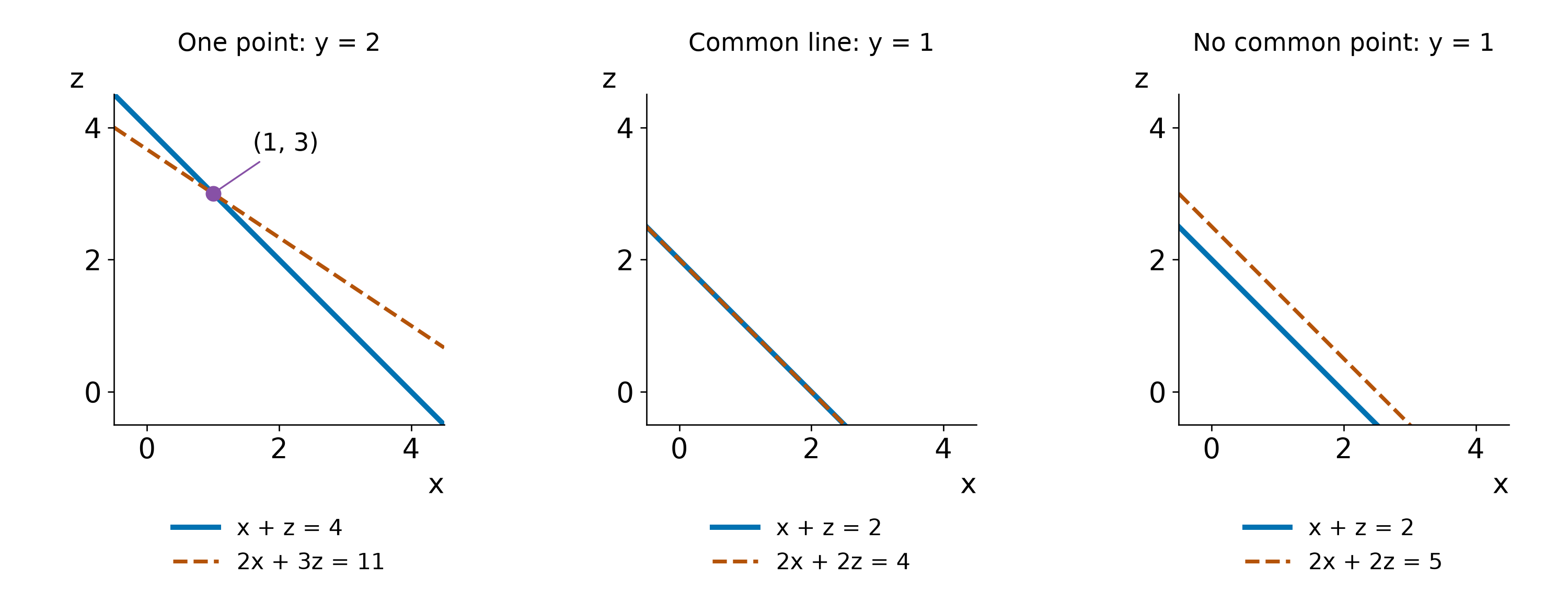
| understand the cases that may arise concerning the consistency or inconsistency of 3 linear simultaneous equations, relate them to the singularity or otherwise of the corresponding matrix, solve consistent systems, and interpret geometrically in terms of lines and planes | e.g. three planes meeting in a common point, or in a common line, or having no common points. |
| understand the terms 'characteristic equation', 'eigenvalue' and 'eigenvector', as applied to square matrices | Including use of the definition $\mathbf{Ae} = \lambda \mathbf{e}$ to prove simple properties, e.g. that $\lambda^n$ is an eigenvalue of $\mathbf{A}^n$. |
| find eigenvalues and eigenvectors of $2 \times 2$ and $3 \times 3$ matrices | Restricted to cases where the eigenvalues are real and distinct. |
| express a square matrix in the form $\mathbf{QDQ}^{-1}$, where $\mathbf{D}$ is a diagonal matrix of eigenvalues and $\mathbf{Q}$ is a matrix whose columns are eigenvectors, and use this expression | e.g. in calculating powers of $2 \times 2$ or $3 \times 3$ matrices. |
| use the fact that a square matrix satisfies its own characteristic equation. | e.g. in finding successive powers of a matrix or finding an inverse matrix; restricted to $2 \times 2$ or $3 \times 3$ matrices only. |
Source: Cambridge International syllabus
One map, many repeated moves
A matrix can describe one change in a model. Repeating the change needs a power such as $A^{20}$; multiplying twenty times hides the structure. This lesson joins three tools: solve a matrix equation 矩阵方程, find special vectors, then simplify powers and inverses. Keep track of when a solution or inverse exists.
Put three equations into one matrix
Put the coefficients of $x,y,z$ in that order in every row. The right-hand side is a column, not another row of the coefficient matrix. To read the matrix equation back, multiply each row by the unknown column. A missing variable has coefficient zero.
$$\begin{aligned}
x+y+z&=6\\x+2y+z&=8\\2x+y+3z&=13
\end{aligned}
\quad\Longleftrightarrow\quad
\underbrace{\begin{pmatrix}1&1&1\\1&2&1\\2&1&3\end{pmatrix}}_{C}
\begin{pmatrix}x\\y\\z\end{pmatrix}
=\begin{pmatrix}6\\8\\13\end{pmatrix}.$$
Find and check the unique point
Here $\det C=1\ne0$, so $C$ is non-singular 非奇异: there is exactly one solution. Inverse multiplication is valid, but elimination is shorter here. Subtract the first equation from the second to get $y=2$. The first then gives $x+z=4$, and the third gives $2x+3z=11$; hence $(x,y,z)=(1,2,3)$.
Check all three original equations: $1+2+3=6$, $1+4+3=8$ and $2+2+9=13$. Geometrically, the three planes meet at one point. Checking only two planes is not enough.
A zero determinant needs another check
A singular 奇异 coefficient matrix has determinant zero. The equations may be consistent 相容 (at least one solution) or inconsistent 不相容 (no solution); singular does not mean no solution. For $x+y+z=3$ and $x+2y+z=4$, subtraction gives $y=1$, $x+z=2$. A third equation $2x+3y+2z=7$ adds no condition: the common line is $(x,y,z)=(2-t,1,t)$, $t\in\mathbb R$.
Change only the third right-hand side to $8$. Subtracting the first two equations from the third gives $0=1$, so no point lies on all three planes. Pairwise intersections do not prove a common intersection. Coincident planes can also occur; three identical equations leave a whole plane of solutions.
Each panel uses the value of y forced by the first two equations. The remaining lines represent the conditions on x and z.
Separate exceptional parameter values
For the system below, subtract row 1 from rows 2 and 3. The determinant is $(a-1)(a+1)$, so only $a=1,-1$ need a separate consistency check. If $a\ne\pm1$, then $y=1/(a-1)$, $z=0$ and $x=3-1/(a-1)$. Never divide by $a-1$ or $a+1$ before separating the zero cases.
$$\begin{aligned}
x+y+z&=3\\x+ay+z&=4\\x+y+(a+2)z&=3
\end{aligned}
\quad\Longrightarrow\quad
\begin{aligned}(a-1)y&=1\\(a+1)z&=0.\end{aligned}$$
At $a=1$, $0=1$ is impossible. At $a=-1$, $y=-1/2$ but $z=t$ is free, giving the common line $(x,y,z)=(7/2-t,-1/2,t)$. Both coefficient matrices are singular; only the second system is consistent.
A special vector stays on its line
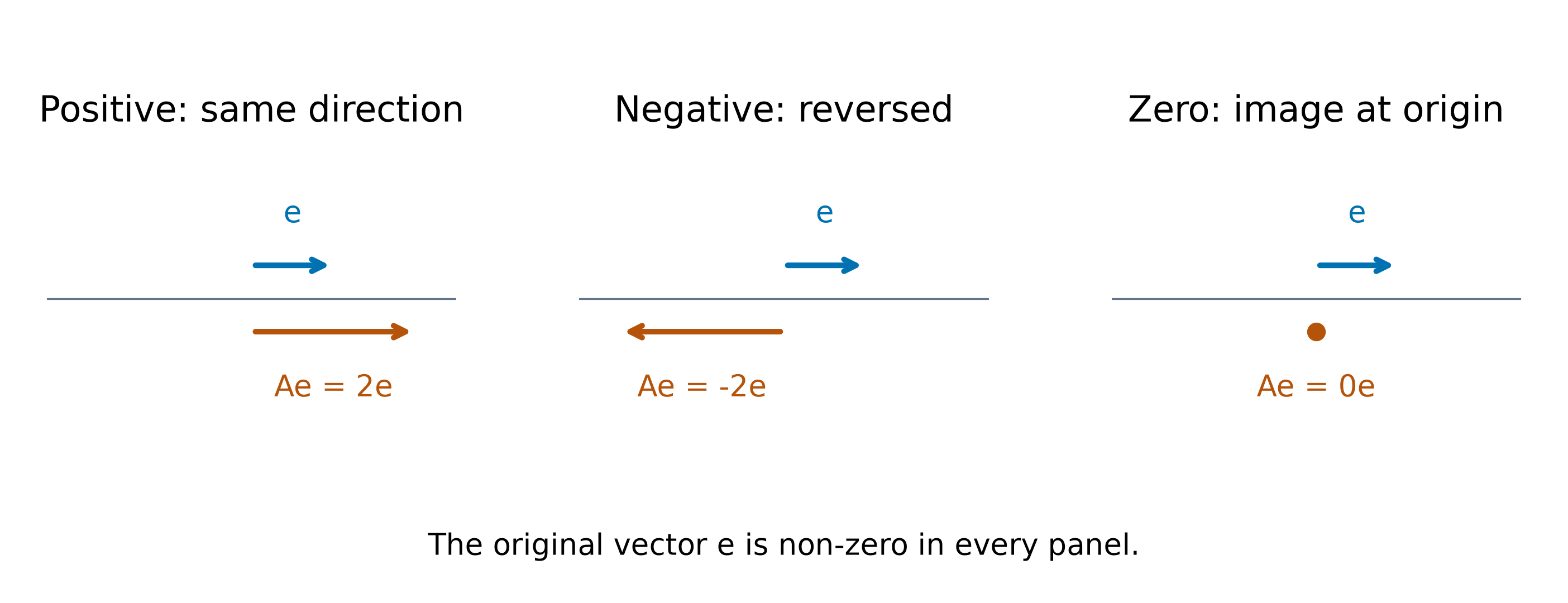
An eigenvector 特征向量 is a non-zero vector $\mathbf e$ with $A\mathbf e=\lambda\mathbf e$. Its eigenvalue 特征值 is the scalar 标量 $\lambda$. Every non-zero multiple of $\mathbf e$ is another eigenvector for the same value. A positive eigenvalue can stretch 拉伸 or shorten a vector. A negative value also reverses it; zero sends it to the origin, where direction is undefined. The zero vector is never an eigenvector, although it solves the equation.
Find two eigenvalues and their vectors
A non-zero solution of $(A-\lambda I)\mathbf e=\mathbf0$ exists when $\det(A-\lambda I)=0$. This is the characteristic equation 特征方程; using $\det(\lambda I-A)=0$ gives the same roots. For the matrix below, $\lambda=1$ gives $u+v=0$, so choose $(1,-1)^T$. For $\lambda=3$, $u-v=0$, so choose $(1,1)^T$. Check each by multiplying by $A$.
$$A=\begin{pmatrix}2&1\\1&2\end{pmatrix},\qquad
\det(\lambda I-A)=(\lambda-2)^2-1=(\lambda-1)(\lambda-3).$$

Extend the method to three dimensions
A triangular matrix has the diagonal entries as eigenvalues: its characteristic determinant is the product of the diagonal factors. Do not row-reduce the original matrix to find its eigenvalues; ordinary row operations need not preserve them. For each root below, solve $(B-\lambda I)\mathbf e=0$. At $\lambda=3$, the first row gives $-u+v=0$ and the third gives $w=0$, hence $(1,1,0)^T$.
$$B=\begin{pmatrix}2&1&0\\0&3&0\\0&0&-1\end{pmatrix},\qquad
\chi_B(\lambda)=(\lambda-2)(\lambda-3)(\lambda+1).$$
$$\begin{array}{c|c|c}
\lambda&\text{conditions}&\text{one eigenvector}\\\hline
2&v=w=0&(1,0,0)^T\\
3&u=v,\ w=0&(1,1,0)^T\\
-1&u=v=0&(0,0,1)^T
\end{array}$$
Prove what happens under powers
Start with $A\mathbf e=\lambda\mathbf e$, not with an inverse of the vector. Then $A^2\mathbf e=A(\lambda\mathbf e)=\lambda^2\mathbf e$; repeating gives $A^n\mathbf e=\lambda^n\mathbf e$ for positive integers $n$. Also $(A+cI)\mathbf e=(\lambda+c)\mathbf e$. If $A$ is invertible, $\lambda\ne0$ and multiplication by $A^{-1}$ gives $A^{-1}\mathbf e=\lambda^{-1}\mathbf e$. Positive powers do not require invertibility.
For $B$, the vector $(0,0,1)^T$ has eigenvalue $-1$. Under $B^2$ its eigenvalue is $1$, under $B^3$ it is $-1$, and under $B^{-1}$ it is $-1$. The vector remains non-zero in all these cases.
Match each column to its eigenvalue
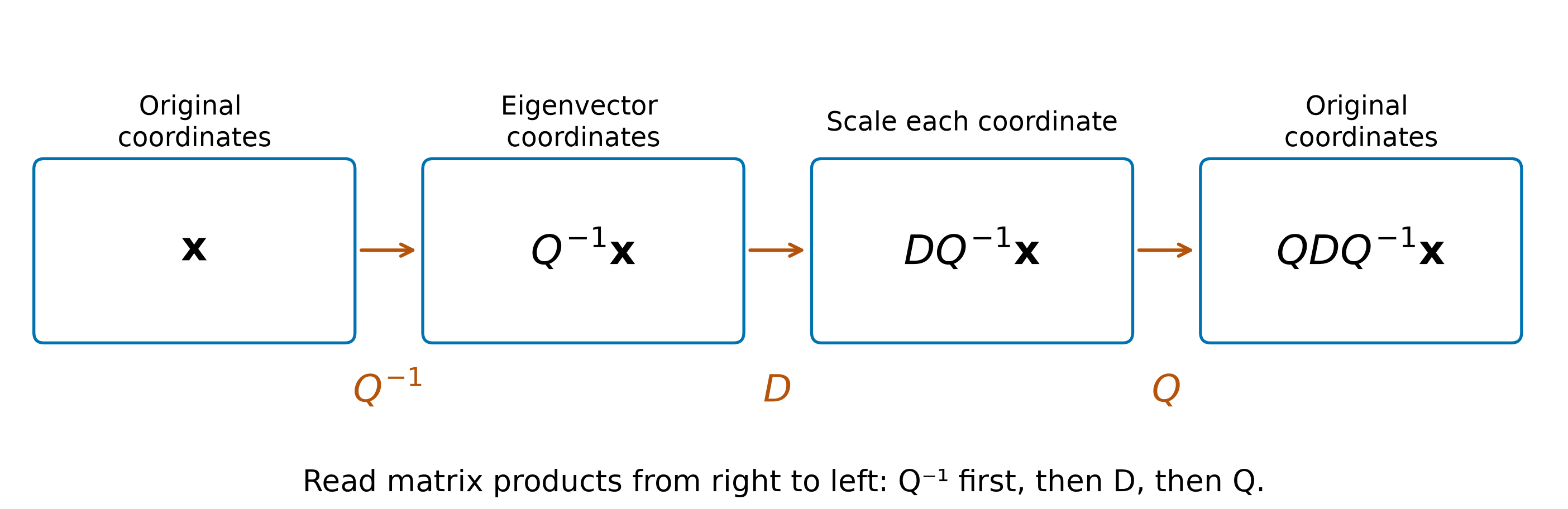
Diagonalisation 对角化 writes $B=QDQ^{-1}$, where $D$ is a diagonal matrix 对角矩阵. Put eigenvectors in the columns of $Q$, and put their eigenvalues in the same order down $D$. $BQ=QD$ checks all three eigenvector equations at once. The columns must be linearly independent 线性无关 so that $Q^{-1}$ exists. Real, distinct eigenvalues guarantee this in the syllabus cases; do not assume every matrix is diagonalisable.
$$Q=\begin{pmatrix}1&1&0\\0&1&0\\0&0&1\end{pmatrix},\quad
D=\begin{pmatrix}2&0&0\\0&3&0\\0&0&-1\end{pmatrix},\quad
Q^{-1}=\begin{pmatrix}1&-1&0\\0&1&0\\0&0&1\end{pmatrix}.$$
Compute powers without repeated multiplication
In $(QDQ^{-1})(QDQ^{-1})$, the middle $Q^{-1}Q$ cancels. Thus $B^n=QD^nQ^{-1}$: raise only the diagonal entries of $D$ to the power. For $n=0$ this gives $I$; because $B$ is invertible, the same formula holds for negative integers too. Its upper-right block shows why powers of individual entries of $B$ would be wrong.
$$B^n=\begin{pmatrix}2^n&3^n-2^n&0\\0&3^n&0\\0&0&(-1)^n\end{pmatrix}.$$
For the earlier $2\times2$ matrix $A$, choose $Q_A=\begin{pmatrix}1&1\\-1&1\end{pmatrix}$ and $D_A=\operatorname{diag}(1,3)$. Then
$$A^n=\frac12\begin{pmatrix}1+3^n&3^n-1\\3^n-1&1+3^n\end{pmatrix}.$$
Reuse the vectors for a changed matrix
A polynomial $f(B)$ has the same eigenvectors with eigenvalues $f(\lambda)$. Therefore $f(B)=Qf(D)Q^{-1}$; do not change $Q$ merely because the question asks about a shifted or squared matrix. For $(B+I)^2$, use $D'=\operatorname{diag}(9,16,0)$ with the same $Q$. It is singular but still diagonalisable. Repeated transformed eigenvalues also do not invalidate an already invertible $Q$.
For $(B-2I)^3$, the diagonal becomes $\operatorname{diag}(0,1,-27)$. For $B^{-1}$ it becomes $\operatorname{diag}(1/2,1/3,-1)$. In every case, keep the order $2,3,-1$ used to build $Q$.
Reconstruct a matrix from its eigenvectors
Given the eigenvectors first, form $Q$ and $D$, then calculate $QDQ^{-1}$. The columns may be scaled separately by non-zero numbers without changing the resulting matrix. If $(1,1)^T$ has eigenvalue $4$ and $(1,-1)^T$ has eigenvalue $2$, the calculation below gives $R$. Check $R(1,1)^T=4(1,1)^T$ and $R(1,-1)^T=2(1,-1)^T$.
$$R=\begin{pmatrix}1&1\\1&-1\end{pmatrix}
\begin{pmatrix}4&0\\0&2\end{pmatrix}
\frac12\begin{pmatrix}1&1\\1&-1\end{pmatrix}
=\begin{pmatrix}3&1\\1&3\end{pmatrix}.$$
A matrix satisfies its own equation
The Cayley–Hamilton theorem 凯莱–哈密顿定理 states that a square matrix satisfies its characteristic equation. Replace the variable by the matrix and each scalar constant by that constant times $I$. For $B$, expanding the three factors gives $\lambda^3-4\lambda^2+\lambda+6=0$. Therefore $B^3-4B^2+B+6I=0$, or $B^3=4B^2-B-6I$.
Use the characteristic equation of the matrix named in the question. Writing $B^3-4B^2+B+6=0$ omits the identity matrix and adds a scalar to a matrix. The theorem does not say that the whole matrix is an eigenvalue.
Reduce higher powers to lower ones
Multiply the identity for $B^3$ by $B$, then replace $B^3$ again. The answer becomes a combination of $B^2,B,I$, without diagonalising again. A shifted cube can be expanded because $B$ and $I$ commute. After expanding, reduce every power of degree three or more using Cayley–Hamilton.
$$\begin{aligned}
B^4&=4B^3-B^2-6B\\
&=4(4B^2-B-6I)-B^2-6B\\
&=15B^2-10B-24I,\\
(B-2I)^3&=B^3-6B^2+12B-8I\\
&=-2B^2+11B-14I.
\end{aligned}$$
Obtain an inverse from Cayley–Hamilton
$\det B=-6\ne0$, so multiply the characteristic identity by $B^{-1}$ and collect it. This gives an inverse as a polynomial in $B$; do not multiply by an inverse before checking it exists. For the $2\times2$ matrix $A$, $A^2-4A+3I=0$ gives $A^{-1}=(4I-A)/3$. Cayley–Hamilton works for both matrix sizes.
$$\begin{aligned}
B^2-4B+I+6B^{-1}&=0,\\
B^{-1}&=\frac{-B^2+4B-I}{6}
=\begin{pmatrix}\frac12&-\frac16&0\\0&\frac13&0\\0&0&-1\end{pmatrix}.
\end{aligned}$$
An inverse square can simplify further. Multiply the identity for $B^3$ by $B^{-2}$: $B-4I+B^{-1}+6B^{-2}=0$. Substitute the expression for $B^{-1}$ to obtain $B^{-2}=(B^2-10B+25I)/36$.
Choose and justify the method
For three equations: form the coefficient matrix, separate singular parameter values, then solve or prove inconsistency and describe the geometry. For eigenvectors: state non-zero, solve the characteristic equation and match each vector to its root. For powers or inverses: choose diagonalisation or Cayley–Hamilton, show the intermediate identity, and check the result. A determinant, a list of roots or a final matrix alone may leave most of the method unexplained.
$C\mathbf x=\mathbf b$ describes simultaneous equations. $A\mathbf e=\lambda\mathbf e$, $\mathbf e\ne0$, describes a special direction. $A=QDQ^{-1}$ requires an invertible eigenvector matrix. Cayley–Hamilton reduces matrix powers and, when the matrix is non-singular, gives its inverse.
Explore
Transformations and the determinant
Change the matrix to rotate, stretch or shear the unit square; the determinant shows how area changes.
Vocabulary
Train
| English |
|---|
| matrix equation/ˈmeɪtrɪks ɪˈkweɪʒn/ |
| characteristic equation/ˌkærɪktəˈrɪstɪk ɪˈkweɪʒn/ |
| eigenvalues/ˈaɪɡənvæljuːz/ |
| eigenvector/ˈaɪɡənvektə/ |
| diagonal matrix/daɪˈæɡənl ˈmeɪtrɪks/ |
| diagonalisation/daɪˌæɡənəlaɪˈzeɪʃn/ |
| scalar/ˈskeɪlə/ |
| stretch/stretʃ/ |
| non-singular/ˌnɒnˈsɪŋɡjʊlə/ |
| singular/ˈsɪŋɡjʊlə/ |
| consistent/kənˈsɪstənt/ |
| inconsistent/ˌɪnkənˈsɪstənt/ |
| linearly independent/ˈlɪnɪəli ˌɪndɪˈpendənt/ |
| Cayley–Hamilton theorem/ˈkeɪli ˈhæmɪltən ˈθɪərəm/ |
2.3
Differentiation

Syllabus
| Candidates should be able to: | Notes and examples |
|---|---|
| • differentiate hyperbolic functions and differentiate $\sin^{-1}x$, $\cos^{-1}x$, $\sinh^{-1}x$, $\cosh^{-1}x$ and $\tanh^{-1}x$ | |
| • obtain an expression for $\frac{\text{d}^2y}{\text{d}x^2}$ in cases where the relation between $x$ and $y$ is defined implicitly or parametrically | |
| • derive and use the first few terms of a Maclaurin's series for a function. | Derivation of a general term is not included, but successive 'implicit' differentiation steps may be required, e.g. for $y = \tan x$ following an initial differentiation rearranged as $y' = 1 + y^2$. |
Source: Cambridge International syllabus
Follow a curve recorded by time
A moving tool may follow a curve given by $x(t)$ and $y(t)$. Its slope is a change in $y$ per change in $x$, not simply per change in time $t$. Differentiation 微分 gives the slope and how it changes. Near $x=0$, a short polynomial 多项式 can match the curve's value, slope and bending without describing the whole curve.
Differentiate the six hyperbolic functions
Differentiate the exponential definitions to obtain $(\sinh x)'=\cosh x$ and $(\cosh x)'=\sinh x$. Unlike ordinary cosine, hyperbolic cosine has no minus sign here. Use the quotient or reciprocal rule for the other four hyperbolic 双曲 functions. The real domains still exclude zeros of a denominator.
| Function | Derivative |
|---|---|
| $\sinh x$ | $\cosh x$ |
| $\cosh x$ | $\sinh x$ |
| $\tanh x$ | $\operatorname{sech}^2x$ |
| $\operatorname{sech}x$ | $-\operatorname{sech}x\tanh x$ |
| $\operatorname{cosech}x$ | $-\operatorname{cosech}x\coth x$ |
| $\coth x$ | $-\operatorname{cosech}^2x$ |
For example, $(\tanh x)'=(\cosh^2x-\sinh^2x)/\cosh^2x=\operatorname{sech}^2x$. The derivatives of cosech and coth apply on $x\ne0$.
Derive inverse trigonometric derivatives
In $y=\sin^{-1}x$, write $\sin y=x$ and differentiate: $\cos y\,y'=1$. The principal branch has $\cos y\ge0$, so $y'=1/\sqrt{1-x^2}$ for $-1<x<1$. For $y=\cos^{-1}x$, $-\sin y\,y'=1$, and $\sin y\ge0$ on its principal branch. The derivative is negative. Also retain the familiar inverse-tangent derivative.
$$\frac{d}{dx}\sin^{-1}x=\frac1{\sqrt{1-x^2}},\qquad
\frac{d}{dx}\cos^{-1}x=-\frac1{\sqrt{1-x^2}},\quad |x|<1.$$
$$\frac{d}{dx}\tan^{-1}x=\frac1{1+x^2},\qquad x\in\mathbb R.$$
Here the superscript $-1$ means an inverse function, not a reciprocal. The inverse sine and cosine functions have endpoint values at $\pm1$, but no finite derivative there.
Derive inverse hyperbolic derivatives
For $y=\sinh^{-1}x$, differentiation of $\sinh y=x$ gives $\cosh y\,y'=1$. Since $\cosh y>0$, use $\cosh y=\sqrt{1+x^2}$. For inverse cosh choose $y\ge0$, so $\sinh y=\sqrt{x^2-1}$. For inverse tanh use $1-\tanh^2y=1-x^2$. Record the open intervals where finite derivatives exist.
$$\begin{aligned}
\frac{d}{dx}\sinh^{-1}x&=\frac1{\sqrt{1+x^2}},&&x\in\mathbb R,\\
\frac{d}{dx}\cosh^{-1}x&=\frac1{\sqrt{x^2-1}},&&x>1,\\
\frac{d}{dx}\tanh^{-1}x&=\frac1{1-x^2},&&|x|<1.
\end{aligned}$$
Inverse cosh is defined at x=1, with value zero. Its finite derivative formula applies only for x greater than 1.
Keep the inner derivative and the domain
The chain rule 链式法则 gives $\dfrac{d}{dx}f(u(x))=f'(u(x))u'(x)$. A correct outer formula is incomplete without the inner derivative. For $\cosh^{-1}(2x)$ the function needs $x\ge1/2$, but the finite derivative below needs $x>1/2$. For $\sin^{-1}(2x)$ the finite derivative needs $|x|<1/2$.
$$\begin{aligned}
\frac{d}{dx}\cosh^{-1}(2x)&=\frac2{\sqrt{4x^2-1}},\\
\frac{d}{dx}\sin^{-1}(2x)&=\frac2{\sqrt{1-4x^2}},\\
\frac{d}{dx}\tanh^{-1}(x^2)&=\frac{2x}{1-x^4},\qquad |x|<1.
\end{aligned}$$
Differentiate an implicit relation once
An implicit 隐式 relation mixes $x$ and $y$. Treat $y$ as a function of $x$: $(y^2)'=2yy'$ and $(xy)'=y+xy'$ by the product rule. For $x^2+xy+y^2=7$, collect all terms containing $y'$ before dividing. At $(1,2)$, the denominator is $5\ne0$ and $y'=-4/5$.
$$\begin{aligned}
2x+y+xy'+2yy'&=0,\\
(x+2y)y'&=-(2x+y),\\
y'&=-\frac{2x+y}{x+2y},\qquad x+2y\ne0.
\end{aligned}$$
Differentiate the implicit relation again
A second derivative 二阶导数 is $y''=d^2y/dx^2$. Differentiate the unsimplified first relation again; this often avoids a long quotient. Differentiating $2x+y+xy'+2yy'=0$ gives the expression below. At $(1,2)$ substitute $y'=-4/5$ only after forming the second-derivative equation.
$$\begin{aligned}
2+2y'+2(y')^2+(x+2y)y''&=0,\\
y''&=-\frac{2+2y'+2(y')^2}{x+2y},\\
y''\big|_{(1,2)}&=-\frac{2-8/5+32/25}{5}=-\frac{42}{125}.
\end{aligned}$$
The derivative of $yy'$ is $(y')^2+yy''$, not just $yy''$. A denominator zero in a slope formula needs separate analysis; it does not automatically prove that the original curve has no point there.
Combine an inverse with an implicit product
For $y^2-\sinh^{-1}(xy)=1-\ln2$, the point $(3/4,1)$ lies on the curve because $\sinh^{-1}(3/4)=\ln2$. Set $p=y'$ and $S=\sqrt{1+x^2y^2}$ to organise the calculation. The first relation below gives $p=4/7$ at the point. For the second derivative, differentiate before substituting: $(y+xp)'=2p+xy''$ and $S'=xy(y+xp)/S$.
$$2yp-\frac{y+xp}{S}=0.$$
$$2p^2+2yy''-\frac{2p+xy''}{S}
+\frac{xy(y+xp)^2}{S^3}=0.$$
At $(3/4,1)$, $S=5/4$ and $p=4/7$. The second relation becomes
$$\frac75y''+\frac{128}{245}=0,
\qquad y''=-\frac{128}{343}.$$
The square-root factor contains the variable $y$ too. Treating it as a function of $x$ alone loses a chain-rule term.
Change the parameter derivative into a slope
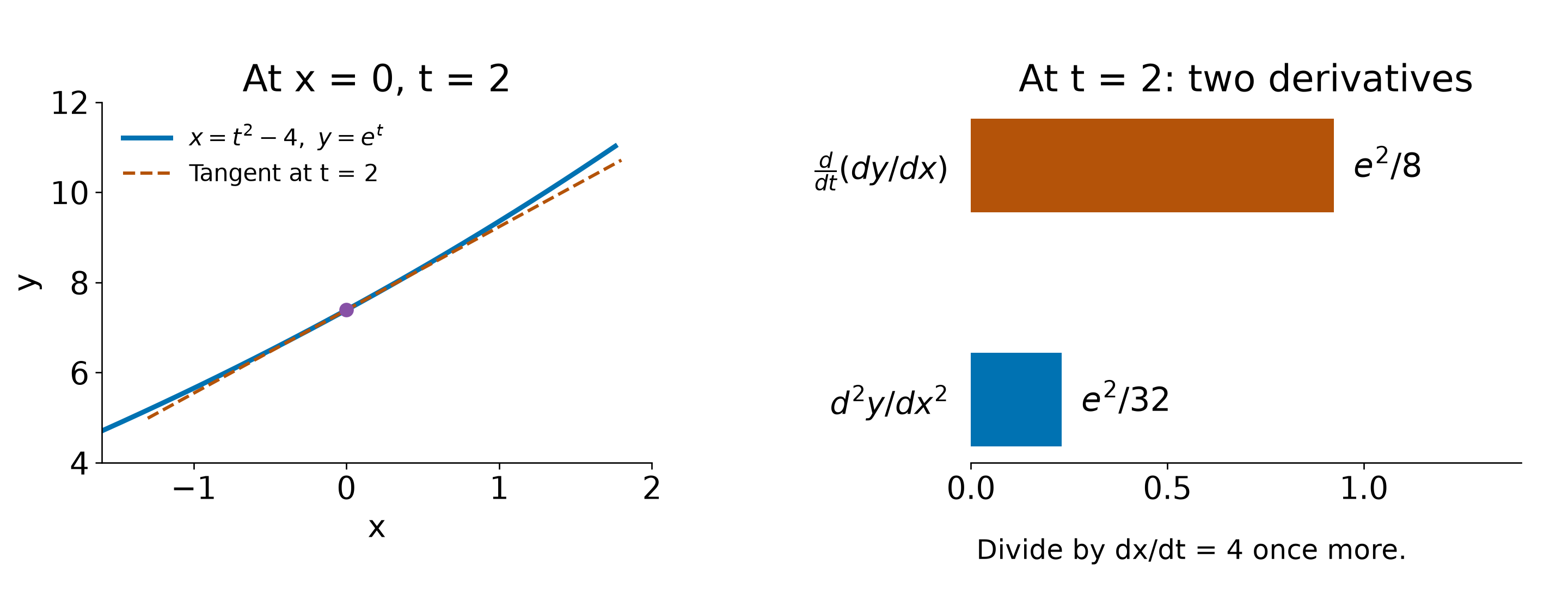
A parametric 参数 description uses $x=x(t)$ and $y=y(t)$. Where $x'(t)\ne0$, $dy/dx=y'(t)/x'(t)$. The prime here must refer to the variable you state. For $x=t^2-4$, $y=e^t$, $t>0$, the slope is $e^t/(2t)$. At $x=0$ the chosen branch has $t=2$, so the point is $(0,e^2)$ and its slope is $e^2/4$.
$$\frac{dx}{dt}=2t,\qquad\frac{dy}{dt}=e^t,\qquad
\frac{dy}{dx}=\frac{e^t}{2t}.$$
Divide by dx over dt for the second derivative too
Differentiating $dy/dx$ with respect to $t$ is not yet a second derivative with respect to $x$. Divide that result by $dx/dt$ once more. In the worked curve, the extra factor changes the denominator. At $t=2$, the result is $e^2/32$, rather than the parameter derivative $e^2/8$.
$$\begin{aligned}
\frac{d^2y}{dx^2}&=\frac{\dfrac{d}{dt}\left(\dfrac{dy}{dx}\right)}{dx/dt},\\
\frac{d}{dt}\left(\frac{e^t}{2t}\right)&=\frac{e^t(t-1)}{2t^2},\\
\frac{d^2y}{dx^2}&=\frac{e^t(t-1)}{4t^3}.
\end{aligned}$$
Build a polynomial from derivatives at zero
A Maclaurin's series 麦克劳林级数 uses derivatives with respect to $x$, evaluated at $x=0$. Its $x^n$ coefficient 系数 is $f^{(n)}(0)/n!$; do not omit the factorial. To find terms through $x^2$, obtain $f(0),f'(0),f''(0)$ before substituting. For $e^x$, these values are all $1$, so the first terms are $1+x+x^2/2$.
$$f(x)=f(0)+f'(0)x+\frac{f''(0)}{2!}x^2+\frac{f'''(0)}{3!}x^3+\cdots.$$

Matching derivatives describes local behaviour. It does not by itself prove that an infinite series equals the function everywhere.
Obtain a composite expansion by differentiation
Let $f(x)=e^{1/(x+3)}$ and write $E=e^{1/3}$. The chain rule gives $f'=-(x+3)^{-2}f$; the product rule is then needed for $f''$. At zero, $f(0)=E$, $f'(0)=-E/9$ and $f''(0)=7E/81$. Divide the last value by $2!$ to obtain the quadratic coefficient.
$$\begin{aligned}
f''(x)&=\left(2(x+3)^{-3}+(x+3)^{-4}\right)f(x),\\
f(x)&=E-\frac E9x+\frac{7E}{162}x^2+\cdots.
\end{aligned}$$
For $f(x)=\ln(1+x)$, the values at zero are $0,1,-1,2$ through the third derivative. Thus the first three non-zero terms are $x-x^2/2+x^3/3$. Keep the factorial: $2/3!=1/3$.
Use successive implicit derivatives for tan
For $y=\tan x$, start with $y'=\sec^2x=1+y^2$. At $x=0$, $y=0$ and $y'=1$; this relation keeps later derivatives in terms of $y$ and its derivatives. The next two derivatives below give $y''(0)=0$ and $y'''(0)=2$. Therefore $\tan x=x+x^3/3+\cdots$; there is no constant or quadratic term. A general coefficient formula is not required here.
$$y''=2yy',\qquad y'''=2(y')^2+2yy''.$$
Locate x zero before expanding a parametric curve
A Maclaurin expansion is centred on $x=0$, which need not mean $t=0$. For $x=t^2-4$, $y=e^t$, $t>0$, use $t=2$ and the derivatives already obtained. Here $y(0)=e^2$, $y_x'(0)=e^2/4$ and $y_{xx}''(0)=e^2/32$. The quadratic coefficient is $e^2/64$, not $e^2/32$.
$$y=e^2\left(1+\frac x4+\frac{x^2}{64}\right)+\cdots.$$
Without the branch $t>0$, $t=\pm2$ gives two different points with $x=0$. Identify the local branch before assigning a single value $y(0)$.
Join hyperbolic parameters to a local expansion
For $x=\sinh t$, $y=2t+\cosh t$, the first derivative is $(2+\sinh t)/\cosh t$. Since $\cosh t>0$, division by $dx/dt$ is valid for all real $t$. Apply the quotient rule, then divide by $\cosh t$ again. At $x=0$, $t=0$, so $y=1$, $dy/dx=2$ and $d^2y/dx^2=1$.
$$\frac{d^2y}{dx^2}=\frac{\cosh^2t-(2+\sinh t)\sinh t}{\cosh^3t}
=\frac{1-2\sinh t}{\cosh^3t}.$$
$$y=1+2x+\frac{x^2}{2}+\cdots.$$
Keep approximation and convergence separate
A finite Taylor polynomial is a local approximation; an infinite series needs an interval of convergence 收敛区间. For $\ln(1+x)$ that interval is $-1<x\le1$; for $e^x$, sine and cosine it is all real $x$. Outside its interval a series may diverge 发散, so adding terms need not improve the approximation. Even within the interval, convergence alone is not a promise of improvement at every finite step.
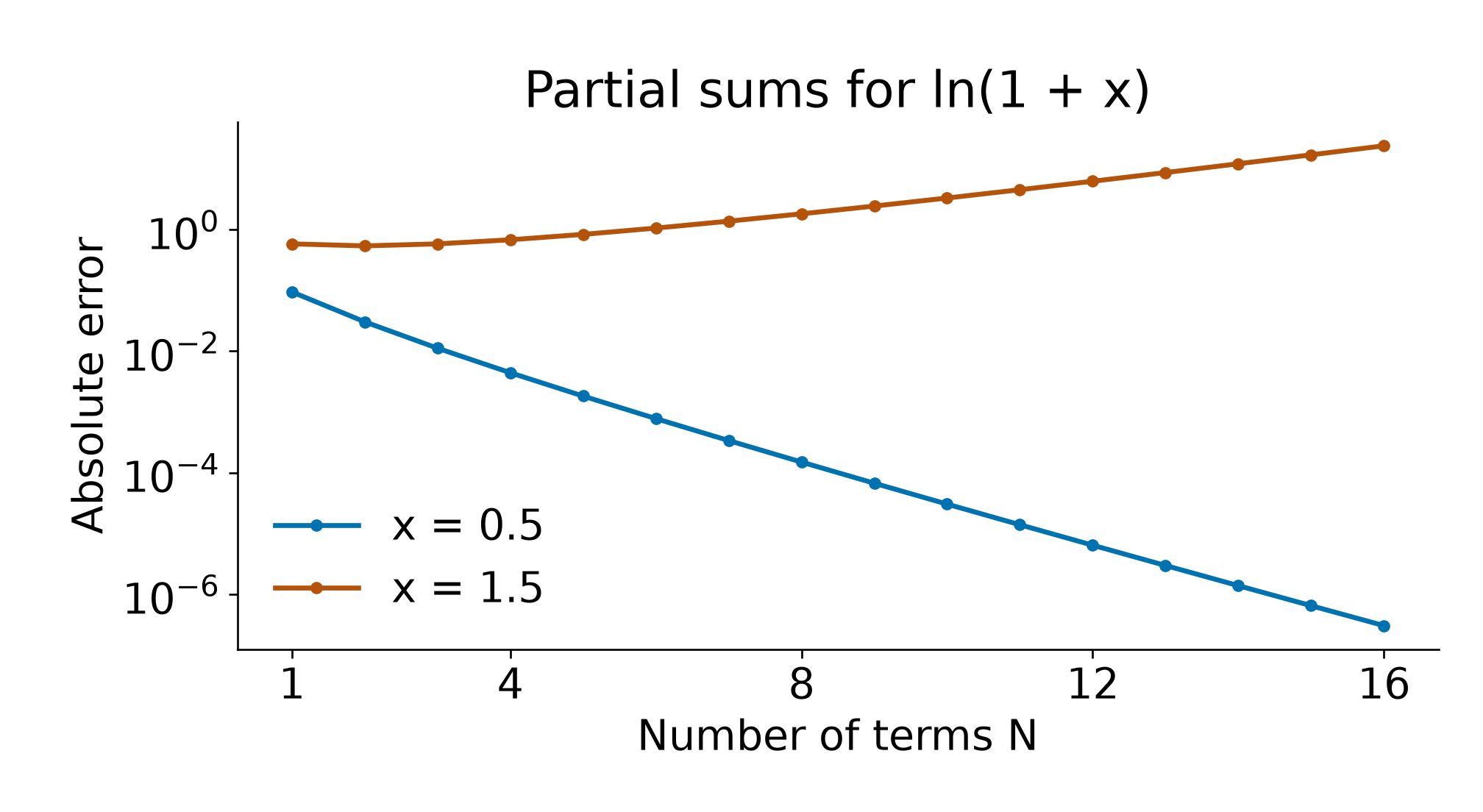
The plotted error is the absolute difference between a finite sum and ln(1+x). Both function values exist; only x=0.5 lies inside the series interval.
Choose the variable before differentiating
For an inverse function, state its branch and finite-derivative domain, then apply the inner derivative. For an implicit relation, carry every $y'$ factor and use the product rule again for $y''$. For a parametric curve, divide by $dx/dt$ for each derivative with respect to $x$. For a Maclaurin expansion, locate $x=0$, evaluate the needed derivatives, and divide by factorials.
An inverse value can exist where its finite derivative does not. A parameter value need not equal the x-coordinate. A second parameter derivative need not equal $d^2y/dx^2$. Checking these distinctions prevents correct formulas being used at the wrong point.
Explore
The gradient at a point
gradient = dy/dx
The derivative is the slope of the tangent, however exotic the function.
Vocabulary
Train
| English |
|---|
| Maclaurin's series/məˈklɔːrɪnz ˈsɪəriːz/ |
| polynomial/ˌpɒlɪˈnəʊmɪəl/ |
| differentiation/ˌdɪfəˌrenʃɪˈeɪʃn/ |
| hyperbolic/ˌhaɪpəˈbɒlɪk/ |
| coefficient/ˌkəʊɪˈfɪʃənt/ |
| interval of convergence/ˈɪntəvl ɒv kənˈvɜːdʒəns/ |
| diverge/daɪˈvɜːdʒ/ |
| chain rule/tʃeɪn ruːl/ |
| implicit/ɪmˈplɪsɪt/ |
| second derivative/ˈsekənd dɪˈrɪvətɪv/ |
| parametric/ˌpærəˈmetrɪk/ |
2.4
Integration
Syllabus
| Candidates should be able to: | Notes and examples |
|---|---|
| • integrate hyperbolic functions and recognise integrals of functions of the form $\frac{1}{\sqrt{a^2 - x^2}}$, $\frac{1}{\sqrt{x^2 + a^2}}$ and $\frac{1}{\sqrt{x^2 - a^2}}$, and integrate associated functions using trigonometric substitutions or hyperbolic substitutions as appropriate | Including use of completing the square where necessary, e.g. to integrate $\frac{1}{\sqrt{x^2 + x}}$. |
| • derive and use reduction formulae for the evaluation of definite integrals | e.g. $\int_0^{\frac{1}{2}\pi} \sin^n x \text{ d}x$, $\int_0^1 \text{e}^{-x}(1-x)^n \text{ d}x$. In harder cases hints may be given, e.g. $\int_0^{\frac{1}{4}\pi} \sec^n x \text{ d}x$ by considering $\frac{\text{d}}{\text{d}x}(\tan x \sec^n x)$. |
| • understand how the area under a curve may be approximated by areas of rectangles, and use rectangles to estimate or set bounds for the area under a curve or to derive inequalities or limits concerning sums | Questions may involve either rectangles of unit width or rectangles whose width can tend to zero, e.g. $1 + \ln n > \sum_{r=1}^n \frac{1}{r} > \ln(n+1)$, $\sum_{r=1}^n \frac{1}{n}\left(1 + \frac{r}{n}\right)^{-1} \approx \int_0^1 (1+x)^{-1} \text{ d}x$. continued |
| • use integration to find – arc lengths for curves with equations in Cartesian coordinates, including the use of a parameter, or in polar coordinates – surface areas of revolution about one of the axes for curves with equations in Cartesian coordinates, including the use of a parameter. | Any questions involving integration may require techniques from Cambridge International A Level Mathematics (9709) applied to more difficult cases, e.g. integration by parts for $\int e^x \sin x \mathrm{d}x$, or use of the substitution $t = \tan \frac{1}{2}x$. Surface areas of revolution for curves with equations in polar coordinates will not be required. |
Source: Cambridge International syllabus
Length and paint are different integrals
A curved strip needs material along its length; rotating it around an axis creates a surface to paint. Neither quantity is simply the area under its graph. First decide what is being measured. Then choose an antiderivative 原函数, a standard form 标准形式 or a substitution 代换, keeping the limits and any sign restrictions.
Integrate the hyperbolic functions
Reverse the known derivatives to integrate hyperbolic functions. Include a constant $C$ for an indefinite integral; use absolute values where a logarithm's argument can be negative. Differentiate a proposed answer to check it. Factors in an argument still matter: $\int\cosh(3x)\,dx=\sinh(3x)/3+C$.
$$\begin{aligned}
\int\sinh x\,dx&=\cosh x+C,\\
\int\cosh x\,dx&=\sinh x+C,\\
\int\tanh x\,dx&=\ln(\cosh x)+C,\\
\int\coth x\,dx&=\ln|\sinh x|+C,\\
\int\operatorname{sech}x\,dx&=\tan^{-1}(\sinh x)+C,\\
\int\operatorname{cosech}x\,dx&=\ln|\tanh(x/2)|+C.
\end{aligned}$$
The coth and cosech formulas apply on intervals that exclude $x=0$. Useful product forms are $\int\operatorname{sech}^2x\,dx=\tanh x+C$ and $\int\operatorname{sech}x\tanh x\,dx=-\operatorname{sech}x+C$.
Match the three square-root forms
For $a>0$, match the expression under the square root before choosing an inverse function. A surd 根式 with a plus sign uses inverse sinh; exchanging the sign changes both the inverse function and the real domain. The inverse-cosh answer below uses the positive branch $x>a$. On either real interval $|x|>a$, the logarithmic expression $\ln|x+\sqrt{x^2-a^2}|+C$ gives an antiderivative instead.
$$\begin{aligned}
\int\frac{dx}{\sqrt{a^2-x^2}}&=\sin^{-1}(x/a)+C,&&|x|<a,\\
\int\frac{dx}{\sqrt{x^2+a^2}}&=\sinh^{-1}(x/a)+C,&&x\in\mathbb R,\\
\int\frac{dx}{\sqrt{x^2-a^2}}&=\cosh^{-1}(x/a)+C,&&x>a.
\end{aligned}$$
$$\int\frac{dx}{a^2+x^2}=\frac1a\tan^{-1}(x/a)+C.$$
Complete the square before substituting
Completing the square 配方法 reveals the standard form. Here $x^2+4x+13=(x+2)^2+9$, so a shift makes the inverse-sinh form visible. If the coefficient of $x^2$ is not one, factor it carefully too. Check the outside multiplier by differentiating the final answer.
$$\begin{aligned}
\int\frac{dx}{\sqrt{x^2+4x+13}}&=\sinh^{-1}\!\left(\frac{x+2}{3}\right)+C,\\
\int\frac{dx}{4x^2+8x+13}&=\frac16\tan^{-1}\!\left(\frac{2(x+1)}3\right)+C.
\end{aligned}$$
Use a hyperbolic substitution for a surd
For $\sqrt{x^2+4}$, put $x=2\sinh u$. Then $dx=2\cosh u\,du$ and the non-negative square root is $2\cosh u$, since $\cosh u>0$. Use $\cosh^2u=(1+\cosh2u)/2$ and return to $x$. For a definite integral, either transform both limits or return to $x$ before evaluating them.
$$\begin{aligned}
\int\sqrt{x^2+4}\,dx&=4\int\cosh^2u\,du\\
&=2u+\sinh2u+C\\
&=2\sinh^{-1}(x/2)+\frac x2\sqrt{x^2+4}+C.
\end{aligned}$$
From $x=0$ to $x=3/2$, the new limits are $u=0$ and $u=\ln2$. The exact integral is $2\ln2+15/8$.
Choose a trigonometric branch
A trigonometric 三角 substitution $x=2\sin\theta$ gives $\sqrt{4-x^2}=2|\cos\theta|$. Choose $-\pi/2\le\theta\le\pi/2$ so $\cos\theta\ge0$ before removing the absolute value. For the definite integral below, $x=0,1$ become $\theta=0,\pi/6$. The double-angle identity integrates $\cos^2\theta$.
$$\begin{aligned}
\int_0^1\sqrt{4-x^2}\,dx
&=4\int_0^{\pi/6}\cos^2\theta\,d\theta\\
&=[2\theta+\sin2\theta]_0^{\pi/6}
=\frac\pi3+\frac{\sqrt3}{2}.
\end{aligned}$$
Reuse integration by parts and a half angle
For $I=\int e^x\sin x\,dx$, two integrations by parts return to $I$. Collect that repeated integral rather than starting the same calculation again. For a rational expression in sine and cosine, $t=\tan(x/2)$ gives $\sin x=2t/(1+t^2)$, $\cos x=(1-t^2)/(1+t^2)$ and $dx=2dt/(1+t^2)$. Work on a branch that does not cross an odd multiple of $\pi$.
$$I=e^x\sin x-(e^x\cos x+I)
\quad\Longrightarrow\quad
I=\frac{e^x}{2}(\sin x-\cos x)+C.$$
$$\int_0^{\pi/2}\frac{dx}{2+\cos x}
=2\int_0^1\frac{dt}{3+t^2}
=\frac\pi{3\sqrt3}.$$
Derive a trigonometric reduction
A reduction formula 递推公式 links an integral to one with a smaller index. For $I_n=\int_0^{\pi/2}\sin^nx\,dx$, take $u=\sin^{n-1}x$, $dv=\sin x\,dx$ in integration by parts. For $n\ge2$, the boundary term is zero. Replacing $\cos^2x$ by $1-\sin^2x$ introduces both $I_{n-2}$ and $I_n$; collect the latter before dividing.
$$\begin{aligned}
I_n&=[-\sin^{n-1}x\cos x]_0^{\pi/2}
+(n-1)\int_0^{\pi/2}\sin^{n-2}x\cos^2x\,dx\\
&=(n-1)(I_{n-2}-I_n),\\
I_n&=\frac{n-1}{n}I_{n-2}.
\end{aligned}$$
The base cases are $I_0=\pi/2$ and $I_1=1$. Thus $I_4=(3/4)(1/2)I_0=3\pi/16$. Even and odd indices lead to different base cases.
Retain a non-zero boundary term
For $J_n=\int_0^1x^ne^{2x}\,dx$, integrate $e^{2x}$ and differentiate $x^n$. At $x=1$, the boundary term is $e^2/2$, not zero. The recurrence below needs $n\ge1$. Evaluate $J_0$ directly: the lower endpoint contributes $-1/2$. Applying the recurrence at $n=0$ would lose it.
$$J_n=\left[\frac{x^ne^{2x}}2\right]_0^1-\frac n2J_{n-1}
=\frac{e^2}2-\frac n2J_{n-1},\quad n\ge1.$$
$$J_0=\frac{e^2-1}2,\qquad J_1=\frac{e^2+1}4,\qquad J_2=\frac{e^2-1}4.$$
Two integrations by parts can reduce by two
Set $K_n=\int_0^2(2-x)^n\sinh x\,dx$. The first integration by parts gives $-2^n+n\int_0^2(2-x)^{n-1}\cosh x\,dx$. For $n\ge2$, a second integration by parts has zero boundary term and gives $K_n=-2^n+n(n-1)K_{n-2}$. The base integrals must still be evaluated directly.
$$K_0=\cosh2-1,\qquad K_1=\sinh2-2,\qquad
K_2=2\cosh2-6.$$
A hint may suggest differentiating $\tan x\sec^{n-2}x$. Its derivative is $(n-1)\sec^nx-(n-2)\sec^{n-2}x$. Integrating from $0$ to $\pi/4$ gives, for $n\ge2$,
$$H_n=\frac{2^{(n-2)/2}+(n-2)H_{n-2}}{n-1},\qquad
H_n=\int_0^{\pi/4}\sec^nx\,dx.$$
Here $H_0=\pi/4$, $H_2=1$ and $H_4=4/3$. The endpoint term is essential.
Draw rectangles before choosing an inequality
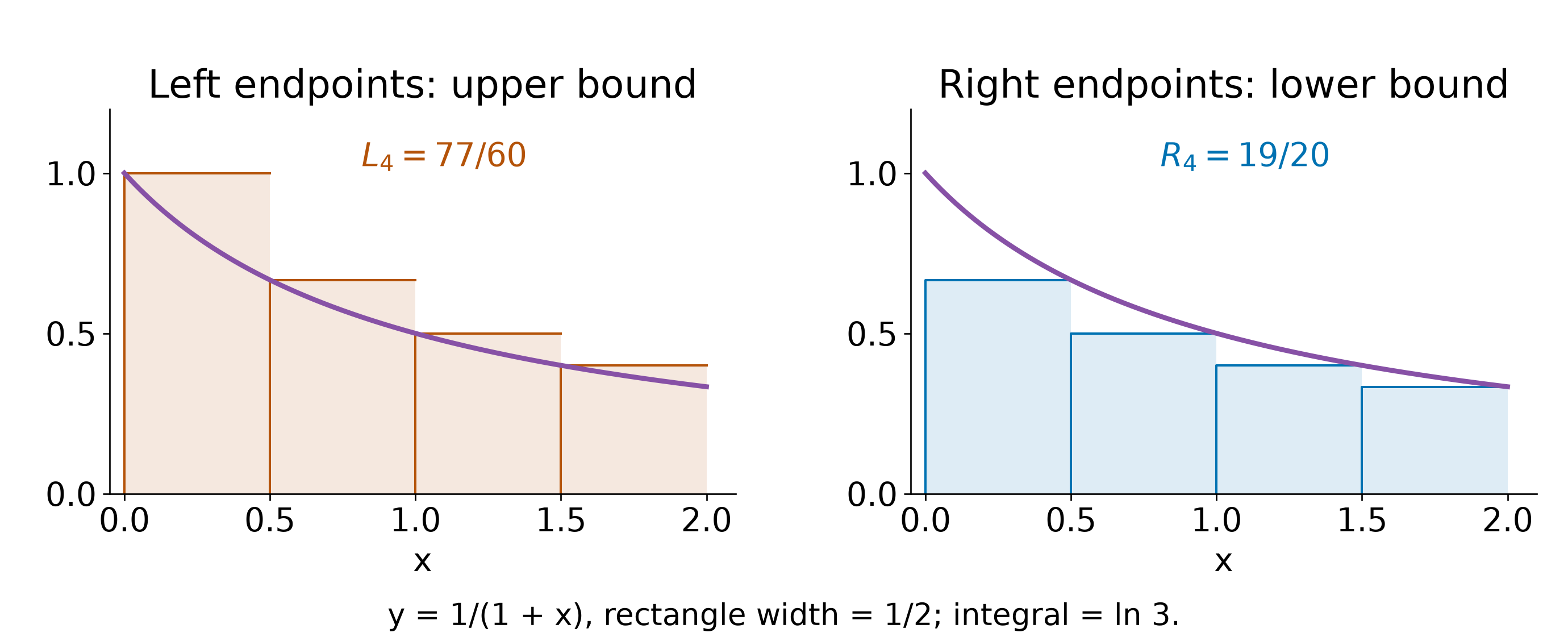
For a positive decreasing function, left-endpoint rectangles overestimate the integral and right-endpoint rectangles underestimate it. Each rectangle has area height times width; a height alone is not its area. For $f(x)=1/(1+x)$ on $[0,2]$ with four rectangles, $\Delta x=1/2$. The sums below trap the exact integral $\ln3$.
$$\begin{aligned}
R_4&=\frac12\left(\frac23+\frac12+\frac25+\frac13\right)=\frac{19}{20},\\
L_4&=\frac12\left(1+\frac23+\frac12+\frac25\right)=\frac{77}{60}.
\end{aligned}$$
$$R_4<\int_0^2\frac{dx}{1+x}=\ln3<L_4.$$
Keep unit-width and shrinking-width sums distinct
Unit-width rectangles under $1/x$ give, for integers $n\ge2$, $\ln(n+1)<\sum_{r=1}^n1/r<1+\ln n$. For the upper bound, keep the first term $1$ separate and compare terms $r=2,\ldots,n$ with strips from $r-1$ to $r$. With $n$ equal strips on $[0,1]$, the width is instead $1/n$. For a continuous function, a Riemann sum 黎曼和 tends to the integral; identify both the width and the sample point.
$$\frac1n\sum_{r=1}^n f(r/n)\longrightarrow\int_0^1 f(x)\,dx.$$
For an increasing function the left/right inequality directions reverse. Do not copy a decreasing-function diagram without checking the derivative or monotonicity on the actual interval.
Rewrite a sum into height times width
Divide each denominator by $n^2$ to expose the sample point $r/n$. The sum below is a right-endpoint rectangle sum, not $n$ times the limiting integral. Since $f(x)=1/(4+x^2)$ decreases on $[0,1]$, the finite sum is below the integral. The gap between the left and right sums is $(f(0)-f(1))/n=1/(20n)$, which tends to zero.
$$\sum_{r=1}^n\frac{n}{4n^2+r^2}
=\frac1n\sum_{r=1}^n\frac1{4+(r/n)^2}
\longrightarrow\frac12\tan^{-1}(1/2).$$
Find Cartesian arc length from ds
A small displacement has length $ds=\sqrt{dx^2+dy^2}$. For a single traversal with increasing $x$, the arc length 弧长 is $L=\int_a^b\sqrt{1+(dy/dx)^2}\,dx$; it is not $\int y\,dx$. For $y=\cosh x$, $0\le x\le\ln2$, $\sqrt{1+\sinh^2x}=\cosh x>0$. Thus $L=[\sinh x]_0^{\ln2}=3/4$.
For $y=x^2$, $0\le x\le1$, a hyperbolic substitution in $\int_0^1\sqrt{1+4x^2}\,dx$ gives $L=\sqrt5/2+\sinh^{-1}(2)/4$. The straight-line distance between the endpoints is $\sqrt2$, which is smaller.
Use speed for a parametric curve
For $x=x(t)$ and $y=y(t)$, $ds=\sqrt{(dx/dt)^2+(dy/dt)^2}\,dt$. Check that the chosen parameter interval traces the required arc once. For $x=3(t-\sin t)$, $y=3(1-\cos t)$, $0\le t\le\pi$, the speed is $3\sqrt{2-2\cos t}=6\sin(t/2)$, since the half-angle sine is non-negative.
$$L=\int_0^\pi6\sin(t/2)\,dt=12.$$
For $x=\ln(\cosh2t)$, $y=\tan^{-1}(\sinh2t)$, $0\le t\le\ln2$, the derivatives are $2\tanh2t$ and $2\operatorname{sech}2t$. The identity $\tanh^2+\operatorname{sech}^2=1$ makes the speed $2$, so $L=2\ln2$.
Include both terms in polar arc length
For a polar curve $r=r(\theta)$, radial and sideways changes contribute separately: $ds^2=dr^2+r^2d\theta^2$. Thus $L=\int_\alpha^\beta\sqrt{r^2+(dr/d\theta)^2}\,d\theta$, with angles in radians. For $r=2(1+\cos\theta)$ on $0\le\theta\le\pi$, the square root is $4|\cos(\theta/2)|=4\cos(\theta/2)$. This interval traces the upper half once; its length is $8$.
$$L=\int_0^\pi4\cos(\theta/2)\,d\theta=8.$$

Choose the radius before finding surface area
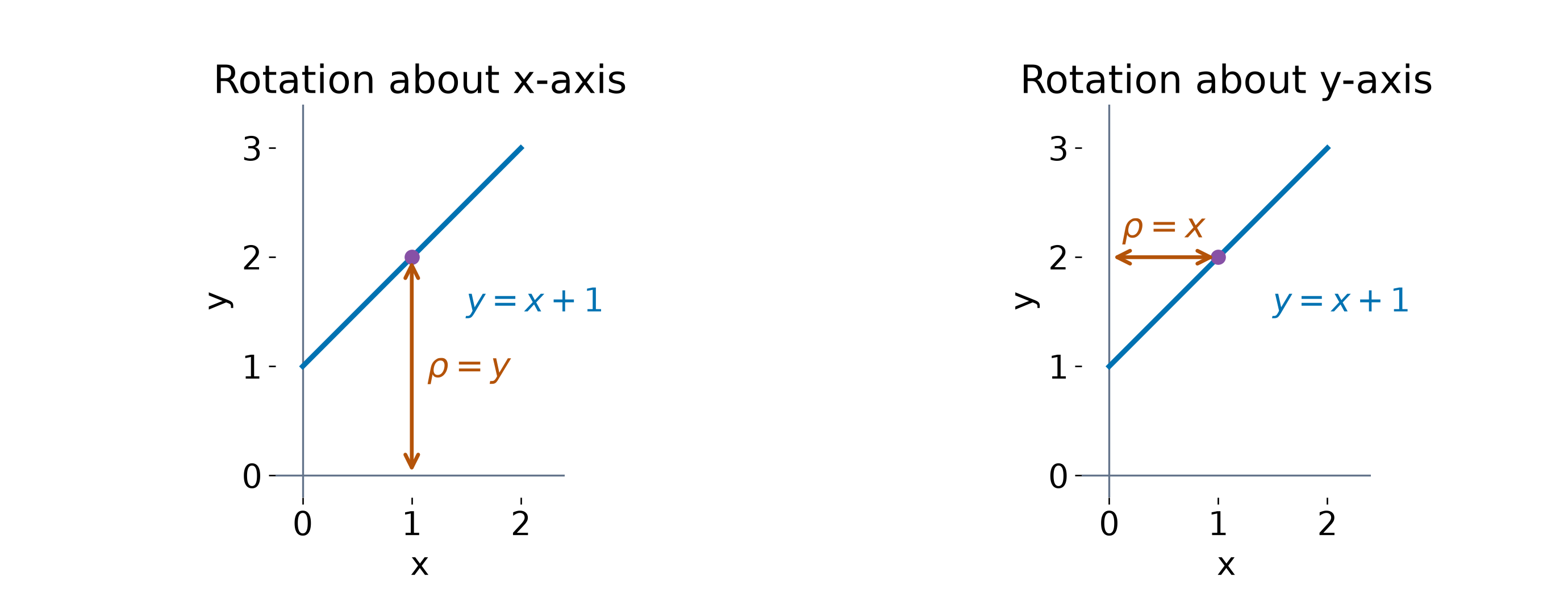
A narrow band of a surface area of revolution 旋转曲面面积 has area $2\pi\rho\,ds$, where $\rho\ge0$ is distance to the rotation axis. About the $x$-axis use $|y|$; about the $y$-axis use $|x|$. For $y=x+1$, $0\le x\le2$, $ds=\sqrt2\,dx$. Changing the axis changes the radius even though the arc is the same.
$$\begin{aligned}
S_x&=2\pi\sqrt2\int_0^2(x+1)\,dx=8\pi\sqrt2,\\
S_y&=2\pi\sqrt2\int_0^2x\,dx=4\pi\sqrt2.
\end{aligned}$$
$\pi\int y^2\,dx$ is a volume formula, not a surface-area formula. Negative coordinates do not give negative areas. The syllabus requires Cartesian and parametric surfaces, not surfaces specified directly in polar form.
Keep the parameter and speed in a surface integral
For a parametric arc, use $S_x=2\pi\int|y(t)|\sqrt{x'(t)^2+y'(t)^2}\,dt$ or replace $|y(t)|$ by $|x(t)|$ for the $y$-axis. The square-root speed handles decreasing coordinates without producing negative length. For $x=2\cos t$, $y=2\sin t$, $0\le t\le\pi/2$, the speed is $2$. Rotation about the $x$-axis gives a hemisphere of radius $2$; the same is true about the $y$-axis.
$$\begin{aligned}
S_x&=2\pi\int_0^{\pi/2}(2\sin t)(2)\,dt=8\pi,\\
S_y&=2\pi\int_0^{\pi/2}(2\cos t)(2)\,dt=8\pi.
\end{aligned}$$
Change the limits when the substitution reverses direction
A surface integral can need a further substitution after its geometric setup. For $y=\tanh x$, rotating $0\le x\le\tanh^{-1}(1/3)$ about the $x$-axis gives $2\pi\int\tanh x\sqrt{1+\operatorname{sech}^4x}\,dx$. Put $u=\sqrt{1+\operatorname{sech}^4x}$. Then $du/dx=-2\operatorname{sech}^4x\tanh x/u<0$ for $x>0$. Reversing the transformed limits removes the minus sign.
$$S=\pi\int_{\sqrt{145}/9}^{\sqrt2}\frac{u^2}{u^2-1}\,du
=\pi\left[u+\frac12\ln\left|\frac{u-1}{u+1}\right|\right]_{\sqrt{145}/9}^{\sqrt2}.$$
At the upper $x$ endpoint, $\tanh x=1/3$, so $\operatorname{sech}^2x=8/9$ and $u=\sqrt{145}/9$. Split $u^2/(u^2-1)=1+1/(u^2-1)$ before integrating. The transformed integral is positive.
Set up, simplify, evaluate and check
For substitutions and reductions, show the transformed differential, endpoint terms and valid index range. For rectangles, draw the comparison and include the rectangle width before taking a limit. For arc length or surface area, write $ds$ first, choose the parameter interval and a non-negative radius, then integrate. A plausible antiderivative cannot repair the wrong geometric setup.
Check an indefinite answer by differentiation. Check a reduction at a low allowed index. Check a sum against its diagram. Check a length against its chord and a surface against a simple geometric case where possible.
Explore
The area under the curve
area = ∫ f(x) dx
Every integral measures the area under the curve — drag the limits.
Vocabulary
Train
| English |
|---|
| completing the square/kəmˈpliːtɪŋ ðə skweə/ |
| reduction formula/rɪˈdʌkʃn ˈfɔːmjʊlə/ |
| arc length/ɑːk leŋθ/ |
| surface area of revolution/ˈsɜːfɪs ˈeərɪə ɒv ˌrevəˈluːʃn/ |
| Riemann sum/ˈriːmən sʌm/ |
| antiderivative/ˌæntɪdɪˈrɪvətɪv/ |
| standard form/ˈstændəd fɔːm/ |
| substitution/ˌsʌbstɪˈtjuːʃn/ |
| trigonometric/ˌtrɪɡənəʊˈmetrɪk/ |
| surd/sɜːd/ |
2.5
Complex numbers
Syllabus
| Candidates should be able to: | Notes and examples |
|---|---|
| • understand de Moivre’s theorem, for a positive or negative integer exponent, in terms of the geometrical effect of multiplication and division of complex numbers | |
| • prove de Moivre’s theorem for a positive integer exponent | e.g. by induction. |
| • use de Moivre’s theorem for a positive or negative rational exponent | e.g. expressing $\cos 5\theta$ in terms of $\cos \theta$ or $\tan 5\theta$ in terms of $\tan \theta$. |
| – to express trigonometrical ratios of multiple angles in terms of powers of trigonometrical ratios of the fundamental angle | e.g. expressing $\sin^6 \theta$ in terms of $\cos 2\theta$, $\cos 4\theta$ and $\cos 6\theta$. |
| – to express powers of $\sin \theta$ and $\cos \theta$ in terms of multiple angles | |
| – in the summation of series | e.g. using the '$C + \mathrm{i}S$' method to sum series such as $\sum_{r=1}^{n} \binom{n}{r} \sin r\theta$. |
| – in finding and using the $n$th roots of unity. |
Source: Cambridge International syllabus
Repeat a turn and a change of scale
Picture an arrow that turns and changes length after each step. Multiplication of non-zero complex numbers 复数 combines these two changes; a power repeats them. De Moivre's theorem 棣莫弗定理 links those powers to angles. It also helps turn a trigonometric identity, a polynomial equation or two real series into one complex calculation.
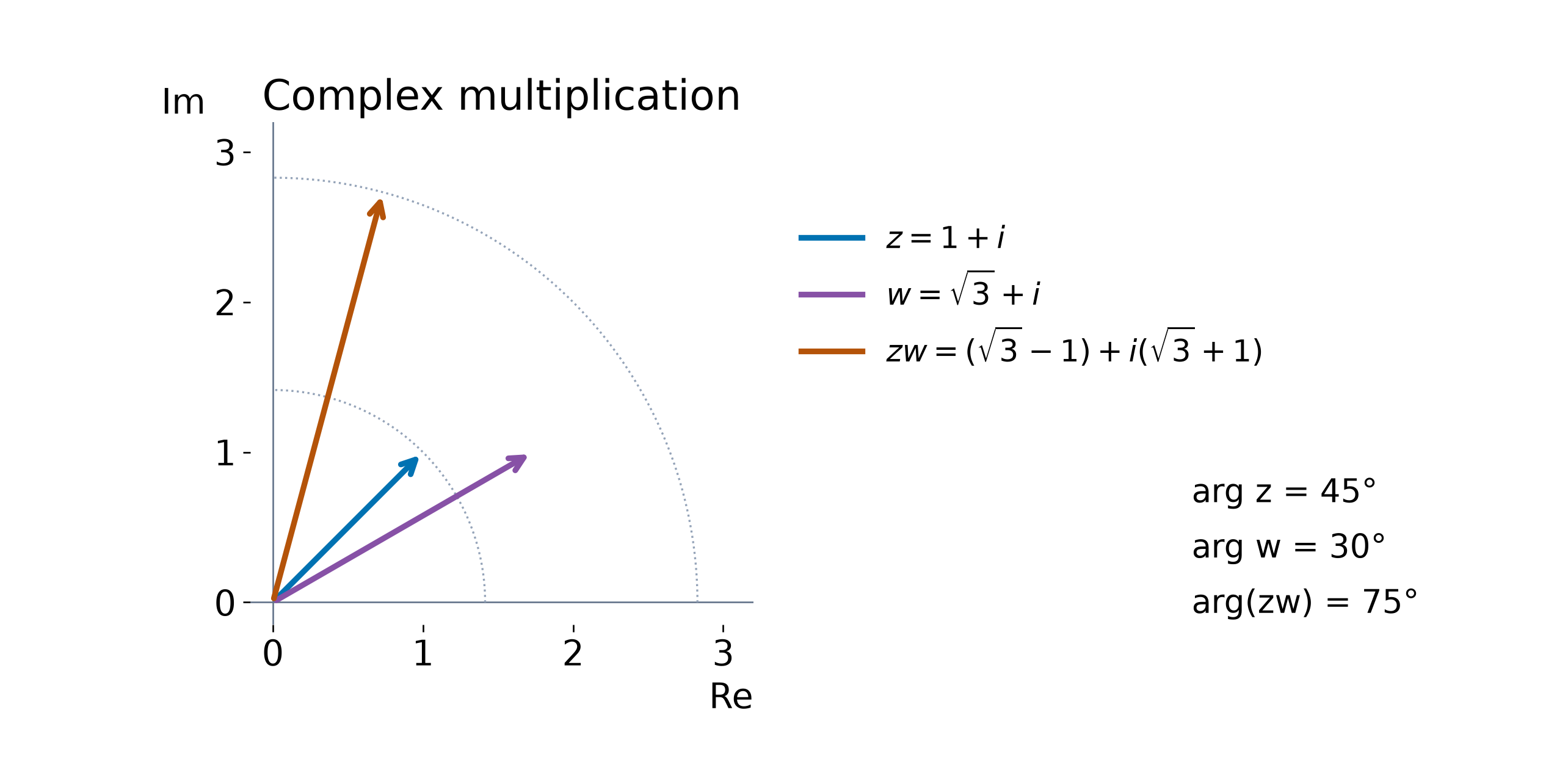
Multiplication by i preserves length. A general non-zero multiplier can change both length and angle.
Multiply lengths and add angles
Write a non-zero number in polar form 极坐标形式 as $z=r\operatorname{cis}\theta$, where $\operatorname{cis}\theta=\cos\theta+i\sin\theta$. Its modulus 模 is $r>0$ and its argument 辐角 is defined modulo $2\pi$. Multiplication multiplies moduli and adds arguments; division divides moduli and subtracts arguments. Adjust the final angle to the interval requested in the question.
$$\begin{aligned}
(r\operatorname{cis}\alpha)(s\operatorname{cis}\beta)&=rs\operatorname{cis}(\alpha+\beta),\\
\frac{r\operatorname{cis}\alpha}{s\operatorname{cis}\beta}&=\frac rs\operatorname{cis}(\alpha-\beta),\quad s>0.
\end{aligned}$$
Apply positive and negative integer powers
For an integer $n$, $z^n=r^n\operatorname{cis}(n\theta)$. A negative exponent needs $z\ne0$; taking a reciprocal reverses the angle and replaces the modulus by its reciprocal. For $z=1+i=\sqrt2\operatorname{cis}(\pi/4)$, $z^6=8\operatorname{cis}(3\pi/2)=-8i$. Also $z^{-2}=(1/2)\operatorname{cis}(-\pi/2)=-i/2$.
The power multiplies the argument; it does not raise the real and imaginary parts separately. Zero has no argument: its positive integer powers can be handled directly, but negative powers of zero are undefined.
Prove the positive-integer theorem by induction
Use mathematical induction 数学归纳法. The claim is true at $n=1$. Assume $(\operatorname{cis}\theta)^k=\operatorname{cis}(k\theta)$ for an arbitrary positive integer $k$. Multiply this assumed equality by $\operatorname{cis}\theta$. The angle-addition identities give the next case below, so the base case and conditional step prove every positive integer case.
$$\begin{aligned}
(\operatorname{cis}\theta)^{k+1}
&=(\cos k\theta+i\sin k\theta)(\cos\theta+i\sin\theta)\\
&=(\cos k\theta\cos\theta-\sin k\theta\sin\theta)\\
&\quad+i(\sin k\theta\cos\theta+\cos k\theta\sin\theta)\\
&=\operatorname{cis}((k+1)\theta).
\end{aligned}$$
For $m>0$, $(\operatorname{cis}\theta)^{-m}=1/\operatorname{cis}(m\theta)=\operatorname{cis}(-m\theta)$. This extends the proved result to negative integers without claiming that the induction itself covered them.
Compare real and imaginary parts
Expand $(c+is)^n$ with $c=\cos\theta$, $s=\sin\theta$, then compare real parts with $\cos n\theta$ and imaginary parts 虚部 with $\sin n\theta$. For the fifth power, replace $s^2$ by $1-c^2$ in the real part, and $c^2$ by $1-s^2$ in the imaginary part. Show that substitution rather than quoting the final identity.
$$\begin{aligned}
\cos5\theta&=c^5-10c^3s^2+5cs^4\\
&=16c^5-20c^3+5c,\\
\sin5\theta&=5c^4s-10c^2s^3+s^5\\
&=16s^5-20s^3+5s.
\end{aligned}$$
The real part of the cube similarly gives $\cos3\theta=c^3-3cs^2=4c^3-3c$.
Divide parts to obtain a tangent formula
If $t=\tan\theta$, divide the imaginary part of $(\cos\theta+i\sin\theta)^3$ by its real part, then divide numerator and denominator by $\cos^3\theta$. Both tangents must exist. Thus $\cos\theta\ne0$ and the denominator $1-3t^2\ne0$; an equation obtained by cross-multiplication still needs those checks.
$$\tan3\theta
=\frac{3\cos^2\theta\sin\theta-\sin^3\theta}
{\cos^3\theta-3\cos\theta\sin^2\theta}
=\frac{3t-t^3}{1-3t^2}.$$
Express a power using multiple angles
Put $z=\operatorname{cis}\theta$, so $z+z^{-1}=2\cos\theta$ and $z-z^{-1}=2i\sin\theta$. Expand powers and pair $z^m$ with $z^{-m}$. The fourth-power expansion below turns $\sin^4\theta$ into a constant plus multiple-angle cosines. Keep the sign of $i^n$ when the power is odd.
$$\begin{aligned}
(z-z^{-1})^4&=z^4-4z^2+6-4z^{-2}+z^{-4},\\
16\sin^4\theta&=2\cos4\theta-8\cos2\theta+6,\\
\sin^4\theta&=\frac{3-4\cos2\theta+\cos4\theta}{8}.
\end{aligned}$$
The fifth power gives $16\sin^5\theta=\sin5\theta-5\sin3\theta+10\sin\theta$. Only after deriving this may you take a reciprocal: for $\sin\theta\ne0$,
$$\operatorname{cosec}^5\theta=
\frac{16}{\sin5\theta-5\sin3\theta+10\sin\theta}.$$
Turn a polynomial into an angle equation
For $32x^5-40x^3+10x-1=0$, put $x=\cos\theta$. The fifth-angle identity gives $2\cos5\theta-1=0$. Choose $0\le\theta\le\pi$, where cosine is one-to-one. Solve $5\theta=\pm\pi/3+2k\pi$ in $[0,5\pi]$, giving the five distinct roots below. Five distinct verified roots exhaust a degree-five polynomial.
$$x=\cos\left(\frac{q\pi}{15}\right),
\qquad q\in\{1,5,7,11,13\}.$$
Listing five angles does not automatically give five distinct roots when using sine on a larger interval. Check the actual sine/cosine values and the polynomial degree; remove repetitions, not valid different roots.
Handle reciprocal trigonometric roots
To express roots using secant, put $x=\sec\theta$ and therefore $1/x=\cos\theta$. Divide by a power of $x$ only after excluding $x=0$ from the original polynomial. For $x^5-10x^4+40x^2-32=0$, zero is not a root. Dividing by $x^5$ gives $1-2\cos5\theta=0$, so the roots are the secants of the same five angles as in the previous step.
$$\begin{aligned}
1-\frac{10}{x}+\frac{40}{x^3}-\frac{32}{x^5}&=0,\\
x&=\sec\left(\frac{q\pi}{15}\right),
\quad q\in\{1,5,7,11,13\}.
\end{aligned}$$
Rational powers need a branch convention
For $z=r\operatorname{cis}\theta\ne0$ and coprime integers $p,q$ with $q>0$, the complex branches of the rational power use all equivalent arguments before dividing the angle by $q$. A specified principal value chooses a branch; solving an equation for all roots must retain all $q$ values. Negative $p$ also needs $z\ne0$. Do not use an unreduced fraction to decide the branch count.
$$w_k=r^{p/q}\operatorname{cis}\!\left(\frac{p(\theta+2k\pi)}q\right),
\qquad k=0,\ldots,q-1.$$
For $z=8$ and exponent $2/3$, the three values solve $w^3=64$: they are $4\operatorname{cis}(0)$, $4\operatorname{cis}(2\pi/3)$ and $4\operatorname{cis}(4\pi/3)$. The familiar real value $4$ is one of them.
Find roots of a non-unit number
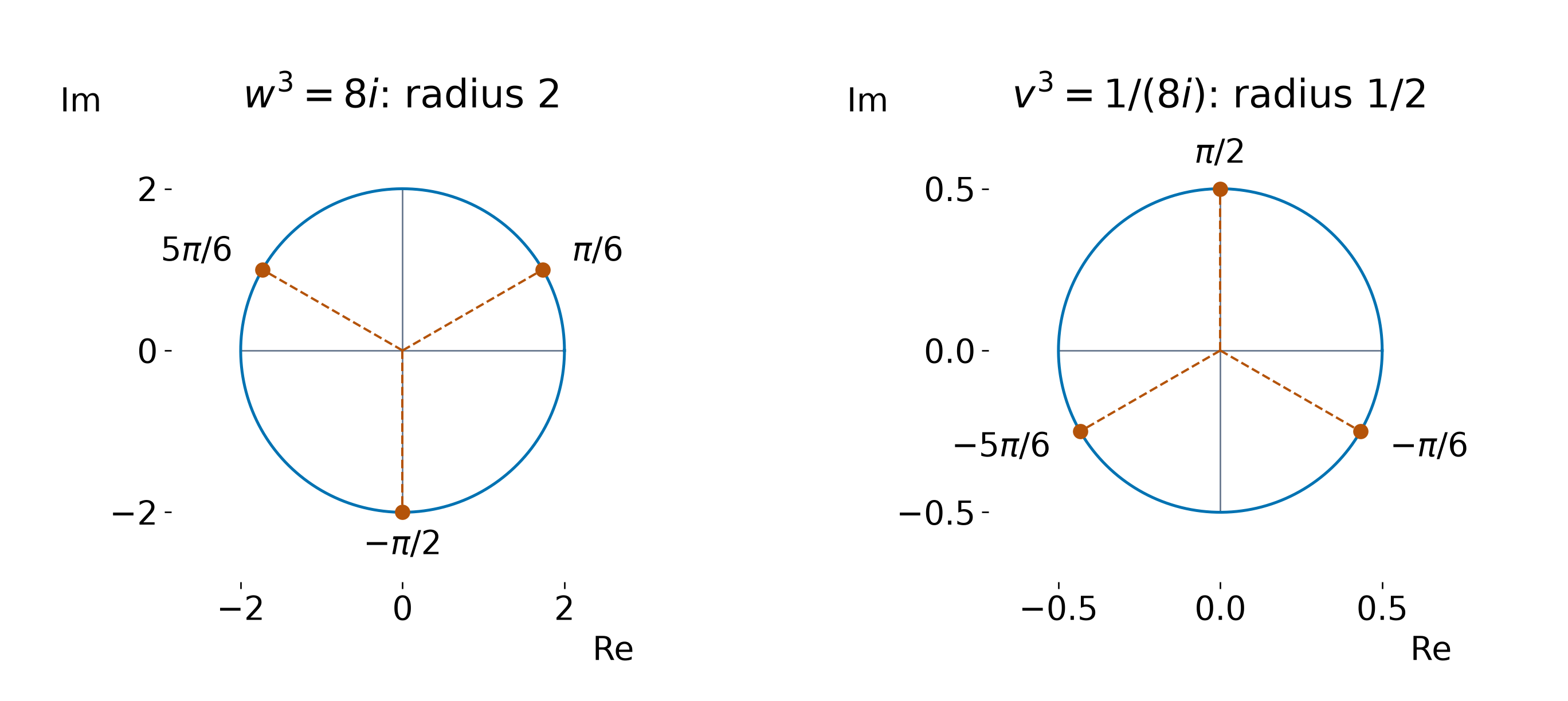
To solve $w^n=R\operatorname{cis}\Theta$ for $R>0$, use modulus $R^{1/n}$ and arguments $(\Theta+2k\pi)/n$, $k=0,\ldots,n-1$. Convert each argument to the requested interval after obtaining the complete set. For $w^3=8i$, the roots have modulus $2$ and arguments $\pi/6,5\pi/6,-\pi/2$. Reciprocating them gives the three values of $(8i)^{-1/3}$, with modulus $1/2$ and opposite arguments.
Use the roots of unity
The $n$ roots of unity 单位根 solve $z^n=1$: $z_k=\operatorname{cis}(2k\pi/n)$ for $k=0,\ldots,n-1$. They lie on the unit circle 单位圆 and are separated by $2\pi/n$ radians, or $360^\circ/n$. For $n>1$, their sum is zero. They give the linear factors $z-z_k$ of $z^n-1$. If $\omega^3=1$ and $\omega\ne1$, then $1+\omega+\omega^2=0$; do not cancel $\omega-1$ without its non-zero condition.

Check whether powers visit every root
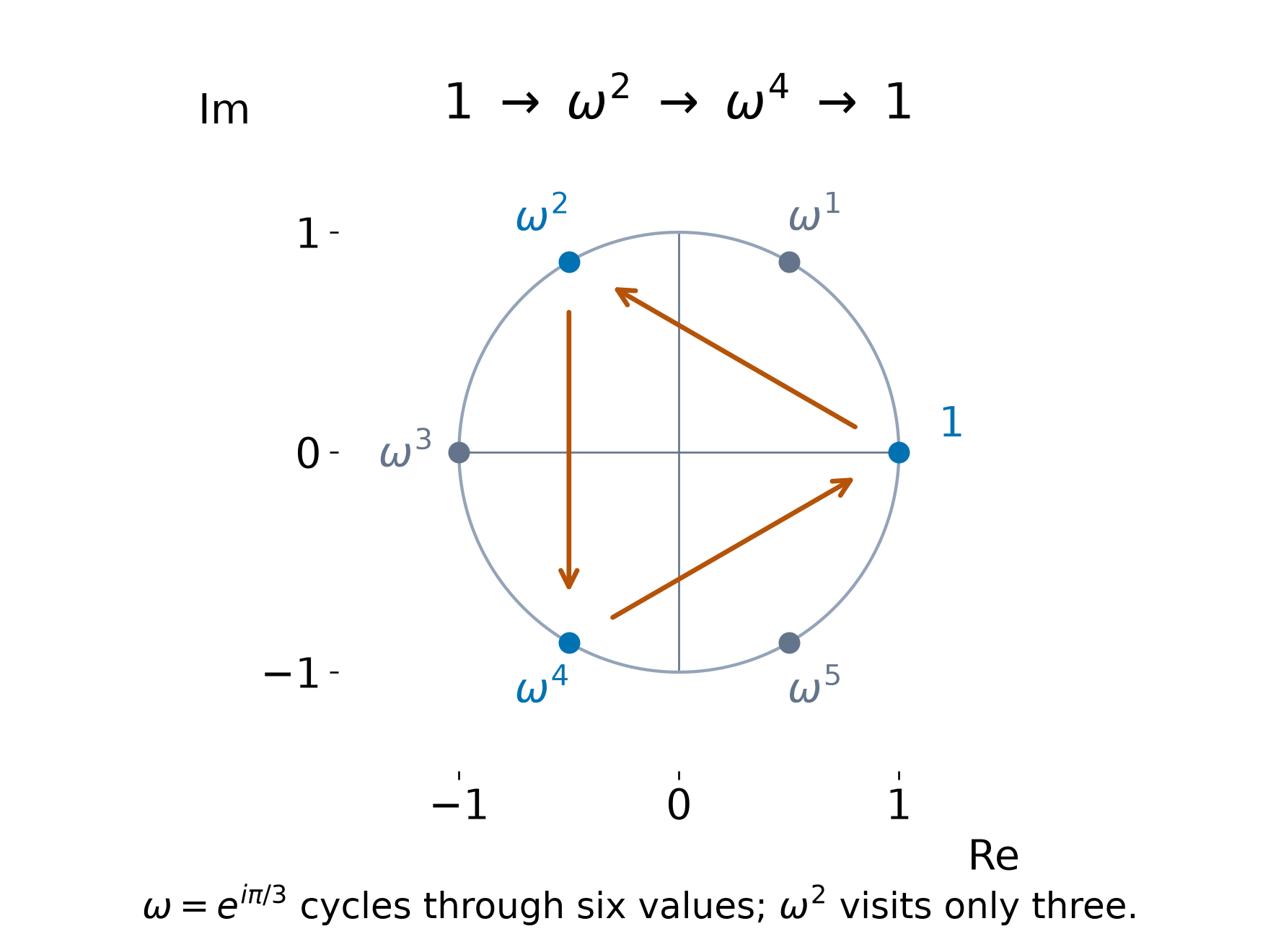
A primitive root of unity 本原单位根 visits all $n$ roots before its powers return to $1$. For $\omega=\operatorname{cis}(2\pi/n)$ this is the full cycle; a power of $\omega$ can have a shorter cycle. For $n=6$, powers of $\omega^2$ visit only $1,\omega^2,\omega^4$ and then repeat. For any integer $m$, the complete sum of $m$th powers below is $6$ if $6$ divides $m$, and zero otherwise.
$$\sum_{k=0}^{5}\omega^{mk}
=\begin{cases}6,&6\mid m,\\0,&6\nmid m.\end{cases}$$
Add C and iS before summing separately
Let $C=\sum_{r=0}^n\cos(r\theta)$ and $S=\sum_{r=0}^n\sin(r\theta)$. Then $C+iS$ is a geometric series 等比级数 with ratio $z=\operatorname{cis}\theta$. For $z\ne1$, sum the series first, then factor the complex exponentials into half-angle forms. When $\theta$ is a multiple of $2\pi$, use the original sums: $C=n+1$, $S=0$.
$$C+iS=\frac{1-z^{n+1}}{1-z}
=\frac{\sin((n+1)\theta/2)}{\sin(\theta/2)}
\operatorname{cis}(n\theta/2).$$
$$\begin{aligned}
C&=\frac{\sin((n+1)\theta/2)\cos(n\theta/2)}{\sin(\theta/2)},\\
S&=\frac{\sin((n+1)\theta/2)\sin(n\theta/2)}{\sin(\theta/2)}.
\end{aligned}$$
Include a geometric weight
For $C_n=\sum_{r=1}^n\rho^r\cos(r\theta)$ and $S_n=\sum_{r=1}^n\rho^r\sin(r\theta)$, take $q=\rho\operatorname{cis}\theta$. The finite sum is $q(1-q^n)/(1-q)$ for $q\ne1$. Multiply by $1-\overline q$ to make the denominator real, then compare parts. With $D=1-2\rho\cos\theta+\rho^2$, the imaginary part is the expression below; obtain the real part from the same numerator.
$$C_n+iS_n=\frac{q-q^{n+1}-\rho^2+\rho^2q^n}{D}.$$
$$S_n=\frac{\rho\sin\theta-\rho^{n+1}\sin((n+1)\theta)
+\rho^{n+2}\sin(n\theta)}D.$$
For $q=(1+i)/2$ and $n=4$, $q/(1-q)=i$ and $q^4=-1/4$. Hence $\sum_{r=1}^4q^r=5i/4$: the cosine-weighted sum is $0$ and the sine-weighted sum is $5/4$.
Use a binomial expansion for binomial weights
For $C=\sum_{r=0}^n\binom nr\cos(r\theta)$ and $S=\sum_{r=0}^n\binom nr\sin(r\theta)$, the binomial expansion 二项式展开 gives $C+iS=(1+e^{i\theta})^n$. On $-\pi<\theta<\pi$, $1+e^{i\theta}=2\cos(\theta/2)e^{i\theta/2}$ has non-negative modulus. Apply de Moivre, then compare real and imaginary parts. Starting the sum at $r=1$ removes $1$ from $C$ only.
$$\begin{aligned}
C&=2^n\cos^n(\theta/2)\cos(n\theta/2),\\
S&=2^n\cos^n(\theta/2)\sin(n\theta/2).
\end{aligned}$$
For $n=6$ and $\theta=\pi/3$, $1+e^{i\theta}=\sqrt3e^{i\pi/6}$, so $C+iS=27e^{i\pi}=-27$. Thus $C=-27$, $S=0$ for $r=0,\ldots,6$.
Take a justified infinite-series limit
If $|q|=\rho<1$, $q^n\to0$ and the complex geometric sum from $r=1$ tends to $q/(1-q)$. Take real and imaginary parts after using this convergence condition. With the real denominator $D=1-2\rho\cos\theta+\rho^2$, the formulas below follow. For $q=(1+i)/2$, the infinite sum is $i$, so $C=0$, $S=1$.
$$C_\infty=\frac{\rho\cos\theta-\rho^2}{D},\qquad
S_\infty=\frac{\rho\sin\theta}{D}.$$
A finite geometric formula does not justify an infinite sum when $|q|\ge1$. Check convergence before discarding its last term. The special case $q=1$ also makes the finite quotient undefined and must be evaluated directly.
Bring down an index by differentiation
Differentiating the finite sine sum with respect to $\theta$ gives $\sum_{r=1}^nr\rho^r\cos(r\theta)$. Alternatively apply $q\,d/dq$ to the finite geometric polynomial. The result below has a justified limit for $|q|<1$, using $n\rho^n\to0$. This uses the finite identity before taking the limit, rather than assuming that an infinite series can always be differentiated term by term.
$$\begin{aligned}
\sum_{r=1}^nrq^r&=\frac{q\{1-(n+1)q^n+nq^{n+1}\}}{(1-q)^2},\\
\sum_{r=1}^\infty rq^r&=\frac q{(1-q)^2},\qquad |q|<1.
\end{aligned}$$
At $q=i/2$, the limiting weighted sum is $-8/25+6i/25$. Therefore the weighted cosine sum is $-8/25$ and the weighted sine sum is $6/25$.
Choose the complex expression that matches the task
For a power, state the modulus, argument and branch conditions. For a trigonometric identity, expand before selecting parts. For polynomial roots, choose an angle interval, exclude invalid divisions and count distinct values. For sums, choose geometric or binomial weights correctly, combine $C+iS$, and retain exceptional cases and convergence conditions. For roots of unity, check whether powers give a full cycle or a shorter one.
Multiplication combines scale and rotation. De Moivre links powers and angles. Comparing parts produces identities and sums; retaining all allowed arguments produces the complete root set.
Explore
The Argand diagram
Drag the point to explore modulus and argument — the language of complex numbers in polar (modulus–argument) form.
Vocabulary
Train
| English |
|---|
| complex number/ˈkɒmpleks ˈnʌmbə/ |
| De Moivre's theorem/də ˈmɔɪvəz ˈθɪərəm/ |
| roots of unity/ruːts ɒv ˈjuːnɪti/ |
| polar form/ˈpəʊlə fɔːm/ |
| argument/ˈɑːɡjuːmənt/ |
| modulus/ˈmɒdjʊləs/ |
| imaginary part/ɪˈmædʒɪnəri pɑːt/ |
| unit circle/ˈjuːnɪt ˈsɜːkl/ |
| mathematical induction/ˌmæθɪˈmætɪkl ɪnˈdʌkʃn/ |
| primitive root of unity/ˈprɪmɪtɪv ruːt əv ˈjuːnɪti/ |
| geometric series/ˌdʒiːəʊˈmetrɪk ˈsɪəriːz/ |
| binomial expansion/baɪˈnəʊmɪəl ekˈspænʃn/ |
2.6
Differential equations

Syllabus
| Candidates should be able to: | Notes and examples |
|---|---|
| • find an integrating factor for a first order linear differential equation, and use an integrating factor to find the general solution | e.g. $\frac{\mathrm{d}y}{\mathrm{d}x} - 2y = x^2$, $x\frac{\mathrm{d}y}{\mathrm{d}x} - y = x^4$, $\frac{\mathrm{d}y}{\mathrm{d}x} + y\coth x = \cosh x$. |
| • recall the meaning of the terms 'complementary function' and 'particular integral' in the context of linear differential equations, and recall that the general solution is the sum of the complementary function and a particular integral | |
| find the complementary function for a first or second order linear differential equation with constant coefficients | For second order equations, including the cases where the auxiliary equation has distinct real roots, a repeated real root or conjugate complex roots. |
| recall the form of, and find, a particular integral for a first or second order linear differential equation in the cases where a polynomial or $ae^{bx}$ or $a\cos px + b\sin px$ is a suitable form, and in other simple cases find the appropriate coefficient(s) given a suitable form of particular integral | e.g. evaluate $k$ given that $kx \cos 2x$ is a particular integral of $$\frac{\text{d}^2y}{\text{d}x^2} + 4y = \sin 2x$$ . |
| use a given substitution to reduce a differential equation to a first or second order linear equation with constant coefficients or to a first order equation with separable variables | e.g. the substitution $x = e^t$ to reduce to linear form a differential equation with terms of the form $$ax^2\frac{\text{d}^2y}{\text{d}x^2} + bx\frac{\text{d}y}{\text{d}x} + cy$$ , or the substitution $y = ux$ to reduce $$\frac{\text{d}y}{\text{d}x} = \frac{x+y}{x-y}$$ to separable form. |
| use initial conditions to find a particular solution to a differential equation, and interpret a solution in terms of a problem modelled by a differential equation. |
Source: Cambridge International syllabus
Balance what enters and leaves
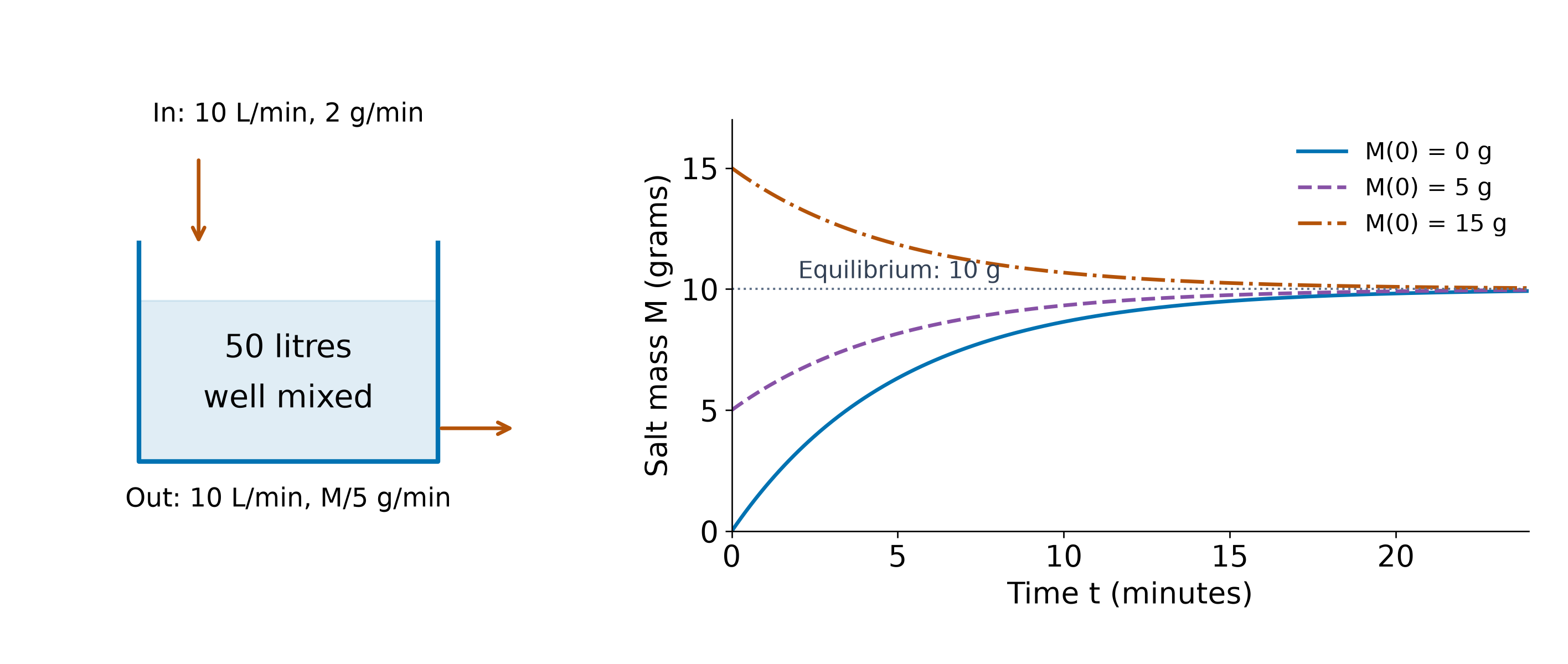
- A tank has 50 litres of well-mixed liquid. Each minute, 10 litres enters carrying 2 grams of salt, and 10 litres leaves. If $M$ is salt mass in grams and $t$ is time in minutes, the outflow removes $10(M/50)=M/5$ grams per minute.
- The differential equation 微分方程 is $M'=2-M/5$. It links a function 函数 to its rate of change. We will find the mass, use the starting mass and check what happens after a long time.
Put a first-order equation in linear form
- A first-order linear equation 一阶线性方程 has the form $y'+P(x)y=Q(x)$. First divide by the coefficient of $y'$, on an interval where it is non-zero. Here a prime means differentiation with respect to the independent variable.
- For $2xy'-4y=2x^3$, division gives $y'-2y/x=x^2$, so $P=-2/x$, not $-4$. Use an interval such as $x>0$; do not extend the result across $x=0$ without checking the original equation.
Build the integrating factor from the product rule
- We want $\mu y'+\mu Py=(\mu y)'$. The product rule requires $\mu'=P\mu$, giving an integrating factor 积分因子 $\mu=e^{\int P\,dx}$. Any non-zero constant multiple works; choose the simplest one.
- Multiply every term by $\mu$, integrate, then divide by $\mu$. Keep one arbitrary constant in the general solution 通解:
$$\begin{aligned}
(\mu y)'&=\mu Q,\\
y&=\frac{\int\mu Q\,dx+C}{\mu}.
\end{aligned}$$
Finish an algebraic integrating-factor example
- For $y'-2y/x=x^2$ on $x>0$, choose $\mu=e^{-2\ln x}=x^{-2}$. Multiplying gives $(x^{-2}y)'=1$, not $x^2$.
- Integrate to get $x^{-2}y=x+C$, so $y=x^3+Cx^2$. If $y(1)=2$, then $C=1$ and $y=x^3+x^2$. Substitution gives $2xy'-4y=2x^3$.
Let the integrating factor reveal a standard integral
- Consider $y'-\dfrac{x+2}{(x+2)^2+9}y=1$, with $y(1)=0$. The numerator is half the derivative of the denominator. Thus $\mu=((x+2)^2+9)^{-1/2}$ and
$$\left(\frac{y}{\sqrt{(x+2)^2+9}}\right)'=\frac1{\sqrt{(x+2)^2+9}}.$$
- Use the inverse-hyperbolic integral from the previous topic. The initial condition 初始条件 fixes the constant:
$$y=\sqrt{(x+2)^2+9}\left[\sinh^{-1}\!\left(\frac{x+2}{3}\right)-\sinh^{-1}1\right].$$
Here $\sinh^{-1}$ means inverse hyperbolic sine, not a reciprocal.
Use hyperbolic factors on a stated interval
- For $y'+y\coth x=\cosh x$ on $x>0$, $\int\coth x\,dx=\ln(\sinh x)$. Choose $\mu=\sinh x$; then $(y\sinh x)'=\sinh x\cosh x$.
- Hence $y\sinh x=\tfrac12\sinh^2x+C$ and $y=\tfrac12\sinh x+C\operatorname{csch}x$. If $y(\ln2)=1$, use $\sinh(\ln2)=3/4$ to find $C=15/32$. The equation itself is undefined at $x=0$.
Separate the complementary and particular parts
- For a linear equation $L[y]=f(x)$, the complementary function 余函数 (CF) solves $L[y]=0$. A particular integral 特积分 (PI) is any one solution of $L[y]=f(x)$. Linearity gives $y=\mathrm{CF}+\mathrm{PI}$.
- This also works at first order: for $y'+2y=e^x$, CF $=Ce^{-2x}$ and PI $=e^x/3$. A particular solution 特解 is the complete solution after its arbitrary constants have been fixed; it is not another name for the PI.
Find all three complementary-function forms
- For $ay''+by'+cy=0$ with constant coefficients and $a\ne0$, substituting $y=e^{mx}$ gives the auxiliary equation 辅助方程 $am^2+bm+c=0$. Use two independent terms, including the extra $x$ for a repeated root.
- These examples cover distinct, repeated and conjugate-complex roots:
| equation | roots | CF |
|---|---|---|
| $y''-3y'+2y=0$ | $1,2$ | $Ae^x+Be^{2x}$ |
| $y''+4y'+4y=0$ | $-2,-2$ | $(A+Bx)e^{-2x}$ |
| $y''+2y'+5y=0$ | $-1\pm2i$ | $e^{-x}(A\cos2x+B\sin2x)$ |
Match every power in a polynomial particular integral
- For $y''+y'-2y=2x^2+3x+1$, try $y_p=ax^2+bx+c$. Include all lower powers even if the right side omits one. Substitute $y_p'=2ax+b$ and $y_p''=2a$.
- Match coefficients, starting with the highest power:
$$\begin{aligned}
-2a&=2,&2a-2b&=3,\\
2a+b-2c&=1.
\end{aligned}$$
Thus $a=-1$, $b=-5/2$, $c=-11/4$ and $y_p=-x^2-5x/2-11/4$.
Try an exponential and substitute its derivatives
- For $y''+2y'+5y=4e^{-x}$, try $y_p=ke^{-x}$. Its derivatives are $-ke^{-x}$ and $ke^{-x}$, so $(1-2+5)ke^{-x}=4e^{-x}$ and $k=1$.
- Combine it with the complex-root CF. If $y(0)=y'(0)=0$, the full solution is $y=e^{-x}(1-\cos2x)$. The derivative condition must include the PI derivative as well as the CF derivative.
Keep both sine and cosine in the trial
- For $y''+2y'+2y=2\sin2x+6\cos2x$, try $y_p=a\sin2x+b\cos2x$. Differentiation mixes the two functions, even if the forcing has only one of them.
- Substitution and coefficient matching give
$$\begin{aligned}
-2a-4b&=2,&4a-2b&=6,\\
a&=1,&b&=-1.
\end{aligned}$$
So $y_p=\sin2x-\cos2x$ and the full solution adds $e^{-x}(A\cos x+B\sin x)$.
Repair a trial that is already in the CF
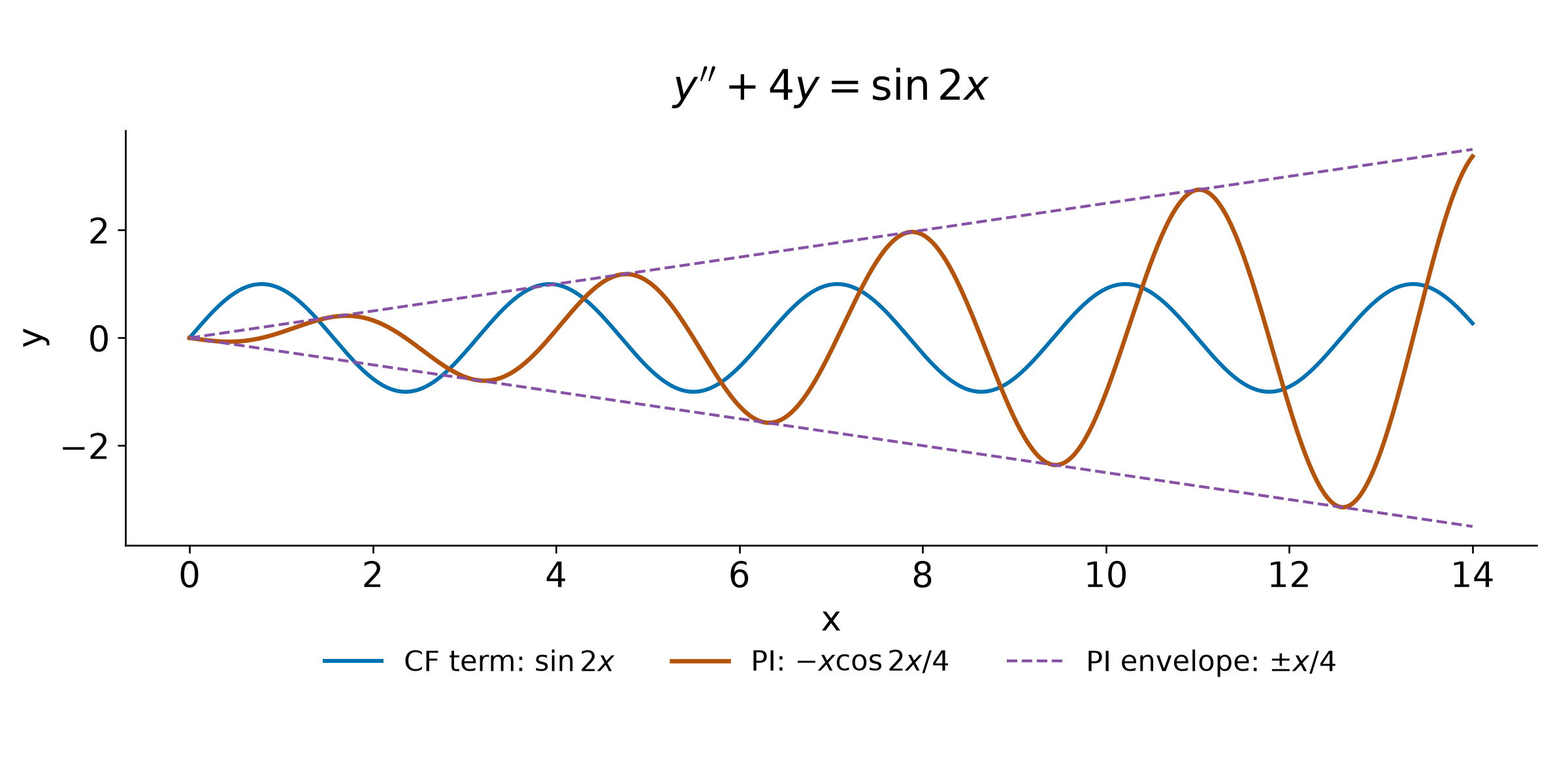
- If a trial is in the CF, applying $L$ gives zero, so no coefficient can match a non-zero right side. Multiply the trial by $x$ until it is independent of the CF. This is the resonance 共振 adjustment in the trial method.
- For $y''+4y=\sin2x$, $\sin2x$ is in the CF. Use $y_p=kx\cos2x$; substitution gives $y_p''+4y_p=-4k\sin2x$, so $k=-1/4$. Thus PI $=-x\cos2x/4$.
Count repeated overlaps before choosing the power of x
- For $y''-4y'+4y=e^{2x}$, the auxiliary root $2$ is repeated. Both $e^{2x}$ and $xe^{2x}$ already occur in the CF, so the trial is $y_p=kx^2e^{2x}$.
- Differentiating and substituting gives $y_p''-4y_p'+4y_p=2ke^{2x}$. Hence $k=1/2$ and
$$y=e^{2x}\left(A+Bx+\frac{x^2}{2}\right).$$
Use a supplied form even when it is unfamiliar
- A question may supply a PI form outside the standard polynomial/exponential/sine-cosine list. Differentiate that form, substitute into the equation and solve for its coefficients; do not guess an extra family.
- Given $y_p=k/x$ for $y''+y=2/x^3+1/x$ on $x>0$, $y_p''=2k/x^3$. Substitution gives $2k/x^3+k/x=2/x^3+1/x$, so $k=1$. The full solution is $A\cos x+B\sin x+1/x$.
Apply conditions to the complete solution
- Return to $y''+y'-2y=2x^2+3x+1$. Its complete solution is $Ae^x+Be^{-2x}-x^2-5x/2-11/4$. Differentiate before applying $y(0)=y'(0)=0$.
- The conditions give $A+B=11/4$ and $A-2B=5/2$, so $A=8/3$, $B=1/12$. Two independent conditions usually determine two constants; some boundary conditions 边界条件 can instead be inconsistent or leave a constant free.
Interpret the transient and the lasting response
- For $y''+2y'+2y=2\sin2x+6\cos2x$, the transient 暂态 term is $e^{-x}(A\cos x+B\sin x)$. It tends to zero as $x\to\infty$, whatever the finite starting constants.
- The lasting response is $y\approx\sin2x-\cos2x=\sqrt2\sin(2x-\pi/4)$. The amplitude 振幅 is $\sqrt2$, the angular frequency is $2$ and the phase lag 相位滞后 relative to $\sin2x$ is $\pi/4$. A positive auxiliary-root real part would prevent this decay argument.
Change independent variable using the chain rule
- If $x=e^t$, write $Y(t)=y(e^t)$ and $t=\ln x$, so $x>0$. The chain rule gives $Y_t=xy_x$; differentiating once more gives $Y_{tt}=xy_x+x^2y_{xx}$.
- Therefore the correct replacement is $x^2y_{xx}=Y_{tt}-Y_t$, not just $Y_{tt}$:
$$ax^2y_{xx}+bxy_x+cy=aY_{tt}+(b-a)Y_t+cY.$$
Solve the transformed equation and change back
- Use $x=e^t$ in $x^2y''-3xy'+4y=x^2$. The transformed equation is $Y_{tt}-4Y_t+4Y=e^{2t}$, with the repeated-resonance solution just found.
- Change back to the original variable before applying the stated conditions. Since $y(1)=0$ and $y'(1)=1$, $A=0$, $B=1$:
$$y=x^2\left(\ln x+\frac{(\ln x)^2}{2}\right),\qquad x>0.$$
Use y equals ux to separate variables
- Given $xy'=y+\sqrt{4x^2+y^2}$ and $y(1)=0$, work on $x>0$ and set $y=ux$. The product rule gives $y'=u+xu'$. Also $\sqrt{x^2(4+u^2)}=x\sqrt{4+u^2}$ on this interval.
- After cancelling $xu$, use separable variables 可分离变量 and integrate:
$$\begin{aligned}
xu'&=\sqrt{4+u^2},\\
\sinh^{-1}(u/2)&=\ln x+C.
\end{aligned}$$
The condition gives $C=0$, so $u=2\sinh(\ln x)=x-1/x$ and $y=x^2-1$. Check the positive square-root sign in the original equation.
A sum substitution can expose a lost solution
- Given $y'=(1+2x+2y)/(2x+2y-1)$, put $z=x+y$. Then $z'=1+y'=4z/(2z-1)$. For $z\ne0$, integrate $(1/2-1/(4z))\,dz=dx$.
- With $y(1)=0$, the local branch has $z>1/2$ and the result is
$$2(x+y)-\ln(x+y)-4x+2=0.$$
Dividing by $z$ loses the separate solution $z=0$, or $y=-x$, which does not meet this initial condition. The original equation is undefined at $z=1/2$.
Answer the model question in its own quantities
- For the tank equation $M'+M/5=2$, an integrating factor is $e^{t/5}$, giving $M=10+Ce^{-t/5}$. Initially fresh liquid means $M(0)=0$, so $M=10(1-e^{-t/5})$ grams.
- Half the limiting mass is reached at $t=5\ln2$ minutes. As $t\to\infty$, $M\to10$ grams and inflow/outflow salt rates both approach 2 grams per minute. The model assumes constant volume, fixed input and immediate uniform mixing.
Choose a method and verify the original equation
- Normalise a first-order linear equation before choosing its integrating factor. For constant coefficients, find CF, choose and check PI, add them, then apply all conditions. For a given substitution, transform derivatives as well as variables.
- Differentiate the final answer and substitute it into the original equation, check the conditions, retain the allowed interval and interpret any units, limits or model assumptions. A correct transformed equation is not yet a solution in the original variable.
Common mistakes.
- Giving only the positive solution of $\cosh x=k$: for $k>1$ there are two, $\pm\ln\!\left(k+\sqrt{k^2-1}\right)$.
- Using Osborn's rule carelessly: change the sign of every product of two sines, including those hidden in $\tanh^2x$.
- Putting eigenvectors into $\mathbf P$ in a different order from the eigenvalues in $\mathbf D$.
- Finding $\dfrac{d^2y}{dx^2}$ for parametric curves as $\dfrac{d}{dt}\left(\dfrac{dy}{dx}\right)$ without dividing by $\dfrac{dx}{dt}$.
- Losing the general root in de Moivre questions: an $n$th root problem has $n$ roots, spaced $\dfrac{2\pi}{n}$ apart.
- Forgetting to multiply the right-hand side by the integrating factor, or dropping the constant before dividing through.
- Choosing a particular integral that is already in the complementary function; then multiply the trial by $x$.
- Applying initial conditions to the complementary function alone instead of the general solution.
Explore
Differential equations
dy/dx = a y
For the separate simple equation y′=0.5y, slope is proportional to y. This widget does not model the salt tank.
Vocabulary
Train
| English |
|---|
| integrating factor/ˈɪntɪɡreɪtɪŋ ˈfæktə/ |
| general solution/ˈdʒenərəl səˈluːʃn/ |
| complementary function/ˌkɒmplɪˈmentəri ˈfʌŋkʃn/ |
| particular integral/pəˈtɪkjʊlə ˈɪntɪɡrəl/ |
| particular solution/pəˈtɪkjʊlə səˈluːʃn/ |
| separable variables/ˈsepərəbl ˈveərɪəblz/ |
| auxiliary equation/ɔːkˈsɪlɪəri ɪˈkweɪʒn/ |
| differential equation/ˌdɪfəˈrenʃl ɪˈkweɪʒn/ |
| boundary condition/ˈbaʊndəri kənˈdɪʃn/ |
| initial condition/ɪˈnɪʃl kənˈdɪʃn/ |
| function/ˈfʌŋkʃn/ |
| first-order linear equation/ˌfɜːst ˈɔːdə ˈlɪniə ɪˈkweɪʒn/ |
| resonance/ˈrezənəns/ |
| transient/ˈtrænsɪənt/ |
| amplitude/ˈæmplɪtjuːd/ |
| phase lag/ˈfeɪz læɡ/ |
2.6
Practice
Answer each before reading the answers below.
- Solve $\cosh x=2$, giving exact answers in logarithmic form.
- Starting from the exponential definitions, prove that $\cosh^2x-\sinh^2x=1$.
- Find the eigenvalues and corresponding eigenvectors of $\mathbf M=\begin{pmatrix}4&1\\2&3\end{pmatrix}$. Hence write $\mathbf M=\mathbf{PDP}^{-1}$ with $\mathbf D$ diagonal.
- A curve is given by $x=t^2$, $y=t^3$ for $t>0$. Find $\dfrac{dy}{dx}$ and $\dfrac{d^2y}{dx^2}$ in terms of $t$.
- Find the Maclaurin series of $e^x\cos x$ up to and including the term in $x^3$.
- Find (a) $\displaystyle\int\frac{1}{\sqrt{x^2+9}}\,dx$; (b) $\displaystyle\int_0^1\frac{1}{1+x^2}\,dx$.
- Let $I_n=\displaystyle\int_0^1x^ne^x\,dx$. Show that $I_n=e-nI_{n-1}$ for $n\ge1$, and hence find $I_2$ exactly.
- Use de Moivre's theorem to express $\cos3\theta$ in terms of $\cos\theta$.
- Find the three cube roots of $8i$ in the form $a+bi$.
- Solve $\dfrac{dy}{dx}+\dfrac{2y}{x}=x$ for $x>0$.
- Solve $\dfrac{d^2y}{dx^2}-3\dfrac{dy}{dx}+2y=4$, given that $y=0$ and $\dfrac{dy}{dx}=1$ when $x=0$.
2.6
Answers
- $\cosh x=2$ gives $e^{2x}-4e^x+1=0$, so $e^x=2\pm\sqrt3$ and $x=\pm\ln(2+\sqrt3)$ (since $\ln(2-\sqrt3)=-\ln(2+\sqrt3)$).
- $\cosh^2x-\sinh^2x=\tfrac14\big(e^{2x}+2+e^{-2x}\big)-\tfrac14\big(e^{2x}-2+e^{-2x}\big)=\tfrac44=1$.
- $\lambda^2-7\lambda+10=0$, so $\lambda=2$ or $5$. For $\lambda=5$: $-x+y=0$, eigenvector $\begin{pmatrix}1\\1\end{pmatrix}$. For $\lambda=2$: $2x+y=0$, eigenvector $\begin{pmatrix}1\\-2\end{pmatrix}$. $\mathbf P=\begin{pmatrix}1&1\\1&-2\end{pmatrix}$, $\mathbf D=\begin{pmatrix}5&0\\0&2\end{pmatrix}$; the columns of $\mathbf P$ must be in the same order as the eigenvalues in $\mathbf D$.
- $\dfrac{dy}{dx}=\dfrac{3t^2}{2t}=\dfrac{3t}{2}$. $\dfrac{d^2y}{dx^2}=\dfrac{d}{dt}\left(\dfrac{3t}{2}\right)\div\dfrac{dx}{dt}=\dfrac{3/2}{2t}=\dfrac{3}{4t}$.
- $\left(1+x+\tfrac{x^2}{2}+\tfrac{x^3}{6}\right)\left(1-\tfrac{x^2}{2}\right)=1+x+\left(\tfrac12-\tfrac12\right)x^2+\left(\tfrac16-\tfrac12\right)x^3=1+x-\tfrac13x^3$.
- (a) $\sinh^{-1}\!\left(\dfrac x3\right)+c$, or $\ln\!\left(x+\sqrt{x^2+9}\right)+c$. (b) $\big[\tan^{-1}x\big]_0^1=\dfrac\pi4$.
- By parts with $u=x^n$, $dv=e^x\,dx$: $I_n=\big[x^ne^x\big]_0^1-n\displaystyle\int_0^1x^{n-1}e^x\,dx=e-nI_{n-1}$. $I_0=e-1$, $I_1=e-(e-1)=1$, $I_2=e-2(1)=e-2$.
- $\cos3\theta=\operatorname{Re}(\cos\theta+i\sin\theta)^3=c^3-3cs^2$ with $c=\cos\theta$, $s=\sin\theta$. Using $s^2=1-c^2$: $\cos3\theta=4\cos^3\theta-3\cos\theta$.
- $8i=8e^{i\pi/2}$. The roots are $2e^{i(\pi/6+2k\pi/3)}$ for $k=0,1,2$: arguments $\tfrac\pi6$, $\tfrac{5\pi}6$, $\tfrac{3\pi}2$, giving $\sqrt3+i$, $-\sqrt3+i$ and $-2i$.
- Integrating factor $e^{\int2/x\,dx}=x^2$. Then $\dfrac{d}{dx}(x^2y)=x^3$, so $x^2y=\tfrac14x^4+c$ and $y=\tfrac14x^2+\dfrac{c}{x^2}$.
- Auxiliary equation $m^2-3m+2=0$, so $m=1,2$: complementary function $Ae^x+Be^{2x}$. A constant particular integral $y=k$ gives $2k=4$, so $k=2$. $y=Ae^x+Be^{2x}+2$. Then $A+B+2=0$ and $A+2B=1$, so $B=3$, $A=-5$: $y=-5e^x+3e^{2x}+2$.
2.6
Exam tips
- Learn the hyperbolic identities and derivatives, and use the inverse hyperbolic functions in integration.
- Solve a linear differential equation as complementary function $+$ particular integral, then apply the boundary conditions.
- Use de Moivre's theorem for powers and roots of complex numbers and to derive trigonometric identities.
- Reduce an integral to a standard form by a stated substitution.
Interactive lessons on this topic
Work through it step by step, with instant-check exercises.