Circular motion
Introduced| English | Meaning |
|---|---|
| inertia/ɪˈnɜːʃə/ | The tendency of a body to keep its velocity unchanged unless a resultant force acts. |
| centrifugal/ˌsentrɪˈfjuːɡl/ | Describing an apparent outward force used in a rotating frame; it is not an extra physical interaction in a ground-fixed inertial frame. |
| angular speed/ˈæŋɡjʊlə spiːd/ | The rate of turning, measured in radians per second. |
| radian/ˈreɪdɪən/ | The angle subtended at a circle centre by an arc whose length equals the radius. |
| linear speed/ˈlɪnɪə spiːd/ | Distance travelled along a path per unit time; on a circle it equals radius times angular speed. |
| period/ˈpɪərɪəd/ | The time for one complete cycle or revolution. |
| frequency/ˈfriːkwənsi/ | The number of complete cycles or revolutions per second. |
| tangent/ˈtændʒənt/ | A line touching a smooth curve with its local direction; a particle’s instantaneous velocity follows the tangent to its path. |
| radial/ˈreɪdɪəl/ | Along a radius, towards or away from the centre. |
| centripetal acceleration/senˈtrɪpɪtl əkˌseləˈreɪʃn/ | The inward radial component of acceleration in circular motion, equal to speed squared divided by radius; at constant speed it is the whole acceleration. |
| tangential/tænˈdʒenʃl/ | Along the tangent to a path; tangential acceleration changes speed. |
| vertical circle/ˈvɜːtɪkl ˈsɜːkl/ | A circular path in a vertical plane; under gravity and without energy loss, speed changes with height. |
| free-body diagram/friː ˈbɒdi ˈdaɪəɡræm/ | A diagram showing all external forces acting on a selected object. |
| centripetal force/senˈtrɪpɪtl fɔːs/ | The net inward force required for circular motion, supplied by actual force components rather than an additional interaction. |
| tension/ˈtenʃn/ | The pulling force along a taut string, rope or cable. |
| horizontal circle/ˌhɒrɪˈzɒntl ˈsɜːkl/ | A circular path in a horizontal plane; the path alone does not imply constant speed. |
| normal reaction/ˈnɔːml rɪˈækʃn/ | The contact force component perpendicular to a surface. |
| limiting friction/ˈlɪmɪtɪŋ ˈfrɪkʃn/ | The greatest available static friction for the stated normal force. |
| conical pendulum/ˈkɒnɪkl ˈpendjʊləm/ | A mass moving in a horizontal circle while its supporting string keeps a fixed angle with the vertical. |
| energy conservation/ˈenədʒi ˌkɒnsəˈveɪʃn/ | A rule stating that energy is not created or destroyed; in a lossless mechanical model, kinetic plus potential energy is constant. |
| taut/tɔːt/ | Stretched tight; an elastic string can pull only when extended and cannot supply a negative tension. |
| slack/slæk/ | Loose rather than stretched tight, so a string supplies no tension. |
| normal contact force/ˈnɔːml ˈkɒntækt fɔːs/ | The pushing contact-force component perpendicular to a surface. |
| loss of contact/lɒs ɒv ˈkɒntækt/ | Separation from a surface when the required contact force cannot be supplied; on a smooth continuing surface, test the zero-normal-reaction boundary. |
A turn needs a change in velocity
- A ball on a string changes direction even when its speed stays the same. The string pulls the ball inwards. Your hand feels the ball's pull outwards: those two forces act on different objects.
- In a frame fixed to the ground, draw the real forces on the ball. Its inertia 惯性 does not supply an extra outward force. The name centrifugal 离心 force belongs to a rotating-frame description, which we do not need here.
A ball moves on a string. The string pulls the ball inwards, while the ball pulls your hand outwards. Do these two forces cancel in the ball’s free-body diagram?
Compare your force diagram, geometry and calculations with the model. Check the constraint before accepting the motion.
Link angular speed to distance along the circle
- An angle of $\theta$ radians 弧度 sweeps arc length $s=r\theta$. For fixed radius, angular speed 角速度 is the rate of turning; linear speed 线速度 is distance travelled per second.
- Therefore $v=r\omega$. A point farther from the axis has greater speed at the same $\omega$. Use radians per second in this formula; degrees per second must first be multiplied by $\pi/180$.
Angle in radians
Circular motion is measured in radians: drag the angle θ and radius r to see the arc swept — angular speed ω turns this into v = rω.
A particle moves in a circle of radius 2 m with angular speed 3 rad/s. What is its speed v = rω (m/s)?
Difficulty 2/5 · 140 coins + a small bonus on first completion today
v = rω = 2 × 3 = 6 m/s.
Linear speed and angular speed are related by v = r ______.
Difficulty 1/5 · 100 coins + a small bonus on first completion today
v = rω.
Convert a period or a revolution rate
- The period 周期 $\tau$ is the time for one full turn. The frequency 频率 $f$ is turns per second. Hence $\omega=2\pi/\tau=2\pi f$.
- At $30$ revolutions per minute, $f=1/2$ turn per second and $\omega=\pi\ \dfrac{\text{rad}}{\text{s}}$. At radius $0.4\ \text{m}$, $v=0.4\pi\ \dfrac{\text{m}}{\text{s}}$. Do not put $30$ straight into $v=r\omega$.
A point is 0.6 m from a rotating axis. It makes 20 revolutions per minute at constant speed. Find angular speed, linear speed and period.
Compare your force diagram, geometry and calculations with the model. Check the constraint before accepting the motion.
Separate inward acceleration from changing speed
- Velocity is along the tangent 切线. The radial 径向 component of acceleration points towards the centre and has magnitude $a_r=v^2/r=r\omega^2$. This inward component is the centripetal acceleration 向心加速度. A proof of the acceleration formulae is not required here.
- At constant speed this is the whole acceleration. If speed changes, there is also a tangential 切向 component. In a vertical circle under gravity, the full acceleration need not point exactly towards the centre.
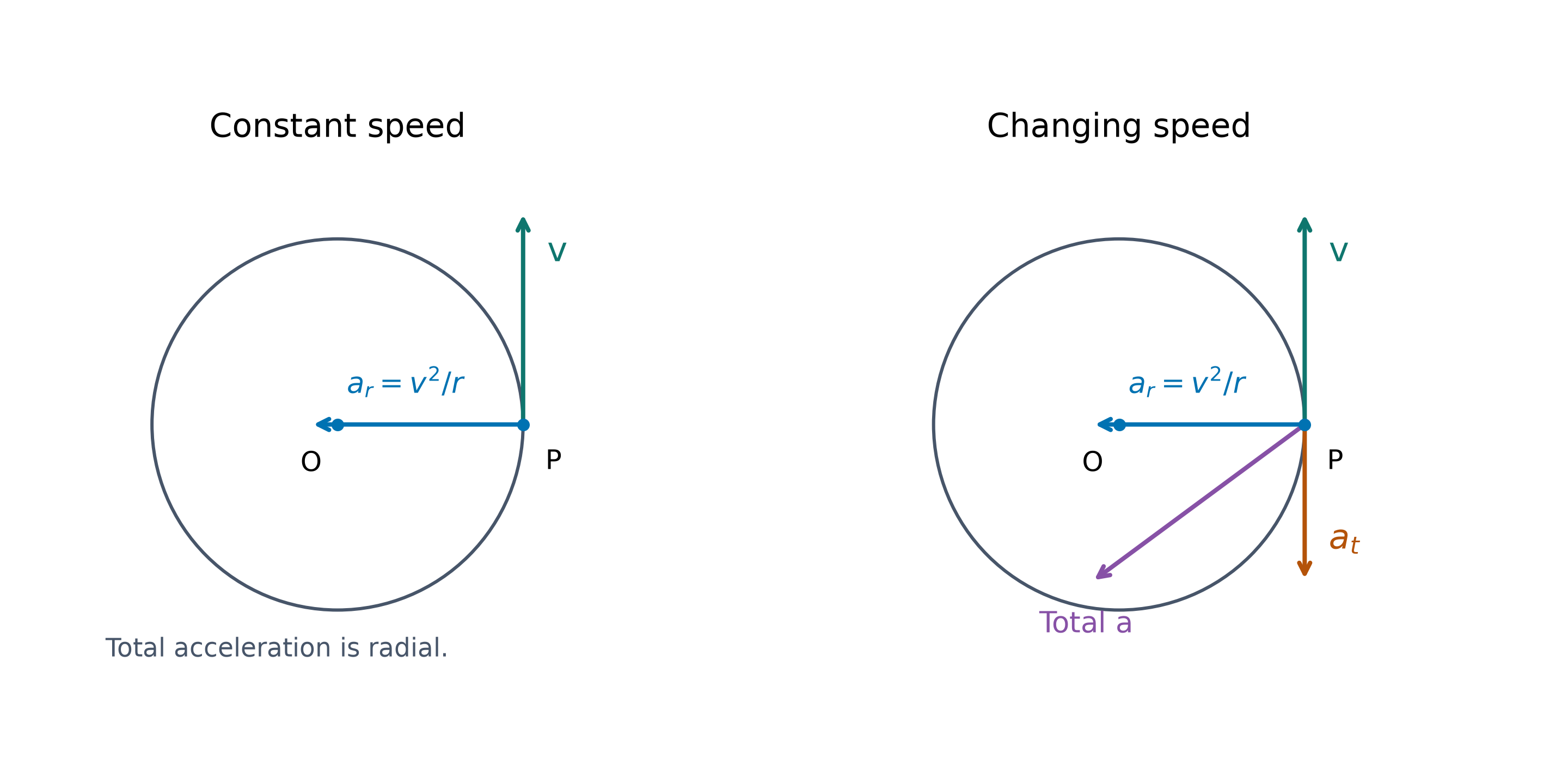
The centripetal acceleration of a particle in circular motion points:
Difficulty 1/5 · 100 coins + a small bonus on first completion today
It points to the centre — that is what continually changes the direction of motion.
The velocity of a particle in circular motion points towards the centre of the circle.
Difficulty 1/5 · 100 coins + a small bonus on first completion today
False. Velocity is tangent to the circle. The radial component of acceleration points towards the centre; if speed changes, a tangential component is also present.
At the side of a vertical circle, a particle is moving upwards on a string under gravity. Is its full acceleration necessarily directed exactly towards the centre?
Compare your force diagram, geometry and calculations with the model. Check the constraint before accepting the motion.
Use both forms of the acceleration formula
- For $r=2\ \text{m}$ and constant $\omega=3\ \dfrac{\text{rad}}{\text{s}}$, the speed is $v=2(3)=6\ \dfrac{\text{m}}{\text{s}}$ and $a_r=2(3^2)=18\ \dfrac{\text{m}}{\text{s}^2}$.
- Checking with $v^2/r=6^2/2=18$ gives the same result. At fixed speed, doubling the radius halves $a_r$; at fixed angular speed, doubling the radius doubles it. State which quantity is fixed.
A particle moves at constant angular speed 3 rad/s in a circle of radius 2 m. Find its centripetal acceleration (m/s²).
Difficulty 2/5 · 140 coins + a small bonus on first completion today
a = rω² = 2 × 9 = 18 m/s².
A particle moves at constant angular speed 2 radians per second in a circle of radius 4 m. Find its speed and acceleration. Explain why a ground-frame force diagram needs no extra centrifugal-force arrow.
Speed is r omega. Centripetal acceleration is r omega squared, toward the centre.
Compare radial acceleration when the radius is tripled: first keeping speed fixed, then keeping angular speed fixed.
Compare your force diagram, geometry and calculations with the model. Check the constraint before accepting the motion.
Resolve real forces towards the centre
- Draw a free-body diagram 受力图 and choose inwards as positive. Newton's law gives $\sum F_{\rm inward}=mv^2/r$. A centripetal force 向心力 is the inward resultant needed for the motion, not another arrow to add beside weight, tension or contact forces.
- A horizontal circle 水平圆 need not have constant speed. In this syllabus's steady horizontal-circle problems, vertical acceleration and tangential acceleration are zero; the inward acceleration is not zero. Resolve vertically and radially as separate equations.
A bob’s inward resultant is supplied by components of tension and weight. A student adds a third force labelled mv²/r towards the centre. Explain the error.
Compare your force diagram, geometry and calculations with the model. Check the constraint before accepting the motion.
Friction can provide the inward resultant
- A particle on a rough horizontal rotating disc has normal reaction 法向反力 $N=mg$. If friction is the only horizontal force, the required friction is $F_f=mr\omega^2$. It must satisfy $F_f\leq\mu N$.
- Therefore $\omega^2\leq\mu g/r$. For $r=1.2\ \text{m}$, $\mu=0.3$ and $g=10\ \dfrac{\text{m}}{\text{s}^2}$, the greatest angular speed is $\sqrt{2.5}\ \dfrac{\text{rad}}{\text{s}}$, about $15.1$ revolutions per minute. Below the limit, friction is not automatically $\mu N$.
A particle at radius 2 m on a rough horizontal disc has coefficient of friction 0.4. Take g = 10 m/s². With no other horizontal force, find the greatest angular speed and linear speed before slipping.
Compare your force diagram, geometry and calculations with the model. Check the constraint before accepting the motion.
An inclined string changes the disc reaction
- A $2\ \text{kg}$ particle moves at radius $1.5\ \text{m}$ on a rough disc. A string pulls towards a point above the axis, with tension 张力 $T=10\ \text{N}$, $\sin\alpha=3/5$ and $\cos\alpha=4/5$, where $\alpha$ is measured from vertical. Take $g=10\ \dfrac{\text{m}}{\text{s}^2}$.
- Vertical balance gives $N=20-10(4/5)=12\ \text{N}$. With $\mu=1/4$ and impending outward slipping, limiting friction 最大静摩擦 is $3\ \text{N}$ inwards. Thus $10(3/5)+3=2(1.5)\omega^2$, giving $\omega=\sqrt3\ \dfrac{\text{rad}}{\text{s}}$.
A 1 kg particle at radius 1 m on a rough horizontal disc is pulled towards a point above its centre by tension 5 N. The string makes angle α with vertical, with sin α = 3/5 and cos α = 4/5. Take g = 10 m/s² and μ = 0.5. Find the angular speed for impending outward slipping.
Compare your force diagram, geometry and calculations with the model. Check the constraint before accepting the motion.
Friction may reverse when the speed changes
- Keep that particle, tension and geometry fixed. The string already supplies $6\ \text{N}$ inwards. Required signed inward friction is $F_f=3\omega^2-6$, while $|F_f|\leq3$.
- Hence $1\leq\omega^2\leq3$. At the lower limit friction acts outwards to reduce the inward resultant; at the upper limit it acts inwards. An outward real friction force is possible even though the net radial force is inwards.

A 2 kg particle moves at radius 2 m on a rough disc. An inclined string has tension 10 N, sin α = 3/5 and cos α = 4/5 from vertical. Take g = 10 m/s² and μ = 1/4. Find the possible interval for ω² and where friction changes direction.
Compare your force diagram, geometry and calculations with the model. Check the constraint before accepting the motion.
A conical pendulum has two useful directions
- A conical pendulum 圆锥摆 has a light inextensible string of length $L$ making angle $\theta$ with the vertical. Its orbit radius is $r=L\sin\theta$, not $L$. The bob stays at one height.
- Resolve tension: $T\cos\theta=mg$ and $T\sin\theta=mr\omega^2$. For a non-zero orbit, substitution gives $\omega^2=g/(L\cos\theta)$. The tension has both vertical and inward components.
Find the orbit before finding its speed
- Let $L=2.5\ \text{m}$, $m=0.4\ \text{kg}$, $\cos\theta=4/5$, $\sin\theta=3/5$ and $g=10\ \dfrac{\text{m}}{\text{s}^2}$. Then $r=1.5\ \text{m}$ and $T=mg/\cos\theta=5\ \text{N}$.
- Now $\omega^2=10/[2.5(4/5)]=5$, so $v=1.5\sqrt5\ \dfrac{\text{m}}{\text{s}}$ and the period is $2\pi/\sqrt5\ \text{s}$. Using the string length as the orbit radius would give the wrong speed.
A conical pendulum has string length 5 m, bob mass 0.3 kg and cos θ = 3/5, with θ measured from vertical. Take g = 10 m/s². Find orbit radius, tension, angular speed and linear speed.
Compare your force diagram, geometry and calculations with the model. Check the constraint before accepting the motion.
A second particle can fix the tension
- A string of total length $9a$ passes through a fixed smooth ring $R$. Particle $A$ of mass $2m$ hangs below it. Particle $B$ of mass $m$ moves in a horizontal circle whose centre is $A$. Let $RB=L$ and let $RB$ make angle $\theta$ with the vertical.
- For $A$, $T=2mg$. For $B$, $T\cos\theta=mg$, so $\cos\theta=1/2$. Geometry gives $RA=L\cos\theta=L/2$ and $RA+RB=9a$, so $L=6a$. Then $\omega^2=g/(L\cos\theta)=g/(3a)$.
A string of total length 8a passes through a fixed smooth ring. Mass 3m hangs vertically below the ring. Mass m at the other end moves in a horizontal circle centred on the hanging mass. Find the sloping length, cos θ and ω², where θ is from vertical.
Compare your force diagram, geometry and calculations with the model. Check the constraint before accepting the motion.
A bowl radius is not the orbit radius
- On the smooth inner surface of a hemispherical bowl of radius $a$, let the normal make angle $\theta$ with upward vertical. The orbit radius is $a\sin\theta$. Vertical and inward equations are $N\cos\theta=mg$ and $N\sin\theta=m(a\sin\theta)\omega^2$.
- Therefore $\omega^2=g/(a\cos\theta)$. If $\cos\theta$ changes from $4/5$ to $5/13$, the angular-speed ratio is $\omega_1/\omega_2=\sqrt{(5/13)/(4/5)}=5/(2\sqrt{13})$. Compare squared speeds first, then take the square root.
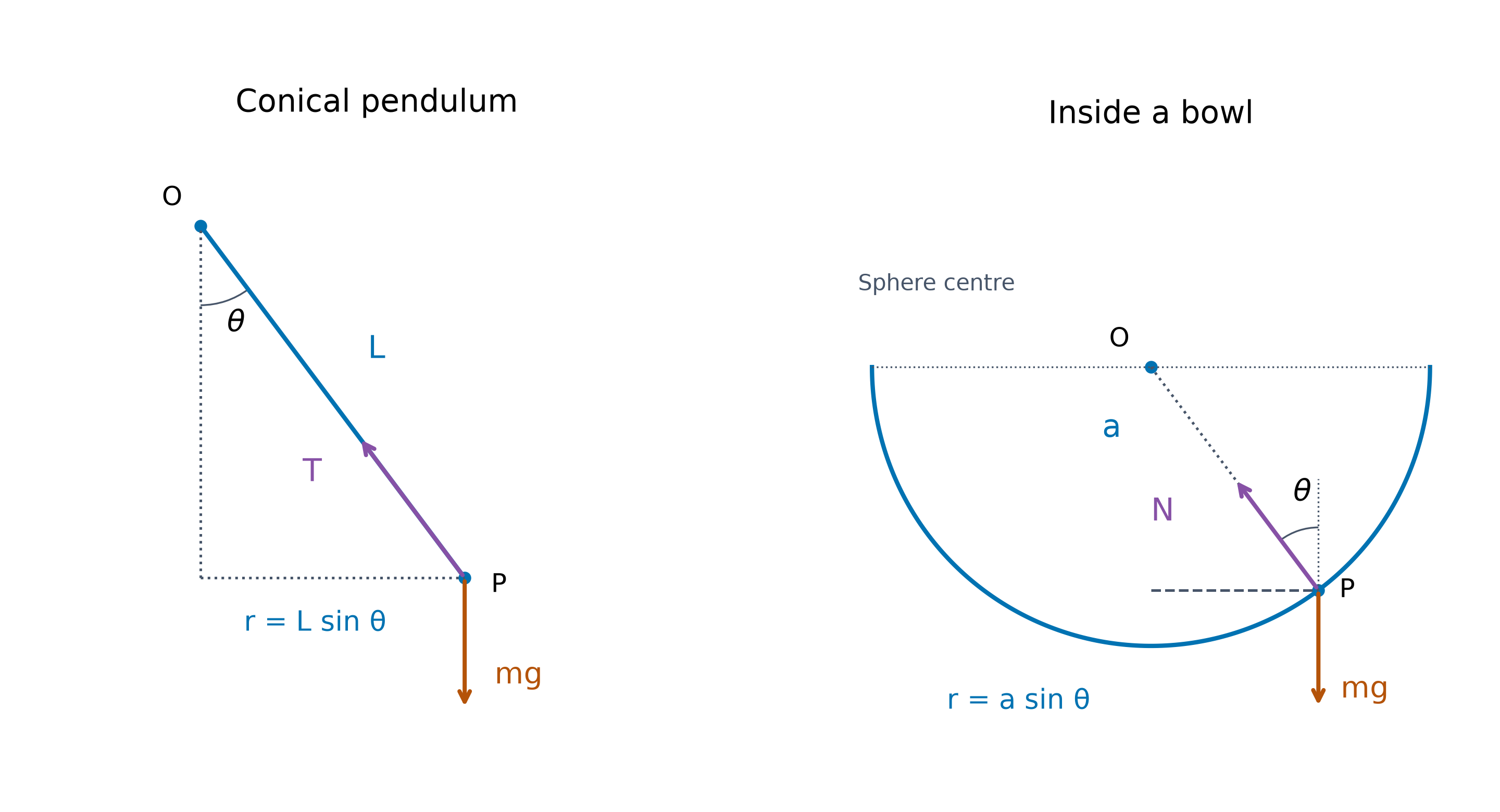
A particle moves steadily on the smooth inner surface of a hemispherical bowl of radius a. The normal’s angle from upward vertical changes from cos θ₁ = 3/5 to cos θ₂ = 5/13. Find ω₁/ω₂.
Compare your force diagram, geometry and calculations with the model. Check the constraint before accepting the motion.
A cone needs its own geometry
- A smooth hollow cone has its vertex downwards and semi-vertical angle $\alpha$. At height $h$ above the vertex the orbit radius is $r=h\tan\alpha$. The normal points upwards and inwards, making angle $\alpha$ above horizontal.
- With only gravity and contact, $N\sin\alpha=mg$ and $N\cos\alpha=mr\omega^2$. These give $\omega^2=g\cot^2\alpha/h$. A cone's radius is set by height; do not borrow the bowl's radius formula.
A particle of mass m moves steadily inside a smooth cone whose vertex points downwards. The semi-vertical angle has tan α = 3/4, and the particle is at height h above the vertex. Only gravity and contact act. Find the normal reaction and ω².
Compare your force diagram, geometry and calculations with the model. Check the constraint before accepting the motion.
Add a string through the cone vertex
- Now attach the particle of mass $m$ to another mass $m$ hanging below the vertex through a smooth hole. The string pulls down the sloping surface towards the vertex. Take $\tan\alpha=4/3$, so $\sin\alpha=4/5$, $\cos\alpha=3/5$ and $r=4h/3$.
- The hanging mass gives $T=mg$. Then $N(4/5)=mg+T(3/5)$ gives $N=2mg$. Radially, $N(3/5)+T(4/5)=mr\omega^2$, hence $\omega^2=3g/(2h)$. The string's downward component increases the reaction.

In a smooth cone with vertex downwards and tan α = 3/4, mass m moves in a horizontal circle at height h. It is attached by a string through a smooth hole at the vertex to a hanging mass 2m in equilibrium. Find the tension, normal reaction and ω².
Compare your force diagram, geometry and calculations with the model. Check the constraint before accepting the motion.
Measure height in a vertical circle
- For a vertical circle 竖直圆 of radius $r$, take angle $\theta$ from the downward vertical and measure height from the bottom. At the right-hand point of the circle, $x=r\sin\theta$ and height $h=r(1-\cos\theta)$.
- At the bottom $\theta=0$ and $h=0$; at the side $\theta=\pi/2$ and $h=r$; at the top $\theta=\pi$ and $h=2r$. Mark the angle's reference direction before writing an energy equation.
In a vertical circle of radius r, θ is measured from downward vertical and cos θ = −3/5. Find height above the bottom. Explain why it exceeds r.
Compare your force diagram, geometry and calculations with the model. Check the constraint before accepting the motion.
Energy gives the speed at each height
- For a light inextensible string or a fixed smooth circular surface, the constraint force is perpendicular to velocity and does no work. With no resistance, energy conservation 能量守恒 gives $\tfrac12mu^2=\tfrac12mv^2+mgr(1-\cos\theta)$, where $u$ is bottom speed.
- Therefore $v^2=u^2-2gr(1-\cos\theta)$. This formula applies while the particle follows the circle. It finds speed, not tension; and $v^2\geq0$ alone does not prove the circular path is possible.
For lossless motion under gravity in a vertical circle, the speed changes with height. Alongside the inward force equation, use:
Difficulty 1/5 · 100 coins + a small bonus on first completion today
Height changes, so gravitational PE ↔ KE: use energy conservation alongside the circular-motion equations.
A particle on a light inextensible string has bottom squared speed 8gr. At an angle θ from downward vertical, cos θ = 1/4. Assume no resistance and a taut string. Find its squared speed there.
Compare your force diagram, geometry and calculations with the model. Check the constraint before accepting the motion.
Take inward components of weight and tension
- For a string pulling towards the centre, the inward equation is $T-mg\cos\theta=mv^2/r$. At the bottom, weight acts outwards; at the top, weight acts inwards. The changing sign is already in $\cos\theta$.
- Combining with energy gives $T/m=u^2/r-2g+3g\cos\theta$. At the bottom $T=mu^2/r+mg$; at the top $T=m(u^2/r-5g)$. These tensions use different speeds at the two heights.
A 0.5 kg particle moves in a vertical circle of radius 2 m on a light inextensible string. Its bottom squared speed is 120 m²/s² and top squared speed is 40 m²/s². Take g = 10 m/s². Find the tensions at the bottom and top.
Compare your force diagram, geometry and calculations with the model. Check the constraint before accepting the motion.
Work from a specified bottom speed
- Suppose $u^2=6gr$. At $\cos\theta=1/2$, energy gives $v^2=5gr$, and the inward equation gives $T=5mg+mg/2=11mg/2$.
- At the bottom the tension is $7mg$; at the top it is $mg$. The particle moves fastest and needs the greatest tension at the bottom. In between, gravity also changes its speed, so the full acceleration has a tangential component.

A particle of mass m moves on a string of length r with bottom squared speed 7gr. Find squared speed and tension where θ from downward vertical has cos θ = −1/2. Also find the greatest and least tensions.
Compare your force diagram, geometry and calculations with the model. Check the constraint before accepting the motion.
A complete loop needs a feasible top force
- A string can pull, not push: a taut 绷紧 string needs $T\geq0$. The top has the least tension. There $T+mg=mv_{\rm top}^2/r$, so $v_{\rm top}^2\geq gr$. Energy then gives the complete-loop condition $u^2\geq5gr$.
- Equality is the limiting complete loop, with zero tension at the top. Merely reaching top height by energy would require $u^2\geq4gr$; that weaker test allows a negative calculated tension before the top. The string would already have gone slack 松弛.
A string has length 0.8 m. Take g = 10 m/s². Find the least bottom speed for a complete vertical loop and the top speed at that limit. Explain why an energy-only top-height test is too weak.
Compare your force diagram, geometry and calculations with the model. Check the constraint before accepting the motion.
Start at a point other than the bottom
- If the starting radius makes angle $\phi$ with the upward vertical, its height above the bottom is $r(1+\cos\phi)$. The climb to the top is $r(1-\cos\phi)$.
- A complete loop requires $v^2\geq gr+2gr(1-\cos\phi)=gr(3-2\cos\phi)$. At $\cos\phi=1/4$, the minimum starting squared speed is $5gr/2$. At equality the bottom squared speed is $5gr$ and the greatest tension is $6mg$.
A particle starts on a string of length r with its radius making angle φ from upward vertical, where cos φ = 2/5. Find the least starting squared speed for a complete loop and the greatest tension at that limit.
Compare your force diagram, geometry and calculations with the model. Check the constraint before accepting the motion.
Use a tension ratio with two energy states
- In a complete loop, bottom tension exceeds top tension by $6mg$. If their ratio is $9:1$, write $T_{\rm bottom}=9T_{\rm top}$. Then $T_{\rm top}=3mg/4$, so $v_{\rm top}^2=7gr/4$ and bottom squared speed is $23gr/4$.
- If the speed at angle $\theta$ from downward vertical is $\sqrt{4gr}$, energy gives $4gr=23gr/4-2gr+2gr\cos\theta$. Thus $\cos\theta=1/8$. Equal top and bottom speeds would violate energy conservation.
A particle makes complete vertical circles on a string of length r. Greatest tension is five times least tension. At angle θ from downward vertical its squared speed is 5gr. Find cos θ.
Compare your force diagram, geometry and calculations with the model. Check the constraint before accepting the motion.
A turning point and a slack point are different
- If bottom squared speed is $gr$, the equation $v=0$ gives $\cos\theta=1/2$: the particle turns back at $60^\circ$, with tension $mg/2>0$. It never reaches the horizontal level.
- If bottom squared speed is $3gr$, the equation $T=0$ instead gives $\cos\theta=-1/3$, about $109.5^\circ$. Here $v^2=gr/3>0$: the string slackens while the particle is still moving. Stop using the string's circular-motion equation beyond this point.
Compare two upward journeys on a light string of length r. Bottom squared speed is 3gr/2 in case A and 4gr in case B. Find the first turning or slack point and the speed or tension needed to identify each event.
Compare your force diagram, geometry and calculations with the model. Check the constraint before accepting the motion.
An inner surface can push only inwards
- On the smooth inner surface of a spherical shell, the normal reaction, or normal contact force 法向接触力 $N$, points towards the sphere centre. Its radial equation is $N-mg\cos\theta=mv^2/r$ with $\theta$ measured from downward vertical.
- The same energy and complete-loop results apply, replacing $T$ by $N$. Require $N\geq0$; a negative answer means the surface would have to pull. For loss of contact 脱离接触, test the boundary $N=0$: the particle leaves if continuing the circle would require $N<0$. A limiting complete loop can have $N=0$ at the top without separating.

A particle makes vertical circles on the smooth inside of a sphere of radius r. At the top its squared speed is 2gr. Find the top and bottom reactions, and decide whether contact is maintained throughout.
Compare your force diagram, geometry and calculations with the model. Check the constraint before accepting the motion.
A reaction ratio can locate a rim
- A particle starts vertically downwards from the side of a smooth inner shell with squared speed $u^2=2gr$. A rim is at height $kr$ above the centre. At the start, $N_A=mu^2/r=2mg$; at the rim, energy gives $v_B^2=(2-2k)gr$.
- The inward weight component there is $mgk$, so $N_B/m=v_B^2/r-gk=(2-3k)g$. If $N_B=N_A/4$, then $k=1/2$. Keeping contact as far as this rim requires $u^2\geq3gr/2$, not just the energy test $u^2\geq gr$.
A particle starts vertically downwards from the side of a smooth inner shell of radius r with squared speed 9gr/5. At a rim height kr above the centre, its normal reaction is one-third of the starting reaction. Find k and check contact there.
Compare your force diagram, geometry and calculations with the model. Check the constraint before accepting the motion.
An outer surface has the opposite normal direction
- A particle starts at the top of a smooth fixed sphere with tangential squared speed $gr/2$. Let $\phi$ be its angle from upward vertical. Energy gives $v^2=gr/2+2gr(1-\cos\phi)$.
- On the outside, the normal points outwards. The inward equation is $mg\cos\phi-N=mv^2/r$, giving $N=mg(3\cos\phi-5/2)$. It loses contact at $\cos\phi=5/6$, with $v^2=5gr/6>0$. Do not copy the inner-surface sign.
A particle starts tangentially at the top of a smooth sphere of radius r with squared speed gr/5, on its outside. Find cos φ at loss of contact, where φ is measured from upward vertical. Find its squared speed then.
Compare your force diagram, geometry and calculations with the model. Check the constraint before accepting the motion.
Release gives a tangent velocity, then a curved path
- At release, position and velocity remain continuous. The initial free-flight velocity is tangent to the circle. Gravity still acts, so the later path is a projectile parabola, not a straight tangent line.
- For the string that slackens at $\cos\theta=-1/3$ with bottom squared speed $3gr$, take centre $O$ as origin. At release, $(x,y)=(2\sqrt2r/3,r/3)$ and speed is $\sqrt{gr/3}$. On the upward trip along the right side, velocity components are $(-v/3,2\sqrt2v/3)$.

A string of length r slackens on the upward trip along the right side of a vertical circle at cos θ = −2/3, with θ from downward vertical. Speed is v. With the centre as origin, find release position and velocity components; describe the next path.
Compare your force diagram, geometry and calculations with the model. Check the constraint before accepting the motion.
Join circular motion to a flight across a rim
- Cut an inner shell at height $r/2$ above its centre. To fly from the right rim to the left rim at the same height, let speed at release be $v$. The horizontal gap is $\sqrt3r$; velocity components are $(-v/2,\sqrt3v/2)$.
- The non-zero return time is $t=\sqrt3v/g$. Horizontal motion gives $\sqrt3r=(v/2)t$, so $v^2=2gr$. If the launch began at the side at centre height, energy gives side squared speed $u^2=3gr$. The rim reaction just before exit is $3mg/2>0$: the surface ends before contact is lost.

A smooth inner shell of radius r ends at a horizontal rim r/3 above its centre. A particle leaves the right rim tangentially, rising leftwards, and reaches the left rim at the same height. Find release squared speed and the side-level starting squared speed.
Compare your force diagram, geometry and calculations with the model. Check the constraint before accepting the motion.
Check the model before accepting a root
- Draw forces and identify the orbit radius. For steady horizontal motion, resolve vertically and inwards. For vertical motion, combine height-based energy with one inward force equation. Check $v^2\geq0$ and the sign of tension or reaction along the route.
- State which event happens first: a turning point, slack string, loss of contact, or the end of the surface. Then use the next model. A collision changes the motion through an impulse; do not carry the no-loss circular energy equation through an impact without a separate collision argument.
A particle starts at the bottom of a vertical circle on a string of length r with squared speed 9gr/2. Energy predicts enough speed to reach top height. Does it complete the circle? Find the first constraint failure.
Compare your force diagram, geometry and calculations with the model. Check the constraint before accepting the motion.
Keep the direction and constraint together
- $v=r\omega$ links speed and angular speed; $a_r=v^2/r$ is the inward component of acceleration. The inward resultant comes from real forces. A horizontal path alone does not guarantee constant speed.
- For a light inextensible string in a lossless vertical loop, bottom squared speed must be at least $5gr$. At a zero-tension or zero-reaction boundary, test whether the constraint can continue. If release occurs, its velocity is initially tangent; gravity controls the following flight.
A particle has orbit radius 4 m and constant angular speed 2 rad/s. What is its speed?
Difficulty 1/5 · 100 coins + a small bonus on first completion today
Use the orbit radius: v = rω = 4 × 2 = 8 m/s. The value 16 m/s² is its radial acceleration, not a speed.
A particle of mass m moves steadily on the smooth inside of a hemispherical bowl of radius 2 m. The normal makes 60° with upward vertical. Take g = 10 m/s². Find its orbit radius, normal reaction, angular speed and linear speed.
Compare your force diagram, geometry and calculations with the model. Check the constraint before accepting the motion.