Momentum (Further Mechanics)
Introduced| English | Meaning |
|---|---|
| collision/kəˈlɪʒn/ | A short contact event in which objects exert impulses on one another. |
| momentum/məʊˈmentəm/ | A vector equal to mass times velocity; its component has the velocity component’s sign. |
| linear momentum/ˈlɪnɪə məʊˈmentəm/ | The vector mass times velocity, distinguished from angular momentum. |
| conservation of linear momentum/ˌkɒnsəˈveɪʃn ɒv ˈlɪnɪə məʊˈmentəm/ | The vector total of mass times velocity is unchanged for a system with zero external impulse; a component is conserved when the external impulse in that direction is zero. |
| conservation of momentum/ˌkɒnsəˈveɪʃn ɒv məʊˈmentəm/ | The total momentum of a system stays constant when its resultant external impulse is zero. |
| line of impact/laɪn ɒv ˈɪmpækt/ | The normal direction of the collision impulse; for two smooth spheres it joins their centres at contact. |
| line of centres/laɪn ɒv ˈsentəz/ | The straight line through both sphere centres; it is the impact normal at smooth contact. |
| direct impact/daɪˈrekt ˈɪmpækt/ | An impact in which the objects move along the contact normal. |
| oblique impact/əˈbliːk ˈɪmpækt/ | An impact in which motion also has a component tangent to the contact surface. |
| Newton's experimental law/ˈnjuːtnz ekˌsperɪˈmentl lɔː/ | The normal relative speed of separation equals restitution times the normal relative speed of approach. |
| coefficient of restitution/ˌkəʊɪˈfɪʃənt ɒv rɪstɪˈtjuːʃn/ | The ratio of normal relative separation speed to normal relative approach speed in an impact; between zero and one in this model. |
| perfectly elastic/ˈpɜːfektlɪ ɪˈlæstɪk/ | Describing an ideal impact with restitution one and no kinetic-energy loss. |
| kinetic energy/kɪˈnetɪk ˈenədʒi/ | Energy of motion, equal to half the mass times the squared speed. |
| inelastic/ɪnɪˈlæstɪk/ | In this syllabus endpoint, an impact with restitution zero and equal final normal velocities; oblique tangent velocities may still differ. |
| perfectly inelastic/ˈpɜːfektlɪ ɪnɪˈlæstɪk/ | Describing an impact with zero normal separation speed; a direct impact has a common final velocity. |
| reduced mass/rɪˈdjuːst mæs/ | The combination mA times mB divided by their sum, used in the relative-motion kinetic-energy loss formula. |
| deflection/dɪˈflekʃn/ | The change from an incoming direction of motion to the outgoing direction. |
| fixed surface/fɪkst ˈsɜːfɪs/ | A surface whose velocity remains zero in the impact model; it can give the sphere an impulse. |
A bounce needs a system and a direction
- A collision 碰撞 brings two low-friction carts into contact. Their velocities change, but their combined momentum 动量 stays constant if the external impulse during contact is negligible.
- A ball hitting a fixed wall is different: the wall gives the ball an impulse. Define your system before writing a conservation equation.

Decide which momentum is conserved
- Linear momentum 线动量 is a vector: $\mathbf p=m\mathbf v$. The law is conservation of linear momentum 动量守恒, often shortened to conservation of momentum. It applies to a system with zero resultant external impulse, or to a component with zero external impulse in that direction.
- For two smooth spheres on a smooth horizontal plane, their mutual impulses cancel. For the sphere alone at a fixed wall, normal momentum changes; the wall belongs outside that one-sphere system.
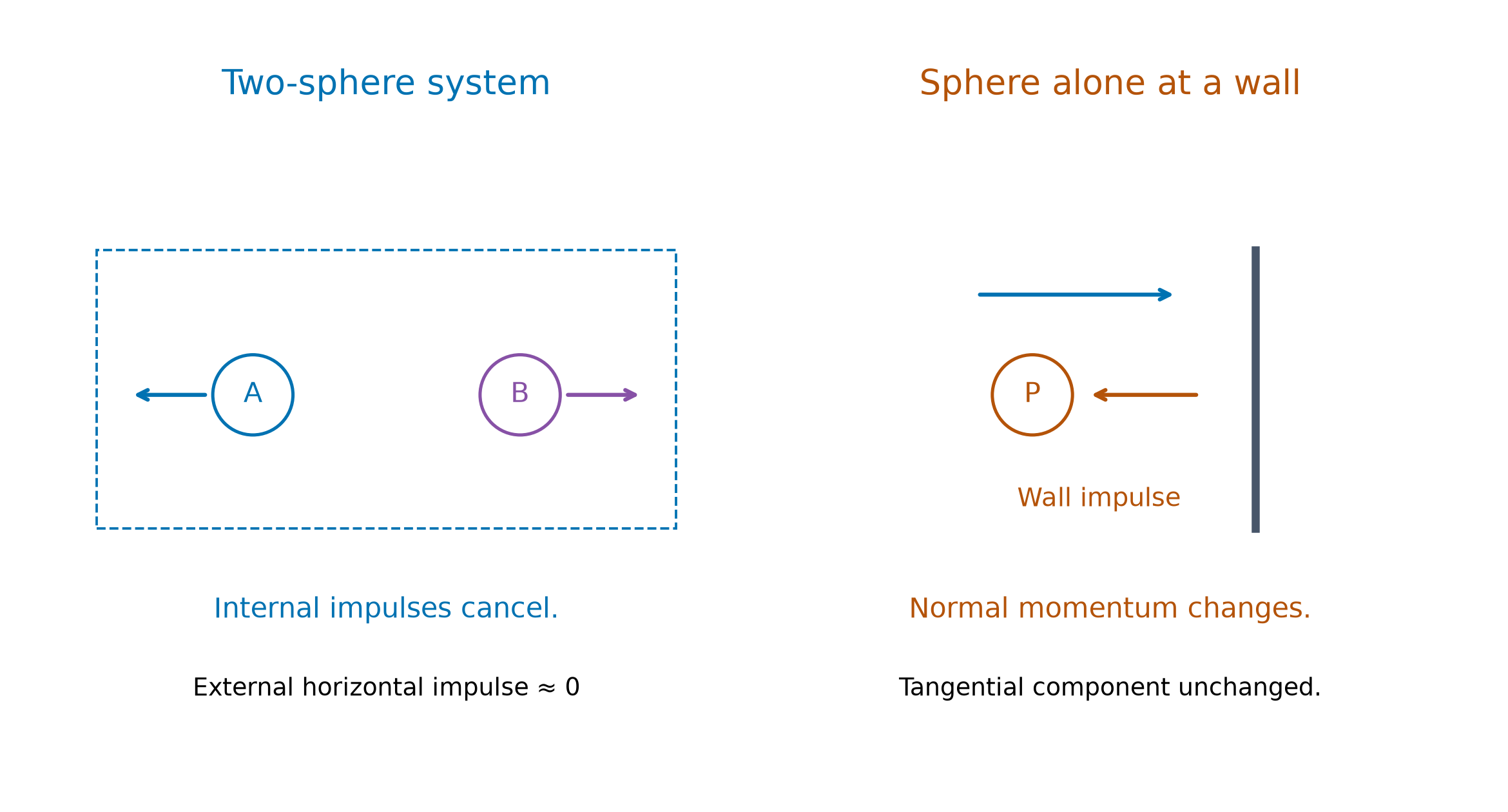
Conservation of momentum
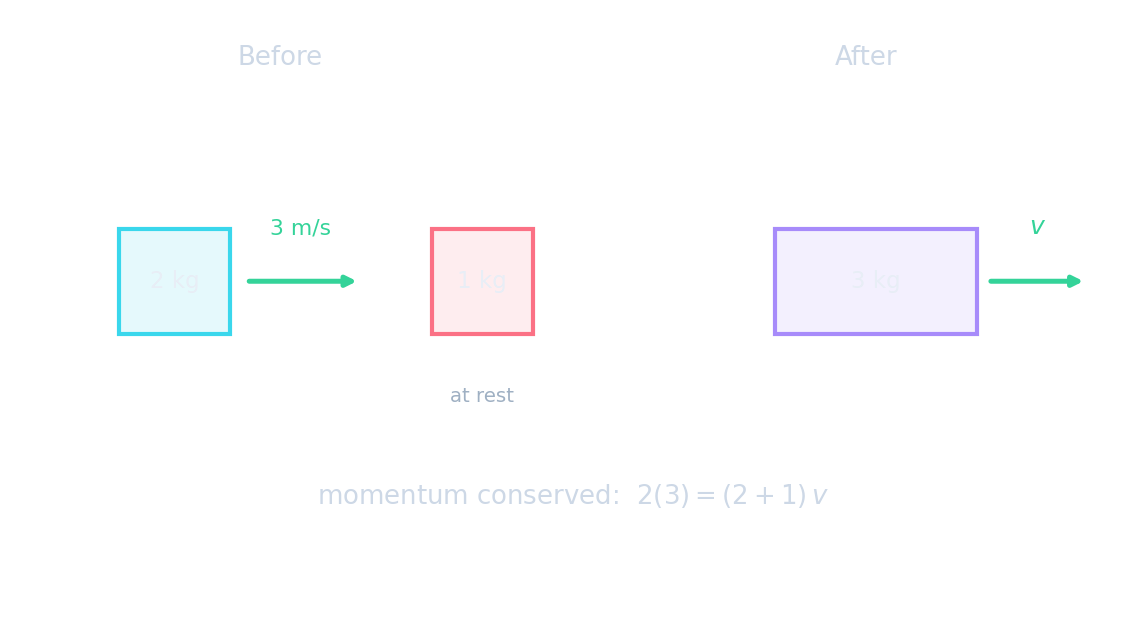
m₁u₁ + m₂u₂ = (m₁+m₂)v
For the two-body system with negligible external horizontal impulse, compare total momentum before and after a sticking collision.
On a smooth horizontal plane, a 2 kg body at 3 m/s hits a stationary 1 kg body and they stick together. Find the common velocity in m/s, taking the incoming direction positive.
Difficulty 2/5 · 140 coins + a small bonus on first completion today
6 = 3v, so v = 2 m/s.
A ball hits a fixed smooth wall normally. A student conserves the momentum of the ball alone. Explain the error and identify the conserved component for an oblique smooth-wall impact.
Compare the system, normal/tangent equations and direction checks with the model before correcting your result.
Draw the line of impact
- For two smooth spheres, the line of impact 碰撞线 is their line of centres 球心连线 at contact. The collision impulse acts along it.
- Call that direction normal, $n$, and a perpendicular direction tangent, $t$. A direct impact 正碰撞 has motion along $n$; an oblique impact 斜碰撞 also has tangential motion.
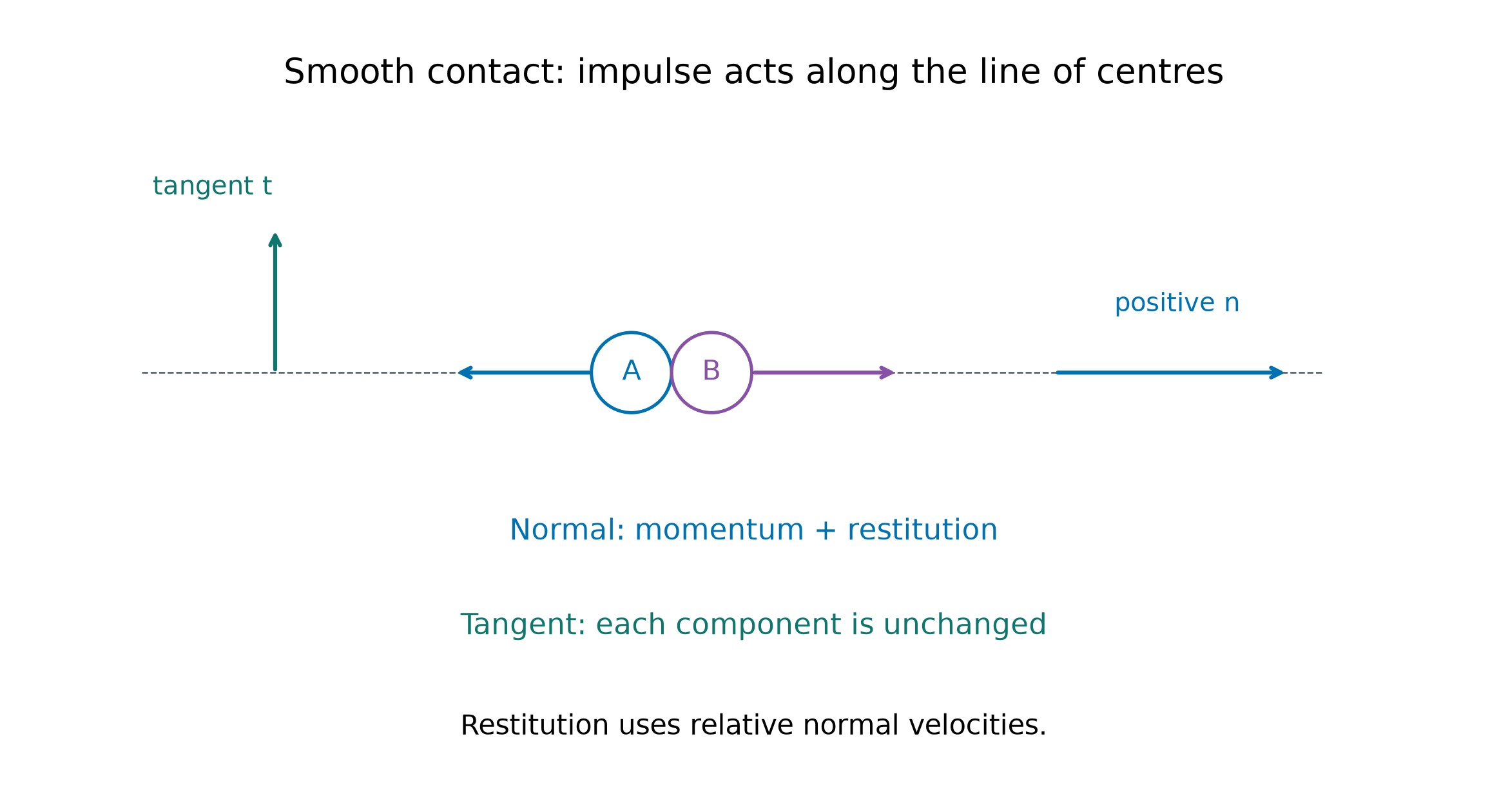
Two smooth spheres touch. Explain which geometric line gives the collision normal and why each tangential velocity is unchanged.
Compare the system, normal/tangent equations and direction checks with the model before correcting your result.
Write restitution with signed components
- Choose positive $n$ from $A$ towards $B$, with $u_{An}>u_{Bn}$ before contact. Newton's experimental law 牛顿实验定律 is
- The coefficient of restitution 恢复系数 $e$ is normal separation speed divided by normal approach speed. In this syllabus model, $0\leq e\leq1$; use relative components, not the two objects' separate speed magnitudes.
In the smooth-impact model used in this syllabus, which range is allowed for the coefficient of restitution e?
Difficulty 1/5 · 100 coins + a small bonus on first completion today
e runs from 0 (perfectly inelastic) to 1 (perfectly elastic).
For smooth spheres, e equals normal relative separation speed divided by normal relative speed of ______.
Difficulty 1/5 · 100 coins + a small bonus on first completion today
e = separation speed / approach speed.
Along the line from A to B, incoming velocities are +7 and −1 m/s and outgoing velocities are +1 and +5 m/s. Find e and check that they separate.
Compare the system, normal/tangent equations and direction checks with the model before correcting your result.
Interpret the two limiting cases
- A perfectly elastic 完全弹性 impact has $e=1$: kinetic energy 动能 is conserved for the ideal smooth collision. An inelastic 非弹性 impact with $e=0$, also called perfectly inelastic 完全非弹性, gives equal final normal velocities.
- In a direct collision, $e=0$ gives a common velocity. In an oblique collision, tangential velocities can differ, so equal normal velocities do not mean that the spheres become glued together.
A particle glancing along a smooth wall with $e=0$ may keep moving along it. Apply the law to the normal component first.
If two bodies coalesce (stick together) on impact, the coefficient of restitution is:
Difficulty 1/5 · 100 coins + a small bonus on first completion today
They move off together (zero separation speed), so e = 0 — perfectly inelastic.
Two smooth spheres have e = 0 in an oblique impact. Their incoming tangential components are +2 and −3 m/s. Must they move with the same final velocity?
Compare the system, normal/tangent equations and direction checks with the model before correcting your result.
Solve the original direct-collision example
- A sphere $A$ of mass $2\ \text{kg}$ moves at $5\ \dfrac{\text{m}}{\text{s}}$ into stationary $B$ of mass $3\ \text{kg}$ on a smooth horizontal plane. Take rightwards positive and $e=0.5$.
- Momentum gives $2v_A+3v_B=10$; restitution gives $v_B-v_A=2.5$. Thus $v_A=0.5\ \dfrac{\text{m}}{\text{s}}$ and $v_B=3\ \dfrac{\text{m}}{\text{s}}$, both rightwards.

On a smooth horizontal plane, a 3 kg body at 4 m/s hits a stationary 1 kg body and they stick together. Find their common speed and the kinetic energy lost.
Conservation concerns momentum for the defined system. Sticking does not conserve kinetic energy.
On a smooth horizontal plane, A of mass 3 kg moves right at 4 m/s into stationary B of mass 1 kg. Their direct impact has e = 1/3. Find both final velocities.
Compare the system, normal/tangent equations and direction checks with the model before correcting your result.
A head-on collision needs negative velocities
- Let $A$ have mass $2\ \text{kg}$ and velocity $+3\ \dfrac{\text{m}}{\text{s}}$, while $B$ has mass $1\ \text{kg}$ and velocity $-3\ \dfrac{\text{m}}{\text{s}}$. They approach at $6\ \dfrac{\text{m}}{\text{s}}$, not zero.
- With $e=0.5$, $2v_A+v_B=3$ and $v_B-v_A=3$. Hence $v_A=0$ and $v_B=3\ \dfrac{\text{m}}{\text{s}}$; $A$ is instantaneously at rest after impact.
A of mass 1 kg moves at +4 m/s towards B of mass 3 kg moving at −2 m/s on a smooth horizontal line. For e = 1/2, find their final velocities and directions.
Compare the system, normal/tangent equations and direction checks with the model before correcting your result.
Check whether contact can occur
- If $A$ is left of $B$ and both move right, a first collision requires $u_A>u_B$. A negative answer for $v_A$ means rebound, not a negative speed.
- After contact, check $v_B-v_A\geq0$. With $e>0$ the bodies separate; with $e=0$ their normal separation speed is zero at that instant.
A is left of B on a smooth line. A has velocity +2 m/s and B has +5 m/s. Can their stated free motion produce a first collision? Explain.
Compare the system, normal/tangent equations and direction checks with the model before correcting your result.
Derive a reusable direct-impact result
- Solving normal momentum and restitution gives
- Then $v_B=v_A+e(u_A-u_B)$. If $B$ starts at rest, $v_B=\dfrac{(1+e)m_Au_A}{m_A+m_B}$; use the equations to check any memorised formula.
A of mass 2 kg and B of mass 3 kg move right at 5 and 1 m/s respectively, with A behind B on a smooth line. Their direct impact has e = 1/2. Find the final velocities.
Compare the system, normal/tangent equations and direction checks with the model before correcting your result.
Infer a mass ratio from rebound
- A sphere of mass $m$ hits a stationary sphere of mass $km$ in a perfectly elastic direct impact. If its final velocity is $-u/3$, restitution gives $v_B=2u/3$.
- Momentum gives $mu=-mu/3+km(2u/3)$, so $k=2$. The sign of the rebound matters in both equations.
A sphere of mass m and speed u hits a stationary sphere of mass km in a perfectly elastic direct collision. A rebounds at speed u/2. Find k and the final velocity of B.
Compare the system, normal/tangent equations and direction checks with the model before correcting your result.
A momentum ratio is not a speed ratio
- A sphere of mass $3m$ moving at $u$ hits a stationary sphere of mass $m$. Afterwards $p_A=2p_B$, both rightwards. Since total momentum is $3mu$, $p_A=2mu$ and $p_B=mu$.
- Thus $v_A=2u/3$, $v_B=u$ and $e=1/3$. Dividing momenta without accounting for the masses would give the wrong velocity ratio.
A of mass 2m moving at speed u hits stationary B of mass m directly. They have equal positive momenta afterwards. Find both velocities and e.
Compare the system, normal/tangent equations and direction checks with the model before correcting your result.
Keep energy loss separate from momentum
- In the original $2\ \text{kg}$ and $3\ \text{kg}$ example, initial kinetic energy is $25\ \text{J}$ and final kinetic energy is $13.75\ \text{J}$. The loss is $11.25\ \text{J}$, although momentum is conserved.
- For an isolated smooth two-sphere collision, the loss is $\tfrac12\mu(1-e^2)(u_{An}-u_{Bn})^2$, where the reduced mass 约化质量 is $\mu=m_Am_B/(m_A+m_B)$. This checks a calculation; it does not replace the signed impact equations.
Kinetic energy is conserved in every collision where momentum is conserved.
Difficulty 1/5 · 100 coins + a small bonus on first completion today
False. For an isolated system momentum is conserved; kinetic energy need not be. In the stated smooth impact model, e = 1 gives the perfectly elastic case.
A of mass 3 kg moving at 4 m/s hits stationary B of mass 1 kg directly. Their final velocities are 8/3 and 4 m/s. Find the kinetic energy lost and check it using e = 1/3.
Compare the system, normal/tangent equations and direction checks with the model before correcting your result.
Resolve an oblique sphere impact
- Smooth spheres exert no tangential impulse on each other. Therefore $v_{At}=u_{At}$ and $v_{Bt}=u_{Bt}$ separately; normal momentum and restitution determine $v_{An},v_{Bn}$.
- Draw a component table before solving. Recombine each sphere's own components using $v=\sqrt{v_n^2+v_t^2}$; the final normal component alone is usually not its speed.
Smooth spheres A and B have tangential velocities +5 and −2 m/s before an oblique impact. Can conservation of total tangential momentum alone determine the two final tangential velocities? State the stronger contact result.
Compare the system, normal/tangent equations and direction checks with the model before correcting your result.
Work through an oblique example
- Sphere $A$ has mass $2\ \text{kg}$ and initial components $(3,4)\ \dfrac{\text{m}}{\text{s}}$ in $(n,t)$. Stationary $B$ has mass $1\ \text{kg}$. For $e=0.5$, $2v_{An}+v_{Bn}=6$ and $v_{Bn}-v_{An}=1.5$.
- Hence $\mathbf v_A=(1.5,4)$ and $\mathbf v_B=(3,0)$ in the same units. Their speeds are $\sqrt{73}/2$ and $3\ \dfrac{\text{m}}{\text{s}}$; $A$ keeps its tangential component.
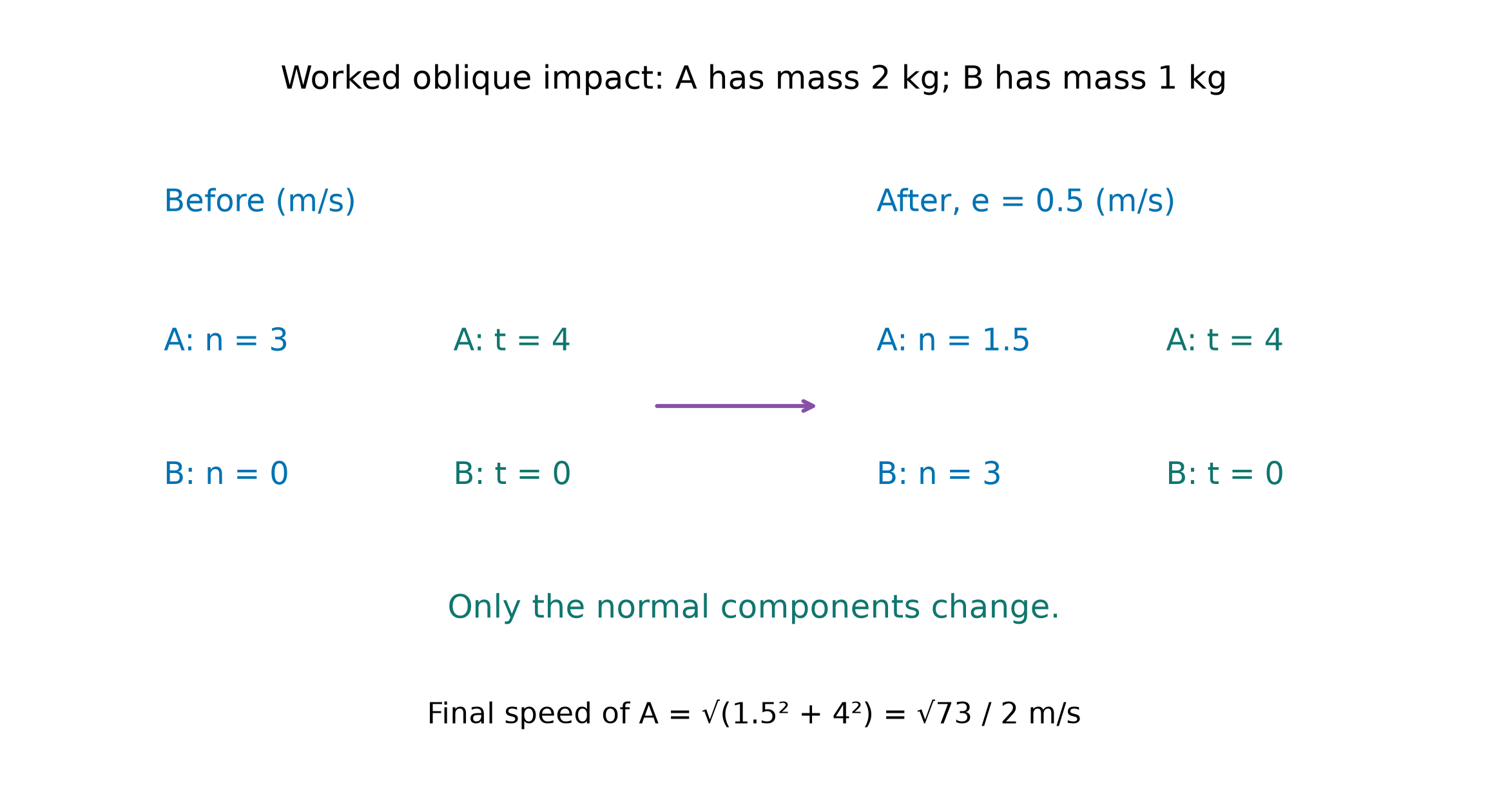
On a smooth horizontal plane, A of mass 3 kg has incoming normal/tangent components (4,3) m/s. B of mass 1 kg is at rest. For e = 1/3, find the final velocity vectors and speeds.
Compare the system, normal/tangent equations and direction checks with the model before correcting your result.
Zero restitution does not remove tangential motion
- Two equal-mass smooth spheres have initial components $\mathbf u_A=(4,3)$ and $\mathbf u_B=(0,-1)$, with positive normal from $A$ to $B$. If $e=0$, both final normal velocities are $2$.
- Their final vectors are $(2,3)$ and $(2,-1)$ in the stated SI units. They have equal normal velocities but different tangential velocities; the particles do not move as a single rigid object.
A of mass m has incoming components (8,1) m/s and B of mass 3m has (0,−2) m/s. Smooth contact has e = 0. Find both final vectors and explain whether they coincide.
Compare the system, normal/tangent equations and direction checks with the model before correcting your result.
Recover direction and deflection
- For final components $(v_n,v_t)$ with $v_n>0$, the angle to positive normal satisfies $\tan\phi=v_t/v_n$. If $v_n<0$, draw the quadrant; a calculator's acute angle alone can hide a rebound.
- In the previous $A=(1.5,4)$ example, $\tan\phi=8/3$. The deflection 偏转 is the change from its incoming direction, whose angle satisfies $\tan\theta=4/3$, not simply $\phi$ itself.
A sphere leaves an oblique impact with components (−3,4) m/s relative to positive normal and positive tangent. Find its speed and describe its direction without giving the wrong acute quadrant.
Compare the system, normal/tangent equations and direction checks with the model before correcting your result.
Infer restitution from final kinetic energies
- Equal-mass spheres collide with $\mathbf u_A=(4,3)$ and $\mathbf u_B=(0,0)$. The final normal velocities are $2(1-e)$ and $2(1+e)$, while their tangential velocities remain $3$ and $0$.
- Equal final kinetic energies require $4(1-e)^2+9=4(1+e)^2$, so $e=9/16$. Both final speeds are $25/8\ \dfrac{\text{m}}{\text{s}}$; keep both components in the energy equation.
Equal-mass smooth spheres have incoming components A = (6,2) m/s and B = (0,0). They have equal kinetic energies after impact. Find e and their final speed.
Compare the system, normal/tangent equations and direction checks with the model before correcting your result.
A fixed wall changes the sphere's momentum
- At a smooth fixed surface 固定表面, take positive normal towards the wall. The surface has zero velocity, so the sphere's final component is $v_n=-eu_n$ and its tangential component is $v_t=u_t$.
- Do not conserve the sphere's normal momentum. The wall's impulse supplies the change: $\Delta p_n=-m(1+e)u_n$. The wall–Earth system can take momentum while its speed is negligible.
A 3 kg sphere approaches a smooth fixed wall with normal velocity +4 m/s, positive towards the wall. If e = 1/4, find the final normal velocity and normal impulse on the sphere.
Compare the system, normal/tangent equations and direction checks with the model before correcting your result.
Recombine components after a wall impact
- A $2\ \text{kg}$ sphere approaches a smooth fixed wall with components $(6,8)\ \dfrac{\text{m}}{\text{s}}$ in normal/tangent directions. For $e=0.5$, the outgoing components are $(-3,8)$.
- Speed changes from $10$ to $\sqrt{73}\ \dfrac{\text{m}}{\text{s}}$. Kinetic energy loss is $100-73=27\ \text{J}$; the overall speed ratio is not $e$.
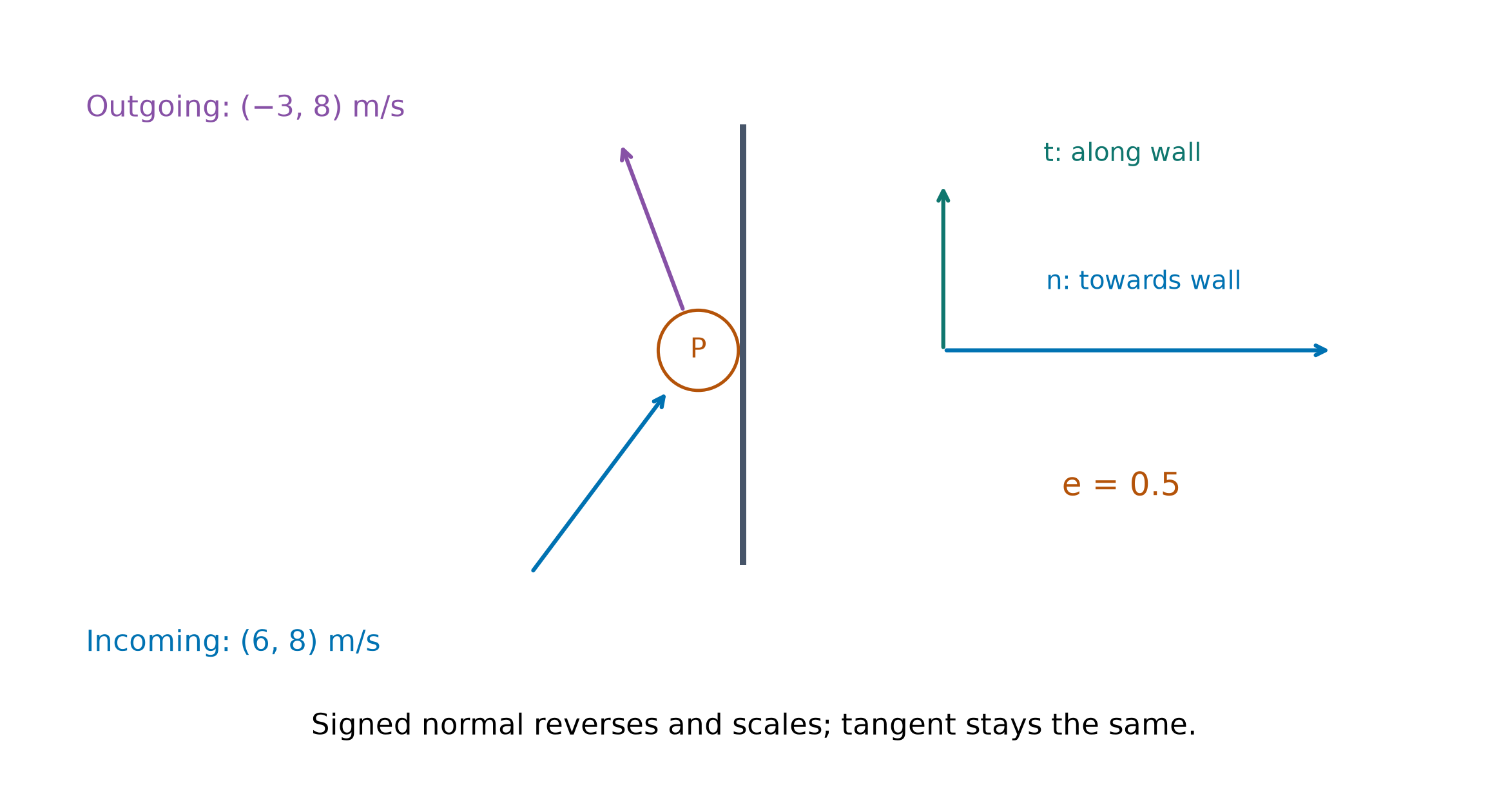
A sphere has incoming normal/tangent components (8,6) m/s at a smooth fixed wall. For e = 1/4, find its outgoing vector, speed and ratio of final to initial kinetic energy.
Compare the system, normal/tangent equations and direction checks with the model before correcting your result.
State which line an angle uses
- If incoming and outgoing acute angles $\alpha,\beta$ are measured from the wall, $u_n=u\sin\alpha$ and $u_t=u\cos\alpha$. Thus $\tan\beta=e\tan\alpha$.
- If $\theta,\phi$ are measured from the normal, $\tan\phi=\tan\theta/e$ for $e>0$. At $e=0$, use components directly; a nonzero tangent component leaves motion parallel to the wall.
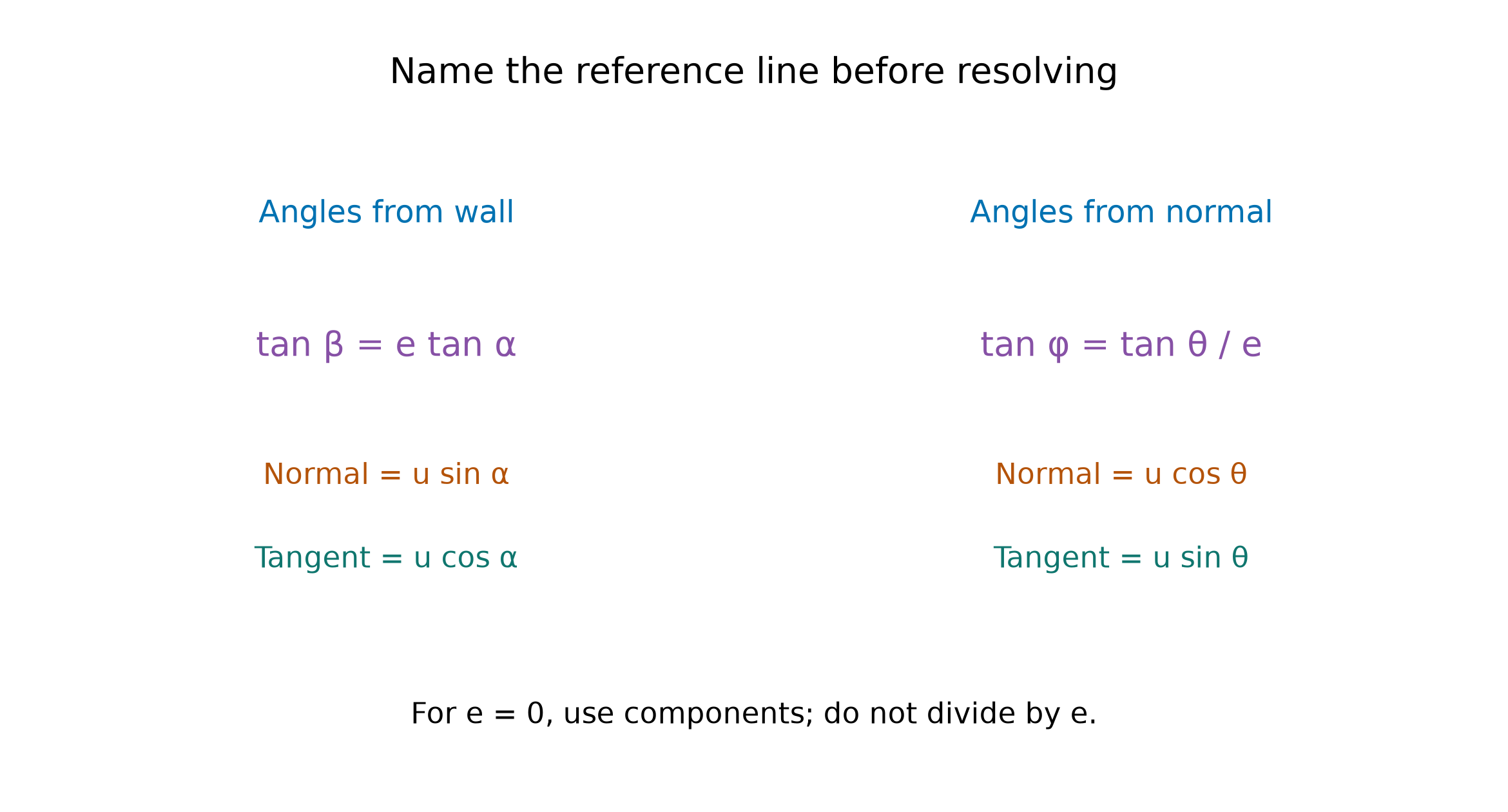
A sphere strikes a smooth fixed wall at 30 degrees to the wall, with e = 1/sqrt(3). Find the tangent of its outgoing angle to the wall and explain why using the complementary angle directly would fail.
Compare the system, normal/tangent equations and direction checks with the model before correcting your result.
Infer a wall coefficient from angles
- A sphere strikes a smooth fixed wall at $45^\circ$ to the wall and leaves at angle $\beta$, with $\tan\beta=1/3$. Then $e=\tan\beta/\tan45^\circ=1/3$.
- Its final speed is $u\sqrt{\cos^2 45^\circ+e^2\sin^2 45^\circ}=u\sqrt5/3$. A change in direction is why the speed ratio differs from $1/3$.
A sphere strikes a smooth fixed wall at 45 degrees to the wall. Its final speed is sqrt(10)/4 times its incoming speed. Find e and the tangent of the outgoing angle to the wall.
Compare the system, normal/tangent equations and direction checks with the model before correcting your result.
Check wall-impact energy and limits
- At a smooth fixed wall, lost kinetic energy is $\tfrac12m(1-e^2)u_n^2$. Only the normal contribution changes; at $e=1$, speed is unchanged and the normal component reverses.
- At $e=0$, normal speed becomes zero. If $u_t\ne0$, the sphere continues along the wall; if both final components are zero, it is at rest immediately after contact.
A 3 kg sphere hits a smooth fixed wall with incoming normal component 4 m/s and e = 1/4. Find the kinetic energy lost, regardless of its tangential component.
Compare the system, normal/tangent equations and direction checks with the model before correcting your result.
A time ratio can reveal restitution
- A particle travels between two parallel smooth fixed walls separated by $d$. If its first flight takes $T$, its normal speed is $d/T$. After a bounce with coefficient $e>0$, the next flight takes $T/e$.
- Thus if the second time is $kT$, $e=1/k$ and $k\geq1$. The case $e=0$ gives no finite second crossing; do not cancel a zero normal speed as though a return occurs.
A particle takes 4 s to cross between two parallel smooth fixed walls. After bouncing it takes 10 s to cross back. Find the restitution coefficient at that bounce and describe the e = 0 case.
Compare the system, normal/tangent equations and direction checks with the model before correcting your result.
Treat successive impacts as separate events
- Equal-mass particles collide directly: $A$ initially has velocity $6\ \dfrac{\text{m}}{\text{s}}$, $B$ is at rest and $e_{AB}=0.5$. They leave with velocities $1.5$ and $4.5\ \dfrac{\text{m}}{\text{s}}$.
- If $B$ then hits a smooth wall with $e_{BW}=1/3$, its velocity becomes $-1.5\ \dfrac{\text{m}}{\text{s}}$. Their next mutual impact uses incoming velocities $+1.5,-1.5$ and $e_{AB}$, giving $v_A=-0.75$, $v_B=+0.75\ \dfrac{\text{m}}{\text{s}}$.
Equal-mass particles collide directly on a smooth line. A initially moves right at 8 m/s, B is at rest and eAB = 1/2. B then hits a wall to its right with eBW = 1/2. Find their velocities after their next mutual impact.
Compare the system, normal/tangent equations and direction checks with the model before correcting your result.
Check the next event using distances
- In that example, put the first mutual collision at $x=0$ and the wall at $x=9\ \text{m}$. Particle $B$ reaches the wall at $t=2\ \text{s}$; then $A$ is at $x=3\ \text{m}$.
- The gap is $6\ \text{m}$ and their closing speed after the wall bounce is $3\ \dfrac{\text{m}}{\text{s}}$. They meet $2\ \text{s}$ later at $x=6\ \text{m}$, before $A$ can reach the wall. Different pairs can have different restitution coefficients.
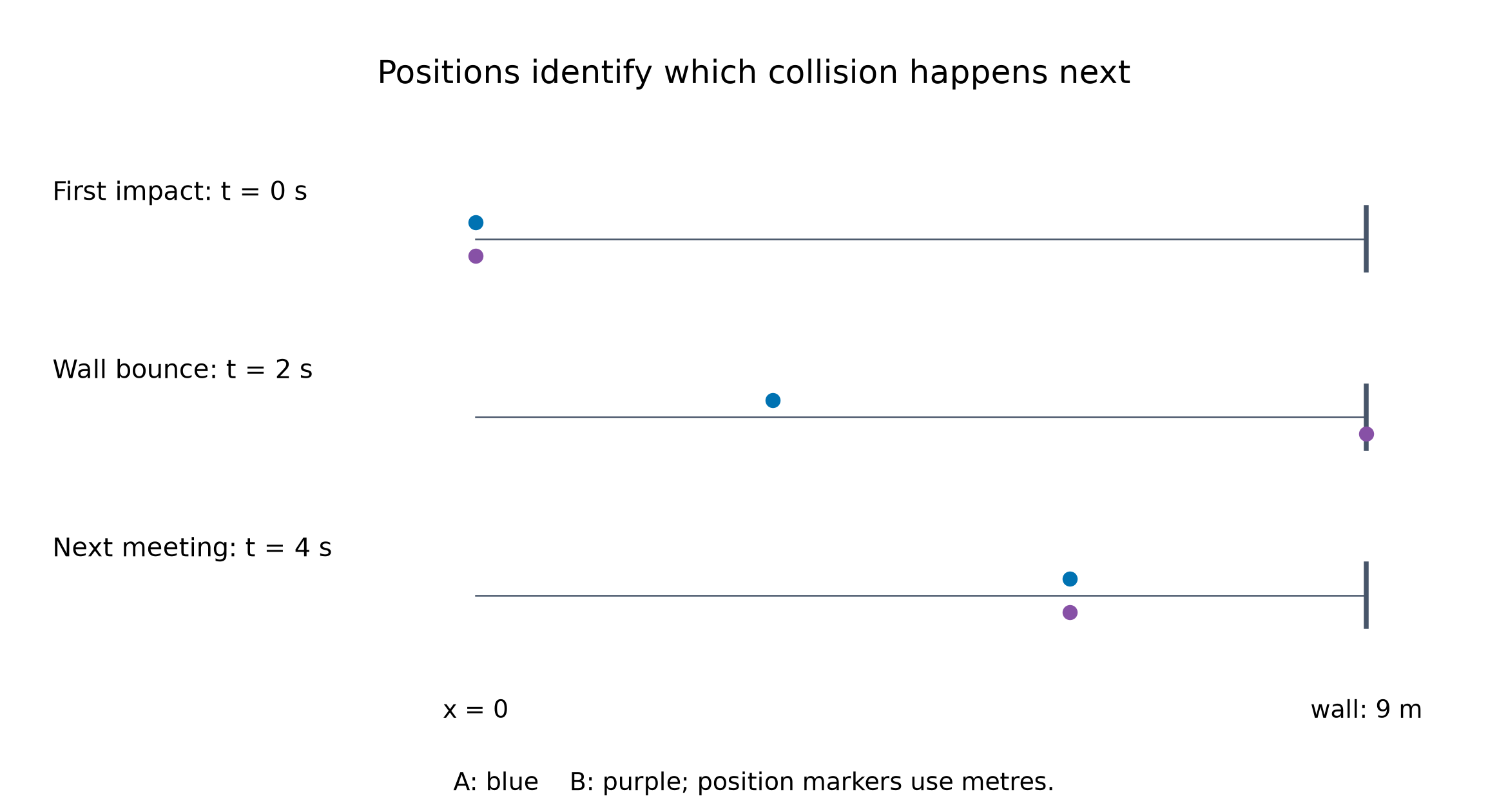
In a one-dimensional particle model, A and B leave a collision at x = 0 with velocities +2 and +6 m/s. A fixed wall is at x = 12 m. B rebounds from it at −3 m/s. Find when and where A and B next meet, and check that A has not already hit the wall.
Compare the system, normal/tangent equations and direction checks with the model before correcting your result.
Use a fresh projectile segment after a barrier
- A particle has incoming velocity $(4,-4)\ \dfrac{\text{m}}{\text{s}}$ at a smooth barrier inclined at $45^\circ$ upwards to the right. Its velocity is purely normal to the barrier; $e=0.5$ gives outgoing velocity $(-2,2)\ \dfrac{\text{m}}{\text{s}}$.
- If impact is $4\ \text{m}$ above horizontal ground and $g=10\ \dfrac{\text{m}}{\text{s}^2}$, solve $0=4+2t-5t^2$. The positive flight time is $(1+\sqrt{21})/5\ \text{s}$ and horizontal distance is $2(1+\sqrt{21})/5\ \text{m}$ to the left.
A particle has incoming velocity (6,−6) m/s when it strikes a smooth fixed barrier inclined at 45 degrees upwards to the right. Restitution is 1/3. Impact is 6 m above the ground; take g = 10 m/s². Find its outgoing velocity and horizontal distance before landing.
Compare the system, normal/tangent equations and direction checks with the model before correcting your result.
Link a collision to a vertical circle
- At a circle's bottom, a particle of mass $m$ and incoming speed $3\sqrt{5ag}$ hits a stationary particle of mass $2m$ in a perfectly elastic direct impact. Momentum and restitution give signed velocities $-\sqrt{5ag}$ and $2\sqrt{5ag}$.
- The first particle rebounds with squared speed $5ag$. Its later energy equation gives top squared speed $ag$, the limiting $T=0$ condition for a taut string. Use energy on the smooth arcs and collision laws at contact; zero tension is a boundary test, not by itself proof of subsequent separation.
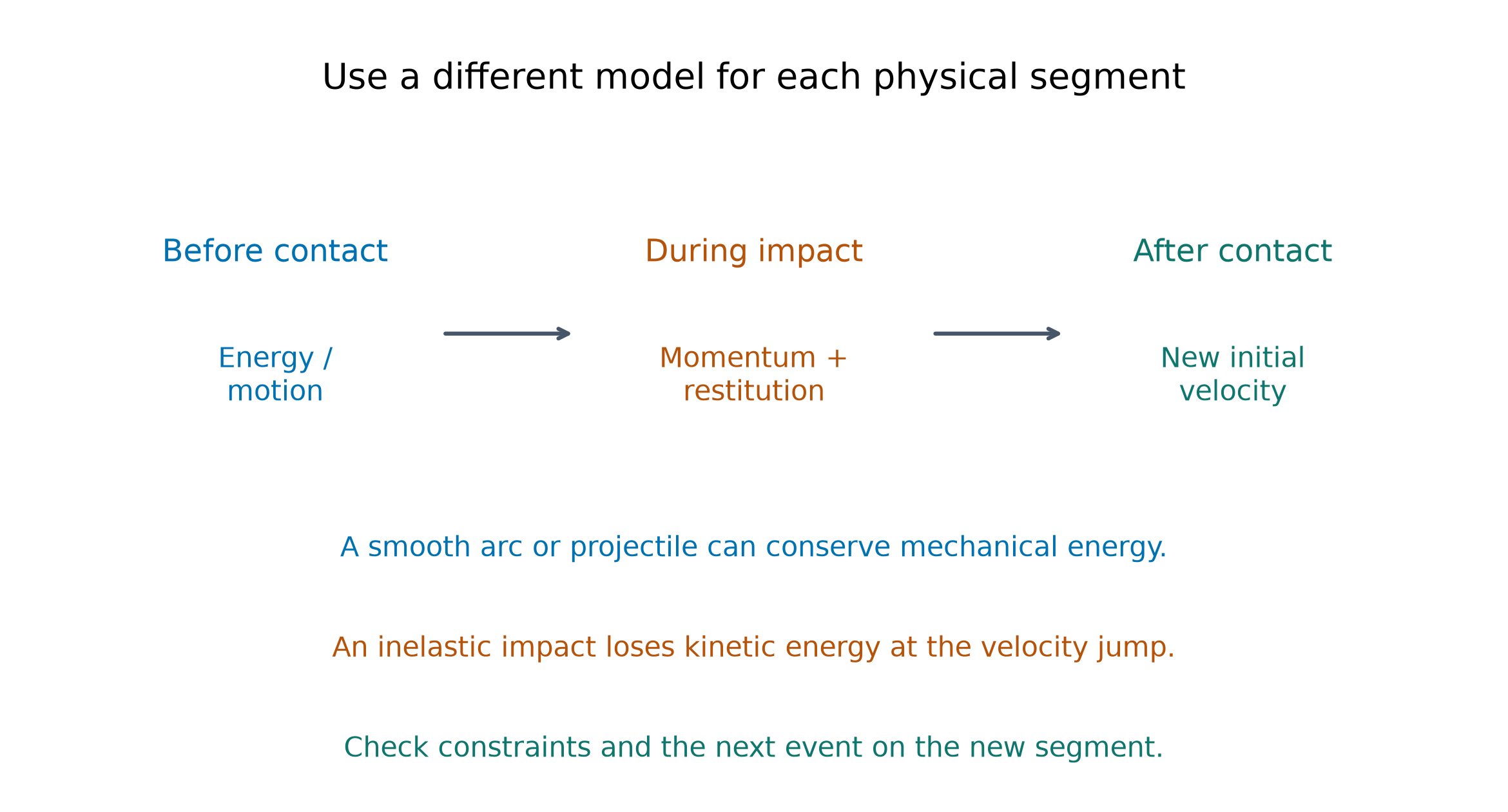
At the bottom of a vertical circle of radius a, a particle of mass m moving at 2sqrt(5ag) collides perfectly elastically with a stationary particle of mass 3m. Find its signed final velocity and test the limiting top tension on its rebound arc.
Compare the system, normal/tangent equations and direction checks with the model before correcting your result.
Reject a physically impossible model
- An algebraic candidate must satisfy $0\leq e\leq1$, the stated incoming approach and outgoing directions. Reject inadmissible roots with a reason; do not turn a negative signed velocity into a positive one midway through the equations.
- Check momentum for the correct system, the restitution relation, unchanged smooth tangential components and nonnegative kinetic-energy loss. A fixed wall can violate one-sphere momentum conservation without violating the model.
A smooth-impact calculation produces restitution candidates e = −1/5 and e = 3/5. What should be checked before accepting the second root, and why is the first rejected?
Compare the system, normal/tangent equations and direction checks with the model before correcting your result.
Organise an independent impact solution
- Draw the contact normal, define signed components and label the system. Write the normal momentum equation only where justified, then restitution and unchanged tangential components.
- Recombine velocities, state directions and check the next physical event. For a question combining topics, carry the outgoing velocity into a new motion segment with its own initial state.
A sphere hits a fixed smooth wall obliquely, then moves freely as a projectile. List the equations and checks needed to find its landing point. Explain where one-sphere momentum conservation and pre-impact projectile constants would fail.
Compare the system, normal/tangent equations and direction checks with the model before correcting your result.
Retrieve the model before calculating
- Direct and oblique impacts use the same normal equations; tangential components survive smooth contact unchanged. For a fixed surface, $v_n=-eu_n$, not conservation of the sphere's normal momentum.
- Always define the system, the angle convention and the event order. Distinguish normal separation from total speed, equal normal velocity from sticking, and energy between impacts from energy across them.
On a smooth horizontal plane, a 3 kg body at 4 m/s hits a stationary 1 kg body and they stick together. What is the common speed?
Difficulty 1/5 · 100 coins + a small bonus on first completion today
3 times 4 is 12, and 12 divided by 4 is 3 metres per second. Other options — 2 metres per second (the lesson speed for a 2 kg body at 3 metres per second); 12 (the momentum before impact).