This handout covers Topic 1: Further Pure Mathematics 进阶纯数学 1. It adds new algebra, matrices, polar coordinates 极坐标, more vectors 向量, and proof by induction.
Further Pure Mathematics 1
A-Level Further Mathematics · Topic 1
 14:28
Further Pure Mathematics 1
Here is a cubic equation, crossing the axis at three roots. Finding those roots exactly can be hard — or even impossible by hand. But here is a beautiful…
English narration · English + 中文 subtitles burned in
1.1
Roots of polynomial equations
Syllabus
| Candidates should be able to: | Notes and examples |
|---|---|
| • recall and use the relations between the roots and coefficients of polynomial equations | e.g. to evaluate symmetric functions of the roots or to solve problems involving unknown coefficients in equations; restricted to equations of degree 2, 3 or 4 only. |
| • use a substitution to obtain an equation whose roots are related in a simple way to those of the original equation | Substitutions will not be given for the easiest cases, e.g. where the new roots are reciprocals or squares or a simple linear function of the old roots. |
Source: Cambridge International syllabus
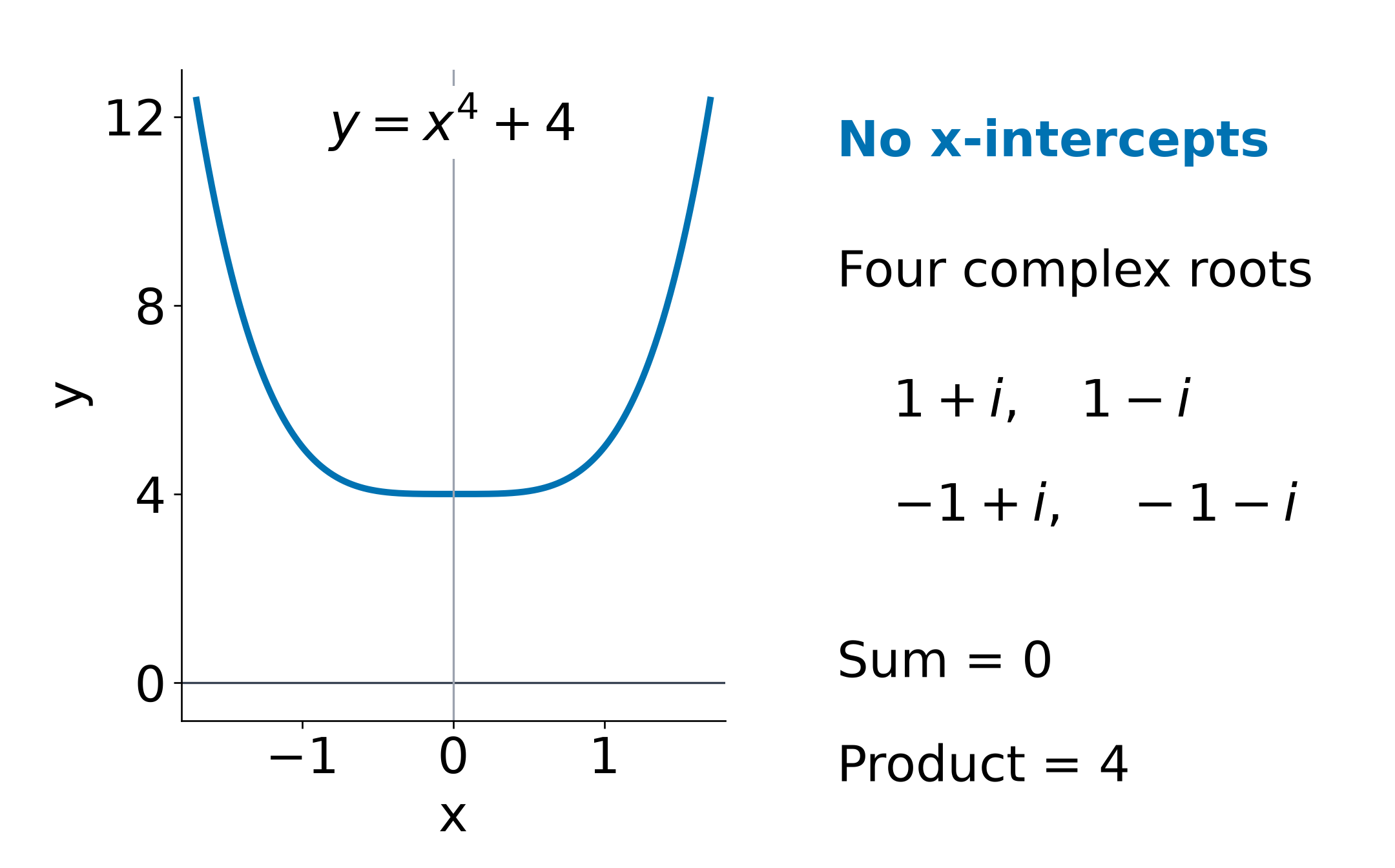
Before trusting a program's calculated roots 根, check their sum and product against its stored polynomial 多项式 coefficients 系数. These relations also give useful sums when finding the individual roots would be difficult. A root makes the polynomial zero. Count repeated roots with their multiplicities and include complex roots; a real graph shows only the real ones. The relations here apply to degrees 2, 3 and 4, always with a non-zero leading coefficient.
Derive the relations from factors
Expand $a(x-\alpha)(x-\beta)$ and compare coefficients with $ax^2+bx+c$. This gives
$$\alpha+\beta=-\frac ba,\qquad \alpha\beta=\frac ca.$$
For $ax^3+bx^2+cx+d=0$ with roots $\alpha,\beta,\gamma$, expansion similarly gives
$$e_1=\alpha+\beta+\gamma=-\frac ba,$$
$$e_2=\alpha\beta+\alpha\gamma+\beta\gamma=\frac ca,\qquad e_3=\alpha\beta\gamma=-\frac da.$$
The signs alternate because each factor contains a minus sign. They do not say that the roots themselves are negative. For $(x-1)^2(x-3)=0$, use the list $1,1,3$, giving $e_1=5,e_2=7,e_3=3$. Counting only the two distinct values breaks the coefficient relations.
Include quartics and complex roots
For a quartic equation 四次方程 $ax^4+bx^3+cx^2+dx+e=0$, define $e_1$ as the sum of its four roots, $e_2$ as the sum of all six different pairs, $e_3$ as the sum of all four different triples, and $e_4$ as their product. Then
$$e_1=-\frac ba,\qquad e_2=\frac ca,\qquad e_3=-\frac da,\qquad e_4=\frac ea.$$
The six pairs are $\alpha\beta,\alpha\gamma,\alpha\delta,\beta\gamma,\beta\delta,\gamma\delta$: count each once. These are symmetric functions 对称函数, unchanged when the roots exchange names.
Find sums of powers without solving the equation
Write $S_k=\alpha^k+\beta^k+\cdots$, including each root with its multiplicity. Expanding the square and cube of the root sum gives
$$S_2=e_1^2-2e_2,\qquad S_3=e_1^3-3e_1e_2+3e_3.$$
The first formula works for degrees 2, 3 and 4; the second is written here for degrees 3 and 4. For a higher sum, use the equation satisfied by each root. If $x^4+bx^3+cx^2+dx+e=0$, add its four root equations:
$$S_4+bS_3+cS_2+dS_1+4e=0.$$
Worked example. For $x^4-2x^3+3x^2-4x+5=0$, the symmetric sums are $2,3,4,5$. Therefore $S_2=4-6=-2$ and $S_3=8-18+12=2$. The original equation then gives $S_4=2(2)-3(-2)+4(2)-4(5)=-2$. Negative sums of squares are possible when the roots are complex.
Recover unknown coefficients from given sums
For a cubic $x^3+bx^2+cx+d=0$ with leading coefficient 1, first use $b=-S_1$ and $c=(S_1^2-S_2)/2$. To connect the remaining coefficient to higher sums, add the three original root equations:
$$S_3+bS_2+cS_1+3d=0.$$
Multiply each root equation by its own root and add again:
$$S_4+bS_3+cS_2+dS_1=0.$$
The constant contributes $3d$ in the first equation but $dS_1$ in the second. Substitute the known sums, solve the resulting simultaneous equations and check in both relations.
Shift or scale all roots
To find an equation with roots $y=mx+k$, where $m\ne0$, use the inverse substitution 代换 $x=(y-k)/m$. Substitute into the original polynomial, clear denominators 分母 and collect powers of $y$. A non-zero constant multiple of an equation has the same roots.
Worked example. Let the original polynomial be $P(x)=x^3-3x+1$. For roots $2\alpha+1,2\beta+1,2\gamma+1$, put $x=(y-1)/2$ and multiply by 8:
$$(y-1)^3-12(y-1)+8=0,$$
$$y^3-3y^2-9y+19=0.$$
Its root sum is 3, also $2S_1+3(1)=3$. For a degree-$n$ polynomial, the corresponding sum check is $mS_1+nk$. Do not substitute $2y+1$ when the original variable should be $(y-1)/2$.
Reciprocals and forbidden values
For new roots $y=1/x$, put $x=1/y$ and multiply by $y^n$. Check the original constant term is non-zero: a zero root has no reciprocal. A cubic $ax^3+bx^2+cx+d=0$ becomes $dy^3+cy^2+by+a=0$.
For example, $2x^3-3x^2+4x-5=0$ gives reciprocal-root equation $5y^3-4y^2+3y-2=0$. Its root sum is $4/5$, also $e_2/e_3$. The new constant term excludes $y=0$.
For $y=1/(x-k)$, use $x=k+1/y$ and check $P(k)\ne0$ before claiming that every original root has an image. Clearing denominators does not define a reciprocal of zero.
Square the roots and preserve multiplicities
Separate a polynomial into its even and odd powers: $P(x)=E(x^2)+xO(x^2)$. If $y=x^2$, eliminate $x$ by writing
$$E(y)^2-yO(y)^2=0.$$
This combines the two possible signs of a square root: one of them solves the original equation. If different original roots have the same square, keep their repeated factors in the new equation.
Worked example. For $x^3-2x^2-x+2=0$, $E(y)=2-2y$ and $O(y)=y-1$. Thus $(2-2y)^2-y(y-1)^2=0$, which simplifies, up to a non-zero constant factor, to $(y-1)^2(y-4)=0$. Original roots $1,-1,2$ become $1,1,4$. Removing the repeated factor would lose one transformed root.
Simplify a higher-power transformation first
If $x^3+3x-2=0$, each root satisfies $x^3=2-3x$. A new root $y=x^3+1$ is therefore $3-3x$. Use $x=(3-y)/3$ in the original equation; multiplying by 27 and collecting terms gives $y^3-9y^2+54y-54=0$. Now use coefficient relations on this new equation to find sums of transformed powers.
Explore
Roots of a polynomial
y = ax³ + bx² + cx + d
The roots are where the curve meets the x-axis — their sum and product link to the coefficients.
Vocabulary
Train
| English |
|---|
| Further Pure Mathematics/ˈfɜːðə pjʊə ˌmæθɪˈmætɪks/ |
| roots/ruːts/ |
| coefficients/ˌkəʊɪˈfɪʃənts/ |
| substitution/ˌsʌbstɪˈtjuːʃn/ |
| symmetric functions/sɪˈmetrɪk ˈfʌŋkʃnz/ |
| quartic equation/ˈkwɔːtɪk ɪˈkweɪʒn/ |
| polynomial/ˌpɒlɪˈnəʊmɪəl/ |
| denominator/dɪˈnɒmɪneɪtə/ |
1.2
Rational functions and graphs

Syllabus
| Candidates should be able to: | Notes and examples |
|---|---|
| • sketch graphs of simple rational functions, including the determination of oblique asymptotes, in cases where the degree of the numerator and the denominator are at most 2 | Including determination of the set of values taken by the function, e.g. by the use of a discriminant. Detailed plotting of curves will not be required, but sketches will generally be expected to show significant features, such as turning points, asymptotes and intersections with the axes. |
| • understand and use relationships between the graphs of $y = f(x)$, $y^2 = f(x)$, $y = \frac{1}{f(x)}$, $y = |f(x)|$ and $y = f(|x|)$ | Including use of such sketch graphs in the course of solving equations or inequalities. |
Source: Cambridge International syllabus
Check a fitted curve before trusting it
A program may fit a ratio of two polynomials to data. Its graph can look smooth on a screen while hiding an excluded input or a separate branch. For a rational function 有理函数 $f(x)=P(x)/Q(x)$, begin with the original denominator: require $Q(x)\ne0$. Then find the features that a sketch must show.
An excluded input can be a hole
A denominator zero gives a vertical asymptote 垂直渐近线 only when the remaining expression becomes unbounded there. Factor first; cancellation may instead leave a missing point. For $f(x)=(x^2-1)/(x-1)=x+1$, the original restriction $x\ne1$ remains. Draw the line with an open point at $(1,2)$, not a vertical asymptote. A zero of the numerator is an intercept only if the original denominator is non-zero there.
Asymptotes from degree and division
After cancellation, compare degrees: a lower-degree numerator gives horizontal limit 0; equal degrees give the ratio of leading coefficients. An oblique asymptote 斜渐近线 is a sloping line, so the numerator degree must be exactly one higher. Divide to obtain the quotient 商 plus the remainder 余数 over the denominator. For $(x^2-1)/(x-2)$, this is $x+2+3/(x-2)$. Thus $y=x+2$ is the slant limit as $x\to\pm\infty$; $x=2$ is vertical.
A horizontal or slant asymptote describes distant behaviour; it may be crossed at a finite input. For $f(x)=(x^2+x)/(x^2+1)$, the horizontal asymptote is $y=1$, and $f(1)=1$.
Turning points 极值点 and a complete sketch
For $f(x)=x+1/x$, $x\ne0$, $f'(x)=1-1/x^2$. The turning points are $(-1,-2)$, a local maximum, and $(1,2)$, a local minimum, as the derivative changes sign. There are no axis intersections. Draw both branches with vertical asymptote $x=0$ and slant asymptote $y=x$. The left branch lies below the slant line and the right above it. Near zero, the left branch falls to $-\infty$ and the right rises to $+\infty$.
Check whether stationary points exist
For $h(x)=(x+1)/(x^2+2x-2)$, the quotient rule gives
$$h'(x)=-\frac{(x+1)^2+3}{(x^2+2x-2)^2}.$$
The numerator inside the minus sign is positive, and the denominator is positive at every allowed input. Therefore the derivative never vanishes. There are no stationary points, and each separate domain interval has a decreasing branch; do not join branches across a pole 极点.
Prove the range with a discriminant 判别式
Rearrange $y=x+1/x$ as $x^2-yx+1=0$. A real input exists exactly when its discriminant satisfies $y^2-4\ge0$. The range is $y\le-2$ or $y\ge2$, including both turning values. Check exclusions and any case where the equation stops being quadratic. For $y=x/(x^2+1)$, rearrangement gives $yx^2-x+y=0$. At $y=0$ this is the valid linear equation $x=0$; do not discard that range value.
For the second function, $1-4y^2\ge0$ gives $-1/2\le y\le1/2$. Its denominator is never zero for real $x$, so all these values occur, including $0$ and the two endpoints.
Change the output: modulus and reciprocal
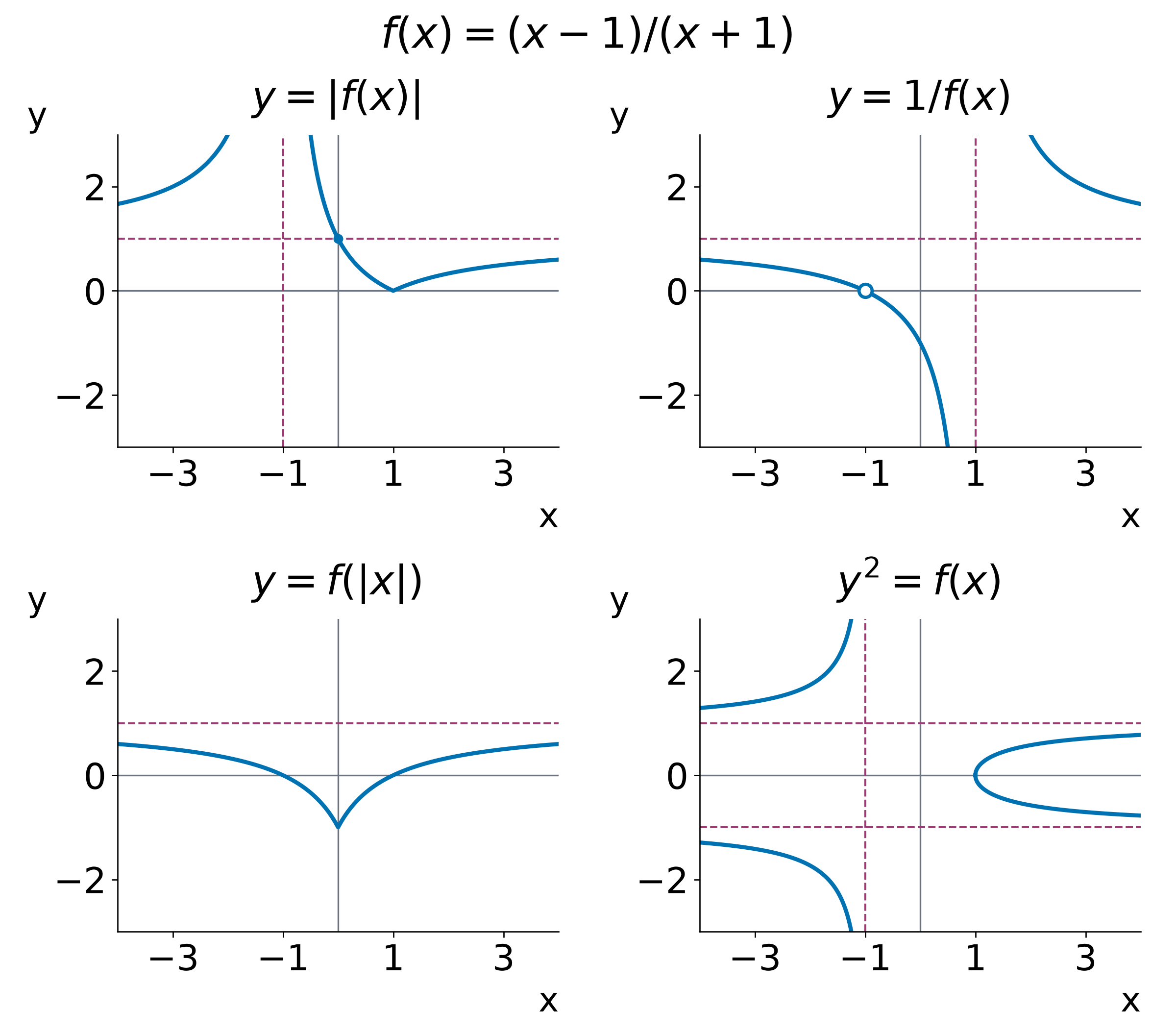
Take $f(x)=(x-1)/(x+1)$. For $y=|f(x)|$, keep nonnegative pieces and reflect negative pieces above the $x$-axis. The exclusion $x=-1$ remains. Its only zero is $x=1$. For $y=1/f(x)=(x+1)/(x-1)$, exclude both $x=-1$ and $x=1$: the first was never in the original domain and the second makes the reciprocal undefined. There is a hole at $(-1,0)$ and a vertical asymptote at $x=1$; the hole is not a zero.
Change the input, or square the output
For $f(|x|)$, keep the original right half and reflect it across the $y$-axis. Here the denominator $|x|+1$ never vanishes; the range is $[-1,1)$, with zeros at $x=\pm1$ and a corner at $(0,-1)$. Such a corner is not automatic: if the original right-hand slope at zero is zero, the join can be smooth. For $y^2=f(x)$, keep only original inputs where $f(x)\ge0$, then draw both $y=\sqrt{f(x)}$ and $y=-\sqrt{f(x)}$. Here $x<-1$ or $x\ge1$; the two branches meet at $(1,0)$, and no graph exists for $-1<x<1$.
For a contrasting smooth join, take $h(x)=(x^2+4x+8)/(x+2)$. Since $h(0)=4$ and $h'(0)=0$, reflecting the right half gives matching slopes 0 on both sides: $h(|x|)$ is smooth at $(0,4)$.
Solve inequalities from boundaries and branches
To solve $|(x-1)/(x+1)|<2$, find where $f=2$ and $f=-2$: the boundary inputs are $-3$ and $-1/3$. Include the pole $-1$ in the sign or branch diagram. Test the intervals separated by these values. The answer is $x<-3$ or $x>-1/3$, with strict endpoints excluded. Do not multiply an inequality by $x+1$ without first deciding its sign; multiplying by $(x+1)^2$ is safe only after excluding $x=-1$.
Use symmetry to solve an input-modulus inequality
For $f(|x|)<1/2$, put $t=|x|\ge0$. Then $(t-1)/(t+1)<1/2$ has a positive denominator and gives $t<3$. Translate back to $-3<x<3$. The value zero is included. If a quadratic calculation produces a negative boundary for $t$, it cannot be a value of $|x|$; inspect the allowed half-line before reflecting the result.
Build the sketch from evidence
Record the domain, intercepts, asymptotes, stationary coordinates and one-sided behaviour. Use a range calculation to confirm which vertical gaps are real; a horizontal asymptote need not be an excluded output value. For a related graph, state the new domain before drawing. For an inequality, mark all boundaries and poles, test branches, and preserve strict or inclusive endpoints.
Explore
Rational functions
y = a/(x − b) + c
A rational function has asymptotes the curve approaches but never touches.
Vocabulary
Train
| English |
|---|
| rational function/ˈræʃənl ˈfʌŋkʃn/ |
| oblique asymptote/əˈbliːk ˈæsɪmptəʊt/ |
| discriminant/dɪˈskrɪmɪnənt/ |
| turning points/ˈtɜːnɪŋ pɔɪnts/ |
| vertical asymptote/ˈvɜːtɪkl ˈæsɪmptəʊt/ |
| quotient/ˈkwəʊʃənt/ |
| remainder/rɪˈmeɪndə/ |
| pole/pəʊl/ |
1.3
Summation of series
Syllabus
| Candidates should be able to: | Notes and examples |
|---|---|
| • use the standard results for $\sum r$, $\sum r^2$, $\sum r^3$ to find related sums | |
| • use the method of differences to obtain the sum of a finite series | Use of partial fractions to express a general term in a suitable form may be required. |
| • recognise, by direct consideration of a sum to $n$ terms, when a series is convergent, and find the sum to infinity in such cases |
Source: Cambridge International syllabus
Count work without adding every stage
An algorithm performs $r^2$ operations at stage $r$. To estimate its total work after thousands of stages, we need one expression for the whole sum. Summation 求和 can combine standard formulas or cancel shifted terms. An infinite total needs a separate check: a finite formula alone does not prove convergence.
Standard sums and their bounds
For a positive integer 正整数 $n$, the standard results are:
$$\sum_{r=1}^n r=\frac{n(n+1)}2,\qquad
\sum_{r=1}^n r^2=\frac{n(n+1)(2n+1)}6,$$
$$\sum_{r=1}^n r^3=\left(\frac{n(n+1)}2\right)^2.$$
The limits matter: $\sum_{r=1}^n1=n$, but $\sum_{r=0}^n1=n+1$. Check the number of terms before applying a formula. The cube identity uses consecutive integers from 1; it is not true for arbitrary lists of numbers.
Expand first, then sum each part
For $\sum_{r=1}^n(2r+1)(r+2)$, expand to $2r^2+5r+2$. The result is $2\sum r^2+5\sum r+2n$. Substitute the standard results and simplify:
$$\sum_{r=1}^n(2r+1)(r+2)=\frac{n(4n^2+21n+29)}6.$$
At $n=2$, the original terms are $3\times3$ and $5\times4$, totalling 29. The formula also gives $2(16+42+29)/6=29$. A small-$n$ check catches missing constants and index errors.
Change the starting or ending index
If $F(m)=\sum_{r=1}^m u_r$, then $\sum_{r=p}^q u_r=F(q)-F(p-1)$. The last removed term is $p-1$, not $p$. For $\sum_{r=0}^n(r+1)^2$, put $k=r+1$. The new bounds are $1$ and $n+1$, so the sum is $(n+1)(n+2)(2n+3)/6$. Change the limits as well as the expression.
The method of differences 差分法
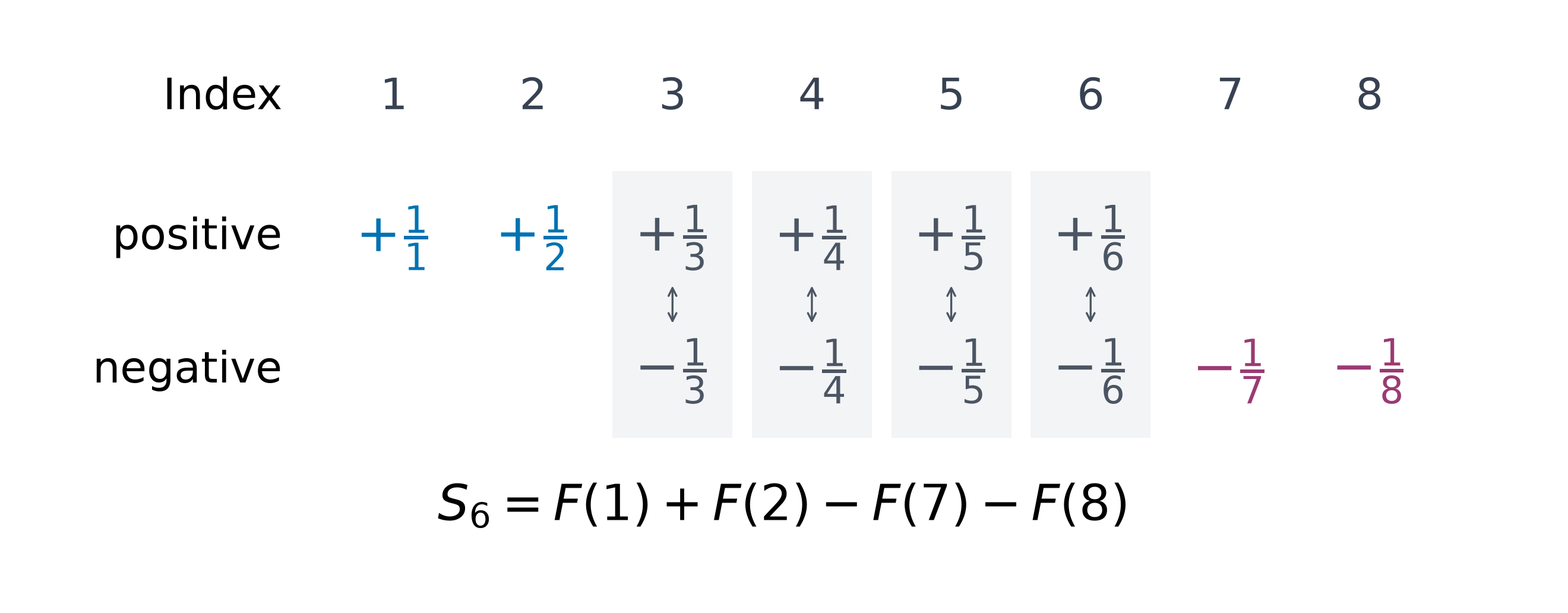
Write a term as $F(r)-F(r+1)$, then show the first few terms and the last one. The middle terms telescope 裂项相消, leaving the boundary values $F(1)-F(n+1)$. A wider shift leaves more boundary terms. For $F(r)-F(r+2)$, the two starting terms and two ending terms survive:
$$\sum_{r=1}^n(F(r)-F(r+2))=F(1)+F(2)-F(n+1)-F(n+2).$$
Partial fractions 部分分式 make cancellation visible
For $1/[r(r+2)]$, solve $1=A(r+2)+Br$: $A=1/2,B=-1/2$. Thus each term is $\tfrac12(1/r-1/(r+2))$. Use the two-step cancellation, keeping its factor:
$$S_n=\frac34-\frac1{2(n+1)}-\frac1{2(n+2)}.$$
A decomposition is not yet a sum. Show enough first and last terms to establish the cancellation, especially when three partial fractions or an index shift are involved. Check the formula at $n=1$: it gives $1/3$, the original first term.
Take the limit of the finite sum
A series is convergent 收敛 when its partial sums approach a finite real limit. In the last example the two ending fractions tend to zero, so its sum to infinity 无穷和 is $3/4$. The remaining tail after $n$ terms is $S_\infty-S_n$. Here it is $\dfrac1{2(n+1)}+\dfrac1{2(n+2)}$, which can be used to choose how many terms give a required accuracy.
Terms tending to zero is not enough. For $u_r=\sqrt{r+1}-\sqrt r$, the terms tend to zero, but $S_n=\sqrt{n+1}-1$ grows without bound. A finite partial-sum limit is the deciding evidence.
Differences need not be partial fractions
Let $P_r=r(r+1)(r+2)$. Factor the common part to obtain $P_{r+1}-P_r=3(r+1)(r+2)$. Hence a sum of $(r+1)(r+2)$ is $(P_{n+1}-P_1)/3$. Another route is to put two fractions over one denominator. For example, $1/r^2-1/(r+1)^2=(2r+1)/[r^2(r+1)^2]$. Recognising the difference avoids trying to use a formula for $\sum1/r^2$.
Check parameter endpoints separately
Let $u_r=t^{r(r+1)}-t^{(r+1)(r+2)}$. The finite sum is $S_n=t^2-t^{(n+1)(n+2)}$. For $|t|<1$, its limit is $t^2$. At $t=1$ or $t=-1$, every exponent is even and every term is zero: the infinite sum is 0, not 1. For $|t|>1$, the ending power grows without bound. The convergence set is $[-1,1]$, but the sum needs separate endpoint values.
Prove the sum before taking infinity
Choose standard sums after expanding, or differences after rearranging the term. State the index limits, show the surviving boundaries and check a small value of $n$. For an infinite series, inspect the limit of the exact partial sum. Check special parameter values in the original terms; use the remaining tail, not just the next term, for an error bound.
Explore
Sequences and their sums
Step through the terms and the running total — the idea behind a series and its sum to n terms.
Vocabulary
Train
| English |
|---|
| method of differences/ˈmeθəd ɒv ˈdɪfrənsɪz/ |
| convergent/kənˈvɜːdʒənt/ |
| sum to infinity/sʌm tʊ ɪnˈfɪnɪti/ |
| partial fractions/ˈpɑːʃl ˈfrækʃnz/ |
| summation/sʌˈmeɪʃn/ |
| telescope/ˈtelɪskəʊp/ |
| positive integer/ˈpɒzɪtɪv ˈɪntɪdʒə/ |
1.4
Matrices
Syllabus
| Candidates should be able to: | Notes and examples |
|---|---|
| carry out operations of matrix addition, subtraction and multiplication, and recognise the terms zero matrix and identity (or unit) matrix | Including non-square matrices. Matrices will have at most 3 rows and columns. |
| recall the meaning of the terms singular and non-singular as applied to square matrices and, for $2 \times 2$ and $3 \times 3$ matrices, evaluate determinants and find inverses of non-singular matrices | The notations $\det \mathbf{M}$ for the determinant of a matrix $\mathbf{M}$, and $\mathbf{I}$ for the identity matrix, will be used. |
| understand and use the result, for non-singular matrices, $(\mathbf{AB})^{-1} = \mathbf{B}^{-1}\mathbf{A}^{-1}$ | Extension to the product of more than two matrices may be required. |
| understand the use of $2 \times 2$ matrices to represent certain geometric transformations in the $x$-$y$ plane, in particular: – understand the relationship between the transformations represented by $\mathbf{A}$ and $\mathbf{A}^{-1}$ – recognise that the matrix product $\mathbf{AB}$ represents the transformation that results from the transformation represented by $\mathbf{B}$ followed by the transformation represented by $\mathbf{A}$ – recall how the area scale factor of a transformation is related to the determinant of the corresponding matrix – find the matrix that represents a given transformation or sequence of transformations | Understanding of the terms rotation, reflection, enlargement, stretch and shear for 2D transformations will be required. Other 2D transformations may be included, but no particular knowledge of them is expected. |
| understand the meaning of invariant as applied to points and lines in the context of transformations represented by matrices, and solve simple problems involving invariant points and invariant lines. | e.g. to locate the invariant points of the transformation represented by $\begin{pmatrix} 6 & 5 \\ 2 & 3 \end{pmatrix}$, or to find the invariant lines through the origin for $\begin{pmatrix} 4 & -1 \\ 2 & 1 \end{pmatrix}$, or to show that any line with gradient 1 is invariant for $\begin{pmatrix} 2 & 0 \\ 1 & 1 \end{pmatrix}$. |
Source: Cambridge International syllabus
Undo an image edit
A graphics program can store a rotation 旋转 or stretch 拉伸 as a matrix 矩阵. Its columns show where the two unit directions move; multiplying maps every point in the image. To undo the edit, an inverse must exist. To combine edits, their order matters. A correct answer should explain both the calculation and what happens to the shape.
Check the sizes before calculating
A matrix with $m$ rows and $n$ columns has size $m\times n$. Add or subtract only matrices of the same size, entry by entry; the zero matrix 零矩阵 has every entry zero. If $A$ is $m\times n$ and $B$ is $n\times p$, then $AB$ is $m\times p$. Match the inner sizes, then multiply each row by each column. A product in the reverse order may have a different size or may not exist.
For the non-square matrices
$$A=\begin{pmatrix}1&2&-1\\0&3&2\end{pmatrix},\qquad
B=\begin{pmatrix}2&0\\1&-1\\3&2\end{pmatrix},$$
$$AB=\begin{pmatrix}1&-4\\9&1\end{pmatrix}.$$
For example, entry $(1,2)$ is $1(0)+2(-1)+(-1)(2)=-4$. The product $BA$ exists but is $3\times3$, so it cannot equal $AB$.
Identity, order and singular matrices
The identity matrix 单位矩阵 $I_n$ is $n\times n$, with ones on its main diagonal and zeros elsewhere. For $A$ of size $m\times n$, $I_mA=A=AI_n$. Usually $AB\ne BA$; matrix multiplication is not commutative. A square matrix is singular when its determinant 行列式 is zero; it has no inverse. A non-singular square matrix has a unique inverse with $AA^{-1}=A^{-1}A=I$. A singular plane 平面 map may collapse the plane to a line or to a single point.
For $A=\begin{pmatrix}3&1\\2&4\end{pmatrix}$,
$$\det A=3(4)-1(2)=10,\qquad
A^{-1}=\frac1{10}\begin{pmatrix}4&-1\\-2&3\end{pmatrix}.$$
For any $2\times2$ matrix, swap the two diagonal entries, negate the other two entries, then divide by $ad-bc$, provided this determinant is non-zero.
Expand a three by three determinant
To find a $3\times3$ determinant, choose a row and delete the row and column of each chosen entry. Each remaining $2\times2$ determinant is a minor 余子式. Across the first row the signs are $+,-,+$. For a parameter, factor the determinant and state every value making it zero. Do not divide by a parameter expression before checking whether it can vanish.
$$M=\begin{pmatrix}1&2&0\\0&1&1\\2&0&1\end{pmatrix}.$$
Expanding across the first row,
$$\det M=1\begin{vmatrix}1&1\\0&1\end{vmatrix}
-2\begin{vmatrix}0&1\\2&1\end{vmatrix}
+0=1-2(-2)=5.$$
The middle minus sign belongs to the position, even if the minor itself is negative.
Find and check a three by three inverse
A cofactor 代数余子式 is a minor multiplied by its position sign. Use the sign pattern $\begin{pmatrix}+&-&+\\-&+&-\\+&-&+\end{pmatrix}$, then transpose the cofactor matrix: rows become columns. Divide that transpose by the non-zero determinant. Check the result by multiplication. Computing one cofactor incorrectly or forgetting the transpose can give a plausible-looking matrix that is not an inverse.
For the matrix $M$ above, the cofactor matrix and inverse are
$$C=\begin{pmatrix}1&2&-2\\-2&1&4\\2&-1&1\end{pmatrix},$$
$$M^{-1}=\frac15 C^{\mathsf T}
=\frac15\begin{pmatrix}1&-2&2\\2&1&-1\\-2&4&1\end{pmatrix}.$$
For example, the second row of $M$ times the first column of $M^{-1}$ gives $(0+2-2)/5=0$, as required for entry $(2,1)$ of $I_3$. Check all nine entries.
Undo several operations in reverse order
For non-singular square matrices of the same size, $(AB)^{-1}=B^{-1}A^{-1}$. Multiplication is associative, so $ABB^{-1}A^{-1}=I$. The reverse order removes the last operation first. Extend this to three factors: $(ABC)^{-1}=C^{-1}B^{-1}A^{-1}$. In a matrix equation, multiply on the correct side: from $AXB=C$, obtain $X=A^{-1}CB^{-1}$ when both inverses exist.
There is no general cancellation rule that moves a matrix through another matrix. Also, $AB$ can be square and singular even when $A$ and $B$ are non-square: calculate the product before trying to take its determinant.
Build a plane transformation from columns
For column coordinates, $\binom XY=T\binom xy$. The first column is the image of $(1,0)$ and the second is the image of $(0,1)$. These determine a linear transformation; the origin stays fixed. Recognise rotation, reflection 反射, enlargement 放大, stretch and shear 切变. State the centre or axis, direction and factor as appropriate. A translation with a non-zero displacement cannot be represented by a $2\times2$ matrix acting on these column coordinates.
| Transformation | Matrix |
|---|---|
| Anticlockwise rotation through $\theta$ about the origin | $\begin{pmatrix}\cos\theta&-\sin\theta\\\sin\theta&\cos\theta\end{pmatrix}$ |
| Reflection in the $x$-axis | $\begin{pmatrix}1&0\\0&-1\end{pmatrix}$ |
| Reflection in $y=x$ | $\begin{pmatrix}0&1\\1&0\end{pmatrix}$ |
| Enlargement, centre origin, scale factor $k$ | $\begin{pmatrix}k&0\\0&k\end{pmatrix}$ |
| Stretch parallel to the $x$-axis, factor $k$ | $\begin{pmatrix}k&0\\0&1\end{pmatrix}$ |
| Shear fixing the $x$-axis, $(0,1)\mapsto(h,1)$ | $\begin{pmatrix}1&h\\0&1\end{pmatrix}$ |
Compose edits and interpret area
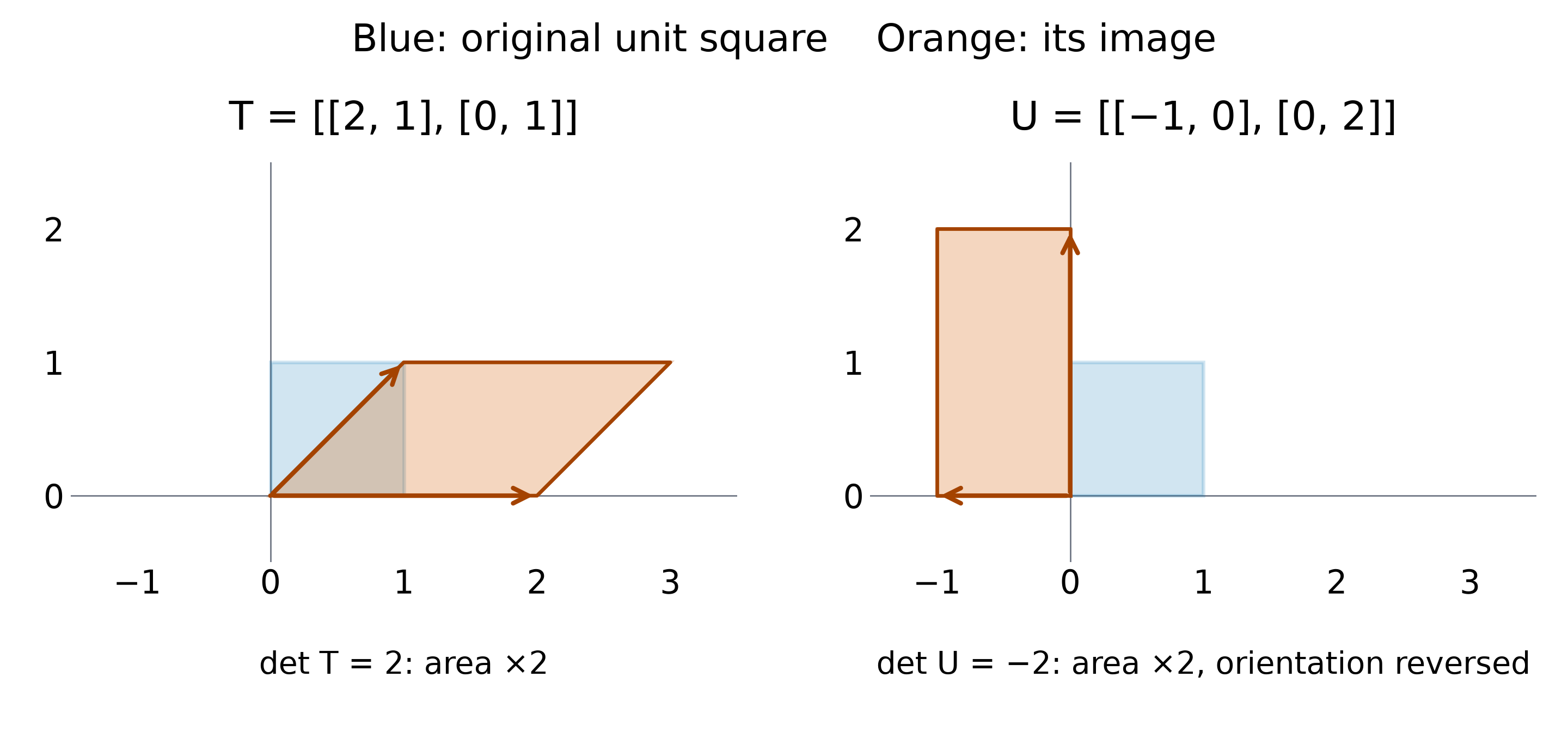
The product $AB$ applies $B$ first, then $A$. A stretch $S=\begin{pmatrix}2&0\\0&1\end{pmatrix}$ followed by a $90^\circ$ anticlockwise rotation $R$ gives $RS=\begin{pmatrix}0&-1\\2&0\end{pmatrix}$. Reversing them gives $SR=\begin{pmatrix}0&-2\\1&0\end{pmatrix}$. The area scale factor is $|\det T|$. The sign of $\det T$ tells whether orientation is reversed, not whether an area is negative. A negative enlargement factor reverses both coordinate directions, so its determinant $k^2$ is positive.
Both images have area 2. Their determinants have opposite signs: area magnitude and orientation are different properties.
Find points that stay fixed
An invariant point keeps its own coordinates: $T\binom xy=\binom xy$. Solve $(T-I)\binom xy=\binom00$. The origin is always a solution; a line of fixed points requires more solutions than the origin alone. For $T=\begin{pmatrix}2&1\\0&1\end{pmatrix}$, the equations reduce to $x+y=0$. Every point on $y=-x$ stays fixed. If $\det(T-I)\ne0$, the origin is the only invariant point; if it is zero, solve the equations to find the actual set.
For $T_\theta=\begin{pmatrix}1&1\\0&1\end{pmatrix}R_\theta$, a non-zero fixed point requires
$$\det(T_\theta-I)=2-2\cos\theta-\sin\theta=0.$$
On $0<\theta<2\pi$, put $t=\tan(\theta/2)$, checking $\theta=\pi$ separately. Then $4t^2-2t=0$, giving $\theta=2\arctan(1/2)$. Substitution gives $T_\theta-I=\frac15\begin{pmatrix}2&-1\\4&-2\end{pmatrix}$, so the fixed line is $y=2x$. The determinant condition alone does not give its equation.
A line can stay invariant while its points move
An invariant line maps onto itself as a set. Its individual points may move along it. For the non-singular map $\binom XY=\begin{pmatrix}a&b\\c&d\end{pmatrix}\binom xy$, put $y=mx$ and require $Y=mX$ for every point on that line. This gives $bm^2+(a-d)m-c=0$. State equations of lines, not just slopes, and test the vertical line $x=0$ separately: assuming a finite gradient can miss it.
For $T=\begin{pmatrix}2&0\\1&3\end{pmatrix}$ the finite-gradient equation is $-m-1=0$, so $y=-x$ is invariant. The vertical line $x=0$ is also invariant, because $(0,y)\mapsto(0,3y)$.
No non-zero point on $x=0$ stays fixed. For this matrix, solving $(T-I)(x,y)^{\mathsf T}=0$ gives only the origin: invariant lines 不变直线 and lines of invariant points 不变点 answer different questions.
Check lines away from the origin
For a line $y=mx+c$, substitute its general point into $(X,Y)$ and require $Y=mX+c$ for all $x$. Compare the coefficient of $x$ and the constant term. Test vertical lines $x=c$ separately. For the shear $H=\begin{pmatrix}1&2\\0&1\end{pmatrix}$, every horizontal line $y=c$ is invariant: $(x,c)\mapsto(x+2c,c)$. Only $y=0$ is a line of invariant points. On $y=1$, every point moves two units right.
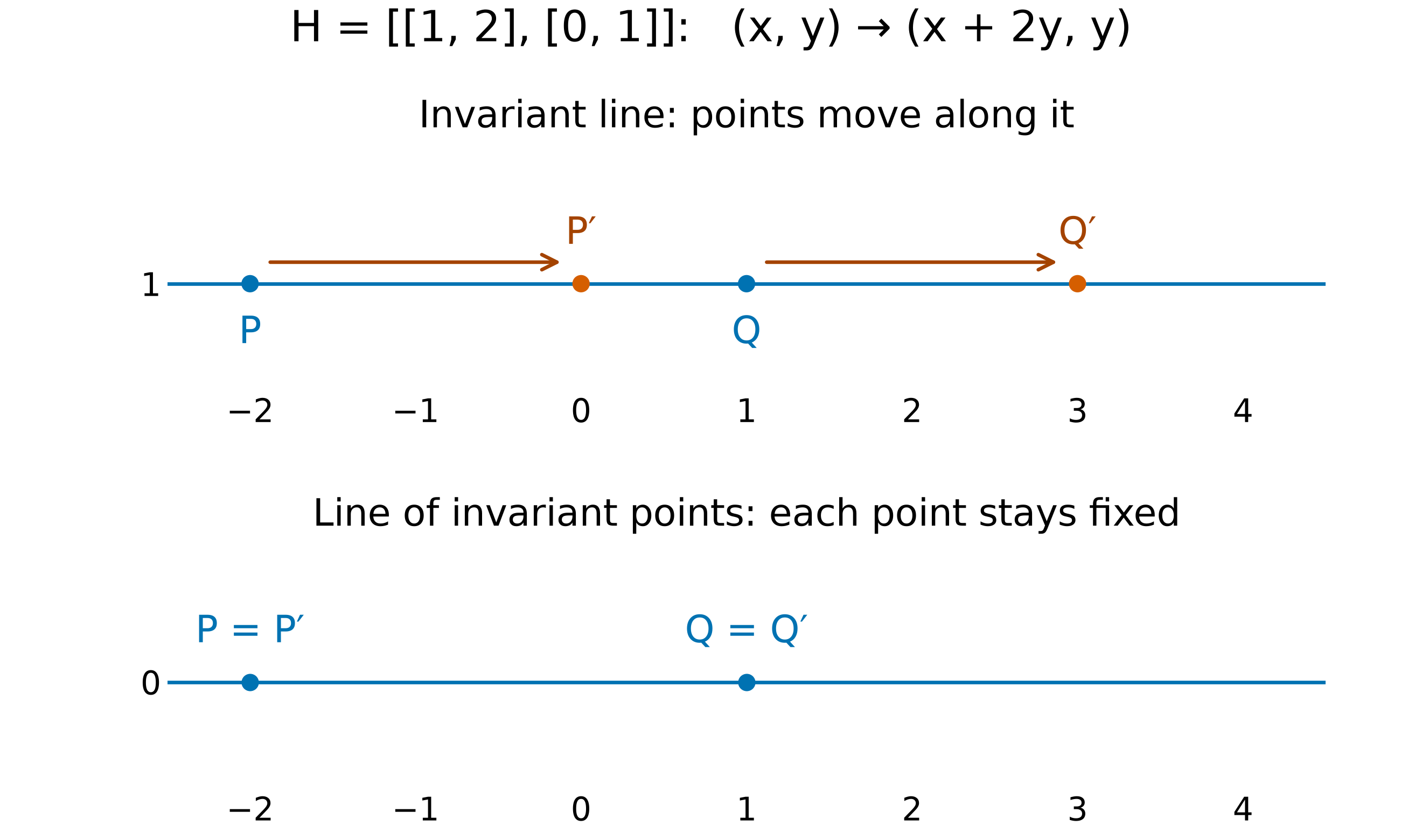
The two marked points move along y=1, so the line stays invariant. Every point on y=0 stays in its own position.
Choose the condition before the algebra
First identify whether the task asks for a product, an inverse, a transformation, an invariant point or an invariant line. State sizes and restrictions before calculating, and describe geometric transformations 几何变换 fully. Verify an inverse by a product, a fixed point by $T\mathbf v=\mathbf v$, and an invariant line by its equation after transformation. A numerical check of one point cannot prove that an entire line is invariant.
The identity matrix is also called the unit matrix. An inverse matrix 逆矩阵 undoes a non-singular map; a singular matrix 奇异矩阵 has no inverse. When describing a geometric transformation, distinguish an invariant point from an invariant line.
Explore
Matrices as transformations
Change the four entries and watch the unit square map to a new shape. The determinant is the area scale factor.
Vocabulary
Train
| English |
|---|
| matrix/ˈmeɪtrɪks/ |
| zero matrix/ˈzɪərəʊ ˈmeɪtrɪks/ |
| identity matrix/aɪˈdentɪti ˈmeɪtrɪks/ |
| determinant/dɪˈtɜːmɪnənt/ |
| singular matrix/ˈsɪŋɡjʊlə ˈmeɪtrɪks/ |
| inverse matrix/ɪnˈvɜːs ˈmeɪtrɪks/ |
| geometric transformation/ˌdʒiːəʊˈmetrɪk trænsfɔːˈmeɪʃn/ |
| invariant points/ɪnˈveərɪənt pɔɪnts/ |
| invariant lines/ɪnˈveərɪənt laɪnz/ |
| plane/pleɪn/ |
| rotation/rəʊˈteɪʃn/ |
| reflection/rɪˈflekʃn/ |
| enlargement/enˈlɑːdʒmənt/ |
| stretch/stretʃ/ |
| shear/ʃɪə/ |
| minor/ˈmaɪnə/ |
| cofactor/ˈkəʊˌfæktə/ |
1.5
Polar coordinates
Syllabus
| Candidates should be able to: | Notes and examples |
|---|---|
| understand the relations between Cartesian and polar coordinates, and convert equations of curves from Cartesian to polar form and vice versa | The convention $r \geqslant 0$ will be used. |
| sketch simple polar curves, for $0 \leqslant \theta < 2\pi$ or $-\pi < \theta \leqslant \pi$ or a subset of either of these intervals | Detailed plotting of curves will not be required, but sketches will generally be expected to show significant features, such as symmetry, coordinates of intersections with the initial line, the form of the curve at the pole and least/greatest values of $r$. |
| recall the formula $\frac{1}{2} \int r^2 \mathrm{d}\theta$ for the area of a sector, and use this formula in simple cases. |
Source: Cambridge International syllabus
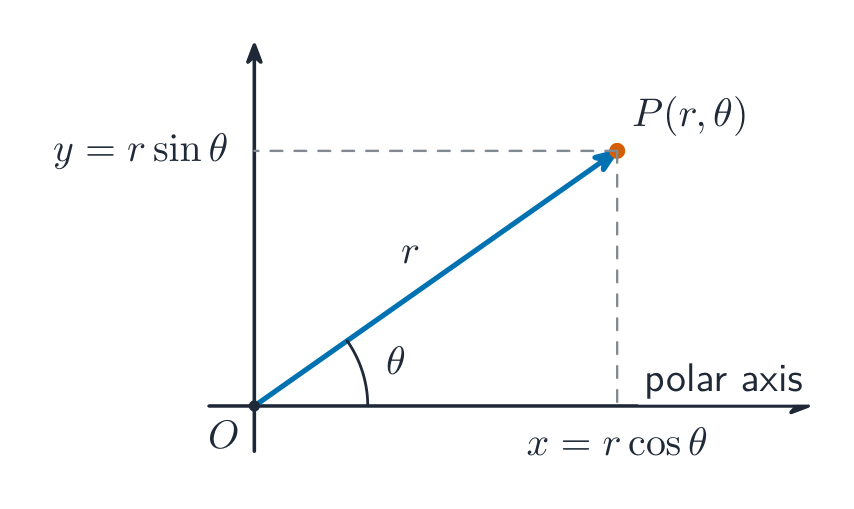
Polar curves 极坐标曲线 are described by a radius and angle, together with an allowed interval.
Choose coordinates that fit the measurement
A radar measures distance and direction. Polar coordinates store these as $(r,\theta)$, rather than the horizontal and vertical distances used by Cartesian coordinates 直角坐标. A circle centred at the radar has the simple equation $r=a$. Other circles need different equations: the choice of origin still matters. Even with rotational symmetry 旋转对称, the permitted interval may show only part of a curve; read the interval too.
Locate a point and choose its angle
The pole is the origin; the initial line 极轴 points along the positive $x$-axis. Use $r\ge0$ in this course. Angles are measured anticlockwise from the initial line; use radians for calculus. Convert with $x=r\cos\theta$, $y=r\sin\theta$ and $r^2=x^2+y^2$. In the reverse direction, use $r=\sqrt{x^2+y^2}$ and select an angle in the stated interval using the quadrant, not just $\arctan(y/x)$.
For $(-\sqrt3,1)$, $r=2$. An angle in $0\le\theta<2\pi$ is $5\pi/6$, not $-\pi/6$: the point lies in quadrant II. At the pole $r=0$, all angle descriptions name the same point, so the angle is not unique.
The radius is a distance. Its horizontal and vertical components may be negative even though r is non-negative.
Convert equations and keep their domains
Substitute the coordinate relations into an equation, simplify, then check any step that multiplied or divided by $r$. Dividing by $r$ can lose the pole; multiplying by $r$ can introduce it. For $r=4\cos\theta$, multiplying by $r$ gives $x^2+y^2=4x$, so $(x-2)^2+y^2=4$. The circle has centre $(2,0)$ and radius $2$, traced once on $-\pi/2\le\theta\le\pi/2$. A negative value from $4\cos\theta$ is not permitted under $r\ge0$.
The line $x=2$ becomes $r\cos\theta=2$, or $r=2\sec\theta$ with $-\pi/2<\theta<\pi/2$. Multiplying by $r$ would give $r^2\cos\theta=2r$, which also admits $r=0$: that extra point is not on $x=2$.
Build a sketch from features
Mark the pole and initial line, the stated angle interval, points on the initial line, zero and greatest/least radii, and the shape near the pole. Use a few special angles to place the curve; detailed point-by-point plotting is unnecessary. Test symmetry using both the equation and the interval. Replacing $\theta$ by $-\theta$ tests reflection in the initial line; reflection in a line at angle $\alpha$ replaces $\theta$ by $2\alpha-\theta$. A symmetric formula on an asymmetric interval need not give a symmetric whole sketch.
For $r=2(1+\cos\theta)$ on $-\pi\le\theta\le\pi$, the curve is a cardioid 心脏线. It is symmetric about the initial line, reaches greatest radius $4$ at $\theta=0$, crosses the $y$-axis at $(0,\pm2)$ and has a cusp at the pole when $\theta=\pm\pi$. It is one closed curve, not a circle.
A restricted interval can select one loop
If $r^2$ is given, take the non-negative square root and check where it is real. For $r^2=\sin2\theta$ on $0\le\theta\le\pi/2$, the curve starts and ends at the pole, stays in the first quadrant and reaches $r=1$ at $\theta=\pi/4$. Since $\sin(2(\pi/2-\theta))=\sin2\theta$, this loop is symmetric about $\theta=\pi/4$. Near $\theta=0$, $r^2\approx2\theta$, so it leaves the pole along the initial line; near the other endpoint it returns along the positive $y$-direction.
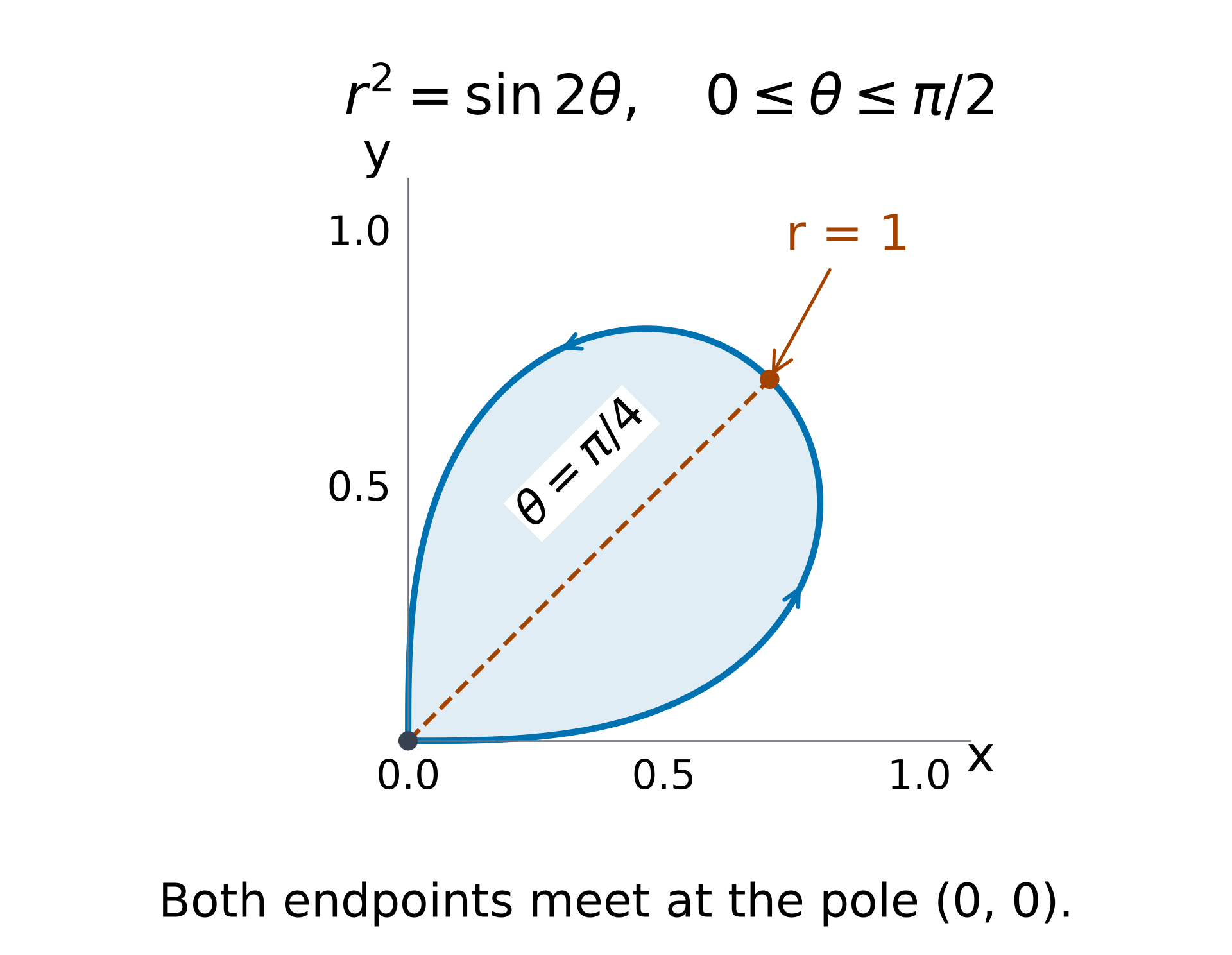
Both endpoints are the same pole. The greatest radius lies on the symmetry line, not on either coordinate axis.
Find an area from radial sectors 扇形
A thin sector has area approximately $\tfrac12r^2\,\Delta\theta$. Adding sectors gives the exact area below, when the selected region is swept once. Square $r$, retain the factor $1/2$ and use radian limits. For the loop above, $r^2$ is already $\sin2\theta$: do not square it again. The endpoints give the bounds, not a memorised full turn.
$$A=\frac12\int_\alpha^\beta r^2\,d\theta.$$
$$A=\frac12\int_0^{\pi/2}\sin2\theta\,d\theta
=\left[-\frac14\cos2\theta\right]_0^{\pi/2}
=\frac12.$$
For a complete cardioid $r=a(1+\cos\theta)$, use $(1+\cos\theta)^2$ and $\cos^2\theta=(1+\cos2\theta)/2$. Its total area is $3\pi a^2/2$.
Bound a region between two curves
Find their common rays by solving their radii equal, and check the pole separately. Identify which radius is outer throughout each interval. The radial strip has area $\tfrac12(r_{\rm outer}^2-r_{\rm inner}^2)\,d\theta$; it is not the square of the difference of radii. In the first quadrant, the region inside $r=4\cos\theta$ but outside $r=2$ lies on $0\le\theta\le\pi/3$. The whole region also has a reflected lower half; include it only if the question asks for it.
$$A_{\rm upper}=\frac12\int_0^{\pi/3}(16\cos^2\theta-4)\,d\theta
=\left[2\theta+2\sin2\theta\right]_0^{\pi/3}
=\frac{2\pi}{3}+\sqrt3.$$
The pole is not a common point: $r=2$ never reaches it. A point on one curve is not an intersection unless it lies on the other.
Furthest from the pole is not highest
Distance from the pole is $r$. To find its extrema, compare the allowed endpoints and stationary values of $r$, or of $r^2$ when $r\ge0$. A point with largest $r$ need not have largest $x$ or $y$. Distance from the initial line for a first-quadrant point is $y=r\sin\theta$. Write the required distance before differentiating, then check its endpoints. For other regions, account for signs and whether the question names a full line or a half-line.
For $r=2\sin2\theta$, $0\le\theta\le\pi/2$, the largest radius is $2$ at $\theta=\pi/4$. However,
$$y=4\sin^2\theta\cos\theta.$$
Writing $u=\cos\theta$ gives $y=4u(1-u^2)$ for $0\le u\le1$. Its maximum occurs at $u=1/\sqrt3$, giving $y_{\max}=8/(3\sqrt3)$ at a different angle. The endpoints both give $y=0$.
Integrate an unfamiliar polar curve
A polar equation need not be a named circle or cardioid. For $r=\theta e^{\theta/2}$ on $0\le\theta\le\pi$, the radius increases from $0$ to $\pi e^{\pi/2}$. The curve starts at the pole, turns anticlockwise through half a turn and ends on the negative $x$-axis. The region swept from the pole is bounded by the curve and the endpoint rays. Its area is $\tfrac12\int_0^\pi\theta^2e^\theta\,d\theta$. Integration by parts twice gives an exact value; do not replace it with the area of a circle having the largest radius.
$$\int\theta^2e^\theta\,d\theta
=e^\theta(\theta^2-2\theta+2)+C,$$
$$A=\frac12e^\pi(\pi^2-2\pi+2)-1.$$
Read the region before choosing limits
State the non-negative-radius convention and allowed angles, sketch the important features, and keep any lost or introduced pole under review when converting equations. For area, identify the region and sweep it once. For a greatest distance, decide whether the expression to optimise is $r$, $x$, $y$ or a distance to the specified line. Check endpoints as well as stationary values.
Explore
Polar curves
Pick a curve and change a. In polar form a point is set by its distance r and angle θ — that draws roses, cardioids and spirals.
Vocabulary
Train
| English |
|---|
| polar coordinates/ˈpəʊlə kəʊˈɔːdɪnəts/ |
| Cartesian coordinates/kɑːˈtiːzɪən kəʊˈɔːdɪnəts/ |
| polar curves/ˈpəʊlə kɜːvz/ |
| rotational symmetry/rəʊˈteɪʃənl ˈsɪmətri/ |
| initial line/ɪˈnɪʃl laɪn/ |
| cardioid/ˈkɑːdiɔɪd/ |
| sector/ˈsektə/ |
1.6
Vectors
Syllabus
| Candidates should be able to: | Notes and examples |
|---|---|
| use the equation of a plane in any of the forms $ax + by + cz = d$ or $\mathbf{r.n} = p$ or $\mathbf{r} = \mathbf{a} + \lambda\mathbf{b} + \mu\mathbf{c}$ and convert equations of planes from one form to another as necessary in solving problems | |
| recall that the vector product $\mathbf{a} \times \mathbf{b}$ of two vectors can be expressed either as $|\mathbf{a}||\mathbf{b}|\sin\theta\hat{\mathbf{n}}$, where $\hat{\mathbf{n}}$ is a unit vector, or in component form as $(a_2b_3 - a_3b_2)\mathbf{i} + (a_3b_1 - a_1b_3)\mathbf{j} + (a_1b_2 - a_2b_1)\mathbf{k}$ | |
| use equations of lines and planes, together with scalar and vector products where appropriate, to solve problems concerning distances, angles and intersections, including: – determining whether a line lies in a plane, is parallel to a plane or intersects a plane, and finding the point of intersection of a line and a plane when it exists – finding the foot of the perpendicular from a point to a plane – finding the angle between a line and a plane, and the angle between two planes – finding an equation for the line of intersection of two planes – calculating the shortest distance between two skew lines – finding an equation for the common perpendicular to two skew lines. |
Source: Cambridge International syllabus
Vectors describe both magnitude and direction.
Find the shortest safe route in space
A drone must approach a flat roof by the shortest route. A cable must join two rails that do not meet. These are different geometry problems: first identify the points, lines and plane involved. A direction alone is not a complete line. A distance alone does not locate its endpoints. Vector products 向量积 and scalar products 数量积 let you construct the geometry and then check it.
Choose the product that answers the question
The scalar product is $\mathbf u\cdot\mathbf v=u_1v_1+u_2v_2+u_3v_3$. For non-zero vectors it equals $|\mathbf u||\mathbf v|\cos\theta$, so a zero scalar product identifies perpendicular 垂直 directions. The zero vector has no direction or defined angle. The vector product is anti-commutative 反交换: swapping the order reverses its sign. Its magnitude is $|\mathbf u||\mathbf v|\sin\theta$, the area of the parallelogram 平行四边形 spanned by the vectors. A triangle has half this area. For non-parallel inputs, $\hat{\mathbf n}$ is the unit normal 单位法向量 in the ordered product direction.
$$\mathbf u\times\mathbf v=|\mathbf u||\mathbf v|\sin\theta\,\hat{\mathbf n},\qquad |\hat{\mathbf n}|=1,$$
$$\mathbf u\times\mathbf v=
\begin{pmatrix}
u_2v_3-u_3v_2\\
u_3v_1-u_1v_3\\
u_1v_2-u_2v_1
\end{pmatrix}.$$
For $\mathbf u=(1,1,0)$ and $\mathbf v=(0,1,1)$,
$$\mathbf u\times\mathbf v=(1,-1,1),\qquad
\mathbf u\cdot\mathbf v=1.$$
The cross product has zero scalar product with each input and magnitude $\sqrt3$. Parallel vectors have zero cross product, so they cannot supply a normal direction to a unique plane. For comparison, $(1,1,0)$ and $(1,-1,0)$ have zero scalar product and are perpendicular.
Read the three forms of a plane
A normal vector 法向量 is a non-zero vector perpendicular to every direction in the plane. The Cartesian form $ax+by+cz=d$ is the scalar-product form $\mathbf r\cdot\mathbf n=d$, with $\mathbf n=(a,b,c)$. A unit normal is $\mathbf n/|\mathbf n|$. The number $d$ is not generally the distance from the origin unless the normal is a unit vector. In $\mathbf r=\mathbf a+\lambda\mathbf b+\mu\mathbf c$, $\mathbf a$ locates a point and the non-parallel vectors $\mathbf b,\mathbf c$ give directions in the plane. The parameters vary independently. Parallel direction vectors describe only a line, not a plane.
A plane with normal $(2,-1,3)$ through $(1,0,2)$ has
$$2x-y+3z=2(1)-0+3(2)=8.$$
Multiplying every coefficient, including the right side, by the same non-zero constant gives the same plane.
Convert a parametric plane to Cartesian form
Take the cross product of its two direction vectors to find a normal. Then use a known point to find the constant: $\mathbf n\cdot\mathbf r=\mathbf n\cdot\mathbf a$. For three given points, first form two displacement vectors from one of them. To return to a parametric equation, choose two coordinates as free parameters, solve for the third and separate a fixed point from the two direction terms. Check both directions have zero scalar product with the normal.
For
$$\mathbf r=(1,0,2)+\lambda(1,1,0)+\mu(0,1,1),$$
the normal is $(1,-1,1)$, giving $x-y+z=3$. Conversely, set $x=1+\lambda$ and $z=2+\mu$. The Cartesian equation gives $y=\lambda+\mu$, recovering the original parametric form.
Classify a line and a plane before solving
Substitute $\mathbf r=\mathbf a+t\mathbf u$ into $\mathbf n\cdot\mathbf r=d$. If $\mathbf n\cdot\mathbf u\ne0$, there is one intersection, found from the parameter below. Substitute back to give the actual point. If $\mathbf n\cdot\mathbf u=0$, test the base point. When $\mathbf n\cdot\mathbf a=d$, the whole line lies in the plane; otherwise it is parallel and separate. Dividing by zero would hide this distinction.
$$t=\frac{d-\mathbf n\cdot\mathbf a}{\mathbf n\cdot\mathbf u}
\quad\text{when }\mathbf n\cdot\mathbf u\ne0.$$
For the plane $x-y+z=3$, the line $\mathbf r=t(1,0,1)$ meets it when $2t=3$, at $(3/2,0,3/2)$. The line $(1,0,2)+t(1,1,0)$ lies in the plane. The line $t(1,1,0)$ is parallel and separate, because its points satisfy $x-y+z=0$ instead.
Find the foot of a perpendicular 垂足
The foot $H$ from a point $P$ to a plane lies on the normal line through $P$. Write $\mathbf h=\mathbf p-t\mathbf n$, substitute into the plane equation, then solve for $t$. The sign determines which way to travel along the normal. Verify both conditions: $H$ lies in the plane and $\overrightarrow{PH}$ is parallel to its normal. Merely finding some point in the plane does not make it the nearest point.
From $P=(3,0,3)$ to $x-y+z=3$, use $\mathbf n=(1,-1,1)$:
$$\mathbf n\cdot(\mathbf p-t\mathbf n)=3
\quad\Rightarrow\quad 6-3t=3.$$
Thus $t=1$ and $H=(2,1,2)$. It satisfies $2-1+2=3$, and $\overrightarrow{PH}=(-1,1,-1)$ is parallel to the normal.
Measure a point-to-plane distance
The shortest distance is the component of the displacement in the normal direction. For a non-zero normal, use the absolute numerator to obtain a non-negative distance; do not confuse the plane constant with the distance symbol. Multiplying a plane equation by a non-zero constant changes numerator and denominator by the same magnitude, leaving the distance unchanged. A zero numerator means the point already lies in the plane.
$$D=\frac{|ax_0+by_0+cz_0-d|}{\sqrt{a^2+b^2+c^2}}
=\frac{|\mathbf n\cdot\mathbf p-d|}{|\mathbf n|}.$$
For $P=(3,0,3)$ and $x-y+z=3$, $D=|6-3|/\sqrt3=\sqrt3$. This agrees with the length of $\overrightarrow{PH}$ above. The plane's distance from the origin is also $|3|/\sqrt3=\sqrt3$, although these are different point-to-plane problems.
Use normals for plane angles
The smaller angle between two planes is the smaller angle between their normal directions, with $0\le\alpha\le\pi/2$. The absolute scalar product removes the choice of normal direction: $\mathbf n$ and $-\mathbf n$ describe the same plane. The angle $\phi$ between a line and a plane is complementary to the angle between its direction and the plane normal. Use sine for the line–plane angle, with $0\le\phi\le\pi/2$, and check both direction vectors are non-zero.
$$\cos\alpha=\frac{|\mathbf n_1\cdot\mathbf n_2|}{|\mathbf n_1||\mathbf n_2|},
\qquad
\sin\phi=\frac{|\mathbf u\cdot\mathbf n|}{|\mathbf u||\mathbf n|}.$$
The planes $x-y+z=3$ and $x+y+z=5$ have normals with scalar product $1$ and lengths $\sqrt3$, so $\alpha=\arccos(1/3)\approx70.5^\circ$. A line with direction $(1,0,1)$ makes angle $\phi=\arcsin(2/\sqrt6)\approx54.7^\circ$ with the first plane. Using cosine would give its angle with the normal instead.
Find the intersection of two planes
For non-parallel normals, the intersection direction is $\mathbf n_1\times\mathbf n_2$. Find a common point by solving both plane equations, then give a full line equation: point plus parameter times direction. If the normals are parallel, compare the constants using the same scale factor: the planes are either identical or parallel and separate. A zero cross product cannot provide an intersection direction.
Subtract $x-y+z=3$ from $x+y+z=5$ to get $y=1$, then $x+z=4$. A common point is $(4,1,0)$. The cross product of the normals is $(-2,0,2)$, so an equivalent intersection line is
$$\mathbf r=(4,1,0)+t(-1,0,1).$$
Every point of this line satisfies both plane equations; there is no need to use the unsimplified direction vector.
Decide whether two lines are skew
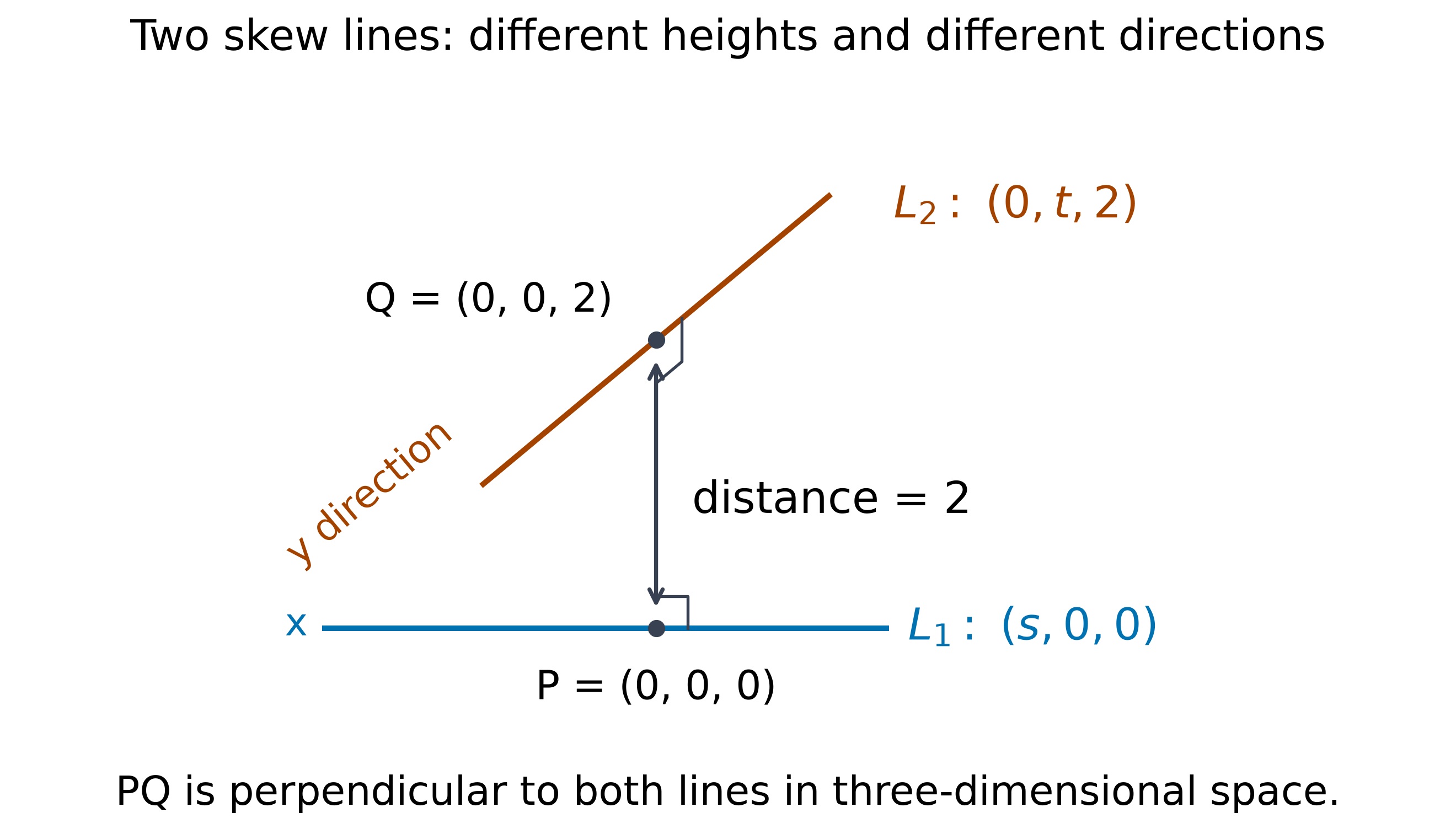
Skew lines 异面直线 are neither parallel nor intersecting. For $\mathbf r=\mathbf a+s\mathbf u$ and $\mathbf r=\mathbf b+t\mathbf v$, compare their directions and, if non-parallel, solve all three coordinate equations for an intersection. Two different line parameters must be used. When $\mathbf u\times\mathbf v\ne0$, the lines are coplanar exactly when $(\mathbf b-\mathbf a)\cdot(\mathbf u\times\mathbf v)=0$. A non-zero value proves they are skew. Do not apply the skew-distance denominator to parallel lines.
This schematic uses the x-axis and a y-parallel line at height 2. Their nearest points have the same x and y coordinates, so their connector has length 2.
Calculate the shortest skew-line distance
For non-parallel lines, $\mathbf u\times\mathbf v$ is perpendicular to both. Project the displacement between their base points onto this direction. Any non-zero multiple of the cross product gives the same distance. The formula below gives a distance, not the location of the shortest segment. For parallel lines use $|(\mathbf b-\mathbf a)\times\mathbf u|/|\mathbf u|$ instead; for intersecting non-parallel lines the numerator is zero.
$$D=\frac{|(\mathbf b-\mathbf a)\cdot(\mathbf u\times\mathbf v)|}
{|\mathbf u\times\mathbf v|}.$$
Let
$$L_1:\ \mathbf r=(1,0,1)+s(1,1,0),\qquad
L_2:\ \mathbf r=(2,2,3)+t(0,1,1).$$
Their cross product is $(1,-1,1)$ and their base-point displacement is $(1,2,2)$. Its scalar product with the cross product is $1$, so they are skew and $D=1/\sqrt3$.
Locate the common perpendicular 公垂线
Let $P=\mathbf a+s\mathbf u$ and $Q=\mathbf b+t\mathbf v$. The shortest connector obeys $(\mathbf q-\mathbf p)\cdot\mathbf u=0$ and $(\mathbf q-\mathbf p)\cdot\mathbf v=0$. Solve these two simultaneous equations for the parameters. Give the common perpendicular as a line through $P$ in direction $\mathbf u\times\mathbf v$, or through $Q$ in the same direction. Check it meets both original lines and that the segment length agrees with the distance formula. A perpendicular direction through an arbitrary point is insufficient.
For the two lines above,
$$\mathbf q-\mathbf p=(1-s,\ 2+t-s,\ 2+t).$$
Orthogonality gives $2s-t=3$ and $s-2t=4$, hence $s=2/3$ and $t=-5/3$. Therefore
$$P=(5/3,2/3,1),\qquad Q=(2,1/3,4/3),$$
$$\mathbf r=(5/3,2/3,1)+k(1,-1,1)$$
is the common perpendicular. At $k=1/3$ it reaches $Q$, and $|PQ|=\sqrt3/3$ agrees with $1/\sqrt3$.
Check the geometric conditions
A normal must be non-zero, a plane needs two independent directions, and the skew-distance denominator requires non-parallel lines. State parameter restrictions before squaring distance equations; absolute values can give more than one valid value. Substitute a proposed point into its plane, check an intersection line in both planes, and verify both orthogonality equations for a common perpendicular. These checks explain why the result solves the geometry.
Explore
Vectors
a · b = |a||b|cos θ
The dot product is zero exactly when two vectors are perpendicular.
Vocabulary
Train
| English |
|---|
| vector product/ˈvektə ˈprɒdʌkt/ |
| vectors/ˈvektəz/ |
| skew lines/skjuː laɪnz/ |
| normal vector/ˈnɔːml ˈvektə/ |
| perpendicular/ˌpɜːpənˈdɪkjʊlə/ |
| parallelogram/ˌpærəˈleləɡræm/ |
| anti-commutative/ˌæntikəˈmjuːtətɪv/ |
| scalar product/ˈskeɪlə ˈprɒdʌkt/ |
| unit normal/ˈjuːnɪt ˈnɔːml/ |
| foot of a perpendicular/fʊt əvə ˌpɜːpənˈdɪkjʊlə/ |
| common perpendicular/ˈkɒmən ˌpɜːpənˈdɪkjʊlə/ |
1.7
Proof by induction
Syllabus
| Candidates should be able to: | Notes and examples |
|---|---|
| use the method of mathematical induction to establish a given result | e.g. $\sum_{r=1}^{n} r^4 = \frac{1}{4}n^2(n+1)^2$, $u_n = \frac{1}{2}(1 + 3^{n-1})$ for the sequence given by $u_{n+1} = 3u_n - 1$ and $u_1 = 1$, $\begin{pmatrix} 4 & -1 \\ 6 & -1 \end{pmatrix}^n = \begin{pmatrix} 3 \times 2^n - 2 & 1 - 2^n \\ 3 \times 2^{n+1} - 6 & 3 - 2^{n+1} \end{pmatrix}$, $3^{2n} + 2 \times 5^n - 3$ is divisible by 8. |
| recognise situations where conjecture based on a limited trial followed by inductive proof is a useful strategy, and carry this out in simple cases. | e.g. find the $n$th derivative of $x e^x$, find $\sum_{r=1}^{n} r \times r!$. |
Source: Cambridge International syllabus
A proof using this method is an inductive proof 归纳证明.
A repeatable rule must start somewhere
Checking a pattern for the first few positive integers cannot establish infinitely many cases. Mathematical induction 数学归纳法 joins a first true statement to a rule that reaches every next statement. The base case 基础情形 starts the chain. The inductive step 归纳步骤 proves a conditional link for an arbitrary allowed integer, not just the next number in a short table.
State exactly what is being proved
Write the claim $P(n)$ and its integer range, starting at $n_0$. Check $P(n_0)$ directly, using a given starting condition if appropriate. Then assume $P(k)$ for an arbitrary integer $k\ge n_0$ and use that assumption to derive $P(k+1)$. The inductive hypothesis 归纳假设 is temporary and conditional: it does not assume the result for every integer. Conclude that $P(n)$ holds for all integers $n\ge n_0$, because the verified base case and the general link together reach them.
Do not assume the $k+1$ case while trying to prove it. Showing only $P(k+1)\Rightarrow P(k)$ gives the wrong implication. Backward algebra can help you plan, but a proof needs a valid forward argument, or a justified chain of equivalent statements.
Add the new term in a sum
For a finite sum, separate the last term of the $k+1$ sum. Replace only its first $k$ terms using the hypothesis, then simplify to the formula with $n=k+1$. Show the starting case, the exact hypothesis and the final conclusion. A line that merely quotes the sum formula for $k+1$ has not established the link.
Prove $\sum_{r=1}^{n}r(r+1)=n(n+1)(n+2)/3$ for positive integers $n$.
At $n=1$, both sides equal $2$. Assume the formula holds for $n=k$. Then
$$\begin{aligned}
\sum_{r=1}^{k+1}r(r+1)
&=\frac{k(k+1)(k+2)}3+(k+1)(k+2)\\
&=\frac{(k+1)(k+2)(k+3)}3.
\end{aligned}$$
This is the required $k+1$ formula, so the result follows for all positive integers by induction.
Expose an integer multiple for divisibility
To prove an expression is divisible 整除 by a non-zero integer $m$, write it as $m$ times an integer. In the inductive step, isolate the assumed divisible expression and show every remaining term is also a multiple of $m$. Both a convenient multiple of the $k$ expression and the difference between consecutive expressions can help. Name the integer multiplier; “it is divisible by inspection” can hide a missing use of the hypothesis.
Let $F_n=10^n-4^n$. At $n=1$, $F_1=6$. Assume $F_k=6q$ for an integer $q$. Then
$$\begin{aligned}
F_{k+1}
&=10(10^k-4^k)+6\cdot4^k\\
&=6(10q+4^k).
\end{aligned}$$
The bracket is an integer. Thus $6$ divides $F_{k+1}$, and induction proves the result for every positive integer $n$.
Use the recurrence to move forward
A recurrence gives a legal way to pass from $u_k$ to $u_{k+1}$. Check that a proposed closed form has the correct first term, substitute its $k$ version into the recurrence and simplify. Do not insert the proposed $k+1$ formula into the recurrence and call it a proof unless you establish a reversible equivalence with the known $k$ formula. The clearest route starts from the given recurrence.
Suppose $u_1=2$ and $u_{n+1}=3u_n+2$. The claim is $u_n=3^n-1$. It is true at $n=1$. Assuming $u_k=3^k-1$,
$$u_{k+1}=3(3^k-1)+2=3^{k+1}-1.$$
This proves the claimed closed form for all positive integers, not just the first computed terms $2,8,26$.
Preserve a bound and check denominator signs
For an inequality involving a recurrence, substitute the hypothesis into an expression whose sign can be controlled. State why its denominator is positive before using it to preserve an inequality. Sometimes the needed hypothesis contains two bounds. Prove both survive the step. Once a bound is established for every term, it can justify a later monotonicity argument without assuming the answer.
Let $u_1=1$ and $u_{n+1}=(4u_n+3)/(u_n+2)$. Prove $0<u_n<3$.
The first term satisfies both inequalities. If $0<u_k<3$, numerator and denominator of $u_{k+1}$ are positive. Also,
$$3-u_{k+1}=\frac{3-u_k}{u_k+2}>0.$$
Thus $0<u_{k+1}<3$. By induction, $0<u_n<3$ for every positive integer $n$. The established bounds then give
$$u_{n+1}-u_n=\frac{(3-u_n)(u_n+1)}{u_n+2}>0,$$
so the sequence is increasing. This last deduction uses the proven bound; it does not replace that proof.
Prove a matrix-power formula by multiplication
For powers of one matrix, $M^{k+1}=M^kM$. Substitute the proposed expression for $M^k$, multiply row by column and show every entry has the $k+1$ form. A matrix power is not found by raising each entry to a power. Also, a formula checked at $M$ and $M^2$ is only evidence until the arbitrary-$k$ step has been proved.
For $M=\begin{pmatrix}2&1\\0&1\end{pmatrix}$, claim
$$M^n=\begin{pmatrix}2^n&2^n-1\\0&1\end{pmatrix}
\quad(n\ge1).$$
The $n=1$ case is $M$ itself. Using the $k$ hypothesis,
$$\begin{aligned}
M^{k+1}
&=\begin{pmatrix}2^k&2^k-1\\0&1\end{pmatrix}
\begin{pmatrix}2&1\\0&1\end{pmatrix}\\
&=\begin{pmatrix}2^{k+1}&2^{k+1}-1\\0&1\end{pmatrix}.
\end{aligned}$$
Therefore the formula holds for all positive integers by induction. The separate $n=0$ case is $M^0=I$, which also fits this formula.
Conjecture 猜想 and prove a derivative pattern
A conjecture is a statement suggested by evidence, not an established theorem. Compute a few derivatives, look for a pattern and express it precisely with its starting value of $n$. For an $n$th-derivative formula, differentiate the assumed $k$th derivative once. A correct pattern needs an actual differentiation and simplification in the inductive step.
For $f(x)=xe^{2x}$, the first derivatives are $e^{2x}(2x+1)$, $e^{2x}(4x+4)$ and $e^{2x}(8x+12)$. Conjecture
$$f^{(n)}(x)=2^{n-1}e^{2x}(2x+n),\qquad n\ge1.$$
The first derivative gives the base case. Differentiating the $k$ formula yields
$$2^{k-1}e^{2x}\{2(2x+k)+2\}
=2^ke^{2x}(2x+k+1),$$
which is the required $k+1$ derivative. Hence the conjecture is true for every positive integer $n$.
Match the derivative order in the statement
If the claimed formula is for derivative order $2n$, increasing $n$ by one increases the derivative order by two. The inductive step must differentiate twice. Count the derivative order before starting the algebra. Track the alternating sign and the coefficient depending on $n$ separately. A statement about selected even orders is not automatically a statement about every derivative order.
For $f(x)=x\sin x$, claim
$$f^{(2n)}(x)=(-1)^n(x\sin x-2n\cos x),\qquad n\ge1.$$
At $n=1$, $f''(x)=2\cos x-x\sin x$, as required. Differentiating the assumed $2k$ formula once gives $(-1)^k\{x\cos x+(2k+1)\sin x\}$. A second differentiation gives
$$(-1)^k\{-x\sin x+(2k+2)\cos x\}
=(-1)^{k+1}\{x\sin x-2(k+1)\cos x\},$$
completing the step to derivative order $2(k+1)$. The formula therefore holds for all positive integers $n$ by induction.
Turn a short trial into a factorial 阶乘 conjecture
A factorial is $n!=1\cdot2\cdots n$ for a positive integer $n$, with $0!=1$. A few partial sums may suggest a shifted factorial, but the pattern must then survive a general induction step. Compute the first terms carefully and look for a simple expression after adding or subtracting a constant. When a question asks for induction, present that proof even if a direct telescoping argument is also available.
For $S_n=\sum_{r=1}^{n}r\,r!$, the first sums are $1,5,23,119$. Adding $1$ suggests $S_n=(n+1)!-1$.
At $n=1$, both sides equal $1$. Assuming the formula for $k$,
$$\begin{aligned}
S_{k+1}
&=(k+1)!-1+(k+1)(k+1)!\\
&=(k+2)(k+1)!-1=(k+2)!-1.
\end{aligned}$$
Thus the conjecture holds for all positive integers by induction. The identity $r\,r!=(r+1)!-r!$ also explains why the sums telescope, but listing early values alone is not a proof.
Start at the first value the claim actually covers
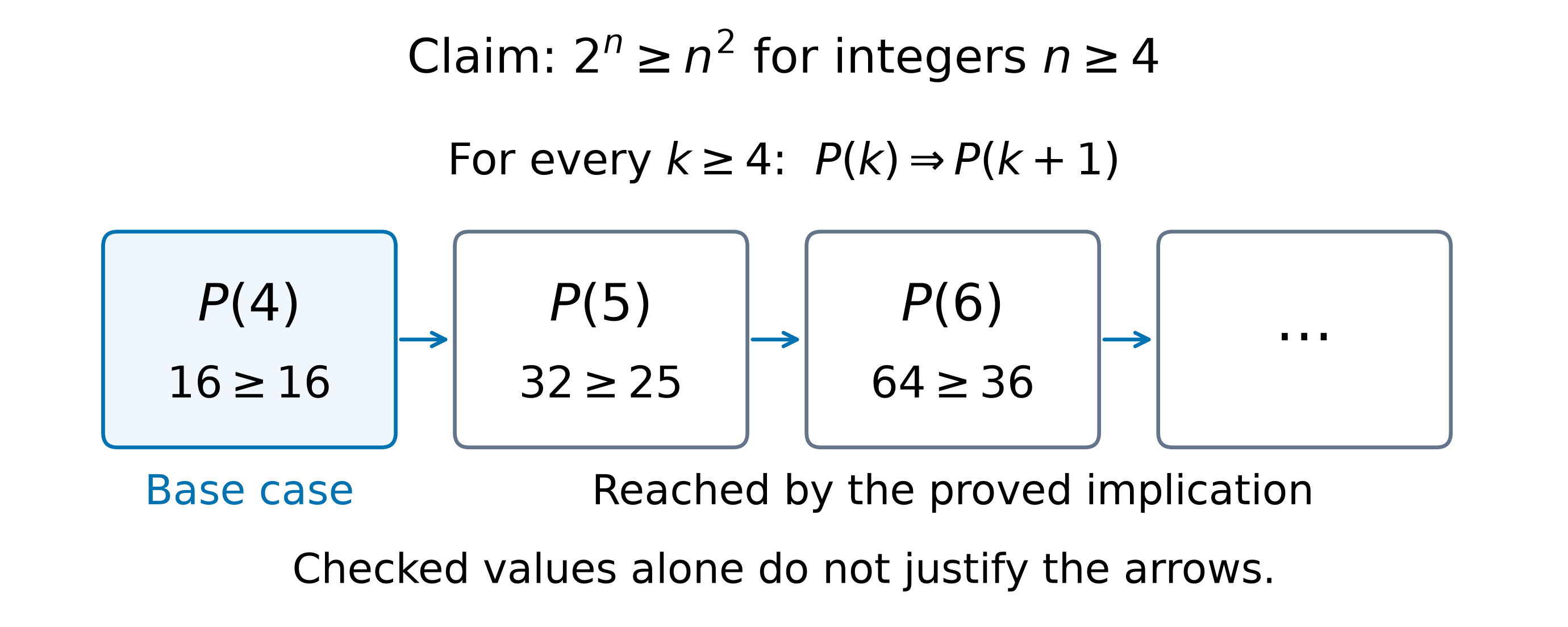
A claim may start at $n=4$ or another stated integer. Prove that starting case and assume $k$ lies in the allowed range; do not silently replace the domain by all positive integers. For $2^n\ge n^2$ with $n\ge4$, the base case is $16=16$. Assuming $2^k\ge k^2$ for $k\ge4$, we have $2^{k+1}\ge2k^2\ge(k+1)^2$, because $2k^2-(k+1)^2=(k-1)^2-2>0$ in that range. Hence induction proves the stated claim for all integers $n\ge4$.
The chain proves the stated range beginning at 4. In fact n=3 fails, since 8 is less than 9; the starting point is part of the claim.
Audit the implication and the conclusion
Check that the hypothesis is used to prove the next case in the forward direction, with all expressions defined. A checked base and a backward implication alone do not establish the claim for later integers. Match the conclusion to the link: $P(k)\Rightarrow P(k+1)$ reaches every later integer, while a link from $k$ to $k+2$ reaches only one parity from a single base. To cover both parities with that link, two starting cases are needed.
The statements $P(n): n\le5$ give a warning. $P(1)$ is true and $P(k+1)\Rightarrow P(k)$ is true for positive integers, yet $P(6)$ is false. The reversed implication cannot replace the required forward step.
Explore
Proof by induction route
See induction as a first domino plus a rule that pushes every next case.
Vocabulary
Train
| English |
|---|
| mathematical induction/ˌmæθɪˈmætɪkl ɪnˈdʌkʃn/ |
| conjecture/kənˈdʒektʃə/ |
| inductive proof/ɪnˈdʌktɪv pruːf/ |
| base case/beɪs keɪs/ |
| inductive step/ɪnˈdʌktɪv step/ |
| divisible/dɪˈvɪzɪbl/ |
| inductive hypothesis/ɪnˈdʌktɪv haɪˈpɒθəsɪs/ |
| factorial/fækˈtɔːrɪəl/ |
1.7
Exam tips
- Use the relationships between roots and coefficients (sum, sum of pairs, product) instead of solving the polynomial.
- For proof by induction, set out the base case, assume the result for $n = k$, prove it for $n = k+1$, and write a clear closing statement.
- Sketch rational-function graphs with their asymptotes and turning points; use the method of differences for a summation.
- For matrices, know the determinant, inverse and invariant lines, and interpret each transformation geometrically.
Interactive lessons on this topic
Work through it step by step, with instant-check exercises.