Linear motion under a variable force
Introduced| English | Meaning |
|---|---|
| drag/dræɡ/ | A resistive force from air or another fluid, opposing an object’s motion relative to that fluid. |
| speed/spiːd/ | The magnitude of velocity; it is never negative. |
| position/pəˈzɪʃn/ | A location specified relative to a chosen reference point and axis. |
| variable force/ˈveərɪəbl fɔːs/ | A force whose value changes with a variable such as time, position or velocity. |
| differential equation/ˌdɪfəˈrenʃl ɪˈkweɪʒn/ | An equation containing a derivative of an unknown function, such as velocity and its rate of change. |
| velocity/vəˈlɒsɪti/ | The signed rate of change of displacement along a line; its sign gives the direction of motion. |
| chain rule/tʃeɪn ruːl/ | The rule for differentiating a composite function by multiplying the outer derivative by the inner derivative. |
| turning point/ˈtɜːnɪŋ pɔɪnt/ | A position where velocity becomes zero and the direction of motion reverses; the resultant force need not be zero. |
| separable differential equation/ˈsepərəbl ˌdɪfəˈrenʃl ɪˈkweɪʒn/ | A differential equation that can be rearranged to put each variable and its differential on a separate side. |
| separate/ˈsepəreɪt/ | To rearrange an equation so the different variables and their differentials are on opposite sides. |
| integrate/ˈɪntɪɡreɪt/ | To find an antiderivative or evaluate a definite integral; here this relates changing force and motion. |
| initial condition/ɪˈnɪʃl kənˈdɪʃn/ | A given value of the solution at its starting time or starting state. |
| boundary condition/ˈbaʊndəri kənˈdɪʃn/ | A condition on a solution or its derivatives at a specified point or endpoint, used to determine constants. |
| separable/ˈsepərəbl/ | Describing an equation whose variables can be put on separate sides with their respective differentials. |
| work/wɜːk/ | Signed energy transferred by a force along a displacement; in one dimension it is the integral of force with respect to position. |
| terminal velocity/ˈtɜːmɪnl vəˈlɒsɪti/ | A constant velocity at which the driving and resistive forces balance; it may be approached only as a limit. |
| partial fractions/ˈpɑːʃl ˈfrækʃnz/ | A way to rewrite a rational expression as simpler fractions, often making its integral easier. |
Why a fast object slows differently
- A bicycle usually feels more air resistance when it moves faster. Its drag 阻力 may depend on speed 速率. A different force might depend on position 位置 or time; these are different models.
- A variable force 变力 can produce changing acceleration. Start with Newton's law and set up a differential equation 微分方程 for the motion; constant-acceleration formulae need not apply.
A model gives air resistance proportional to speed squared. Another gives a spring force proportional to displacement. Must both be treated as forces depending only on position?
Compare your Newton equation, integration constants and branch checks with the model. Correct the reasoning as well as the final result.
Choose a positive direction first
- Take displacement $x$ positive to the right, and write velocity 速度 $v=dx/dt$. It can be negative. Speed is $|v|$, so a negative velocity does not mean a negative speed.
- Add signed forces on the particle: $m\,dv/dt=\sum F$. For motion to the right, resistance is negative. After reversal, ordinary resistance reverses too; a prescribed force towards a fixed point follows its own direction rule.
Right is positive. A particle has velocity −3 m/s and acceleration +2 m/s² at one instant. Is it moving right, and is its speed increasing at that instant?
Compare your Newton equation, integration constants and branch checks with the model. Correct the reasoning as well as the final result.
Change the variable using the chain rule
- If velocity is written as a function of position along a branch of the motion, the chain rule 链式法则 gives
- This is useful for finding $v$ at a position without first finding time. At a turning point 转折点 $v(x)$ may have a vertical tangent; do not assume $a=0$ merely because $v=0$. Use the original force law there.
To find velocity directly as a function of position x under a position-dependent resultant force, which acceleration form is most convenient?
Difficulty 1/5 · 100 coins + a small bonus on first completion today
a = dv/dt = (dv/dx)(dx/dt) = v dv/dx — convenient when force depends on x.
The identity a = v dv/dx comes from the ______ rule.
Difficulty 1/5 · 100 coins + a small bonus on first completion today
dv/dt = (dv/dx)(dx/dt) = v dv/dx by the chain rule.
A particle reaches a turning point with zero velocity but a non-zero resultant force. A student says a = v dv/dx must give a = 0. Explain the error.
Compare your Newton equation, integration constants and branch checks with the model. Correct the reasoning as well as the final result.
Choose the variables for the requested answer
- For a time-dependent force, $m\,dv/dt=F(t)$ often gives $v(t)$ directly. For a position-dependent force, $mv\,dv/dx=F(x)$ often gives $v(x)$ directly.
- If force depends on velocity, either form may help: use $dv/dt$ for a time question and $v\,dv/dx$ for a distance question. These are choices of variables for the same Newton equation, not different laws.
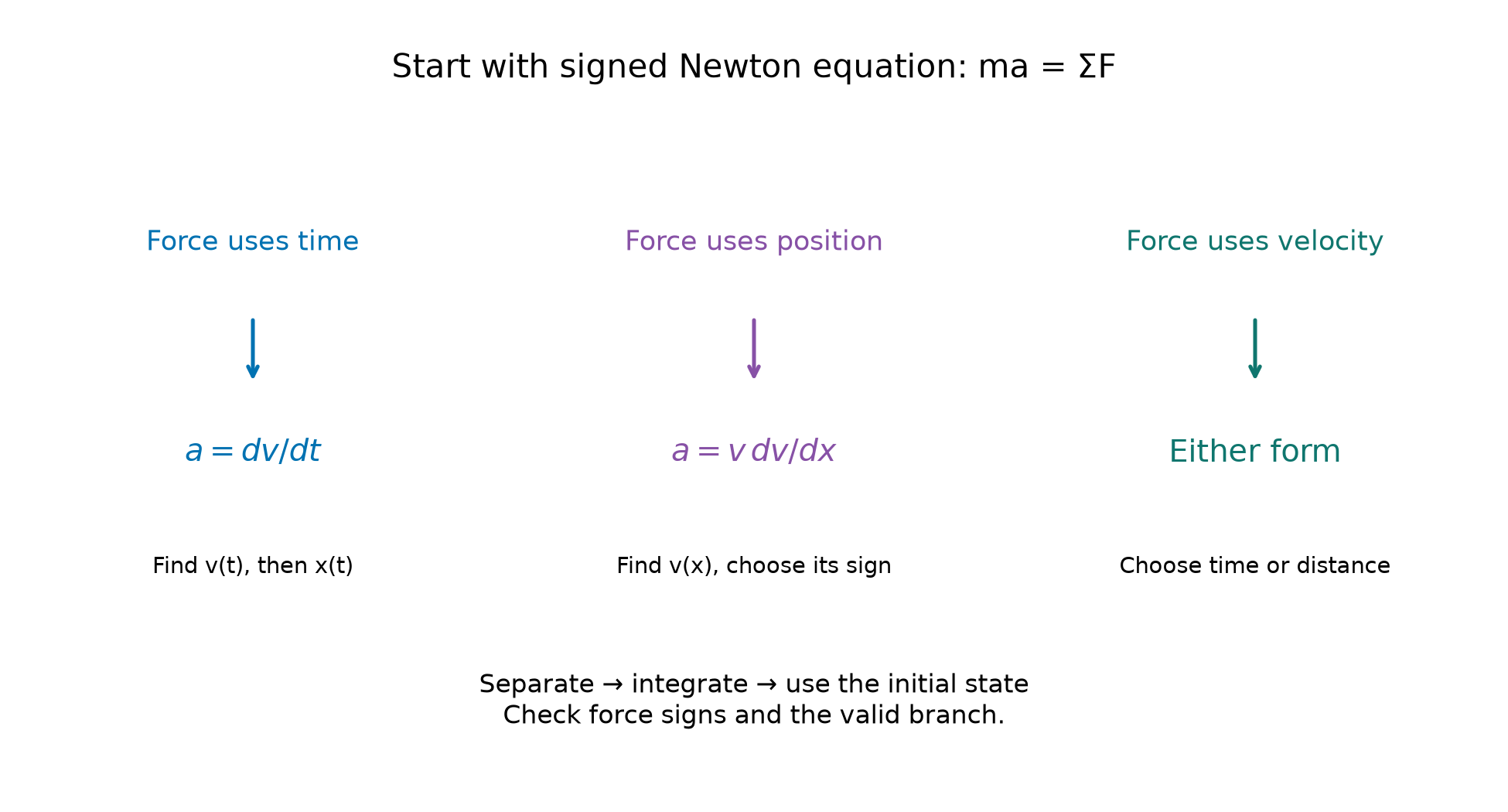
If instead the force depends on time t, the natural form for acceleration is:
Difficulty 1/5 · 100 coins + a small bonus on first completion today
Time-dependent force → a = dv/dt; position-dependent → a = v dv/dx.
A horizontal resistance is a known function of positive speed v. For one question you need the time to reach a given speed; for another you need the distance. Which acceleration forms help?
Compare your Newton equation, integration constants and branch checks with the model. Correct the reasoning as well as the final result.
Use each stated condition
- A separable differential equation 可分离微分方程 can be rearranged so each side contains one variable and its differential. Separate 分离 the variables, integrate 积分, include a constant, then use an initial condition 初始条件 to determine it.
- A condition at a specified position is often called a boundary condition 边界条件. Here use only separable 可分离 equations and Pure Mathematics 3 calculus. Check any value divided out: division by a factor that can be zero may remove a constant solution.
The only resultant force on a constant-mass particle is F(x). Substituting a = v dv/dx gives a separable equation in v and x.
Difficulty 1/5 · 100 coins + a small bonus on first completion today
F(x) = mv dv/dx separates into v dv and an x-expression, then integrate.
Put the steps for solving motion under a position-dependent force in order.
Difficulty 3/5 · 200 coins + a small bonus on first completion today
Set up with v dv/dx, separate, integrate, then use the conditions to fix the constant.
For dv/dt = 4 − v, a solver divides by 4 − v and declares that every initial velocity is covered by the resulting logarithm. Which solution must be checked separately?
Compare your Newton equation, integration constants and branch checks with the model. Correct the reasoning as well as the final result.
A force depending on time can reverse the velocity
- A $2\ \text{kg}$ particle has resultant force $6t\ \text{N}$ to the right. At $t=0$, $v=-1\ \dfrac{\text{m}}{\text{s}}$ and $x=0$. Newton's law gives $2\,dv/dt=6t$, so $v=\tfrac32t^2+C$; the initial velocity gives $C=-1$.
- Now integrate $dx/dt=-1+\tfrac32t^2$. The initial position gives $x=-t+\tfrac12t^3$. There are two integrations and two initial conditions. The particle initially moves left even though acceleration is to the right for $t>0$.
A 2 kg particle has resultant force 4t N to the right. At t = 0 it has x = 0 and v = −2 m/s. Find v(t), x(t), and its first turning time.
Compare your Newton equation, integration constants and branch checks with the model. Correct the reasoning as well as the final result.
Displacement and distance differ across a turn
- In that example, $v=0$ first at $t_* =\sqrt{2/3}\ \text{s}$. Its position is $x_*=-2t_*/3\ \text{m}$. At $t=2\ \text{s}$, displacement is $x=2\ \text{m}$.
- Total distance is the leftward distance $-x_*$ plus the rightward distance $2-x_*$. Thus distance is $2+4\sqrt{2/3}/3\ \text{m}$, greater than the displacement. Integrating signed velocity gives displacement; split at each reversal to find distance.
A particle has velocity v = 2t − 2 m/s for 0 ≤ t ≤ 3 s and starts at x = 0. Find displacement and total distance over the three seconds.
Compare your Newton equation, integration constants and branch checks with the model. Correct the reasoning as well as the final result.
A position-dependent force links work to speed
- With $F=mv\,dv/dx$, separation gives $mv\,dv=F(x)\,dx$. Integrating between two known states gives
- The signed area under a force–position graph is work 功. It equals the change in kinetic energy for the resultant force. This relation determines squared speed; use the direction of motion to choose the sign of velocity.
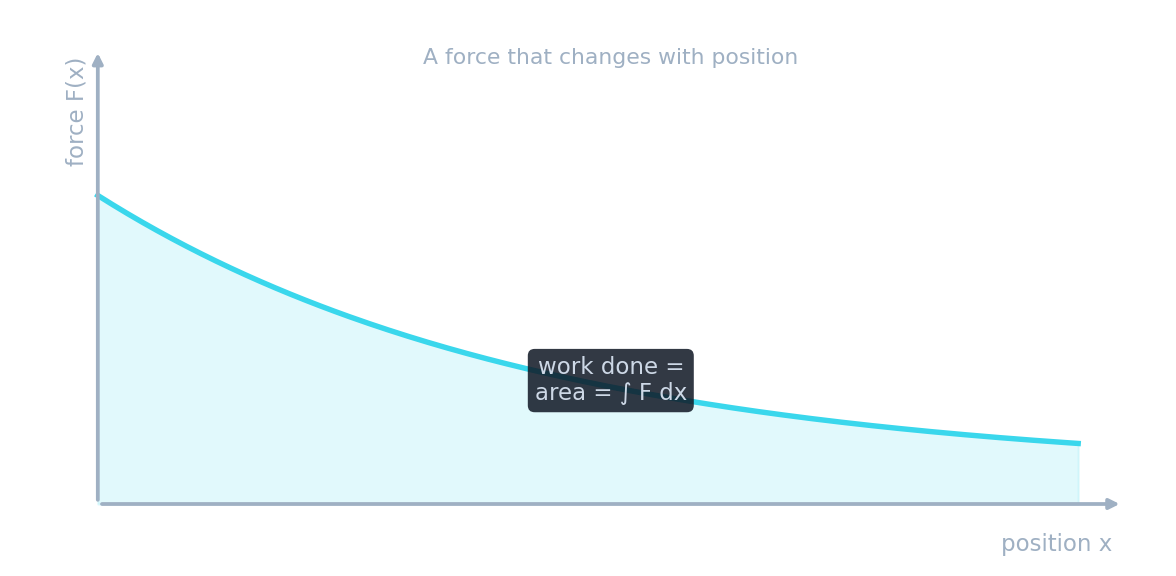
Work from a variable force
W = ∫ F dx
When the force changes, the work done is the area under the force–distance graph.
A force F = 6x acts from x = 0 to x = 2. What is the work done, and which form of acceleration is used when the force depends on position?
Work is the area under the force-distance graph. The chain rule turns acceleration into v dv/dx.
A 2 kg particle starts at x = 0 with velocity 3 m/s to the right. Its only horizontal force is F = 4 − 2x N. Find its speed at x = 1 m and check whether it stops before reaching that point.
Compare your Newton equation, integration constants and branch checks with the model. Correct the reasoning as well as the final result.
Work through a polynomial force
- A particle of mass $8\ \text{kg}$ starts at $x=0$ with $v=1\ \dfrac{\text{m}}{\text{s}}$. For its outward motion the force is $(x^3+4x)\ \text{N}$. Newton's law gives $8v\,dv/dx=x^3+4x$.
- Separate and integrate: $4v^2=x^4/4+2x^2+C$. Initially $C=4$, so $v^2=x^4/16+x^2/2+1=(x^2/4+1)^2$. The outward velocity is $v=x^2/4+1$; the negative square root would describe a different direction.
A 2 kg particle starts at x = 0 with velocity 2 m/s to the right. The resultant force is F = 8x + 4x³ N for x ≥ 0. Find v(x) on its outward branch.
Compare your Newton equation, integration constants and branch checks with the model. Correct the reasoning as well as the final result.
A second separation can give position in time
- For that outward branch, $dx/dt=1+x^2/4$. Separate as $dt=4\,dx/(x^2+4)$ and integrate: $t=2\tan^{-1}(x/2)+C$. The initial position gives $C=0$.
- Hence $x=2\tan(t/2)$ on the branch $0\leq t<\pi$. The mathematical model predicts unbounded position as $t\to\pi$ from below. Do not continue the periodic tangent formula across that boundary or assume a real system can sustain the force model indefinitely.
A particle satisfies dx/dt = x² + 2 and x(0) = 0. Find x(t) on its first nonnegative branch and the upper endpoint of that branch.
Compare your Newton equation, integration constants and branch checks with the model. Correct the reasoning as well as the final result.
A turning root limits a position formula
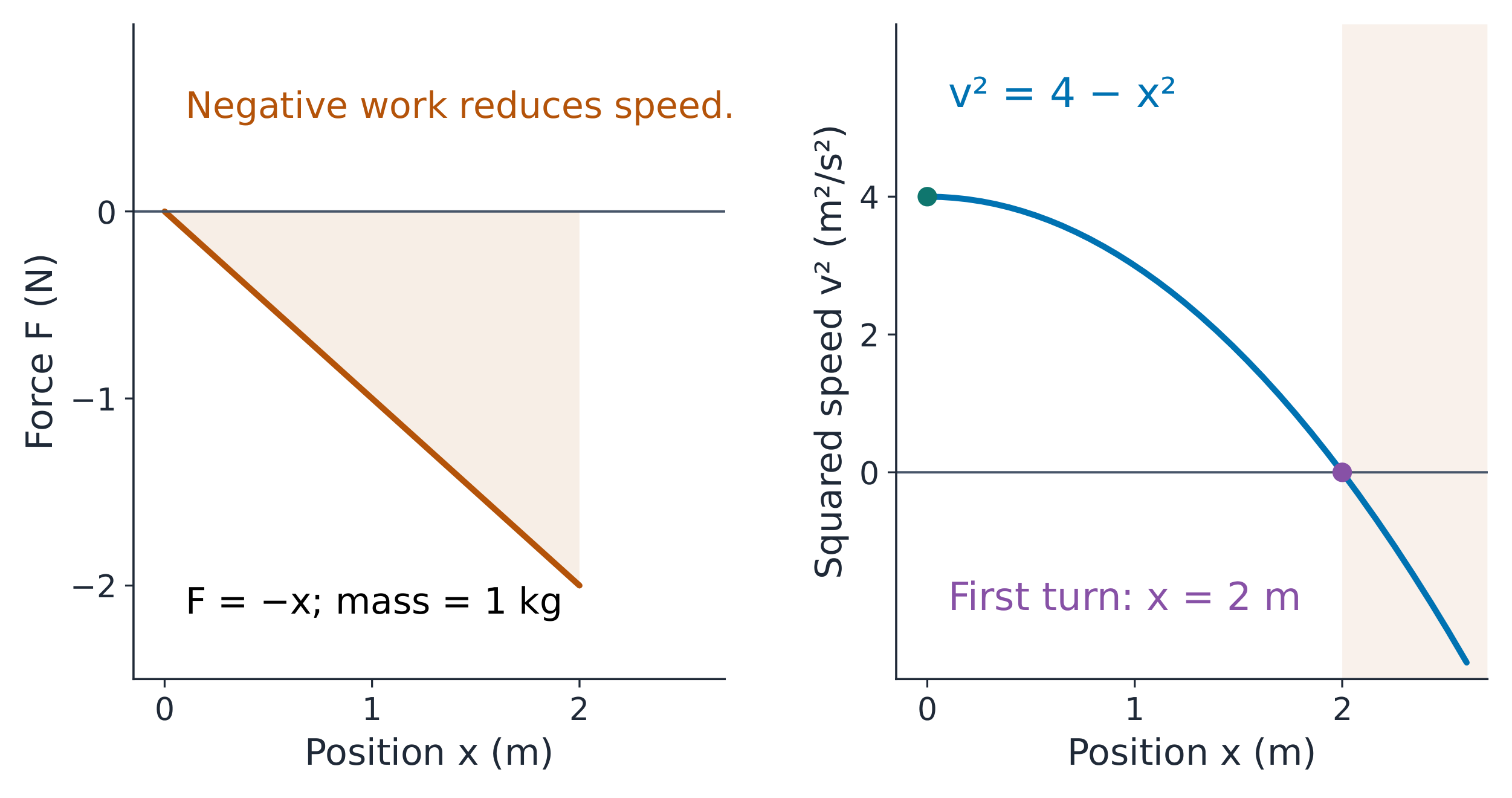
- A $1\ \text{kg}$ particle starts at $x=0$ with velocity $2\ \dfrac{\text{m}}{\text{s}}$, under force $-x\ \text{N}$. Newton's law gives $v\,dv/dx=-x$, hence $v^2=4-x^2$ from the initial state.
- It first stops at $x=2\ \text{m}$, where acceleration is $-2\ \dfrac{\text{m}}{\text{s}^2}$, so it turns back. Use $v=+\sqrt{4-x^2}$ before that turn and $v=-\sqrt{4-x^2}$ immediately afterwards. The region $|x|>2\ \text{m}$ would require negative squared speed and is inaccessible at this energy.
A 2 kg particle starts at x = 0 with velocity 6 m/s under resultant force F = −8x N. Find its first positive turning position, acceleration there, and velocity sign just after that turn.
Compare your Newton equation, integration constants and branch checks with the model. Correct the reasoning as well as the final result.
Linear resistance gives an exponential speed
- A $2\ \text{kg}$ particle moves horizontally with initial velocity $3\ \dfrac{\text{m}}{\text{s}}$, opposed by resistance of magnitude $4v\ \text{N}$ while $v>0$. Newton's law gives $2\,dv/dt=-4v$, so $dv/v=-2\,dt$.
- Integration gives $\ln v=-2t+C$. The initial value gives $v=3e^{-2t}$. It remains positive for every finite $t\geq0$ and tends to zero as time grows. An exponential is not zero merely because a calculator rounds it to zero.
A 3 kg particle moves right with initial speed 4 m/s under resistance of magnitude 6v N. Find v(t) while it moves right and the time for its speed to halve.
Compare your Newton equation, integration constants and branch checks with the model. Correct the reasoning as well as the final result.
A limiting distance is not a finite stopping point
- Integrating $v=3e^{-2t}$ with $x(0)=0$ gives $x=\tfrac32(1-e^{-2t})$. Thus the particle travels towards a limiting displacement of $1.5\ \text{m}$.
- It never reaches that limit in finite time under this ideal model. Equivalently $v=3-2x$ on the moving branch, but putting $v=0$ in that relation gives a limit, not a finite arrival time. Check the time law before describing a stop.
A particle starts at x = 0 with velocity v = 4e^(−2t) m/s. Find its limiting displacement, the time when x = 1.5 m, and whether it reaches the limiting displacement in finite time.
Compare your Newton equation, integration constants and branch checks with the model. Correct the reasoning as well as the final result.
Quadratic resistance has a different distance limit
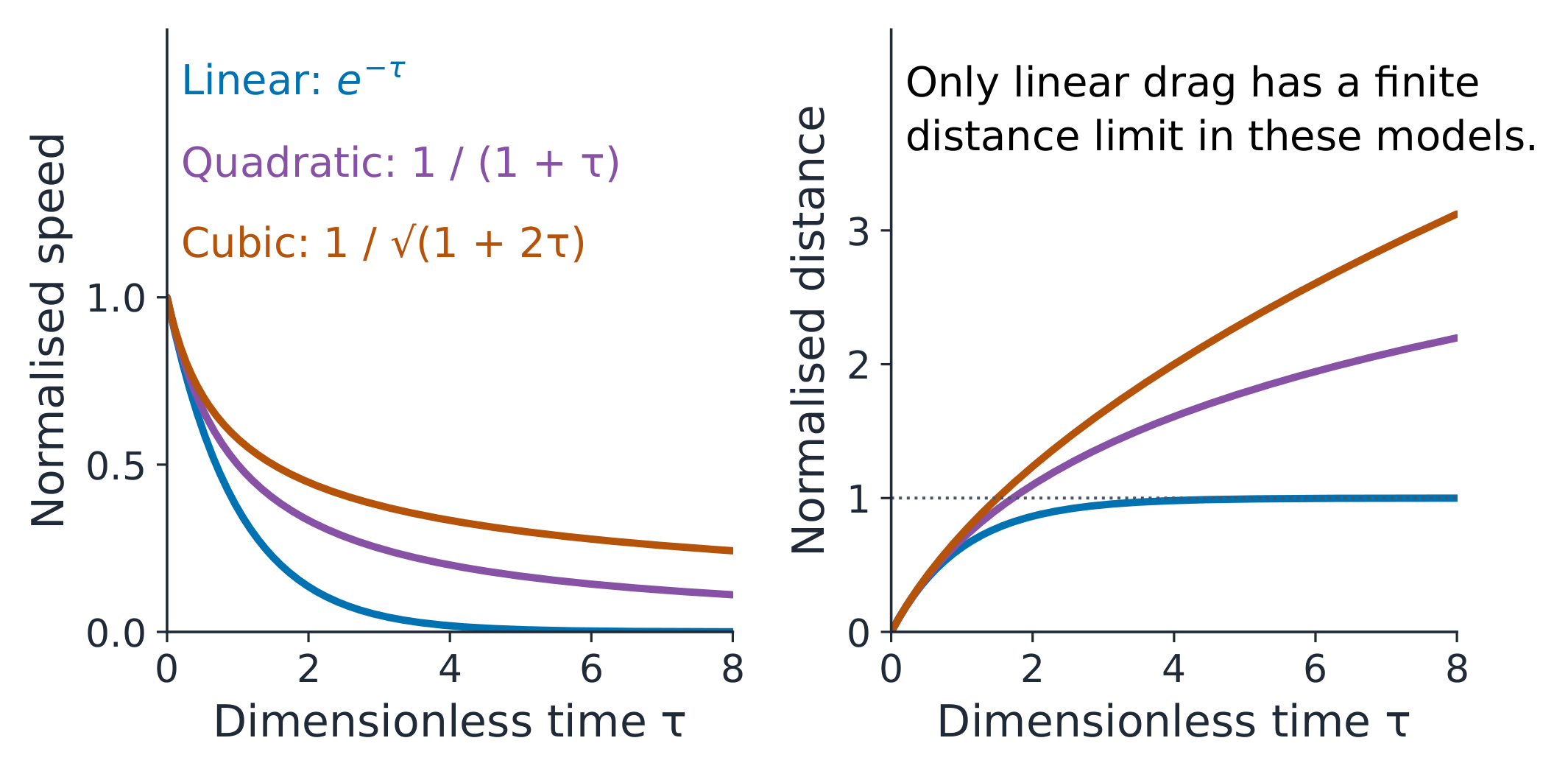
- Suppose horizontal motion satisfies $dv/dt=-v^2/2$ with $v(0)=4$. Separation gives $-1/v=-t/2+C$, so $v=4/(1+2t)$ for $t\geq0$.
- With $x(0)=0$, integration gives $x=2\ln(1+2t)$. Speed tends to zero, but displacement has no finite upper limit. A decreasing speed does not by itself imply a finite total distance.
A particle moving right obeys dv/dt = −v², starts with v = 3 m/s at x = 0, and remains on the positive-velocity branch. Find v(t), x(t), and its limiting total distance.
Compare your Newton equation, integration constants and branch checks with the model. Correct the reasoning as well as the final result.
A cubic resistance gives another power law
- Suppose $dv/dt=-3v^3$ with $v(0)=2$. Separate as $v^{-3}\,dv=-3\,dt$. Integration and the initial value give $1/v^2=6t+1/4$.
- Choose the positive branch: $v=2/\sqrt{1+24t}$. With $x(0)=0$, integration gives $x=(\sqrt{1+24t}-1)/6$. Both this model and the quadratic model slow forever while covering an unbounded distance; their rates of slowing differ.
For positive velocity, a particle obeys dv/dt = −v³/2. At t = 0 it has v = 2 m/s and x = 0. Find v(t) and its displacement at t = 2 s.
Compare your Newton equation, integration constants and branch checks with the model. Correct the reasoning as well as the final result.
Falling with linear drag approaches a balance
- Take downward as positive. A mass $m$ falling under gravity and linear resistance $kv$ obeys $m\,dv/dt=mg-kv$. Its terminal velocity 终端速度 is $V=mg/k$, where the resultant is zero.
- For $m=2\ \text{kg}$, $k=4\ \dfrac{\text{N}\,\text{s}}{\text{m}}$ and $g=10\ \dfrac{\text{m}}{\text{s}^2}$, $V=5\ \dfrac{\text{m}}{\text{s}}$. Released from rest, separation gives $v=5(1-e^{-2t})$ and downward distance $y=5t-\tfrac52(1-e^{-2t})$.
A 3 kg particle falls from rest under gravity g = 10 m/s² and linear resistance 6v N, with downward velocity positive. Find terminal velocity and v(t).
Compare your Newton equation, integration constants and branch checks with the model. Correct the reasoning as well as the final result.
Check a constant solution before dividing
- In $dv/dt=(k/m)(V-v)$, dividing by $V-v$ excludes $v=V$. Test it in the original equation: it is a valid constant-velocity solution if that is the initial velocity.
- An initial downward velocity below $V$ increases towards $V$; one above $V$ decreases towards it. At terminal velocity the particle is moving with zero acceleration. It is not at rest, and the model need not reach the limit in finite time.
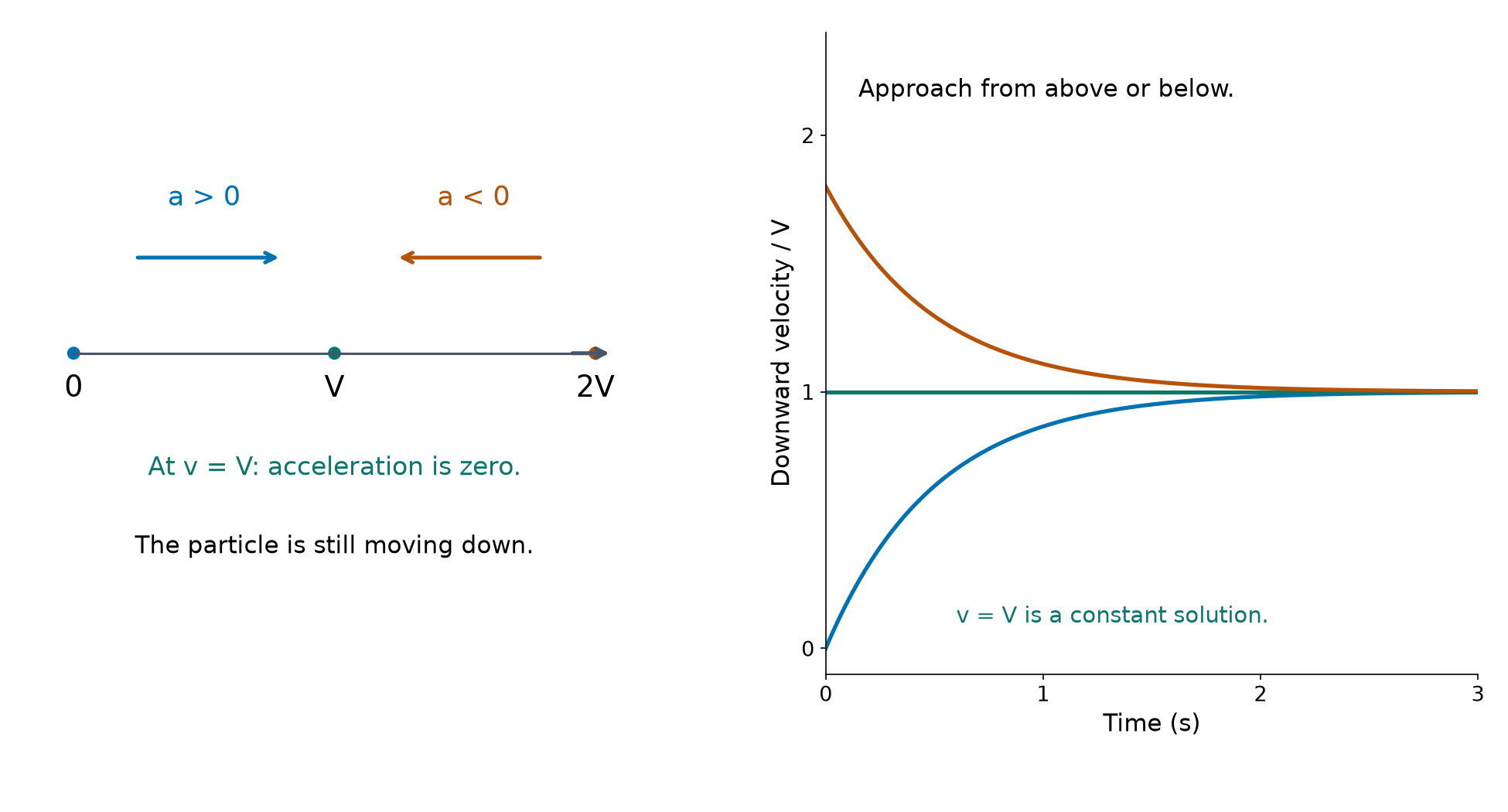
A falling particle obeys dv/dt = 2(5 − v), with downward velocity positive. It starts at v = 8 m/s. Find v(t) and initial acceleration, and describe the limit. Also test the initial value v = 5.
Compare your Newton equation, integration constants and branch checks with the model. Correct the reasoning as well as the final result.
Separate the falling quadratic-drag equation
-
Take downward speed $v\geq0$ with resistance per unit mass $gv^2/V^2$. Then $dv/dt=g(1-v^2/V^2)$. From rest, $0\leq v<V$, so separation gives $dv/(V^2-v^2)=(g/V^2)\,dt$.
$$\frac{1}{V^2-v^2}=\frac{1}{2V}\left(\frac{1}{V+v}+\frac{1}{V-v}\right).$$ -
Partial fractions 部分分式 give $\ln[(V+v)/(V-v)]=2gt/V$ after using $v(0)=0$. Rearranging gives $v=V(e^{2gt/V}-1)/(e^{2gt/V}+1)$. The formula approaches $V$ from below; keep logarithm arguments and the initial branch consistent.
A particle falls from rest with downward acceleration 10(1 − v²/400) m/s². Find terminal speed and the time to reach half of it.
Compare your Newton equation, integration constants and branch checks with the model. Correct the reasoning as well as the final result.
Falling speed can be found from distance instead
- For the same quadratic-drag fall from rest, choose $v\,dv/dy=g(1-v^2/V^2)$ with downward distance $y$. Separation and the initial state give
- With $g=10\ \dfrac{\text{m}}{\text{s}^2}$ and $V=10\ \dfrac{\text{m}}{\text{s}}$, this is $v^2=100(1-e^{-y/5})$. Gravity's lost potential energy does not all become kinetic energy: resistance does negative work.
A particle falls from rest with downward acceleration 10(1 − v²/400) m/s². Find the downward distance needed to reach speed 10 m/s.
Compare your Newton equation, integration constants and branch checks with the model. Correct the reasoning as well as the final result.
Upward motion puts gravity and drag together
- Launch a particle vertically upwards with speed $u$. Take upwards as positive on the ascent, so $v>0$. Gravity and resistance both act downwards. For quadratic resistance per unit mass $kv^2$, the equation is $dv/dt=-g-kv^2$.
- Define $V^2=g/k$ to simplify the algebra. Here $V$ is the terminal speed for a later downward fall, not a possible steady upward speed. Using $g-kv^2$ during ascent would reverse the resistance incorrectly.
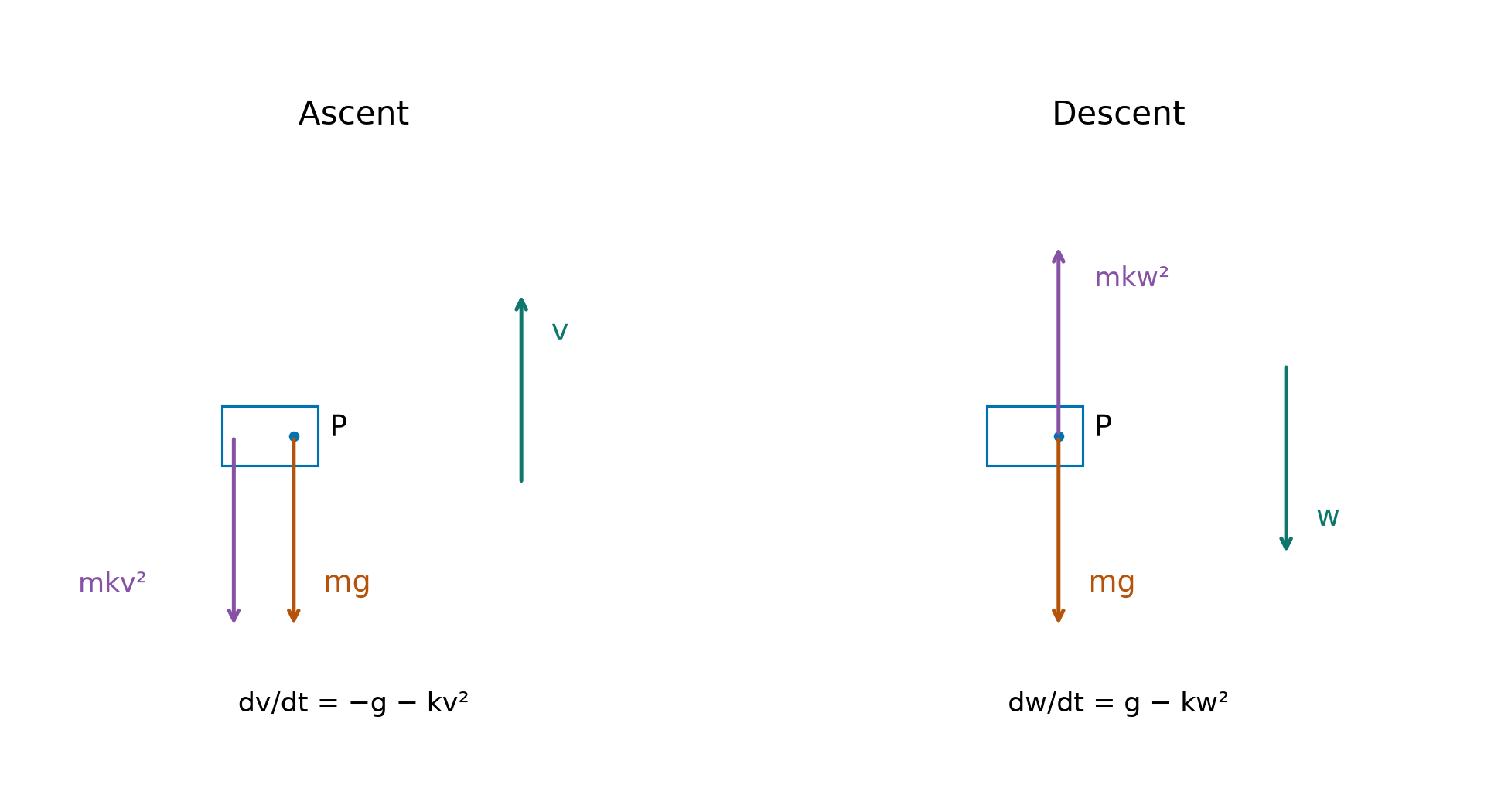
A particle is launched upwards at 5 m/s. Take upwards as positive, g = 10 m/s² and quadratic resistance per unit mass 2v²/5 while it moves upwards. Write its differential equation and initial acceleration. What is the corresponding downward terminal speed?
Compare your Newton equation, integration constants and branch checks with the model. Correct the reasoning as well as the final result.
Find maximum height from the position equation
- On ascent use $v\,dv/dx=-g-kv^2$. Separate and use the launch state in the integration:
- Rearranging gives $v^2=(u^2+V^2)e^{-2kx}-V^2$ on ascent until its first zero. For $g=10$, $k=1/10$ and $u=10$ in consistent SI units, $V=10$ and $v^2=200e^{-x/5}-100$. Maximum height is $H=5\ln2\ \text{m}$. It is less than the no-drag height $u^2/(2g)=5\ \text{m}$.
A particle is launched upwards at 5 m/s with acceleration dv/dt = −10 − 2v²/5. Let x be upward displacement from launch. Find v²(x) and maximum height.
Compare your Newton equation, integration constants and branch checks with the model. Correct the reasoning as well as the final result.
Find ascent time by an inverse tangent
- Separate $dv/dt=-k(V^2+v^2)$. Integration gives $\tan^{-1}(v/V)=\tan^{-1}(u/V)-gt/V$. Use radians for the inverse tangent in this calculus calculation.
- In the example $u=V=10$ and $g=10$, $v=10\tan(\pi/4-t)$. The first zero gives ascent time $t=\pi/4\ \text{s}$. Stop using this ascent equation at the top; resistance reverses during the descent.
A particle is launched upwards with v(0) = 5 m/s and dv/dt = −10 − 2v²/5 while ascending. Find v(t), ascent time and the valid time interval for the ascent formula.
Compare your Newton equation, integration constants and branch checks with the model. Correct the reasoning as well as the final result.
Join the descent to the top state
- At the top, velocity is continuous and equals zero. Restart a downward coordinate $y$ from the top, with downward speed $w\geq0$. The new equation is $dw/dt=g-kw^2$, because resistance now acts upwards.
- The falling-distance result gives $w^2=V^2(1-e^{-2ky})$. The ascent and descent each have a consistent sign convention; record the new initial state rather than carrying a negative ascent speed into an unchanged force equation.
A particle reaches its highest point with zero velocity under gravity and quadratic resistance per unit mass 2v²/5. Take a new downward distance y from the top and downward speed w. Write the new equations and find w²(y), taking g = 10 m/s².
Compare your Newton equation, integration constants and branch checks with the model. Correct the reasoning as well as the final result.
Compare the return speed with the launch speed
- In the example $u=V=10$, $k=1/10$ and $H=5\ln2$, the particle returns to launch height after falling distance $H$. Its downward squared speed is $w^2=100(1-e^{-H/5})=50$.
- The return speed is $5\sqrt2\ \dfrac{\text{m}}{\text{s}}$, less than the launch speed $10\ \dfrac{\text{m}}{\text{s}}$. Gravity has the same potential energy at both endpoints, but resistance has removed mechanical energy during both parts.
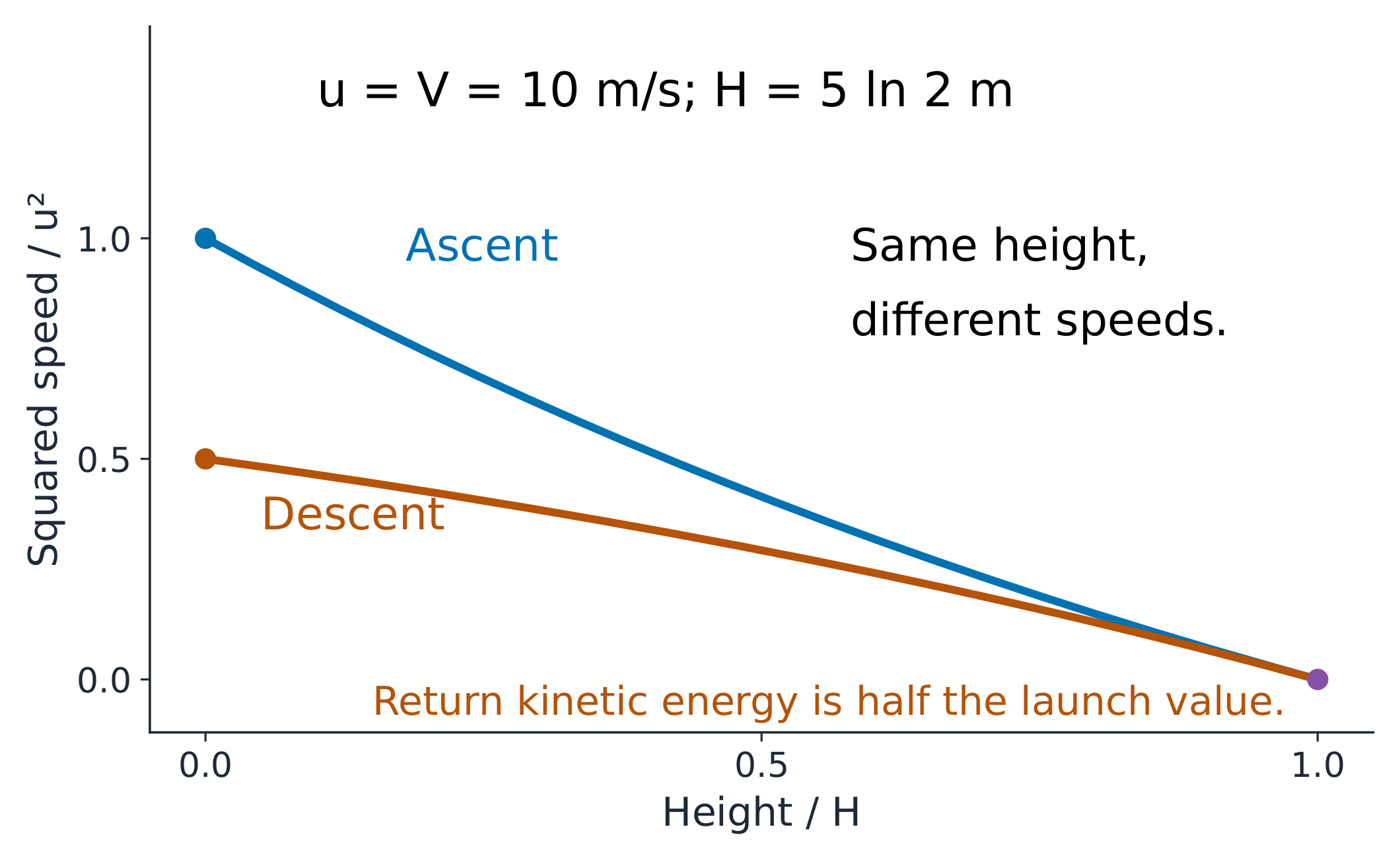
A particle is launched upwards at 10 m/s under gravity g = 10 m/s² and quadratic resistance per unit mass 2v²/5. Its maximum height is (5/4)ln5 m. Find its speed on returning to launch height and the ratio of final to initial kinetic energy.
Compare your Newton equation, integration constants and branch checks with the model. Correct the reasoning as well as the final result.
A force towards a point is not always drag
- Suppose acceleration is $-(v^2+9)/3$ while a particle is to the right of $O$. It is prescribed to point towards $O$, even after the particle reverses and moves left. It then speeds up leftwards rather than resisting that motion.
- With $x(0)=0$ and $v(0)=3$, separation gives $\tan^{-1}(v/3)=\pi/4-t$, so $v=3\tan(\pi/4-t)$. The particle first stops at $t=\pi/4$. A negative velocity after this time correctly describes the return towards $O$.
A particle starts at O moving right at 2 m/s. While x > 0 its acceleration is −(v² + 4) m/s², directed towards O. Find v(t) until the first return to O and the first turning time. Is this ordinary drag after the turn?
Compare your Newton equation, integration constants and branch checks with the model. Correct the reasoning as well as the final result.
Integrate the return branch with its domain
- Integrating that velocity and using $x(0)=0$ gives $x=3\ln[\cos(t-\pi/4)]+\tfrac32\ln2$ before the next return to $O$. At the turn the maximum displacement is $\tfrac32\ln2$.
- The next zero of $x$ is $t=\pi/2$, found from the first return branch, not a later periodic tangent value. At $O$ the direction rule changes; a formula derived for $x>0$ is not automatically valid beyond that event.
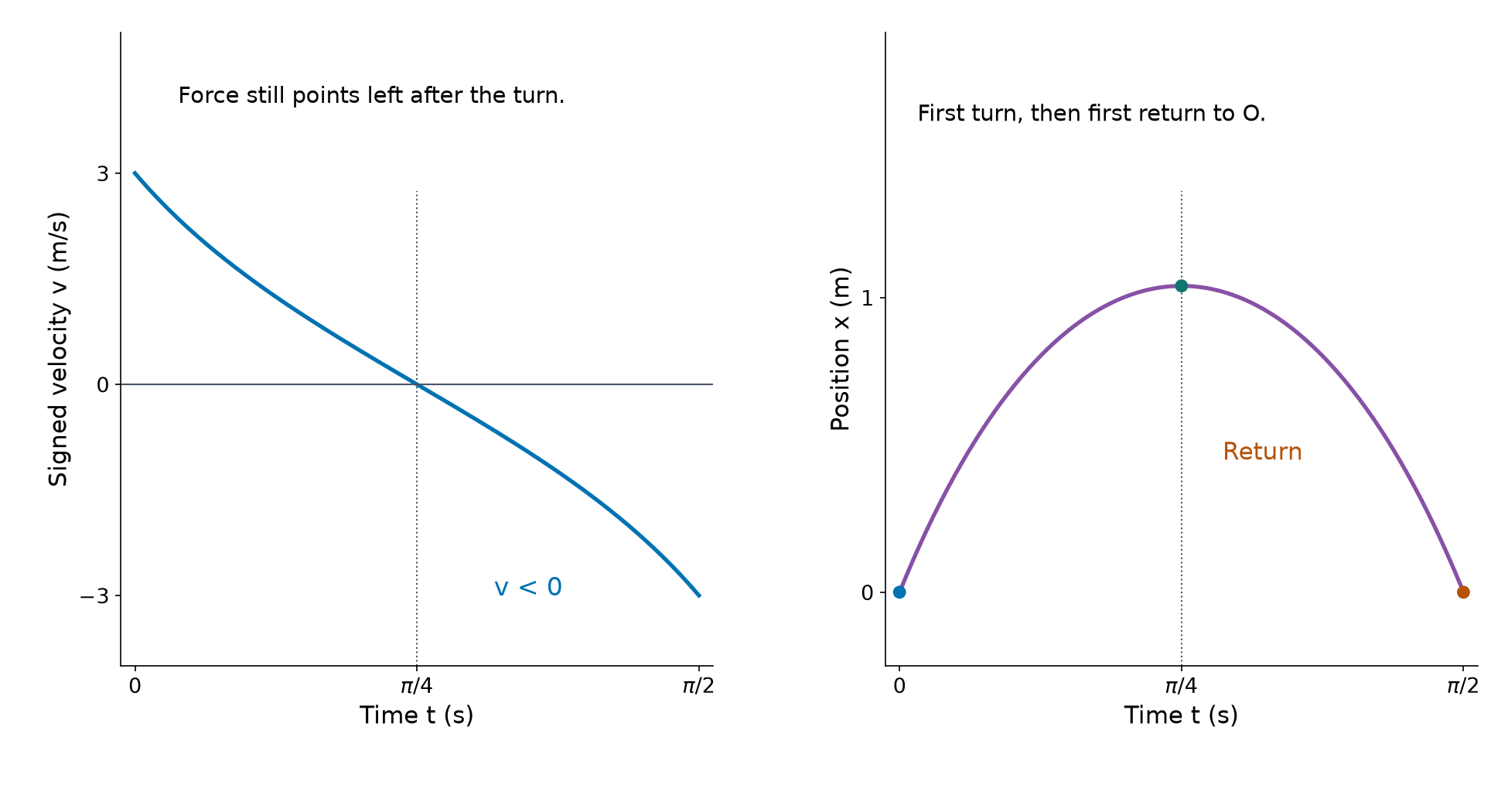
A particle starts at x = 0 with velocity 2 m/s. While x > 0 its acceleration is −(v² + 4) m/s² and its velocity is 2tan(π/4 − 2t). Find x(t), maximum displacement and the first return time to O.
Compare your Newton equation, integration constants and branch checks with the model. Correct the reasoning as well as the final result.
Infer a force from a velocity relation
- If a $2\ \text{kg}$ particle has velocity $v=1+x^2$ on its outward branch, then $a=v\,dv/dx=(1+x^2)(2x)$. Its resultant force is $F=ma=4x(1+x^2)$ in consistent SI units.
- To infer unknown parameters, substitute measured states into the integrated model and solve for the constants. Then check another state when available. A force coefficient has units chosen so the whole expression is a force, not necessarily newtons alone.
A 3 kg particle has velocity v = 2 + x² m/s on an outward branch. Find the resultant force as a function of x, with x measured in metres.
Compare your Newton equation, integration constants and branch checks with the model. Correct the reasoning as well as the final result.
Check a proposed solution in the original equation
- Differentiate the proposed $v(t)$ or $v(x)$, substitute into Newton's law, and check the initial value. For $v=4/(1+2t)$, differentiation gives $dv/dt=-8/(1+2t)^2=-v^2/2$, as required.
- Check signs, units and domains as well as algebra. A positive drag magnitude must oppose velocity; a squared-speed expression must stay nonnegative; logarithms need valid arguments; a new branch needs its own physical assumptions.
Decide which event ends the current model
- Mark any turning point, crossing of a force-direction boundary, change of resistance law, or endpoint of the allowed motion. Decide whether a zero-speed state occurs at a finite time or only as a limit.
- A terminal solution can disappear when dividing by a zero factor, and a square root can hide a return branch. Restore such possibilities by checking the original equation and the order of events.
A proposed motion is v = 2/(1 + t) m/s and x = 2ln(1 + t) m for t ≥ 0. Verify its acceleration law, initial state, and whether it stops or has a finite limiting distance.
Compare your Newton equation, integration constants and branch checks with the model. Correct the reasoning as well as the final result.
Keep the force law tied to the motion
- Choose a signed direction, add the real forces, then select $a=dv/dt$ or $a=v\,dv/dx$ to suit the variables. Separate, integrate and apply the initial conditions at every stage.
- Distinguish force, acceleration, velocity and speed. Check each answer against the original equation, its branch and its limits; after a physical event, reconsider the model before continuing.
A force F = 6x newtons acts along the positive x direction from x = 0 m to x = 2 m. What is its work done?
Difficulty 1/5 · 100 coins + a small bonus on first completion today
3 times 2 squared is 12 J. Other options — 6x (the force expression); 2 (the upper limit).