English
Learning Objective 2.1.A: Explain the relationship between the type of bonding and the properties of the elements participating in the bond.
- 2.1.A.1 Electronegativity values for the representative elements increase going from left to right across a period and decrease going down a group. These trends can be understood qualitatively through the electronic structure of the atoms, the shell model, and Coulomb's law.
- 2.1.A.2 Valence electrons shared between atoms of similar electronegativity constitute a nonpolar covalent bond. For example, bonds between carbon and hydrogen are effectively nonpolar even though carbon is slightly more electronegative than hydrogen.
- 2.1.A.3 Valence electrons shared between atoms of unequal electronegativity constitute a polar covalent bond.
- i. The atom with a higher electronegativity will develop a partial negative charge relative to the other atom in the bond.
- ii. In single bonds, greater differences in electronegativity lead to greater bond dipoles.
- iii. All polar bonds have some ionic character, and the difference between ionic and covalent bonding is not distinct but rather a continuum.
- 2.1.A.4 The difference in electronegativity is not the only factor in determining if a bond should be designated as ionic or covalent. Generally, bonds between a metal and nonmetal are ionic, and bonds between two nonmetals are covalent. Examination of the properties of a compound is the best way to characterize the type of bonding.
- 2.1.A.5 In a metallic solid, the valence electrons from the metal atoms are considered to be delocalized and not associated with any individual atom.
ไทย
วัตถุประสงค์การเรียนรู้ 2.1.A: อธิบายความสัมพันธ์ระหว่างประเภทของพันธะกับคุณสมบัติของธาตุที่มีส่วนร่วมในพันธะ
- 2.1.A.1 ค่าอิเล็กโทรเนกาติวิตีของธาตุกลุ่มหลักเพิ่มขึ้นเมื่อเคลื่อนที่จากซ้ายไปขวาข้ามคาบ และลดลงเมื่อเคลื่อนที่ลงกลุ่ม แนวโน้มเหล่านี้สามารถเข้าใจในเชิงโครงสร้างอิเล็กทรอนิกส์ของอะตอม โมเดลชั้นพลังงาน และกฎของคูลอมบ์
- 2.1.A.2 อิเล็กตรอนวงนอกที่แบ่งปันกันระหว่างอะตอมที่มีค่าอิเล็กโทรเนกาติวิตีใกล้เคียงกันจะสร้างพันธะโคเวเลนต์ไม่มีขั้ว ตัวอย่างเช่น พันธะระหว่างคาร์บอนและไฮโดรเจนแทบจะเป็นไม่มีขั้วแม้ว่าคาร์บอนจะมีค่าอิเล็กโทรเนกาติวิตีสูงกว่าไฮโดรเจนเล็กน้อยก็ตาม
- 2.1.A.3 อิเล็กตรอนวงนอกที่แบ่งปันกันระหว่างอะตอมที่มีค่าอิเล็กโทรเนกาติวิตีไม่เท่ากันจะสร้างพันธะโคเวเลนต์มีขั้ว
- i. อะตอมที่มีค่าอิเล็กโทรเนกาติวิตีสูงกว่าจะเกิดประจุลบบางส่วนเมื่อเทียบกับอะตอมอื่นในพันธะ
- ii. ในพันธะเดี่ยว ความแตกต่างของค่าอิเล็กโทรเนกาติวิตีที่ใหญ่ขึ้นจะนำไปสู่ไดโพลของพันธะที่ใหญ่ขึ้น
- iii. พันธะมีขั้วทั้งหมดมีลักษณะเป็นไอออนิกบางส่วน และการแยกแยะระหว่างพันธะไอออนิกและพันธะโคเวเลนต์ไม่ได้ชัดเจนแต่เป็นต่อเนื่อง
- 2.1.A.4 ความแตกต่างของค่าอิเล็กโทรเนกาติวิตีไม่ใช่ปัจจัยเดียวในการกำหนดว่าควรระบุว่าเป็นพันธะไอออนิกหรือโคเวเลนต์ โดยทั่วไป พันธะระหว่างโลหะและไม่โลหะจะเป็นไอออนิก และพันธะระหว่างไม่โลหะสองชนิดจะเป็นโคเวเลนต์ การพิจารณาคุณสมบัติของสารประกอบเป็นวิธีที่ดีที่สุดในการจำแนกประเภทของพันธะ
- 2.1.A.5 ในของแข็งโลหะ อิเล็กตรอนวงนอกจากอะตอมโลหะถูกมองว่าเป็นอิเล็กตรอนที่กระจายตัวและไม่เกี่ยวข้องกับอะตอมใดอะตอมหนึ่งโดยเฉพาะ


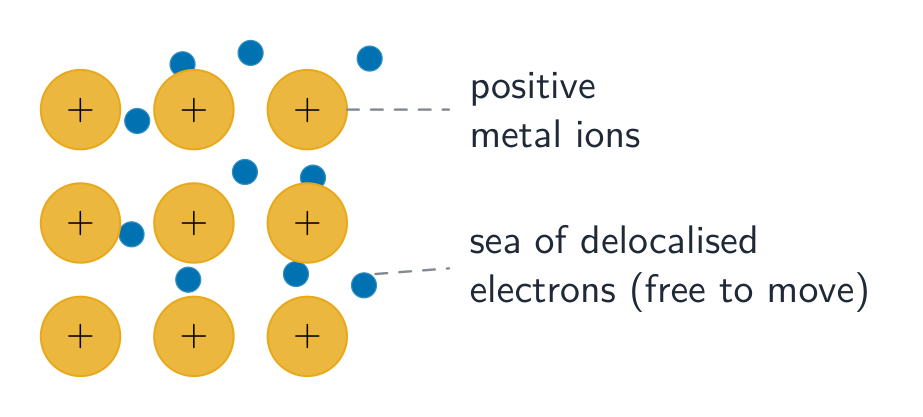
 *ทองแดงธรรมชาติ: พันธะโลหะทำให้เป็นของแข็งมันวาว ยืดหยุ่น และมีอิเล็กตรอนอิสระเคลื่อนที่