| Learning Objective | Essential Knowledge |
|---|---|
4.1.A |
|
Chemical Reactions
AP Chemistry · Topic 4
 7:42
Chemical Reactions
A strip of magnesium metal. Touch it with a flame and it burns — combustion — with a light too bright to look at. What is left is not magnesium any more. It is…
English narration · English + 中文 subtitles burned in
4.1
Recognizing a Chemical Reaction

Syllabus
Source: College Board AP Course and Exam Description
In a car crash, an airbag fills in about 0.03 seconds. A spark sets off a solid, sodium azide, which breaks down into nitrogen gas: $2\text{NaN}_3(s)\rightarrow2\text{Na}(s)+3\text{N}_2(g)$. Engineers must put in exactly the right mass of solid: too little and the bag is soft, too much and it bursts. That calculation, from a balanced equation to grams of reactant, is the heart of this unit.
A chemical reaction 化学反应 rearranges atoms into new substances. Possible evidence includes a color change, a gas or precipitate 沉淀 forming, or a temperature change. These observations alone do not prove that new substances formed. Atoms are conserved, so an equation must be balanced – the same count of each element on both sides.
Physical changes have equations too. Dissolving salt is written $\text{NaCl}(s)\rightarrow\text{Na}^+(aq)+\text{Cl}^-(aq)$, and boiling water is $\text{H}_2\text{O}(l)\rightarrow\text{H}_2\text{O}(g)$. The state symbols carry the meaning: nothing new is made, but the form changes. A balanced equation must conserve charge as well as atoms: the total charge on the left equals the total on the right.
Explore
Chemical reaction or not?
Decide whether each observation is a sign of a chemical reaction or just a physical change.
Vocabulary
Train
| English |
|---|
| chemical reaction/ˈkemɪkl rɪˈækʃn/ |
| precipitate/prɪˈsɪpɪteɪt/ |
4.2
Net Ionic Equations

Syllabus
| Learning Objective | Essential Knowledge |
|---|---|
4.2.A |
|
Source: College Board AP Course and Exam Description
When writing aqueous ionic equations, split dissolved strong electrolytes into ions; keep insoluble solids and weak electrolytes in their appropriate forms. A net ionic equation 净离子方程式 shows only the species that actually change, leaving out the spectator ions 旁观离子 that appear unchanged on both sides. It captures the real chemistry (e.g. $\text{Ag}^+ + \text{Cl}^- \rightarrow \text{AgCl}(s)$).
Worked example (three forms of one equation). Lead(II) nitrate solution is mixed with potassium iodide solution, and a bright yellow solid forms. Write the three forms.
- Molecular equation: $\text{Pb(NO}_3)_2(aq)+2\text{KI}(aq)\rightarrow\text{PbI}_2(s)+2\text{KNO}_3(aq)$.
- Complete ionic equation 完整离子方程式 (every dissolved strong electrolyte split into ions): $\text{Pb}^{2+}+2\text{NO}_3^-+2\text{K}^++2\text{I}^-\rightarrow\text{PbI}_2(s)+2\text{K}^++2\text{NO}_3^-$.
- Net ionic equation: cross out $\text{K}^+$ and $\text{NO}_3^-$, which appear unchanged on both sides, to leave $\text{Pb}^{2+}(aq)+2\text{I}^-(aq)\rightarrow\text{PbI}_2(s)$.
How do you know the solid is $\text{PbI}_2$ and not $\text{KNO}_3$? AP expects you to know one solubility rule: all sodium, potassium, ammonium and nitrate salts are soluble. So $\text{KNO}_3$ stays dissolved, and the precipitate must be the other product. Check the charge: $+2+2(-1)=0$ on the left and 0 on the right.
Vocabulary
Train
| English |
|---|
| net ionic equation/net aɪˈɒnɪk ɪˈkweɪʒn/ |
| spectator ions/spekˈteɪtə ˈaɪɒnz/ |
| complete ionic equation |
4.3
Three Ways to Represent a Reaction

Syllabus
| Learning Objective | Essential Knowledge |
|---|---|
4.3.A |
|
Source: College Board AP Course and Exam Description
The same reaction can be shown as a symbolic equation, a particulate drawing (atoms and molecules), and a macroscopic observation (what you see). Moving between these levels – connecting the equation to the particles to the beaker – is a core skill.
A good particle drawing follows three rules. It keeps every atom: count each element before and after. It shows the right ratio of particles, matching the coefficients. And it shows the right form: an ionic solid dissolved in water appears as separate ions, a molecular substance such as sugar stays as whole molecules, and any reactant in excess still appears after the reaction. The limiting-reactant drawing in the Stoichiometry section shows 4 $\text{H}_2$ and 1 $\text{O}_2$: only one $\text{O}_2$ can react, so 2 $\text{H}_2$ remain.
Explore
Three ways to see a reaction
Sort each description by the level chemists are working at.
4.4
Physical Changes versus Chemical Changes

Syllabus
| Learning Objective | Essential Knowledge |
|---|---|
4.4.A |
|
Source: College Board AP Course and Exam Description
A physical change 物理变化 alters form but not identity (melting, dissolving); a chemical change 化学变化 makes new substances by breaking and forming bonds. Dissolving sugar is physical; the sugar is unchanged and recoverable.
At the particle level, the test is which forces change. A chemical process breaks or forms chemical bonds (covalent, ionic or metallic). A physical process changes only intermolecular forces, as when ice melts: the $\text{H}_2\text{O}$ molecules stay whole, and only the hydrogen bonds between them break. Some cases sit on the line. Dissolving salt breaks ionic bonds in the crystal, yet the salt comes back when the water evaporates. You can argue it either way, as long as your argument uses the particle model.
Explore
Physical or chemical change?
Sort each change.
Vocabulary
Train
| English |
|---|
| physical change/ˈfɪzɪkl tʃeɪndʒ/ |
| chemical change/ˈkemɪkl tʃeɪndʒ/ |
4.5
Stoichiometry

Syllabus
| Learning Objective | Essential Knowledge |
|---|---|
4.5.A |
|
Source: College Board AP Course and Exam Description
Stoichiometry 化学计量 uses the balanced equation's mole ratios to relate amounts of reactants and products. The path is always grams → moles → (mole ratio) → moles → grams. The limiting reactant 限量反应物 runs out first and sets the maximum product (the theoretical yield 理论产量); the percent yield compares actual to theoretical.
Worked example. How much water forms when $4.0\ \text{g}$ of hydrogen burns in excess oxygen? $2\text{H}_2+\text{O}_2\rightarrow2\text{H}_2\text{O}$. Convert to moles, cross the mole ratio ($2:2=1:1$ here), convert back:
$$n(\text{H}_2)=\frac{4.0}{2.0}=2.0\ \text{mol}\;\Rightarrow\;n(\text{H}_2\text{O})=2.0\ \text{mol}\;\Rightarrow\;m=2.0\times18=36\ \text{g}.$$
Worked example (limiting reactant). $10.0\ \text{g}$ of N$_2$ reacts with $5.0\ \text{g}$ of H$_2$ ($\text{N}_2+3\text{H}_2\rightarrow2\text{NH}_3$). Which runs out? Moles: $n(\text{N}_2)=10.0/28.0=0.357$, $n(\text{H}_2)=5.0/2=2.5$. The reaction needs $3$ H$_2$ per N$_2$; you have $2.5/0.357=7.0$, far more than $3$, so N$_2$ is limiting. It makes $2\times0.357=0.714\ \text{mol}$ of ammonia ($12.1\ \text{g}$), with hydrogen left over.
Worked example (percent yield). In the same experiment, only 8.5 g of ammonia is collected. The percent yield 产率 is
$$\frac{\text{actual yield}}{\text{theoretical yield}}\times100\%=\frac{8.5}{12.1}\times100\%=70\%.$$
A yield below 100% can come from an incomplete reaction, side reactions, or product lost while collecting it. A yield above 100% means an error, often a product that is still wet.
Worked example (the airbag). An airbag must fill with 60.0 L of nitrogen at 1.00 atm and 298 K. What mass of $\text{NaN}_3$ ($M=65.0$ g/mol) is needed? Use the ideal gas law for the gas, then the mole ratio:
$$n(\text{N}_2)=\frac{PV}{RT}=\frac{(1.00)(60.0)}{(0.08206)(298)}=2.45\ \text{mol},\qquad n(\text{NaN}_3)=2.45\times\frac{2}{3}=1.64\ \text{mol}.$$
The mass is $1.64\times65.0=106$ g, which fits in your palm.
Worked example (solution stoichiometry). What mass of $\text{PbI}_2$ ($M=461$ g/mol) forms when 50.0 mL of 0.200 M $\text{Pb(NO}_3)_2$ is mixed with 50.0 mL of 0.300 M KI? Moles: $n(\text{Pb}^{2+})=0.0500\times0.200=0.0100$ mol and $n(\text{I}^-)=0.0500\times0.300=0.0150$ mol. The net ionic equation needs 2 $\text{I}^-$ per $\text{Pb}^{2+}$, so 0.0100 mol of lead needs 0.0200 mol of iodide. There is only 0.0150 mol, so iodide is limiting. It gives $0.0150/2=0.00750$ mol of $\text{PbI}_2$, or $0.00750\times461=3.46$ g.
Worked example (gravimetric analysis). A 1.250 g tablet containing iodide is dissolved, and excess $\text{AgNO}_3$ precipitates all the iodide as AgI ($M=234.8$ g/mol). The dried precipitate has a mass of 0.4110 g. Moles of AgI $=0.4110/234.8=1.750\times10^{-3}$ mol, which is also the moles of $\text{I}^-$ (a 1 : 1 ratio). Mass of $\text{I}^-$ $=1.750\times10^{-3}\times126.9=0.2221$ g, so the tablet is $0.2221/1.250\times100\%=17.8\%$ iodide by mass.
Exam skill (gravimetric errors). The precipitate is dried, weighed, and dried again until two weighings agree: drying to constant mass. That proves all the water has gone. A precipitate weighed while still wet has too large a mass, so the calculated percent is too high. If some precipitate passes through the filter paper, the mass is too low, so the percent is too low. Adding the precipitating reagent in excess makes sure all of the ion you are measuring comes out of solution.
Explore
Scale reactants and products by the mole ratio
A balanced equation fixes the mole ratio between species. Product amount is proportional to the limiting reactant, scaled by that ratio.
Vocabulary
Train
| English |
|---|
| Stoichiometry/ˌstəʊɪkɪˈɒmətri/ |
| limiting reactant/ˈlɪmɪtɪŋ rɪˈæktənt/ |
| theoretical yield/θɪəˈretɪkl jiːld/ |
| percent yield |
4.6
Introduction to Titration

Syllabus
| Learning Objective | Essential Knowledge |
|---|---|
4.6.A |
|
Source: College Board AP Course and Exam Description
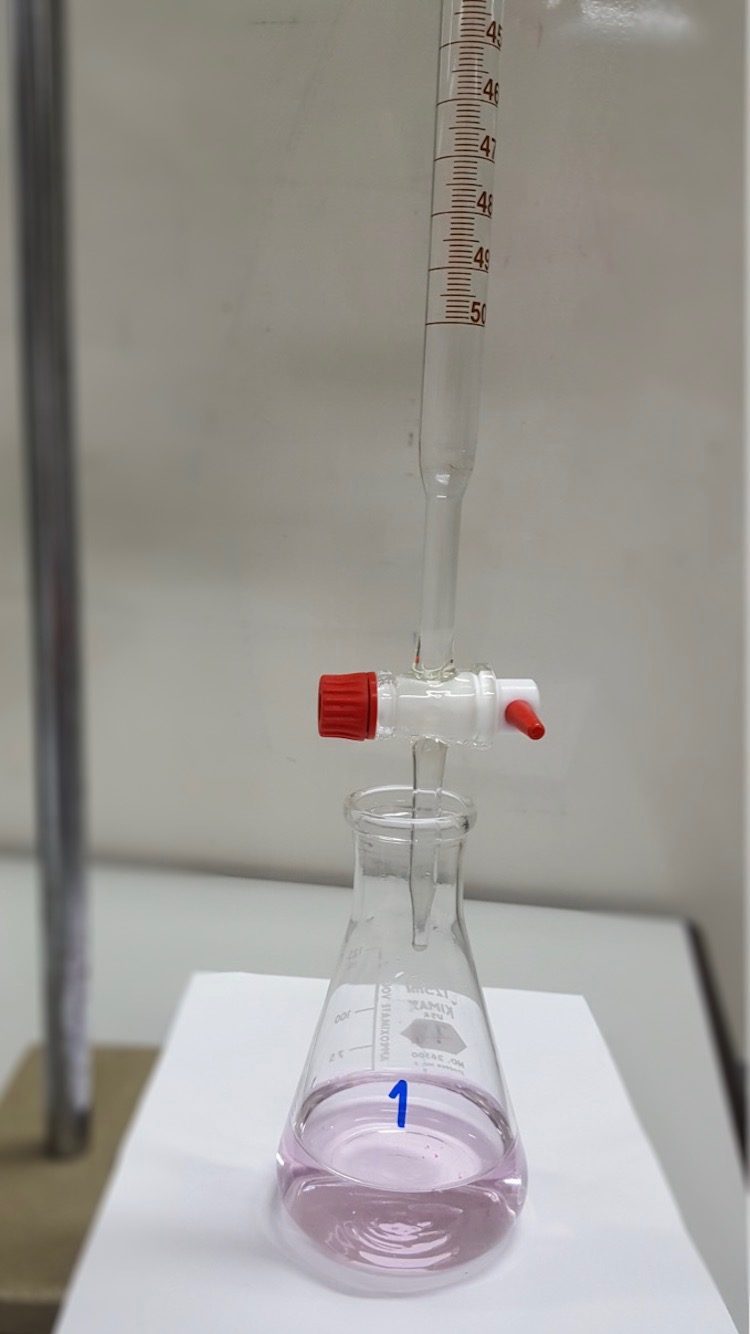
A titration 滴定 finds an unknown concentration by reacting it with a solution of known concentration until they reach the equivalence point 等当点 (stoichiometrically equal). From the known volume and concentration, use the mole ratio to find the unknown. An indicator or a pH curve signals the endpoint.
The solution in the burette, whose concentration you know, is the titrant 滴定剂. The substance in the flask, whose amount you want, is the analyte 被测物. At the equivalence point the analyte has just been used up. Any property that changes sharply there can show it: the colour of an indicator, the pH, or the electrical conductivity.
Worked example. $25.0\ \text{mL}$ of hydrochloric acid is exactly neutralized by $30.0\ \text{mL}$ of $0.100\ \text{M}$ NaOH. Find the acid's concentration. The reaction is $1:1$, so the moles match:
$$n(\text{NaOH})=0.0300\times0.100=3.00\times10^{-3}\ \text{mol}=n(\text{HCl}),\qquad [\text{HCl}]=\frac{3.00\times10^{-3}}{0.0250}=0.120\ \text{M}.$$
Worked example (a 1:2 titration). 20.0 mL of sulfuric acid needs 32.0 mL of 0.150 M NaOH: $\text{H}_2\text{SO}_4+2\text{NaOH}\rightarrow\text{Na}_2\text{SO}_4+2\text{H}_2\text{O}$. Moles of NaOH are $0.0320\times0.150=4.80\times10^{-3}$. Each acid molecule uses two hydroxide ions, so $n(\text{H}_2\text{SO}_4)=2.40\times10^{-3}$ mol and $[\text{H}_2\text{SO}_4]=2.40\times10^{-3}/0.0200=0.120$ M. Forgetting the 2 gives an answer twice too large.
Explore
Titrate an acid and find the equivalence point
Adding base to acid raises the pH slowly, then sharply at the equivalence point where moles of acid and base are equal. The steep jump locates that volume.
Vocabulary
Train
| English |
|---|
| titration/taɪˈtreɪʃn/ |
| equivalence point/ɪˈkwɪvələns pɔɪnt/ |
| titrant |
| analyte |
4.7
Types of Chemical Reactions

Syllabus
| Learning Objective | Essential Knowledge |
|---|---|
4.7.A |
|
Source: College Board AP Course and Exam Description
Common patterns include synthesis (combining), decomposition (breaking apart), combustion (with oxygen, releasing energy), precipitation (forming an insoluble solid), acid–base (proton transfer), and redox (electron transfer). Recognizing the type helps predict the products.
AP focuses on three types and how to tell them apart:
| Type | What moves | How to spot it |
|---|---|---|
| Acid–base | a proton, $\text{H}^+$ | an acid such as HCl meets a base such as $\text{OH}^-$ or $\text{NH}_3$ |
| Redox | electrons | oxidation numbers change; an element appears alone on one side |
| Precipitation | ions out of solution | two ionic solutions give an $(s)$ product |
Combustion 燃烧 is a kind of redox: a substance reacts with oxygen gas. A hydrocarbon burned completely gives carbon dioxide and water, as in $\text{C}_3\text{H}_8+5\text{O}_2\rightarrow3\text{CO}_2+4\text{H}_2\text{O}$. Carbon goes from $-\tfrac83$ to $+4$ (oxidized) and oxygen from 0 to $-2$ (reduced).
Explore
Classify the reaction
Sort each equation by its reaction pattern.
Vocabulary
Train
| English |
|---|
| combustion/kəmˈbʌstʃn/ |
4.8
Acid-Base Reactions

Syllabus
| Learning Objective | Essential Knowledge |
|---|---|
4.8.A |
|
Source: College Board AP Course and Exam Description
An acid 酸 donates a proton ($\text{H}^+$); a base 碱 accepts one (Brønsted–Lowry). For an aqueous acid reacting with a hydroxide base, the net neutralisation is: $\text{H}^+ + \text{OH}^- \rightarrow \text{H}_2\text{O}$. Strong acids ionise essentially completely in dilute water; soluble strong hydroxide bases dissociate into ions. Weak acids and bases establish equilibria.
Water can play either role. With ammonia it gives a proton, acting as an acid:
$$\text{NH}_3(aq)+\text{H}_2\text{O}(l)\rightleftharpoons\text{NH}_4^+(aq)+\text{OH}^-(aq).$$
With hydrogen chloride it takes one, acting as a base: $\text{HCl}+\text{H}_2\text{O}\rightarrow\text{H}_3\text{O}^++\text{Cl}^-$. Each acid–base reaction makes two conjugate acid–base pairs 共轭酸碱对, which differ by one $\text{H}^+$. In the ammonia equation, $\text{NH}_4^+/\text{NH}_3$ is one pair and $\text{H}_2\text{O}/\text{OH}^-$ is the other. To find the conjugate base of an acid, remove one $\text{H}^+$; to find the conjugate acid of a base, add one.
Explore
Move along the pH scale
pH measures how acidic or basic a solution is. Each step of 1 pH is a tenfold change in hydrogen-ion concentration; 7 is neutral, below is acidic, above is basic.
Vocabulary
Train
| English |
|---|
| acid/ˈæsɪd/ |
| base/beɪs/ |
| conjugate acid–base pairs |
4.9
Oxidation-Reduction (Redox) Reactions

Syllabus
| Learning Objective | Essential Knowledge |
|---|---|
4.9.A |
|
Source: College Board AP Course and Exam Description
In a redox 氧化还原 reaction, electrons transfer between species. Oxidation 氧化 is loss of electrons (oxidation number rises); reduction 还原 is gain (oxidation number falls). Track changes with oxidation numbers, and remember every oxidation is paired with a reduction – the electrons lost equal the electrons gained.
Worked example. Find the oxidation number of manganese in permanganate, $\text{KMnO}_4$. Potassium is $+1$ and each oxygen is $-2$ (four of them, $-8$). The whole formula is neutral, so $(+1)+\text{Mn}+(-8)=0$, giving $\text{Mn}=+7$ – its maximum, which is why permanganate is a powerful oxidizing agent (it can only gain electrons).
A redox equation can be built from two half-reactions 半反应, one for oxidation and one for reduction. Balance each half for atoms and charge, then multiply so that the electrons lost equal the electrons gained.
Worked example (balancing with half-reactions). Permanganate oxidizes iron(II) in acid solution to give $\text{Mn}^{2+}$ and $\text{Fe}^{3+}$.
- Oxidation: $\text{Fe}^{2+}\rightarrow\text{Fe}^{3+}+e^-$.
- Reduction: balance Mn, then add $\text{H}_2\text{O}$ to balance O, then $\text{H}^+$ to balance H, then electrons to balance charge: $\text{MnO}_4^-+8\text{H}^++5e^-\rightarrow\text{Mn}^{2+}+4\text{H}_2\text{O}$.
- Multiply the oxidation by 5 so both halves involve 5 electrons, then add and cancel the electrons:
$$\text{MnO}_4^-+8\text{H}^++5\text{Fe}^{2+}\rightarrow\text{Mn}^{2+}+5\text{Fe}^{3+}+4\text{H}_2\text{O}.$$
Check the charge: on the left $-1+8+10=+17$; on the right $+2+15=+17$. Balanced.
Common mistakes.
- Splitting a precipitate or a weak acid into ions. In a net ionic equation only dissolved strong electrolytes are written as ions; $\text{AgCl}(s)$, water and $\text{CH}_3\text{COOH}$ stay whole.
- Choosing the limiting reactant by the smaller mass. Compare moles, divided by the coefficients: in the example above, 10.0 g of N$_2$ is the larger mass but it runs out first.
- Rounding moles early. Carry an extra figure through the working ($0.357$, not $0.36$) and round only the final answer.
- Using mL in $n=cV$. Change to litres first: $30.0\ \text{mL}=0.0300\ \text{L}$.
- Calling every "disappearing" solid a chemical change. Dissolving sugar is physical: the molecules are unchanged and the sugar comes back when the water evaporates. Judge by which bonds or forces break, not by what you see.
- Mixing up oxidation and reduction. Oxidation is loss of electrons (the oxidation number rises); the species oxidised is the reducing agent.
Explore
Watch electrons transfer in a redox reaction
In a redox reaction one species is oxidised (loses electrons) and another is reduced (gains them). Follow the electrons move from the metal to the non-metal.
Vocabulary
Train
| English |
|---|
| redox/rɪˈdɒks/ |
| Oxidation/ˌɒksɪˈdeɪʃn/ |
| reduction/rɪˈdʌkʃn/ |
| half-reactions |
4.9
Exam tips
- Balance every equation and work in moles — convert grams→moles, cross the mole ratio, then convert back.
- Find the limiting reactant by comparing mole ratios; it sets the maximum product (theoretical yield).
- In redox, remember OIL RIG: oxidation is loss of electrons, reduction is gain; every oxidation is paired with a reduction.
- For titrations use the balanced ratio to link the known and unknown at the equivalence point.
- A net ionic equation shows only the species that change; leave out spectator ions.
Interactive lessons on this topic
Work through it step by step, with instant-check exercises.