Structure of Metals and Alloys
Introduced| English | Meaning |
|---|---|
| delocalized electrons/dɪˈlɒkəlaɪzd ɪˈlektrɒnz/ | An electron distributed over several atoms rather than confined to one atom or a single bond. |
| alloy/ˈælɔɪ/ | A metallic material made by combining a metal with other elements, which may include nonmetals; steel contains iron and carbon. |
Bendable, shiny, and conducting
- A copper wire bends without snapping and carries current.
- A gold ring shines and can be hammered paper-thin.
- What lets these materials bend, shine, and conduct all at once?
- The answer is a shared pool of roaming electrons.
A sea of electrons
- In a metal, cations sit in a lattice bathed in delocalized electrons 离域电子.
- These electrons roam freely through the whole solid.
- They belong to no single atom.
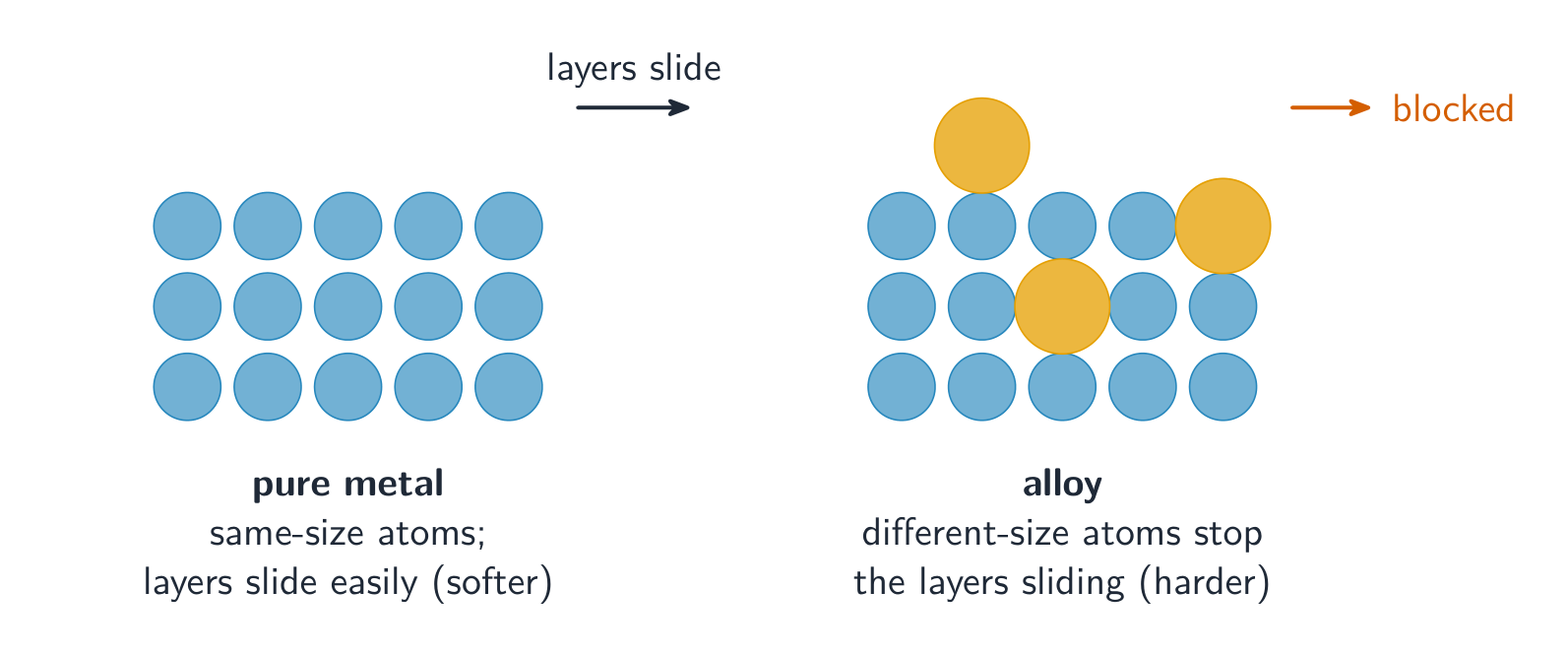
Different-sized atoms in an alloy 合金 stop the layers sliding, so it is harder
What carries electric current through a solid metal?
Difficulty 1/5 · 100 coins + a small bonus on first completion today
Free (delocalized) electrons move and carry the charge.
Why metals conduct and bend
- Free electrons carry charge, giving good electrical conductivity.
- Layers slide without breaking the bond, so metals are malleable and ductile.
- Mobile electrons reflect light, giving a shiny lustre.
Metals are malleable because...
Difficulty 1/5 · 100 coins + a small bonus on first completion today
The electron sea lets layers shift while still bonding.
Select all properties explained by the sea of delocalized electrons.
Difficulty 2/5 · 140 coins + a small bonus on first completion today
Free electrons carry charge, allow sliding, and reflect light.
Metals are shiny because mobile electrons ____ light.
Difficulty 1/5 · 100 coins + a small bonus on first completion today
The electron sea reflects light, giving lustre.
Alloys: mixing metals
- An alloy is a metal blended with other elements.
- Different-sized atoms block the layers from sliding, making it harder.
- Steel (iron + carbon) and bronze (copper + tin) are classic alloys.
The sea of electrons
Delocalised electrons let metal layers slide and carry a current.
An alloy is a mixture, so it has no single fixed ratio of elements.
Difficulty 1/5 · 100 coins + a small bonus on first completion today
Alloys are mixtures with variable composition, not compounds.
Why is steel harder than pure iron?
- Carbon atoms sit among the iron atoms.
- They jam the layers so they cannot slide as easily, making it harder and stronger.
Adding carbon to iron to make steel makes it...
Difficulty 1/5 · 100 coins + a small bonus on first completion today
Different-sized atoms jam the layers, so steel is harder than iron.
In a solid metal it is the delocalized electrons — not moving ions — that carry current (unlike an ionic solid, which needs mobile ions). Alloys are mixtures, not compounds, so they have no fixed ratio. And adding a different-sized atom usually makes a metal harder but less ductile.
A metal is cations in a sea of delocalized electrons that roam freely. Those electrons explain conductivity (they carry charge), malleability (layers slide), and lustre (they reflect light). An alloy blends in other atoms that block sliding, making the metal harder — like steel and bronze.