| Learning Objective | Essential Knowledge |
|---|---|
7.1.A |
|
Equilibrium
AP Chemistry · Topic 7
 8:24
Equilibrium
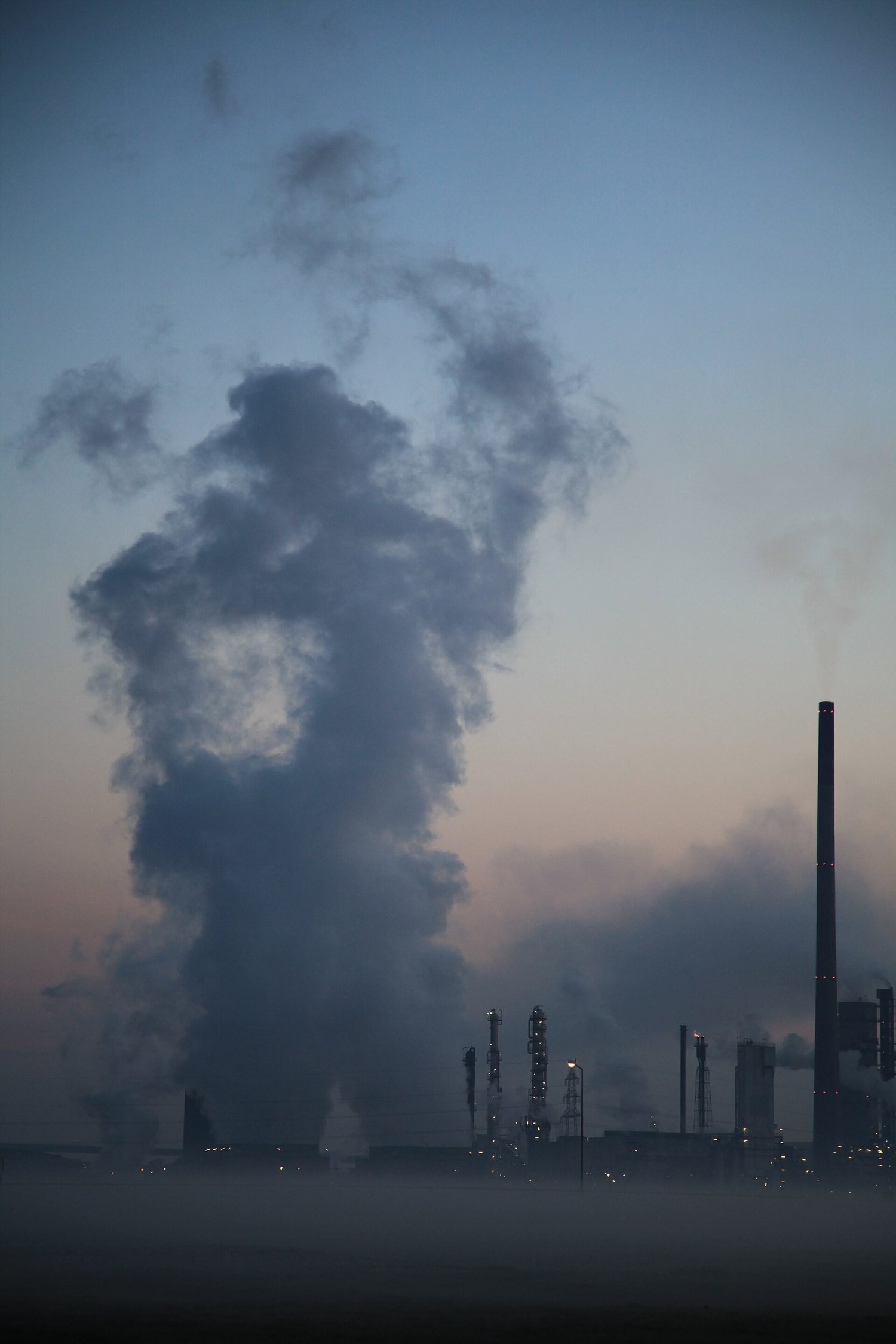
A chemical plant at dusk. Inside it, nitrogen from the air is turned into ammonia — the fertiliser that feeds about half the people alive today. But the…
English narration · English + 中文 subtitles burned in
7.1
Introduction to Equilibrium

Syllabus
Source: College Board AP Course and Exam Description
Some souvenir "weather" figures change colour: blue on a dry day, pink on a damp one. The colour comes from cobalt chloride, and it is a window into equilibrium. In solution, a pink cobalt ion and a blue one turn into each other all the time, in both directions at once. Change the conditions (water, chloride, temperature) and the balance between them moves, so the colour moves too. This unit explains how to predict where such a balance sits and which way it will move.
A reversible reaction 可逆反应 runs both ways. Chemical equilibrium 化学平衡 is reached when the forward reaction 正反应 and reverse reaction 逆反应 rates become equal, so concentrations 浓度 stop changing. Equilibrium is dynamic 动态的 – both reactions continue, but at matching rates, so nothing appears to change.
Physical processes can reach equilibrium too. In a closed water bottle, water evaporates and water vapour condenses. Once the two rates are equal, the amount of liquid stops changing even though molecules keep crossing the surface. A saturated salt solution, where dissolving and crystallising run at equal rates, is another example.
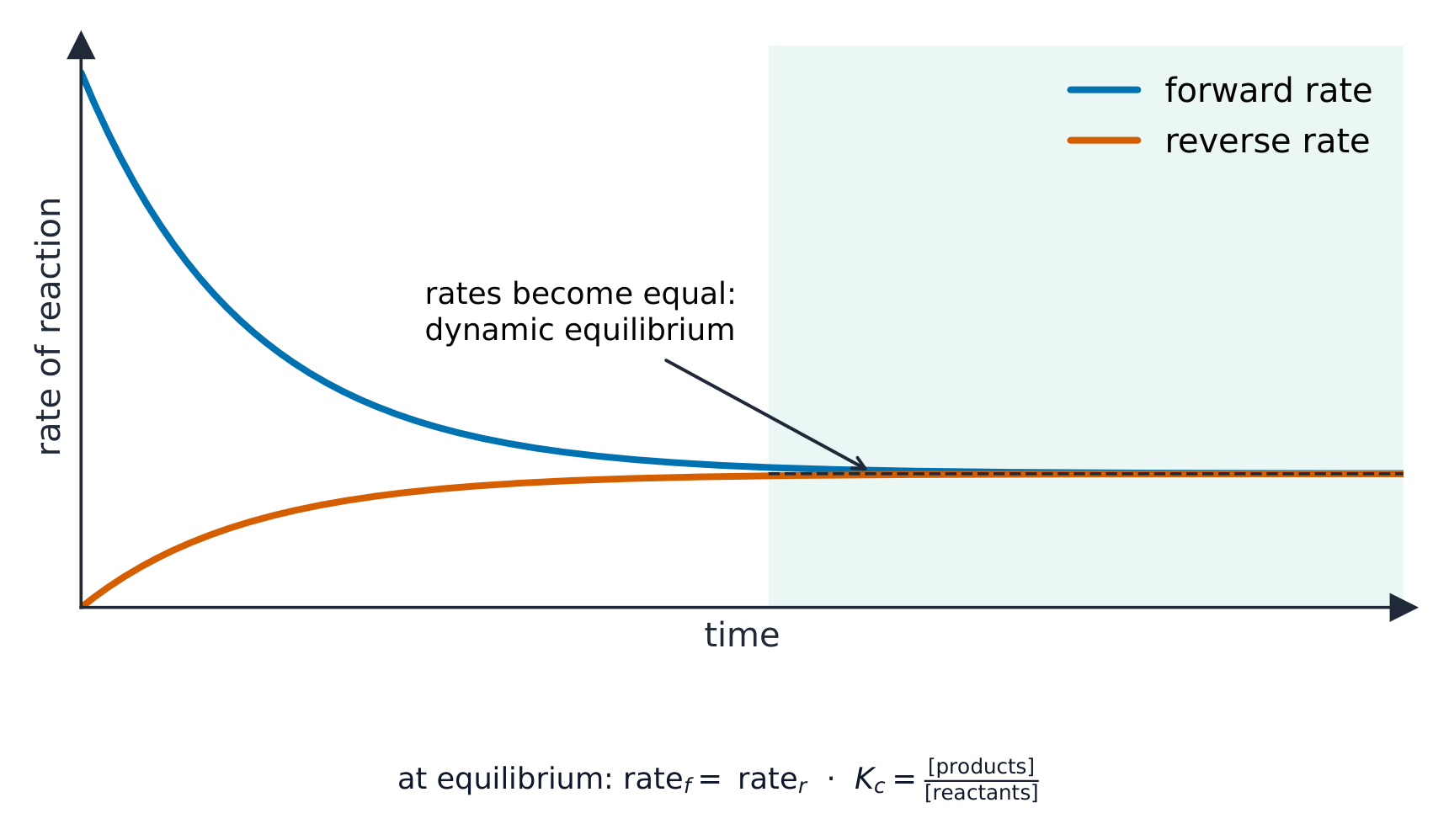
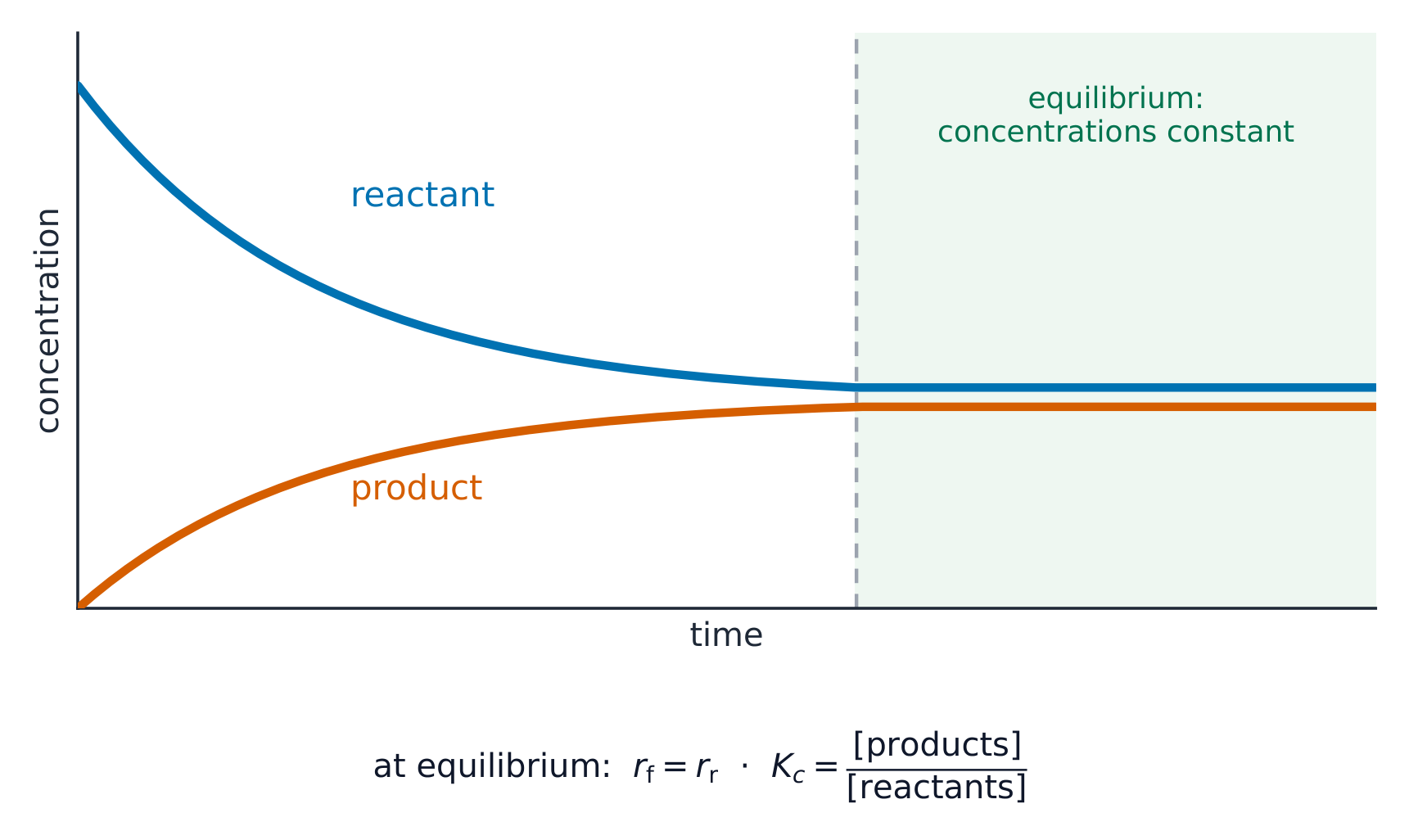
The rates graph above explains why concentrations settle; this next graph shows what the concentrations do – reactants 反应物 fall and products 生成物 rise until, once the rates match, both hold constant (they need not be equal).
Vocabulary
Train
| English |
|---|
| reversible reaction/rɪˈvɜːsɪbl rɪˈækʃn/ |
| chemical equilibrium/ˈkemɪkl ˌiːkwɪˈlɪbrɪəm/ |
| forward reaction/ˈfɔːwəd rɪˈækʃn/ |
| reverse reaction/rɪˈvɜːs rɪˈækʃn/ |
| concentration/ˌkɒnsənˈtreɪʃn/ |
| dynamic/daɪˈnæmɪk/ |
| reactant/rɪˈæktənt/ |
| product/ˈprɒdʌkt/ |
7.2
Direction of Reversible Reactions
Syllabus
| Learning Objective | Essential Knowledge |
|---|---|
7.2.A |
|
Source: College Board AP Course and Exam Description
At equilibrium the amounts of reactants and products are fixed but usually not equal. Whether the mixture favors products or reactants depends on the reaction; you compare the current state to the equilibrium condition to predict which way it shifts.
Think in terms of rates. If the forward rate is greater than the reverse rate, there is a net change from reactants to products. If the reverse rate is greater, the net change goes the other way. Starting with only reactants, the forward rate is high and the reverse rate is zero. As products build up, the forward rate falls and the reverse rate rises, until they meet.
Explore
Which way will it go?
Compare the reaction quotient Q with K to predict the direction.
7.3
The Reaction Quotient and Equilibrium Constant

Syllabus
| Learning Objective | Essential Knowledge |
|---|---|
7.3.A |
|
Source: College Board AP Course and Exam Description
The reaction quotient 反应商 $Q$ has the same form as the equilibrium expression but uses current concentrations:
$$Q=\frac{[\text{products}]}{[\text{reactants}]}\ \text{(each raised to its coefficient)}.$$
At equilibrium $Q$ equals the equilibrium constant 平衡常数 $K$. Comparing them predicts direction: $Q<K$ shifts forward (toward products); $Q>K$ shifts reverse; $Q=K$ means already at equilibrium.
Explore
What goes into K?
Sort each species by whether it appears in the equilibrium expression.
Vocabulary
Train
| English |
|---|
| reaction quotient/rɪˈækʃn ˈkwəʊʃənt/ |
| equilibrium constant/ˌiːkwɪˈlɪbrɪəm ˈkɒnstənt/ |
7.4
Calculating the Equilibrium Constant

Syllabus
| Learning Objective | Essential Knowledge |
|---|---|
7.4.A |
|
Source: College Board AP Course and Exam Description
Write $K$ from the balanced equation 配平方程式 (pure solids and liquids are left out). From equilibrium concentrations (or partial pressures 分压 for $K_p$), plug in and compute. $K_c$ uses molarities 摩尔浓度; $K_p$ uses pressures.
Worked example. For $\text{N}_2\text{O}_4\rightleftharpoons2\text{NO}_2$, the equilibrium concentrations are $[\text{N}_2\text{O}_4]=0.20\ \text{M}$ and $[\text{NO}_2]=0.10\ \text{M}$. Then
$$K_c=\frac{[\text{NO}_2]^2}{[\text{N}_2\text{O}_4]}=\frac{(0.10)^2}{0.20}=0.050.$$
The NO$_2$ coefficient 系数 of $2$ becomes the power; N$_2$O$_4$ (coefficient $1$) is just to the first power.
Worked example (leave out solids and liquids). For $\text{CaCO}_3(s)\rightleftharpoons\text{CaO}(s)+\text{CO}_2(g)$, the expression is simply $K_p=P_{\text{CO}_2}$. The two solids do not appear: adding more solid does not change its concentration. If the equilibrium pressure of $\text{CO}_2$ is 0.22 atm at some temperature, then $K_p=0.22$, whatever the amount of solid present.
AP will not ask you to convert between $K_c$ and $K_p$, but read each question carefully to see which one it uses.
Worked example (K from a particle picture). In the drawing above, the box starts with 4 $\text{A}_2$ and 4 $\text{B}_2$. At equilibrium it holds 2 $\text{A}_2$, 2 $\text{B}_2$ and 4 AB. If each particle stands for 0.10 mol in 1.0 L, the concentrations are 0.20, 0.20 and 0.40 M, so
$$K=\frac{[\text{AB}]^2}{[\text{A}_2][\text{B}_2]}=\frac{(0.40)^2}{(0.20)(0.20)}=4.0.$$
Check the atoms: 8 A atoms and 8 B atoms before, and 8 of each after.
Vocabulary
Train
| English |
|---|
| balanced equation |
| partial pressure/ˈpɑːʃl ˈpreʃə/ |
| molarity/məʊˈlærɪti/ |
| coefficient/ˌkəʊɪˈfɪʃənt/ |
7.5
Magnitude of the Equilibrium Constant

Syllabus
| Learning Objective | Essential Knowledge |
|---|---|
7.5.A |
|
Source: College Board AP Course and Exam Description
- $K\gg 1$: products strongly favored (reaction nearly complete).
- $K\ll 1$: reactants favored (little reaction).
- $K\approx 1$: significant amounts of both.
The size of $K$ tells you where the equilibrium "sits."
Explore
What does K's size tell you?
Match the size of K to the make-up of the equilibrium mixture.
7.6
Properties of the Equilibrium Constant
Syllabus
| Learning Objective | Essential Knowledge |
|---|---|
7.6.A |
|
Source: College Board AP Course and Exam Description
$K$ changes in predictable ways: reversing a reaction inverts $K$ ($1/K$); multiplying coefficients by $n$ raises $K$ to the $n$th power; adding reactions multiplies their $K$ values. Only temperature changes the value of $K$ itself.
Worked example (changing K with the equation). For $\text{N}_2\text{O}_4\rightleftharpoons2\text{NO}_2$, $K=0.050$.
- Reversed, $2\text{NO}_2\rightleftharpoons\text{N}_2\text{O}_4$: $K=1/0.050=20$.
- Halved, $\text{NO}_2\rightleftharpoons\tfrac12\text{N}_2\text{O}_4$: $K=20^{1/2}=4.5$.
- Added steps: if reaction 1 has $K_1$ and reaction 2 has $K_2$, their sum has $K=K_1K_2$. For example, $\text{N}_2+\text{O}_2\rightleftharpoons2\text{NO}$ ($K_1$) plus $2\text{NO}+\text{O}_2\rightleftharpoons2\text{NO}_2$ ($K_2$) gives $\text{N}_2+2\text{O}_2\rightleftharpoons2\text{NO}_2$ with $K=K_1K_2$.
These rules follow from the expressions: write them out and you can see why. Compare Hess's law, where the $\Delta H$ values add; here the $K$ values multiply.
Explore
How K changes when you rewrite
Rewriting an equation changes K in a predictable way.
7.7
Calculating Equilibrium Concentrations
Syllabus
| Learning Objective | Essential Knowledge |
|---|---|
7.7.A |
|
Source: College Board AP Course and Exam Description
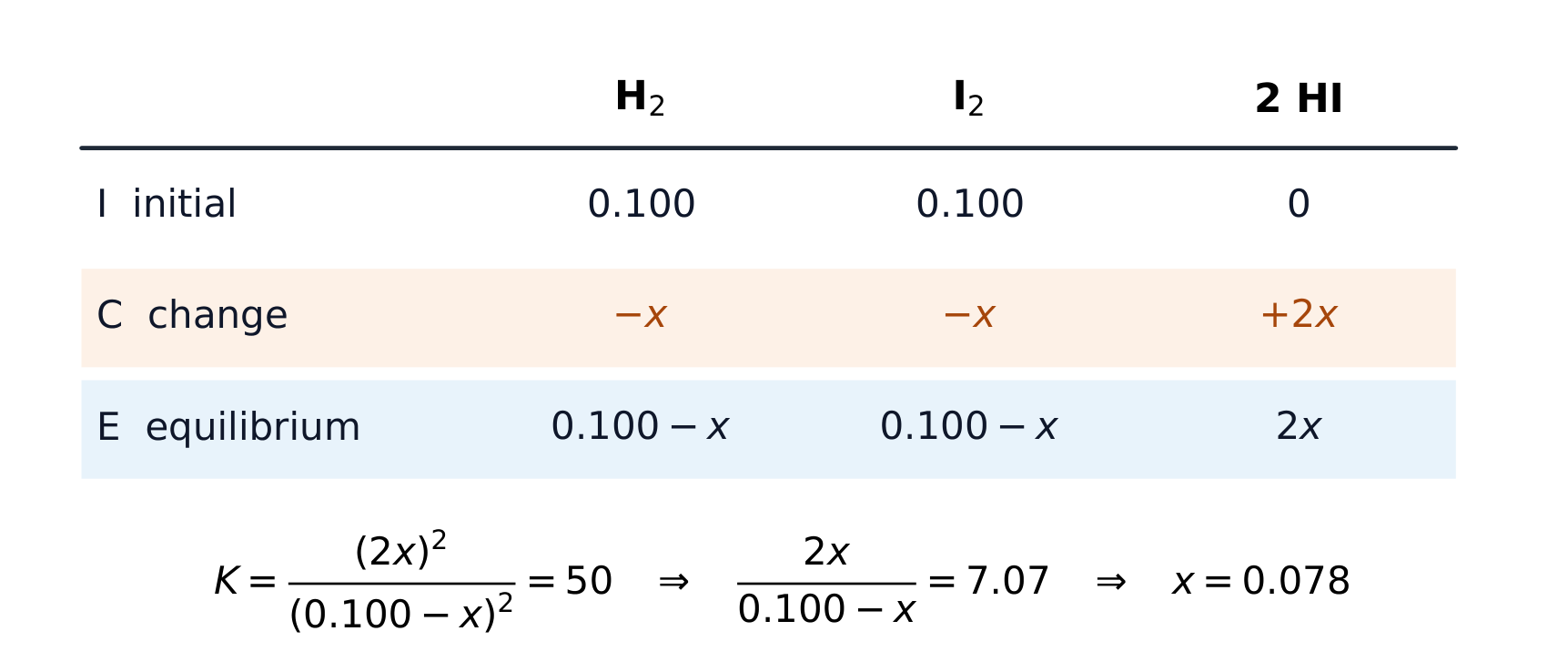
Use an ICE table 三段式 (Initial, Change, Equilibrium): fill in starting amounts, express the change with $x$ using the mole ratios 摩尔比, then substitute into the $K$ expression and solve for $x$. When $K$ is small, the approximation "$x$ is negligible 可忽略的" often simplifies the algebra.
Worked example. For $\text{H}_2+\text{I}_2\rightleftharpoons2\text{HI}$ with $K_c=50$, start with $0.100\ \text{M}$ each of H$_2$ and I$_2$. The ICE table gives equilibrium $[\text{H}_2]=[\text{I}_2]=0.100-x$ and $[\text{HI}]=2x$. Substitute:
$$K_c=\frac{(2x)^2}{(0.100-x)^2}=50\;\Rightarrow\;\frac{2x}{0.100-x}=\sqrt{50}=7.07\;\Rightarrow\;x=0.078,$$
so $[\text{HI}]=2x=0.156\ \text{M}$. Taking the square root of both sides works here because the expression is a perfect square.
Worked example (when x is small). For $\text{PCl}_5(g)\rightleftharpoons\text{PCl}_3(g)+\text{Cl}_2(g)$ at a certain temperature, $K_c=1.0\times10^{-5}$. Start with 0.50 M $\text{PCl}_5$. At equilibrium $[\text{PCl}_5]=0.50-x$ and $[\text{PCl}_3]=[\text{Cl}_2]=x$:
$$\frac{x^2}{0.50-x}=1.0\times10^{-5}.$$
Because $K$ is so small, very little reacts, so $0.50-x\approx0.50$. Then $x^2=5.0\times10^{-6}$ and $x=2.2\times10^{-3}$ M. Check: $0.0022$ is under 1% of 0.50, so the approximation was safe. If $x$ came out bigger than about 5% of the starting value, you would have to solve the full quadratic.
Vocabulary
Train
| English |
|---|
| ICE table/aɪs ˈteɪbl/ |
| mole ratio/məʊl ˈreɪʃɪəʊ/ |
| negligible/ˈneɡlɪdʒəbl/ |
7.8
Representations of Equilibrium
Syllabus
| Learning Objective | Essential Knowledge |
|---|---|
7.8.A |
|
Source: College Board AP Course and Exam Description
A particulate 微粒 picture at equilibrium shows a fixed mix of reactant and product particles. Graphs of concentration vs time level off (never reaching zero) once equilibrium is reached – both curves flatten at the same moment.
A particle picture can also tell you which way a mixture will go. Count the particles to find $Q$, and compare it with $K$. Suppose $K=4.0$ for $\text{A}_2+\text{B}_2\rightleftharpoons2\text{AB}$, and a box (0.10 mol per particle, 1.0 L) holds 1 $\text{A}_2$, 1 $\text{B}_2$ and 6 AB. Then $Q=(0.60)^2/[(0.10)(0.10)]=36>K$, so some AB must break up: the mixture shifts toward reactants.
Explore
A mixture at equilibrium
Tap the particle box to see what stays constant at equilibrium.
Vocabulary
Train
| English |
|---|
| particulate/pəˈtɪkjʊleɪt/ |
7.9
Introduction to Le Chatelier's Principle

Syllabus
| Learning Objective | Essential Knowledge |
|---|---|
7.9.A |
|
Source: College Board AP Course and Exam Description
Le Chatelier's principle 勒沙特列原理: if you disturb a system at equilibrium, it shifts to partly counteract the change. Adding a reactant shifts forward; removing product shifts forward; increasing pressure (by reducing volume) shifts toward the side with fewer gas moles; raising temperature shifts in the endothermic direction. Diluting a solution shifts toward the side with more dissolved particles.
Worked example (a colour change). In the cobalt solution,
$$[\text{Co(H}_2\text{O)}_6]^{2+}(aq)\ \text{(pink)}+4\text{Cl}^-(aq)\rightleftharpoons[\text{CoCl}_4]^{2-}(aq)\ \text{(blue)}+6\text{H}_2\text{O}(l)\qquad\Delta H>0.$$
- Add concentrated HCl (more $\text{Cl}^-$): the mixture shifts forward and turns bluer.
- Add water: it shifts back and turns pinker. Dilution lowers every ion concentration, and the left side has 5 dissolved particles against 1 on the right.
- Heat it: the forward direction is endothermic, so it turns blue. Put it in ice and it turns pink.
Le Chatelier's principle also predicts other things you can measure, such as pH and temperature. For example, removing $\text{H}^+$ from an equilibrium that makes $\text{H}^+$ shifts it to make more, which partly restores the pH.
Explore
Disturb an equilibrium
Le Chatelier's principle: an equilibrium shifts to oppose a change. Add reactant, change pressure or temperature and watch the position of equilibrium move.
Vocabulary
Train
| English |
|---|
| Le Chatelier's principle/lə ˈtʃeɪtlɪəz ˈprɪnsɪpl/ |
7.10
The Reaction Quotient and Le Chatelier's Principle

Syllabus
| Learning Objective | Essential Knowledge |
|---|---|
7.10.A |
|
Source: College Board AP Course and Exam Description
You can justify every Le Chatelier shift with $Q$ versus $K$: a disturbance changes $Q$, and the system reacts to bring $Q$ back to $K$. This quantitative view backs up the qualitative rule and is the fuller answer on the exam.
Worked example. For $\text{N}_2\text{O}_4(g) \rightleftharpoons 2\text{NO}_2(g)$ (forward endothermic), an equilibrium mixture has $[\text{N}_2\text{O}_4] = 0.40\ M$ and $[\text{NO}_2] = 0.20\ M$, so
$$K = \frac{[\text{NO}_2]^2}{[\text{N}_2\text{O}_4]} = \frac{0.20^2}{0.40} = 0.10$$
- Add $\text{N}_2\text{O}_4$ until $[\text{N}_2\text{O}_4] = 0.70\ M$: $Q = \dfrac{0.20^2}{0.70} = 0.057 < K$, so the reaction runs forward until $Q = 0.10$ again.
- Halve the volume: every concentration doubles, so $Q = \dfrac{0.40^2}{0.80} = 0.20 > K$. The reaction runs in reverse, towards the side with fewer moles of gas. This works because the top of $Q$ is squared and the bottom is not.
- Add argon at constant volume: no concentration in $Q$ changes, so $Q = K$ and there is no shift, even though the total pressure rises.
- Raise the temperature: this time $Q$ does not change, but $K$ does. Heat favours the endothermic (forward) direction, so $K$ increases and now $Q < K$.
Common mistakes.
- Saying that adding a reactant "changes $K$". Only temperature changes $K$; other disturbances change $Q$.
- Saying that any pressure increase causes a shift. Adding an inert gas at constant volume does not change $Q$.
- Drawing the graph with every line jumping at a temperature change, or with the system returning to the original concentrations.
- Forgetting that a catalyst changes neither $Q$ nor $K$, so it causes no shift.
Explore
Compare Q with K
If the reaction quotient $Q<K$ the forward reaction is favoured; $Q>K$ favours the reverse. Perturb the system and watch it move back toward $Q=K$.
7.11 7.12
Introduction to Solubility Equilibria

Syllabus
| Learning Objective | Essential Knowledge |
|---|---|
7.11.A |
|
| Learning Objective | Essential Knowledge |
|---|---|
7.12.A |
|
Source: College Board AP Course and Exam Description
For a slightly soluble 微溶的 salt, the solubility product 溶度积 $K_{sp}$ is the equilibrium constant for its dissolving:
$$\text{M}_a\text{X}_b(s)\rightleftharpoons a\,\text{M}^{b+}+b\,\text{X}^{a-},\qquad K_{sp}=[\text{M}^{b+}]^a[\text{X}^{a-}]^b.$$
Compare $K_{sp}$ values directly only for salts with the same dissolution stoichiometry 化学计量 under the same conditions. For different stoichiometries, calculate molar solubility 摩尔溶解度 from each balanced equilibrium expression. The common-ion effect 同离子效应 – adding an ion already in the salt – pushes the equilibrium back and lowers solubility.
Worked example. Silver chloride has $K_{sp}=1.8\times10^{-10}$. If its molar solubility is $s$, then $[\text{Ag}^+]=[\text{Cl}^-]=s$, so $K_{sp}=s^2$ and
$$s=\sqrt{1.8\times10^{-10}}=1.3\times10^{-5}\ \text{M}.$$
Adding NaCl (a common ion) would raise $[\text{Cl}^-]$, forcing $s$ down – far less AgCl would dissolve.
Worked example (a 1:2 salt). Calcium fluoride has $K_{sp}=3.9\times10^{-11}$. Each $\text{CaF}_2$ that dissolves gives one $\text{Ca}^{2+}$ and two $\text{F}^-$, so $[\text{Ca}^{2+}]=s$ and $[\text{F}^-]=2s$:
$$K_{sp}=s(2s)^2=4s^3,\qquad s=\sqrt[3]{\frac{3.9\times10^{-11}}{4}}=2.1\times10^{-4}\ \text{M}.$$
$\text{CaF}_2$ has the smaller $K_{sp}$ but the larger molar solubility, which is why $K_{sp}$ values can only be compared directly for salts of the same type. The calculation also runs backwards: a measured molar solubility gives $K_{sp}$. Salts that AP calls "soluble" (sodium, potassium, ammonium and nitrate salts) have $K_{sp}>1$.
Worked example (common ion, with numbers). How much AgCl dissolves in 0.10 M NaCl? Now $[\text{Cl}^-]=0.10+s\approx0.10$, because $s$ is tiny:
$$s=\frac{K_{sp}}{[\text{Cl}^-]}=\frac{1.8\times10^{-10}}{0.10}=1.8\times10^{-9}\ \text{M}.$$
That is about 7000 times less than in pure water ($1.3\times10^{-5}$ M).

Explore
Solubility as an equilibrium
Sort each salt by whether its dissolving needs a solubility equilibrium (Ksp).
Vocabulary
Train
| English |
|---|
| slightly soluble |
| solubility product/ˌsɒljuːˈbɪlɪti ˈprɒdʌkt/ |
| stoichiometry/ˌstəʊɪkɪˈɒmətri/ |
| molar solubility/ˈməʊlə ˌsɒljuːˈbɪlɪti/ |
| common-ion effect/ˈkɒmən ˈaɪɒn ɪˈfekt/ |
7.11 7.12
Exam tips
- At equilibrium the forward and reverse rates are equal, but the amounts are usually not.
- Leave pure solids and liquids out of the $K$ expression; a large $K$ favours products, a small $K$ favours reactants.
- Apply Le Chatelier: add reactant → shift forward; raise pressure → shift toward fewer gas moles; raise temperature → shift in the endothermic 吸热 direction.
- A catalyst 催化剂 does not shift the position of equilibrium — it only speeds the approach.
- Use an ICE table for equilibrium concentrations, and the small-$x$ approximation when $K$ is small.
Vocabulary
Train
| English |
|---|
| endothermic/ˌendəʊˈθɜːmɪk/ |
| catalyst/ˈkætəlɪst/ |
Interactive lessons on this topic
Work through it step by step, with instant-check exercises.
- Introduction to Equilibrium
- Direction of Reversible Reactions
- The Reaction Quotient and Equilibrium Constant
- Calculating the Equilibrium Constant
- Magnitude of the Equilibrium Constant
- Properties of the Equilibrium Constant
- Calculating Equilibrium Concentrations
- Representations of Equilibrium
- Introduction to Le Chatelier's Principle
- The Reaction Quotient and Le Chatelier's Principle
- Introduction to Solubility Equilibria
- The Common-Ion Effect