Types of Chemical Bonds
Introduced| English | Meaning |
|---|---|
| ionic bond/aɪˈɒnɪk bɒnd/ | The electrostatic attraction between oppositely charged ions. |
| metallic bond/məˈtælɪk bɒnd/ | A lattice of cations in a sea of shared electrons. |
| covalent bond/ˈkəʊvələnt bɒnd/ | A chemical bond involving a shared pair of electrons attracted to the nuclei of bonded atoms. |
What holds atoms together
- Atoms rarely sit alone — they cling to each other.
- Sometimes they hand electrons over; sometimes they share.
- Metals pool their electrons into a common sea.
- The way they connect decides a material's whole personality.
Ionic bonds: give and take
- An ionic bond 离子键 forms when a metal gives electrons to a nonmetal.
- The resulting positive and negative ions attract strongly.
- Sodium and chlorine, for example, form $\text{NaCl}$.
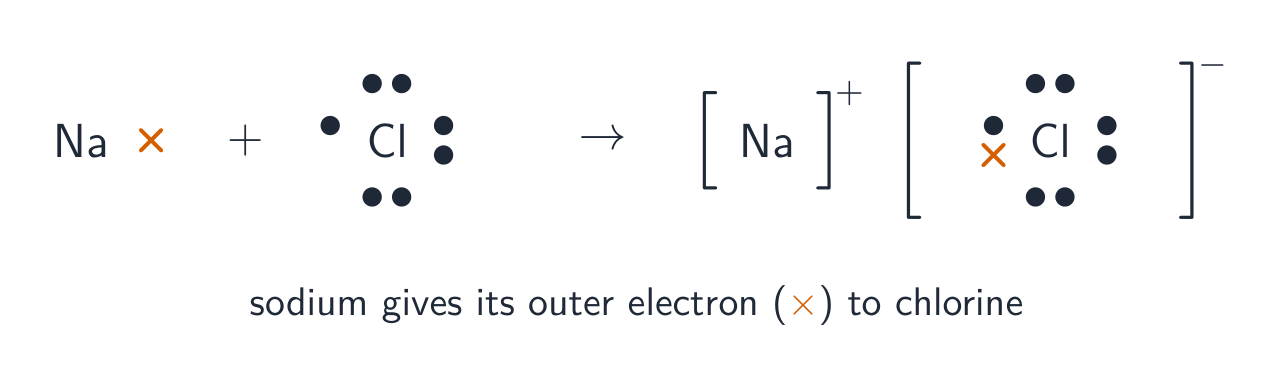
Ionic bonding: a metal transfers its outer electrons to a non-metal
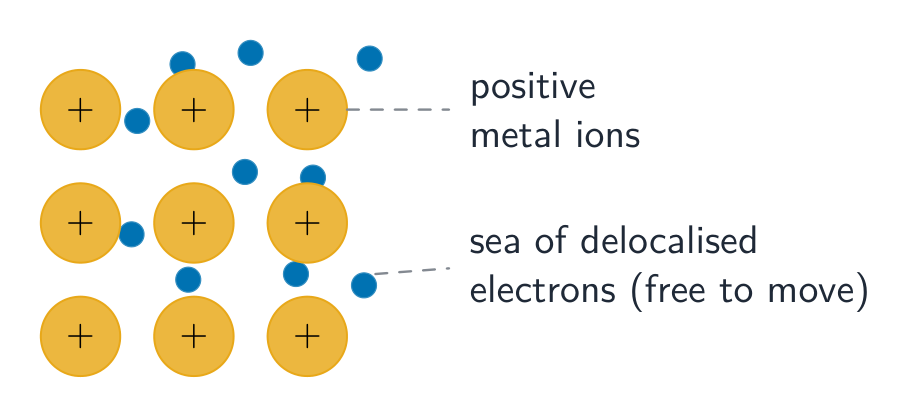
Metallic bonding 金属键: positive ions in a sea of delocalised electrons
A metal transfers electrons to a nonmetal. What bond forms?
Difficulty 1/5 · 100 coins + a small bonus on first completion today
Electron transfer between a metal and nonmetal makes an ionic bond.
Covalent bonds: sharing
- A covalent bond 共价键 forms when two nonmetals share electrons.
- The shared pairs hold the atoms together.
- Two oxygen atoms share electrons to make $\text{O}_2$.
Two nonmetals share electrons. What bond forms?
Difficulty 1/5 · 100 coins + a small bonus on first completion today
Shared electron pairs between nonmetals make a covalent bond.
Metallic bonds and choosing the type
- A metallic bond is a lattice of cations in a sea of shared electrons.
- A big electronegativity difference gives ionic; a small one covalent; metals alone give metallic.
- That single difference predicts the bond.
Which type of bond?
Predict the bond type from the elements involved.
A lattice of metal cations in a shared sea of electrons is a ____ bond.
Difficulty 1/5 · 100 coins + a small bonus on first completion today
This "sea of electrons" model describes a metallic bond.
A large electronegativity difference between two atoms suggests a nonpolar covalent bond.
Difficulty 1/5 · 100 coins + a small bonus on first completion today
False. A large difference means electrons are transferred rather than shared, suggesting an ionic bond. Nonpolar covalent bonds have little or no difference.
Select all compounds likely to have covalent bonds.
Difficulty 2/5 · 140 coins + a small bonus on first completion today
$\text{CO}_2$ and $\text{H}_2\text{O}$ are nonmetals sharing; $\text{NaCl}$ is ionic.
Predict the bond in $\text{MgO}$ and in $\text{Cl}_2$.
- Mg (a metal) with O (a nonmetal), a large difference, gives an ionic bond.
- Cl with Cl, zero difference, gives a nonpolar covalent bond.
Two identical atoms (like $\text{Cl}_2$) share electrons equally. The bond is...
Difficulty 1/5 · 100 coins + a small bonus on first completion today
Equal sharing (zero electronegativity difference) is nonpolar covalent.
Bond type is a spectrum, not three sharp boxes: a large electronegativity gap leans ionic, a small gap covalent, and an unequal share makes a polar covalent bond. Metal + nonmetal usually means ionic, two nonmetals means covalent, and all-metal means metallic. Do not force a compound into the wrong category.
An ionic bond transfers electrons (metal to nonmetal), a covalent bond shares them (nonmetal to nonmetal), and a metallic bond pools them in a sea around metal cations. The electronegativity difference predicts which: large gives ionic, small gives covalent, and an uneven share gives polar covalent.