| Learning Objective | Essential Knowledge |
|---|---|
6.1.A |
|
Thermochemistry
AP Chemistry · Topic 6
 8:53
Thermochemistry
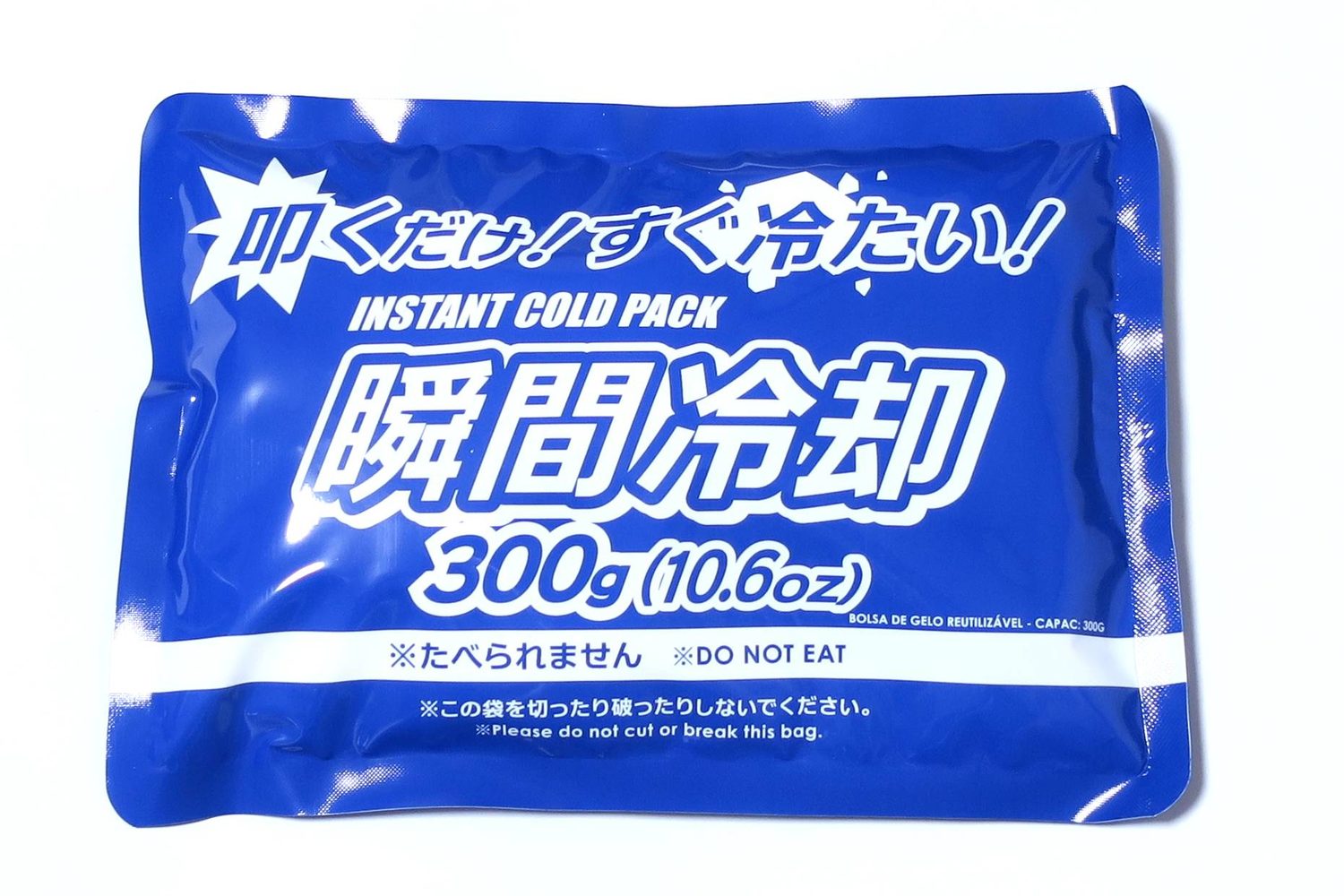
Squeeze this pack and in seconds it turns icy cold. Nothing is burning; nothing is cooling it from outside. A solid is simply dissolving in the water inside…
English narration · English + 中文 subtitles burned in
6.1
Endothermic and Exothermic Processes
Syllabus
Source: College Board AP Course and Exam Description
Squeeze an instant cold pack and within seconds it is cold enough to soothe a sprained ankle. Nothing was plugged in and no ice was added. Inside, a bag of water breaks and ammonium nitrate dissolves, and that process takes energy from its surroundings, including your skin. A hand warmer does the opposite: iron powder rusts and gives energy out. This unit measures those energy flows and predicts them from bonds.
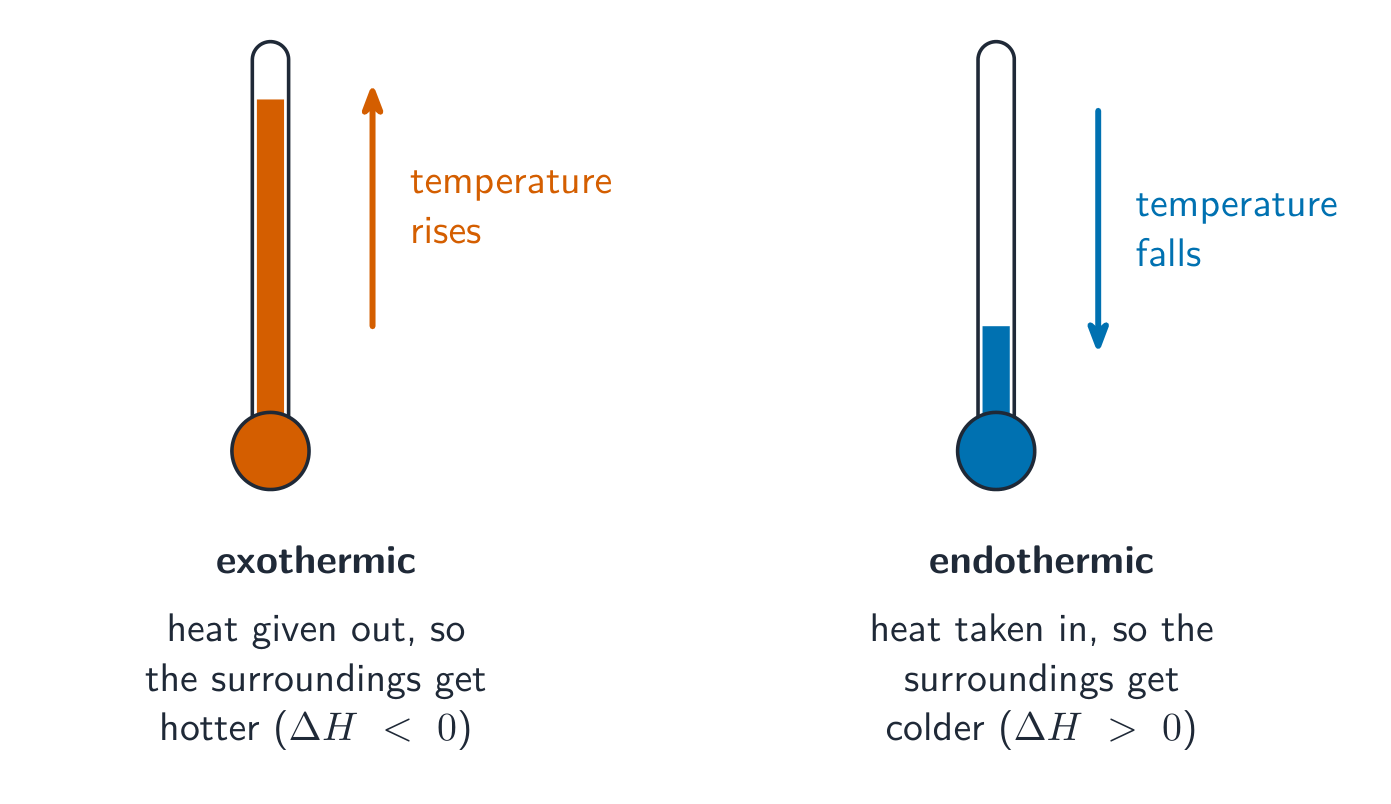
Thermochemistry 热化学 tracks energy in reactions. A process is exothermic 放热 if it releases energy to the surroundings 环境 (feels hot, $\Delta H<0$) and endothermic 吸热 if it absorbs energy (feels cold, $\Delta H>0$). Breaking bonds 断键 costs energy; forming bonds 成键 releases it – the net decides the sign.
The system 体系 is the part you study, such as the reacting chemicals. Everything else, including the water they are dissolved in, is the surroundings. A thermometer in the solution reads the surroundings, so a rising temperature means the system gave energy out. Physical processes have a sign too. Dissolving can go either way, depending on the forces broken and made. Ammonium nitrate dissolving is endothermic: the attractions between its ions are stronger than the new ion–water attractions. Calcium chloride dissolving is exothermic, and it is used in hot packs.
Explore
Compare endothermic and exothermic profiles
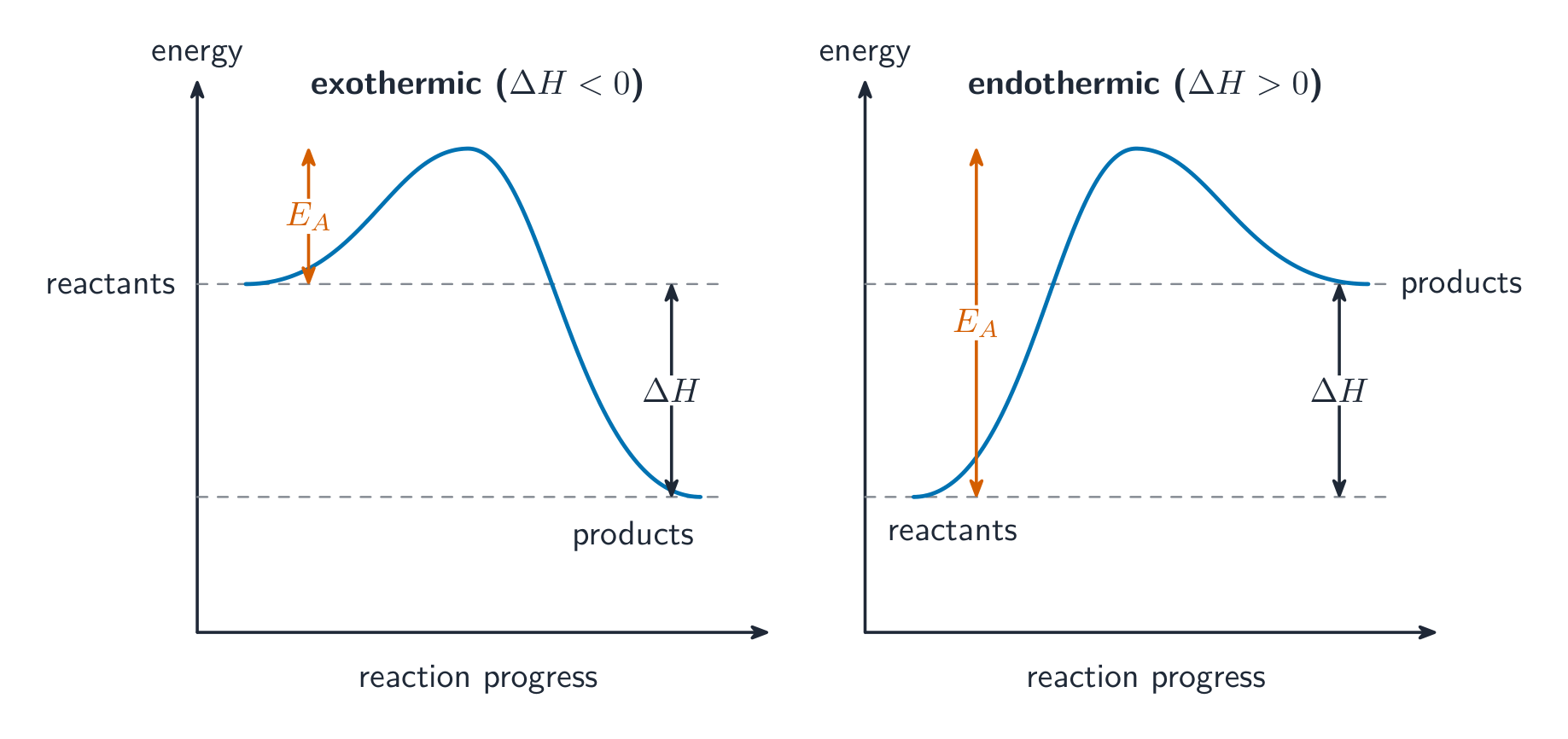
An exothermic reaction releases energy (products lower than reactants, $\Delta H<0$); an endothermic one absorbs it. The hump is the activation energy.
Vocabulary
Train
| English |
|---|
| Thermochemistry/ˈθɜːməkemɪstri/ |
| exothermic/eɡzəˈðɜːmɪk/ |
| surroundings/səˈraʊndɪŋz/ |
| endothermic/ˌendəʊˈθɜːmɪk/ |
| Breaking bonds |
| forming bonds |
| system/ˈsɪstəm/ |
6.2
Energy Diagrams
Syllabus
| Learning Objective | Essential Knowledge |
|---|---|
6.2.A |
|
Source: College Board AP Course and Exam Description
An energy diagram 能量图 plots energy from reactants 反应物 to products 生成物. Reactants above products means exothermic; below means endothermic. The vertical gap between them is the enthalpy change 焓变 $\Delta H$.
To draw one, mark the reactants on the left and the products on the right at the right heights, then join them with a curve that rises to a hump. The hump is the energy needed to start the reaction; it does not change $\Delta H$. Label the arrow from reactants to products with its sign and size, for example $\Delta H=-891$ kJ for burning one mole of methane.
Explore
An endothermic energy diagram
When a reaction absorbs energy, the products sit higher than the reactants.
Vocabulary
Train
| English |
|---|
| energy diagram |
| reactants/rɪˈæktənts/ |
| products/ˈprɒdʌkts/ |
| enthalpy change/enˈθælpi tʃeɪndʒ/ |
6.3
Heat Transfer and Thermal Equilibrium
Syllabus
| Learning Objective | Essential Knowledge |
|---|---|
6.3.A |
|
Source: College Board AP Course and Exam Description
Heat 热量 flows from hot to cold until objects reach thermal equilibrium 热平衡 (equal temperature). Energy is conserved 能量守恒: for an isolated 孤立的 pair, the heat lost by the hot object equals the heat gained by the cold one.
At the particle level, temperature measures the average kinetic energy of the particles. In a hot metal block the atoms vibrate faster than the water molecules around it. When fast and slow particles collide, energy passes from fast to slow. The collisions continue until both sides have the same average kinetic energy, which is the same temperature. Then energy still moves in both directions, but there is no net flow.
Worked example (identify a metal). A 50.0 g metal block at 100.0 °C is dropped into 100.0 g of water at 20.0 °C in an insulated cup. The final temperature is 24.0 °C. The water gains
$$q_{\text{water}}=(100.0)(4.18)(24.0-20.0)=1672\ \text{J}.$$
The metal loses the same amount, so
$$c_{\text{metal}}=\frac{1672}{(50.0)(100.0-24.0)}=0.44\ \text{J/(g}\,{}^{\circ}\text{C)}.$$
That matches iron, 0.45. Note how differently the two temperatures changed: the metal fell 76 °C while the water rose only 4 °C, because water's specific heat is about nine times larger.
Vocabulary
Train
| English |
|---|
| Heat/hiːt/ |
| thermal equilibrium/ˈθɜːml ˌiːkwɪˈlɪbrɪəm/ |
| Energy is conserved |
| isolated/ˈaɪsəleɪtɪd/ |
6.4
Heat Capacity and Calorimetry
Syllabus
| Learning Objective | Essential Knowledge |
|---|---|
6.4.A |
|
Source: College Board AP Course and Exam Description
The heat to change a substance's temperature is
$$q=mc\,\Delta T,$$
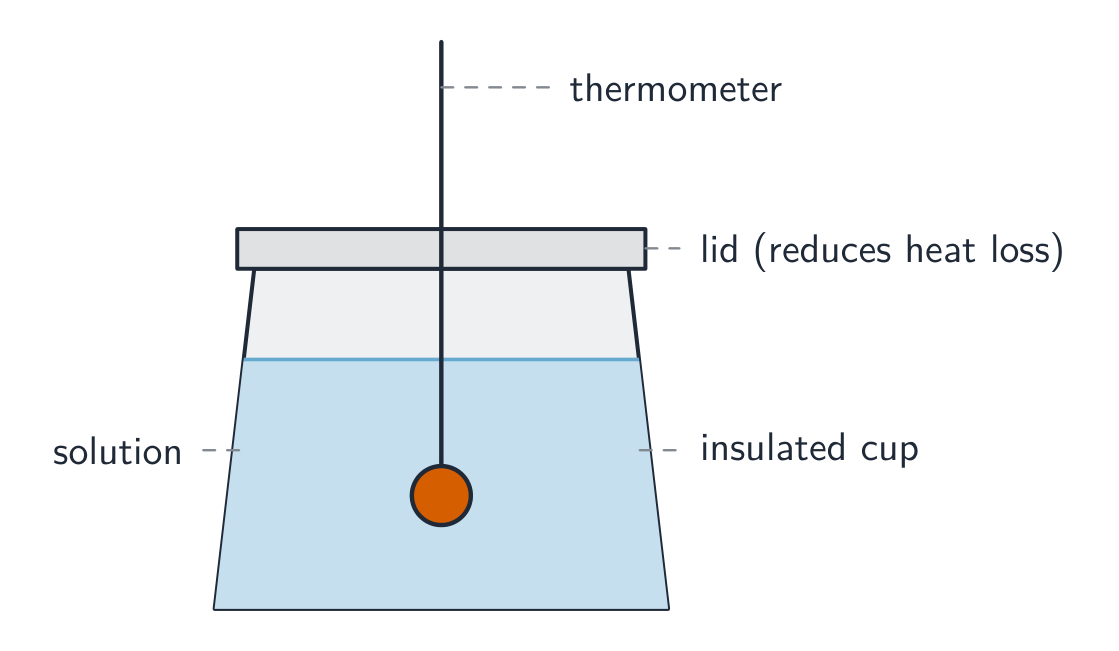
where $c$ is the specific heat 比热容 (energy per gram per degree). Calorimetry 量热法 measures a reaction's heat by tracking the temperature change of surrounding water: in a simple insulated 隔热的 model, the heat the water gains equals the heat the reaction releases. Include heat absorbed by the container and any losses when they matter.
Worked example. A reaction in a coffee-cup calorimeter 量热计 warms $100\ \text{g}$ of water by $8.0\,{}^{\circ}\text{C}$ ($c=4.18\ \text{J/(g}\,{}^{\circ}\text{C)}$). The heat absorbed by the water is
$$q=mc\,\Delta T=100\times4.18\times8.0=3.3\times10^{3}\ \text{J}.$$
By energy conservation the reaction released this $3.3\ \text{kJ}$, so it is exothermic ($q_{\text{rxn}}=-3.3\ \text{kJ}$).
The same heat gives different temperature changes in different materials. This is why a sandy beach is too hot to walk on at noon while the sea stays cool: sand's specific heat is about one-fifth of water's. Tables also give the molar heat capacity 摩尔热容, the energy to warm one mole by one degree. For water it is $18.0\times4.18=75.3$ J/(mol °C).
Worked example (enthalpy of dissolving). 5.00 g of $\text{NH}_4\text{NO}_3$ ($M=80.0$ g/mol) dissolves in 100.0 g of water. The temperature falls from 22.0 °C to 18.4 °C. Use the mass of the whole solution, 105.0 g, and assume it has the specific heat of water:
$$q_{\text{solution}}=(105.0)(4.18)(18.4-22.0)=-1580\ \text{J}.$$
The solution lost 1580 J, so the dissolving absorbed $+1580$ J. With $n=5.00/80.0=0.0625$ mol,
$$\Delta H_{\text{soln}}=\frac{+1.58\ \text{kJ}}{0.0625\ \text{mol}}=+25.3\ \text{kJ/mol}.$$
A falling temperature means an endothermic process; the sign of $\Delta H$ is opposite to the sign of the solution's $q$.
Exam skill (calorimetry errors). A real coffee cup is not perfectly insulated. In an exothermic reaction some heat escapes to the room, so the measured $\Delta T$ is too small and the magnitude of $\Delta H$ comes out too small. In an endothermic one, heat leaks in from the room, so again the measured temperature change is too small and the magnitude of $\Delta H$ too small. Other errors follow the same path through $q=mc\Delta T$: a metal calorimeter that absorbs heat, or a thermometer read before the temperature has finished changing, also makes $|\Delta T|$ too small. To give $\Delta H$ per mole of reaction, divide $q$ by the moles of the limiting reactant (scaled by its coefficient), not by the moles of the reactant in excess.
Explore
Heat different materials
$Q=mc\Delta T$: a high specific heat (like water's) means a lot of energy for a small temperature rise. Compare materials for the same heat input.
Vocabulary
Train
| English |
|---|
| specific heat/spəˈsɪfɪk hiːt/ |
| Calorimetry/ˌkælɔːˈrɪmətri/ |
| insulated |
| calorimeter |
| molar heat capacity |
6.5
Energy of Phase Changes
Syllabus
| Learning Objective | Essential Knowledge |
|---|---|
6.5.A |
|
Source: College Board AP Course and Exam Description
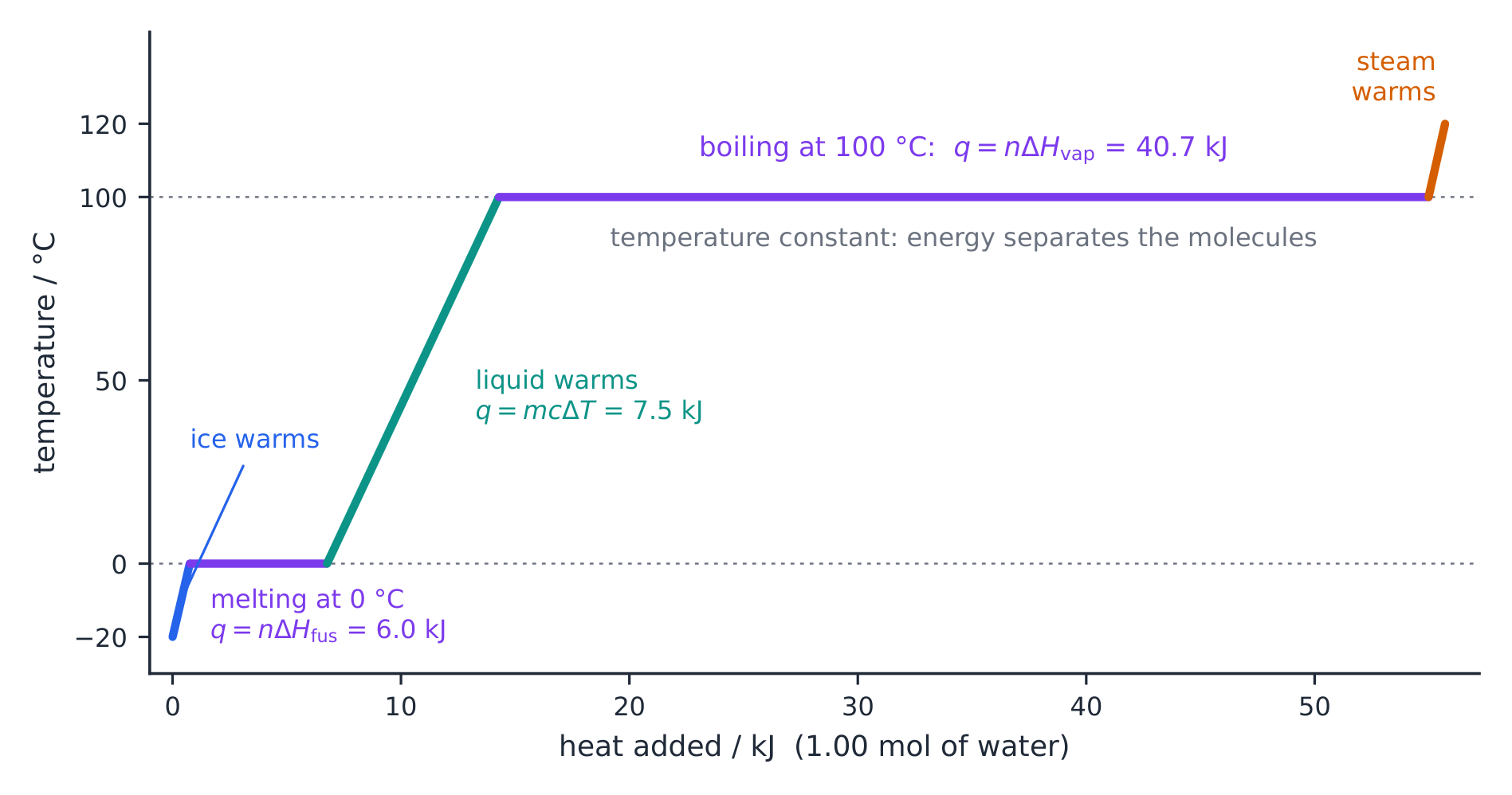
During a phase change 相变 (melting 熔化, boiling 沸腾) the temperature stays constant while heat goes into breaking intermolecular forces 分子间作用力, not raising kinetic energy 动能. The energy needed is $q=n\,\Delta H_{\text{fus}}$ (melting) or $q=n\,\Delta H_{\text{vap}}$ (boiling) – the flat steps on a heating curve 加热曲线.
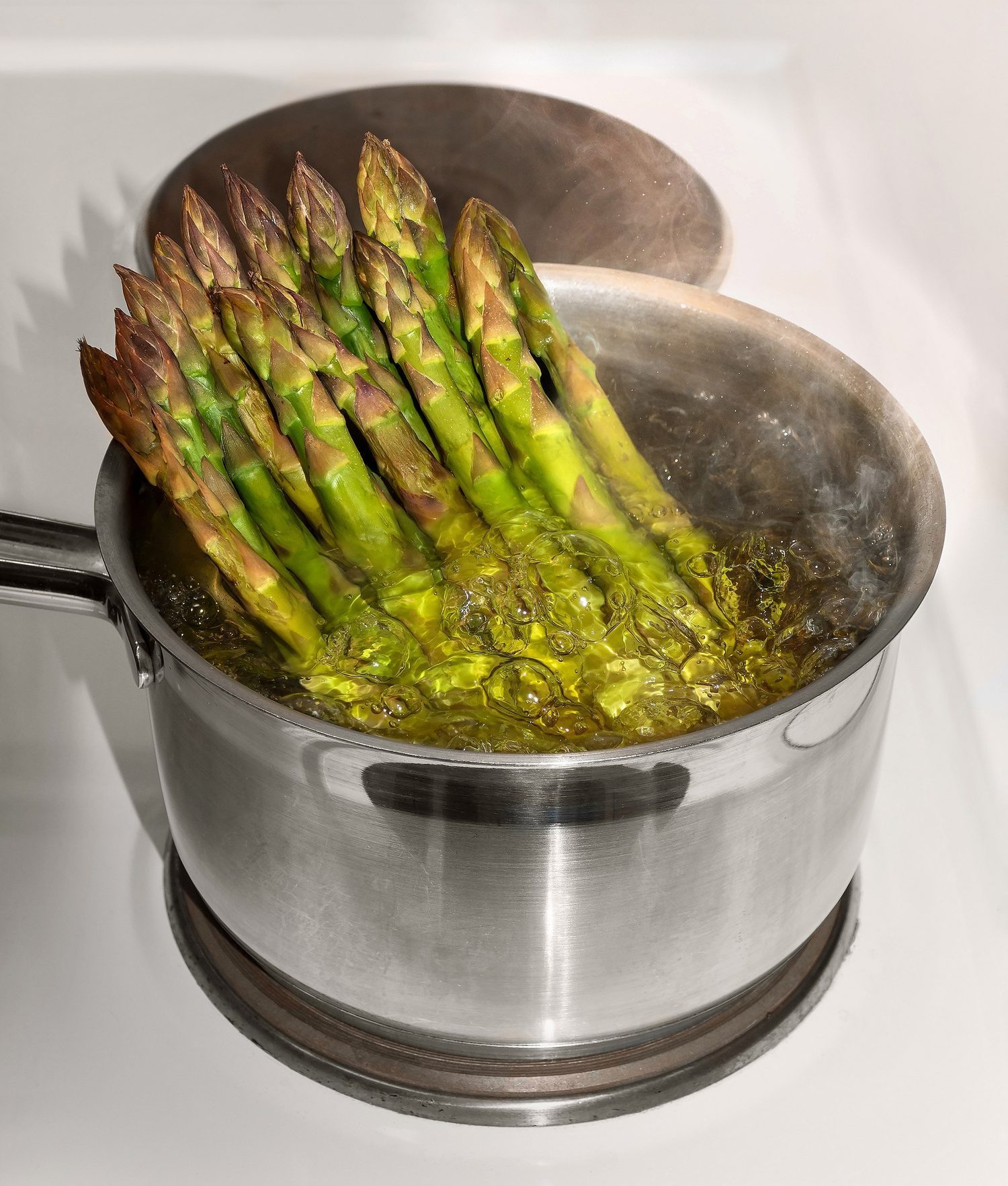
The reverse changes give out the same amount of energy. Freezing releases $\Delta H_{\text{fus}}$ per mole, and condensing releases $\Delta H_{\text{vap}}$: $\Delta H_{\text{cond}}=-\Delta H_{\text{vap}}$. That is why a steam burn is worse than a burn from boiling water at the same 100 °C: the steam releases 40.7 kJ/mol as it condenses on your skin before it even starts to cool.
Worked example (ice to steam). How much energy turns 18.0 g (1.00 mol) of ice at 0 °C into steam at 100 °C? Use $\Delta H_{\text{fus}}=6.01$ kJ/mol and $\Delta H_{\text{vap}}=40.7$ kJ/mol. Add the three steps:
$$q=\underbrace{(1.00)(6.01)}_{\text{melt}}+\underbrace{\frac{(18.0)(4.18)(100)}{1000}}_{\text{warm the liquid}}+\underbrace{(1.00)(40.7)}_{\text{boil}}=6.01+7.52+40.7=54.2\ \text{kJ}.$$
Boiling accounts for three-quarters of the total. Use $q=mc\Delta T$ on the sloped parts and $q=n\Delta H$ on the flat parts, and keep all terms in the same unit.
Explore
Heat through a phase change
During a phase change the temperature holds flat while energy breaks bonds — the latent heat. Watch the plateaus at melting and boiling.
Vocabulary
Train
| English |
|---|
| phase change/feɪz tʃeɪndʒ/ |
| melting/ˈmeltɪŋ/ |
| boiling/ˈbɔɪlɪŋ/ |
| intermolecular forces/ˌɪntəməˈlekjʊlə ˈfɔːsɪz/ |
| kinetic energy/kɪˈnetɪk ˈenədʒi/ |
| heating curve/ˈhiːtɪŋ kɜːv/ |
6.6
Introduction to Enthalpy of Reaction
Syllabus
| Learning Objective | Essential Knowledge |
|---|---|
6.6.A |
|
Source: College Board AP Course and Exam Description
The enthalpy of reaction 反应焓 $\Delta H_{\text{rxn}}$ is the heat released or absorbed at constant pressure 恒压. Because enthalpy is a state function 状态函数, $\Delta H$ depends only on the initial and final states, not the path taken – the key that makes the next three methods work.
$\Delta H$ is given per mole of reaction as written, so the heat scales with the amount that reacts: $q=n\Delta H$.
Worked example (heat from burning). For $\text{CH}_4+2\text{O}_2\rightarrow\text{CO}_2+2\text{H}_2\text{O}$, $\Delta H=-891$ kJ/mol. Burning 4.00 g of methane ($M=16.0$ g/mol) means $n=0.250$ mol, so the heat released is $0.250\times891=223$ kJ. That energy appears first as faster-moving product molecules, a high temperature, and then passes to the surroundings as the products cool.
Explore
Enthalpy scales with amount
Enthalpy of reaction is energy per mole, so the total heat is proportional to how much reacts.
Vocabulary
Train
| English |
|---|
| enthalpy of reaction/enˈθælpi ɒv rɪˈækʃn/ |
| constant pressure |
| state function/steɪt ˈfʌŋkʃn/ |
6.7
Bond Enthalpies
Syllabus
| Learning Objective | Essential Knowledge |
|---|---|
6.7.A |
|
Source: College Board AP Course and Exam Description
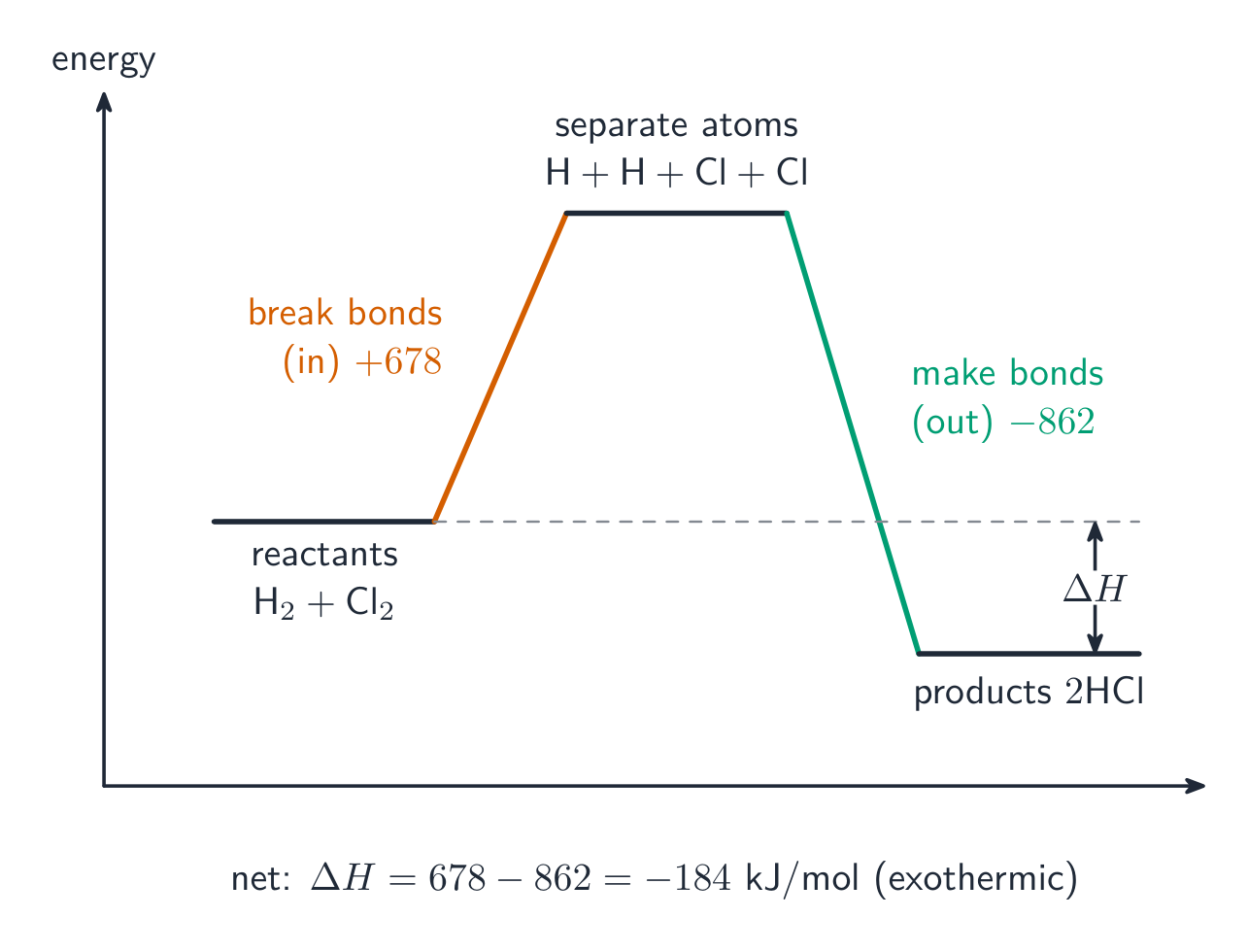
One way to estimate $\Delta H$: sum the energy to break all reactant bonds, then subtract the energy released forming product bonds:
$$\Delta H \approx \sum (\text{bonds broken}) - \sum (\text{bonds formed}).$$
This is an approximation, since bond enthalpies 键焓 are averages.
Worked example. Estimate $\Delta H$ for $\text{H}_2+\text{Cl}_2\rightarrow2\text{HCl}$ using bond enthalpies H–H $=436$, Cl–Cl $=242$, H–Cl $=431\ \text{kJ/mol}$. Break both reactant bonds ($436+242=678$) and form two H–Cl bonds ($2\times431=862$):
$$\Delta H\approx 678-862=-184\ \text{kJ},$$
exothermic, because the strong H–Cl bonds formed release more than the reactant bonds cost.
Worked example (comparing two methods). Estimate $\Delta H$ for burning methane from bond enthalpies: C–H 413, O=O 495, C=O 799, O–H 467 kJ/mol. Draw the molecules to count the bonds. One $\text{CH}_4$ has four C–H; two $\text{O}_2$ have two O=O; one $\text{CO}_2$ has two C=O; two $\text{H}_2\text{O}$ have four O–H.
$$\text{broken}=4(413)+2(495)=2642,\qquad\text{formed}=2(799)+4(467)=3466,$$
$$\Delta H\approx2642-3466=-824\ \text{kJ}.$$
The formation-enthalpy method below gives $-891$ kJ. The two differ for two reasons. Bond enthalpies are averages over many molecules. And they are for gases, so the estimate makes water vapour, not liquid water, and misses the energy released when the vapour condenses.
Explore
Bonds broken and formed
In the combustion of methane, sort each bond change by whether it takes in or gives out energy.
Vocabulary
Train
| English |
|---|
| bond enthalpies |
6.8
Enthalpy of Formation
Syllabus
| Learning Objective | Essential Knowledge |
|---|---|
6.8.A |
|
Source: College Board AP Course and Exam Description
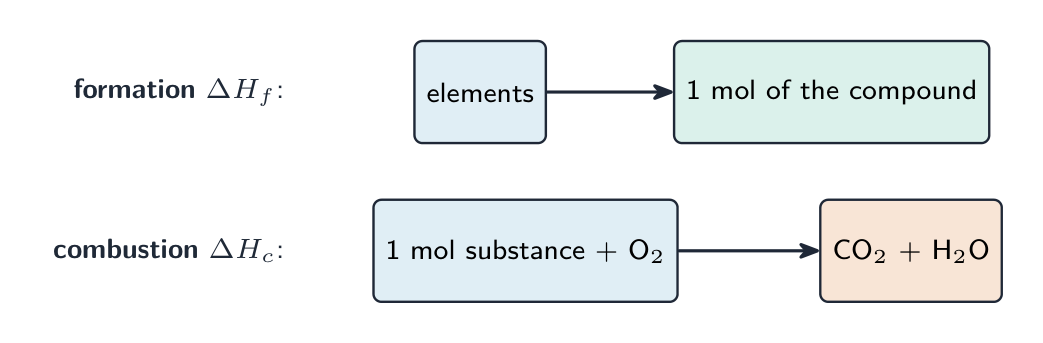
The standard enthalpy of formation 生成焓 $\Delta H_f^\circ$ is the enthalpy to make one mole of a compound from its elements 单质 (zero for an element in its standard state 标准状态). Then
$$\Delta H_{\text{rxn}}^\circ = \sum \Delta H_f^\circ(\text{products}) - \sum \Delta H_f^\circ(\text{reactants}).$$
Worked example. Find $\Delta H_{\text{rxn}}^\circ$ for burning methane, $\text{CH}_4+2\text{O}_2\rightarrow\text{CO}_2+2\text{H}_2\text{O}$, given $\Delta H_f^\circ$: CH$_4=-75$, CO$_2=-394$, H$_2$O$=-286\ \text{kJ/mol}$ (O$_2=0$). Products minus reactants:
$$\Delta H_{\text{rxn}}^\circ=[-394+2(-286)]-[-75+0]=-966+75=-891\ \text{kJ},$$
a large release, as expected for a combustion 燃烧.
Vocabulary
Train
| English |
|---|
| standard enthalpy of formation/ˈstændəd enˈθælpi ɒv fɔːˈmeɪʃn/ |
| elements/ˈelɪmənts/ |
| standard state |
| combustion/kəmˈbʌstʃn/ |
6.9
Hess's Law
Syllabus
| Learning Objective | Essential Knowledge |
|---|---|
6.9.A |
|
6.9.B |
|
Source: College Board AP Course and Exam Description
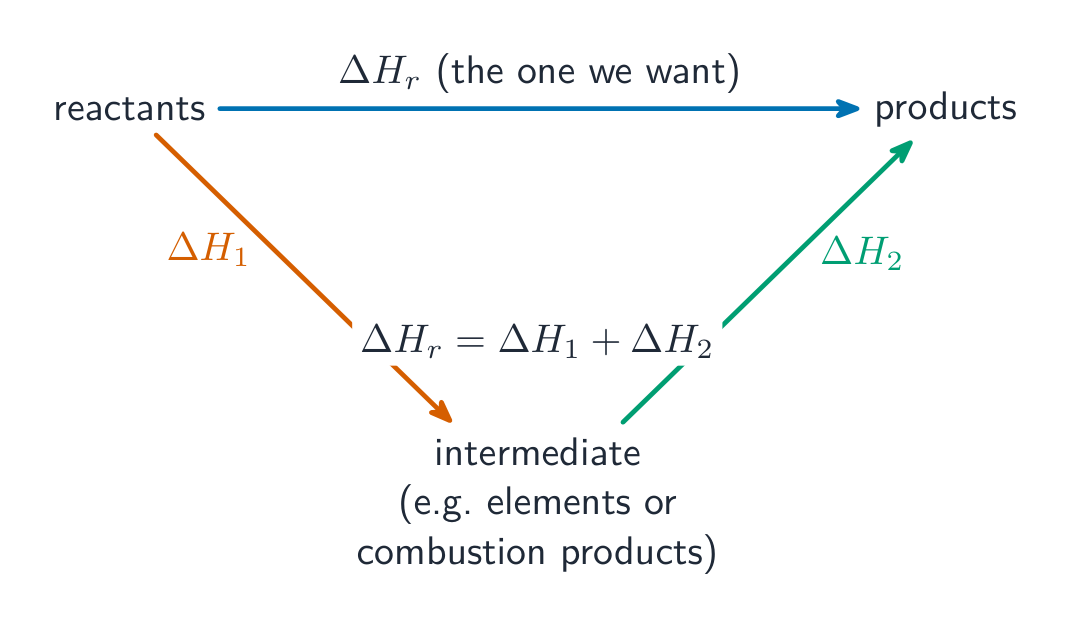
Hess's law 盖斯定律: if a reaction is the sum of several steps, its $\Delta H$ is the sum of the steps' $\Delta H$ values. Reverse a step and flip the sign; scale a step and scale its $\Delta H$. This lets you find a hard-to-measure $\Delta H$ by combining known reactions – a frequent exam calculation.
Worked example. Find $\Delta H$ for $\text{C}(s)+\tfrac12\text{O}_2(g)\rightarrow\text{CO}(g)$, which cannot be measured directly because some $\text{CO}_2$ always forms. You are given
$$\text{C}(s)+\text{O}_2(g)\rightarrow\text{CO}_2(g)\qquad \Delta H_1=-394\ \text{kJ}$$
$$\text{CO}(g)+\tfrac12\text{O}_2(g)\rightarrow\text{CO}_2(g)\qquad \Delta H_2=-283\ \text{kJ}$$
Keep step 1 as written (it has C on the left). Reverse step 2 so that CO is a product: $\text{CO}_2\rightarrow\text{CO}+\tfrac12\text{O}_2$, $\Delta H=+283\ \text{kJ}$. Add the two: $\text{CO}_2$ cancels, and $\text{O}_2 - \tfrac12\text{O}_2$ leaves $\tfrac12\text{O}_2$ on the left, which is the target. So
$$\Delta H=-394+283=-111\ \text{kJ}.$$
Check that every species left over matches the target equation before you add the numbers.
Common mistakes.
- Losing the sign in calorimetry. The water gains heat ($q_{\text{water}}>0$), so the reaction releases it: $q_{\text{rxn}}=-q_{\text{water}}$.
- Using the mass of the solid that dissolved, not of the solution, in $q=mc\,\Delta T$. The temperature change is of the water or solution, so use its mass.
- Turning a bond-enthalpy calculation upside down. It is broken − formed; with products − reactants (the $\Delta H_f^\circ$ order) you get the right size but the wrong sign.
- Counting bonds per molecule, not per equation. In $\text{H}_2+\text{Cl}_2\rightarrow2\text{HCl}$ there are two H–Cl bonds formed.
- Giving $\text{O}_2(g)$ or another element in its standard state a non-zero $\Delta H_f^\circ$. It is zero by definition.
- Forgetting the coefficients with $\Delta H_f^\circ$. Multiply each value by its coefficient: $2(-286)$ for two moles of water.
- Saying bond breaking releases energy. Breaking bonds always costs energy; energy is released only when bonds form.
Vocabulary
Train
| English |
|---|
| Hess's law/ˈhesɪz lɔː/ |
6.9
Exam tips
- An exothermic reaction has $\Delta H<0$ (feels hot); endothermic has $\Delta H>0$ — always give $\Delta H$ a sign and units.
- In calorimetry use $q=mc\,\Delta T$ with the mass of the water/solution; the reaction releases what the water and calorimeter gain in an insulated model.
- Bond enthalpies: $\Delta H\approx\sum(\text{bonds broken})-\sum(\text{bonds made})$ — breaking is endothermic, making is exothermic (the classic sign trap).
- Hess's law: the total $\Delta H$ is the sum of the steps' — reverse a step and flip the sign, scale a step and scale $\Delta H$.
- During a phase change of a pure substance at fixed pressure, temperature stays constant while energy changes the interactions between particles.
Interactive lessons on this topic
Work through it step by step, with instant-check exercises.